ECU BUICK REGAL 1994 User Guide
[x] Cancel search | Manufacturer: BUICK, Model Year: 1994, Model line: REGAL, Model: BUICK REGAL 1994Pages: 308, PDF Size: 15.78 MB
Page 62 of 308
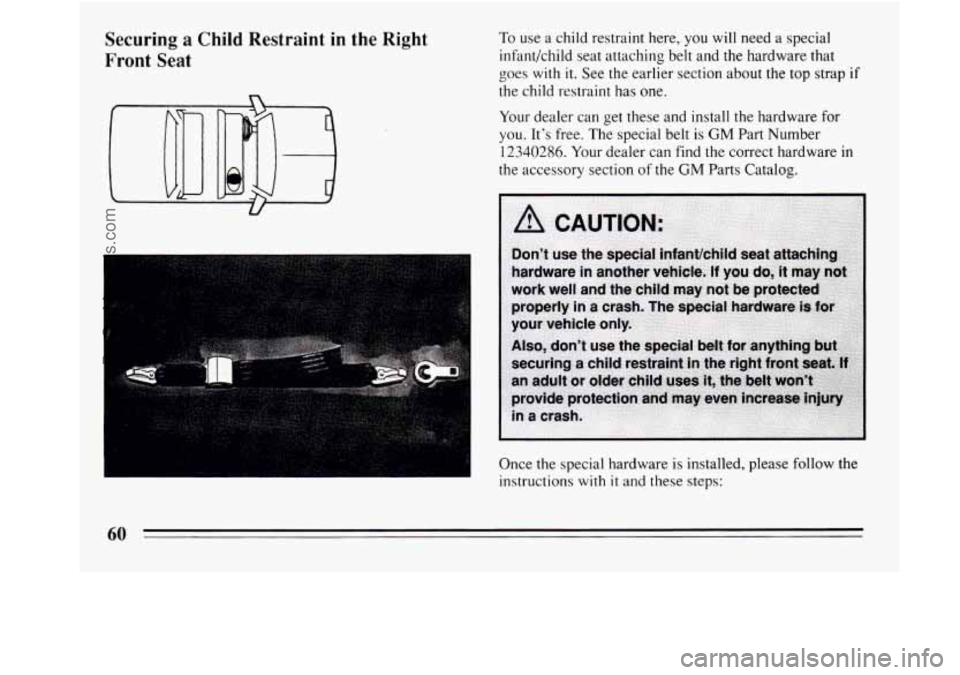
Securing a Child Restraint in the Right
Front
Seat
To use a child restraint here, you will need a special
infant/child seat attaching belt and the hardware that
goes with
it. See the earlier section about the top strap if
the child restraint has one.
Your dealer can get these and install the hardware
for
you. It’s free. The special belt is GM Part Number
12340286. Your dealer can find the correct hardware in
the accessory section of the
GM Parts Catalog.
Once the special hardware is installed, please follow the
instructions
with it and these steps:
60
ProCarManuals.com
Page 64 of 308
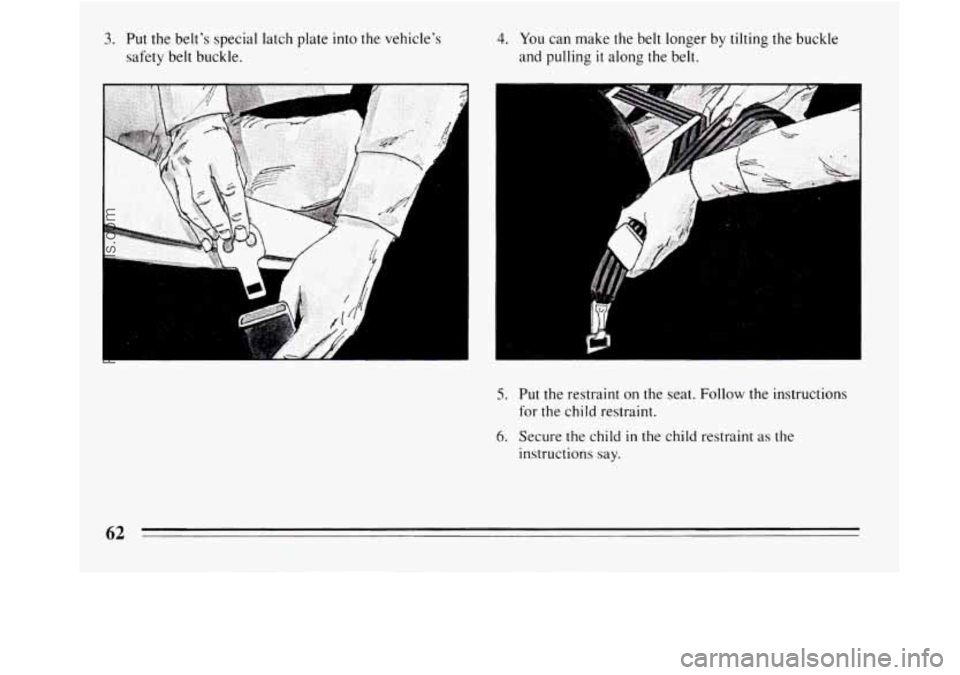
3. Put the belt's special latch plate into the vehicle's
safety belt buckle.
I
4. You can make the belt longer by tilting the buckle
and pulling
it along the belt.
.:
5. Put the restraint on the seat. Follow the instructions
for the child restraint.
6. Secure the child in the child restraint as the
instructions say.
62
ProCarManuals.com
Page 65 of 308
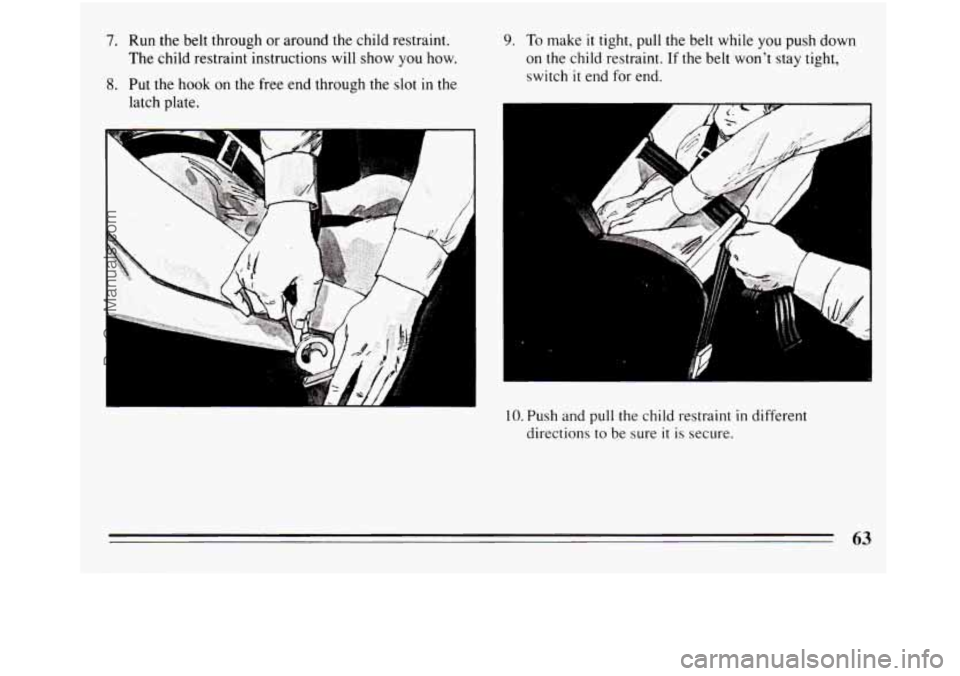
7. Run the belt through or around the child restraint.
The child restraint instructions will show
you how.
8. Put the hook on the free end through the slot in the
latch plate.
x
9. To make it tight, pull the belt while you push down
on the child restraint. If the belt won't stay tight,
switch
it end for end.
10. Push and pull the child restraint in different
directions to be sure
it is secure.
63
ProCarManuals.com
Page 80 of 308
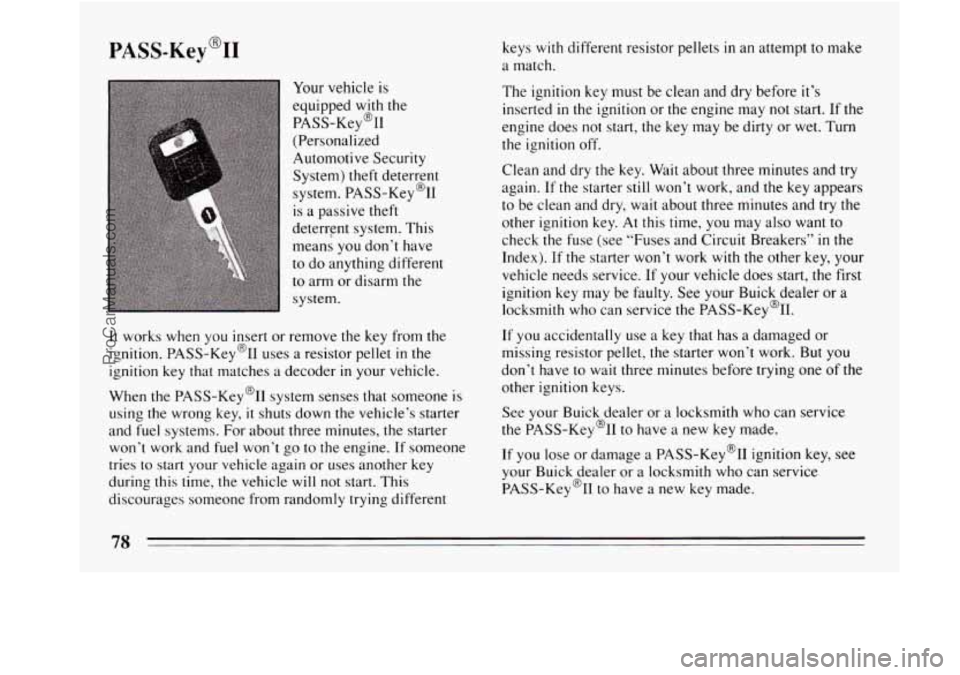
PASS-Key@II
Your vehicle is
equipped
with the
PASS-Key@II
(Personalized
Automotive Security
System) theft deterrent
system. PASS-Key(%
is a passive theft
deterrFnt system. This
means you don’t have
to do anything different
to arm or disarm the
system.
It works
when you insert or remove the key from the
ignition. PASS-Key% uses a resistor pellet
in the
ignition key that matches a decoder
in your vehicle.
When the PASS-Key% system senses that someone
is
using the wrong key, it shuts down the vehicle’s starter
and
fuel systems. For about three minutes, the starter
won’t work and fuel won’t
go to the engine. If someone
tries to start your vehicle again or uses another key
during this time, the vehicle will not start. This
discourages someone from randomly trying different keys
with different resistor pellets in an
attempt to make
a match.
The ignition key must be clean and dry before it’s
inserted
in the ignition or the engine may not start. If the
engine does not start, the key may be dirty or wet. Turn
the ignition off.
Clean and dry the key. Wait about three minutes and
try
again. If the starter still won’t work, and the key appears
to be clean and dry, wait about three minutes and try the
other ignition key. At this time, you may also want to
check the fuse (see “Fuses and Circuit Breakers’’
in the
Index). If the starter won’t work
with the other key, your
vehicle needs service. If your vehicle does start, the first
ignition key may be faulty. See your Buick dealer or a
locksmith who can service
the PASS-Key@II.
If you accidentally use
a key that has a damaged or
missing resistor pellet, the starter won’t work. But you
don’t have to wait three minutes before trying one of
the
other ignition keys.
See your Buick dealer or a locksmith who can service
the PASS-Key(% to have a new key made.
If you lose or damage a PASS-Key% ignition key, see
your Buick dealer or a locksmith who can service
PASS-Key@II to have a new key made.
78
ProCarManuals.com
Page 113 of 308
Luggage Carrier (Option)
If you have the optional luggage carrier, you can load
things on the deck lid of your vehicle. The luggage
carrier has slats attached to the deck lid, a rear rail, and
tiedowns.
NOTICE:
Loading cargo that weighs more than 50 Ibs
(23 kg) on the luggage carrier may damage your
vehicle. When you carry large things, never let
them hang over the rear or the sides of your
vehicle. Load your cargo
so that it rests on the
slats and does not scratch
or damage the
vehicle. Put the cargo against the rear rail and
fasten
it securely to the luggage carrier.
Don’t exceed the maximum vehicle capacity when
loading your Buick. For more information on vehicle
capacity and loading, see “Loading Your Vehicle”
in the
Index.
To prevent damage or loss of cargo as you’re driving,
check
now and then to make sure the luggage carrier
and cargo are still securely fastened.
The Instrument Panel: Your
Information System
I
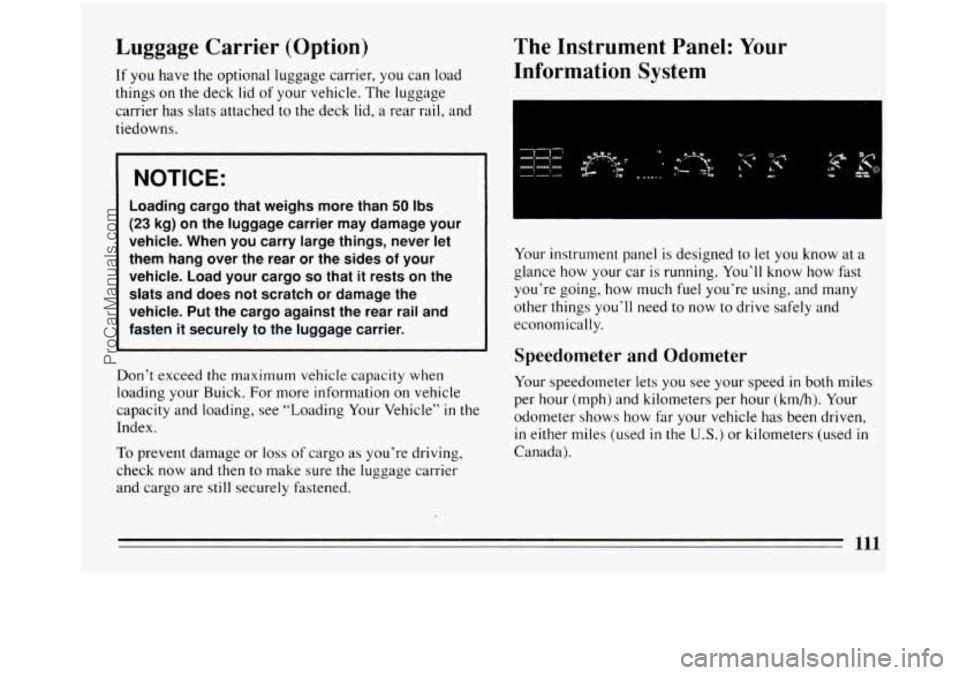
Your instrument panel is designed to let you know at a
glance how your car is running. You’ll know how fast
you’re going, how much fuel you’re using, and many
other things
you’ll need to now to drive safely and
economically.
Speedometer and Odometer
Your speedometer lets you see your speed in both miles
per hour (mph) and kilometers per hour (km/h). Your
odometer shows how far
your vehicle has been driven,
in either miles (used in the U.S.) or kilometers (used in
Canada).
111
ProCarManuals.com
Page 163 of 308
I
............... .. I ...... .... .?". .<. ... I
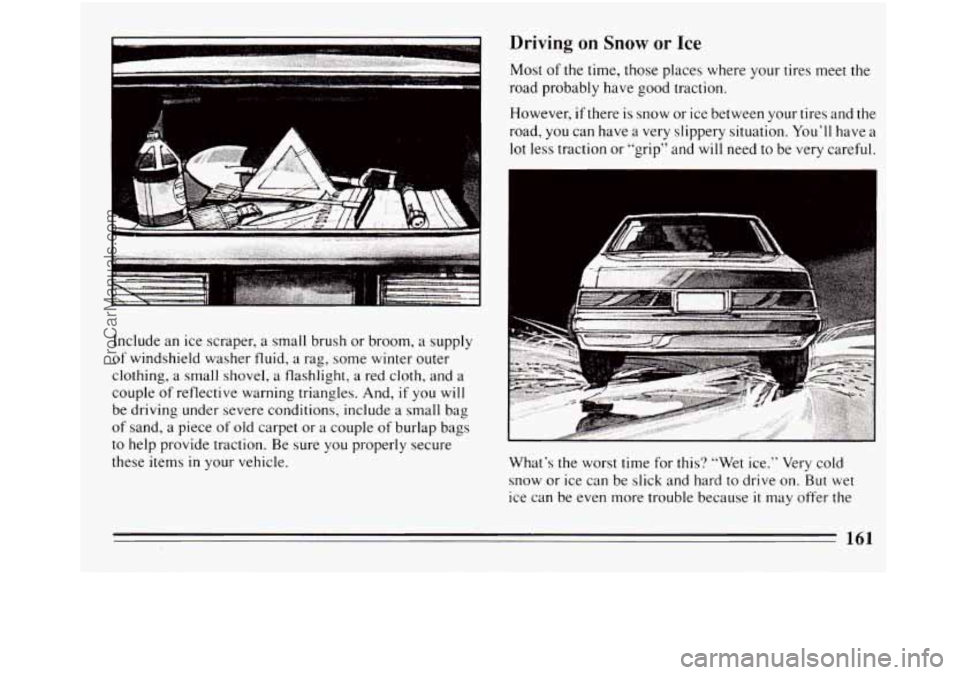
Include an ice scraper, a small brush or broom, a supply
of windshield washer fluid, a rag, some winter outer
clothing, a small shovel,
a flashlight, a red cloth, and a
couple
of reflective warning triangles. And, if you will
be driving under severe conditions, include a small bag
of sand, a piece of old carpet or a couple of burlap bags
to help provide traction.
Be sure you properly secure
these items
in your vehicle.
What's the worst time for this? "Wet ice." Very cold
snow or ice can be slick and hard to drive
on. But wet
ice can be even more trouble because
it may offer the
161
ProCarManuals.com
Page 169 of 308
monoxide (CO) from your exhaust can get into your
vehicle (see “Carbon Monoxide”
in the Index). Dirt
and water can,
too.
The bumpers on your vehicle are not intended for
hitches. Do not attach rental hitches or other
bumper-type hitches to them. Use only a
frame-mounted hitch that does not attach to the
bumper.
Safety Chains
You should always attach chains between your vehicle
and your trailer. Cross the safety chains under the
tongue of the trailer
so that the tongue will not drop to
the road
if it becomes separated from the hitch.
Instructions about safety chains may be provided by the
hitch manufacturer or by the trailer manufacturer.
Follow the manufacturer’s recommendation for
attaching safety chains. Always leave just enough slack
so you can turn with your rig. And, never allow safety
chains to drag
on the ground.
Trailer Brakes
If your trailer weighs more than 1,000 pounds (450 kg)
loaded, then
it needs its own brakes -- and they must be
adequate. Be sure to read and follow the instructions for
the trailer brakes
so you’ll be able to install, adjust and maintain
them properly. Because you have anti-lock
brakes, do not try to tap into your vehicle’s brake
system. If you do, both brake systems won’t work well,
or at all.
Driving with a Trailer
Towing a trailer requires a certain amount of experience.
Before setting out for the open road, you’ll want to get
to know your rig. Acquaint yourself with the feel of
handling and braking with the added weight
of the
trailer. And always keep
in mind that the vehicle you are
driving
is now a good deal longer and not nearly so
responsive as your vehicle is by itself.
Before you start, check the trailer hitch and platform,
,
safety chains, electrical connector, lights, tires and
mirror adjustment. If
the trailer has electric brakes, start
your vehicle and trailer moving and then apply the
trailer brake controller by hand to be sure the brakes are
working. This lets you check your electrical connection
at the same time.
During your trip, check occasionally to be sure that the
load is secure, and that the lights and any trailer brakes
are still working.
167
ProCarManuals.com
Page 234 of 308
A
B
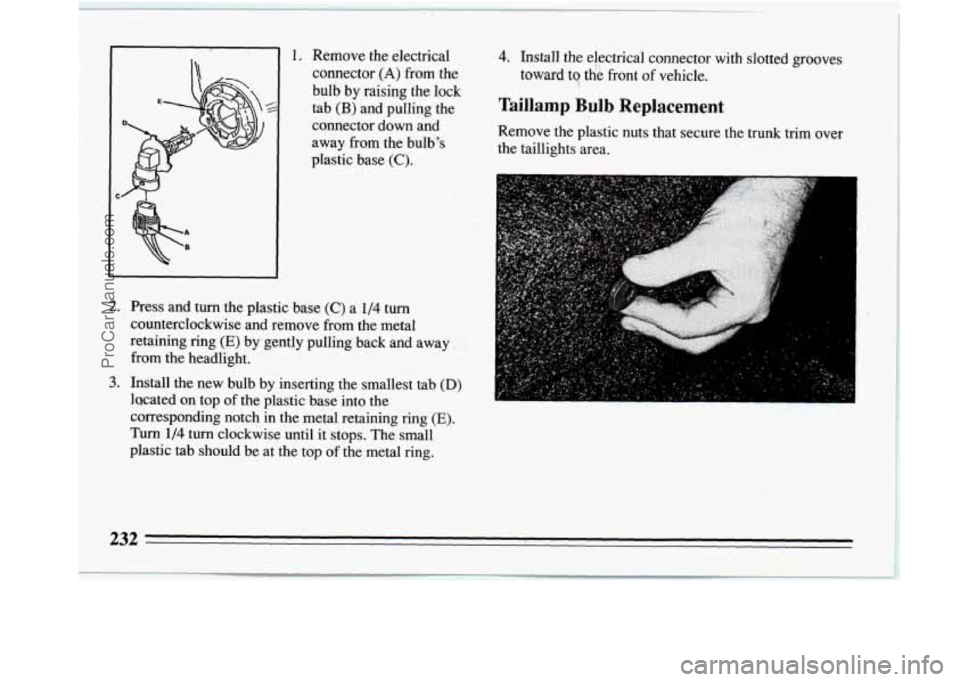
1. Remove the electrical 4. Install the electrical connector with slotted grooves
connector
(A) from the toward to de front of vehicle.
bulb
by raising the lock
tab (B) and pulling the
connector down and
away from the bulb’s
plastic base
(C).
i
Taillamp Bulb Replacement
Remove the plastic nuts that secure the trunk trim over
the taillights area.
2.
3.
Press and turn the plastic base (C) a 1/4 turn
counterclockwise and remove from the metal
retaining ring
(E) by gently pulling back and away
from the headlight.
Install the new bulb by inserting the smallest tab
(D)
lqcated on top of the plastic base into the
corresponding notch in the metal retaining ring
(E).
Turn 1/4 turn clockwise until it stops. The small
plastic tab should be at the top
of the metal ring.
232
ProCarManuals.com
Page 245 of 308
Used Replacement Wheels Tire Chains
NOTICE:
If your Buick has P215/60R16 or P225/60R16 size
tires, don’t use tire chains; they can damage
your vehicle.
If you have other tires, use tire chains only where
legal and only when you must.
Use only SAE
Class “S” type chains that are the proper size for
your tires. Install them on the front tires and
tighten them as tightly as possible with the ends
securely fastened. Drive slowly and follow the
chain manufacturer’s instructions.
If you can
hear the chains contacting your vehicle, stop and
retighten them. If the contact continues, slow
down until
it stops. Driving too fast with chains
on will damage your vehicle.
243
ProCarManuals.com
Page 289 of 308
Roadside Assistance
Buick Motor Division is proud to offer Buick Roadside
Assistance to customers for vehicles covered under the
new car warranty during the,36 month/36,000 mile
(whichever comes first).
Our commitment to Buick owners has always included
superior service through our network of 3,000 Buick
dealers. Buick Roadside Assistance provides an extra
measure of convenience and security providing once
again that Buick is “The Next Symbol for Quality in
America.” For details
of Buick
Roadside Assistance, please consult
your Buick Roadside Assistance owner booklet included
with your owner’s manual. For needed assistance, call
the Buick Roadside Assistance toll-free hotline:
1-800-252-
1 1 12.
Canada Roadside Assistance
Vehicles purchased in Canada have an extensive
Roadside Assistance program accessible from anywhere
in Canada or the United States. Please refer to the
separate brochure provided by
the dealer or call
1-800-268-6800 for emergency services.
Buick Roadside Assistance:
- Provides owners with access to minor repairs or
towing for disabled vehicles.
- Takes the anxiety out of uncertain situations by
providing easy access to service professionals trained
to work with Buick owners, 24-hour a day, 365 days
a year, including weekends and holidays.
287
ProCarManuals.com