lights BUICK REGAL 1994 User Guide
[x] Cancel search | Manufacturer: BUICK, Model Year: 1994, Model line: REGAL, Model: BUICK REGAL 1994Pages: 308, PDF Size: 15.78 MB
Page 114 of 308
Your Buick has a “tamper-resistant odometer.” If you
can see very noticeable bright silver lines between the
numbers, probably someone has tried to turn
it back.
The numbers may not be true.
You may wonder what happens
if a car has to have a
new odometer installed. If possible, the new one has to
be set to
the same reading as the old one. If it can’t be,
then it’s set at zero, and a label on the driver’s door must
show the old reading and when the new one
was
installed.
Trip Odometer
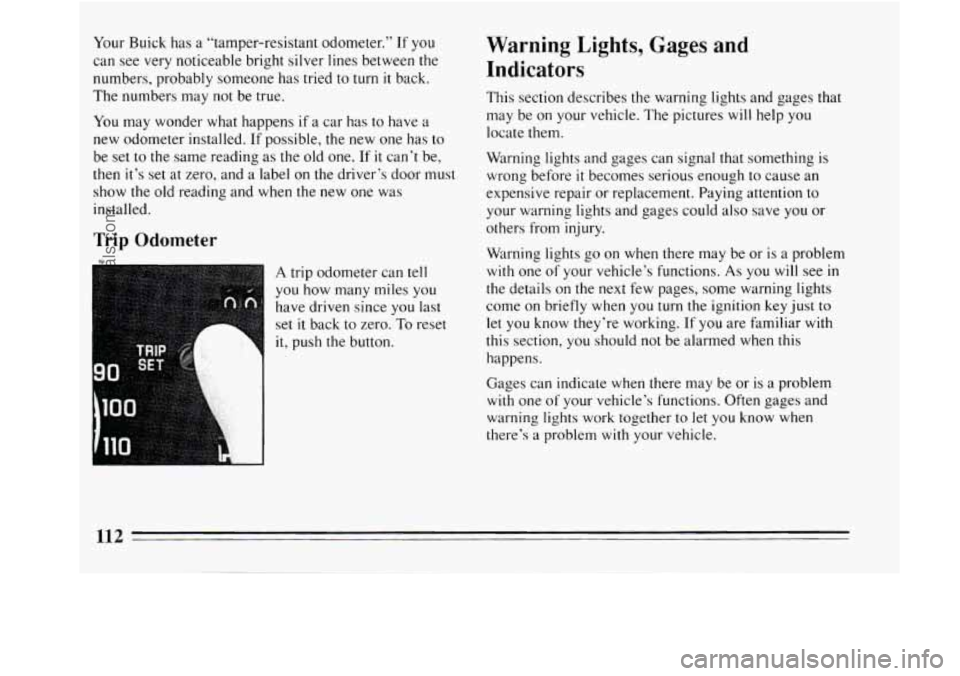
A trip odometer can tell
you how many miles you
have driven since
you last
set
it back to zero. To reset
it, push the button.
Warning Lights, Gages and
Indicators
This section describes the warning lights and gages that
may be on your vehicle. The pictures will help you
locate them.
Warning lights and gages can signal that something is
wrong before
it becomes serious enough to cause an
expensive repair or replacement. Paying attention to
your warning lights and gages could
also save you or
others from injury.
Warning lights
go on when there may be or is a problem
with one of your vehicle’s functions. As you will see in
the details on the next few pages, some warning lights
come on briefly when you turn the ignition key
just to
let you know they’re working.
If you are familiar with
this section, you should not be alarmed
when this
happens.
Gages can indicate when there may be or is a problem
with one of your vehicle’s functions. Often gages and
warning lights work together to let
you know when
there’s a problem
with your vehicle.
112
ProCarManuals.com
Page 115 of 308
When one of the warning lights comes on and stays on
when you are driving, or
when one of the gages shows
there may be a problem, check the section that tells you
what to do about
it. Please follow the manual’s advice.
Waiting to do repairs can be costly
-- and even
dangerous.
So please get to know your warning lights
and gages. They’re a big help.
Fuel Gage
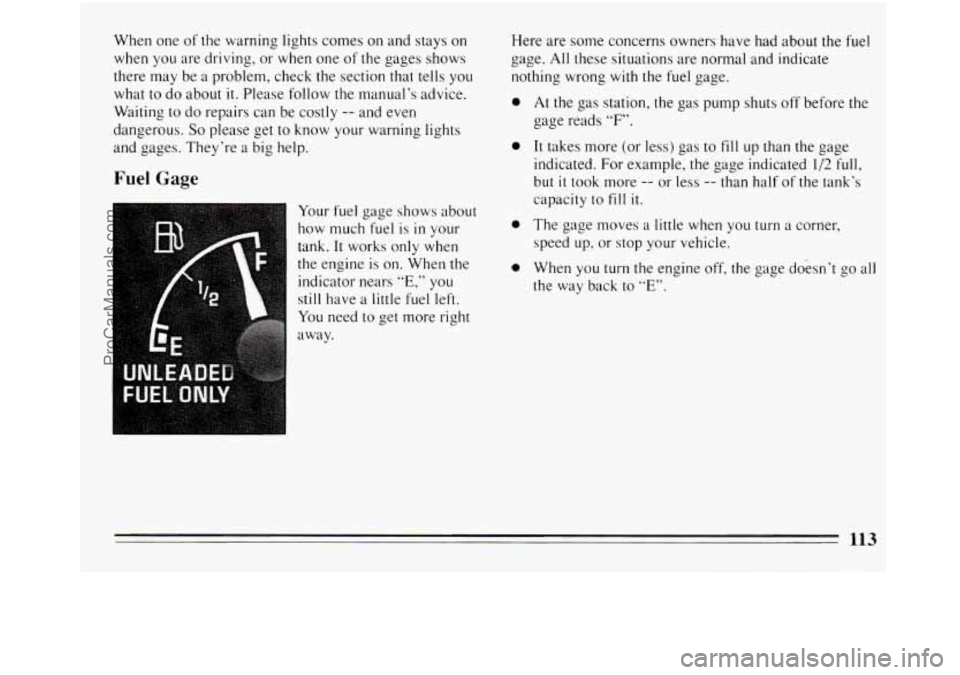
Your fuel gage shows about
how much fuel is
in your
tank.
It works only when
the engine is on. When the
indicator nears
“E,” you
still have a little fuel left. Here
are some concerns owners have had about the fuel
gage. All these situations are normal and indicate
nothing wrong
with the fuel gage.
0
0
a
0
At the gas station, the gas pump shuts off before the
gage reads
“F”.
It takes more (or less) gas to fill up than the gage
indicated. For example, the gage indicated 1/2
full,
but it took more -- or less -- than half of the tank’s
capacity to
fill it.
The gage moves a little when you turn a corner,
speed
up, or stop your vehicle.
When you turn the engine off, the gage d&sn’t go all
the way back to
“E”.
113
ProCarManuals.com
Page 152 of 308
Do not get too close to the vehicle you want to pass
while you’re awaiting an opportunity. For one thing,
following too closely reduces your area of vision,
especially if you’re following a larger vehicle. Also,
you won’t have adequate space if the vehicle ahead
suddenly slows or stops. Keep back a reasonable
distance.
0 When it looks like a chance to pass is coming up,
start
to accelerate but stay in the right lane and don’t
get too close. Time.your move
so you will be
increasing speed as the time comes to move into the
other lane. If the way is clear
to pass, you will have a
“running start” that more than makes up for
the
distance you would lose by dropping back. And if
something happens to cause
you to cancel your pass,
you need only slow down and drop back again and
wait for another opportunity.
0 If other cars are lined up to pass a slow vehicle, wait
your turn. But take care that someone isn’t trying to
pass you as
you pull out to pass the slow vehicle.
Remember to glance over your shoulder and check
the blind spot.
Check your mirrors, glance over your shoulder, and
start your left lane change signal before moving out
of the right lane to pass. When you are far enough
ahead of the passed vehicle to see its front in you:
inside mirror, activate your right lane change signal
and move back into the right lane. (Remember that
your right outside mirror is convex. The vehicle you
just passed may seem to be farther away from
you
than it really is.)
Try not to pass more than one vehicle at a time on
two-lane roads. Reconsider before passing the next
vehicle.
0 Don’t overtake a slowly moving vehicle too rapidly.
Even though the brake lights are not flashing,
it may
be slowing down or starting to turn.
If you’re being passed, make it easy for the
following driver to get ahead of you. Perhaps you
can ease a little
to the right.
ProCarManuals.com
Page 154 of 308
Driving at Night Adjust your inside rearview mirror to reduce the
glare from headlights behind you.
1 Since you can’t see as well, you may need to slow
down and keep more space between
you and other
vehicles.
0 Slow down, especially on higher speed roads. Your
headlights can light
up only so much road ahead.
0 In remote areas, watch for animals.
0 If you’re tired, pull off the road in a safe place and
rest.
Night Vision
i No one can see as well at night as in the daytime. But as
~ we get older these differences increase. A 50-year-old
’ driver may require at least twice as much light to see the A same thing at night as a 20-year-old.
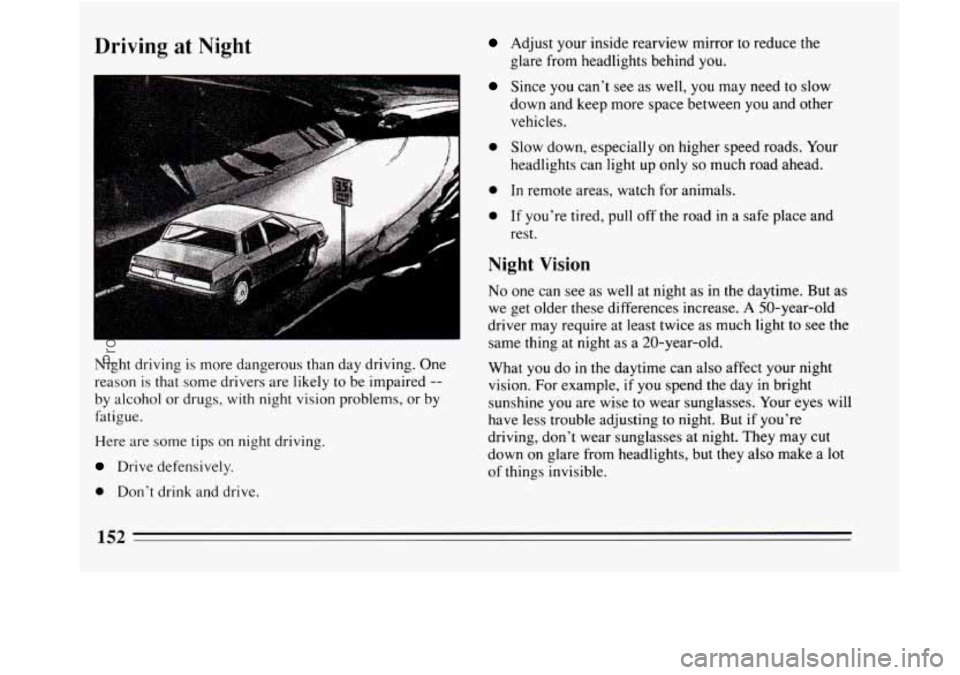
Night driving is more dangerous than day driving. One
reason
is that some drivers are likely to be impaired --
by alcohol or drugs, with night vision problems, or by
fatigue.
Here are some tips on night driving.
Drive defensively.
0 Don’t drink and drive. What
you do in the daytime can also affect your night
vision. For example, if you spend the day in bright
sunshine you are wise to wear sunglasses. Your eyes will
have less trouble adjusting
to night. But if you’re
driving, don’t wear sunglasses at night. They may cut
down
on glare from headlights, but they also make a lot
of things invisible.
152
ProCarManuals.com
Page 155 of 308
You can be temporarily blinded by approaching lights. It
can take a second or two, or even several seconds, for
your eyes
to readjust to the dark. When you are faced
with severe glare (as from
a driver who doesn’t lower
the high beams, or a vehicle with misaimed headlights),
slow down a little. Avoid staring directly into the
approaching lights.
Keep your windshield and all the glass
on your vehicle
clean
-- inside and out. Glare at night is made much
worse by dirt on the glass. Even the inside
of the glass
can build
up a film caused by dust. Dirty glass makes
lights dazzle and flash more than clean glass would,
making
the pupils of your eyes contract repeatedly.
Remember that your headlights light up far less
of a
roadway when you are in
a turn or curve. Keep your
eyes moving; that way, it’s easier to pick out dimly
lighted objects. Just as your headlights should be
checked regularly for proper aim,
so should your eyes
be examined regularly. Some drivers suffer from night
blindness
-- the inability to see in dim light -- and aren’t
even aware
of it.
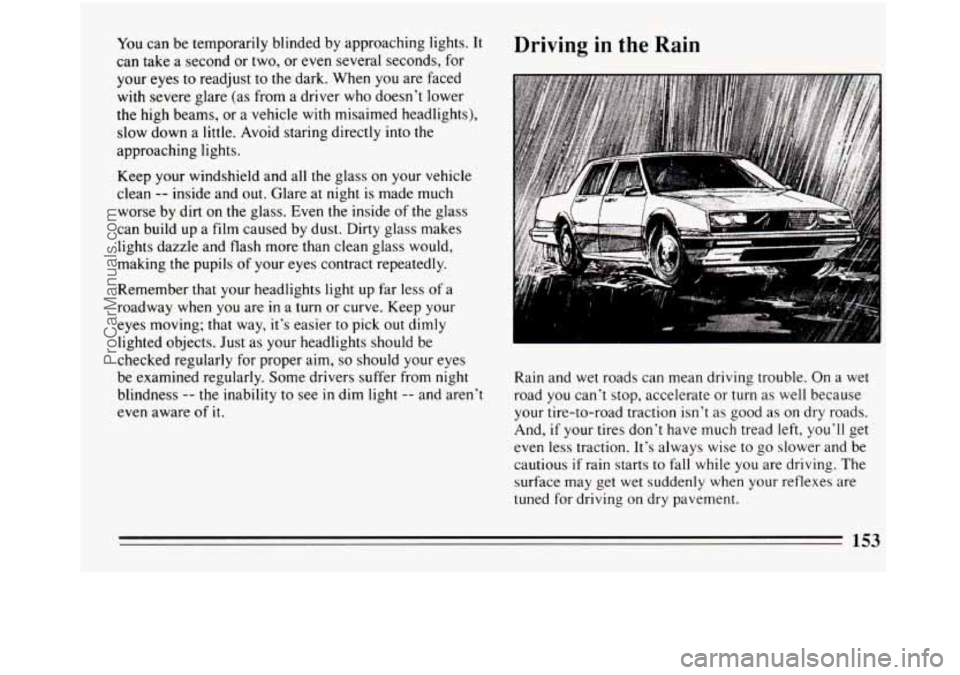
Driving in the Rain
Rain and wet roads can mean driving trouble. On a wet
road you can’t stop, accelerate or turn as well because
your tire-to-road traction isn’t as good as on dry roads.
And,
if your tires don’t have much tread left, you’ll get
even less traction. It’s always wise
to go slower and be
cautious
if rain starts to fall while you are driving. The
surface may get
wet suddenly when your reflexes are
tuned for driving on dry pavement.
153
ProCarManuals.com
Page 157 of 308
“dimple” the water’s surface, there could be
hydroplaning.
Hydroplaning usually happens at higher speeds. There
just isn’t a hard and fast rule about hydroplaning. The
best advice
is to slow down when it is raining.
Some Other Rainy Weather Tips
Turn on your low-beam headlights -- not just your
parking lights
-- to help make you more visible to
others.
City Driving
Besides slowing down, allow some extra following
distance. And be especially careful when you pass
another vehicle. Allow yourself more clear room
ahead, and be prepared to have your view restricted
by road spray.
Have good tires with proper tread depth. (See
“Tires”
in the Index.)
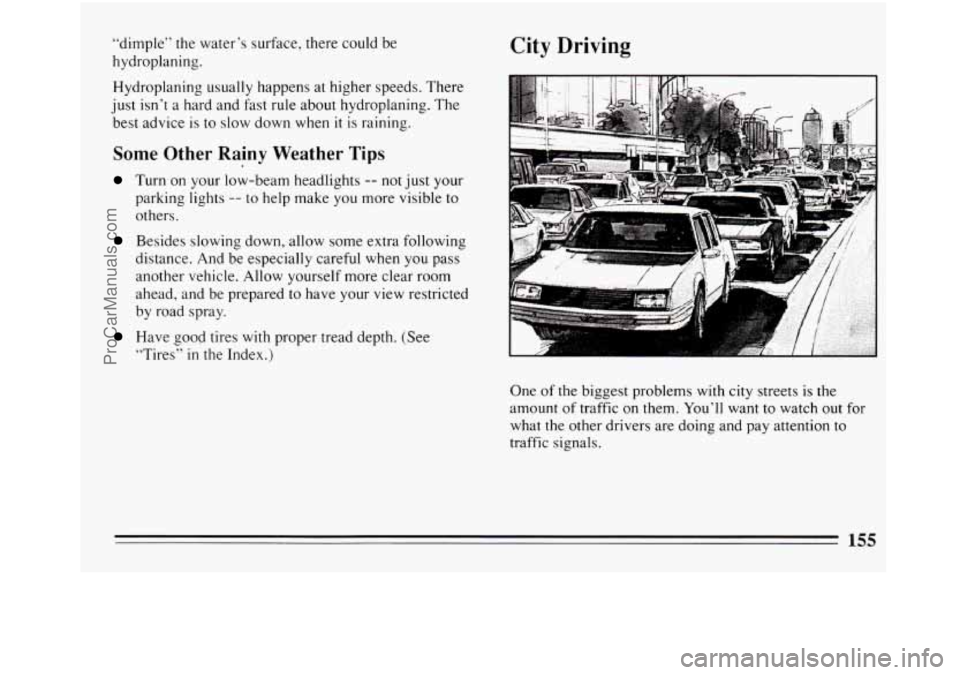
One of the biggest problems with city streets is the
amount of traffic on them. You’ll want to watch out for
what the other drivers are doing and pay attention to
traffic signals.
155
ProCarManuals.com
Page 160 of 308
Here are some things you can check before a trip:
0
0
0
0
0
0
0
Windshield Washer Fluid: Is the reservoir full? Are
all windows clean inside and outside?
Wiper Blades: Are they
in good shape?
Fuel, Engine Oil, Other Fluids: Have you checked all
levels?
Lights: Are they all working? Are the lenses clean?
Tires: They are vitally important
to a safe,
trouble-free trip. Is the tread good enough for
long-distance driving? Are the tires all inflated to the
recommended pressure?
Weather Forecasts: What’s
the weather outlook along
your route? Should you delay
your trip a short time
to avoid a major storm system?
Maps:
Do you have ur>-to-date maps?
Highway Hypnosis
Is there actually such a condition as “highway hypnosis”?
Or is
it just plain falling asleep at the wheel? Call it
highway hypnosis, lack of awareness, or whatever.
There is something about an easy stretch
of road with the
same scenery, along with the hum of the tires on the road,
the drone of the engine, and the rush of the wind against
the vehicle that can make you sleepy. Don’t let
it happen
to you! If
it does, your vehicle can leave the road in
than a second, and
you could crash and be injured.
What can you do about highway hypnosis? First, be
aware that
it can happen.
Then here are some tips:
0
0
a
Make sure your vehicle is well ventilated, with a
comfortably cool interior.
Keep your eyes moving. Scan the road ahead and to
the sides. Check your rearview mirrors and your
instruments frequently.
If you get sleepy,
pull off the road into a rest, service,
or parking area and take a nap, get some exercise, or
both. For safety, treat drowsiness on the highway as
an emergency.
158
ProCarManuals.com
Page 165 of 308
bags, rags, floor mats -- anything you can wrap around
yourself or tuck under your clothing to keep warm.
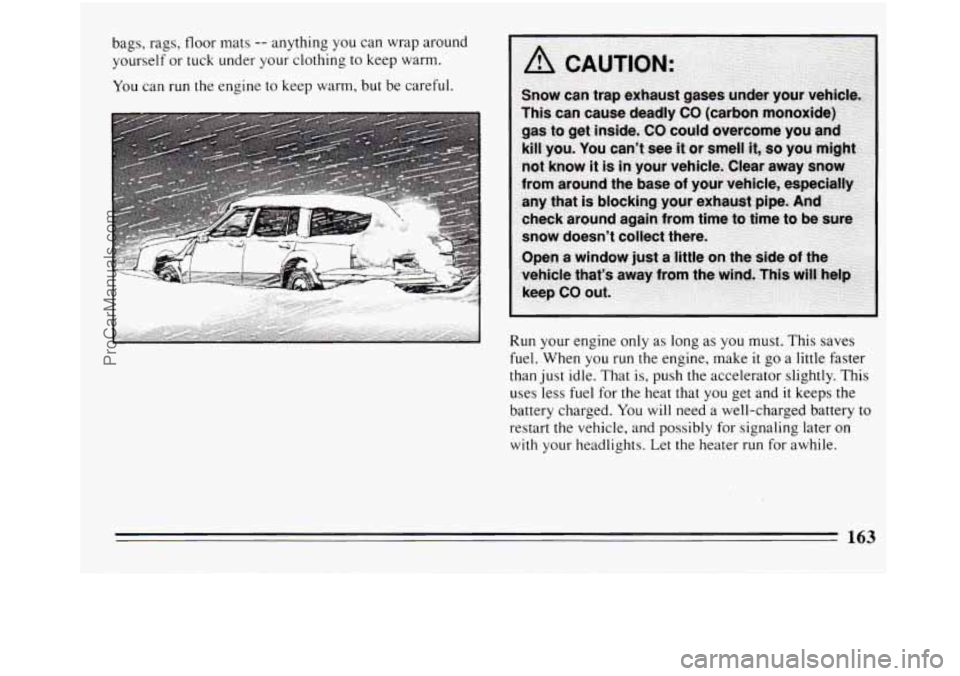
You can run the engine to keep warm, but be careful.
Run your engine only as long as you must. This saves
fuel. When you run the engine, make it go a little faster
than just idle. That
is, push the accelerator slightly. This
uses less fuel for the heat that you get and
it keeps the
battery charged. You will need a well-charged battery to
restart the vehicle, and possibly for signaling later on
with your headlights. Let the heater run for awhile.
163
ProCarManuals.com
Page 169 of 308
monoxide (CO) from your exhaust can get into your
vehicle (see “Carbon Monoxide”
in the Index). Dirt
and water can,
too.
The bumpers on your vehicle are not intended for
hitches. Do not attach rental hitches or other
bumper-type hitches to them. Use only a
frame-mounted hitch that does not attach to the
bumper.
Safety Chains
You should always attach chains between your vehicle
and your trailer. Cross the safety chains under the
tongue of the trailer
so that the tongue will not drop to
the road
if it becomes separated from the hitch.
Instructions about safety chains may be provided by the
hitch manufacturer or by the trailer manufacturer.
Follow the manufacturer’s recommendation for
attaching safety chains. Always leave just enough slack
so you can turn with your rig. And, never allow safety
chains to drag
on the ground.
Trailer Brakes
If your trailer weighs more than 1,000 pounds (450 kg)
loaded, then
it needs its own brakes -- and they must be
adequate. Be sure to read and follow the instructions for
the trailer brakes
so you’ll be able to install, adjust and maintain
them properly. Because you have anti-lock
brakes, do not try to tap into your vehicle’s brake
system. If you do, both brake systems won’t work well,
or at all.
Driving with a Trailer
Towing a trailer requires a certain amount of experience.
Before setting out for the open road, you’ll want to get
to know your rig. Acquaint yourself with the feel of
handling and braking with the added weight
of the
trailer. And always keep
in mind that the vehicle you are
driving
is now a good deal longer and not nearly so
responsive as your vehicle is by itself.
Before you start, check the trailer hitch and platform,
,
safety chains, electrical connector, lights, tires and
mirror adjustment. If
the trailer has electric brakes, start
your vehicle and trailer moving and then apply the
trailer brake controller by hand to be sure the brakes are
working. This lets you check your electrical connection
at the same time.
During your trip, check occasionally to be sure that the
load is secure, and that the lights and any trailer brakes
are still working.
167
ProCarManuals.com
Page 170 of 308
Following Distance
Stay at least twice as far behind the vehicle ahead as you
would when driving your vehicle without a trailer. This
can help you avoid situations that require heavy braking
and sudden turns.
Passing
You’ll need more passing distance up ahead when
you’re towing a trailer. And, because you’re a good deal
longer, you’ll need
to go much farther beyond the
passed vehicle before
you can return to your lane.
Backing Up
Hold the bottom of the steering wheel with one hand.
Then,
to move the trailer to the left, just move that hand
to the left.
To move the trailer to the right, move your
hand
to the right. Always back up slowly and, if
possible, have someone guide you.
Making Turns
When you’re turning with a trailer, make wider turns
than normal.
Do this so your trailer won’t strike soft
shoulders, curbs, road signs, trees, or other objects.
Avoid jerky or sudden maneuvers. Signal well
in
advance.
Turn Signals When Towing a Trailer
When you tow a trailer, your vehicle has to have a
different turn signal flasher and extra wiring. The green
arrows
on your instrument panel will flash whenever
you signal a turn or lane change. Properly hooked up,
the trailer lights will also flash, telling other drivers
you’re about to turn, change lanes or stop.
When towing a trailer,
the green arrows on your
instrument panel will flash for turns even
if the bulbs on
the trailer are burned out. Thus, you may think drivers
behind you are seeing your signal when they are
not. It’s
important to check occasionally to be sure the trailer
bulbs are still working.
Driving On Grades
Reduce speed and shift to a lower gear before you start
down a long or steep downgrade. If you don’t shift
down,
you might have to use your brakes so much that
they would get hot and no longer work
well.
On a long uphill grade, shift down and reduce your
speed to around
45 mph (70 km/h) to reduce the
possibility
of engine and transaxle overheating.
If you are towing a trailer that weighs more than
1,000
pounds (450 kg), you may prefer to drive in “D” instead
of Overdrive (or, as you need to, a lower gear).
168
ProCarManuals.com