turn signal BUICK REGAL 1994 User Guide
[x] Cancel search | Manufacturer: BUICK, Model Year: 1994, Model line: REGAL, Model: BUICK REGAL 1994Pages: 308, PDF Size: 15.78 MB
Page 157 of 308
“dimple” the water’s surface, there could be
hydroplaning.
Hydroplaning usually happens at higher speeds. There
just isn’t a hard and fast rule about hydroplaning. The
best advice
is to slow down when it is raining.
Some Other Rainy Weather Tips
Turn on your low-beam headlights -- not just your
parking lights
-- to help make you more visible to
others.
City Driving
Besides slowing down, allow some extra following
distance. And be especially careful when you pass
another vehicle. Allow yourself more clear room
ahead, and be prepared to have your view restricted
by road spray.
Have good tires with proper tread depth. (See
“Tires”
in the Index.)
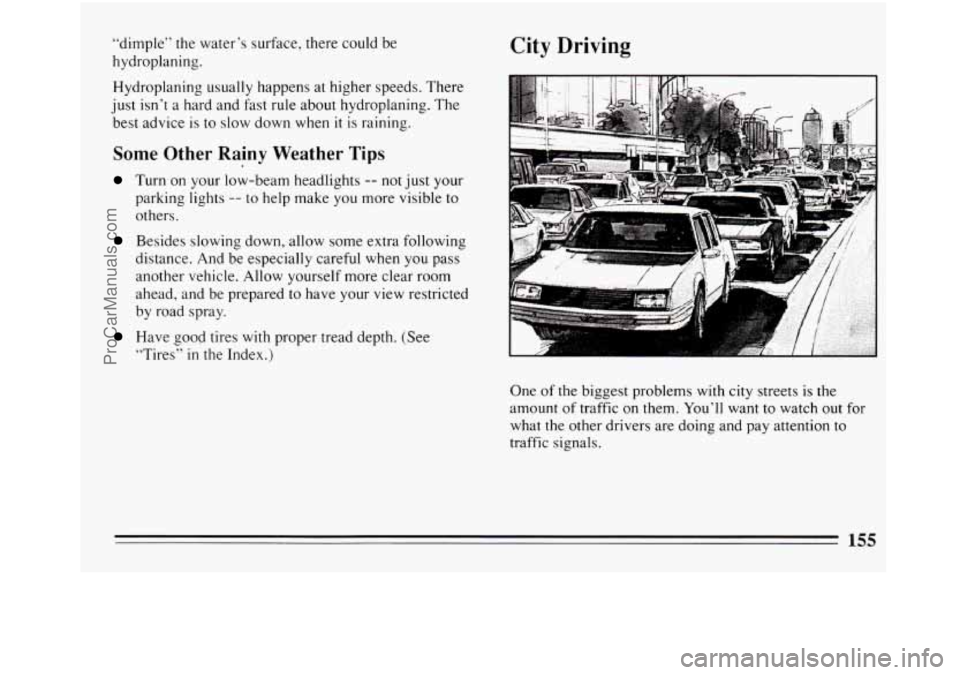
One of the biggest problems with city streets is the
amount of traffic on them. You’ll want to watch out for
what the other drivers are doing and pay attention to
traffic signals.
155
ProCarManuals.com
Page 158 of 308
Here are ways to increase your safety in city driving: Freeway Driving
Treat a green light as a warning signal. A traffic light
is there because the corner is busy enough
to need it.
When a light turns green, and just before you start to
move, check both ways for vehicles that have not
cleared the intersection or may be running the red
light.
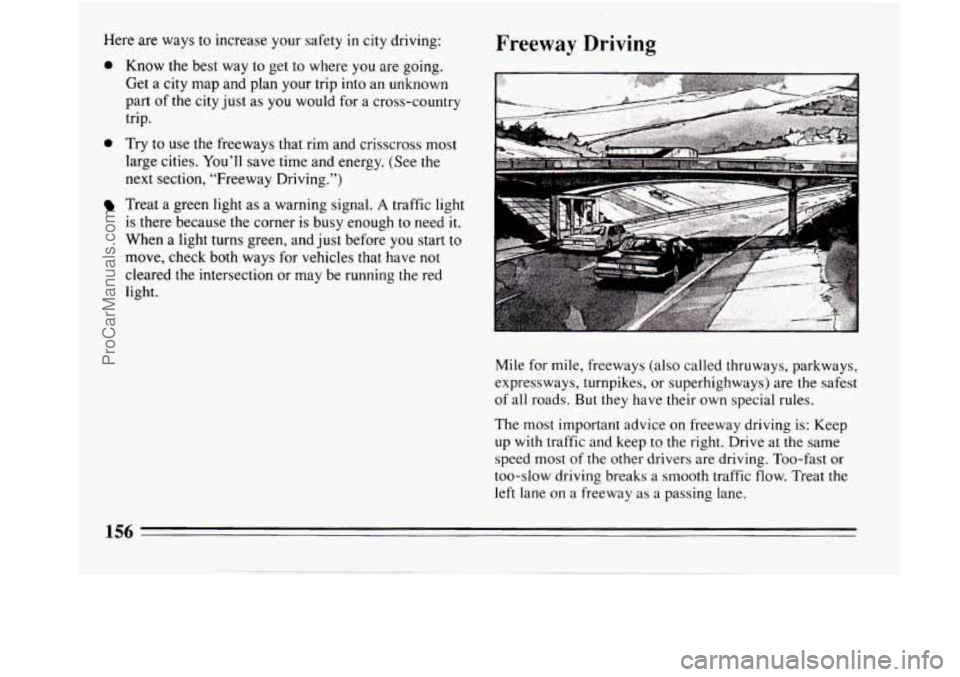
Mile for mile, freeways (also called thruways, parkways,
expressways, turnpikes, or superhighways) are the safest
of all roads. But they have their own special rules.
The most important advice on freeway driving
is: Keep
up
with traffic and keep to the right. Drive at the same
speed most
of the other drivers are driving. Too-fast or
too-slow driving breaks a smooth traffic flow. Treat the
left lane
on a freeway as a passing lane.
156
ProCarManuals.com
Page 159 of 308
At the entrance there is usually a ramp that leads to the
freeway. If you have a clear view of the freeway as you
drive along the entrance ramp, you should begin to
check traffic. Try
to determine where you expect to
blend with the flow. Try to merge into the gap at close to
the prevailing speed. Switch on your turn signal, check
your mirrors and glance over your shoulder as often as
necessary. Try to blend smoothly
with the traffic flow.
Once you are
on the freeway, adjust your speed to the
posted
limit or to the prevailing rate if it’s slower. Stay
in the right lane unless you want to pass.
Before changing lanes, check your mirrors. Then use
your turn signal.
Just before you leave the lane, glance quickly over your
shoulder to make sure there isn’t another vehicle
in your
“blind” spot.
Once you are moving
on the freeway, make certain you
allow a reasonable following distance. Expect to move
slightly slower at night.
When you want to leave the freeway, move to the proper
lane well
in advance. If you miss your exit do not, under
any circumstances, stop and back up. Drive on
to the
next exit. The exit
ramp can be curved, sometimes quite sharply.
The
exit speed is usually posted.
Reduce your speed according to your speedometer, not
to your sense
of motion. After driving for any distance
at higher speeds, you may tend to
think you are going
slower than you actually are.
Before Leaving on a Long Trip
Make sure you’re ready. Try to be well rested. If you
must start when you’re not fresh
-- such as after a day’s
work
-- don’t plan to make too many miles that first part
of the journey. Wear comfortable clothing and shoes you
can easily drive
in.
Is your vehicle ready for a long trip? If you keep it
serviced and maintained, it’s ready to go. If it needs
service, have
it done before starting out. Of course,
you’ll find experienced and able service experts
in
Buick dealerships all across North America. They’ll be
ready and willing to help if you need it.
157
ProCarManuals.com
Page 170 of 308
Following Distance
Stay at least twice as far behind the vehicle ahead as you
would when driving your vehicle without a trailer. This
can help you avoid situations that require heavy braking
and sudden turns.
Passing
You’ll need more passing distance up ahead when
you’re towing a trailer. And, because you’re a good deal
longer, you’ll need
to go much farther beyond the
passed vehicle before
you can return to your lane.
Backing Up
Hold the bottom of the steering wheel with one hand.
Then,
to move the trailer to the left, just move that hand
to the left.
To move the trailer to the right, move your
hand
to the right. Always back up slowly and, if
possible, have someone guide you.
Making Turns
When you’re turning with a trailer, make wider turns
than normal.
Do this so your trailer won’t strike soft
shoulders, curbs, road signs, trees, or other objects.
Avoid jerky or sudden maneuvers. Signal well
in
advance.
Turn Signals When Towing a Trailer
When you tow a trailer, your vehicle has to have a
different turn signal flasher and extra wiring. The green
arrows
on your instrument panel will flash whenever
you signal a turn or lane change. Properly hooked up,
the trailer lights will also flash, telling other drivers
you’re about to turn, change lanes or stop.
When towing a trailer,
the green arrows on your
instrument panel will flash for turns even
if the bulbs on
the trailer are burned out. Thus, you may think drivers
behind you are seeing your signal when they are
not. It’s
important to check occasionally to be sure the trailer
bulbs are still working.
Driving On Grades
Reduce speed and shift to a lower gear before you start
down a long or steep downgrade. If you don’t shift
down,
you might have to use your brakes so much that
they would get hot and no longer work
well.
On a long uphill grade, shift down and reduce your
speed to around
45 mph (70 km/h) to reduce the
possibility
of engine and transaxle overheating.
If you are towing a trailer that weighs more than
1,000
pounds (450 kg), you may prefer to drive in “D” instead
of Overdrive (or, as you need to, a lower gear).
168
ProCarManuals.com
Page 174 of 308
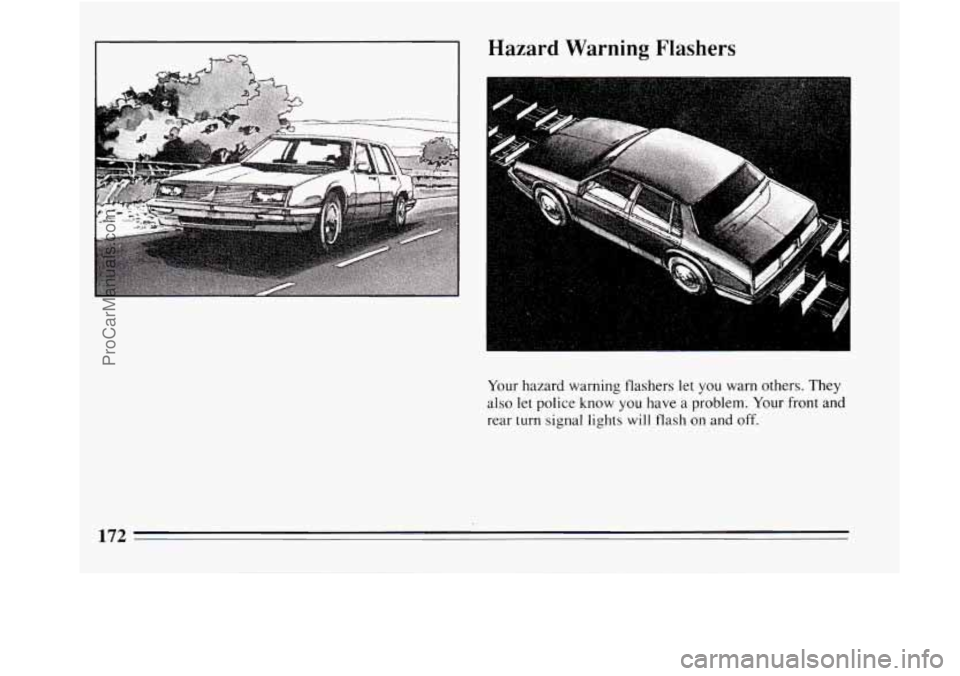
Hazard Warning Flashers
Your hazard warning flashers let you warn others. They
also
let police know you have a problem. Your front and
rear turn
signal lights will flash on and off.
172
ProCarManuals.com
Page 175 of 308
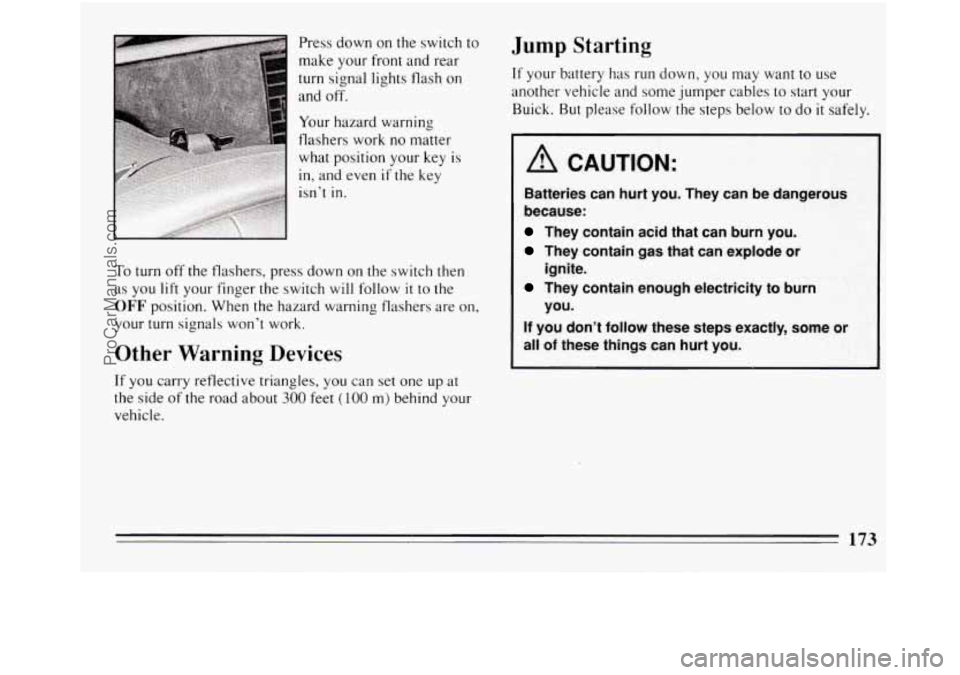
Press down on the switch to
make your front and rear
turn signal lights flash on
and off.
Your hazard warning
flashers work
no matter
what position your key is
in, and even if the key
isn’t
in.
To turn off the flashers, press down on the switch then
as you
lift your finger the switch will follow it to the
OFF position. When the hazard warning flashers are on,
your turn signals won’t work.
Other Warning Devices
If you carry reflective triangles, you can set one up at
the side of the road about
300 feet (100 m) behind your
vehicle.
Jump Starting
If your battery has run down, you may want to use
another vehicle and some jumper cables to start your
Buick. But please follow
the steps below to do it safely.
A CAUTION:
Batteries can hurt you. They can be dangerous
because:
They contain acid that can burn you.
They contain gas that can explode or
They contain enough electricity to burn
If you don’t follow these steps exactly, some or
all
of these things can hurt you.
ignite.
you.
173
ProCarManuals.com
Page 257 of 308
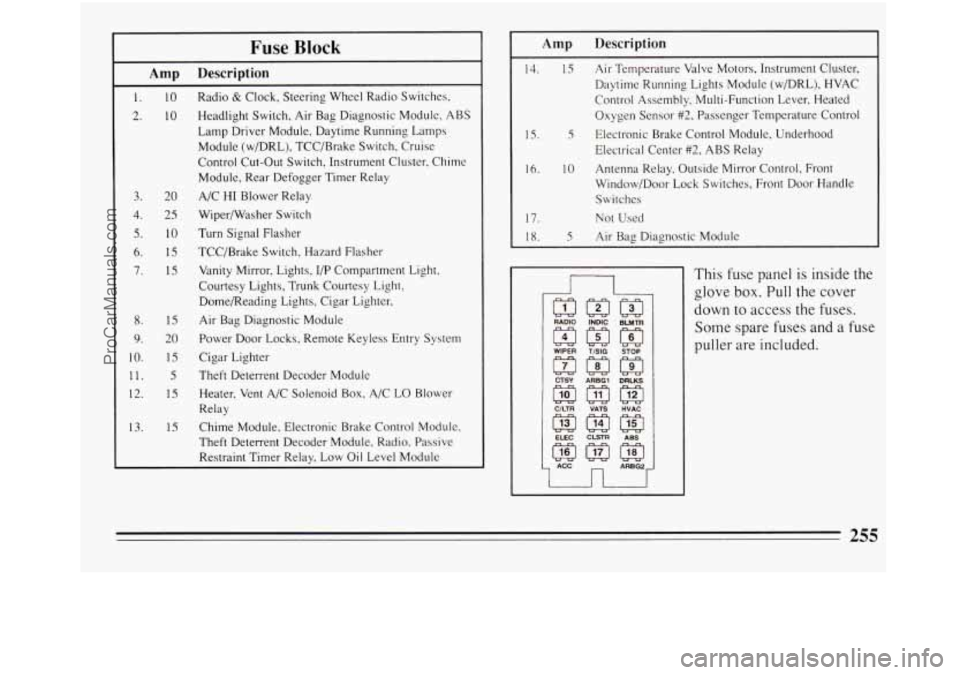
Fuse Block
Amp Description
1.
2.
10
10
3. 20
4.
2s
5. IO
6. 15
7. 15
8. 1s
9. 20
10.
1s
11. 5
12. 1s
13. 15 Radio
& Clock, Steering
Wheel Radio Switches.
Headlight Switch, Air Bag Diagnostic Module, ABS
Lamp Driver Module, Daytime Running Lamps
Module (w/DRL), TCC/Brake Switch, Cruise
Control Cut-Out Switch, Instrument Cluster, Chime
Module, Rear Defogger Timer Relay
A/C HI Blower Relay
Wipermasher Switch
Turn Signal Flasher
TCC/Brake Switch, Hazard Flasher
Vanity Mirror, Lights, I/P Compartment Light,
Courtesy Lights, Trunk Courtesy Light,
Dome/Reading Lights, Cigar Lighter.
Air Bag Diagnostic Module
Power Door Locks, Remote Keyless Entry System
Cigar Lighter
Theft Deterrent Decoder Module
Heater, Vent A/C Solenoid Box, A/C LO Blower
Relay
Chime Module, Electronic Brake Control Module.
Theft Deterrent Decoder Module, Radio, Passive
Restraint Timer Relay, Low Oil Level Module
1s.
Amp Description
14. 15 Air Temperature Valve Motors, Instrument Cluster,
Daytime Running Lights Module (w/DRL), HVAC
Control Assembly, Multi-Function Lever, Heated
Oxygen Sensor
#2, Passenger Temperature Control
Electrical Center
#2, ABS Relay
16. 10 Antenna Relay, Outside Mirror Control, Front
Window/Door Lock Switches, Front Door Handle
Switches
17.
Not Used
18. 5 Air Bag Diagnostic Module
5 Electronic Brake Control Module, Underhood
n
CTSY ARBGl DRLKS
@m@
ClLTR VATS HVAC
This fuse panel is inside the
glove
box. Pull the cover
down to access the
fuses.
Some spare fuses and a fuse
puller are included.
255
ProCarManuals.com
Page 260 of 308
10
25
1s
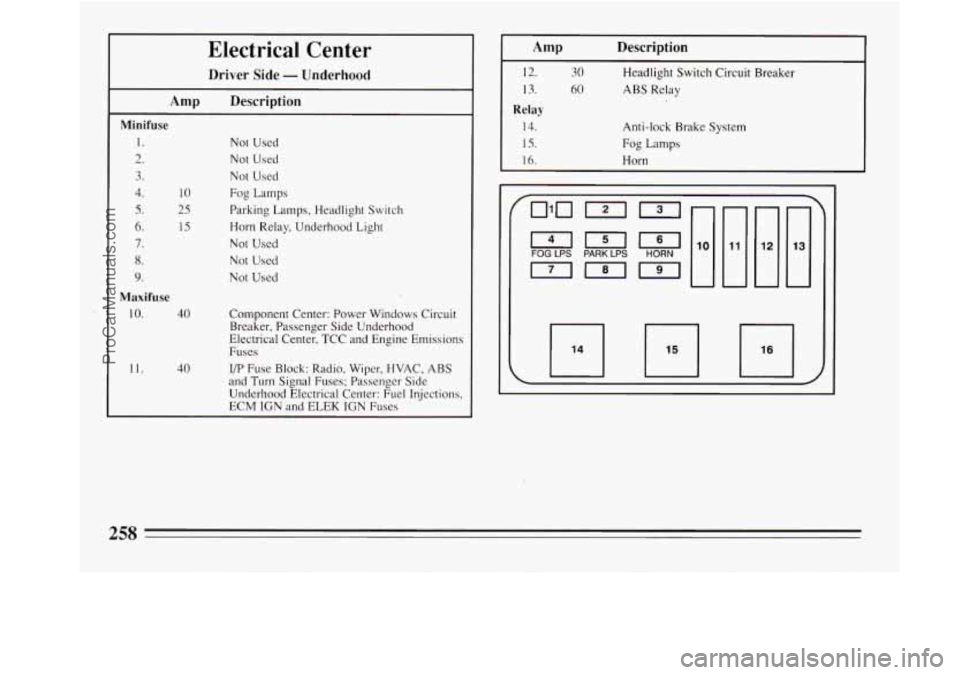
Electrical Center
Driver Side - Underhood
Amp Description
Minifuse
1. Not Used
2. Not Used
3. Not Used
4. Fog Lamps
5. Parking Lamps, Headlight Switch
6. Horn Relay, Underhood Light
7. Not Used
8. Not Used
9. Not Used
Maxifuse
10. 40
11 40
Component Center: Power Windows Circuit
Breaker, Passenger Side Underhood
Electrical Center, TCC and Engine Emissions
Fuses
I/P Fuse Block: Radio, Wiper, HVAC, ABS
and Turn Signal Fuses; Passenger Side
Underhood Electrical Center:
Fuel Injections,
ECM IGN and
ELEK IGN Fuses
Amp Description
12. 30 Headlight Switch Circuit Breaker
13. 60 ABS Relay
Relay
14. Anti-lock Brake System
1s. Fog Lamps
16. Horn
258
ProCarManuals.com
Page 302 of 308
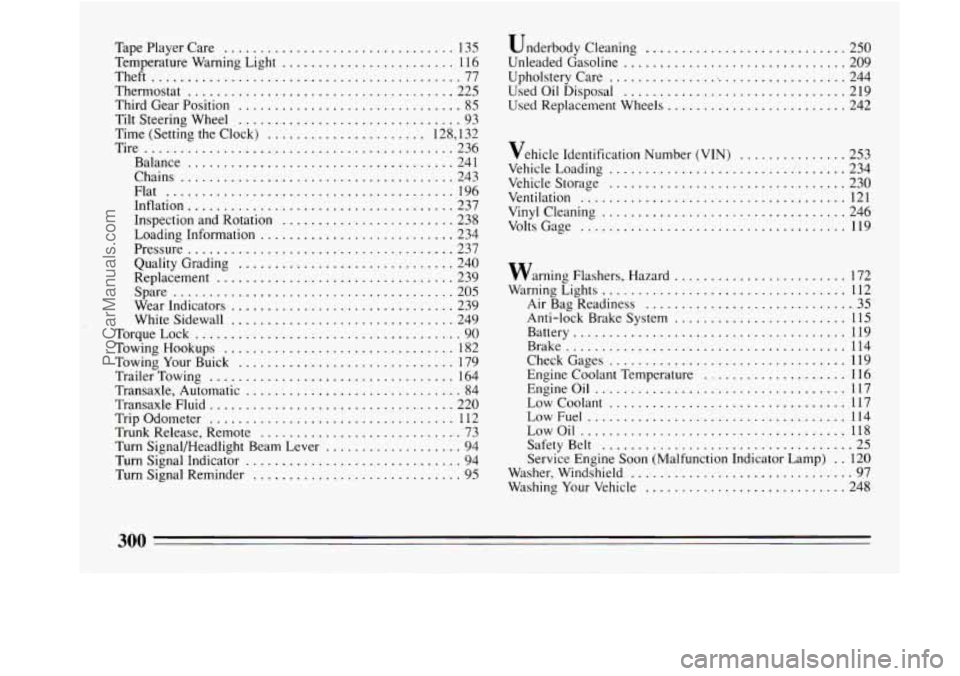
Tape Player Care ................................ 135
Temperature Warning Light
........................ 1 16
Theft
........................................... 77
Thermostat
..................................... 225
Third Gear Position
............................... 85
Tilt Steering Wheel
............................... 93
Time (Setting the Clock)
...................... 128. 132
Tire
........................................... 236
Balance
..................................... 241
Chains
...................................... 243
Flat
........................................ 196
Inflation
..................................... 237
Inspection and Rotation
........................ 238
Loading Information
........................... 234
Pressure
..................................... 237
Quality Grading
.............................. 240
Replacement
................................. 239
Spare
....................................... 205
Wear Indicators
............................... 239
White Sidewall
............................... 249
TorqueLock
..................................... 90
TowingHookups
................................ 182
Towing Your Buick
.............................. 179
Trailer Towing
.................................. 164
Transaxle. Automatic
.............................. 84
Transaxle Fluid
.................................. 220
Trip Odometer
.................................. 1 12
Trunk Release. Remote
............................ 73
Turn Signalmeadlight Beam Lever
................... 94
Turn Signal Indicator
.............................. 94
Turn Signal Reminder
............................. 95 Underbody
Cleaning
............................ 250
Unleaded Gasoline
............................... 209
Upholstery Care
.................................. 244
Used Oil Disposal
............................... 219
Used Replacement Wheels
......
Vehicle Identification Number (VI
Vehicle Loading ..............
Vehicle Storage ..............
.................. 242
N) ............... 253
.................. 234
.................. 230 . Ventilation ..................................... 121
Vinyl Cleaning .................................. 246
VoltsGage
..................................... 119
warning Flashers. Hazard
........................ 172
Warning Lights
.................................. 112
Air Bag Readiness ............................. 35
Anti-lock Brake System
........................ 115
Battery
...................................... 119
CheckGages
................................. 119
Brake
....................................... 114
Engine Coolant Temperature
.................... 116
Engineoil
................................... 117
LowCoolant
................................. 117
LowFuel
.................................... 114
LowOil
..................................... 118
Service Engine Soon (Malfunction Indicator Lamp)
. . 120
Washer. Windshield
............................... 97
Washing Your Vehicle
............................ 248
Safety Belt
................................... 25
300
ProCarManuals.com