fuel BUICK REGAL 1994 Owner's Manual
[x] Cancel search | Manufacturer: BUICK, Model Year: 1994, Model line: REGAL, Model: BUICK REGAL 1994Pages: 308, PDF Size: 15.78 MB
Page 219 of 308
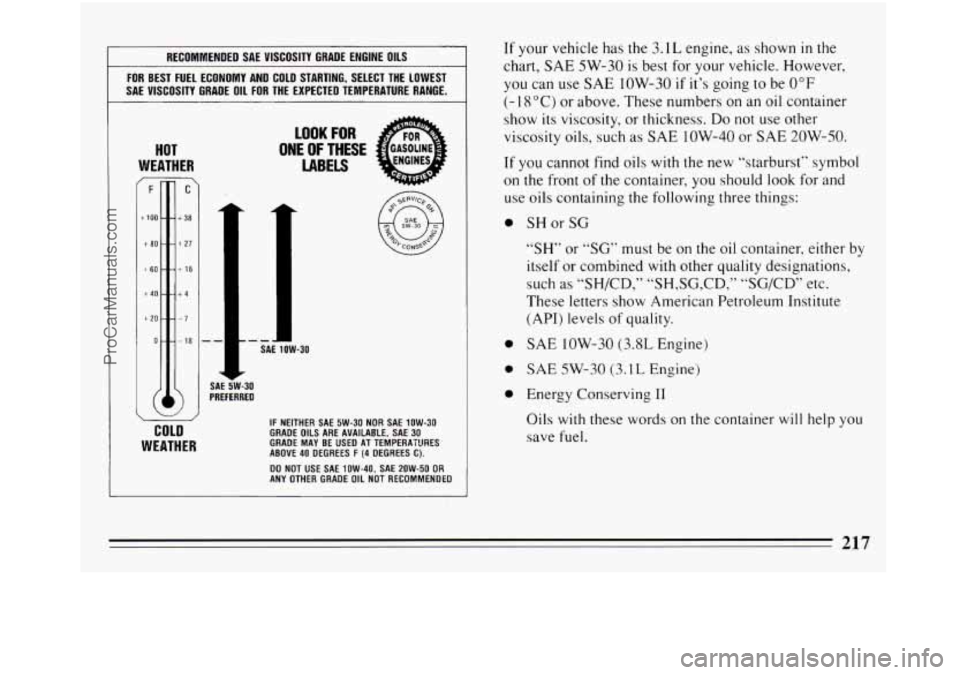
RECOMMENDED SAE VISCOSITY GRADE ENGINE OILS
FOR BEST FUEL ECONOMY AND COLD STARTING, SELECT THE LOWEST
SAE VISCOSITY GRADE
OIL FOR THE EXPECTED TEMPERATURE RANGE.
HOT
WEATHER
r
COLD
WEATHER
LOOK FOR
ONE OF THESE
LABELS
SAE 1OW-30
r
f-30 RED
IF NEITHER SAE 5W-30 NOR SAE 1OW-30
GRADE OILS ARE AVAILABLE, SAE 30
GRADE MAY BE USED AT TEMPERATURES
ABOVE 40 DEGREES
F (4 DEGREES C).
ANY OTHER GRAOE OIL NOT RECOMMENOEO DO NOT USE SAE 1OW-40, SAE 2OW-50 OR
If your vehicle has the 3.1 L engine, as shown in the
chart, SAE
5W-30 is best for your vehicle. However,
you can use SAE
low-30 if it’s going to be 0°F
(- 18 “C) or above. These numbers on an oil container
show its viscosity, or thickness.
Do not use other
viscosity
oils, such as SAE 1OW-40 or SAE 20W-50.
If you cannot find oils with the new “starburst” symbol
on the front of
the container, you should look for and
use oils containing the following three things:
0
0
0
0
SH or SG
“SH” or “SG” must be on the oil container, either by
itself or combined with other quality designations,
such as “SH/CD,” “SH,SG,CD,” “SG/CD” etc.
These letters show American Petroleum Institute
(API) levels of quality.
SAE
low-30 (3.8L Engine)
SAE 5W-30 (3.1L Engine)
Energy Conserving I1
Oils with these words
on the container will help you
save fuel.
217
ProCarManuals.com
Page 237 of 308
and the total weight that you can carry. This weight is
called the Vehicle Capacity Weight and includes the weight of all occupants, cargo, and all
nonfactory-installed options. And, if you do have a heavy load, you should spread it
out. Don’t carry more than
167 pounds (76 kilograms)
in your trunk.
(81
7
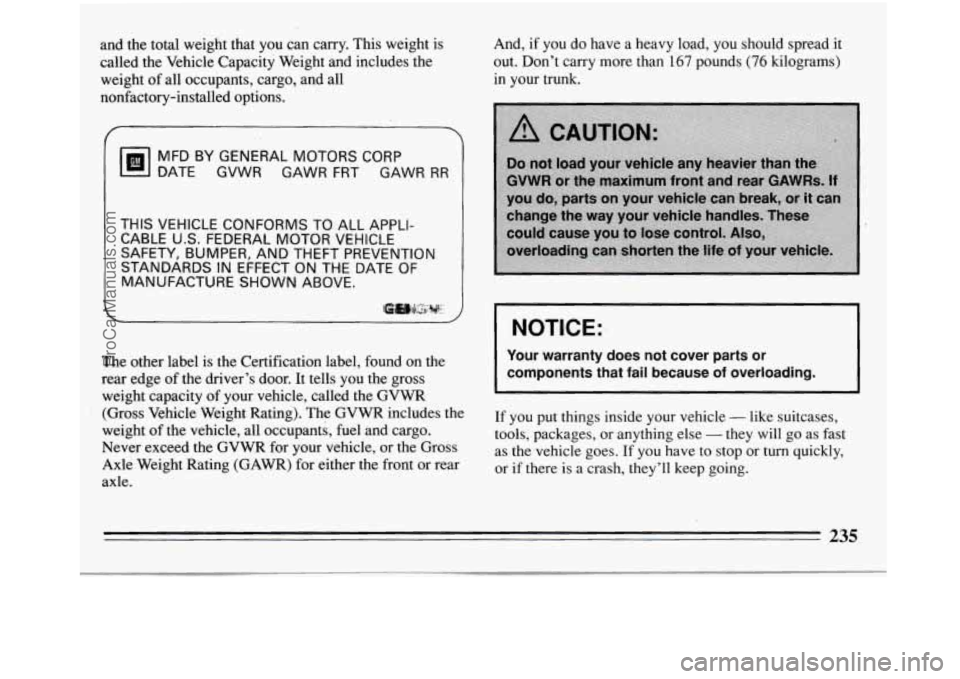
MFD BY GENERAL MOTORS CORP
DATE GVWR GAWR FRT GAWR
RR
THIS VEHICLE CONFORMS TO ALL APPLI-
CABLE U.S. FEDERAL MOTOR VEHICLE
SAFETY, BUMPER, AND THEFT PREVENTION
STANDARDS
IN EFFECT ON THE DATE OF
MANUFACTURE SHOWN ABOVE.
The other label is the Certification label, found on the
rear edge of the driver’s door. It tells
you the gross
weight capacity of your vehicle, called the GVWR
(Gross Vehicle Weight Rating). The GVWR includes the
weight of the vehicle, all occupants, fuel and cargo.
Never exceed the GVWR for your vehicle, or the Gross
Axle Weight Rating (GAWR) for either the front
or rear
axle.
If you put things inside your vehicle - like suitcases,
tools, packages, or anything else
- they will go as fast
as the vehicle goes. If you have to stop or turn quickly,
or if there is a crash, they’ll keep going.
NOTICE:.
~~~
Your warranty does not cover parts or
components that fail because of overloading.
235
ProCarManuals.com
Page 239 of 308
Inflation - Tire Pressure
The Tire-Loading Information label which is on the deck lid
shows the correct inflation pressures for your tires, when
they’re cold. “Cold” means your vehicle has been sitting for
at least three hours or driven no more than a mile.
NOTICE:
Don’t let anyone tell you that underinflation or
overinflation is all right. It’s not. If your tires don’t
have enough air (underinflation) you can get:
0 Too much flexing
Too much heat
Tire overloading
Bad wear
0 Bad handling
Bad fuel economy.
If your tires have too much air (overinflation),
you can get:
Unusual wear
0 Bad handling
0 Rough ride
Needless damage from road hazards.
When to Check
Check your tires once a month or more.
Don’t forget your compact spare tire. It should be at
60
psi (420 kPa).
How to Check
Use a good quality pocket-type gage to check tire
pressure. Simply looking at the tires will not tell
you the
pressure, especially
if you have radial tires -- which
may look properly inflated even
if they’re underinflated.
If your tires have valve caps, be sure to put them back
on. They help prevent leaks by keeping out dirt and
moisture.
237
ProCarManuals.com
Page 252 of 308
Foreign Material
Calcium chloride and other salts, ice melting agents,
road oil and tar, tree sap, bird droppings, chemicals from
industrial chimneys, and other foreign matter can
damage your vehicle’s finish if they remain on painted
surfaces. Use cleaners that are marked safe for painted
surfaces to remove foreign matter.
Finish Damage
Any stone chips, fractures or deep scratches in the finish
should be repaired right away. Bare metal
will corrode
quickly and may develop
into a major repair expense.
Minor chips and scratches can be repaired
with touch-up
materials available from your dealer or other service
outlets. Larger areas of finish damage can be corrected
in your dealer’s body and paint shop.
Underbody Maintenance
Chemicals used for ice and snow removal and dust
control can collect on the underbody. If these are not
removed, accelerated corrosion (rust) can occur on the
underbody parts such as fuel lines, frame, floor pan, and
exhaust system even though they have corrosion
protection.
At least every spring, flush these materials from the
underbody
with plain water. Clean any areas where mud
and other debris can collect. Dirt packed
in closed areas
of the frame should be loosened before being flushed.
Your dealer or an underbody vehicle washing system
can do this for you.
ProCarManuals.com
Page 259 of 308
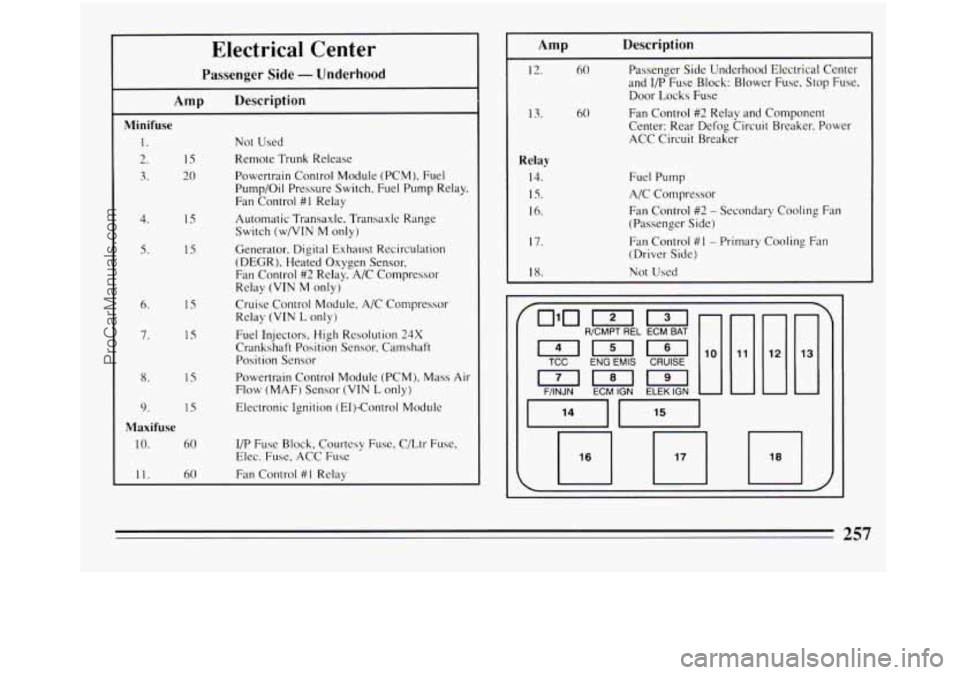
15
20
15
IS
1s
' 1s
Electrical Center
Passenger Side - Underhood
Amp Description
Minifuse
1. Not Used
2. Remote Trunk Release
3. Powertrain Control Module (PCM), Fuel
Pump/Oil Pressure Switch, Fuel Pump Relay.
Fan Control
#I Relay
Switch (w/VIN
M only)
(DEGR), Heated Oxygen Sensor,
Fan Control
#2 Relay, A/C Compressor
Relay
(VIN M only)
Relay
(VIN L only)
Crankshaft Position Sensor, Camshaft
Position Sensor
Flow (MAF) Sensor
(VIN L only)
4. Automatic Transaxle, Transaxle Range
5. Generator. Digital Exhaust Recirc'ulation
6. Cruise Control Module. A/C Compressor
7. Fuel Injectors, High Resolution 24X
8. IS Powertrain Control Module (PCM), Mass Air
9. 1s Electronic Ignition (E1)-Control Module
10. 60 I/P Fuse Block, Courtesy Fuse. C/Ltr Fuse.
11. 60 Fdn Control #I Relay
Maxifuse
Elec. Fuse, ACC Fuse
Description
12.
13.
Relay
14.
1s.
16.
17.
18
60 Passenger Side Underhood Electrical Center
and
I/P Fuse Block: Blower Fuse. Stop Fuse.
Door Locks Fuse
Fan Control
#2 Relay and Component
Center: Rear Defog Circuit Breaker, Power
ACC Circuit Breaker 60
Fuel Pump
A/C Compressor
Fan Control
#2 - Secondary Cooling Fan
(Passenger
Side)
Fan Control #I - Primary Cooling Fan
(Driver Side)
Not Used
~~~~~ ~
[I [I
Erlmm
~~~
TCC ENG EMlS CRUISE
F/INJN
ECM IGN ELEK IGN
257
ProCarManuals.com
Page 260 of 308
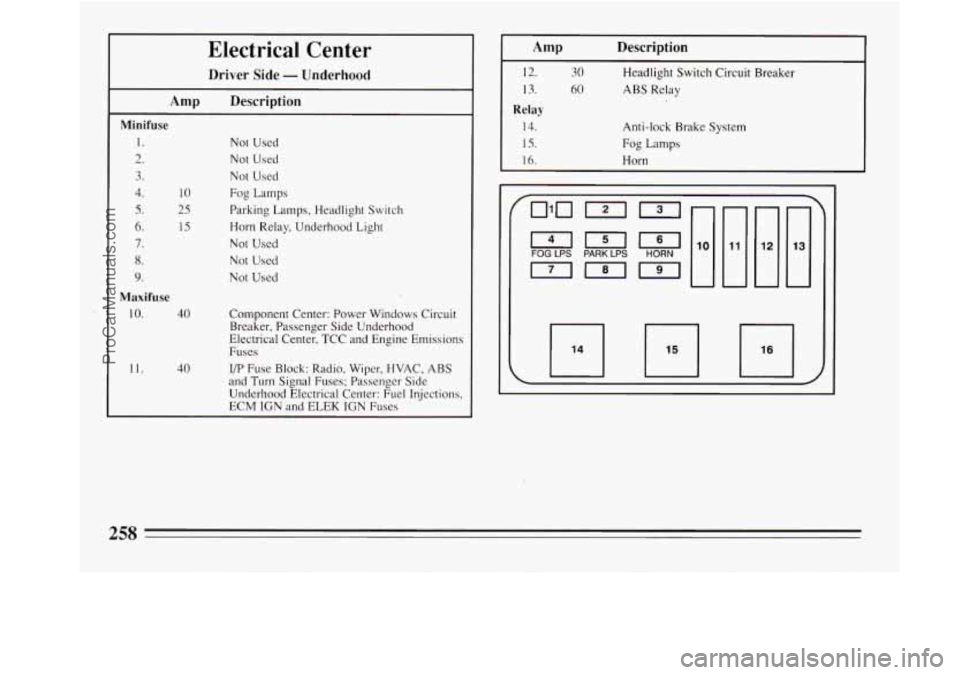
10
25
1s
Electrical Center
Driver Side - Underhood
Amp Description
Minifuse
1. Not Used
2. Not Used
3. Not Used
4. Fog Lamps
5. Parking Lamps, Headlight Switch
6. Horn Relay, Underhood Light
7. Not Used
8. Not Used
9. Not Used
Maxifuse
10. 40
11 40
Component Center: Power Windows Circuit
Breaker, Passenger Side Underhood
Electrical Center, TCC and Engine Emissions
Fuses
I/P Fuse Block: Radio, Wiper, HVAC, ABS
and Turn Signal Fuses; Passenger Side
Underhood Electrical Center:
Fuel Injections,
ECM IGN and
ELEK IGN Fuses
Amp Description
12. 30 Headlight Switch Circuit Breaker
13. 60 ABS Relay
Relay
14. Anti-lock Brake System
1s. Fog Lamps
16. Horn
258
ProCarManuals.com
Page 263 of 308
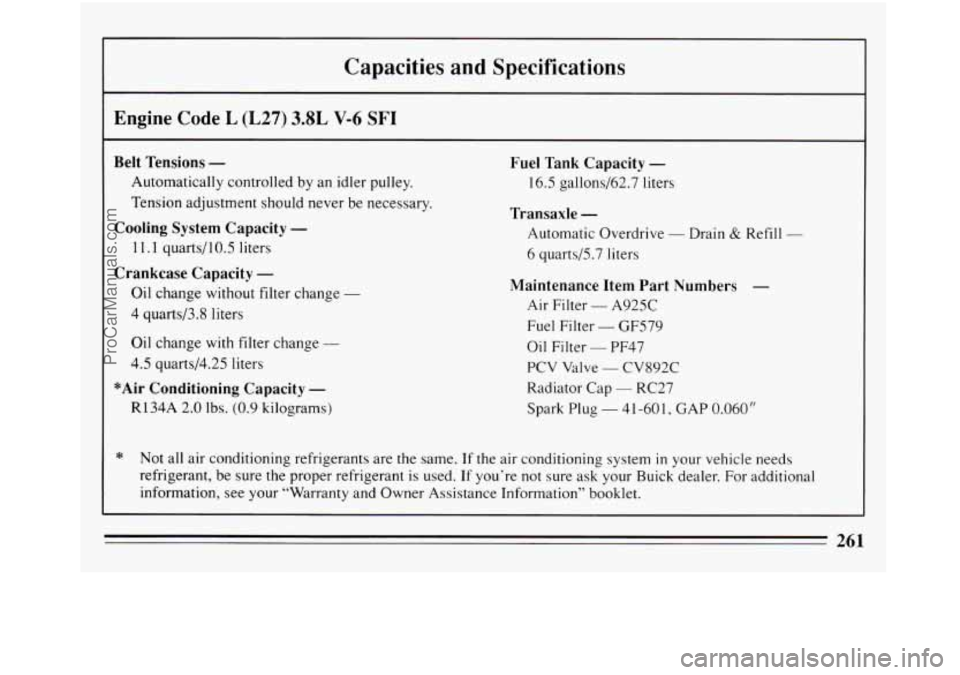
Capacities and Specifications
Engine Code L (L27) 3.8L V-6 SF1
Belt Tensions -
Automatically controlled by an idler pulley.
Tension adjustment should never be necessary.
Cooling System Capacity -
11.1 quartsl10.5 liters
Crankcase Capacity -
Oil change without filter change -
4 quarts/3.8 liters
Oil change with filter change -
4.5 quarts/4.25 liters
*Air Conditioning Capacity -
R134A 2.0 lbs. (0.9 kilograms)
Fuel Tank Capacity -
16.5 gallons/62.7 liters
Transaxle -
Automatic Overdrive - Drain & Refi 11 -
6 quarts/5.7 liters
Maintenance Item Part Numbers -
Air Filter - A925C
Fuel Filter
- GF579
Oil Filter
- PF47
PCV Valve
- CV892C
Radiator Cap
- RC27
Spark Plug
- 4 1-60 1, GAP 0.060”
* Not all air conditioning refrigerants are the same. If the air conditioning system in your vehicle needs
refrigerant, be sure the proper refrigerant is used. If you’re not sure ask your Buick dealer. For additional
information, see your “Warranty and Owner Assistance Information” booklet.
261
ProCarManuals.com
Page 264 of 308
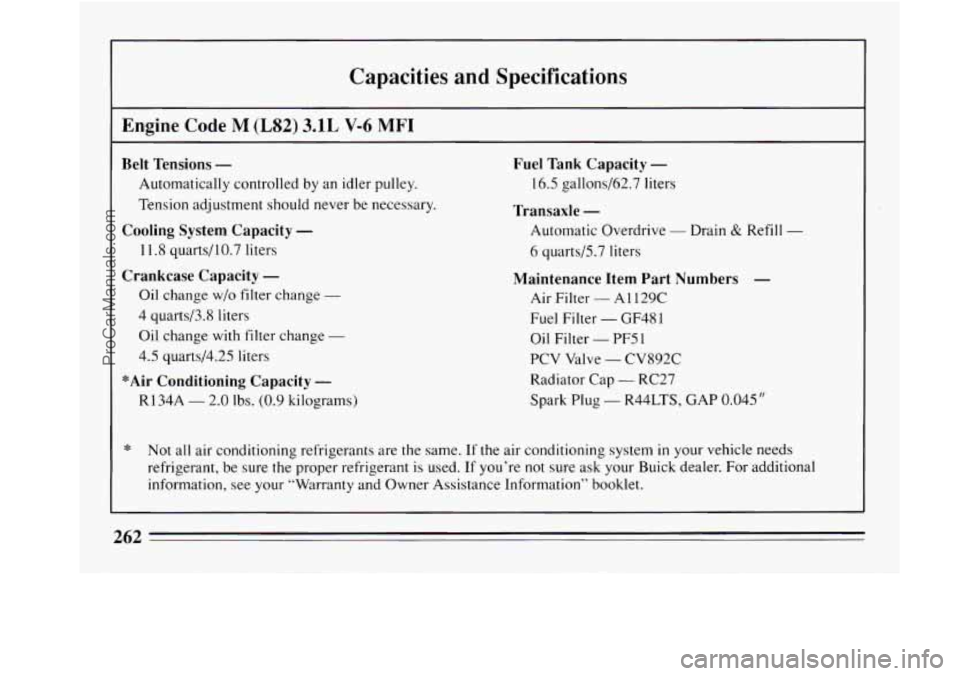
Capacities and Specifications
Engine Code M (LS2) 3.1L V-6 MFI
Belt Tensions -
Automatically controlled by an idler pulley.
Tension adjustment should never be necessary.
Cooling System Capacity -
11.8 quartsll0.7 liters
Crankcase Capacity -
Oil change w/o filter change -
4 quarts/3.8 liters
Oil change with filter change
-
4.5 quarts/4.25 liters
*Air Conditioning Capacity -
R134A - 2.0 lbs. (0.9 kilograms)
Fuel Tank Capacity -
16.5 gallons/62.7 liters
Transaxle -
Automatic Overdrive - Drain & Refill -
6 quarts/5.7 liters
Maintenance Item Part Numbers -
Air Filter - A 1 129C
Fuel Filter - GF48 1
Oil Filter - PF5 1
PCV Valve - CV892C
Radiator Cap
- RC27
Spark Plug
- R44LTS, GAP 0.045”
* Not all air conditioning refrigerants are the same. If the air conditioning system in your vehicle needs
refrigerant, be sure the proper refrigerant is used. If you’re not sure ask your Buick dealer. For additional
information, see your “Warranty and Owner Assistance Information” booklet.
262
ProCarManuals.com
Page 265 of 308
Part 7 Maintenance Schedule
This part covers the maintenance required for your Buick . Your vehicle needs these services to retain its safety.
dependability and emission control performance
.
Part 7 includes:
Introduction ......................................... ......... ................ 264
A Word About Maintenance ..................................................... 264
Your Vehicle and the Environment
................................................ 265
How This Part is Organized ..................................................... 265
Section A: Scheduled Maintenance Services
............................................. 266
Using Your Maintenance Schedules
............................................... 266
Selecting the Right Schedule
.................................................... 267
Schedule1
................................................................... 268
Schedule11
.................................................................. 270
Explanation
of Scheduled Maintenance Services ..................................... 272
Section
B: Owner Checks and Services ................................................. 274
AtEachFuelFill .............................................................. 274
At Least Once
a Month ......................................................... 275
AtLeastOnceaYear .......................................................... 275
Section
C: Periodic Maintenance Inspections ............................................ 277
Section D:Recommendgd Fluids
and Lubricants .......................................... 279
Section E: Maintenance Record ....................................................... 281
263
ProCarManuals.com
Page 267 of 308
Your Vehicle and the Environment
Proper vehicle maintenance not only helps to keep your
vehicle
in good working condition, but also helps the
environment. All recommended maintenance procedures
are important. Improper vehicle maintenance or the
removal
of important components can sigHificantly
affect the quality
of the air we breathe. Improper fluid
levels or
even the wrong tire inflation can increase the
level of emissions from your vehicle.
To help protect
our environment, and
to help keep your vehicle in good
condition, please maintain your vehicle properly.
How This Part is Organized
The remainder of this part is divided into five sections:
“Section
A: Scheduled Maintenance Services” shows
what to have done and how often. Some of these
services can be complex,
so unless you are technically
qualified and have
the necessary equipment, you should
let your dealer’s service department or another qualified
service center do these jobs. If you
are skilled enough to do some work on your
vehicle,
you will probably want to get the service
information
GM publishes. You will find a list of
publications and how to get them in this manual. See
“Service Publications”
in the Index.
“Section B: Owner Checks and Services” tells you what
should be checked whenever you stop for fuel.
It also
explains what you can easily do to help keep your
vehicle
in good condition.
“Section C: Periodic Maintenance Inspections” explains important inspections that your Buick dealer’s service
department or another qualified service center should perform.
265
ProCarManuals.com