oil BUICK REGAL 1994 Owner's Manual
[x] Cancel search | Manufacturer: BUICK, Model Year: 1994, Model line: REGAL, Model: BUICK REGAL 1994Pages: 308, PDF Size: 15.78 MB
Page 247 of 308
0 Use solvent-type cleaners in a well-ventilated area
only. If you use them, don’t saturate the stained area.
0 If a ring forms after spot cleaning, clean the entire
area immediately or
it will set.
Using Foam-Type Cleaner on Fabric
0
0
0
0 0
0
Vacuum and brush the area to remove any loose dirt.
Always clean a whole trim panel or section. Mask
surrounding trim along stitch or welt lines.
Mix Multi-Purpose Powdered Cleaner following the
directions on the container label.
Use suds only and apply
with a clean sponge.
Don’t saturate the material.
Don’t
rub it roughly.
As soon as you’ve cleaned the section, use a sponge
to remove the suds.
Rinse
the section with a clean, wet sponge.
Wipe off what’s left
with a slightly damp paper towel
or cloth.
Then dry
it immediately with a blow dryer or a heat
lamp.
NOTICE:
Be careful with a hair dryer or heat lamp. You
could scorch the fabric.
.
0 Wipe with a clean cloth.
Using Solvent-Type Cleaner on Fabric
First, see if you have to use solvent-type cleaner at all.
Some spots and stains
will clean off better with just
water and mild soap.
If you need to use a solvent:
0
a
Gently scrape excess soil from the trim material with
a clean, dull knife or scraper. Use very little cleaner,
light pressure and clean cloths (preferably
cheesecloth). Cleaning should start at the outside of
the stain, “feathering” toward the center. Keep
changing to
a clean section of the cloth.
When you clean a stain from fabric, immediately dry
the area
with an air hose, hair dryer, or heat lamp to
help prevent a cleaning ring. (See the previous
NOTICE.)
ProCarManuals.com
Page 248 of 308
Special Cleaning Problems
Greasy or Oily Stains
Such as grease, oil, butter, margarine, shoe polish,
coffee with cream, chewing gum, cosmetic creams,
vegetable oils, wax crayon, tar and asphalt.
0 Carefully scrape off excess stain.
0 Follow the solvent-type instructions described
earlier.
0 Shoe polish, wax crayon, tar and asphalt will stain if
left on a vehicle seat fabric. They should be removed
as soon as possible. Be careful, because the cleaner
will dissolve them and may cause them to spread.
Non-Greasy Stains
Such as catsup, coffee (black), egg, fruit, fruit juice,
milk, soft drinks, wine, vomit, urine and blood.
0 Carefully scrape off excess stain, then sponge the
0 If a stain remains, follow the foam-type instructions
soiled area
with cool water.
described earlier.
0 If an odor lingers after cleaning vomit or urine, treat
the area with a waterbaking soda solution:
1 teaspoon (5 ml) of baking soda to 1 cup (250 ml)
of lukewarm water.
0 If needed, clean lightly with solvent-type cleaner.
Combination Stains
Such as candy, ice cream, mayonnaise, chili sauce and
unknown stains.
0 Carefully scrape off excess stain, then clean with
cool water and allow to dry.
0 If a stain remains, clean it with solvent-type cleaner.
Cleaning Vinyl
Use warm water and a clean cloth.
0 Rub with a clean, damp cloth to remove dirt. You
may have to do it more than once.
you don’t get them off quickly. Use a clean cloth and
a solvent-type vinyl cleaner.
0 Things like tar, asphalt and shoe polish will stain if
246
ProCarManuals.com
Page 249 of 308
Cleaning Leather
Use a soft cloth with lukewarm water and a mild soap or
saddle soap.
0 For stubborn stains, use a mild solution of 10%
isopropyl alcohol (rubbing alcohol) and 90% water.
0 Never use oils, varnishes, solvent-based or abrasive
cleaners, furniture polish or shoe polish on leather.
Soiled leather should be cleaned immediately. If dirt
is allowed to work into finish, it can harm the
leather.
Cleaning the Top of the Instrument Panel
Use only mild soap and water to clean the top surfaces
of the instrument panel. Sprays containing silicones or
waxes may cause annoying reflections
in the windshield
and even make
it difficult to see through the windshield
under certain conditions.
Care of Safety Belts
Keep belts clean and dry.
I not be able to provide adequate protection. Clean
Glass
Glass should be cleaned often. GM Glass Cleaner (GM
Part No. 1050427) or a liquid household glass cleaner
will remove normal tobacco smoke and dust films.
Don’t use abrasive cleaners on glass, because they may
cause scratches. Avoid placing decals on the inside rear
window, since they may have to be scraped off later.
If
abrasive cleaners are used on the inside of the rear
window, an electric defogger element may be damaged.
Any temporary license should not be attached across the
defogger grid.
247
ProCarManuals.com
Page 252 of 308
Foreign Material
Calcium chloride and other salts, ice melting agents,
road oil and tar, tree sap, bird droppings, chemicals from
industrial chimneys, and other foreign matter can
damage your vehicle’s finish if they remain on painted
surfaces. Use cleaners that are marked safe for painted
surfaces to remove foreign matter.
Finish Damage
Any stone chips, fractures or deep scratches in the finish
should be repaired right away. Bare metal
will corrode
quickly and may develop
into a major repair expense.
Minor chips and scratches can be repaired
with touch-up
materials available from your dealer or other service
outlets. Larger areas of finish damage can be corrected
in your dealer’s body and paint shop.
Underbody Maintenance
Chemicals used for ice and snow removal and dust
control can collect on the underbody. If these are not
removed, accelerated corrosion (rust) can occur on the
underbody parts such as fuel lines, frame, floor pan, and
exhaust system even though they have corrosion
protection.
At least every spring, flush these materials from the
underbody
with plain water. Clean any areas where mud
and other debris can collect. Dirt packed
in closed areas
of the frame should be loosened before being flushed.
Your dealer or an underbody vehicle washing system
can do this for you.
ProCarManuals.com
Page 257 of 308
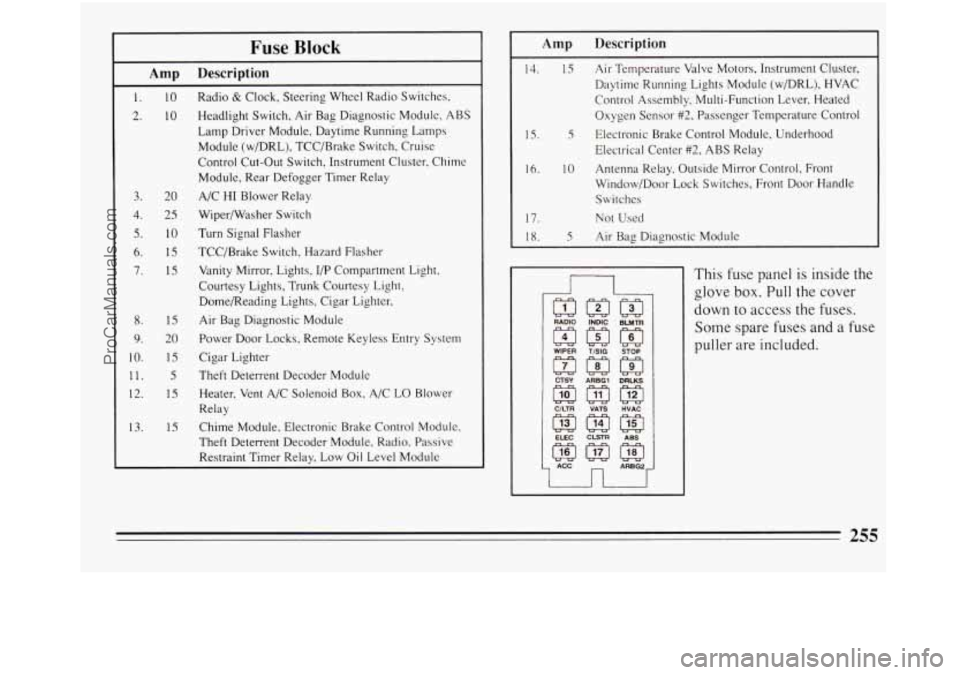
Fuse Block
Amp Description
1.
2.
10
10
3. 20
4.
2s
5. IO
6. 15
7. 15
8. 1s
9. 20
10.
1s
11. 5
12. 1s
13. 15 Radio
& Clock, Steering
Wheel Radio Switches.
Headlight Switch, Air Bag Diagnostic Module, ABS
Lamp Driver Module, Daytime Running Lamps
Module (w/DRL), TCC/Brake Switch, Cruise
Control Cut-Out Switch, Instrument Cluster, Chime
Module, Rear Defogger Timer Relay
A/C HI Blower Relay
Wipermasher Switch
Turn Signal Flasher
TCC/Brake Switch, Hazard Flasher
Vanity Mirror, Lights, I/P Compartment Light,
Courtesy Lights, Trunk Courtesy Light,
Dome/Reading Lights, Cigar Lighter.
Air Bag Diagnostic Module
Power Door Locks, Remote Keyless Entry System
Cigar Lighter
Theft Deterrent Decoder Module
Heater, Vent A/C Solenoid Box, A/C LO Blower
Relay
Chime Module, Electronic Brake Control Module.
Theft Deterrent Decoder Module, Radio, Passive
Restraint Timer Relay, Low Oil Level Module
1s.
Amp Description
14. 15 Air Temperature Valve Motors, Instrument Cluster,
Daytime Running Lights Module (w/DRL), HVAC
Control Assembly, Multi-Function Lever, Heated
Oxygen Sensor
#2, Passenger Temperature Control
Electrical Center
#2, ABS Relay
16. 10 Antenna Relay, Outside Mirror Control, Front
Window/Door Lock Switches, Front Door Handle
Switches
17.
Not Used
18. 5 Air Bag Diagnostic Module
5 Electronic Brake Control Module, Underhood
n
CTSY ARBGl DRLKS
@m@
ClLTR VATS HVAC
This fuse panel is inside the
glove
box. Pull the cover
down to access the
fuses.
Some spare fuses and a fuse
puller are included.
255
ProCarManuals.com
Page 259 of 308
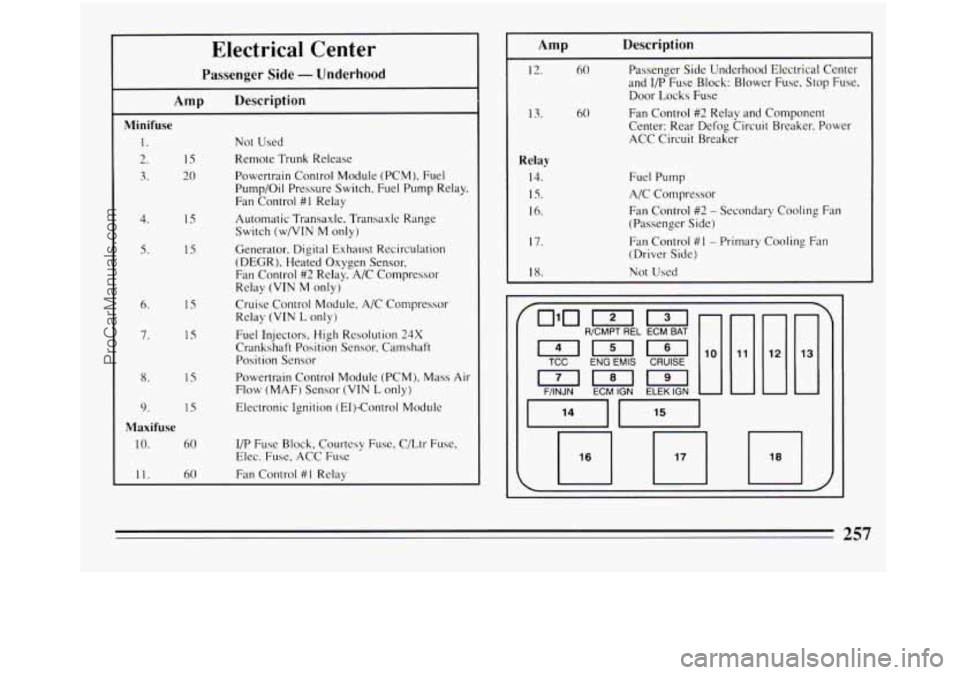
15
20
15
IS
1s
' 1s
Electrical Center
Passenger Side - Underhood
Amp Description
Minifuse
1. Not Used
2. Remote Trunk Release
3. Powertrain Control Module (PCM), Fuel
Pump/Oil Pressure Switch, Fuel Pump Relay.
Fan Control
#I Relay
Switch (w/VIN
M only)
(DEGR), Heated Oxygen Sensor,
Fan Control
#2 Relay, A/C Compressor
Relay
(VIN M only)
Relay
(VIN L only)
Crankshaft Position Sensor, Camshaft
Position Sensor
Flow (MAF) Sensor
(VIN L only)
4. Automatic Transaxle, Transaxle Range
5. Generator. Digital Exhaust Recirc'ulation
6. Cruise Control Module. A/C Compressor
7. Fuel Injectors, High Resolution 24X
8. IS Powertrain Control Module (PCM), Mass Air
9. 1s Electronic Ignition (E1)-Control Module
10. 60 I/P Fuse Block, Courtesy Fuse. C/Ltr Fuse.
11. 60 Fdn Control #I Relay
Maxifuse
Elec. Fuse, ACC Fuse
Description
12.
13.
Relay
14.
1s.
16.
17.
18
60 Passenger Side Underhood Electrical Center
and
I/P Fuse Block: Blower Fuse. Stop Fuse.
Door Locks Fuse
Fan Control
#2 Relay and Component
Center: Rear Defog Circuit Breaker, Power
ACC Circuit Breaker 60
Fuel Pump
A/C Compressor
Fan Control
#2 - Secondary Cooling Fan
(Passenger
Side)
Fan Control #I - Primary Cooling Fan
(Driver Side)
Not Used
~~~~~ ~
[I [I
Erlmm
~~~
TCC ENG EMlS CRUISE
F/INJN
ECM IGN ELEK IGN
257
ProCarManuals.com
Page 263 of 308
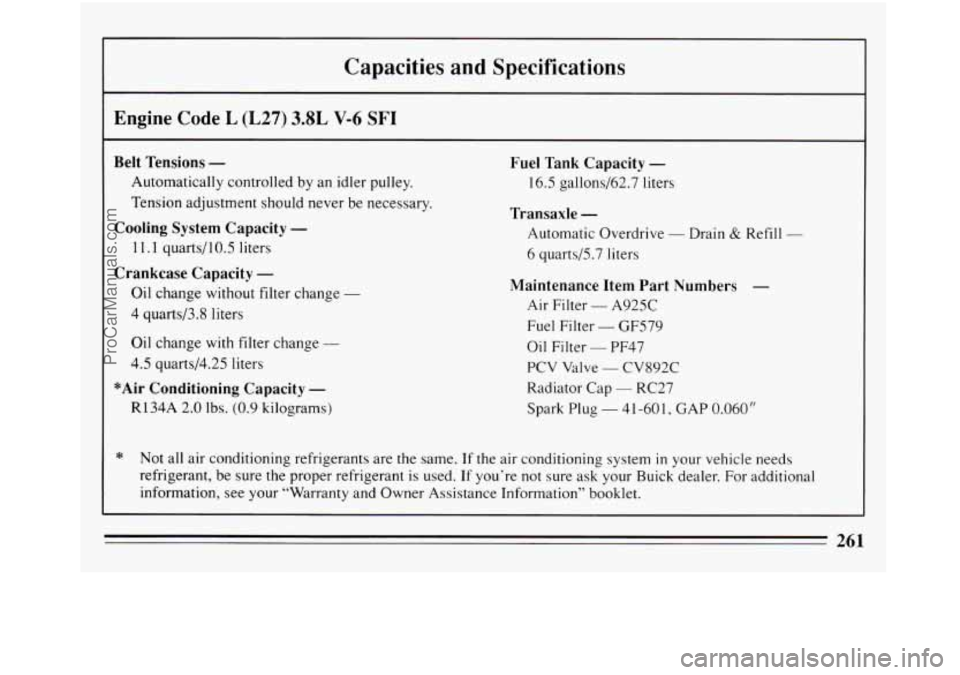
Capacities and Specifications
Engine Code L (L27) 3.8L V-6 SF1
Belt Tensions -
Automatically controlled by an idler pulley.
Tension adjustment should never be necessary.
Cooling System Capacity -
11.1 quartsl10.5 liters
Crankcase Capacity -
Oil change without filter change -
4 quarts/3.8 liters
Oil change with filter change -
4.5 quarts/4.25 liters
*Air Conditioning Capacity -
R134A 2.0 lbs. (0.9 kilograms)
Fuel Tank Capacity -
16.5 gallons/62.7 liters
Transaxle -
Automatic Overdrive - Drain & Refi 11 -
6 quarts/5.7 liters
Maintenance Item Part Numbers -
Air Filter - A925C
Fuel Filter
- GF579
Oil Filter
- PF47
PCV Valve
- CV892C
Radiator Cap
- RC27
Spark Plug
- 4 1-60 1, GAP 0.060”
* Not all air conditioning refrigerants are the same. If the air conditioning system in your vehicle needs
refrigerant, be sure the proper refrigerant is used. If you’re not sure ask your Buick dealer. For additional
information, see your “Warranty and Owner Assistance Information” booklet.
261
ProCarManuals.com
Page 264 of 308
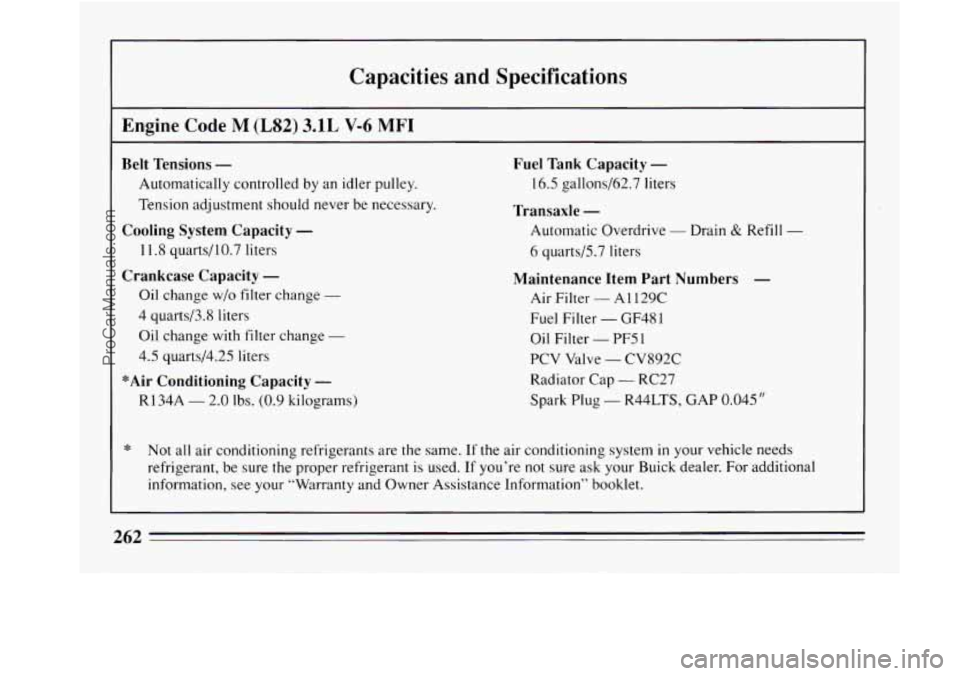
Capacities and Specifications
Engine Code M (LS2) 3.1L V-6 MFI
Belt Tensions -
Automatically controlled by an idler pulley.
Tension adjustment should never be necessary.
Cooling System Capacity -
11.8 quartsll0.7 liters
Crankcase Capacity -
Oil change w/o filter change -
4 quarts/3.8 liters
Oil change with filter change
-
4.5 quarts/4.25 liters
*Air Conditioning Capacity -
R134A - 2.0 lbs. (0.9 kilograms)
Fuel Tank Capacity -
16.5 gallons/62.7 liters
Transaxle -
Automatic Overdrive - Drain & Refill -
6 quarts/5.7 liters
Maintenance Item Part Numbers -
Air Filter - A 1 129C
Fuel Filter - GF48 1
Oil Filter - PF5 1
PCV Valve - CV892C
Radiator Cap
- RC27
Spark Plug
- R44LTS, GAP 0.045”
* Not all air conditioning refrigerants are the same. If the air conditioning system in your vehicle needs
refrigerant, be sure the proper refrigerant is used. If you’re not sure ask your Buick dealer. For additional
information, see your “Warranty and Owner Assistance Information” booklet.
262
ProCarManuals.com
Page 266 of 308
I
IMPORTANT:
KEEP ENGINE OIL
AT THE PROPER
LEVEL AND CHANGE AS
RECOMMENDED
Protection
Plan
Have you purchased the GM Protection Plan? The
Plan supplements
your new vehicle warranties. See
your Buick dealer for details.
Introduction
A Word About Maintenance
We at General Motors want to help you keep your
vehicle
in good working condition. But we don’t know
exactly how you’ll drive it. You may drive very short
distances only a few times a week. Or you may drive
long distances all the time in very hot, dusty weather.
You may use your vehicle in making deliveries. Or you
may drive
it to work, to do errands or in many other
ways.
Because of all the different ways people use their
GM
vehicles, maintenance needs vary. You may even need
more frequent checks and replacements than you will
find
in the schedules in this part. So please read this part
and note how you drive. If you have any questions on
how-to keep your vehicle
in good condition, see your
Buick dealer, the place many
GM owners choose to
have their maintenance work done. Your dealer can be
relied upon to use proper parts and practices.
264
ProCarManuals.com
Page 270 of 308
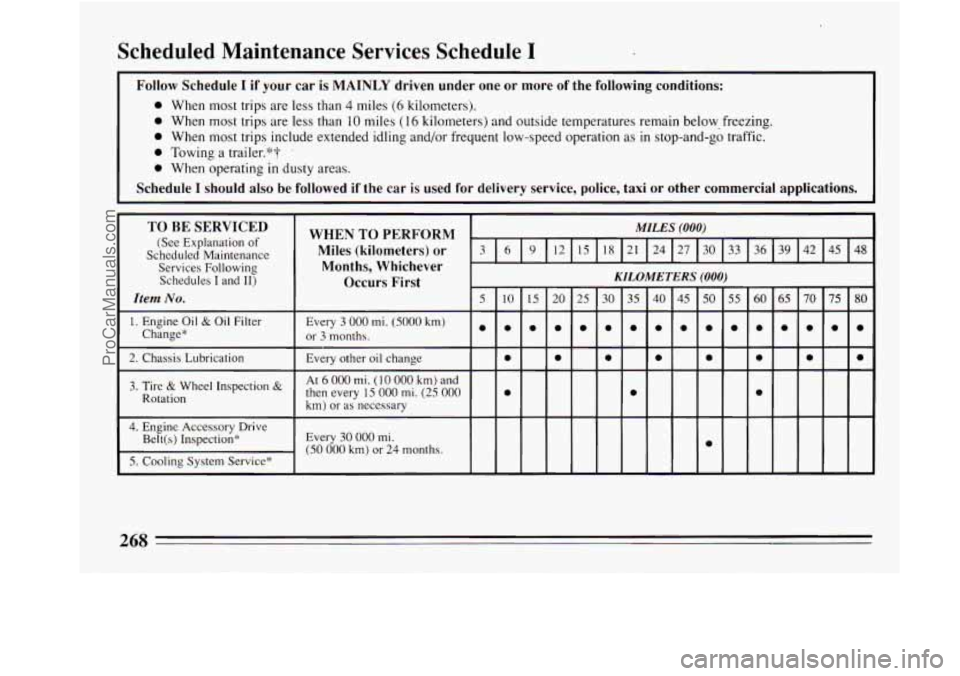
Scheduled Maintenance Services Schedule I
Follow Schedule I if your car is MAINLY driven under one or more of the following conditions:
0 When most trips are less than 4 miles (6 kilometers).
0 When most trips are less than 10 miles (16 kilometers) and outside temperatures remain below freezing.
0 When most trips include extended idling and/or frequent low-speed operation as in stop-and-go traffic.
0 Towing a trailer."? '
0 When operating in dusty areas.
I
Schedule I should also be followed if the car is used for delivery service, police, taxi or other commercial applications.
TO BE SERVICED
(See Explanation of
Scheduled Maintenance
Services Following Schedules
I and 11)
Item No.
1. Engine Oil & Oil Filter
Change"
2. Chassis Lubrication
3. Tire & Wheel Inspection &
Rotation
4. Engine Accessory Drive
Belt(s) Inspection*
5. Cooling System Service*
268
ProCarManuals.com