light BUICK REGAL 1994 Workshop Manual
[x] Cancel search | Manufacturer: BUICK, Model Year: 1994, Model line: REGAL, Model: BUICK REGAL 1994Pages: 308, PDF Size: 15.78 MB
Page 174 of 308
Hazard Warning Flashers
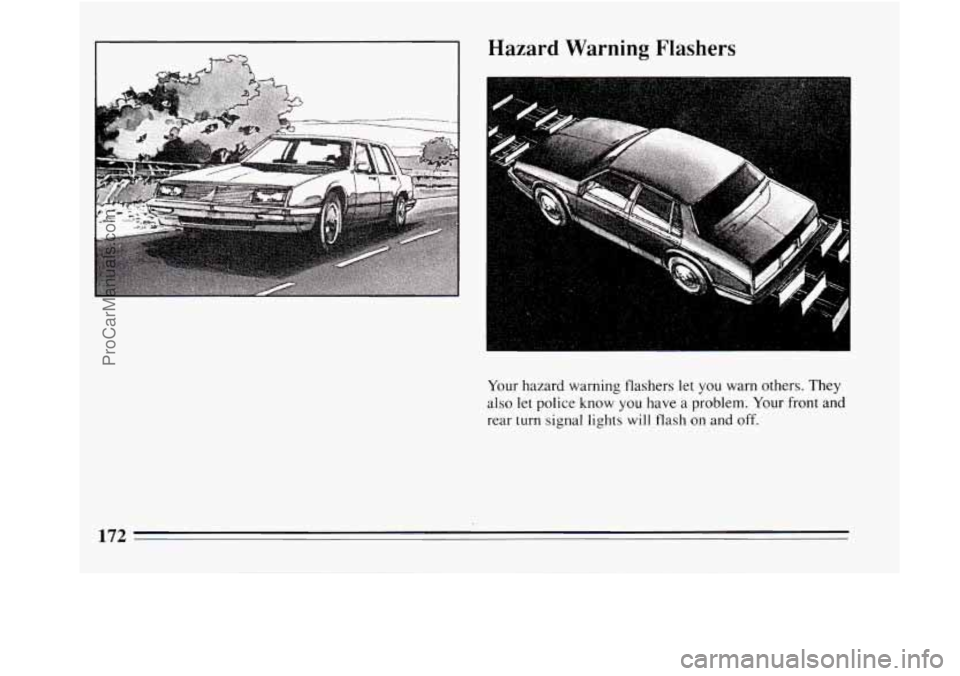
Your hazard warning flashers let you warn others. They
also
let police know you have a problem. Your front and
rear turn
signal lights will flash on and off.
172
ProCarManuals.com
Page 175 of 308
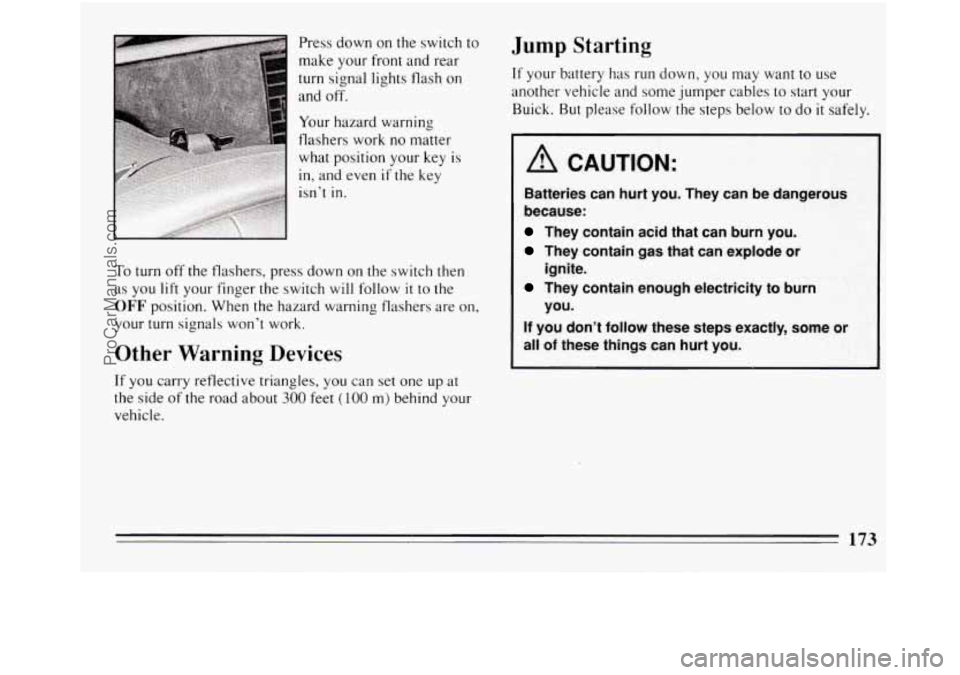
Press down on the switch to
make your front and rear
turn signal lights flash on
and off.
Your hazard warning
flashers work
no matter
what position your key is
in, and even if the key
isn’t
in.
To turn off the flashers, press down on the switch then
as you
lift your finger the switch will follow it to the
OFF position. When the hazard warning flashers are on,
your turn signals won’t work.
Other Warning Devices
If you carry reflective triangles, you can set one up at
the side of the road about
300 feet (100 m) behind your
vehicle.
Jump Starting
If your battery has run down, you may want to use
another vehicle and some jumper cables to start your
Buick. But please follow
the steps below to do it safely.
A CAUTION:
Batteries can hurt you. They can be dangerous
because:
They contain acid that can burn you.
They contain gas that can explode or
They contain enough electricity to burn
If you don’t follow these steps exactly, some or
all
of these things can hurt you.
ignite.
you.
173
ProCarManuals.com
Page 176 of 308
I NOTICE:
Ignoring these steps could result in costly
damage
to your vehicle that wouldn’t be covered
by your warranty. Trying to start your Buick by
pushing or pulling it won’t work, and it could
damage your vehicle.
To Jump Start Your Buick:
1. Check the other vehicle. It must have a 12-volt
battery
with a negative ground system.
NOTICE:
If the other system isn’t a 12-volt system with a
negative ground, both vehicles can be damaged.
2. Get the vehicles close enough so the jumper cables
can reach, but be sure the vehicles aren’t touching
each other.
If they are, it could cause a ground
connection you don’t want.
You wouldn’t be able to
start your Buick, and the bad grounding could
damage the electrical systems. You
could be injured
if the vehicles roll. Set the
parking brake firmly on each vehicle. Put an
automatic transaxle
in “P” (Park) or a manual
transaxle
in “N” (Neutral).
3. Turn off the ignition on both vehicles. Turn off all
lights that aren’t needed, and radios. This will avoid
sparks and help save both batteries. And
it could
save your radio!
1 NOTICE:
If you leave your radio on, it could be badly
damaged. The repairs wouldn’t be covered by
your warranty.
ProCarManuals.com
Page 189 of 308
Engine Overheating
You will find the coolant temperature gage on your
instrument panel.
You may also find a low coolant
warning light.
If Steam Is Coming From Your Engine
I NOTICE:
If your engine catches fire because you keep
driving with no coolant, your vehicle can be
badly damaged. The costly repairs would not be
covered by your warranty.
If No Steam Is Coming From Your Engine
If you get the overheat warning but see or hear no
steam, the problem may not be too serious. Sometimes
the engine can get a little too hot when you:
Climb a long hill on a hot day.
Stop after high speed driving.
Idle for long periods in traffic.
0 Tow a trailer.
187
ProCarManuals.com
Page 208 of 308
If You’re Stuck: In Sand, Mud, Ice or
Snow
What you don’t want to do when your vehicle is stuck is
to spin your wheels. The method known as “rocking”
can help you get out
when you’re stuck, but you must
use caution.
I I
I NOTICE:
Spinning your wheels can destroy parts of your
vehicle as well
as the tires. If you spin the wheels
too fast while shifting your transaxle back and
forth, you can destroy your transaxle.
Rocking your vehicle to get it out:
~ First, turn your steering wheel left and right. That will
clear the area around your front wheels. Then shift back
and forth between
“R” (Reverse) and a forward gear,
spinning the wheels as little as possible. Release the
accelerator pedal while you shift, and press lightly on
the accelerator pedal when the transaxle
is in gear. If
that doesn’t get you out after a few tries, you may need
to be towed out. If you do need to be towed out, see
“Towing Your Car”
in the Index.
206
ProCarManuals.com
Page 216 of 308
Engine Oil
LOW
OIL
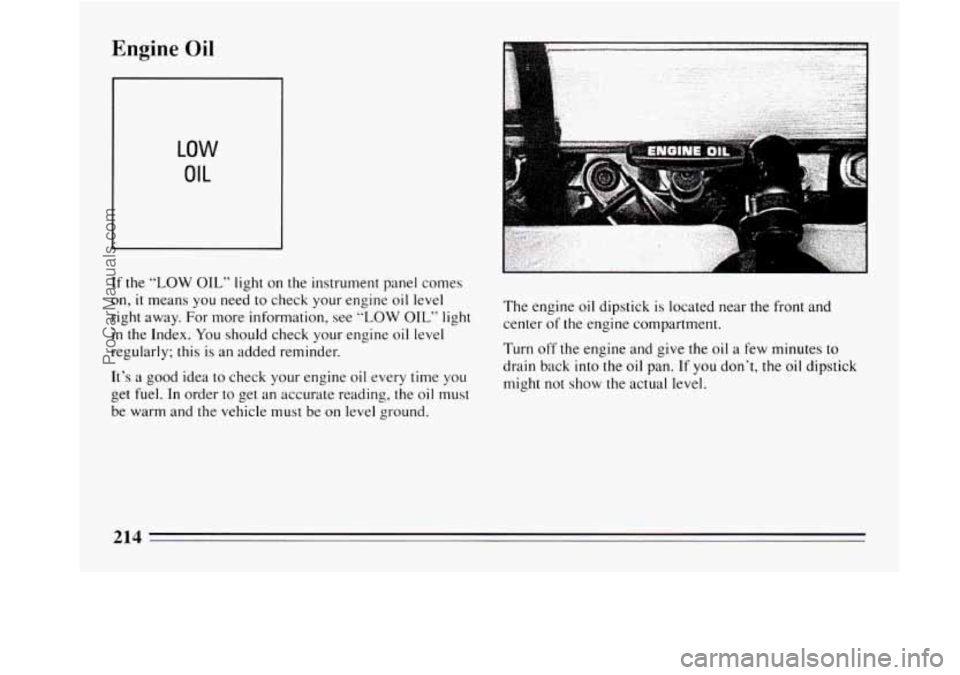
If the “LOW OIL” light on the instrument panel comes
on,
it means you need to check your engine oil level
right away. For more information, see
“LOW OIL” light
in the Index. You should check your engine oil level
regularly; this
is an added reminder.
It’s a good idea
to check your engine oil every time you
get fuel. In order to get an accurate reading, the oil must
be warm and the vehicle
must be on level ground. The
engine oil dipstick is located near the front and
center of the engine compartment.
Turn off the engine and give the oil
a few minutes to
drain back into the oil pan. If you don’t, the oil dipstick
might not show the actual level.
214
ProCarManuals.com
Page 225 of 308

Engine Coolant
The following explains your cooling system and how to
add coolant when it is low. If you have a problem with
engine overheating or if you need to add coolant to your
radiator, see “Engine Overheating” in the Index.
The proper coolant for your Buick will:
0 Give freezing protection down to -34°F (-37°C).
0 Give boiling protection up to 262°F (128°C).
Protect against rust and corrosion.
0 Help keep the proper engine temperature.
Let the warning lights work as they should.
What to Use
Use a mixture of one-half clean water (preferably
distilled) and one-half antifreeze that meets “GM Specification
1825-M,” which won’t damage aluminum
parts. You can also use a recycled coolant conforming to
GM Specification 1825-M with a complete coolant flush
and refill.
If you use this mixture, you don’t need to add
anything else.
NOTICE:
If you use an improper coolant mix, your engine
could overheat and be badly damaged. The repair cost wouldn’t be covered by your
warranty. Too much water in the mix can freeze
‘and crack the engine, radiator, heater core and other parts.
223
ProCarManuals.com
Page 226 of 308
Adding Coolant
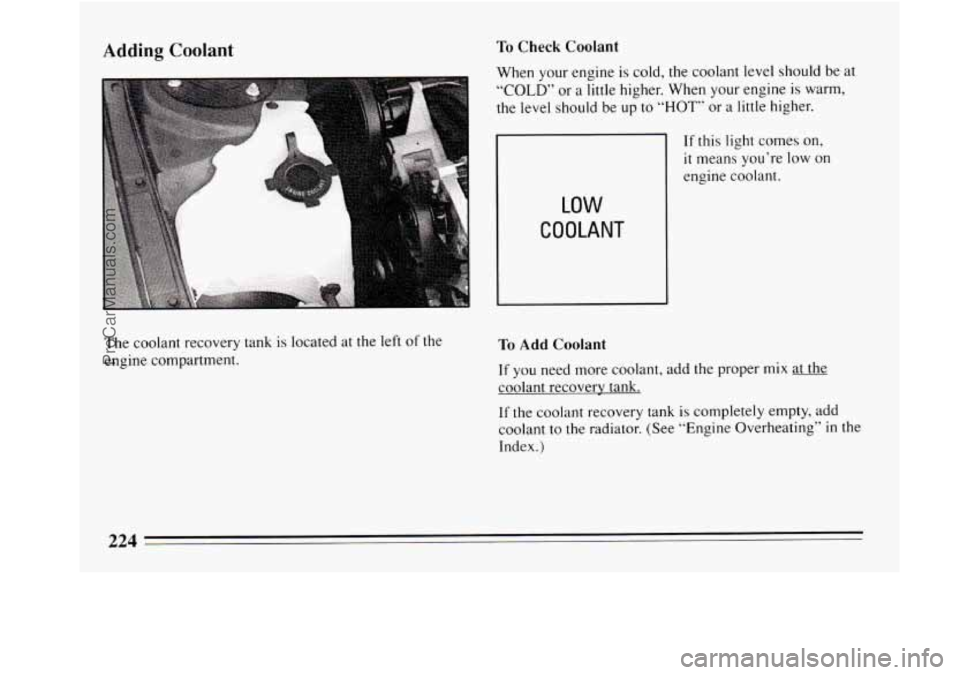
The coolant recovery tank is located at the left of the
engine compartment.
To Check Coolant
When your engine is cold, the coolant level should be at
“COLD” or a little higher. When your engine is warm,
the level should be up to
“HOT” or a little higher.
LOW
COOLANT
If this light comes on,
it means you’re low on
engine coolant.
To Add Coolant
If you need more coolant, add the proper mix at the
coolant recovery tank.
If the coolant recovery tank is completely empty, add
coolant to the radiator. (See “Engine Overheating” in the
Index.)
224
ProCarManuals.com
Page 230 of 308
Brakes
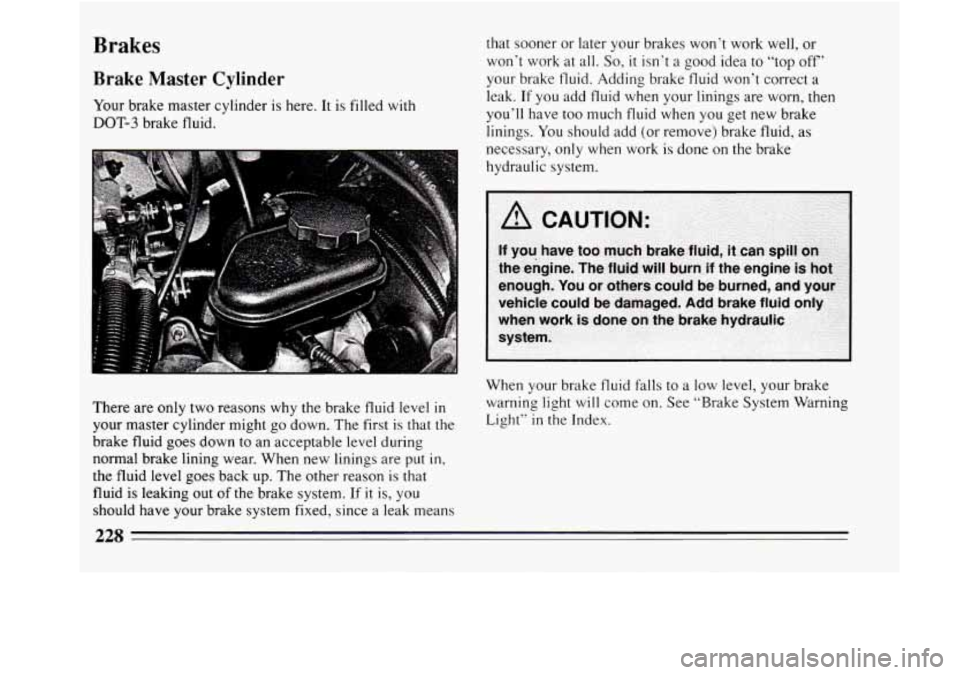
Brake Master Cylinder
Your brake master cylinder is here. It is filled with
DOT-3 brake fluid. that
sooner or later your brakes won’t work well, or
won’t work at all.
So, it isn’t a good idea to “top off’
your brake fluid. Adding brake fluid won’t correct a
leak. If you add fluid when your linings are worn, then
you’ll have too much fluid when you get new brake
linings. You should add (or remove) brake fluid, as
necessary, only when work is done on the brake
hydraulic system.
When your brake fluid falls to a low level, your brake
There are only two reasons why
the brake fluid level in warning light will come on. See “Brake System Warning
your master cylinder might
go down. The first is that the Light” in the Index.
brake fluid goes down to an acceptable level during
normal brake lining wear. When new linings are
put in,
the fluid level goes back up. The other reason is that
fluid is leaking out
of the brake system. If it is, you
should have your brake system fixed, since a leak means
228
ProCarManuals.com
Page 232 of 308
Some driving conditions or climates may cause a brake
squeal when the brakes are first applied or
lightly
applied. This does not mean something is wrong with
your brakes.
Brake linings should always be replaced as complete
axle sets.
Brake Pedal Travel
See your dealer if the brake pedal does not return to
normal height, or if there is a rapid increase in pedal
travel. This could
be a sign of brake trouble.
Brake Adjustment
Every time you make a moderate brake stop, your disc
brakes adjust for wear. If you rarely make a moderate .or
heavier siop, then your brakes might not adjust
correctly. If you drive
in that way, then -- very carefully
-- make a few moderate brake stops about every 1000
miles (1600 km), so your brakes will adjust properly.
Keplacing Brake System Parts
The braking system on a modern vehicle is complex. Its
many parts have to be
of top quality and work well
together
if the vehicle is to have really good braking. Vehicles we
design and test have top-quality
GM brake
parts
in them, as your Buick does when it is new. When
you replace parts of your braking system
-- for example,
when your brake linings wear down and you have
to
have new ones put in -- be sure you get new genuine
GM replacement parts. If you don’t, your brakes may no
longer work properly. For example,
if someone puts in
brake linings that are wrong for your vehicle, the
balance between your front and rear brakes can change,
for the worse. The braking performance you’ve come
to
expect can change in many other ways if someone puts
in the wrong replacement brake parts.
Battery
Every new Buick has a Delco Freedom@ battery. You
never have to add water to one of these. When it’s time
for a new battery, we recommend a Delco Freedom@
battery. Get one that has the catalog number shown on
the original battery’s label.
Vehicle Storage
If you’re not going to drive your vehicle for 25 days or
more, take off the black, negative
(-) cable from the
battery. This
will help keep your battery from running
down.
230
ProCarManuals.com