ESP BUICK REGAL 1994 Owners Manual
[x] Cancel search | Manufacturer: BUICK, Model Year: 1994, Model line: REGAL, Model: BUICK REGAL 1994Pages: 308, PDF Size: 15.78 MB
Page 6 of 308
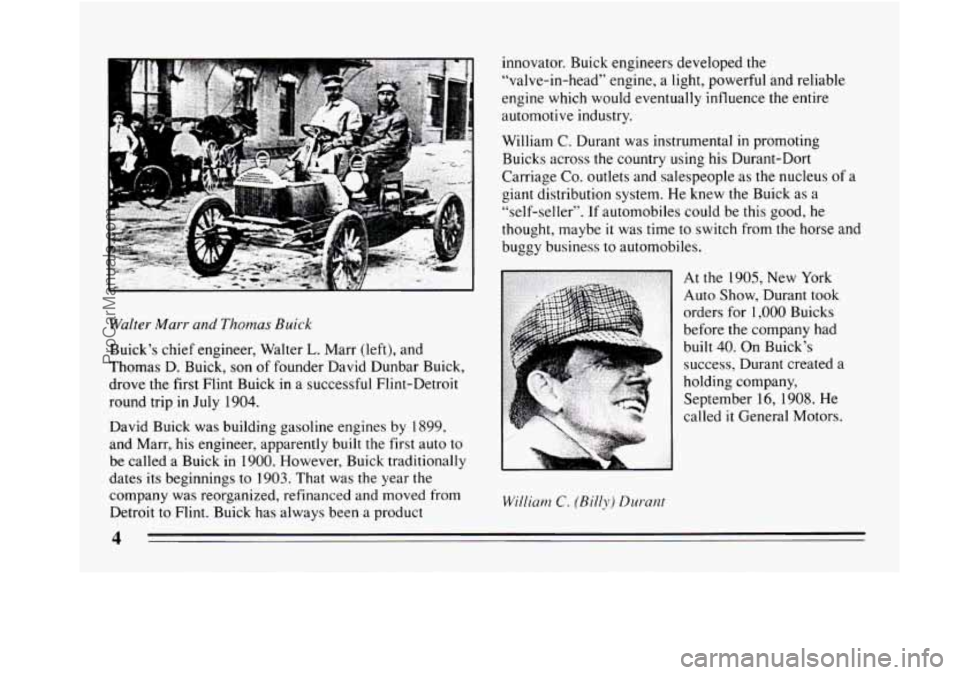
Walter Marr and Thomas Buick
Buick’s chief engineer, Walter L. Marr (left), and
Thomas D. Buick, son of founder David Dunbar Buick,
drove the first Flint Buick in a successful Flint-Detroit
round trip in July 1904.
David Buick was building gasoline engines by 1899,
and Marr, his engineer, apparently built the first auto to
be called a Buick in
1900. However, Buick traditionally
dates
its beginnings to 1903. That was the year the
company was reorganized, refinanced and moved from
Detroit to Flint. Buick has always been a product innovator.
Buick engineers developed the
“valve-in-head” engine, a light, powerful and reliable
engine which would eventually influence the entire
automotive industry.
William
C. Durant was instrumental in promoting
Buicks across
the country using his Durant-Dort
Carriage
Co. outlets and salespeople as the nucleus of a
giant distribution system. He knew the Buick as a
“self-seller”. If automobiles could be this good, he
thought, maybe it was time to switch from the horse and
buggy business to automobiles.
William C. (Billy) Durant
At the 1905, New York
Auto Show, Durant took
orders for
1,000 Buicks
before the company had
built 40. On Buick’s
success, Durant created a
holding company,
September
16, 1908. He
called
it General Motors.
4
ProCarManuals.com
Page 26 of 308
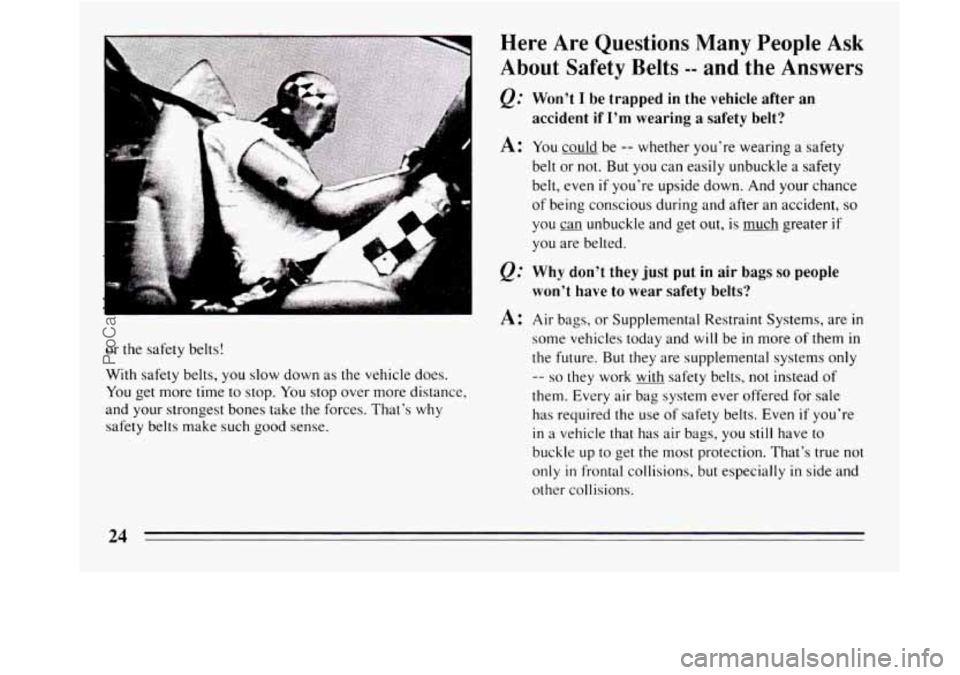
or the safety belts!
With safety belts, you slow down as the vehicle does.
You get more time to stop.
You stop over more distance,
and your strongest bones take the forces. That’s why
safety belts make such good sense.
Here Are Questions Many People Ask
About Safety Belts
-- and the Answers
@ Won’t I be trapped in the vehicle after an
accident if
I’m wearing a safety belt?
A: You could be -- whether you’re wearing a safety
belt or not.
But you can easily unbuckle a safety
belt, even
if you’re upside down. And your chance
of being conscious during and after an accident,
so
you can unbuckle and get out, is much greater if
you are belted.
Q: Why don’t they just put in air bags so people
won’t have
to wear safety belts?
A: Air bags, or Supplemental Restraint Systems, are in
some vehicles today and will be in more of them in
the future. But they are supplemental systems only
-- so they work with safety belts, not instead of
them. Every air bag system ever offered for sale
has required the use of safety belts. Even if you’re
in a vehicle that has air bags, you still have to
buckle up to get the most protection. That’s true not
only
in frontal collisions, but especially in side and
other collisions.
24
ProCarManuals.com
Page 39 of 308
What will you see after an air bag inflation?
After the air bag has inflated, it will then quickly
deflate. This occurs
so quickly that some people may
not
even realize that the air bag inflated. Some
components
of the air bag module in the steering wheel
hub may be hot for a short time, but the portion of the
bag that comes into contact
with you will not be hot to
the touch. There will be small amounts of smoke and
dust coming from vents
in the deflated air bag. The air
bag will
not impede the driver’s vision or ability to steer
the vehicle, nor will
it hinder the occupants from exiting
the vehicle.
0
0
The air bag is designed to inflate only once. After it
inflates, you’ll need some new parts for your air bag
system.
If you don’t get them, the air bag system
won’t be there to help protect you
in another crash.
A new system will include the air bag module and
possibly other parts. The service manual has information about
the need to replace other parts.
Your vehicle is equipped
with a diagnostic module,
which records information about the air bag system
if the air bag deploys during a crash: The module
records information about the readiness of the
system, which sensors activated the deployment, and
whether the driver’s safety belt was
in use.
Let only qualified technicians work on your air bag
system. Improper service can mean that your air bag
system won’t work properly. See your dealer for
service.
NOTICE:
If you damage the cover for the driver’s air bag, it
may not work properly. You may have to replace
the air bag on the steering wheel.
Do not open or
break the air bag cover.
Is the smoke from an air bag inflation harmful?
The particles emitted during air bag inflation are not
harmful to most people. Some people
with respiratory
ailments may .experience difficulty breathing
if they stay
in the vehicle with the windows closed after air bag
inflation.
So, if your air bag inflates, you and any
passengers should exit the vehicle
if and when it is safe
to do
so. If you or your passengers can’t get out of the
vehicle,
try to get fresh air by opening a window,
turning on the
fm, or opening a door.
37
ProCarManuals.com
Page 79 of 308
2. Lift off the front cover, bottom half first.
3. Remove and replace the batteries. Put them in as the
direction under the batteries indicate.
4. Replace the front cover. Make sure the cover is on
tightly,
so water won’t get in. Replace the screw in
the back cover, if there is one. If there is no screw,
snap the covers together.
5. Check the operation of the transmitter.
Theft
Vehicle theft is big business, especially in some cities.
Although your Buick has a number of theft deterrent
features, we know that nothing we put on
it can make it
impossible to steal. However, there are ways you can
help.
Key in the Ignition
If you walk away from your vehicle with the keys
inside, it’s an easy target for joy riders or professional
thieves
-- so don’t do it.
When you park your Buick and open the driver’s door,
you’ll hear a chime reminding you
to remove your key
from the ignition and take
it with you. Always do this.
Your steering wheel will be locked, and
so will your
ignition and transaxle. And remember to lock the doors.
Parking at Night
Park in a lighted spot, close all windows and lock your
vehicle. Remember to keep your valuables out
of sight.
Put them
in a storage area, or take them with you.
Parking Lots
If you park in a lot where someone will be watching
your vehicle, it’s best to lock
it up and take your keys.
But what if you have to leave your ignition key? What if
you have to leave something valuable in your vehicle?
Put your valuables in a storage area, like your trunk
or glove box.
Lock the glove box.
Lock all the doors except the driver’s.
0 Then take the door key with you.
77
ProCarManuals.com
Page 97 of 308
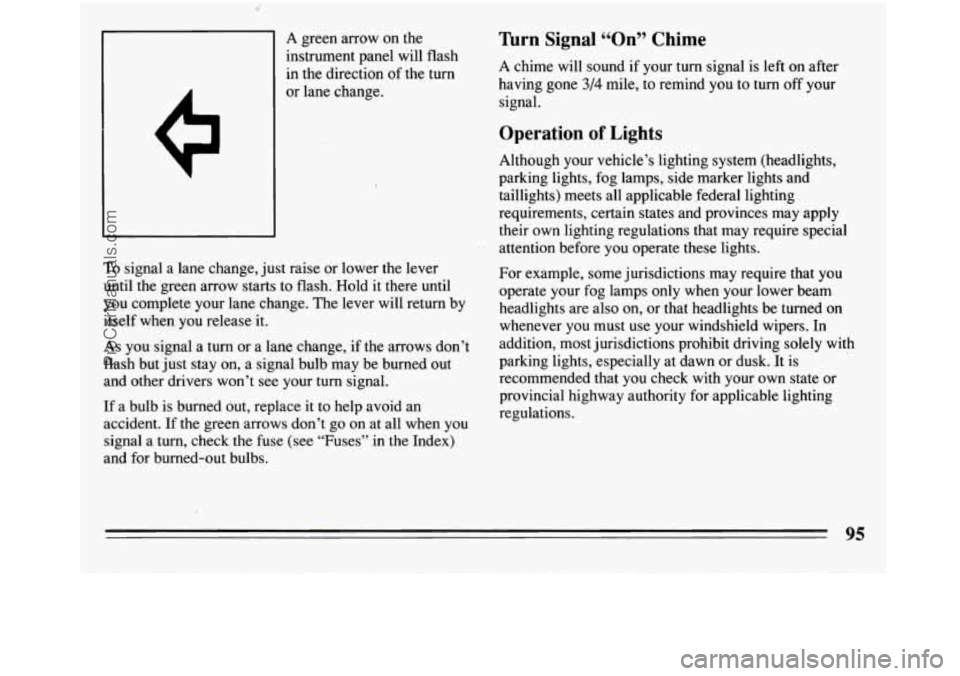
Q
A green arrow on the
instrument panel will flash
in the direction of the ‘turn
or lane change.
To signal
a lane change, just raise or lower the lever
until the green arrow starts to flash. Hold it there until
you complete your lane change. The lever will return by
itself when you release it.
As you signal a turn or a lane change, if the arrows don’t
flash but just stay on, a signal bulb may
6e burned out
and other drivers won’t see your turn signal.
If a bulb is burned out, replace it to help avoid an
accident. If the green arrows don’t go on at all when you
signal a turn, check the fuse (see “Fuses” in the Index)
and for burned-out bulbs.
Turn Signal ccOn99 Chime
A chime will sound if your turn signal is left on after
having gone
3/4 mile, to remind you to turn off your
signal.
Operation of Lights
Although your vehicle’s lighting system (headlights,
parking lights, fog lamps, side marker lights and
taillights) meets all applicable federal lighting
requirements, certain states and provinces may apply
their own lighting regulations that may require special
attention before you operate these lights.
For example, some jurisdictions may require that you operate your fog lamps only when your lower beam
headlights are also on, or that headlights be turned on
whenever you must use your windshield wipers.
In
addition, most jurisdictions prohibit driving solely with
parking lights, especially at dawn or dusk.
It is
recommended that you check with your own state or
provincial highway authority for applicable lighting
regulations.
95
ProCarManuals.com
Page 127 of 308
Rear Window Defogger (Option) Audio Systems
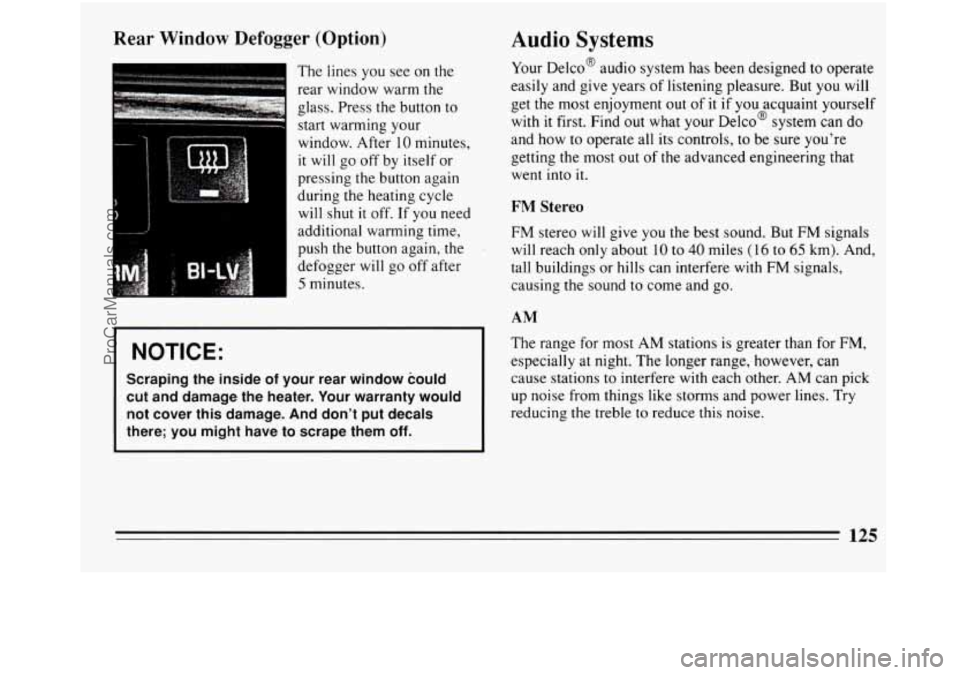
The lines you see on the
rear window warm the
glass. Press the button to
start warming your
window. After
10 minutes,
it
will go off by itself or
pressing the button again
during the heating cycle
will shut it off. If you need
additional warming time,
push the button again, the
defogger will go off after
5 minutes. Your
DelcoB audio system has been designed to operate
easily and give years of listening pleasure. But you will
get the most enjoyment out of it if you acquaint yourself
with
it first. Find out what your Delco@ system can do
and how to operate all its controls, to be sure you’re
getting the most out
of the advanced engineering that
went into it.
FM Stereo
FM stereo will give you the best sound. But FM signals
will reach only about
10 to 40 miles (16 to 65 km). And,
tall buildings or hills can interfere with FM signals,
causing
the sound to come and go.
AM
NOTICE:
Scraping the inside of your rear window could
cut and damage the heater. Your warranty would
not cover this damage. And don’t put decals
there;
you might have to scrape them off.
The range for most AM stations is greater than for FM,
especially at night. The longer range, however, can
cause stations to interfere with each other. AM can pick
up noise from things like storms and power lines. Try
reducing
the treble to reduce this noise.
-
125
ProCarManuals.com
Page 134 of 308
Scan
Press the SCAN button to hear each station for a few
seconds. Push
it again to stop scanning.
Pushbuttons
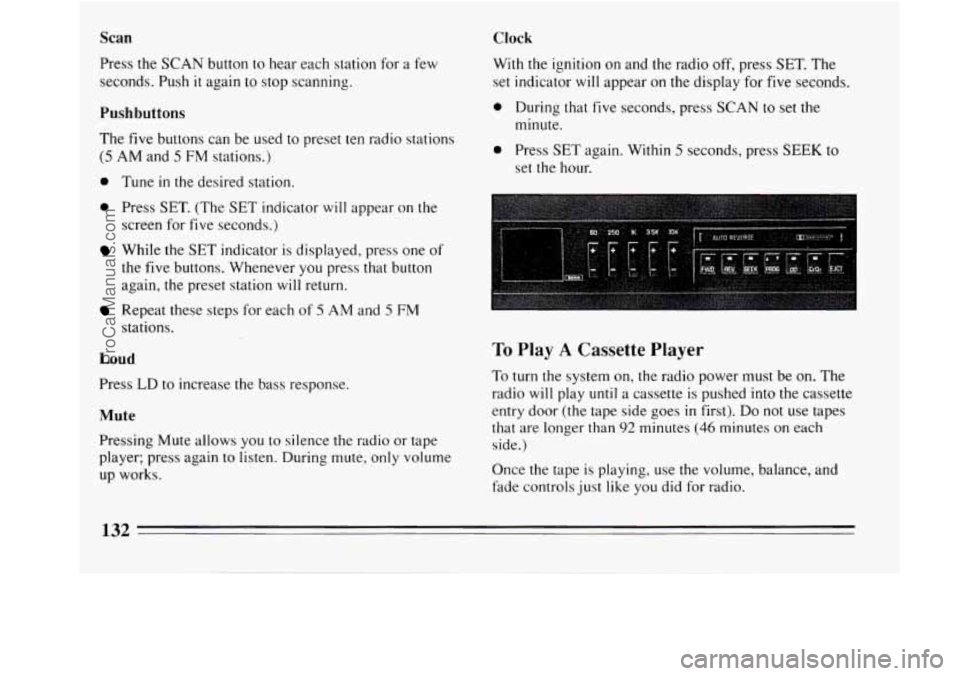
The five buttons can be used to preset ten radio stations
(5 AM and 5 FM stations.)
0 Tune in the desired station.
0 Press SET. (The SET indicator will appear on the
screen for five seconds.)
While the SET indicator is displayed, press one of
the five buttons. Whenever you press that button
again, the preset station
will return.
Repeat these steps for each of 5 AM and 5 FM
stations.
Loud
Press LD to increase the bass response.
Mute
Pressing Mute allows you to silence the radio or tape
player; press again to listen. During mute, only volume
up works.
Clock
With the ignition on and the radio off, press SET. The
set indicator
will appear on the display for five seconds.
0 During that five seconds, press SCAN to set the
minute.
0 Press SET again. Within 5 seconds, press SEEK to
set the hour.
To Play A Cassette Player
To turn the system on, the radio power must be on. The
radio
will play until a cassette is pushed into the cassette
entry door (the tape side goes
in first). Do not use tapes
that are longer than
92 minutes (46 minutes on each
side.)
Once the tape is playing, use the volume, balance, and
fade controls just like you did for radio.
132
ProCarManuals.com
Page 145 of 308
There’s something else about drinking and driving that
many people don’t know. Medical research shows that
alcohol
in a person’s system can make crash injuries
worse. That’s especially true for brain, spinal cord and
heart injuries. That means that if anyone who has been
drinking
-- driver or passenger -- is in a crash, the
chance of being killed or permanently disabled
is higher
than if that person had not been drinking. And we’ve
already seen that the chance of
a crash itself is higher for
drinking drivers.
Control of a Vehicle
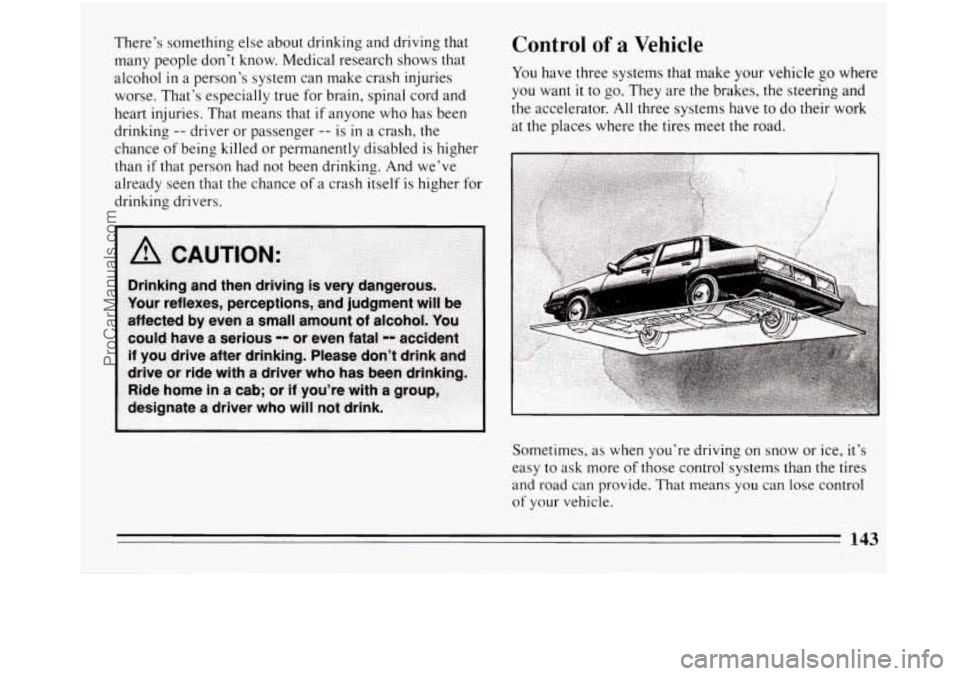
You have three systems that make your vehicle go where
you want it to go. They are the brakes, the steering and
the accelerator. All three systems have to do their work
at the places where the tires meet the road.
.... . . ...
Sometimes, as when you’re driving on snow or ice, it’s
easy
to ask more of those control’systems than the tires
and road can provide. That means
you can lose control
of your vehicle.
ProCarManuals.com
Page 152 of 308
Do not get too close to the vehicle you want to pass
while you’re awaiting an opportunity. For one thing,
following too closely reduces your area of vision,
especially if you’re following a larger vehicle. Also,
you won’t have adequate space if the vehicle ahead
suddenly slows or stops. Keep back a reasonable
distance.
0 When it looks like a chance to pass is coming up,
start
to accelerate but stay in the right lane and don’t
get too close. Time.your move
so you will be
increasing speed as the time comes to move into the
other lane. If the way is clear
to pass, you will have a
“running start” that more than makes up for
the
distance you would lose by dropping back. And if
something happens to cause
you to cancel your pass,
you need only slow down and drop back again and
wait for another opportunity.
0 If other cars are lined up to pass a slow vehicle, wait
your turn. But take care that someone isn’t trying to
pass you as
you pull out to pass the slow vehicle.
Remember to glance over your shoulder and check
the blind spot.
Check your mirrors, glance over your shoulder, and
start your left lane change signal before moving out
of the right lane to pass. When you are far enough
ahead of the passed vehicle to see its front in you:
inside mirror, activate your right lane change signal
and move back into the right lane. (Remember that
your right outside mirror is convex. The vehicle you
just passed may seem to be farther away from
you
than it really is.)
Try not to pass more than one vehicle at a time on
two-lane roads. Reconsider before passing the next
vehicle.
0 Don’t overtake a slowly moving vehicle too rapidly.
Even though the brake lights are not flashing,
it may
be slowing down or starting to turn.
If you’re being passed, make it easy for the
following driver to get ahead of you. Perhaps you
can ease a little
to the right.
ProCarManuals.com
Page 153 of 308
Loss of Control
Let’s review what driving experts say about what
happens when the three control systems. (brakes, steering
and acceleration) don’t have enough friction where the
tires meet the road to do what the driver has asked.
In any emergency, don’t give up. Keep trying to steer
and constantly seek an escape route or area of less
danger.
Skidding
In a skid, a driver can lose control of the vehicle.
Defensive drivers avoid most skids by taking reasonable
care suited to existing conditions, and by not
“overdriving” those conditions. But skids are always
possible.
The three types of skids correspond to your Buick’s
three control systems.
In the braking skid your wheels
aren’t rolling. In the steering or cornering skid, too
much speed or steering in a curve causes tires to slip and
lose cornering force. And
in the acceleration skid too
much throttle causes the driving wheels to spin.
A cornering skid and an acceleration skid are best
handled by easing your foot off the accelerator pedal. If
your vehicle starts to slide, ease your foot off the
accelerator pedal and quickly steer the way you want the
vehicle to go. If you start steering quickly enough, your
vehicle may straighten out. Always be ready for a
second skid
if it occurs.
Of course, traction is reduced when water, snow, ice,
gravel, or other material is on the road. For safety, you’ll
want to slow down and adjust your driving to these
conditions. It is important to slow down on slippery
surfaces because stopping distance will be longer and
vehicle control more limited.
While driving on a surface with reduced traction, try
your best to avoid sudden steering, acceleration, or
braking (including engine braking by shifting
to a lower
gear). Any sudden changes could cause the tires to slide.
You may not realize the surface is slippery
until your
vehicle is skidding. Learn to recognize warning clues
--
such as enough water, ice or packed snow on the road to
make a “mirrored surface”
-- and slow down when you
have any doubt.
Remember: Any anti-lock braking system (ABS) helps
avoid only the braking skid.
151
ProCarManuals.com