mirror BUICK REGAL 1994 Owners Manual
[x] Cancel search | Manufacturer: BUICK, Model Year: 1994, Model line: REGAL, Model: BUICK REGAL 1994Pages: 308, PDF Size: 15.78 MB
Page 71 of 308
Part 2 Features and Controls
Here you can learn about the many standard and optional features on your Buick. and information on starting. shifting
and braking
. Also explained are the instrument panel and the warning systems that tell you if everything is working
properly
.. and what to do if you have a problem .
Part 2 includes:
Keys ........................................................................\
.... 70
DoorLocks
....................................................................... \
71
NewVehicleBreak-In
.............................................................. 79
StartingtheEngine
................................................................. 80
ShiftingtheTransaxle .............................................................. 84
Windows ........................................................................\
. 92
Turn Signal/Headlight Beam Lever
.................................................... 94
Headlight High-Low Beam Changer
.............................................. 96
Windshield Wipermasher
...................................................... 96
CruiseControl
................................................................ 98
Headlights ........................................................................\
103
Mirrors ........................................................................\
.. 106
Instrumentpanel
................................................................... 111
Speedometer and Odometer ..................................................... 111
Warning Lights, Gages and Indicators
............................................. 112
TiltSteeringWheel
................................................................ 93
69
ProCarManuals.com
Page 107 of 308
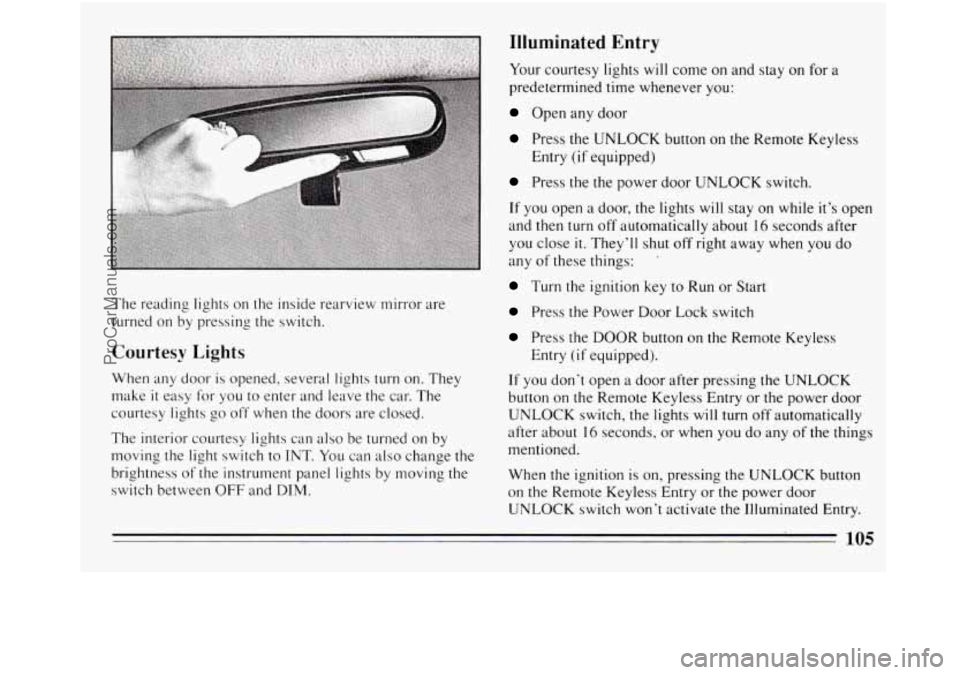
The reading lights on the inside rearview mirror are
turned on by pressing the switch.
Courtesy Lights
When any door is opened, several lights turn on. They
make
it easy for you to enter and leave the car. The
courtesy lights
go off when the doors are closed.
The interior courtesy lights can also be turned on by
moving the light switch to
INT. You can also change the
brightness of the instrument panel lights by moving the
switch between
OFF and DIM.
Illuminated Entry
Your courtesy lights will come on and stay on for a
predetermined time whenever you:
Open any door
Press the UNLOCK button on the Remote Keyless
Press the the power door UNLOCK switch.
If you open a door, the lights will stay on while it’s open
and then turn
off automatically about 16 seconds after
you close
it. They’ll shut off right away when you do
any of these things: ’
Turn the ignition key to Run or Start
Press the Power Door Lock switch
Press the DOOR button on the Remote Keyless
If you don’t open a door after pressing the UNLOCK
button on the Remote Keyless Entry or the power door
UNLOCK switch, the lights will turn off automatically
after about
16 seconds, or when you do any of the things
mentioned.
When the ignition is
on, pressing the UNLOCK button
on the Remote Keyless Entry or the power door
UNLOCK switch won’t activate
the Illuminated Entry.
Entry
(if equipped)
Entry
(if equipped).
105
ProCarManuals.com
Page 108 of 308
Mirrors
Inside Mirror
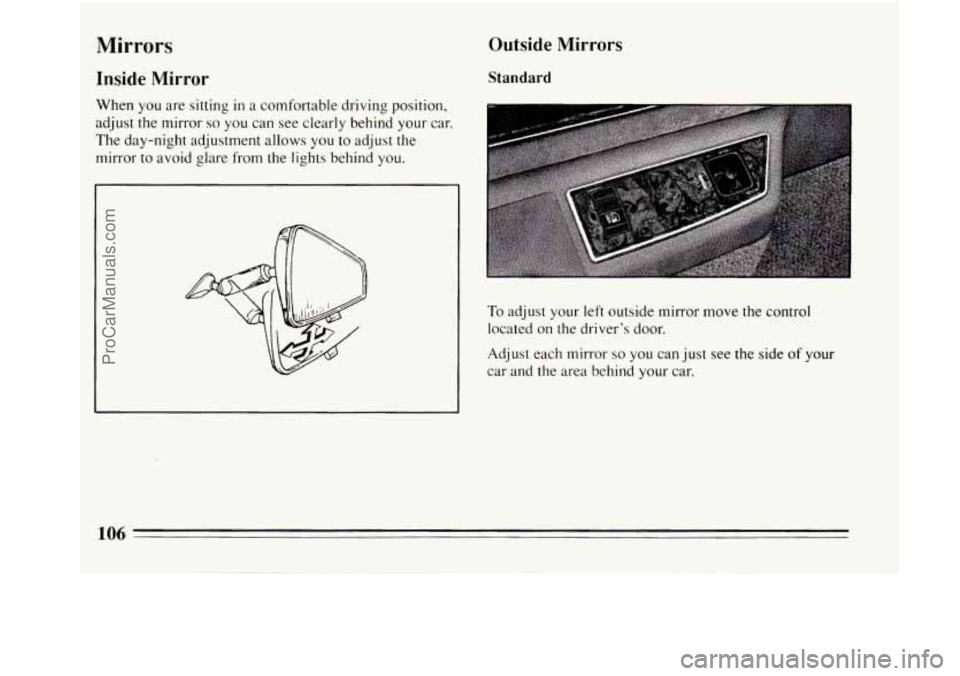
When you are sitting in a comfortable driving position,
adjust the mirror
so you can see clearly behind your car.
The day-night adjustment allows you to adjust the
mirror to avoid glare from the lights behind you.
Outside Mirrors
Standard
To adjust your left outside mirror move the control
located on the driver’s door.
Adjust each mirror
so you can just see the side of your
car and the area behind your car.
106
ProCarManuals.com
Page 109 of 308
Optional
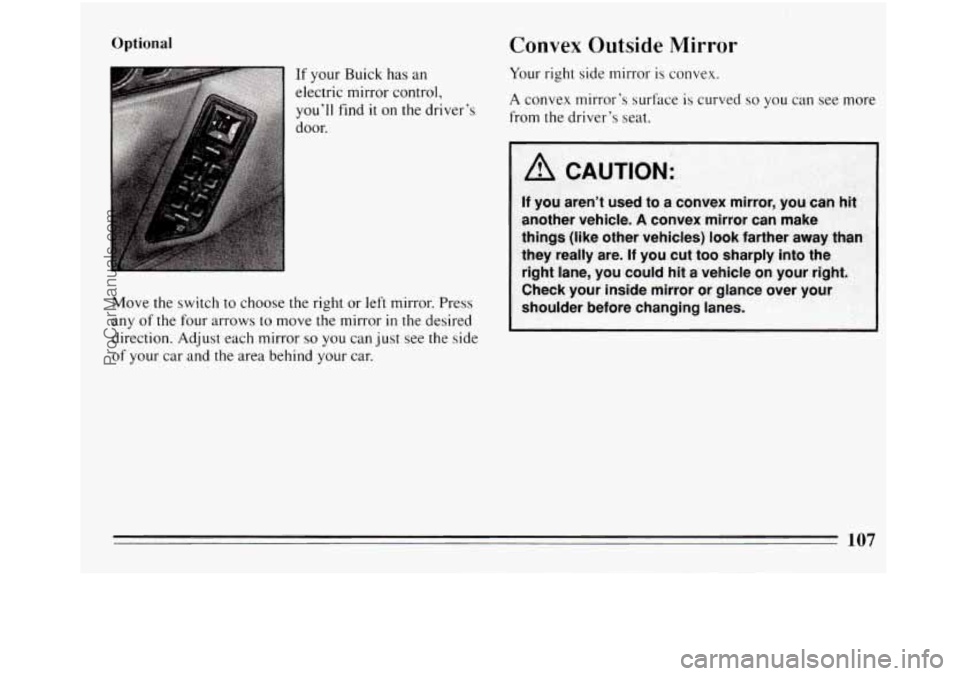
If your Buick has an
electric mirror control,
you’ll find
it on the driver’s
door.
Move the switch
to choose the right or left mirror. Press
any
of the four arrows to move the mirror in the desired
direction. Adjust each mirror
so you can just see the side
of your car and the area behind your car.
Convex Outside Mirror
Your right side mirror is convex.
A convex mirror’s surface is curved so you can see more
from the driver’s seat.
107
ProCarManuals.com
Page 152 of 308
Do not get too close to the vehicle you want to pass
while you’re awaiting an opportunity. For one thing,
following too closely reduces your area of vision,
especially if you’re following a larger vehicle. Also,
you won’t have adequate space if the vehicle ahead
suddenly slows or stops. Keep back a reasonable
distance.
0 When it looks like a chance to pass is coming up,
start
to accelerate but stay in the right lane and don’t
get too close. Time.your move
so you will be
increasing speed as the time comes to move into the
other lane. If the way is clear
to pass, you will have a
“running start” that more than makes up for
the
distance you would lose by dropping back. And if
something happens to cause
you to cancel your pass,
you need only slow down and drop back again and
wait for another opportunity.
0 If other cars are lined up to pass a slow vehicle, wait
your turn. But take care that someone isn’t trying to
pass you as
you pull out to pass the slow vehicle.
Remember to glance over your shoulder and check
the blind spot.
Check your mirrors, glance over your shoulder, and
start your left lane change signal before moving out
of the right lane to pass. When you are far enough
ahead of the passed vehicle to see its front in you:
inside mirror, activate your right lane change signal
and move back into the right lane. (Remember that
your right outside mirror is convex. The vehicle you
just passed may seem to be farther away from
you
than it really is.)
Try not to pass more than one vehicle at a time on
two-lane roads. Reconsider before passing the next
vehicle.
0 Don’t overtake a slowly moving vehicle too rapidly.
Even though the brake lights are not flashing,
it may
be slowing down or starting to turn.
If you’re being passed, make it easy for the
following driver to get ahead of you. Perhaps you
can ease a little
to the right.
ProCarManuals.com
Page 153 of 308
Loss of Control
Let’s review what driving experts say about what
happens when the three control systems. (brakes, steering
and acceleration) don’t have enough friction where the
tires meet the road to do what the driver has asked.
In any emergency, don’t give up. Keep trying to steer
and constantly seek an escape route or area of less
danger.
Skidding
In a skid, a driver can lose control of the vehicle.
Defensive drivers avoid most skids by taking reasonable
care suited to existing conditions, and by not
“overdriving” those conditions. But skids are always
possible.
The three types of skids correspond to your Buick’s
three control systems.
In the braking skid your wheels
aren’t rolling. In the steering or cornering skid, too
much speed or steering in a curve causes tires to slip and
lose cornering force. And
in the acceleration skid too
much throttle causes the driving wheels to spin.
A cornering skid and an acceleration skid are best
handled by easing your foot off the accelerator pedal. If
your vehicle starts to slide, ease your foot off the
accelerator pedal and quickly steer the way you want the
vehicle to go. If you start steering quickly enough, your
vehicle may straighten out. Always be ready for a
second skid
if it occurs.
Of course, traction is reduced when water, snow, ice,
gravel, or other material is on the road. For safety, you’ll
want to slow down and adjust your driving to these
conditions. It is important to slow down on slippery
surfaces because stopping distance will be longer and
vehicle control more limited.
While driving on a surface with reduced traction, try
your best to avoid sudden steering, acceleration, or
braking (including engine braking by shifting
to a lower
gear). Any sudden changes could cause the tires to slide.
You may not realize the surface is slippery
until your
vehicle is skidding. Learn to recognize warning clues
--
such as enough water, ice or packed snow on the road to
make a “mirrored surface”
-- and slow down when you
have any doubt.
Remember: Any anti-lock braking system (ABS) helps
avoid only the braking skid.
151
ProCarManuals.com
Page 154 of 308
Driving at Night Adjust your inside rearview mirror to reduce the
glare from headlights behind you.
1 Since you can’t see as well, you may need to slow
down and keep more space between
you and other
vehicles.
0 Slow down, especially on higher speed roads. Your
headlights can light
up only so much road ahead.
0 In remote areas, watch for animals.
0 If you’re tired, pull off the road in a safe place and
rest.
Night Vision
i No one can see as well at night as in the daytime. But as
~ we get older these differences increase. A 50-year-old
’ driver may require at least twice as much light to see the A same thing at night as a 20-year-old.
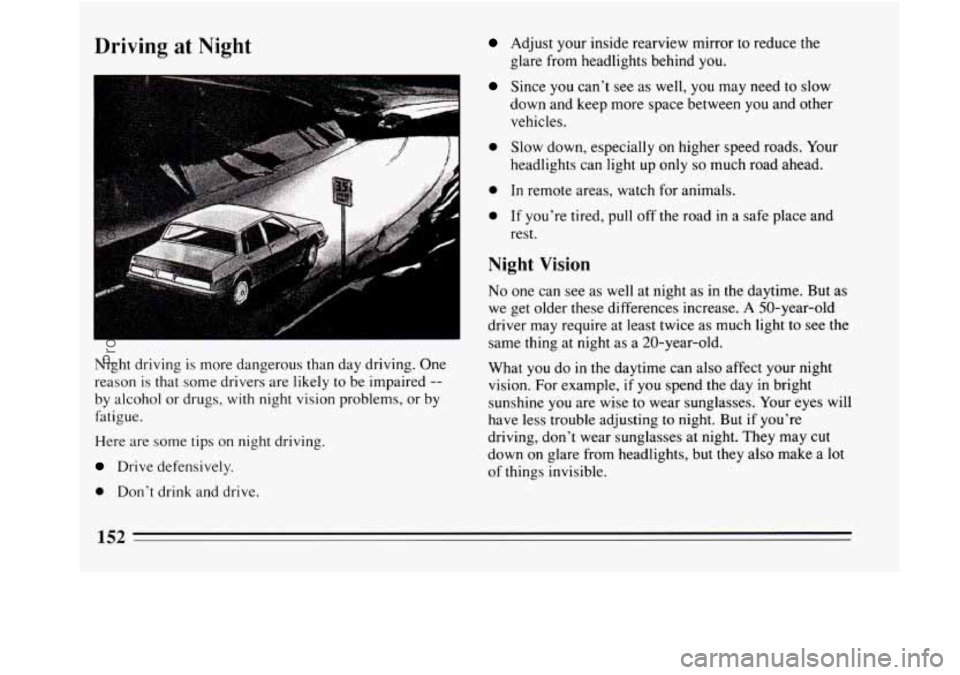
Night driving is more dangerous than day driving. One
reason
is that some drivers are likely to be impaired --
by alcohol or drugs, with night vision problems, or by
fatigue.
Here are some tips on night driving.
Drive defensively.
0 Don’t drink and drive. What
you do in the daytime can also affect your night
vision. For example, if you spend the day in bright
sunshine you are wise to wear sunglasses. Your eyes will
have less trouble adjusting
to night. But if you’re
driving, don’t wear sunglasses at night. They may cut
down
on glare from headlights, but they also make a lot
of things invisible.
152
ProCarManuals.com
Page 159 of 308
At the entrance there is usually a ramp that leads to the
freeway. If you have a clear view of the freeway as you
drive along the entrance ramp, you should begin to
check traffic. Try
to determine where you expect to
blend with the flow. Try to merge into the gap at close to
the prevailing speed. Switch on your turn signal, check
your mirrors and glance over your shoulder as often as
necessary. Try to blend smoothly
with the traffic flow.
Once you are
on the freeway, adjust your speed to the
posted
limit or to the prevailing rate if it’s slower. Stay
in the right lane unless you want to pass.
Before changing lanes, check your mirrors. Then use
your turn signal.
Just before you leave the lane, glance quickly over your
shoulder to make sure there isn’t another vehicle
in your
“blind” spot.
Once you are moving
on the freeway, make certain you
allow a reasonable following distance. Expect to move
slightly slower at night.
When you want to leave the freeway, move to the proper
lane well
in advance. If you miss your exit do not, under
any circumstances, stop and back up. Drive on
to the
next exit. The exit
ramp can be curved, sometimes quite sharply.
The
exit speed is usually posted.
Reduce your speed according to your speedometer, not
to your sense
of motion. After driving for any distance
at higher speeds, you may tend to
think you are going
slower than you actually are.
Before Leaving on a Long Trip
Make sure you’re ready. Try to be well rested. If you
must start when you’re not fresh
-- such as after a day’s
work
-- don’t plan to make too many miles that first part
of the journey. Wear comfortable clothing and shoes you
can easily drive
in.
Is your vehicle ready for a long trip? If you keep it
serviced and maintained, it’s ready to go. If it needs
service, have
it done before starting out. Of course,
you’ll find experienced and able service experts
in
Buick dealerships all across North America. They’ll be
ready and willing to help if you need it.
157
ProCarManuals.com
Page 160 of 308
Here are some things you can check before a trip:
0
0
0
0
0
0
0
Windshield Washer Fluid: Is the reservoir full? Are
all windows clean inside and outside?
Wiper Blades: Are they
in good shape?
Fuel, Engine Oil, Other Fluids: Have you checked all
levels?
Lights: Are they all working? Are the lenses clean?
Tires: They are vitally important
to a safe,
trouble-free trip. Is the tread good enough for
long-distance driving? Are the tires all inflated to the
recommended pressure?
Weather Forecasts: What’s
the weather outlook along
your route? Should you delay
your trip a short time
to avoid a major storm system?
Maps:
Do you have ur>-to-date maps?
Highway Hypnosis
Is there actually such a condition as “highway hypnosis”?
Or is
it just plain falling asleep at the wheel? Call it
highway hypnosis, lack of awareness, or whatever.
There is something about an easy stretch
of road with the
same scenery, along with the hum of the tires on the road,
the drone of the engine, and the rush of the wind against
the vehicle that can make you sleepy. Don’t let
it happen
to you! If
it does, your vehicle can leave the road in
than a second, and
you could crash and be injured.
What can you do about highway hypnosis? First, be
aware that
it can happen.
Then here are some tips:
0
0
a
Make sure your vehicle is well ventilated, with a
comfortably cool interior.
Keep your eyes moving. Scan the road ahead and to
the sides. Check your rearview mirrors and your
instruments frequently.
If you get sleepy,
pull off the road into a rest, service,
or parking area and take a nap, get some exercise, or
both. For safety, treat drowsiness on the highway as
an emergency.
158
ProCarManuals.com
Page 169 of 308
monoxide (CO) from your exhaust can get into your
vehicle (see “Carbon Monoxide”
in the Index). Dirt
and water can,
too.
The bumpers on your vehicle are not intended for
hitches. Do not attach rental hitches or other
bumper-type hitches to them. Use only a
frame-mounted hitch that does not attach to the
bumper.
Safety Chains
You should always attach chains between your vehicle
and your trailer. Cross the safety chains under the
tongue of the trailer
so that the tongue will not drop to
the road
if it becomes separated from the hitch.
Instructions about safety chains may be provided by the
hitch manufacturer or by the trailer manufacturer.
Follow the manufacturer’s recommendation for
attaching safety chains. Always leave just enough slack
so you can turn with your rig. And, never allow safety
chains to drag
on the ground.
Trailer Brakes
If your trailer weighs more than 1,000 pounds (450 kg)
loaded, then
it needs its own brakes -- and they must be
adequate. Be sure to read and follow the instructions for
the trailer brakes
so you’ll be able to install, adjust and maintain
them properly. Because you have anti-lock
brakes, do not try to tap into your vehicle’s brake
system. If you do, both brake systems won’t work well,
or at all.
Driving with a Trailer
Towing a trailer requires a certain amount of experience.
Before setting out for the open road, you’ll want to get
to know your rig. Acquaint yourself with the feel of
handling and braking with the added weight
of the
trailer. And always keep
in mind that the vehicle you are
driving
is now a good deal longer and not nearly so
responsive as your vehicle is by itself.
Before you start, check the trailer hitch and platform,
,
safety chains, electrical connector, lights, tires and
mirror adjustment. If
the trailer has electric brakes, start
your vehicle and trailer moving and then apply the
trailer brake controller by hand to be sure the brakes are
working. This lets you check your electrical connection
at the same time.
During your trip, check occasionally to be sure that the
load is secure, and that the lights and any trailer brakes
are still working.
167
ProCarManuals.com