instrument panel BUICK REGAL 1995 User Guide
[x] Cancel search | Manufacturer: BUICK, Model Year: 1995, Model line: REGAL, Model: BUICK REGAL 1995Pages: 340, PDF Size: 17.16 MB
Page 93 of 340
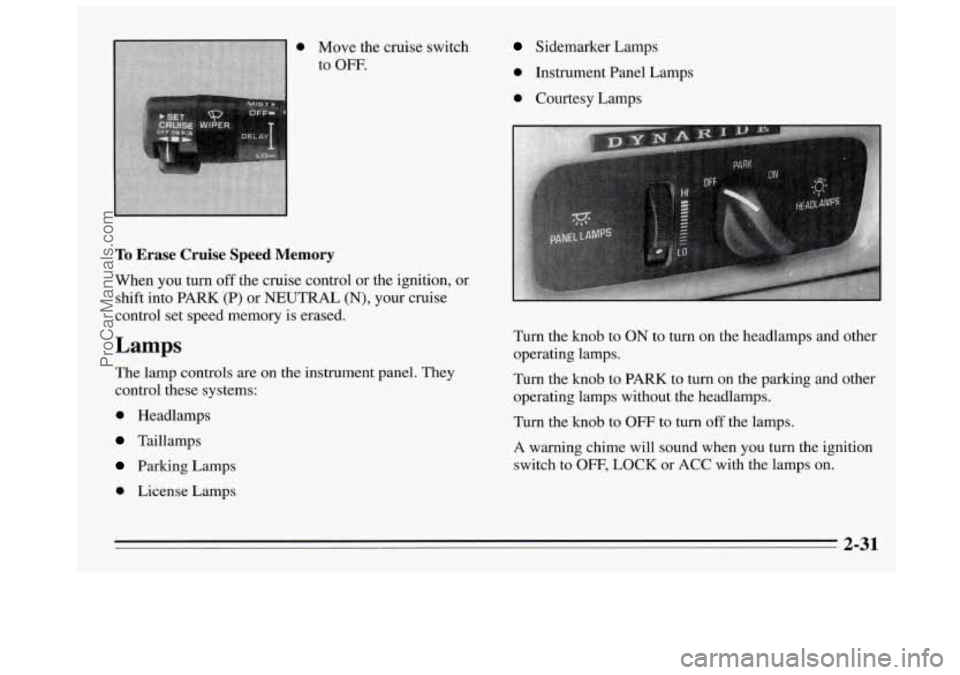
To Erase Cruise Speed Memory
When you turn off the cruise control or the ignition, or
shift into PARK (P) or NEUTRAL
(N), your cruise
control set speed memory is erased.
Lamps
The lamp controls are on the instrument panel. They
control these systems:
0 Headlamps
Taillamps
Parking Lamps
0 License Lamps
Sidemarker Lamps
0 Instrument Panel Lamps
0 Courtesy Lamps
Turn the knob to
ON to turn on the headlamps and other
operating lamps.
Turn the knob to PARK to
turn on the parking and other
operating lamps without the headlamps.
Turn the knob to
OFF to turn off the lamps.
A warning chime will sound when you turn the ignition
switch
to OFF', LOCK or ACC with the lamps on.
2-31
ProCarManuals.com
Page 94 of 340

Instrument Panel Lamps
You can brighten or dim the instrument panel lamps by
moving the PANEL
LAMPS dial. If you turn the dial
past
HI, your courtesy or interior lamps will conle on.
Daytime Running Lamps (Canada Only)
Daytime Running Lamps (DRL) can make it easier for
others to see the front of your vehicle during the day.
DRL can be helpful in many different driving
conditions, but they can be especially helpful
in the
short periods after dawn and before sunset.
A light sensor on top of the instrument panel makes the
DRL work,
so be sure it isn’t covered,
The
DRL system will make your low-beam headlamps
come on at a reduced brightness when: When the DRL
are
on, only your low-bearn headlamps
will be on. The taillamps, sidemarker and other lamps
won‘t be
on. Your instrument panel won’t be lit up either.
When it’s dark enough outside, your low-beam
headlamps will change to
full brightness. The other lamps
that come
on with your headlamps will also come on.
When it’s bright enough outside, the regular lamps
will
go off, and your low-beam headlamps change to the
reduced brightness of DRL.
To idle your vehicle with the DRL off, set the parking brake
while the ignition is
in OFF or LOCK. Then start your vehicle.
The
DIU will stay off until you release the parking brake.
As with any vehicle, you should turn on the regular
headlamp system any time you need it.
0 The ignition is on,
0 The headlamp switch is off, and
0 The parking brake is released.
2-32
ProCarManuals.com
Page 103 of 340
Ashtrays and Lighter
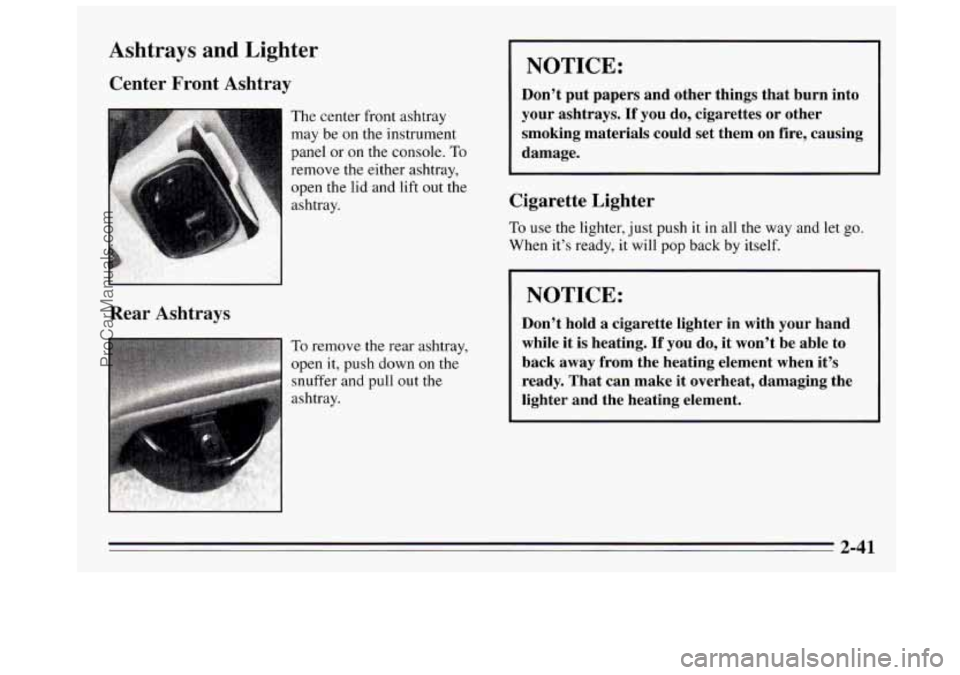
Center Front Ashtray
The center front ashtray
may be on the instrument
panel or
on the console. To
remove the either ashtray,
open the lid and lift
out the
ashtray.
Rear Ashtrays
To remove the rear ashtray,
open
it, push down on the
snuffer and pull
out the
ashtray.
I NOTICE:
Don’t put papers and other things that burn into
your ashtrays.
If you do, cigarettes or other
smoking materials could set them on fire, causing
damage.
Cigarette Lighter
To use the lighter, just push it in all the way and let go.
When it’s ready, it will pop back
by itself.
~ NOTICE:
Don’t hold a cigarette lighter in with your hand
while it is heating.
If you do, it won’t be able to
back away from the heating element when it’s
ready. That can make it overheat, damaging the
lighter and the heating element.
2-41
ProCarManuals.com
Page 104 of 340
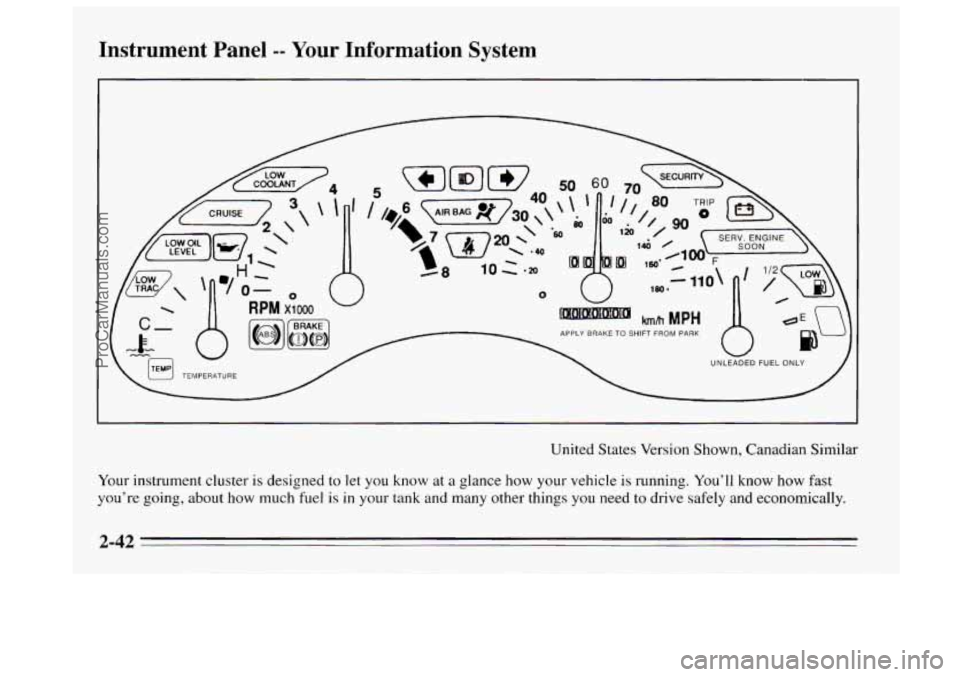
Instrument Panel -- Your Information System
United States Version Shown, Canadian Similar
Your instrument cluster
is designed to let you know at a glance how your vehicle is running. You’ll know how fast
you’re going, about how much fuel
is in your tank and many other things you need to drive safely and economically.
2-42
ProCarManuals.com
Page 108 of 340

Safety Belt Reminder Light
b3
8
When the key is turned to
RUN or START, a chime
will come
on for about eight
seconds to remind people to
fasten their safety belts,
unless the driver’s safety belt
is already buckled.
The safety belt light will also come on and stay
on
until the driver’s belt is buckled.
Air Bag Readiness Light
There is an air bag readiness light on the instrument
panel, which shows AIR BAG. The system checks the
air bag’s electrical system for malfunctions. The light
tells
you if there is an electrical problem. The system
check includes the air bag sensors and modules, the
wiring and the diagnostic module. For more information
on the air bag system, see “Air Bag” in the Index.
10: I
You will see this light flash
for a few seconds when you
turn your ignition to RUN
or START. Then the light
AIR BAG 4 3 should go out. This means
the system is ready.
-8 10 :
If the air bag readiness light doesn’t come on when you
start your vehicle, or stays on, or comes on when you
are driving, your air bag system may not work properly.
Have your vehicle serviced right away.
2-46
ProCarManuals.com
Page 118 of 340
System Controls
Fan Lever
The bottom lever selects the force of air you want.
Temperature Lever
The upper lever changes the temperature of the air coming
through the system. Slide the lever toward
WARM for
warmer air. Slide the lever toward
COOL for cooler air. If
your system has the auxiliary temperature control option,
this lever controls the temperature for
the whole vehicle
unless
DUAL is pressed. When DUAL is pressed, this
lever controls the temperature for the driver.
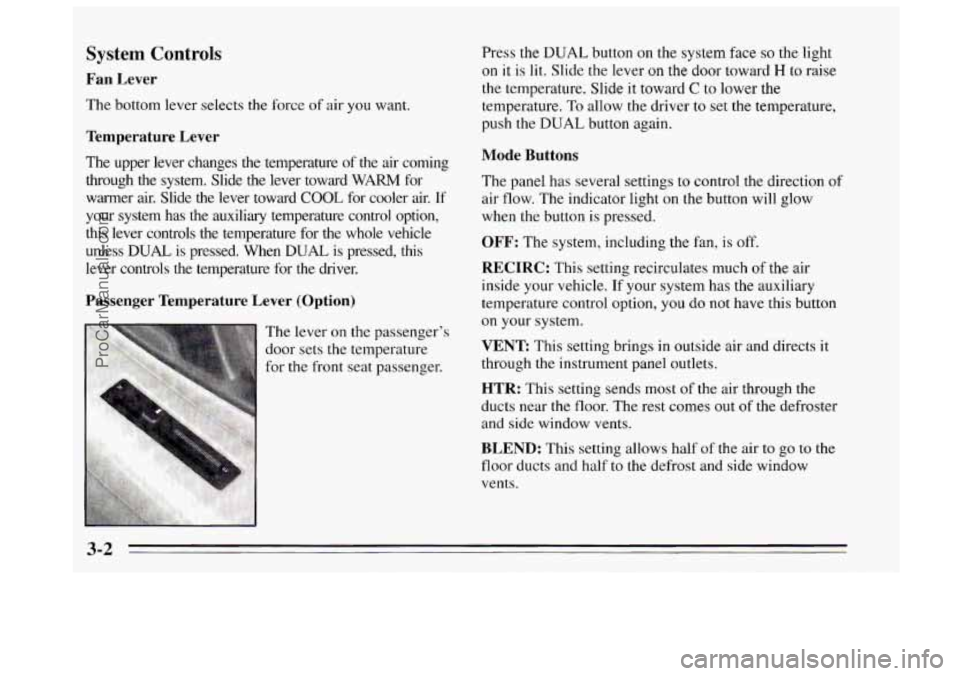
Passenger Temperature Lever (Option)
Press the DUAL button on the system face so the light
on it is lit. Slide the lever on the door toward H to raise
the temperature. Slide it toward
C to lower the
temperature. To allow the driver
to set the temperature,
push the
DUAL button again.
Mode Buttons
The panel has several settings to control the direction of
air flow. The indicator light
on the button will glow
when the button
is pressed.
OFF: The system, including the fan, is off.
RECIRC: This setting recirculates much or tne air
inside your vehicle.
If your system has the auxiliary
temperature control option, you do not have this button
on your system.
VENT This setting brings in outside air and directs it
through the instrument panel outlets.
HTR: This setting sends most of the air through the
ducts near the floor. The rest comes out of the defroster
and side window vents.
BLEND: This setting allows half of the air to go to the
floor ducts and half to
the defrost and side window
vents.
3-2
ProCarManuals.com
Page 119 of 340
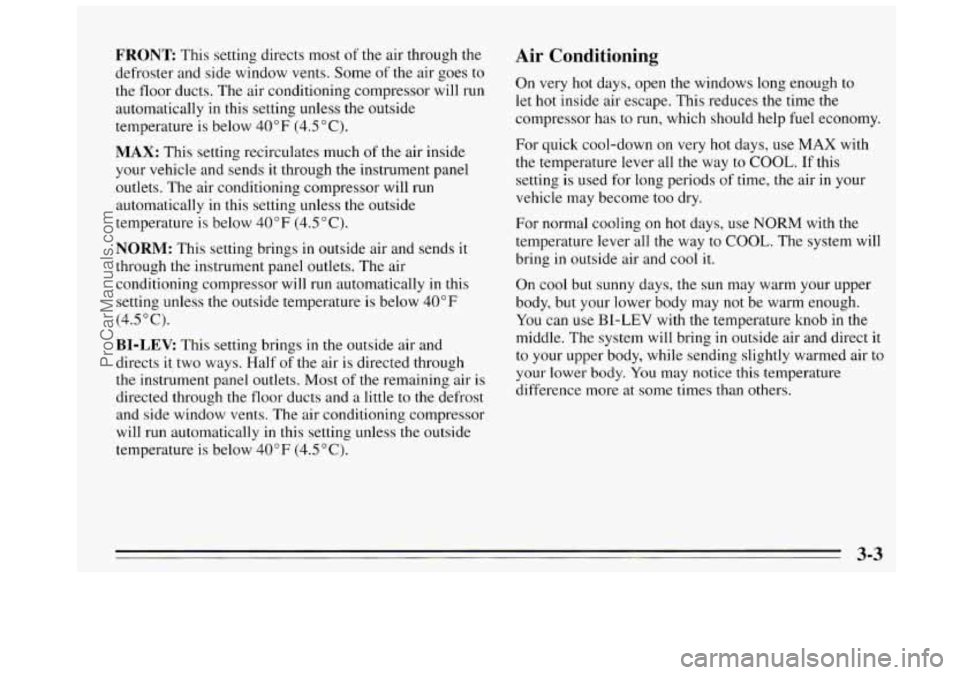
FRONT This setting directs most of the air through the
defroster and side window vents. Some
of the air goes to
the floor ducts. The air conditioning compressor will run
automatically in this setting unless the outside
temperature is below 40°F (4.5"C).
MAX: This setting recirculates much of the air inside
your vehicle and sends it through the instrument panel
outlets. The air conditioning compressor will run
automatically in this setting unless the outside
temperature is below 40°F (4.5"C).
NORM: This setting brings in outside air and sends it
through the instrument panel outlets. The air
conditioning compressor will run automatically in this
setting unless the outside temperature
is below 40°F
(4.5
" C).
BI-LEV This setting brings in the outside air and
directs it two ways. Half of the air is directed through
the instrument panel outlets. Most
of the remaining air is
directed through the floor ducts and a little
to the defrost
and side window vents. The air conditioning compressor
will run automatically
in this setting unless the outside
temperature
is below 40°F (4.5"C).
Air Conditioning
On very hot days, open the windows long enough to
let hot inside air escape. This reduces the time
the
compressor has to run, which should help fuel economy.
For quick cool-down on very hot days, use
MAX with
the temperature lever all the way to
COOL. If this
setting is used for long periods of time, the air in your
vehicle may become too dry.
For normal cooling on hot days, use
NORM with the
temperature lever all the way to
COOL. The system will
bring in outside air and cool
it.
On cool but sunny days, the sun may warm your upper
body, but your lower body may not be warm enough.
You can use
BI-LEV with the temperature knob in the
middle. The system will bring
in outside air and direct it
to your upper body, while sending slightly warmed air to
your lower body.
You may notice this temperature
difference more at some times than others.
3-3
ProCarManuals.com
Page 144 of 340
Avoid needless heavy braking. Some people drive
in spurts -- heavy acceleration followed by heavy
braking
-- rather than keeping pace with traffic. This is a
mistake. Your brakes may not have time to cool between
hard stops. Your brakes will wear out much fidster
if YOLI
do a lot of heavy braking. If you keep pace with the
traffic and allow realistic following distances, you will
eliminate a lot of unnecessary braking. That means
better braking and longer brake life.
If your engine ever stops while you’re driving, brake
normally but don’t pump your brakes. If
you do, the
pedal may get harder to push down. If your engine
stops, you will still have some power brake assist. But
you will use it when you brake. Once the power assist is
used up,
it may take longer to stop and the brake pedal
will be harder to push.
Anti-Lock Brakes (ABS)
Your Buick has an advanced electronic braking system
that will help prevent
a braking skid.
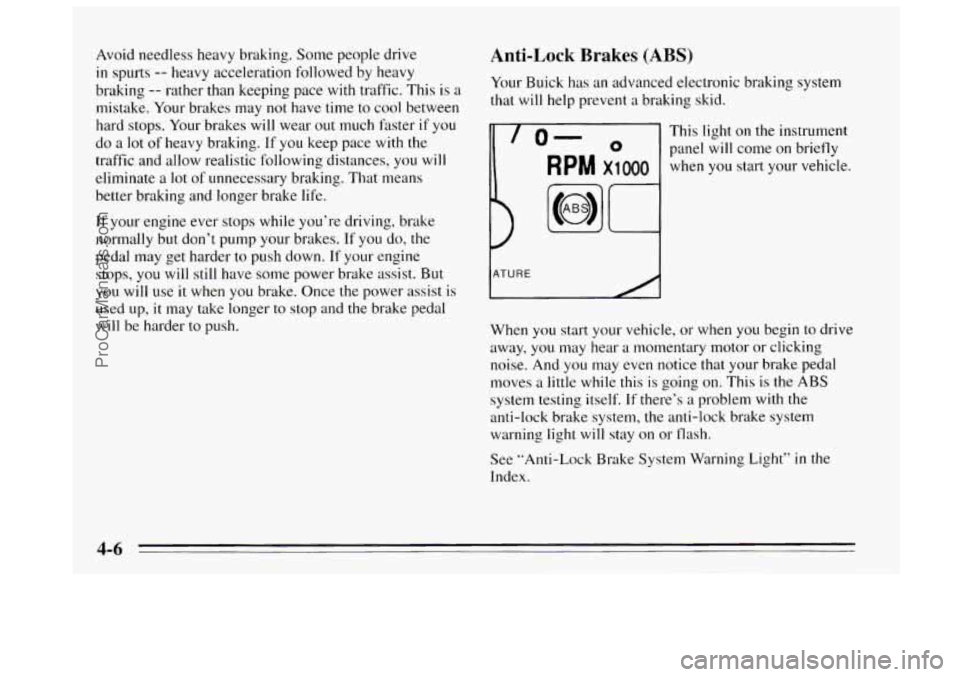
This light on the instrument
panel
will come on briefly
when you start your vehicle.
When you start your vehicle, or when
you begin to drive
away, you may hear
a momentary motor or clicking
noise. And
you may even notice that your brake pedal
moves
a little while this is going on. This is the ABS
system testing itself.
If there’s a problem with the
anti-lock brake system, the anti-lock brake system
warning light
will stay on or flash.
See ”Anti-Lock Brake System Warning Light”
in the
Index.
4-6
ProCarManuals.com
Page 171 of 340
Making Turns
NOTICE:
Making very sharp turns while trailering could
cause the trailer to come in contact with the
vehicle. Your vehicle could be damaged. Avoid
making very sharp turns while trailering.
When you’re turning with a trailer, make wider turns
than normal.
Do this so your trailer won’t strike soft
shoulders, curbs, road signs, trees, or other objects.
Avoid jerky or sudden maneuvers. Signal well
in
advance.
Turn Signals When Towing a Trailer
When you tow a trailer, your vehicle has to have a
different turn signal flasher and extra wiring. The green
arrows on your instrument panel will flash whenever
you signal
a turn or lane change. Properly hooked up,
the trailer lamps will also flash, telling other drivers
you’re about to turn, change lanes or stop. When
towing
a trailer, the green arrows on your
instrument panel will flash for turns even
if the bulbs on
the trailer are burned out. Thus, you may
think drivers
behind
you are seeing your signal when they are not. It’s
important to check occasionally
to be sure the trailer
bulbs are still working.
Driving On Grades
Reduce speed and shift to a lower gear Oefbve you start
down
a long or steep downgrade. If you don’t shift
down,
you might have to use your brakes so much that
they would get hot and no longer work well.
On
a long uphill grade, shift down and reduce your
speed to around
45 mph (70 km/h) to reduce the
possibility of engine and transaxle overheating.
If you are towing
a trailer that weighs more than
1,000 pounds (450 kg), you may prefer to drive in
THIRD (3) instead of DRIVE (D) (or, as you need to,
a lower gear).
4-33
ProCarManuals.com
Page 188 of 340
Engine Overheating
You will find a coolant temperature gage and a warning
light about
a hot engine on your instrument panel. See
“Engine Coolant Temperature Gage” and “Engine
Coolant Temperature Warning Light”
in the Index. You
also have a low coolant light on your instwrnent panel.
See “Low Coolant Light”
in the Ilrdex.
If Steam Is Coming From Your Engine
A CAUTION:
Steam from an overheated engine can burn you
badly, even if you just open the hood. Stay away
from the engine
if you see or hear steam corning
from it. Just turn
it off and get everyone away
from the vehicle until it cools down. Wait until
there is no sign of steam
or coolant before
opening the hood.
If you keep driving when your engine is
overheated, the liquids in it can catch fire. You or
others could be badly burned. Stop your engine
if
it overheats, and get out of the vehicle until the
engine is cool.
ProCarManuals.com