wheel pressure BUICK REGAL 1995 Owners Manual
[x] Cancel search | Manufacturer: BUICK, Model Year: 1995, Model line: REGAL, Model: BUICK REGAL 1995Pages: 340, PDF Size: 17.16 MB
Page 78 of 340
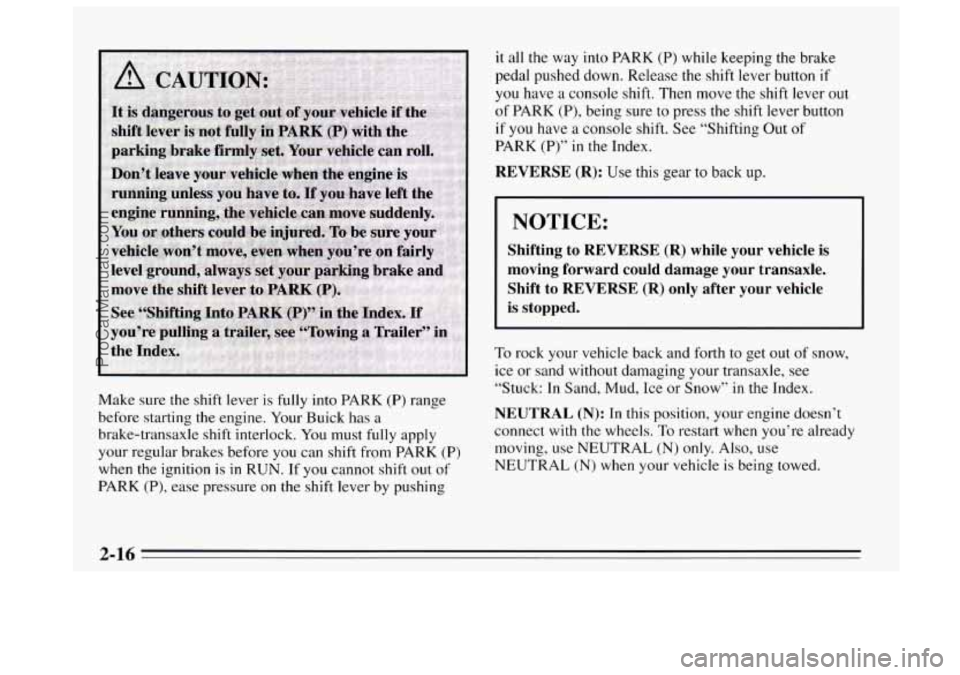
Make sure the shift lever is fully into PARK (P) range
before starting the engine. Your Buick has a
brake-transaxle shift interlock. You must fully apply
your regular brakes before you can shift from
PARK (P)
when the ignition is in RUN. If you cannot shift out of
PARK
(P), ease pressure on the shift lever by pushing
it all the way into PARK (P) while keeping the brake
pedal pushed down. Release the shift lever button
if
you have a console shift. Then move the shift lever out
of PARK (P), being sure to press the shift lever button
if you have a console shift. See “Shifting Out of
PARK (P)” in the Index.
REVERSE (R): Use this gear to back up.
NOTICE:
Shifting to REVERSE (R) while ybm vehicle is
moving forward could damage your transaxle.
Shift to REVERSE
(R) only after your vehicle
is stopped.
To rock your vehicle back and forth to get out of snow,
ice
or sand without damaging your transaxle, see
“Stuck: In Sand, Mud, Ice or Snow” in the Index.
NEUTRAL (N): In this position, your engine doesn’t
connect with the wheels.
To restart when you’re already
moving, use NEUTRAL (N)
only. Also, use
NEUTRAL (N) when your vehicle is being towed.
ProCarManuals.com
Page 145 of 340
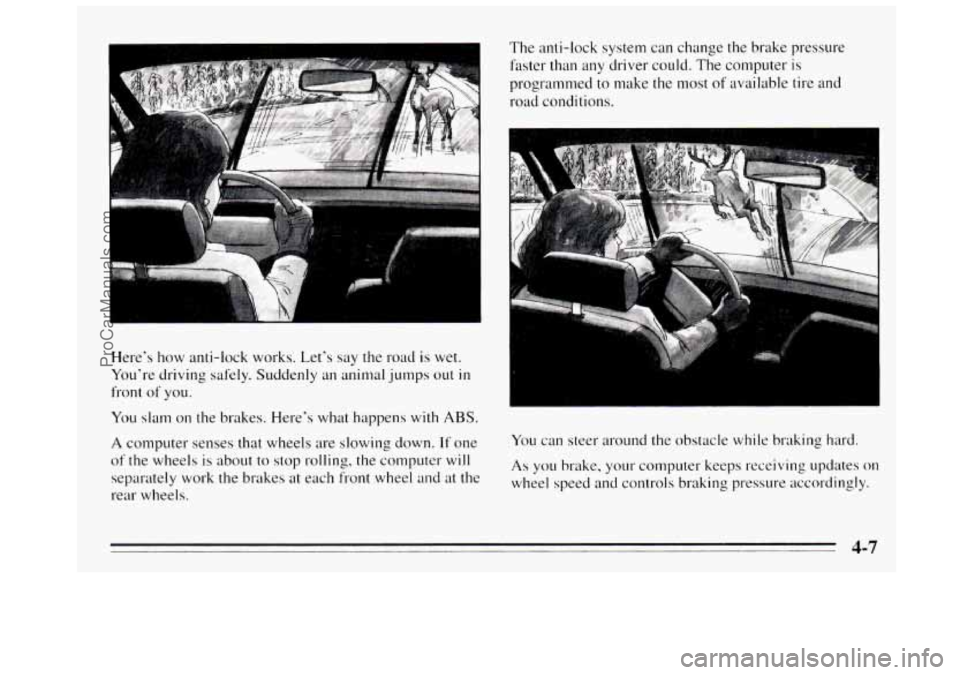
Here‘s how anti-lock works. Let’s say the road is wet.
You’re driving safely. Suddenly an animal jumps
out in
front of you.
You slam on the brakes. Here’s what happens with
ABS.
A colnputer senses that wheels are slowing down. If one
of the wheels is about to stop rolling, the computer will
separately work the brakes at each
front wheel and at the
rear wheels. The
anti-lock system can change the brake pressure
faster than any driver could. The computer
is
programmed to make the most of available tire and
road conditions.
You can steer around the obstacle while braking hard.
As you brake, your computer keeps receiving updates on
wheel speed and controls braking pressure accordingly.
4-7
ProCarManuals.com
Page 146 of 340
Remember: Anti-lock doesn’t change the time you need
to get your foot up to the brake pedal. If you get too
close to the vehicle in front of you, you won’t have time
to apply your brakes
if that vehicle suddenly slows or
stops. Always leave enough room up ahead
to stop, even
though you have anti-lock brakes.
To Use Anti-Lock
Don’t pump the brakes. Just hold the brake pedal down
and let anti-lock work for you. You may feel the system
working, or
you may notice some noise, but this is
normal. When your anti-lock system is adjusting brake
pressure to help avoid a braking skid, the
LOW TRAC
light will come on. See “Anti-Lock Brake System
Active Light”
in the Index.
Braking in Emergencies
Use your anti-lock braking system when you need to.
With anti-lock,
you can steer and brake at the same
time. In many emergencies, steering can help
you more
than even the very best braking.
Steering
Power Steering
If you lose power steering assist because the engine
stops or the system is not functioning, you can steer but
it will take much more effort.
Steering Tips
Driving on Curves
It’s important to take curves at a reasonable speed.
A lot of the “driver lost control” accidents mentioned on
the news happen on curves. Here’s why:
Experienced driver or beginner, each
of us is subject to
the same laws of physics when driving on curves. The
traction
of the tires against the road surface makes it
possible for the vehicle to change its path when you turn
the front wheels. If there’s no traction, inertia will keep
the vehicle going
in the same direction. If you’ve ever
tried to steer
a vehicle on wet ice, you’ll understand this.
The traction you can get in a curve depends on the
condition
of your tires and the road surface, the angle at
which the curve
is banked, and your speed. While
you’re
in a curve, speed is the one factor you can
control.
ProCarManuals.com
Page 206 of 340
Compact Spare Tire
Although the compact spare was fully inflated when
your vehicle was
new, it can lose air after a time. Check
the inflation pressure regularly. It should be 60 psi
(420 kPa). After installing the compact spare on your
vehicle, you should stop
as soon as possible and make
sure your spare tire
is correctly inflated. The compact
spare is made
to perform well at posted speed limits for
distances
up to 3,000 miles (5 000 km), so you can
finish your trip and have your full-size tire repaired or
replaced where you want.
Of course, it’s best to replace
your spare with
a full-size tire as soon as you can. Your
spare will last longer and be in good shape
in case you
need it again.
1 NOTICE:
Don’t take your compact spare through an
automatic
car wash with guide rails. The
compact spare can get caught on the rails. That
can damage the tire and wheel, and maybe other
parts
of your vehicle.
Don’t use your compact spare on some other vehicle.
And don’t mix your compact spare or wheel
with other
wheels or tires. They won’t
fit. Keep your spare and its
wheel together.
NOTICE:
Tire chains won’t fit your compact spare. Using
them will damage your vehicle and destroy the
chains too. Don’t use tire chains on your compact
spare.
5-32
ProCarManuals.com
Page 240 of 340
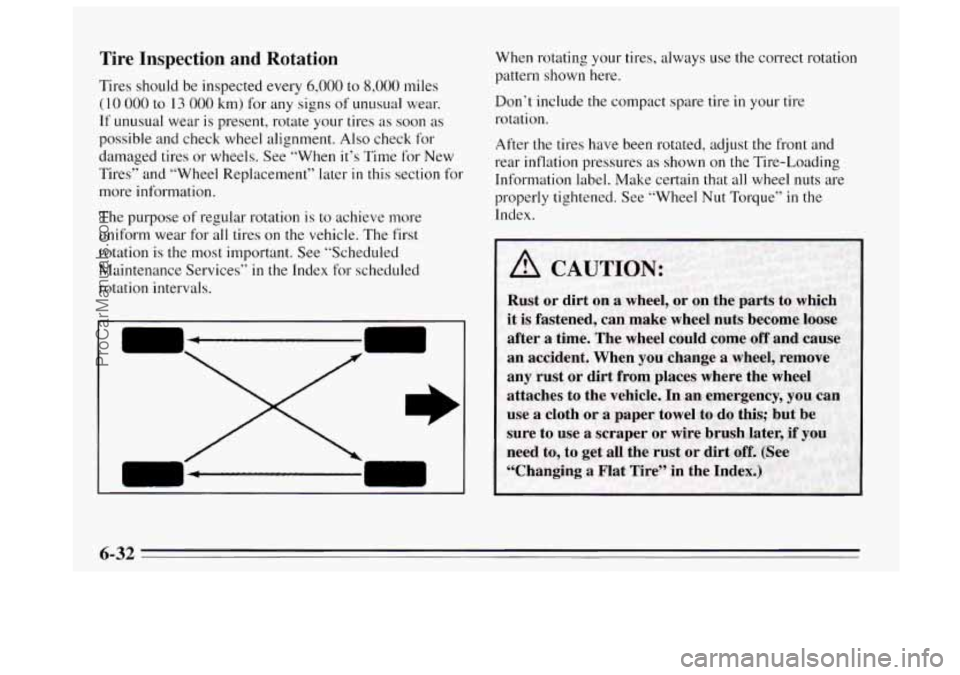
Tire Inspection and Rotation
Tires should be inspected every 6,000 to 8,000 miles
(I 0 000 to 13 000 km) for any signs of unusual wear.
If unusual wear is present, rotate your tires as soon as
possible and check wheel alignment. Also check for
damaged tires or wheels. See “When
it’s Time ,for New
Tires” and “Wheel Replacement” later
in this section for
more information.
The purpose of regular rotation is to achieve more
uniform wear for all tires on the vehicle. The first
rotation is the most important. See “Scheduled
Maintenance Services”
in the Index for scheduled
rotation intervals. When
rotating your tires, always use the correct rotation
pattern shown here.
Don’t include the compact spare tire
in your tire
rotation.
After the tires have been rotated, adjust the front and
rear inflation pressures
as shown on the Tire-Loading
Information label. Make certain that all wheel nuts are
properly tightened. See “Wheel
Nut Torque” in the
Index.
6-32
ProCarManuals.com
Page 332 of 340
Halogen Bulbs ................................ 6-27
Hazard Wdrning Flashers
.......................... 5- I
Head Restraints ................................. 1-5
Headlamp Bulb Replacement ...................... 6-27
Headlamp HigldLow Beam Changer
................ 2-26
Headlamp. Wiring
.............................. 6-53
Headlamps. Operation
........................... 2-3 1
Hearing Impaired. Customer Assistance .............. 8-2
Heating
........................................ 3-4
Heritage Pages
................................... 111
High-Beam Lamps. How to Change ................ 2-26
Highway Hypnosis
.............................. 4-20
Hill and Mountain Roads
......................... 4-20
Hitches. Trailer
................................. 4-3 1
Hood Release ................................... 6-7
Horn
......................................... 2-25
HotEngine
.................................... 5-14
Hydroplaning
.................................. 4- 16
...
Ice . Driving On ................................ 4-23
Ignition Key Positions
........................... 2- IO
Ignition Switch ................................. 2- IO
Illuminated Entry System ......................... 2-33
Intlation
- Tire Pressure .......................... 6-3 I
Inside Day/Night Rearview Mirror ................. 2-35
Inspections Brake System
............................... 7-39
Exhaust Systems
............................. 7-39
Restraint Systems
............................ 7-39 Steering
. Suspension and
Front-Wheel-Drive
Axle
Boot and Seal ......................... 7-39
Throttle Linkage
............................. 7-39
Instrument Panel
............................... 2-42
Instrument Panel Intensity Control
................. 2-32
Instrument Panel
. Cleaning ....................... 6-41
Interior Lamps ................................. 2-33
Jack
. Tire .................................... 5-26
Jump Starting
................................... 5-2
Key Lock Cylinders
. Maintenance ................ 7-37
Key Reminder Warning
.......................... 2-11
Keys .......................................... 2-1
Lamp . M. L~ If unction Indicator ..................... 2-51
La111ps ........................................ 2-31
Battery Saver
............................... 2-33
Daytime Running
............................ 2-32
Dome
..................................... 2-35
Illuminated Entry
............................ 2-33
Interior
.................................... 2-33
On Reminder
................................ 2-31
Panel
...................................... 2-32
Larger Children
. Safety Belt Use ................... 1-47
Latches . Front Searback ........................... 1-5
Lane Change Indicator ........................... 2-26
ProCarManuals.com
Page 335 of 340

Radiator Pressure cap .......................... 6-20
Radiator. Adding Coolant To ...................... 5-20
Radio Reception. Understanding ................... 3- 17
Rain . Driving In ................................ 4-15
Reading Lamps. Rearview Mirror
.................. 2-34
Reading Lamps
. Roof Console .................... 2-34
Rear Safety Belt Comfort Guides
.................. 1-33
Radio.
AM/FM Slereo
............................ 3-6
Rainy Weather Driving Tips
...................... 4- 16
Rear Seat Outside Passenger Positions
(2-Door Models) .............................. 1-26
Rear
Seat Outside Passenger Positions
(4-Door Models)
.............................. 1-29
Rear Window Defogger
........................... 3-4
Rearview Mirror. Inside Day/Night
................. 2-35
Reclining Front Seatbacks
......................... I- 2
Recommended Fluids and Lubricants ............... 7-40
Recovery Tank. Adding Coolant To
................. 5- I8
Remote Lock Control
............................. 2-5
Battery Replacement ........................... I ?-6
Matching Transmitters ......................... 2-6
Operation ................................... 2-5
Remote
Trunk Release ............................ 2-7
Replacement Bulbs ............................. 6-54
Replacement Parts
.............................. 6-56
Replacing Safety Belts ........................... 1-50
Replacing Seat and Restraint System Parts
After
a Crash ................................. 1 -SO
Rearview Mirror Reading Lamps .................. 2-34
Replacement
. Wheel ............................ 6-36 Reporting
Safety Defects
.......................... 8-4
Restraints. Checking
Your ........................ 1-50
Restraints . Child ................................ 1-37
Restraints. Head
................................. 1-5
Restraints. Replacing Parts After a Crash ............ 1-50
Reverse Position. Autotnatic Transaxle .............. 2-16
Right Front Passenger Position
.................... 1-24
Roadside Assistance .............................. 8-6
Roadside Assistance . Canadian ..................... 8-6
Rocking Your Vehicle ........................... 5-33
Roof Console Reading Lamps ..................... 2-34
Rotation
. Tire .................................. 6-32
Safety Belt Extender
............................ 1-50
Safety Belt Remincler Light ................... 1-6 . 2-46
Safety Belts
.................................... 1-6
Adults ..................................... 1 . 11
CareOf .................................... 6-41
Center Passenger Position
...................... 1-24
Driver Position ..............................
1 . 11
Extender ................................... 1-50
How to Wear Properly ........................ 1 . 11
Incorrect Usage ......................... I . 14$ 1-48
Lap Bclt ................................... 1-25
Lap-Shoulder
............................... 1-11
Lap.Shoulcler. Rear (2-Door Models) ............ 1-27
Lap-Shoulder. Rear (4-Door Models)
............ 1-29
Questions People Ask ......................... 1 . 10
Rear Safety Belt Comfort Guides ................ 1-3-3
9-9
ProCarManuals.com