check engine BUICK REGAL 1996 User Guide
[x] Cancel search | Manufacturer: BUICK, Model Year: 1996, Model line: REGAL, Model: BUICK REGAL 1996Pages: 356, PDF Size: 17.97 MB
Page 178 of 356
Snow can trap exhaust gases under your vehicle.
This can cause deadly CO (carbon monoxide) gas
to get inside.
CO could overcome you and kill
you. You can’t see it
or smell it, so you might not
know it is in your vehicle. Clear away snow from
around the base of your vehicle, especially any
that is blocking your exhaust pipe. And check
around again from time to time to be sure snow
doesn’t collect there.
Open
a window just a little on the side of the
vehicle that’s away from the wind. This will help
keep CO out.
Run your engine only as long as you must. Ths saves
fuel. When you run the engine, make it go a little faster
than just idle. That is, push the accelerator slightly. This
uses less fuel for the heat that you get and
it keeps the
battery charged. You will need a well-charged battery
to
restart the vehicle, and possibly for signaling later on
with your headlamps. Let the heater run for awhile.
Then, shut the engine
off and close the window almost
all
the way to preserve the heat. Start the engine again
and repeat this
only when you feel really uncomfortable
from the cold. But do it as little as possible. Preserve the
fuel as long as you can.
To help keep warm, you can get
out of the vehicle and do some fairly vigorous exercises
every half hour or
so until help comes.
ProCarManuals.com
Page 186 of 356
I
~~ ~ ~~~ ~ ~ ~~~~ ~~___~~~ ~
Making mrns
NOTICE:
Making very sharp turns while trailering could
cause the trailer to come in contact with the
vehicle. Your vehicle could be damaged. Avoid
making very sharp turns while trailering.
When you’re turning with a trailer, make wider turns than
normal. Do
this so your trailer won’t strike soft shoulders,
curbs, road signs, trees or other objects. Avoid jerky or
sudden maneuvers. Signal well in advance.
nrn Signals When Towing a Trailer
When you tow a trailer, your vehicle may need a
different turn signal flasher and/or extra wiring. Check
with your Buick dealer. The green arrows on your
instrument pariel will flash whenever you signal a turn
or lane change. Properly hooked up, the trailer lamps
will also flash, telling other drivers you’re about to turn,
change lanes or stop.
~ ~~~ ~ ~~~ ~
When towing a trailer, the green arrows on your
instrument panel will flash for turns even
if the bulbs on
the trailer
are burned out. Thus, you may think drivers
behind you are seeing your signal when they are not. It’s
important to check occasionally to be sure the trailer
bulbs are still working.
Driving On Grades
Reduce speed and shift to a lower gear before you start
down a long or steep downgrade. If you don’t shift
down, you might have to use your brakes
so much
that they would get hot and no longer work well.
On a long uphill grade, shift down and reduce your
speed to around
45 mph (70 km/h) to reduce the
possibility of engine and transaxle overheating.
If you are towing a trailer that weighs more than
1,000 lbs. (450 kg), you may prefer to drive in
THIRD
(3) instead of AUTOMATIC OVERDRIVE (a)
(or, as you need to, a lower gear).
ProCarManuals.com
Page 187 of 356
Parking on Hills
You really should not park your vehicle, with a trailer
attached, on a hill.
If something goes wrong, your rig
could start to move. People can be injured, and both
your vehicle and the trailer can be damaged.
But if you ever have to park your rig
on a hill, here’s
how
to do it:
1. Apply your regular brakes, but don’t shift into
PARK (P)
yet.
2. Have someone place chocks under the trailer wheels.
3. When the wheel chocks are in place, release the
regular brakes until
the chocks absorb the load.
4. Reapply the regular brakes. Then apply your parking
brake, and then shift
to PARK (P).
5. Release the regular brakes.
When You Are Ready to Leave After
Parking on a Hill
1. Apply your regular brakes and hold the pedal down
while you:
Start your engine;
Shift into a gear; and
0 Release the parking brake.
2. Let up on the brake pedal.
3. Drive slowly until the trailer is clear of the chocks.
4. Stop and have someone pick up and store the chocks.
Maintenance When Trailer Towing
Your vehicle will need service more often when you’re
pulling a trailer. See the Maintenance Schedule for more
on this. Things that are especially important in trailer
operation are automatic transaxle
fluid (don’t overfill),
engine oil, belt, cooling system and brake adjustment.
Each of these is covered in this manual, and the Index will
help you find them quickly. If you’re trailering, it’s a good
idea to review these sections before you start your trip.
Check periodically to see that all hitch nuts and bolts
are tight.
4-35
ProCarManuals.com
Page 192 of 356
A
,- I
Using a match near a battery can cause battery
gas to explode. People have been hurt doing this,
and some have been blinded. Use a flashlight
if
you need more light.
Be sure the battery has enough water. You don't
need to add water to the Delco Freedom@ battery
installed in every new
GM vehicle. But if a battery
has filler caps, be sure the right amount of fluid is
there.
If it is low, add water to take care of that
first.
If you don't, explosive gas could be present.
Battery fluid contains acid that can burn you.
Don't get it on you.
If you accidentally get it in
your eyes or on your skin, flush the place with
water and get medical help immediately.
6. Check that the jumper cables don't have loose or
missing insulation. If they do, you could get a shock.
The vehicles could be damaged too.
Before you connect
the cables, here are some basic
things
you should know. Positive (+) will go to
positive
(+) and negative (-) will go to negative (-)
or a metal engine part. Don't connect positive (+) to
negative
(-) or you'll get a short that would damage
the battery and maybe other parts too.
Fans or other moving engine parts can injure you
badly. Keep your hands away from moving parts
once the engines are running.
5-4
ProCarManuals.com
Page 203 of 356
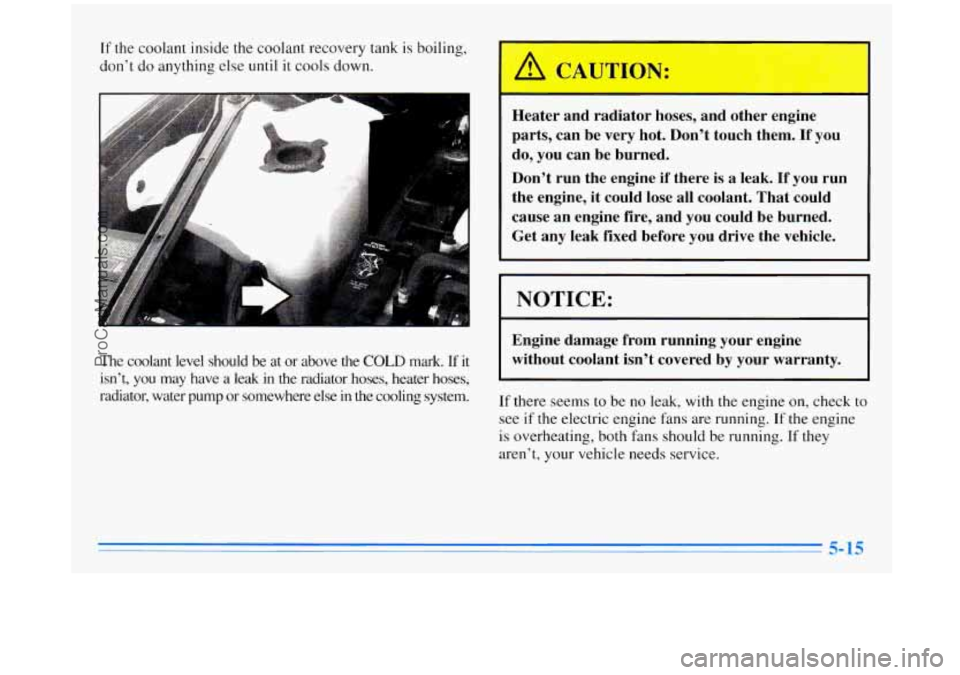
If the coolant inside the coolant recovery tank is boiling,
don’t do anything else until it cools down.
The coolant level should be at or above the COLD mark. If it
isn’t, you may have a leak in the radiator hoses, heater hoses,
radiator, water
pump or somewhere else in the cooling system.
Heater and radiator hoses, and other engine
parts, can be very hot. Don’t touch them.
If you
do, you can be burned.
Don’t run the engine if there is
a leak. If you run
the engine, it could lose all coolant. That could
cause an engine
fire, and you could be burned.
Get any leak fixed before you drive the vehicle.
I NOTICE:
Engine damage from running your engine
without coolant isn’t covered by your warranty.
If there seems to be no leak, with the engine on, check to
see
if the electric engine fans are running. If the engine
is overheating, both fans should be running. If they
aren’t, your vehicle needs service.
ProCarManuals.com
Page 209 of 356
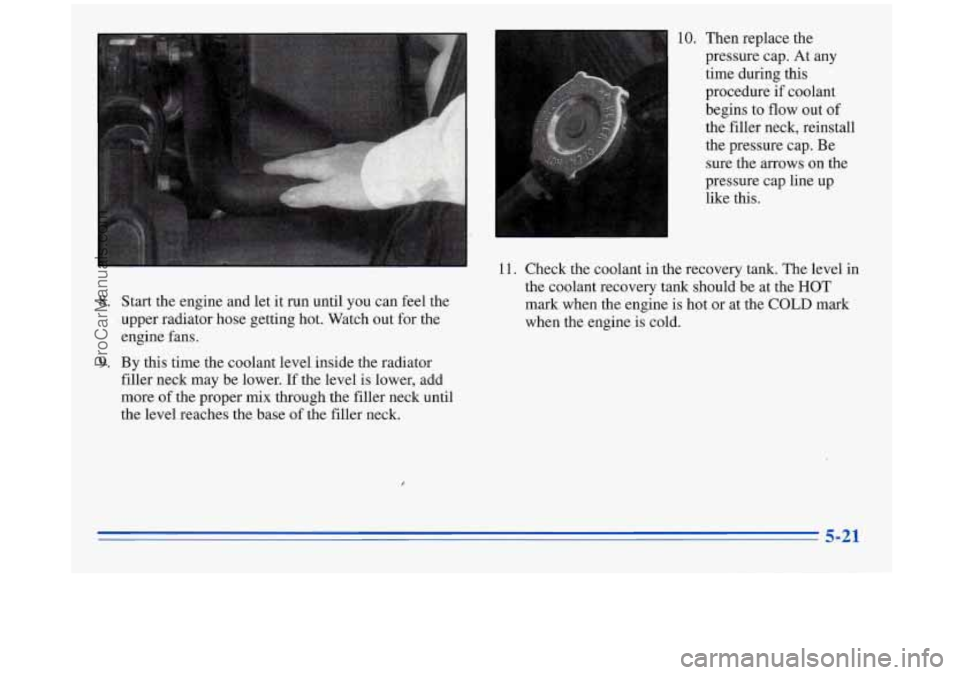
8. Start the engine and let it run until you can feel the
,.upper radiator hose getting hot. Watch out for the
engine fans.
filler neck may be lower. If the level is lower, add
more of the proper mix through the filler neck until
the level reaches
the base of the filler neck.
9. By this time the coolant level inside the radiator
10. Then replace the
pressure cap. At any
time during this
procedure if coolant
begins to
flow out of
the filler neck, reinstall
the pressure cap. Be
sure the
arrows on the
pressure cap line up
like this.
11. Check the coolant in the recovery tank. The level in
the coolant recovery tank should be at the
HOT
mark when the engine is hot or at the COLD mark
when the engine is cold.
5-21
ProCarManuals.com
Page 225 of 356
Fuel
Use regular unleaded gasoline rated at 87 octane or higher.
At a minimum, it should meet specifications ASTM
D4814
in the United States and CGSB 3.5-M93 in Canada.
Improved gasoline specifications have been developed by
the American Automobile Manufacturers Association
(AAMA) for better vehicle performance and engine
protection. Gasolines meeting the
AAMA specification
could provide improved driveability and emission control
system protection compared to other gasolines.
Be sure
the posted octane is at least 87. If the octane is
less than
87, you may get a heavy knocking noise when
you drive. If it’s bad enough,
it can damage your engine.
If you’re using fuel rated at
87 octane or higher and you
still hear heavy knocking, your engine needs service.
But don’t worry
if you hear a little pinging noise when
you’re accelerating or driving up a hill. That’s normal,
and you don’t
have to buy a higher octane fuel to get rid
of pinging. It’s the heavy, constant knock that means
you have a problem. If
your vehicle is certified to meet California Emission
Standards (indicated
on the underhood tune-up label), it
is designed to operate on fuels that meet California specifications. If such fuels are not available in states
adopting California emissions standards, your vehicle will
operate satisfactorily on fuels meeting federal specifications, but emission control system pexformance
may be affected. The malfunction indicator lamp on your
instrument panel may turn on and/or your vehicle may
fail
a smog-check test. If this occurs, return to your authorized
Buick dealer for diagnosis to determine the cause of
failure. In the event
it is determined that the cause of the
condition is
the type of fuels used, repairs may not be
covered by your warranty.
In Canada, some gasolines contain an octane enhancing
additive called MMT. If you use such fuels, your
emission control system performance may deteriorate
and the malfunction indicator lamp on your instrument
panel may turn on.
If this happens, return to your
authorized Buick dealer for service.
6-3
ProCarManuals.com
Page 226 of 356
To provide cleaner air, all gasolines are now required to
contain additives that will help prevent deposits from
forming
in your engine and fuel system, allowing your
emission control system to function properly. Therefore,
you should not have to add anything to the fuel. In
addition, gasolines containing oxygenates, such as ethers
and ethanol, and reformulated gasolines may be
available in your area to help clean the air. General
Motors recommends that you use these gasolines if they
comply with the specifications described earlier.
NOTICE:
Your vehicle was not designed for fuel that
contains methanol. Don’t use it. It can corrode
metal parts in your fuel system and also damage
plastic and rubber parts. That damage wouldn’t
be covered under your warranty.
Fuels id Foreign Countries
If you plan on driving in another country outside the
United States or Canada, the proper fuel may be hard to
find. Never use leaded gasoline or any other fuel not
recommended in the previous text on fuel. Costly repairs
caused by use of improper fuel wouldn’t be covered by
your warranty.
To check on fuel availability, ask an auto club, or
contact a major oil company that does business in the
country where you’ll be driving.
You can also write us at the following address for
advice. Just tell us where you’re going and give your
Vehicle Identification Number (VIN).
General Motors Overseas Distribution Corporation,
North American Export Sales (NAES)
1908 Colonel Sam Drive
Oshawa, Ontario
L1H 8P7
ProCarManuals.com
Page 228 of 356
CAUTION:
If you get gasoline on yourself and then
something ignites it, you could be badly burned.
Gasoline can spray out on you if
you open the
fuel filler cap too quickly. This spray can happen
if your tank is nearly full, and
is more likely in
hot weather. Open the fuel filler cap slowly and
wait
for any “hiss” noise to stop. Then unscrew
the cap all the way.
Be careful not to spill gasoline. Clean gasoline
from
painted surfaces as soon as possible. See “Cleaning the
Outside
of Your Buick” in the Index.
When you put the cap back on, turn
it to the right until
you hear at least three clicks. Make sure you
fully install
the cap. The diagnostic system can determine if the fuel
cap
has been left off or improperly installed. This would
allow fuel
to evaporate into the atmosphere. See
“Malfunction Indicator Lamp”
in the Index.
NOTICE:
If you need a new cap, be sure to get the right
type. Your dealer can get one for you.
If you get
the wrong type, it may not fit
or have proper
venting, and your fuel tank and emissions system
might be damaged.
Checking Things Under the Hood
A CAUl iON:
An electric fan under the hood can start up and
injure you even when the engine
is not running.
Keep hands, clothing and tools away from any
underhood electric fan.
ProCarManuals.com
Page 232 of 356
Before closing the hood, be sure all the filler caps are
on properly. Then just pull the hood down and close
it firmly.
hgine
If the LOW OIL LEVEL
light on the instrument
panel comes on, it means
you need to check your
engine oil
level right away.
For more information, see
“Low Oil Level Light” in
LOW OIL
LEVEL
the Index.
You should check your engine oil level regularly; this is
an added reminder.
It’s a good idea to check your engine oil after you get
fuel. In order to get an accurate reading, the oil must be
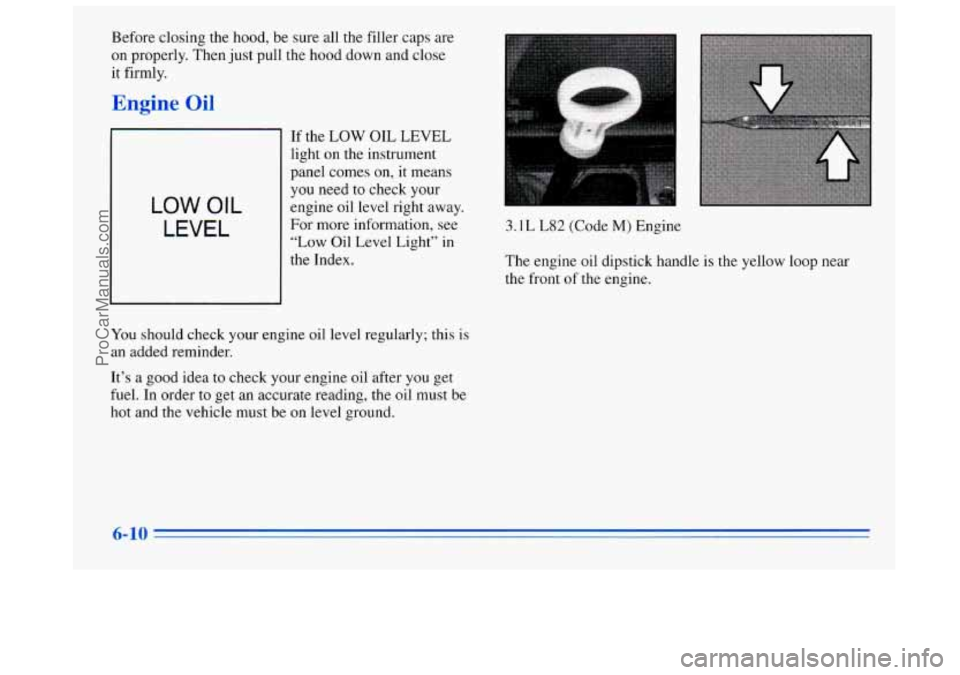
hot and the vehicle must be on level ground. 3.1L
LS2 (Code
M) Engine
The engine oil dipstick handle is the yellow loop near
the front
of the engine.
6-10
ProCarManuals.com