flat tire BUICK REGAL 1996 User Guide
[x] Cancel search | Manufacturer: BUICK, Model Year: 1996, Model line: REGAL, Model: BUICK REGAL 1996Pages: 356, PDF Size: 17.97 MB
Page 220 of 356
Con 1ct 5 Tirt
Although the compact spare tire was fully inflated
when your vehicle
was new, it can lose air after a time.
Check the inflation pressure regularly. It should be
60 psi (420 kPa).
After installing the compact spare on your vehicle, you
should
stop as soon as possible and make sure your
spare tire is correctly inflated. The compact spare is
made to perform well at posted speed limits for
distances up to
3,000 miles (5 000 km), so you can
finish your trip and have your full-size tire repaired or
replaced where
you want. Of course, it’s best to replace
your spare with
a full-size tire as soon as you can. Your
spare will last longer and be in good shape in case
you
need it again.
NOTICE:
When the compact spare is installed, don’t take
your vehicle through an automatic car wash with
guide rails. The compact spare can get caught on
the rails. That can damage the tire and wheel,
and maybe other parts
of your vehicle. Don’t use your
compact spare on other vehicles.
And don’t mix your compact spare tire or wheel with
other wheels or tires. They won’t
fit. Keep your spare
tire and its wheel together.
NOTICE:
Tire chains won’t fit your compact spare. Using
them can damage your vehicle and can damage
the chains too. Don’t use tire chains
on your
compact spare.
ProCarManuals.com
Page 257 of 356
CAUTION: (Conunut
0
0
0
Underinflated tires pose the Sme danger as
overloaded tires. The resulting accident
could cause serious injury. Check all tires
frequently to maintain the recommended pressure. Tire pressure should be checked
when your tires are cold.
Overinflated tires are more likely to be
cut, punctured
or broken by a sudden
impact
-- such as when you hit a pothole.
Keep tires at the recommended pressure.
Worn, old tires can cause accidents.
If your
tread is badly worn, or if your tires have
been damaged, replace them.
Inflation - Tire Pressure
The Tire-Loading Information label which is inside the
trunk lid shows the correct inflation pressures for your
tires when they’re cold. “Cold” means your vehicle has
been sitting for at least three
hours or driven no more
than a mile.
NOTICE:
Don’t let anyone tell you that underinflation or
overinflation is all right. It’s not.
If your tires
don’t have enough air (underinflation), you can
get the following:
Too much flexing
Too much heat
Tire overloading
Bad wear
0 Bad handling
Bad fuel economy.
NOTICE: (Continued)
6-35
ProCarManuals.com
Page 258 of 356
NOTICE: (Continued)
If your tires have too much air (overinflation),
you can get the following:
Unusual wear
0 Bad handling
Rough ride
Needless damage from road hazards.
When
to Check
Check your tires once a month or more.
Don’t forget your compact spare tire.
It should be
at
60 psi (420 kPa).
How to Check
Use a good quality pocket-type gage to check tire
pressure. You can’t tell if
your tires are properly inflated
simply by looking at them. Radial tires may look
properly inflated even when they’re underinflated.
Be sure
to put the valve caps back on the valve stems.
They help prevent leaks
by keeping out dirt and moisture.
Tire Inspection and Rotation
Tires should be inspected every 6,000 to 8,000 miles
(10
000 to 13 000 km) for any signs of unusual wear.
If unusual wear is present, rotate your tires
as soon as
possible and check wheel alignment. Also check for
damaged tires or wheels. See “When It’s Time for New
Tires” and “Wheel Replacement” later in this section for
more information.
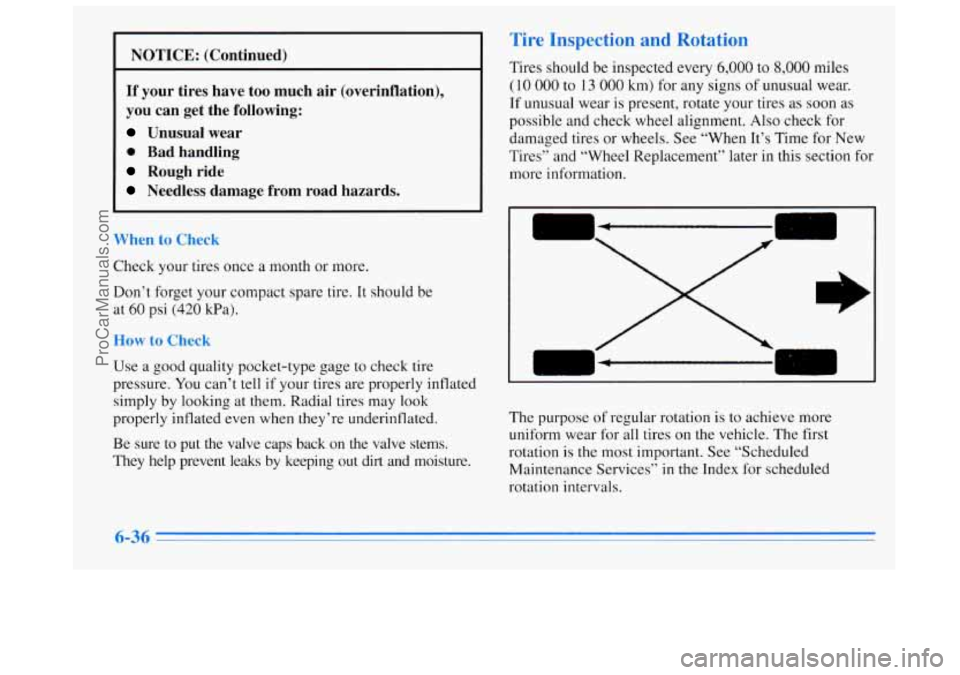
The purpose of regular rotation is to achieve more
uniform wear for all tires on the vehicle.
The first
rotation is the most important. See “Scheduled
Maintenance Services”
in the Index for scheduled
rotation intervals.
6-36
ProCarManuals.com
Page 259 of 356
When rotating your tires, always use the correct rotation
pattern shown here.
Don’t include the compact spare tire in your tire
rotation.
After the tires have been rotated, adjust the front and
rear inflation pressures as shown on the Tire-Loading
Information label. Make certain that all wheel nuts are
properly tightened. See “Wheel Nut Torque” in
the Index.
Rust or dirt on a wheel, or on the parts to which
it is fastened, can make wheel nuts become loose
after a time. The, wheel could come
off and cause
an accident. When you change
a wheel, remove
any rust or
dirt from.places where the wheel
attaches to the vehicle. In an emergency, you can
use a cloth or a paper towel to
do this; but be
sure to use a scraper or wire brush later,
if you
need to, to get
all the rust or dirt off. (See
“Changing a Flat Tire” in the Index.) When
It’s Time for New Tires
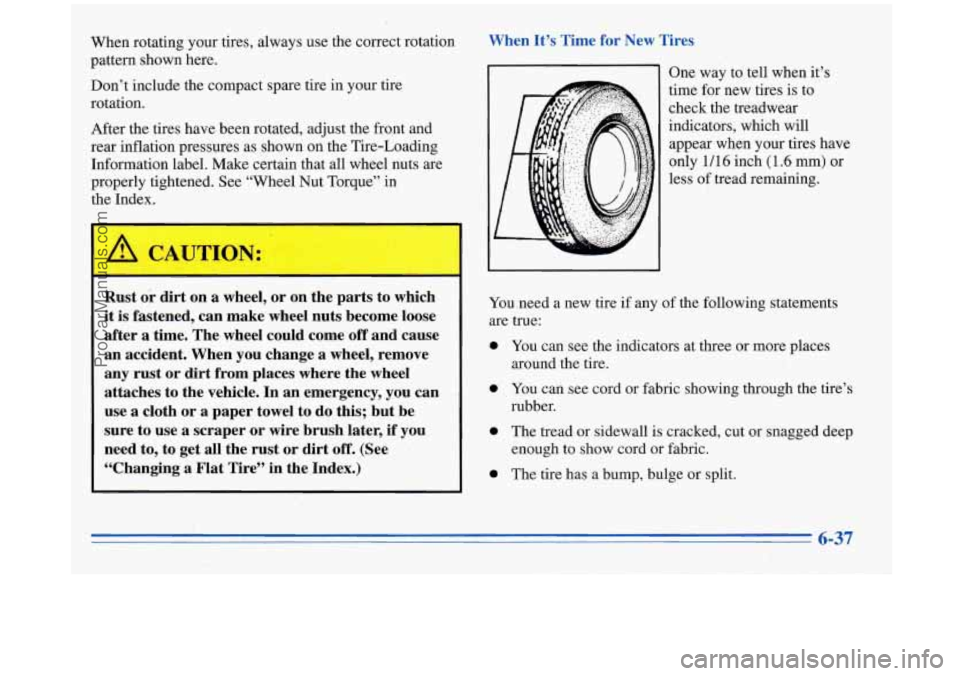
One way to tell when it’s
time for new tires is to
check the treadwear
indicators, which will
appear when your tires have
only
1/16 inch (1.6 mm) or
less of tread remaining.
You, need a new tire if any of the following statements
are true:
0
0
0
0
You can see the indicators at three or more places
around the tire.
You can see cord or fabric showing through the tire’s
rubber.
The tread or sidewall
is cracked, cut or snagged deep
enough to show cord or fabric.
The tire has a bump, bulge or split.
6-37
ProCarManuals.com
Page 262 of 356
Warning: The temperature grade for this tire is
established
for a tire that is properly inflated and not
overloaded. Excessive speed, underinflation, or
excessive loading, either separately or
in combination,
can cause heat buildup and possible tire failure.
Wheel Alignment and Tire Balance
The wheels on your vehicle were aligned and balanced
carefully at the factory
to give you the longest tire life
and best overall performance.
In most cases, you will not need to have your wheels
aligned again. However, if you notice unusual tire wear
or your vehicle pulling
one way or the other, the
alignment may need to be reset.
If you notice your
vehicle vibrating when driving on
a smooth road, your
wheels may need to be rebalanced.
Wheel Replacement
Replace any wheel that is bent, cracked, or badly rusted
or corroded. If wheel
nuts keep coming loose, the wheel,
wheel bolts and wheel
nuts should be replaced. If the
wheel leaks air, replace it (except some aluminum
wheels, which can sometimes be repaired). See your
Buick dealer if
any of these conditions exist.
I
Your dealer will know the kind of wheel you need.
Each new wheel should have the
same load-carrying
capacity, diameter, width, offset and be mounted the
same way
as the one it replaces.
If you need to replace any of your wheels, wheel bolts
or wheel nuts, replace them only with new
GM original
equipment parts. This way, you will be sure to have
the right wheel, wheel bolts and wheel nuts for your
Buick model.
Using the wrong replacement wheels, wheel bolts I
or wheel nuts on your vehicle can be dangerous.
It could affect the braking and handling
of your
vehicle, make your tires lose air and make you
lose control.
You could have a collision in which
you or others could be injured. Always use the
correct wheel, wheel bolts and wheel nuts for
replacement.
6-40
ProCarManuals.com
Page 263 of 356

NOTICE:
The wrong wheel can also cause problems with
bearing life, brake cooling, speedometer/odometer
calibration, headlamp aim, bumper height, vehicle
ground clearance and tire or tire chain clearance to
the body and chassis.
See “Changing
a Flat Tire” in the Index .for more
information. Used
Replacement Wheels
Putting
a used wheel on your vehicle is
dangerous. You can’t know how it’s been used
or
how many miles it’s been driven. It could fail
suddenly and cause an accident.
If you have to
replace a wheel, use a new
GM original
equipment wheel.
6-41
ProCarManuals.com
Page 287 of 356
Section 7 Maintenance Schedule
I IMPORTANT:
KEEP ENGINE OIL
I ’ 1
.
Introduction
Your Vehicle and the Environment
Proper vehicle maintenance not only helps to keep your
vehicle in good working condition, but also helps the
environment.
All recommended maintenance procedures
are important. Improper vehicle maintenance can even
affect the quality
of the air we breathe. Improper fluid
levels or the wrong tire inflation can increase the level
of emissions from your vehicle. To help protect our
environment, and to keep your vehicle in
good
condition, please maintain your vehicle properly.
I
This section covers the maintenance required for your
Buick. Your vehicle needs these services to retain its
safety, dependability and emission control performance.
F
I I
Have you purchased the GM Protection Plan? The Plan
supplements
your IWPV vehicle warrunties. See your
Warranty and Owner Assistance booklet, or your Buick
dealer
for details.
7-1
ProCarManuals.com
Page 321 of 356
Part B: Owner Checks and Services
Listed below are owner checks and services which
should be performed at the intervals specified to help
ensure the safety, dependability and emission control
performance of your vehicle.
Be sure any necessary repairs are completed at once.
Whenever any fluids or lubricants are added to your
vehicle, make sure they are the proper ones,
as shown
in Part D.
Engine Coolant Level Chec
Check the engine coolant level and add the proper
coolant mix
if necessary. See “Engine Coolant” in the
Index for further details.
Windshield Washer Fluid Level Check
Check the windshield washer fluid level in the
windshield washer tank and add the proper
fluid if
necessary. See “Windshield Washer Fluid” in the Index
for further details.
At Each Fuel Fill
Engine Oil Level Check
Check the engine oil level and add the proper oil if
necessary. See “Engine Oil” in the Index for
further details.
At Least Once a Month
Tire Inflation Check
Make sure tires are inflated to the correct pressures.
See “Tires” in the Index for further details.
7-35
ProCarManuals.com
Page 345 of 356
(@ Section 9 Index
I- .I
Accessory Outlet .............................. 2-4 I
AirBag ....................................... 1-18
How Does it Restrain .......................... 1-22
How
it Works ................................ 1-20
Location
.................................... 1-20
Readiness Light
......................... 1 . 19. 2.47
Servicing
................................... 1-23
What Makes
it Inflate .......................... 1-2 1
What Will You See After it Inflates ............... 1-22
When Should
it Inflate ......................... 1-21
AirCleane
r .................................... 6-16
Air Conditioning
................................ 3-3
Alarm, Theft-Deterrent ........................... 2-8
Alignment and Balance. Tire
...................... 6-40
Aluminum Wheels, Cleaning
...................... 6-48
Antenna, Fixed
................................. 3-26
Antenna, Power
................................ 3-26
Antifreeze ................................... 6-20
Anti-Lock Brake System Active Light
................. 2-50.4-8
Brake System Warning Light
................ 2-49.4-6
Brakes
...................................... 4-6
Anti-Theft, Radio
.............................. 3-2 I
Appearance Care ............................... 6-42
Air Conditioning Refrigerants ..................... 6-63 Appearance Care Materials
....................... 6-50
Arbitration Program
.............................. 8-6
Armrest. Storage
............................... 2-38
Ashtrays
...................................... 2-40
Astroroof
..................................... 2-42
Audio Controls
. Steering Wheel Touch Control ....... 3-23
Audio Equipment. Adding
........................ 3-24
Audio Systems
.................................. 3-6
Auto-Down Window
............................ 2-25
Automatic DoorLocks
................................... 2-4
Overdrive
. Automatic Transaxle ................. 2-16
Shifting ..................................... 2-14
Transaxle Check
.............................. 7-36
Transaxle Fluid
............................... 6-17
Transaxle Park Mechanism Check ................ 7-38
Battery
...................................... 6-30
J~np Starting ................................. 5-2
Saver
...................................... 2-36
Warnings
................................ 5.2. 5.4
BBB Auto Line
................................. 8-6
Better Business Bureau Mediation
................... 8-6
Replacement. Remote Keyless Entry ............... 2-5
9-1
ProCarManuals.com
Page 346 of 356
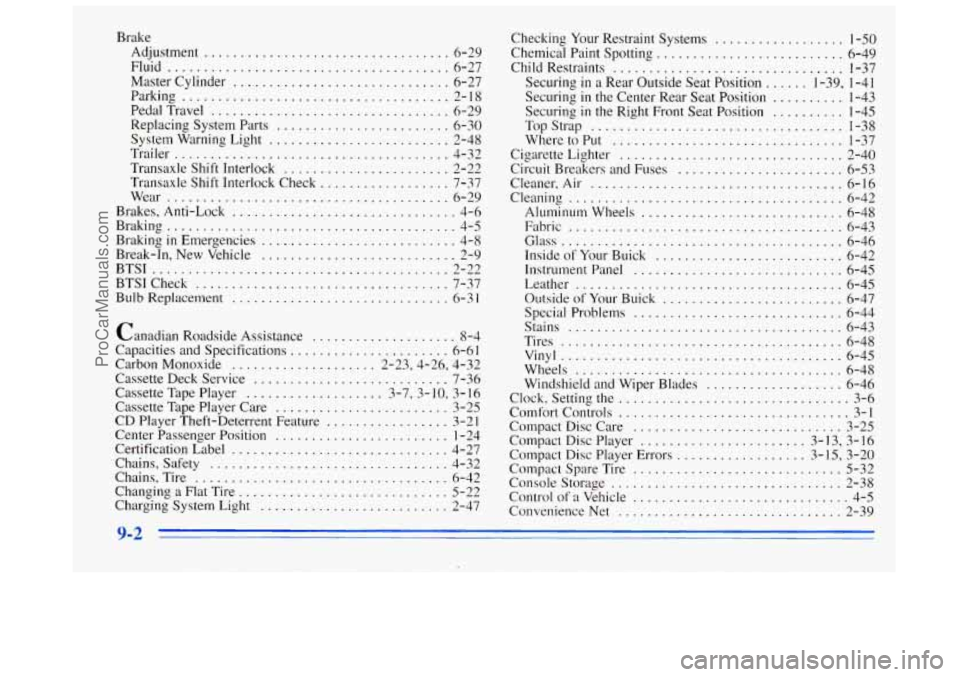
Brake Adjustment
.................................. 6-29
Fluid
....................................... 6-27
Master Cylinder
.............................. 6-27
Parking
..................................... 2-1 8
PedalTravel
................................. 6-29
Replacing System Parts
........................ 6-30
System Warning Light
......................... 2-48
Trailer
...................................... 4-32
Transaxle Shift Interlock
....................... 2-22
Transaxle Shift Interlock Check
.................. 7-37
Wear
....................................... 6-29
Brakes, Anti-Lock
............................... 4-6
Braking
........................................ 4-5
Break-In, New Vehicle
........................... 2-9
Bulb Replacement
.............................. 6-3 1
Braking in Emergencies ........................... 4-8
BTSI
......................................... 2-22
BTSICheck
................................... 7-37
Canadian Roadside Assistance
.................... 8-4
Capacities and Specifications
...................... 6-6 I
Carbon Monoxide .................... 2-23,4-26, 4-32
Cassette Deck Service
........................... 7-36
Cassette Tape Player
................... 3-7,3-10, 3-16
Cassette Tape Player Care
........................ 3-25
CD Player Theft-Deterrent Feature
................. 3-2 1
Center Passenger Position ........................ 1-24
Certification Label
.............................. 4-27
Chains, Safety
................................. 4-32
Chains, Tire
................................... 6-42
Changing
a Flat Tire ............................. 5-22
Charging System Light
.......................... 2-47 Checking
Your Restraint Systems
.................. 1-50
Chemical Paint Spotting .......................... 6-49
Child Restraints
................................ 1-37
Securing
in a Rear Outside Seat Position ...... 1-39. 1-41
Securing in the Center Rear Seat Position .......... 1-43
Securing
in the Right Front Seat Position .......... 1-45
TopStrap
................................... 1-38
Where to Put
................................ 1-37
Cigarette Lighter
............................... 2-40
Circuit Breakers
and Fuses ....................... 6-53
Cleaner. Air
................................... 6-16
Cleaning ...................................... 6-42
Aluminum Wheels
............................ 6-48
Fabric
...................................... 6-43
Glass
....................................... 6-46
Inside of Your Buick
.......................... 6-42
Instrument Panel
............................. 6-45
Leather
..................................... 6-45
Outside
of Your Buick ......................... 6-47
Special Problems
............................. 6-44
Stains
...................................... 6-43
Tires
....................................... 6-48
Vinyl ....................................... 6-45
Wheels
..................................... 6-48
Windshield and Wiper Blades
................... 6-46
Clock. Setting the
................................ 3-6
Comfort Controls
................................ 3-1
Compact Disc Care
............................. 3-25
Compact: Disc Player ....................... 3- 13. 3-16
Compact Disc Player Errors
.................. 3- 15. 3-20
Compact Spare Tire
............................. 5-32
Console Storage
................................ 2-38
Control
of a Vehicle .............................. 4-5
Convenience Net
............................... 2-39
ProCarManuals.com