brake BUICK REGAL 1996 Owners Manual
[x] Cancel search | Manufacturer: BUICK, Model Year: 1996, Model line: REGAL, Model: BUICK REGAL 1996Pages: 356, PDF Size: 17.97 MB
Page 12 of 356
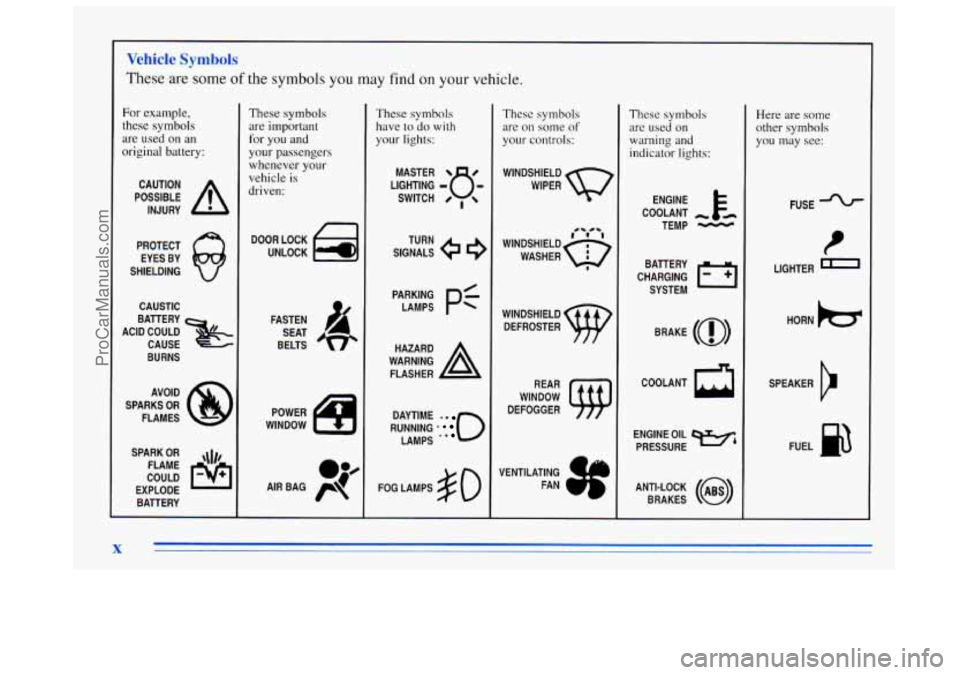
Ve hide bols
These are some of the symbols you may find on your vehicle.
For example,
these symbols
are used on an
original battery:
POSSIBLE A
CAUTION
INJURY
PROTECT EYES BY
SHIELDING
CAUSTIC
BURNS AVOID
SPARKS
OR
FLAMES
SPARK
OR ,\I/,
COULD FLAME
EXPLODE BATTERY
These symbols
are important
for you and
your passengers
whenever
your
vehicle is
driven:
DOOR LOCK
UNLOCK
FASTEN SEAT
BELTS
POWER
WINDOW
These symbols have to do
with
your lights:
SIGNALS e
TURN
RUNNING
* 0
DAYTIME ..
LAMPS .*
FOG LAMPS # 0
These symbols
are
on some of
your controls:
WINDSHIELD
WIPER
WINDSHIELD DEFROSTER
WINDOW
DEFOGGER
VENTILATING FAN
1 d J
These symbols
are used on
warning and
indicator lights:
ENGINE F-
COOLANT -
TEMP -
CHARGING I-1
BAllERY
SYSTEM
BRAKE
(a)
COOLANT a
ENGINE OIL e,
PRESSURE
ANTI-LOCK
(@)
BRAKES
Here are some
other symbols
you may see:
FUSE
t
LIGHTER n
HORN hs
SPEAKER
b
FUEL p3
ProCarManuals.com
Page 75 of 356
If you accidentally use a key that has a damaged or
missing resistor pellet, the starter won’t work, and the
SECURITY light will flash. But you don’t have to wait
three minutes before trying another ignition key.
See your Buick dealer
or a locksmith who can service
the PASS-Key
I1 to have a new key made.
If you’re ever driving and the SECURITY light comes
on, you will be able to restart your engine if you turn it
off. Your PASS-Key I1 system, howevcr, is not working
properly and must be serviced by your Buick dealer. Your
vehicle is not protected by the PASS-Key I1 system.
If you lose or damage a PASS-Key I1 ignition key, see
your Buick dealer or a locksmith who can service
PASS-Key I1 to have a new key made.
New Vehicle CCBreak-InSS
NOTICE:
Your modern Buick doesn’t need an elaborate
“break-in.” But it will perform better in the long
run if you follow these guidelines:
0 Don’t drive at any one speed -- fast or
slow -- for the first 500 miles (804 km).
Don’t make full-throttle starts.
200 miles (322 km) or so. During this time
your new brake linings aren’t yet broken
in. Hard stops with new linings can mean
premature wear and earlier replacement.
Follow this breaking-in guideline every
time you get new brake linings.
See “Towing
a Trailer’’ in the Index for
more information.
0 Avoid making hard stops for the first
0 Don’t tow a trailer during break-in.
ProCarManuals.com
Page 80 of 356
Automatic Transaxle Operation
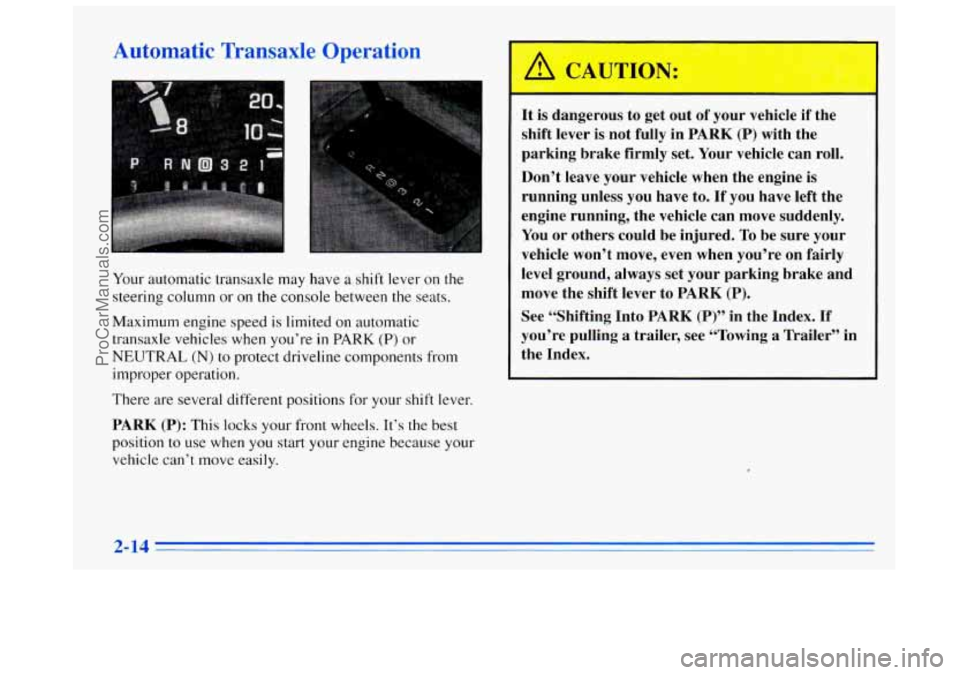
Your automatic transaxle may have a shift lever on the
steering column
or on the console between the seats.
Maximum engine speed is limited
on automatic
transaxle vehicles when you’re
in PARK (P) or
NEUTRAL (N) to protect driveline components from
improper operation.
There are several different positions for your shift lever.
PARK (P): This locks your front wheels. It’s the best
position to use
when you start your engine because your
vehicle can’t move easily.
It is dangerous to get out of your vehicle if the
shift lever is not fully in
PARK (P) with the
parking brake firmly set. Your vehicle can roll.
Don’t leave your vehicle when the engine is
running unless you have to.
If you have left the
engine running, the vehicle can move suddenly.
You or others could be injured.
To be sure your
vehicle won’t move, even when you’re on fairly
level ground, always
set your parking brake and
move the shift lever to
PARK (P).
See “Shifting Into PARK (P)” in the Index. If
you’re pulling a trailer, see “Towing a Trailer” in
the Index.
ProCarManuals.com
Page 81 of 356
Make sure the shift lever is fully into PARK (P)
range before starting the engine. Your Buick has a
brake-transaxle shift interlock. You must fully apply
your regular brakes before you can shift from PARK
(P)
when the ignition is in RUN. If you cannot shift out of
PARK (P), ease pressure on the shift lever by pushing it
all the way into PARK (P) while keeping the brake pedal
pushed down. Release the shift lever button
if you have
a console shift. Then move the shift lever
out of
PARK (P), being sure to press the shift lever button if
you have a console shift. See “Shifting Out of
PARK (P)” in the Index.
REVERSE (R): Use this gear to back up.
NOTICE:
I
Shifting to REVERSE (R) while your vehicle is
moving forward could damage your transaxle.
Shift to REVERSE (R) only after your vehicle
is stopped.
To rock your vehicle back and forth to get out of snow,
ice or sand without damaging your transaxle,
see
“Stuck: In Sand, Mud, Ice or Snow” in the Index.
NEUTRAL (N): In this position, your engine
doesn’t connect with the wheels. To restart when you’re
already moving, use NEUTRAL (N) only.
Also, use
NEUTRAL
(N) when your vehicle is being towed.
Shifting out of PARK (P) or NEUTRAL (N) while
your engine is “racing” (running
at high speed)
is dangerous. Unless your foot is firmly on the
brake pedal, your vehicle could move very
rapidly. You could lose control and hit people or
objects. Don’t shift out of PARK
(P) or
NEUTRAL
(N) while your engine is racing.
I NOTICE:
r
Damage to your transaxle caused by shifting out
of PARK
(P) or NEUTRAL (N) with the engine
racing isn’t covered by your warranty.
ProCarManuals.com
Page 83 of 356
SECOND (2): This position gives you more power but
lower fuel economy. You can use SECOND
(2) on hills.
It can help control your speed
as you go down steep
mountain roads, but then you would
also want to use
your brakes
off and on.
NOTICE:
Don’t drive in SECOND (2) for more than
25 miles (41 km), or at speeds over 55 mph
(88 km/h), or you can damage your transaxle.
Use AUTOMATIC OVERDRIVE
(@) or
THIRD (3) as much as possible.
Don’t shift into SECOND
(2) unless you are
going slower than
65 mph (105 km/h), or you can
damage your engine. FIRST
(1): This
position gives you even more power
(but lower
fuel economy) than SECOND (2). You can
use it on very steep hills, or in deep snow or mud. If the
shift lever
is put in FIRST ( 1 ), the transaxle won’t shift
into first gear
until the vehicle is going slowly enough.
NOTICE:
If your front wheels can’t rotate, don’t try to
drive. This might happen if you were stuck in
very deep sand or mud or were up against
a solid
object. You could damage your transaxle.
Also, if you stop when going uphill, don’t hold
your vehicle there with only the accelerator
pedal. This could overheat and damage the
transaxle. Use your brakes or shift into PARK
(P)
to hold your vehicle in position on a hill.
2-17
ProCarManuals.com
Page 84 of 356
Parking Brake
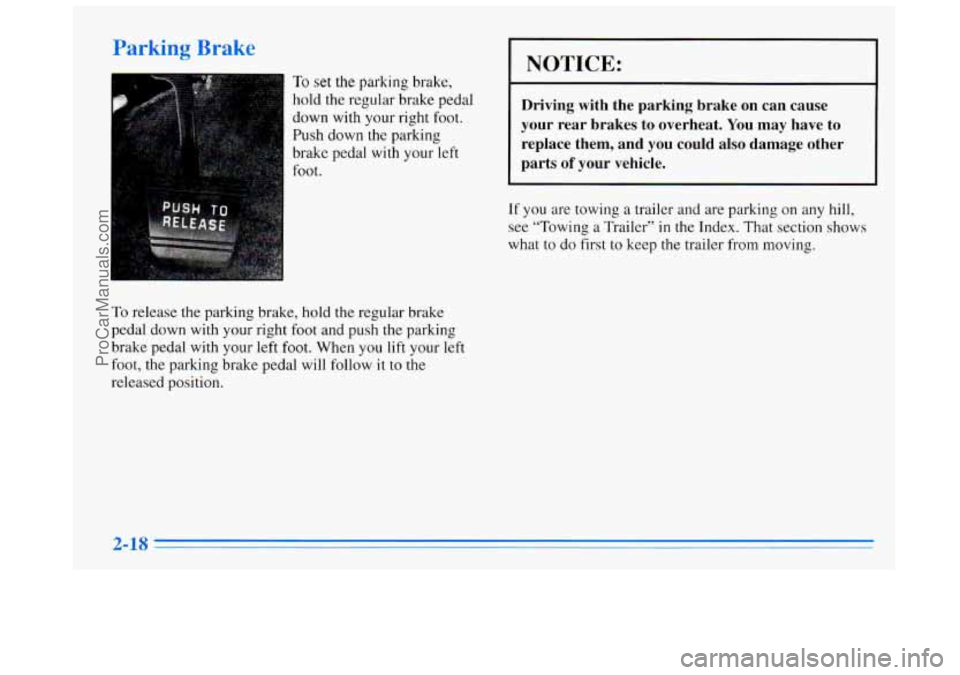
To set the parking brake,
hold the regular brake pedal down with your right foot.
Push down the parking
brake pedal with your left
foot.
NOTICE:
Driving with the parking brake on can cause
your rear brakes
to overheat. You may have to
replace them, and you could also damage other
parts
of your vehicle.
If you are towing a trailer and are parking on any hill,
see “Towing a Trailer” in the Index. That section shows
what to
do first to keep the trailer from moving.
To release the parking brake, hold the regular brake
pedal down with your right foot and push the parking
brake pedal with your left foot. When you lift your left
foot, the parking brake pedal will follow it to the
released position.
2-18
ProCarManuals.com
Page 85 of 356
Shifting Into PARK (P)
It can be dangerous to get out of your vehicle if
the shift lever is not fully in PARK (P) with the
parking brake firmly set. Your vehicle can roll.
If you have left the engine running, the vehicle
can move suddenly. You
or others could be
injured.
To be sure your vehicle won’t move, even
when you’re on fairly level ground, use the steps
that follow. If you’re pulling a trailer, see
“Towing a Trailer’’ in the Index.
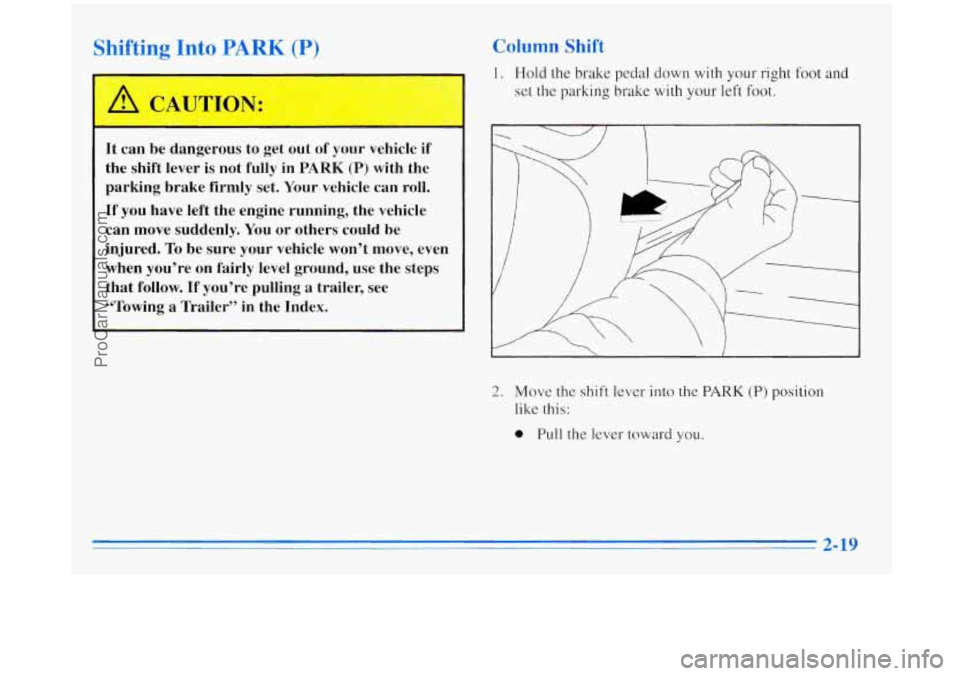
Column Shift
1. Hold the brake pedal down with your right foot and
set the parking brake with your left foot.
I-
2. Move the shift lever into the PARK (P) position
like this:
0 Pull the lever toward you.
ProCarManuals.com
Page 86 of 356
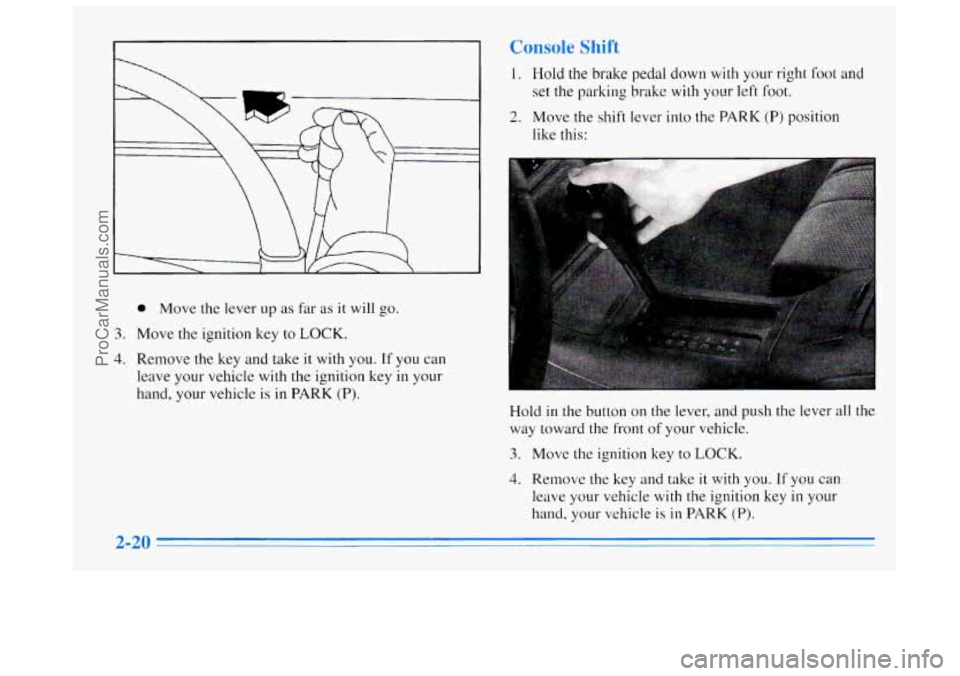
0 Move the lever up as far as it will go.
3.
4.
Move the ignition key to LOCK.
Remove the key and take
it with you. If you can
leave your vehicle with
the ignition key in your
hand, your vehicle
is in PARK (P).
lift
1. Hold the brake pedal down with your right foot and
set the parking brake with your left foot.
2. Move the shift lever into the PARK (P) position
like this:
Hold in the button on the lever, and push the lever all the
way toward the front of your vehicle.
3. Move the ignition key to LOCK.
4. Remove the key and take it with you. If you can
leave your vehicle
with the ignition key in your
hand, your vehicle
is in PARK (P).
ProCarManuals.com
Page 87 of 356
Leaving Your Vehicle With the Engine
Running
It can be dangerous to leave your vehicle with
the engine running. Your vehicle could move
suddenly if the shift lever is not fully in PARK
(P)
with the parking brake firmly set. And, if you
leave the vehicle with the engine running, it could
overheat and even catch fire. You
or others could
be injured. Don’t leave your vehicle with the
engine running unless you have to.
If you have to leave your vehicle with the engine
running, be sure your vehicle is
in PARK (P) and your
parking brake is firmly set before you leave
it. After
you’ve moved the shift lever into the PARK
(P)
position, hold the regular brake pedal down. Then, see if
you can move the shift lever away from PARK (P)
without first pulling it toward you (or, if you have the
console shift lever, without first pushing the button). If
you can, it means that the shift lever wasn’t fully locked
into PARK
(P).
Torque Lock
If you are parking on a hill and you don’t shift your
transaxle into PARK (P) properly, the weight of the
vehicle
may put too much force on the parking pawl in
the transaxle.
You may find it difficult to pull the shift
lever out
of PARK (P). This is called “torque lock.” To
prevent torque lock, set the parking brake and then shift
into PARK
(P) properly before you leave the driver’s
seat. To find out how, see “Shifting Into PARK
(P)” in
the Index.
When you are ready to drive, move
the shift lever out of
PARK (P)
bqfore you release the parking brake.
If torque lock does occur, you may need to have another
vehicle push yours
a little uphill to take some of the
pressure from the transaxle,
so you can pull .the shift
lever out of PARK (P).
ProCarManuals.com
Page 88 of 356
Shifting Out of PARK (P)
Your Buick has a brake-transaxle shift interlock. You
must fully apply your regular brakes before you can
shift from PARK (P) when the ignition is in RUN. See
“Automatic Transaxle Operation”
in the Index.
If you cannot shift out of PARK (P), ease pressure on
the shift lever by pushing it all the way into PARK (P)
while keeping the brake pedal pushed down. Release the
shift lever button if you have
a console shift. Then move
the shift lever
out of PARK (P), being sure to press the
shift lever button
if you have a console shift.
If
you ever hold the brake pedal down but still can’t
shift out
of PARK (P), try this:
1.
2.
3.
4.
5.
Turn the key to OFF.
Apply and hold the brake until the end of Step 4.
Shift to NEUTRAL (N).
Start the engine and shift to the drive gear
you want.
Have the vehicle fixed as soon as you can.
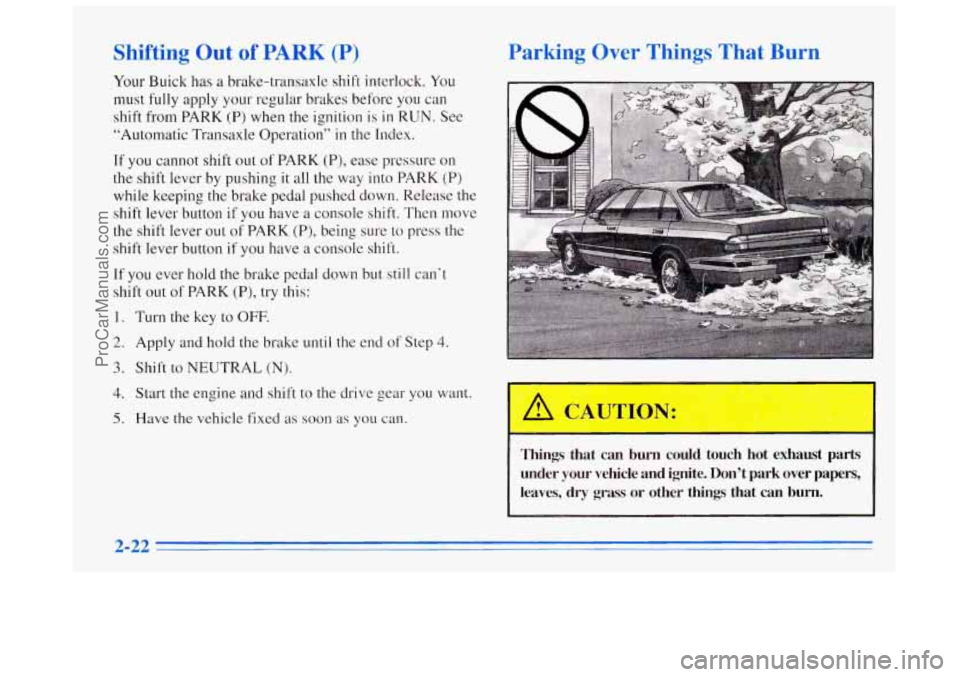
Parking Over Things That Burn
I
Things that can burn could touch hot exhaust parts
under your vehicle and ignite. Don’t park over papers,
leaves, dry grass or other things that can burn.
2-22
ProCarManuals.com