oil level BUICK REGAL 1996 Owners Manual
[x] Cancel search | Manufacturer: BUICK, Model Year: 1996, Model line: REGAL, Model: BUICK REGAL 1996Pages: 356, PDF Size: 17.97 MB
Page 121 of 356
Sometimes when the engine is idling at a stop, the
light may blink on and off. This is normal.
Don’t keep driving if the oil pressure is low. If
you do, your engine can become so hot that it
catches fire. You or others could be burned.
Check your oil as soon as possible and have your
vehicle serviced.
NOTICE:
Damage to your engine from neglected oil
problems can be costly and is not covered by
your warranty.
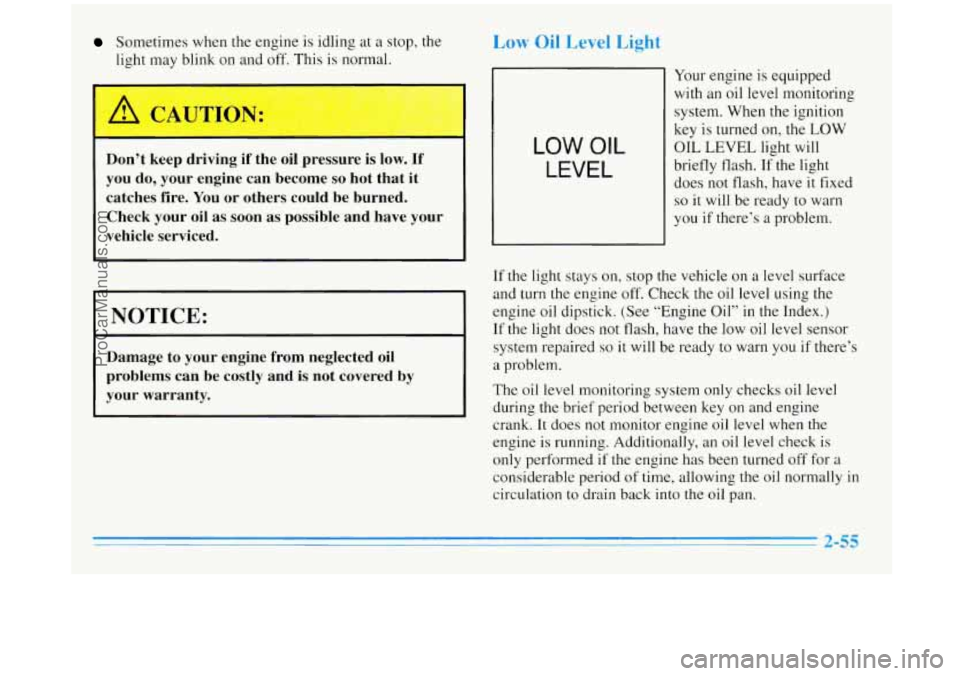
Low Oil Level Light
LOW OIL
LEVEL
Your engine is equipped
with
an oil level monitoring
system. When the ignition
key is turned on, the LOW
OIL LEVEL light will
briefly flash. If the light
does not flash, have
it fixed
so it will be ready to warn
you
if there’s a problem.
If
the light stays on, stop the vehicle on a level surface
and turn
the engine off. Check the oil level using the
engine oil dipstick. (See “Engine Oil” in the Index.)
If the light does
not flash, have the low oil level sensor
system repaired
so it will be ready to warn you if there’s
a problem.
The oil level monitoring system only checks oil level
during the brief period between key on and engine
crank. It does not monitor engine oil level when the
engine is running. Additionally, an oil level check is
only performed
if the engine has been turned off for a
considerable period
of time, allowing the oil normally in
circulation to drain back into the oil pan.
2-55
ProCarManuals.com
Page 172 of 356
Here are some things you can check before a trip:
0
0
0
0
0
0
0
Windsh.ield Washer Fluid: Is the reservoir full? Are
all windows clean inside and outside?
Wiper Blades: Are they in good shape?
Fuel, Engine Oil, Other Fluids: Have you checked
all levels?
Lamps: Are they all working? Are the lenses clean?
Tires: They are vitally important to a safe,
trouble-free trip.
Is the tread good enough for
long-distance driving? Are
the tires all inflated to the
recommended pressure?
Weather Forecasts: What’s the weather outlook
along your route? Should you delay your trip
a short
time to avoid a major storm system?
Maps: Do you have up-to-date maps?
Highway Hypnosis
Is there actually such a condition as “highway hypnosis”?
Or is
it just plain falling asleep at the wheel? Call it
highway hypnosis, lack
of awareness, or whatever.
There is something about an easy stretch of road with the
same scenery, along with the hum of the tires
on the road,
the drone of the engine, and the rush of the wind against
the vehicle that can make
you sleepy. Don’t let it happen
to you!
If it does, your vehicle can leave the road in less
than
a second, and you could crash and be injured.
What can you do about highway hypnosis? First, be
aware that it can happen.
Then here are some tips:
0
0
0
Make sure your vehicle is well ventilated, with a
comfortably cool interior.
Keep your eyes moving. Scan
the road ahead and to
the sides. Check your rearview mirrors and your
instruments frequently.
If you get sleepy, pull off the road into a rest, service
or parking area and take a nap, get some exercise, or
both. For safety, treat drowsiness on the highway as
an emergency.
4-20
ProCarManuals.com
Page 203 of 356
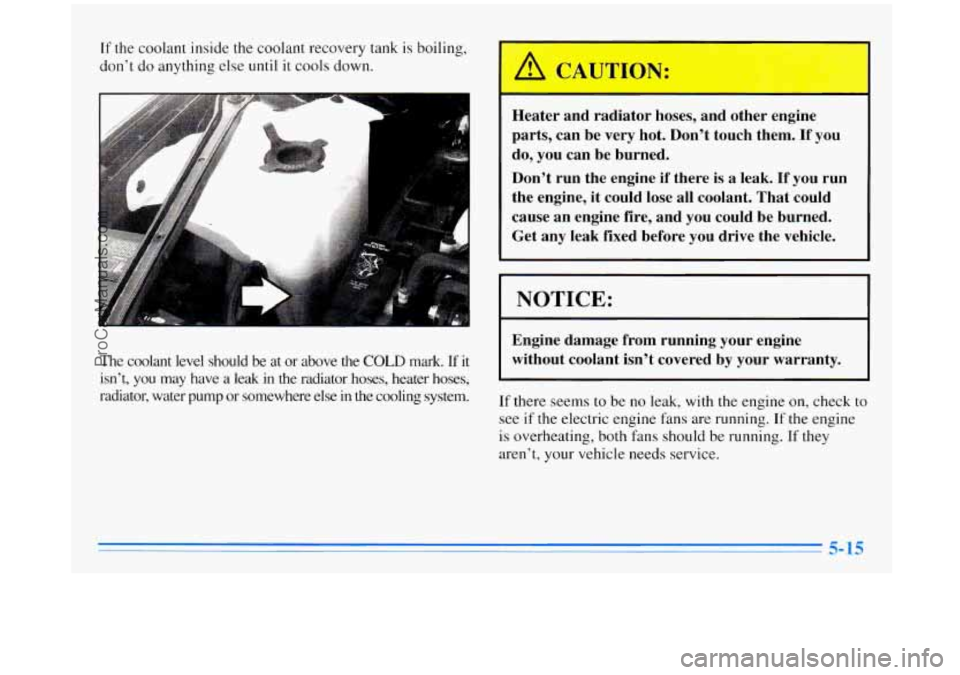
If the coolant inside the coolant recovery tank is boiling,
don’t do anything else until it cools down.
The coolant level should be at or above the COLD mark. If it
isn’t, you may have a leak in the radiator hoses, heater hoses,
radiator, water
pump or somewhere else in the cooling system.
Heater and radiator hoses, and other engine
parts, can be very hot. Don’t touch them.
If you
do, you can be burned.
Don’t run the engine if there is
a leak. If you run
the engine, it could lose all coolant. That could
cause an engine
fire, and you could be burned.
Get any leak fixed before you drive the vehicle.
I NOTICE:
Engine damage from running your engine
without coolant isn’t covered by your warranty.
If there seems to be no leak, with the engine on, check to
see
if the electric engine fans are running. If the engine
is overheating, both fans should be running. If they
aren’t, your vehicle needs service.
ProCarManuals.com
Page 204 of 356
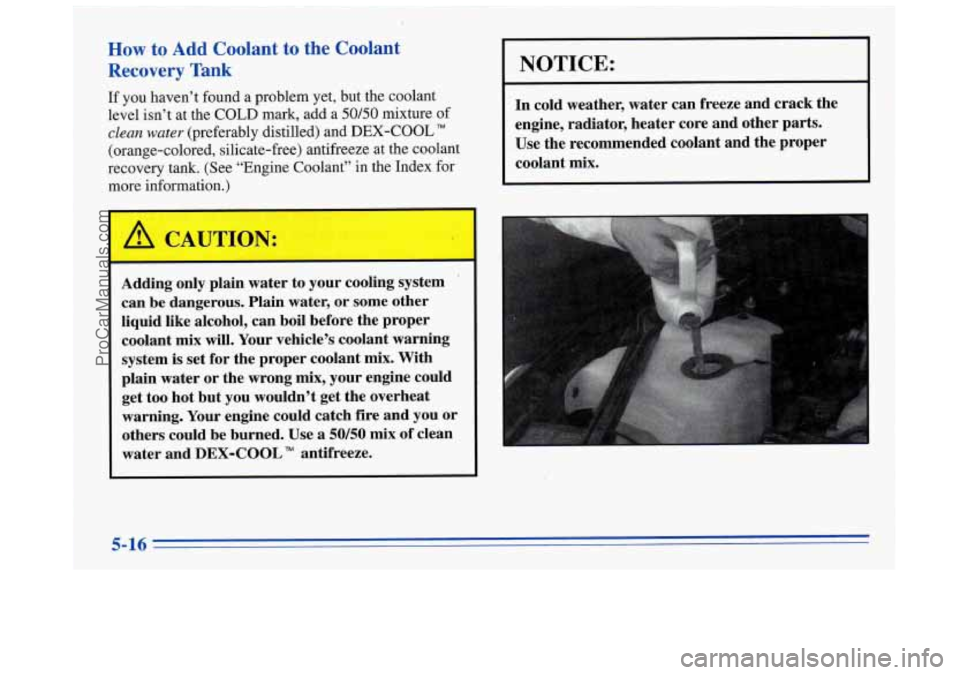
How to Add Coolant to the Coolant
Recovery Tank
If you haven’t found a problem yet, but the coolant
level isn’t at the COLD mark, add a
50/50 mixture of
clean water (preferably distilled) and DEX-COOL TM
(orange-colored, silicate-free) antifreeze at the coolant
recovery tank. (See “Engine Coolant” in the Index for
more information.)
I
Adding only plain water to your cooling system ‘
can be dangerous. Plain water, or some other
liquid like alcohol, can boil before the proper
coolant
mix will. Your vehicle’s coolant warning
system is set for the proper coolant
mix. With
plain water or the wrong mix, your engine could
get
too hot but you wouldn’t get the overheat
warning. Your engine could catch fire and you or
others could be burned. Use a
50/50 mix of clean
water and
DEX-COOL TM antifreeze.
NOTICE:
In cold weather, water can freeze and crack the
engine, radiator, heater core and other parts.
.Use the recommended coolant and the proper
coolant mix.
ProCarManuals.com
Page 232 of 356
Before closing the hood, be sure all the filler caps are
on properly. Then just pull the hood down and close
it firmly.
hgine
If the LOW OIL LEVEL
light on the instrument
panel comes on, it means
you need to check your
engine oil
level right away.
For more information, see
“Low Oil Level Light” in
LOW OIL
LEVEL
the Index.
You should check your engine oil level regularly; this is
an added reminder.
It’s a good idea to check your engine oil after you get
fuel. In order to get an accurate reading, the oil must be
hot and the vehicle must be on level ground. 3.1L
LS2 (Code
M) Engine
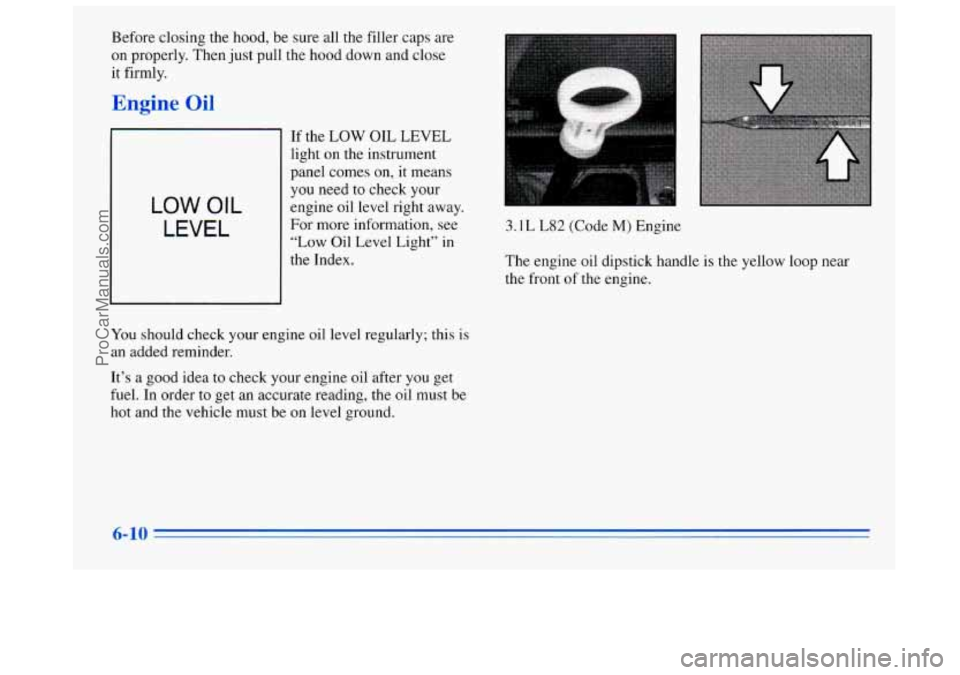
The engine oil dipstick handle is the yellow loop near
the front
of the engine.
6-10
ProCarManuals.com
Page 233 of 356
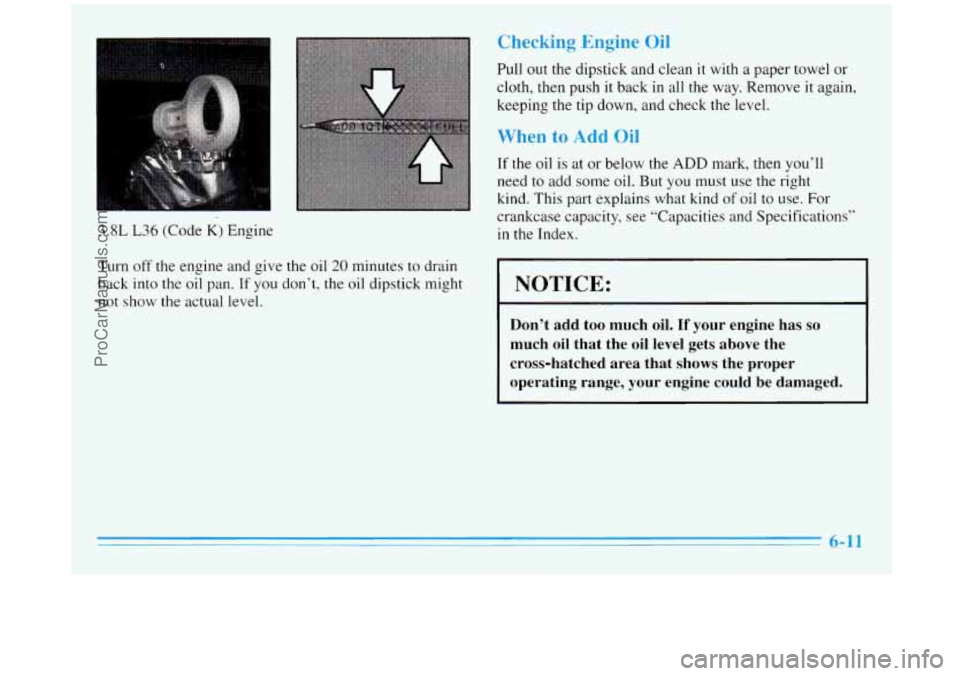
3.8L L36 (Code K) Engine
Checking Engine Oil
Pull out the dipstick and clean it with a paper towel or
cloth, then push it back in all the way. Remove
it again,
keeping the tip down, and check the level.
When to Add Oil
If the oil is at or below the ADD mark, then you’ll
need to add some oil. But
you must use the right
kind. This part explains what kind
of oil to use. For
crankcase capacity, see “Capacities and Specifications”
in the Index.
Turn off the engine and give the oil
20 minutes to drain
back into
the oil pan. If you don’t, the oil dipstick might
not show the actual level. NOTICE:
Don’t add too much oil. If your engine has so
much oil that the oil level gets above the
cross-hatched area that
shows the proper
operating range, your engine could be damaged.
6-11
ProCarManuals.com
Page 234 of 356
I
I
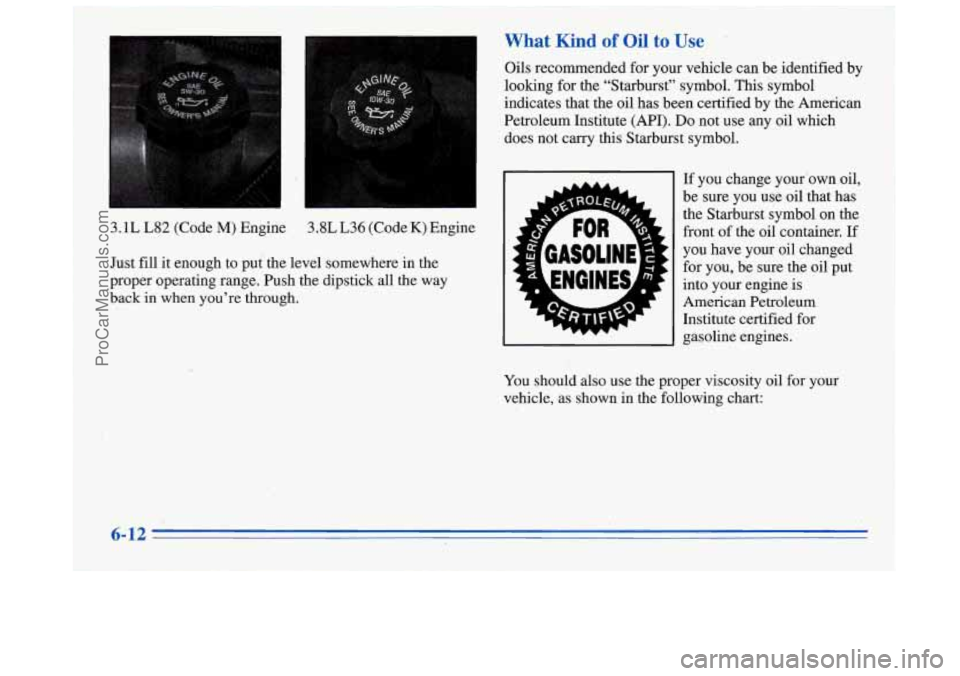
3.1L L82 (Code M) Engine 3.8L L36 (CodeK) Engine
Just
fill it enough to put the level somewhere in the
proper operating range. Push the dipstick all the way
back
in when you’re through.
What Kind of Oil to Use
Oils recommended for your vehicle can be identified by
looking for the “Starburst” symbol.
This symbol
indicates that the oil has been certified by the American
Petroleum Institute
(API). Do not use any oil which
does not carry this Starburst symbol.
If you change your ’own oil,
be sure you use oil that has
the Starburst symbol on the
front
of the oil container. If
you have your oil changed
for you, be sure the oil put
into your engine is
American Petroleum
Institute certified for
You should also use the proper viscosity oil for your
vehicle, as shown in the following chart:
i I
ProCarManuals.com
Page 239 of 356
L
Operating the engine with the air cleaner off
can cause you or others to be burned. The air
cleaner not only cleans the air, it stops flame if
the engine backfires.
If it isn’t there, and the
engine backfires, you could be burned. Don’t
drive with it
off, and be careful working on the
engine with the air cleaner
off.
NOTICE:
If the air cleaner is off, a backfire can cause a
damaging engine fire. And, dirt can easily get into your engine, which will damage it. Always
have the air cleaner in place when you’re driving.
Automatic Transaxle Fluid
When to Check and Change
A good time to check your automatic transaxle fluid
level is when the engine
oil is changed.
Change both the fluid and filter every
50,000 miles
(83 000 km) if the vehicle is mainly driven under one or
more of these conditions:
0 In heavy city traffic where the outside temperature
regularly reaches
90°F (32°C) or higher.
In hilly or mountainous ten-ain.
When doing frequent trailer towing.
Uses such as found in taxi, police or delivery service.
If you do not use your vehicle under any of these
conditions, the fluid and filter do not require changing.
See “Scheduled Maintenance Services”
in the Index.
6-17
ProCarManuals.com
Page 242 of 356
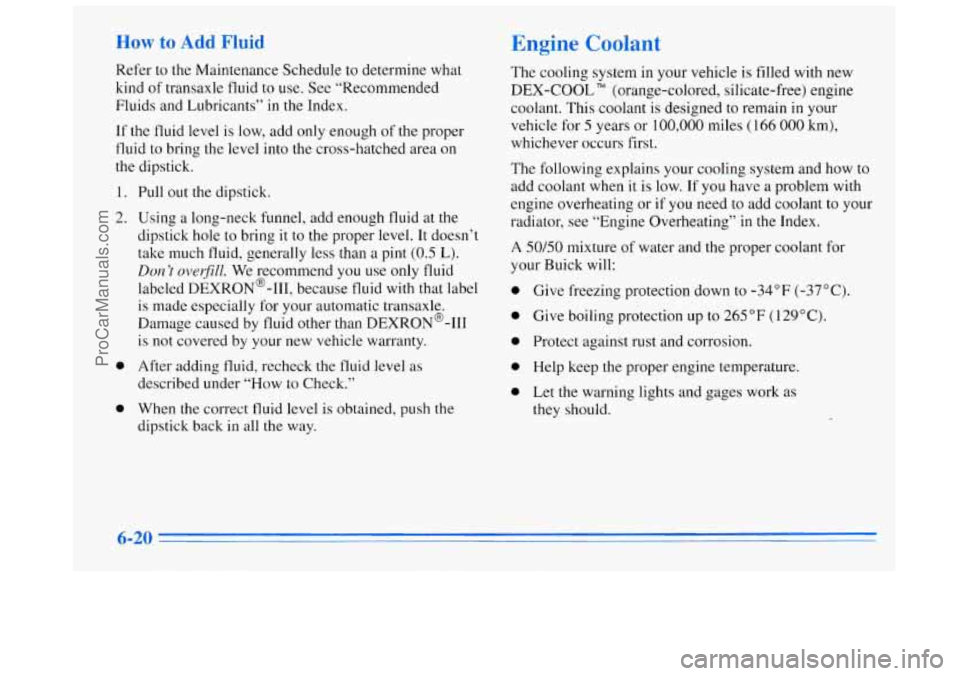
How to Add Fluid
Refer to the Maintenance Schedule to determine what
kind
of transaxle fluid to use. See “Recommended
Fluids and Lubricants’’
in the Index.
If the fluid level is low, add
only enough of the proper
fluid to bring the level into the cross-hatched area on
the dipstick.
1.
2.
0
0
Pull out the dipstick.
Using
a long-neck funnel, add enough fluid at the
dipstick hole to bring
it to the proper level. It doesn’t
take much fluid, generally less than a pint
(0.5 L).
Don t overfill. We recommend you use only fluid
labeled DEXRONO-111, because fluid with that label
is made especially for your automatic transaxle.
Damage caused by fluid other than DEXRON@-I11
is not covered by your new vehicle warranty.
After adding fluid, recheck the fluid level
as
described under “How to Check.”
When
the correct fluid level is obtained, push the
dipstick back in all the way.
Engine Coolant
The cooling system in your vehicle is filled with new
DEX-COOL
TM (orange-colored, silicate-free) engine
coolant. This coolant
is designed to remain in your
vehicle for
5 years or 100,000 miles (166 000 km),
whichever occurs first.
The following explains your cooling system and how to
add coolant when
it is low. If you have a problem with
engine overheating or
if you need to add coolant to your
radiator, see “Engine Overheating” in the Index.
A 50/50 mixture of water and the proper coolant for
your Buick will:
Give freezing protection down to
-34°F (-37°C).
Give boiling protection up
to’ 265 “F ( 129” C).
Protect against rust and corrosion.
Help keep the proper engine temperature.
Let the warning lights and gages work as
they should.
ProCarManuals.com
Page 283 of 356
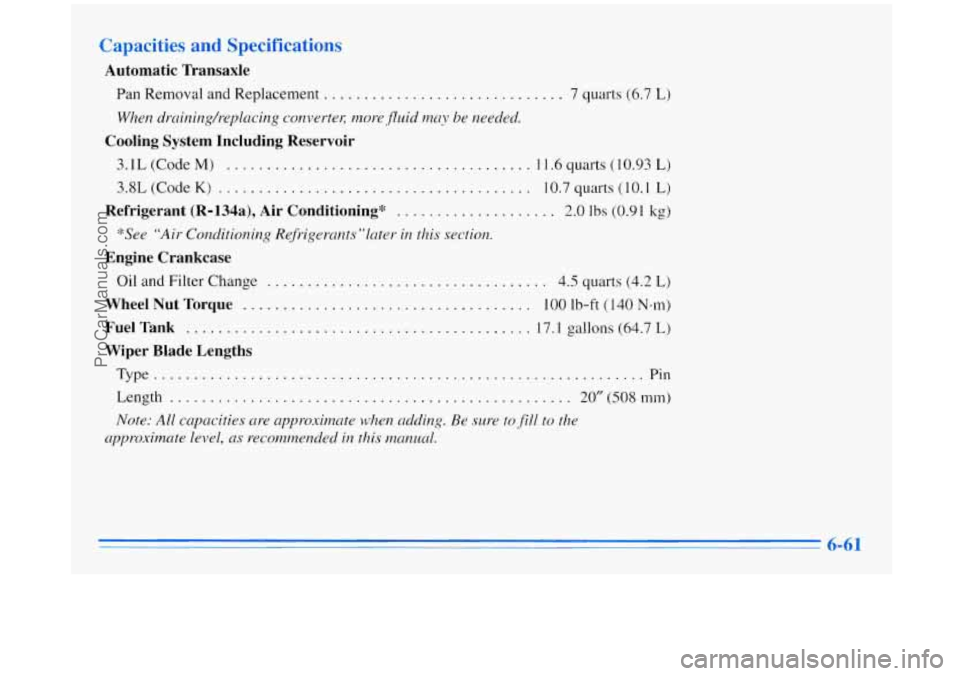
Capacities and Specifications
Automatic Transaxle
Pan Removal and Replacement .............................. 7 quarts (6.7 L)
When draiizilzg/replacil.Ig convertec more,fluid may be needed.
Cooling System Including Reservoir
3.1L(CodeM) ...................................... 11.6quarts(10.93L)
3.8L (Code
K) ....................................... 10.7 quarts (10.1 L)
Refrigerant (R-l34a), Air Conditioning* .................... 2.0 lbs (0.91 kg)
*See “Air Conditioning Refriger~-lnts”l~~tel- in th,is section.
Engine Crankcase
Oil and Filter Change ................................... 4.5 quarts (4.2 L)
Wheel Nut Torque .................................... 100 Ib-ft (140 N.m)
Fuel Tank ........................................... 17.1 gallons (64.7 L)
Wiper Blade Lengths
Type ............................................................. Pin
Length
.................................................. 20”(508mm)
Note: All capacities are approximate when adding. Be sure to Jill to the
approximate level, as recommended in this manual.
6-61
ProCarManuals.com