check engine BUICK REGAL 1997 Owner's Manual
[x] Cancel search | Manufacturer: BUICK, Model Year: 1997, Model line: REGAL, Model: BUICK REGAL 1997Pages: 422, PDF Size: 21.34 MB
Page 279 of 422
Adding Equipment to the Outside of
Your Vehicle
Things you might add to the outside of your vehicle can
affect the airflow around it. This may cause wind noise
and affect windshield washer performance. Check with
your Buick dealer before adding equipment
to the
outside
of your vehicle.
Fuel
The 8th digit of your vehicle identification number
(VIN) shows the code letter for your engine. You will
find the VIN at the top left of your instrument panel.
(See “Vehicle Identification Number” in the Index.)
If you have the
3800 engine (VIN Code K), use
regular unleaded gasoline rated at 87 octane or higher.
If you’re using fuel rated at the recommended octane
or higher and you hear heavy knocking, your
engine
needs service. But don’t worry if you hear a
little pinging noise when you’re accelerating or driving
up a hill. That’s normal, and you don’t have to buy a
higher octane fuel to get rid
of pinging. It’s the heavy,
constant knock that means you have a problem.
If you have the 3800 Supercharged engine (VIN
Code l), use premium unleaded gasoline rated at
91 octane or higher. With the 3800 Supercharged
engine, in an emergency,
you may be able to use a
lower octane -- as low as 87 -- if heavy knocking
does not occur.
If you are using 91 or higher octane
unleaded gasoline and you hear heavy knocking, your
engine needs service.
At
a minimum, the gasoline you use should meet
specifications ASTM D48
I4 in the United States
and CGSB
3.5-M93 in Canada. Improved gasoline
specifications have been developed by the American
Automobile Manufacturers Association (AAMA) for
better vehicle performance and engine protection.
Gasolines meeting
the AAMA specification could
provide improved driveability and emission control
system protection compared to other gasolines.
Be sure the posted octane for premium is at least
91
(at least 89 for middle grade and 87 for regular). If the
octane is less than 87, you may get
a heavy knocking
noise when you drive. If it’s bad enough, it can damage
your engine.
ProCarManuals.com
Page 280 of 422
If your vehicle is certified to meet California Emission
Standards (indicated on the underhood emission control
label), it
is designed to operate on fuels that meet
California specifications. If such fuels are not available
in states adopting California emissions standards, your
vehicle will operate satisfactorily on fuels meeting
federal specifications, but emission control system
performance may be affected. The malfunction indicator
lamp on your instrument panel may turn
on and/or
your vehicle may fail a smog-check test. If this occurs,
return to your authorized Buick dealer for diagnosis
to determine the cause of failure. In the event it is
determined that the cause of the condition is the type of
fuels used, repairs may
not be covered by your warranty.
Some gasolines that are not reformulated
for low
emissions contain an octane-enhancing additive called
methylcyclopentadienyl manganese tricarbonyl (MMT);
ask your service station operator whether or not his fuel
contains MMT. General Motors does not recommend the
use of such gasolines.
If fuels containing MMT are used,
spark plug life may be reduced and your emission
control system performance may be affected. The
malfunction indicator lamp
on your instrument panel
may turn on. If this occurs, return to your authorized
Buick dealer for service.
To provide cleaner air, all gasolines in the United States
are now required to contain additives
that will help
prevent deposits from forming in your engine and
fuel
system, allowing your emission control system to
function properly. Therefore, you should not have
to
add anything to the fuel. In addition, gasolines
containing oxygenates, such as ethers and ethanol, and
reformulated gasolines may be available
in your area to
help clean the air. General Motors recommends that you
use these gasolines
if they comply with the
specifications described earlier.
I NOTICE:
Your vehicle was not designed for fuel that
contains methanol. Don’t use it. It can corrode
metal parts
in your fuel system and also damage
plastic and rubber parts. That damage wouldn’t be covered under your warranty.
6-4
ProCarManuals.com
Page 283 of 422
When you put the cap back on, turn it to the right
(clockwise) until
you hear a clicking sound. Make
sure
you fully install the cap. The diagnostic system
can determine
if the fuel cap has been left off or
improperly installed. This would allow fuel to
evaporate into the atmosphere. See “Malfunction
Indicator Lamp” in the Index.
NOTICE:
If you need a new cap, be sure to get the right
type. Your dealer can get one
for you. If you get
the wrong type, it may not
fit properly. This may
cause your malfunction indicator lamp to light
and your
fuel tank and emissions system may be
damaged. See “Malfunction Indicator Lamp” in
the Index.
Checking Things Under the Yood
An electric fan under the hood can start up and
injure you even when the engine is not running.
Keep hands, clothing and tools away from any
underhood electric fan.
Things that burn can get
on hot engine parts and
start a fire. These include liquids like gasoline,
oil, coolant, brake fluid, windshield washer and
other fluids, and plastic or rubber. You or others
could be burned. Be careful not to drop
or spill
things that will burn onto a hot engine.
ProCarManuals.com
Page 287 of 422
Before closing the hood, be sure all the filler caps are
on properly. Then just pull the hood down and close
it firmly.
3800 Supercharged (Code 1) Engine
(If Equipped)
Your Buick may have a 3800 Supercharged engine.
The supercharger is a device which is designed to
pump more air into the engine than it would normally
use. This air is mixed with fuel, which creates increased
engine power. Since the supercharger is a pump and is
driven from an engine accessory drive belt, increased
pressure is available at all driving conditions.
The powertrain control module
(PCM), works with
a vacuum control to regulate the increased pressure
required during specific driving conditions. When
this
increased pressure or boost is not desired, such as during
idling and light throttle cruising, the excess air that the
supercharger
is pumping is routed through a bypass.
All of these controls working together provide high
performance character and fuel efficiency in the
3800 Supercharged L67 engine.
Engine
I --
LOW
OIL
If the LOW OIL light on
the instrument panel comes on, it means you need to
check your engine oil level right away. For more
information, see
“Low Oil
Level Light” in the Index.
You should check your
engine oil level regularly;
this is an added reminder.
It’s
a good idea to check your engine oil every time you
get fuel. In order to get an accurate reading, the oil must
be warm and the vehicle must be on level ground.
6-11
ProCarManuals.com
Page 288 of 422
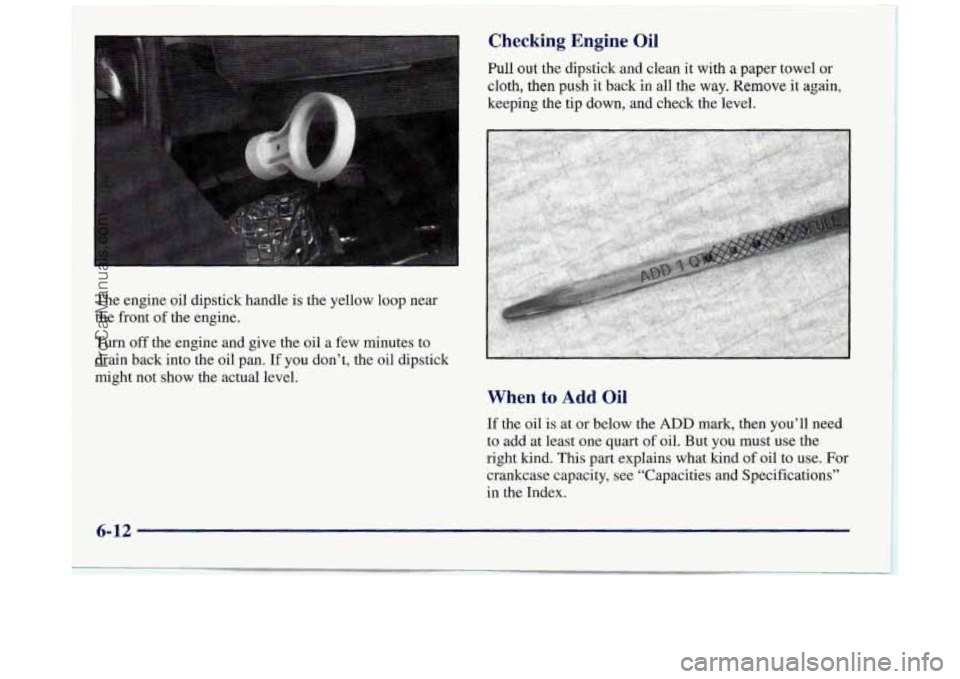
The engine oil dipstick handle is the yellow loop near
the front of
the engine.
Turn off the engine and give the oil a few minutes to
drain back into the oil pan. If you don’t, the oil dipstick
might not show the actual level.
Checking Engine Qil
Pull out the dipstiik and clean it with a paper tuwel or
cloth, then push it back iri all the way. Remove it again,
keeping the tip down, ;and check the level.
When to Add Oil
If the oil is at or below the ADD mark, then you’ll need
to add at least one quart of oil. But you must use the
right kind. This part explains what kind of oil to use. For
crankcase capacity, see “Capacities and Specifications”
in
the Index.
6-12
ProCarManuals.com
Page 292 of 422
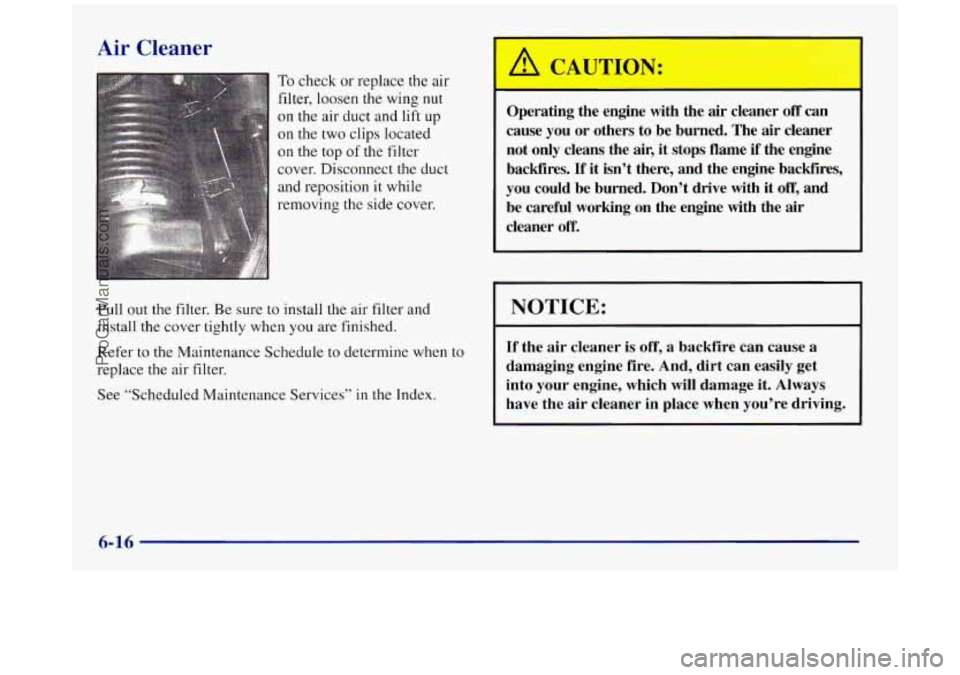
Air Cleaner
To check or replace the air
filter, loosen the wing nut
on the
air duct and lift up
on the
two clips located
on the top of the filter
cover, Disconnect the duct
and reposition it while
removing the side cover.
r
Operating the engine with the air cleaner off can
cause you or others to be burned. The air cleaner
not only cleans the air, it stops flame if the engine
backfires.
If it isn’t there, and the engine backfires,
you could be burned. Don’t drive with it
off, and
be careful working on the engine with the air
cleaner
off.
Pull out the filter. Be sure to install the air filter and NOTICE:
install the cover tightly when you are finished.
Refer to the Maintenance Schedule to determine when to
If the air cleaner is off, a backfire can cause a
replace the air filter. damaging engine fire. And, dirt can easily get
I
See “Scheduled Maintenance Services” in the Index.
I
into your engine, which will damage it. Always
have the air cleaner in place when you’re driving.
I
6-16
ProCarManuals.com
Page 294 of 422
Supercharger Oil
Unless you are technically qualified and have the proper
tools, you should let your dealer or a qualified service
center perform this maintenance.
When to Check
Check oil level every 30,000 miles (50 000 km) or every
36 months, whichever occurs first.
What Kind of Oil to Use
See “Recommended Fluids and Lubricants’’ in the Index
and use only the recommended oil.
How to Check and Add Oil
Check oil only when the engine is cold. Allow the
engine to cool two to three hours after running.
If you remove the supercharger oil fill plug while
the engine is hot, pressure may cause
hot oil to
blow out
of the oil fill hole. You may be burned.
Do not remove the plug until the engine cools.
1.
2.
3.
3.
Clean the area around the oil fill plug before
removing it.
Remove
the oil fill plug using a 3/16 inch Allen
wrench.
The oil level is correct when
it just reaches the
bottom
of the threads of the inspection hole.
Replace the oil plug with the O-ring
in place.
Torque to
88 lb-in (10 N-m).
6-18
ProCarManuals.com
Page 295 of 422
Automatic Transaxle Fluid
When to Check and Change
A good time to check your automatic transaxle fluid
level is when the engine oil is changed.
Change both the fluid and filter
every 50,000 miles
(83
000 km) if the vehicle is mainly driven under one
or more of these conditions:
In heavy city traffic where the outside temperature
regularly reaches
90°F (32°C) or higher.
In hilly or mountainous terrain.
When doing frequent trailer towing.
Uses such as found in taxi, police or delivery service.
If you do not use your vehicle under any of these
conditions, the fluid and filter
do not require changing.
See “Scheduled Maintenance Services” in the Index.
How to Check
Because this operation can be a little difficult, you may
choose to have this done at your Buick dealership
Service Department.
If
you do it yourself, be sure to follow all the
instructions here,
or you could get a false reading on
the dipstick.
I I
I NOTICE:
Too much or too little fluid can damage your
transaxle.
Too much can mean that some of the
fluid could come out and fall on hot engine parts
or exhaust system parts, starting a fire. Be sure to
get an accurate reading if you check your
transaxle fluid.
6-19
.~ -
ProCarManuals.com
Page 296 of 422
Wait at least 30 minutes before checking the transaxle
fluid level
if you have been driving:
When outside temperatures are above 90°F (32°C).
At high speed for quite a while.
In heavy traffic -- especially in hot weather.
While pulling a trailer.
To get the right reading, the fluid should be at normal
operating temperature, which is
180°F to 200°F
(82°C to 93°C).
Get the vehicle warmed up by driving about 15 miles
(24 km) when outside temperatures are above 50°F
(10°C). If it's colder than 50°F (lO"C), you may have
to drive longer.
Checking the Fluid Level
0 Park your vehicle on a level place. Keep the
0 With the parking brake applied, place the shift lever
0 With your foot on the brake pedal, move the shift
engine running.
in PARK
(P).
lever through each gear range, pausing for about
three seconds in each range. Then, position the shift
lever in
PARK (P).
0 Let the engine run at idle for three to five minutes.
Then, without shutting off the engine, follow these steps:
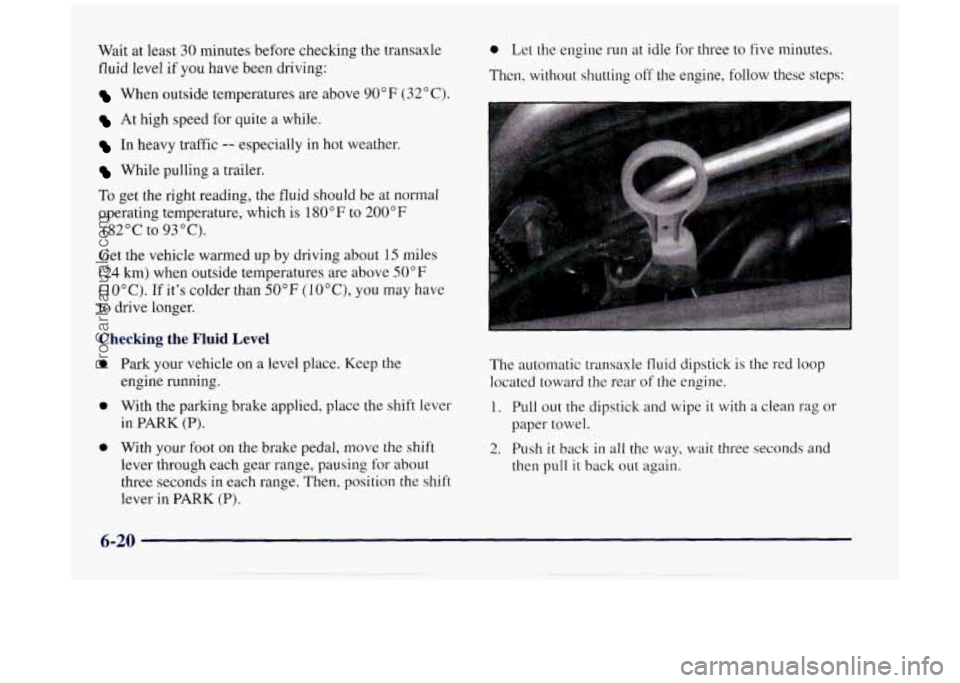
The automatic transaxle fluid dipstick is the red
loop
located toward the rear of the engine.
1. Pull out the dipstick and wipe it with a clean rag or
paper towel.
2. Push it back in all the way, wait three seconds and
then
pull it back out: again.
6-20
ProCarManuals.com
Page 299 of 422
What to Use
Use a mixture of one-half clean wnter (preferably
distilled) and one-half
DEX-COOL@ coolant which
won’t damage aluminum parts.
If you use this mixture,
you don’t need to add anything else.
Adding only plain water to your cooling system
can be dangerous. Plain water, or some other
liquid like alcohol, can boil before the proper coolant mix will. Your vehicle’s coolant warning
system is set for the proper coolant mix. With
plain water
or the wrong mix, your engine could
get too hot but you wouldn’t get the overheat warning. Your engine could catch fire and you or
others could be burned. Use a
50/50 mix of clean
water and
DEX-COOL@ coolant.
NOTICE:
If you use an improper coolant mix, your engine
could overheat and be badly damaged. The
repair cost wouldn’t be covered
by your
warranty.
Too much water in the mix can freeze
and crack the engine, radiator, heater core and
other parts.
If you have to add coolant more than four times a year,
have
your dealer check your cooling system.
NOTICE:
If you use the proper coolant, you don’t have to
add extra inhibitors or additives which claim to
improve the system. These can be harmful.
ProCarManuals.com