brake light BUICK REGAL 1998 User Guide
[x] Cancel search | Manufacturer: BUICK, Model Year: 1998, Model line: REGAL, Model: BUICK REGAL 1998Pages: 388, PDF Size: 20.19 MB
Page 140 of 388
Enhanced Traction System Active Light
When your Enhanced
Traction System is limiting wheel
spin, this light will
LOW TRAC come on.
Slippery road conditions may exist if the Enhanced
Traction System active light comes on,
so adjust your
driving accordingly. The light will stay on for
a few
seconds after the Enhanced Traction System stops
limiting wheel spin.
The Enhanced Traction System active light
also comes
on briefly when you turn the ignition key to
RUN. If the
light doesn’t come on then, have it fixed
so it will be
there to tell you when
the system is active.
Low Traction Light
When your anti-lock system
is adjusting brake pressure
to help avoid
a braking skid,
this light will come on. See
“Anti-Lock Brake System
Active Light” earlier
in
this section.
If you have the Enhanced Traction System or the Traction
Control System, this light will also come
on when the
system
is limiting wheel spin. You may feel or hear the
system working, but this is normal. Slippery road
conditions may exist if the low traction light comes on,
so
adjust your driving accordingly. The light will stay on for
a few seconds after the anti-lock system stops adjusting
brake pressure or the Enhanced Traction System stops
limiting wheel spin. See “Enhanced Traction System” or
“Traction Control System” in the Index.
The low traction light also comes
on briefly when you
turn
the ignition key to RUN. If the light doesn’t come
on then, have
it fixed so it will be there to tell you when
the anti-lock brake system, Traction Control System or
Enhanced Traction System is active.
2-66
ProCarManuals.com
Page 191 of 388
Avoid needless heavy braking. Some people drive in
spurts
-- heavy acceleration followed by heavy
braking
-- rather than keeping pace with traffic. This is a
mistake. Your brakes may not have time to cool between
hard stops. Your brakes will wear out much faster
if you
do a lot of heavy braking. If you keep pace with the
traffic and allow realistic following distances, you will
eliminate a lot of unnecessary braking. That means
better braking and longer brake life.
If your engine ever stops while you’re driving, brake
normally but don’t pump your brakes.
If you do, the
pedal may get harder to push down.
If your engine
stops, you will still have some power brake assist. But
you will use
it when you brake. Once the power assist is
used up,
it may take longer to stop and the brake pedal
will be harder to push.
Anti-Lock Brakes (ABS)
Your vehicle has anti-lock brakes (ABS). ABS is an
advanced electronic braking system that will help
prevent a braking skid.
When you start your engine, or when you begin to drive
away, your anti-lock brake system will check itself. You
may hear a momentary motor or clicking noise while
this test
is going on, and you may even notice that your
brake pedal moves or pulses a little. This is normal.
ANTI -
LOCK
If there’s a problem with the
anti-lock brake system, this
warning light will stay on or
flash. See “Anti-Lock
Brake System Warning
Light”
in the Index.
4-7
ProCarManuals.com
Page 193 of 388
Remember: Anti-lock doesn’t change the time you need
to get your foot up to the brake pedal or always decrease
stopping distance. If you get too close to the vehicle in
front
of you, you won’t have time to apply your brakes
if that vehicle suddenly slows or stops. Always leave
enough room up ahead to stop, even though you have
anti-lock brakes.
Using Anti-Lock
Don’t pump the brakes. Just hold the brake pedal down
firmly and let anti-lock work for you. You may feel a
slight brake pedal pulsation or notice some noise, but
this is normal.
When your anti-lock system
is adjusting brake pressure
to help avoid a braking skid,
this light will come on. See
“Anti-Lock Brake System
Active Light”
in the Index.
Traction Control System
(With
3800 Supercharged Engine)
Your vehicle has a traction control system that limits wheel
spin. This is especially useful in slippery road conditions.
The system operates only if it senses that one or both of
the front wheels are spinning or beginning to lose traction.
When this happens, the system works the front brakes and
reduces engine power to limit wheel spin.
LOW TRAC
This light will come on
when your traction control
system is limiting wheel
spin. See “Traction Control
System Active Light” in
the Index.
You may feel or hear the system working, but this
is normal.
If your vehicle is in cruise control when the traction
control system begins to limit wheel spin, the cruise
control will automatically disengage. When road
conditions allow
you to safely use it again, you may
reengage the cruise control. (See “Cruise Control’’
in the Index.)
4-9
ProCarManuals.com
Page 196 of 388
To turn the system on or
off, press the TRACTION
button on the black panel located directly behind
your automatic transaxle
shift lever.
When
you turn the system off, the Enhanced Traction
System warning light will come on and stay on. If the
Enhanced Traction System is limiting wheel spin when
you press the button to turn the system off, the warning
light will come on
-- but the system won’t turn off right
away. It will wait until there’s no longer a current need
to limit wheel spin.
You can turn the system back on at any time by pressing
the button again. The Enhanced Traction System
warning light should go off.
Braking in Emergencies
With anti-lock, you can steer and brake at the same
time. In many emergencies, steering can help you more
than even
the very best braking.
Steering
Power Steering
If you lose power steering assist because the engine
stops or the system
is not functioning, you can steer but
it will take much more effort.
Magnetic Variable Effort Steering TM
This steering system provides lighter steering effort for
parking and when driving at low speeds. Steering effort
will increase at higher speeds for improved road feel.
Steering Tips
Driving on Curves
It’s important to take curves at a reasonable speed.
A lot of the “driver lost control’’ accidents mentioned on
the news happen on curves. Here’s why:
Experienced driver or beginner, each
of us is subject to
the same laws of physics when driving on curves. The
traction
of the tires against the road surface makes it
possible for the vehicle
to change its path when you turn
the front wheels.
If there’s no traction, inertia will keep
the vehicle going
in the same direction. If you’ve ever
tried to steer a vehicle on wet ice, you’ll understand this.
4-12
ProCarManuals.com
Page 204 of 388
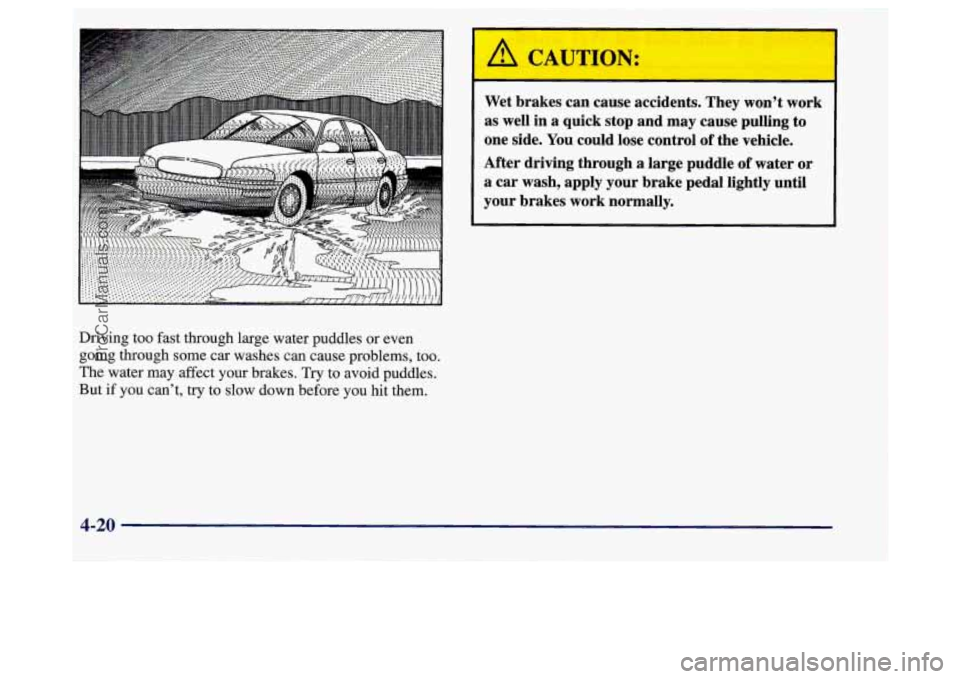
Driving too fast through large water puddles or even
going through some car washes can cause problems, too.
The water may affect your brakes. Try to avoid puddles.
But if you can't, try to slow down before you hit them.
A CAUTION:
-
Wet brakes can cause accidents. They won't work
as well in a quick stop and may cause pulling to
one side. You could lose control of the vehicle.
After driving through a large puddle of water or
a car wash, apply your brake pedal lightly until
your brakes work normally.
ProCarManuals.com
Page 230 of 388
2. Get the vehicles close enough so the jumper cables
can reach, but be sure the vehicles aren’t touching
each other. If they are, it could cause
a ground
connection you don’t want. You wouldn’t be able to
start your vehicle, and the bad grounding could
damage the electrical systems.
To avoid the possibility of the vehicles rolling, set
the parking brake firmly on both vehicles involved in
the jump
start procedure. Put your automatic
transaxle in
PARK (P) before setting the
parking brake.
3. Turn off the ignition on both vehicles. Unplug
unnecessary accessories plugged into the cigarette
lighter
or accessory power outlet. Turn off all lamps
that aren’t needed as well
as radios. This will avoid
sparks and help save both batteries. In addition, it
could save your radio!
NOTICE:
If you leave your radio on, it could be badly
damaged. The repairs wouldn’t
be covered by
your warranty.
4. Open the hoods and locate the batteries. (Your
vehicle’s battery is located toward the front
of the
passenger’s side
of the vehicle’s engine, underneath
a diagonal brace.)
An electric fan can start up even when the engine
is not running and can injure you. Keep hands, clothing and tools away
from any underhood
electric fan.
5-4
ProCarManuals.com
Page 294 of 388
Brakes
Brake Fluid
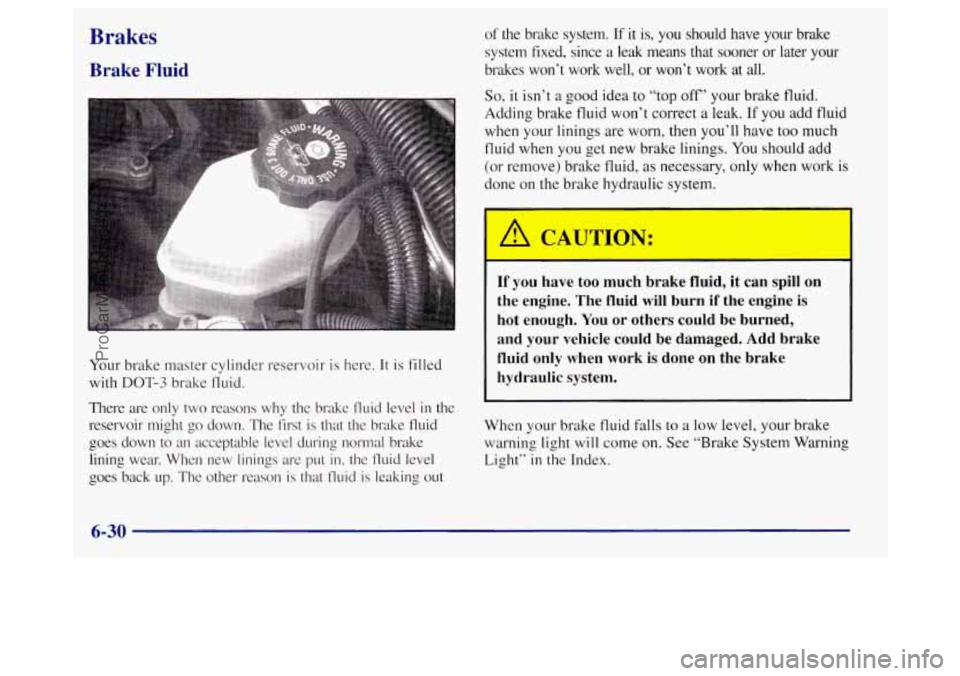
Your brake master cylinder reservoir is here. It is filled
with
DOT-3 brake fluid.
There are only two reasons
why the brake fluid level in the
reservoir might
go down. The first is that the brake fluid
goes down to an acceptable level during normal brake
lining wear. When new linings are put in, the fluid level
goes back up. The other reason is that fluid is leaking out
of the brake system. If it is, you should have your brake
system fixed, since
a leak means that sooner or later your
brakes won’t work well, or won’t work at
all.
So, it isn’t a good idea to “top off’ your brake fluid.
Adding brake fluid won’t correct a leak.
If you add fluid
when your linings are worn, then you’ll have too much
fluid when you get new brake linings.
You should add
(or remove) brake fluid, as necessary, only when work
is
done on the brake hydraulic system.
’ A CAUTION:
F-
If you have too much brake fluid, it can spill on
the engine. The fluid will burn if the engine is
hot enough.
You or others could be burned,
and your vehicle could be damaged. Add brake
fluid only when work is done on the brake
hydraulic system.
When your brake fluid falls to a low level, your brake
warning light
will come on. See “Brake System Warning
Light”
in the Index.
6-30
ProCarManuals.com
Page 296 of 388
Brake Wear
Your vehicle has four-wheel disc brakes.
Disc brake pads have built-in wear indicators that make a
high-pitched warning sound when the brake pads are worn
and new pads are needed. The sound may come and
go or
be heard all the time your vehicle is moving (except when
you are pushing
on the brake pedal firmy).
Some driving conditions or climates may cause a brake
squeal when the brakes are first applied or lightly
applied. This does not mean something is wrong with
your brakes.
Properly torqued wheel nuts are necessary
to help
prevent brake pulsation. When tires are rotated, inspect
brake pads for wear and evenly torque wheel nuts in the
proper sequence to
GM specifications.
The brake wear warning sound means that soon
your brakes won’t work well. That could lead to
an accident. When
you hear the brake wear
warning sound, have
your vehicle serviced.
I Brake linings should always be replaced as complete
axle sets.
See “Brake System Inspection” in Section
7 of this
manual under Part
C “Periodic Maintenance
Inspections.”
I NOTICE:
Continuing to drive with worn-out brake pads
could result in costly brake repair.
Brake Pedal navel
See your dealer if the brake pedal does not return to
normal height, or if there is a rapid increase in pedal
travel. This could be a sign of brake trouble.
Brake Adjustment
Every time you apply the brakes, with or without the
vehicle moving, your brakes adjust for wear.
6-32
ProCarManuals.com
Page 327 of 388
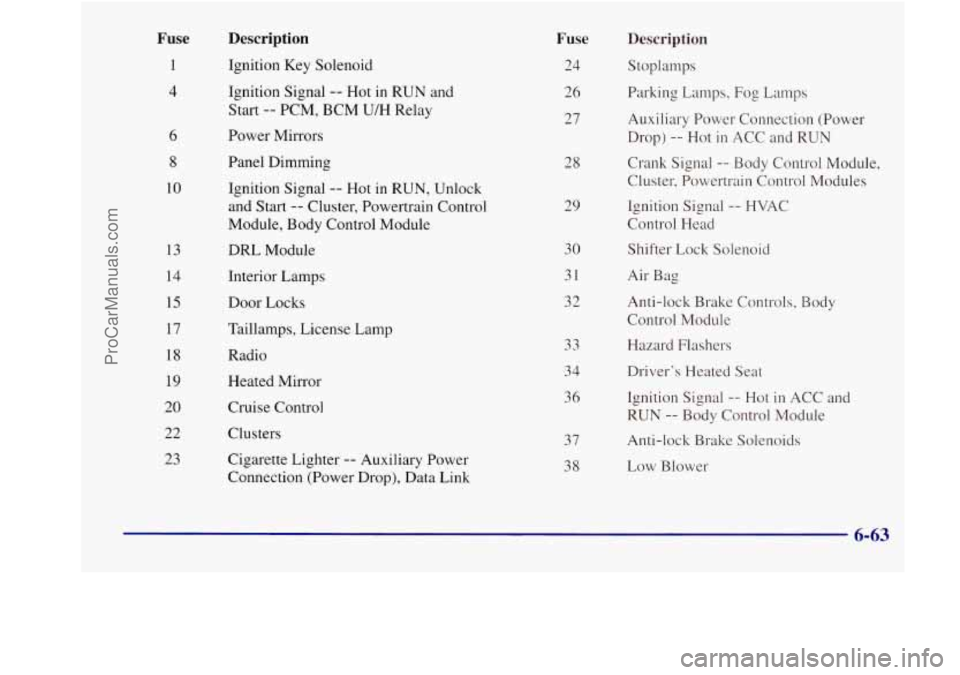
Fuse
1
4
6
8
10
13
14
15
17
18
19
20
22
23
Description
Ignition Key Solenoid
Ignition Signal
-- Hot in RUN and
Start
-- PCM, BCM U/H Relay
Power Mirrors
Panel Dimming
Ignition Signal
-- Hot in RUN, Unlock
and Start
-- Cluster, Powertrain Control
Module, Body Control Module
DRL Module
Interior Lamps
Door
Locks
Taillamps, License Lamp
Radio
Heated Mirror
Cruise Control
Clusters
Cigarette Lighter
-- Auxiliary Power
Connection (Power Drop), Data Link
Fuse
24
26
27
28
29
30
31
32
33
34
36
37
38
Description
Stoplamps
Parking Lamps,
Fog Lamps
Auxiliary Power Connection (Power
Drop)
-- Hot in ACC and RUN
Crank Signal
-- Body Control Module,
Cluster, Powertrain Control Modules
Ignition Signal
-- HVAC
Control Head
Shifter Lock Solenoid
Air Bag
Anti-lock Brake Controls, Body
Control Module
Hazard Flashers
Driver’s Heated Seat
Ignition Signal
-- Hot in ACC and
RUN
-- Body Control Module
Anti-lock Brake Solenoids
Low Blower
6-63
ProCarManuals.com
Page 339 of 388
I Maintenance Schedule I
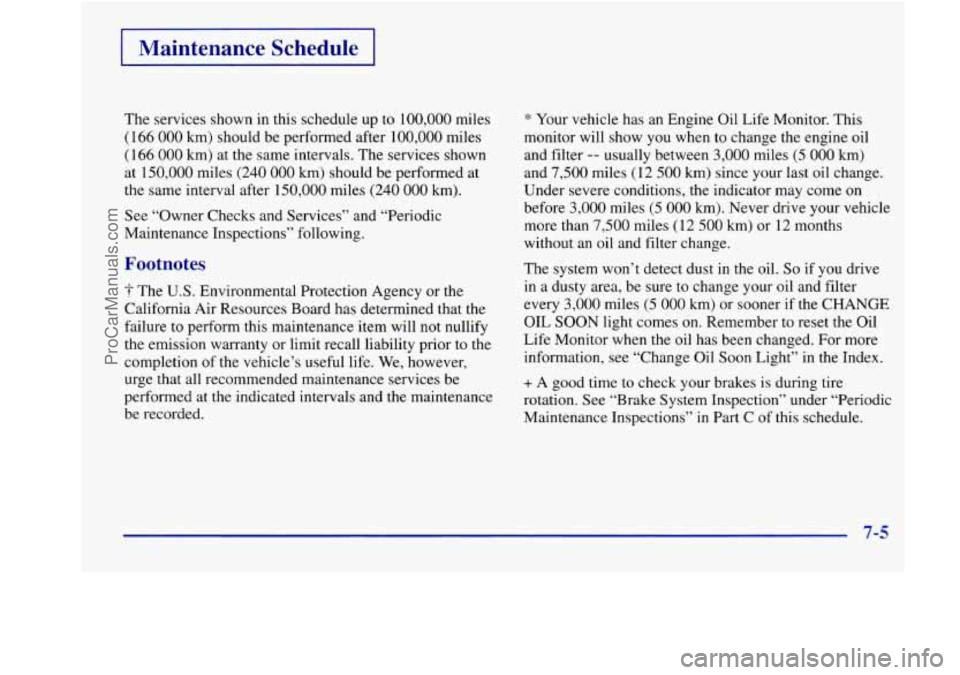
The services shown in this schedule up to 100,000 miles
(166
000 km) should be performed after 100,000 miles
(166
000 km) at the same intervals. The services shown
at 150,000 miles
(240 000 km) should be performed at
the same interval after
150,000 miles (240 000 km).
See “Owner Checks and Services” and “Periodic
Maintenance Inspections” following.
Footnotes
The U.S. Environmental Protection Agency or the
California Air Resources Board has determined that the
failure
to perform this maintenance item will not nullify
the emission warranty or limit recall liability prior to the
completion of the vehicle’s useful life. We, however,
urge that all recommended maintenance services be
performed at the indicated intervals and the maintenance
be recorded.
* Your vehicle has an Engine Oil Life Monitor. This
monitor will show you when to change the engine oil
and filter
-- usually between 3,000 miles (5 000 km)
and 7,500 miles (12 500 km) since your last oil change.
Under severe conditions, the indicator may come on
before
3,000 miles (5 000 km). Never drive your vehicle
more than
7,500 miles (12 500 km) or 12 months
without an oil and filter change.
The system won’t detect dust in the oil.
So if you drive
in a dusty area, be sure to change your oil and filter
every
3,000 miles (5 000 km) or sooner if the CHANGE
OIL SOON light comes
on. Remember to reset the Oil
Life Monitor when the oil has been changed. For more
information,
see “Change Oil Soon Light” in the Index.
+ A good time to check your brakes is during tire
rotation. See “Brake System Inspection” under “Periodic
Maintenance Inspections” in Part C of this schedule.
7-5
ProCarManuals.com