headlamp BUICK REGAL 1998 User Guide
[x] Cancel search | Manufacturer: BUICK, Model Year: 1998, Model line: REGAL, Model: BUICK REGAL 1998Pages: 388, PDF Size: 20.19 MB
Page 202 of 388
Here are some tips on night driving.
0
0
0
0
e
0
0
Drive defensively.
Don’t drink and drive.
Adjust your inside rearview mirror to reduce the
glare from headlamps behind
you.
Since you can’t see as well, you may need to slow
down and keep more space between you and
other vehicles.
Slow down, especially on higher speed roads. Your
headlamps can light up only
so much road ahead.
In remote areas, watch for animals.
If you’re tired, pull off the road in a safe place
and rest.
Night Vision
No one can see as well at night as in the daytime. But as
we get older these differences increase.
A 50-year-old
driver may require at least twice as much light to see the
same thing at night as
a 20-year-old.
What you do in the daytime can also affect your night
vision. For example, if you spend the day in bright
sunshine you are wise to wear sunglasses. Your eyes will
have less trouble adjusting to night. But if you’re driving,
don’t wear sunglasses at night. They may cut
down on glare from headlamps, but they also make
a lot
of things invisible.
You can be temporarily blinded by approaching
headlamps. It can take a second or two, or even several
seconds, for your eyes to readjust to the dark. When
you
are faced with severe glare (as from a driver who
doesn’t lower the high beams, or a vehicle with
misaimed headlamps), slow down a little. Avoid staring
directly into the approaching headlamps.
Keep your windshield and all the glass
on your vehicle
clean
-- inside and out. Glare at night is made much
worse by dirt on the glass. Even the inside of the glass
can build up a film caused by dust. Dirty glass
makes
lights dazzle and flash more than clean glass would,
making the pupils of your eyes contract repeatedly.
Remember that your headlamps light up far less of a
roadway when you are in a turn or curve. Keep your
eyes moving; that way, it’s easier to pick out dimly
lighted objects. Just as your headlamps should be
checked regularly for proper aim,
so should your eyes
be examined regularly. Some drivers suffer from night
blindness
-- the inability to see in dim light -- and
aren’t even aware
of it.
4-18
ProCarManuals.com
Page 215 of 388

Run your engine only as long as you must. This saves
fuel. When you run the engine, make it go a little faster
than just idle. That is, push the accelerator slightly. This
uses less fuel for the heat that you get and it keeps the
battery charged. You will need a well-charged battery to
restart the vehicle, and possibly for signaling later
on
with your headlamps. Let the heater run for a while.
Then,
shut the engine off and close the window almost
all the way to preserve the heat. Start the engine again
and repeat this only when
you feel really uncomfortable
from the cold. But do it as little as possible. Preserve the
fuel as long as you can.
To help keep warm, you can get
out of the vehicle and
do some fairly vigorous exercises
every half hour or
so until help comes.
Loading Your Vehicle
Two labels on your vehicle show how much weight it
may properly calry. The Tire-Loading Information label
is inside the trunk lid. The label tells you the proper size,
speed rating and recommended inflation pressures for
the tires
on your vehicle. It also gives you important
information about the number of people that can be in
your vehicle and the total weight you can carry. This
weight is called the vehicle capacity weight and includes
the weight of all occupants, cargo and all
nonfactory-installed options.
4-31
ProCarManuals.com
Page 298 of 388
Bulb Replacement
In this section you’ll find directions for changing the
bulbs in some
of the lamps on your vehicle. See
“Replacement Bulbs”
in the Index to find the type of
bulb you should use.
Halogen Bulbs
Halogen bulbs have pressurized gas inside and
can burst
if you drop or scratch the bulb. You or
others could be injured.
Be sure to read and
follow the instructions on the bulb package.
Headlamps
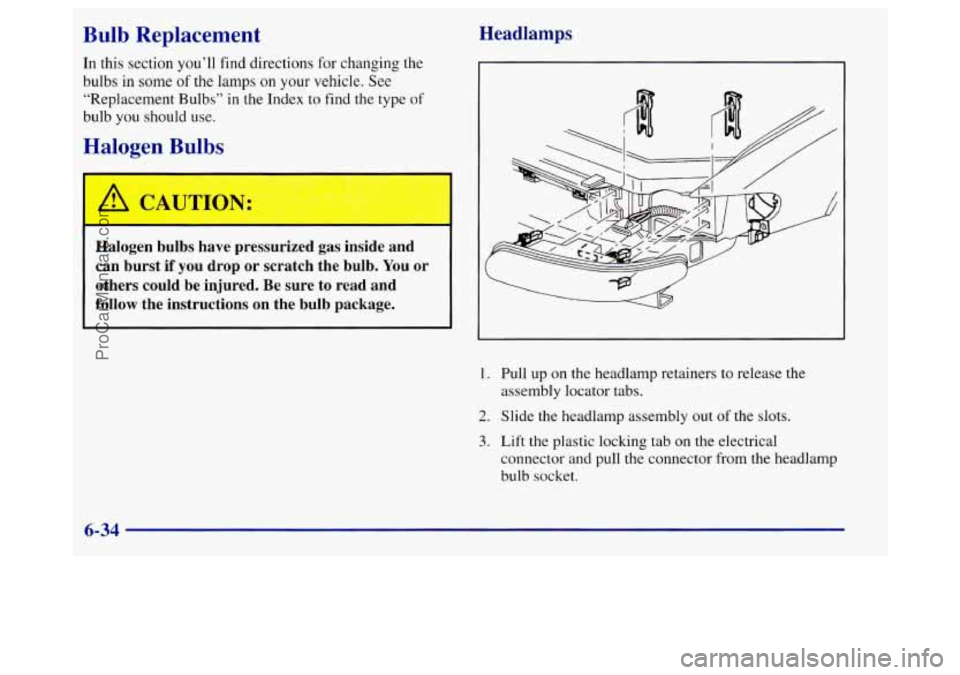
1. Pull up on the headlamp retainers to release the
assembly locator tabs.
2. Slide the headlamp assembly out of the slots.
3. Lift the plastic locking tab on the electrical
connector and pull the connector from the headlamp
bulb socket.
6-34
ProCarManuals.com
Page 299 of 388
4. Connect the new headlamp assembly to the wiring
harness, making sure the connector tab snaps
into place.
5. Insert the headlamp into the slots in the fascia.
6. Slide the retainers downward until they are
fully seated.
Headlamp Aiming
Your vehicle has a modular headlamp system. These
headlamps have horizontal and vertical aim indicators.
The aim has been optically pre-set at the factory and
should need
no further adjustment.
If your vehicle is damaged in an accident and the
headlamp aim seems to be affected,
see your dealer.
Headlamps on damaged vehicles may require
recalibration of the vertical and horizontal aim by
your dealer.
To check the aim, the vehicle should be properly
prepared as follows:
0
0
0
0
0
0
0
Place the vehicle on a level pad or surface.
The vehicle should not have any snow, ice or mud
attached to it.
The vehicle should be fully assembled and all other
work stopped while headlamp aiming
is being done.
There should not be any cargo
or loading of the
vehicle, except it should have a full tank
of gas and
one person or
160 lbs. (75 kg) on the driver’s seat.
Close all doors.
Tires should be properly inflated.
Rock the vehicle to stabilize the suspension.
I I
NOTICE:
To make sure your headlamps are aimed
properly, read all the instructions before
beginning. Failure to follow these instructions
could cause damage to headlamp parts.
6-35
ProCarManuals.com
Page 300 of 388
For the vertical adjustment, state inspection stations
will generally allow a reading of plus
0.76 degrees or
minus
0.76 degrees from the center of the bubble.
down
It is recommended that the
upper limit not exceed
plus
0.4 degrees from the
center of the bubble.
Other drivers may flash
their high beams
at you if
your adjustment is much
above plus
0.4 degrees.
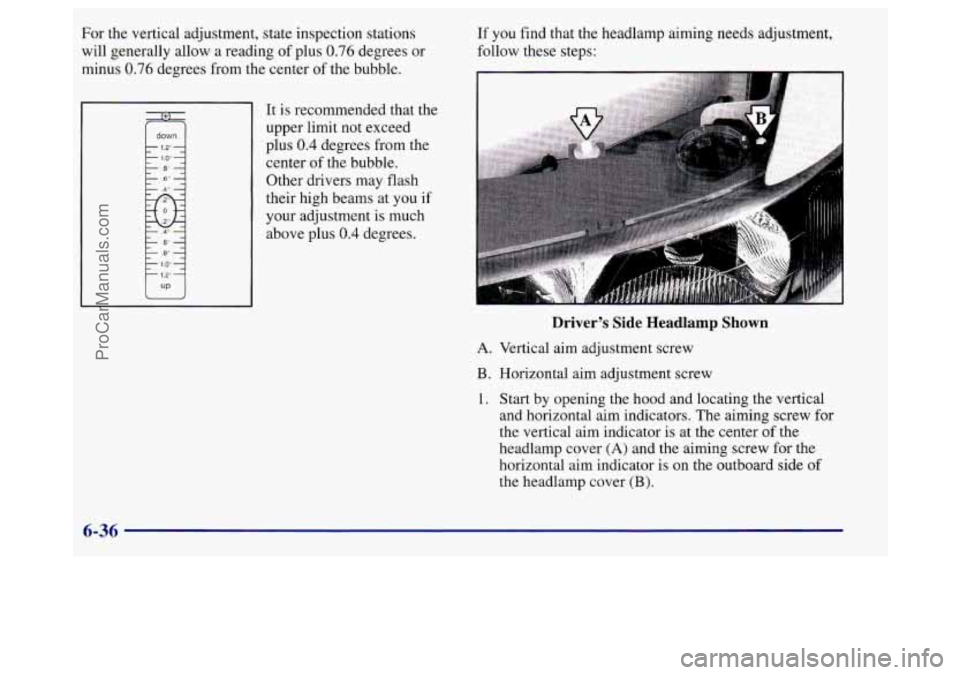
If you find that the headlamp aiming needs adjustment,
follow these steps:
Driver's Side Headlamp Shown
A. Vertical aim adjustment screw
B. Horizontal aim adjustment screw
1. Start by opening the hood and locating the vertical
and horizontal aim indicators. The aiming screw for
the vertical aim indicator is at the center of the
headlamp cover
(A) and the aiming screw for the
horizontal aim indicator
is on the outboard side of
the headlamp cover (B).
6-36
ProCarManuals.com
Page 301 of 388
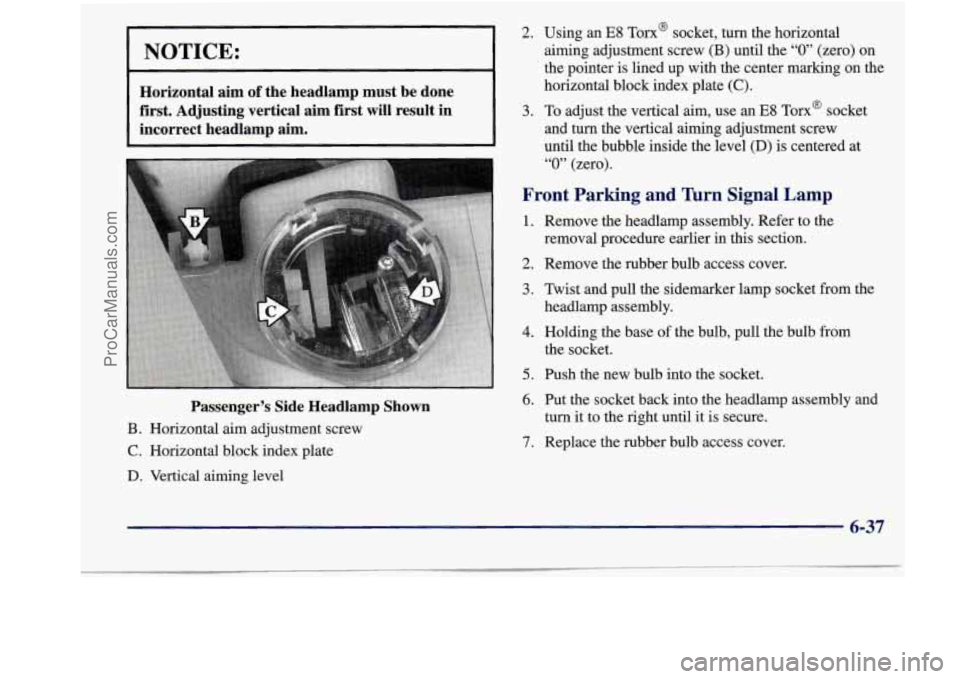
NOTICE:
Horizontal aim of the headlamp must be done
first. Adjusting vertical
aim first will result in
2. Using an E8 Torx@ socket, turn the horizontal
aiming adjustment screw
(B) until the “0” (zero) on
the pointer is lined up with the center marking on the
horizontal block index plate
(C).
3. To adjust the vertical aim, use an E8 Torn@ socket
and turn the vertical aiming adjustment screw
until the bubble inside the level
(D) is centered at
“0” (zero).
Front Parking and I’urn Signal Lamp
1. Remove the headlamp assembly. Refer to the
removal procedure earlier in this section.
2. Remove the rubber bulb access cover.
3. Twist and pull the sidemarker lamp socket from the
4. Holding the base of the bulb, pull the bulb from
5. Push the new bulb into the socket.
headlamp assembly.
the socket.
B.
C.
D.
Passenger’s Side Headlamp Shown
Horizontal aim adjustment screw Horizontal block index plate
Vertical aiming level
6. Put the socket back into the headlamp assembly and
turn it to the right until it is secure.
7. Replace the rubber bulb access cover.
6-37
ProCarManuals.com
Page 314 of 388
Used Replacement Wheels
Using the wrong replacement wheels, wheel
bolts or wheel nuts on your vehicle can be
dangerous.
It could affect the braking and
handling of your vehicle, make your tires lose air
and make you lose control. You could have
a
collision in which you or others could be injured.
Always use the correct wheel, wheel bolts and
wheel nuts for replacement.
NOTICE:
The wrong wheel can also cause problems with
bearing life, brake cooling, speedometer or
odometer calibration, headlamp aim, bumper
height, vehicle ground clearance and tire or tire
chain clearance to the body and chassis.
See “Changing a Flat Tire” in the Index for
more information.
Putting a used wheel on your vehicle is
dangerous.
You can’t know how it’s been used or
how
far it’s been driven. It could fail suddenly
and cause an accident.
If you have to replace a
wheel, use
a new GM original equipment wheel.
Tire Chains
NOTICE:
If your vehicle has P225/60R16 size tires, don’t
use tire chains. They can damage your vehicle
because there’s not enough clearance.
NOTICE: (Continued)
6-50
ProCarManuals.com
Page 325 of 388
Electrical System
Add-on Electrical Equipment
1 NOTICE:
Don’t add anything electrical to your vehicle
unless you check with your dealer first. Some
electrical equipment can damage your vehicle and the damage wouldn’t be covered by your
warranty. Some add-on electrical equipment
can keep other components from working as
they should.
Your vehicle has an air bag system. Before attempting to
add anything electrical to your vehicle, see “Servicing
Your Air Bag-Equipped Vehicle” in the Index.
Headlamp Wiring
The headlamp wiring is protected by a circuit breaker in
the underhood electrical center. An electrical overload
will cause the lamps to
go on and off, or in some cases
to remain off. If this happens, have your headlamp
system checked right away.
Windshield Wipers
The windshield wiper motor is protected by a circuit
breaker and a fuse. If the motor overheats due to heavy
snow, etc., the wiper will stop until the motor cools. If
the overload is caused by some electrical problem, have
it fixed.
Power Windows and Other Power Options
Circuit breakers in the fuse panel protect the power
windows and other power accessories. When the current
load is too heavy, the circuit breaker opens and closes,
protecting
the circuit until the problem is fixed.
6-61
ProCarManuals.com
Page 330 of 388
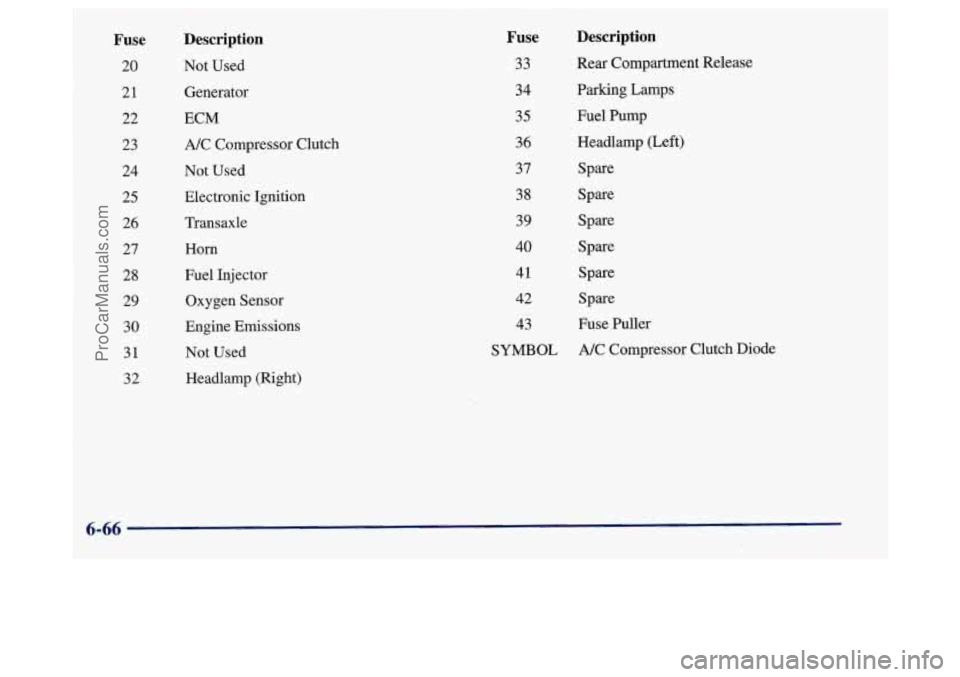
Fuse
20
21
22 23
24 25
26 27
28
29
30
31 32
Description
Not Used
Generator
ECM
A/C Compressor Clutch
Not Used Electronic Ignition
Transaxle
Horn
Fuel Injector
Oxygen Sensor
Engine Emissions
Not Used
Headlamp (Right)
Fuse
33
34 35
36 37
38
39
40
41
42
43
SYMBOL
Description
Rear Compartment Release
Parking Lamps Fuel Pump
Headlamp (Left) Spare Spare
Spare
Spare Spare
Spare
Fuse Puller A/C Compressor Clutch Diode
ProCarManuals.com
Page 331 of 388
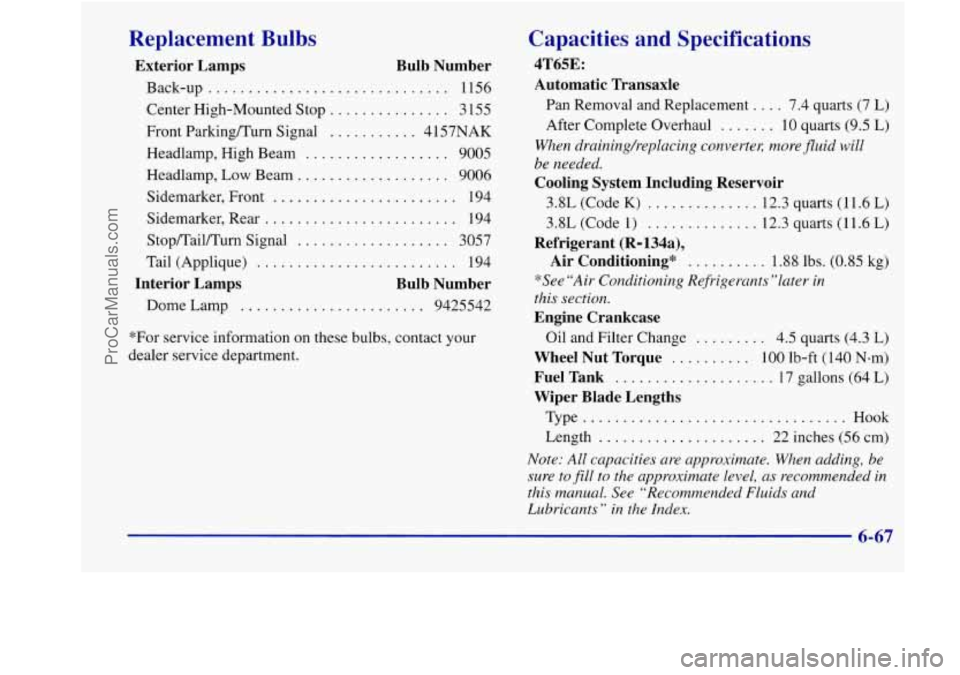
Replacement Bulbs
Exterior Lamps Bulb Number
Back-up .............................. 1156
Center High-Mounted Stop
............... 3155
Front Parking/Turn Signal
........... 4 157NAK
Headlamp, High Beam
.................. 9005
Headlamp, Low Beam.
.................. 9006
Sidemarker, Front ....................... 194
Sidemarker, Rear
........................ 194
Stop/Tail/Turn Signal
................... 3057
Tail (Applique)
....................... 194
Interior Lamps Bulb Number
Dome Lamp ....................... 9425542
*For service information on these bulbs, contact your
dealer service department.
Capacities and Specifications
4T65E:
Automatic Transaxle
Pan Removal and Replacement .... 7.4 quarts (7 L)
After Complete Overhaul
....... 10 quarts (9.5 L)
When drainingheplacing converter; more fluid will
be needed.
Cooling System Including Reservoir
3.8L (Code K) .............. 12.3 quarts (11.6 L)
3.8L (Code 1)
.............. 12.3 quarts (11.6 L)
Air Conditioning* .......... 1.88 lbs. (0.85 kg)
Refrigerant (R-l34a),
*See “Air Conditioning Refrigerants ”later in
this section.
Engine Crankcase
Oil and Filter Change ......... 4.5 quarts (4.3 L)
Wheel Nut Torque .......... 100 lb-ft (140 N-m)
Fuel Tank .................... 17 gallons (64 L)
Wiper Blade Lengths
Type ................................. Hook
Length ..................... 22 inches (56 cm)
Note: All capacities are approximate. When adding, be
sure
to fill to the approximate level, as recommended in
this manual. See “Recommended Fluids and
Lubricants” in the Index.
ProCarManuals.com