light BUICK REGAL 1998 User Guide
[x] Cancel search | Manufacturer: BUICK, Model Year: 1998, Model line: REGAL, Model: BUICK REGAL 1998Pages: 388, PDF Size: 20.19 MB
Page 90 of 388
PASS-Key@ I1
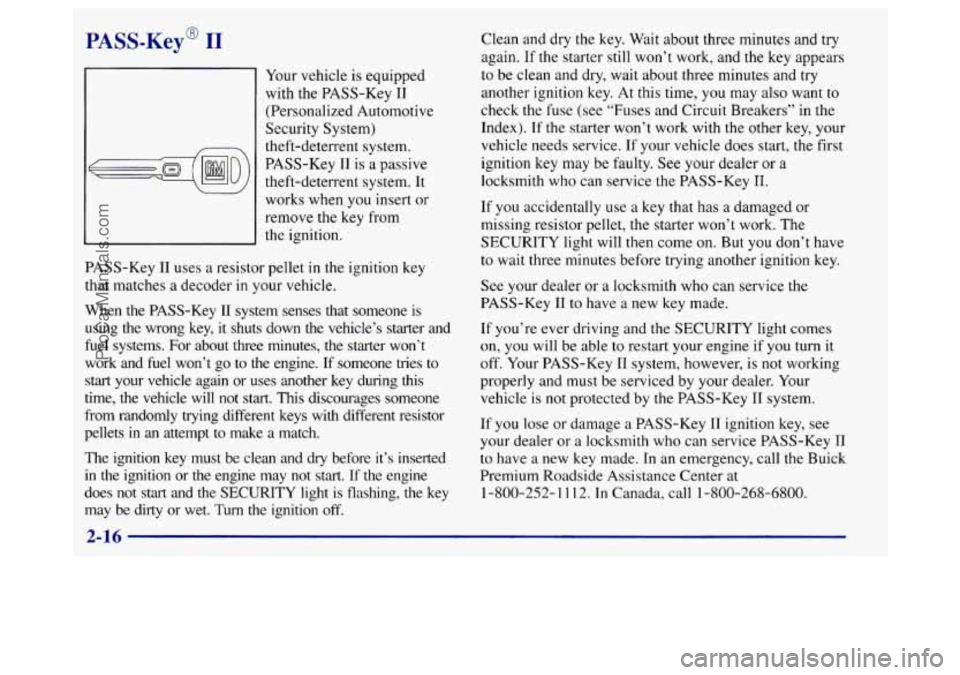
Your vehicle is equipped
with the PASS-Key
I1
(Personalized Automotive
Security System)
theft-deterrent system.
PASS-Key I1 is a passive
theft-deterrent system. It
works when you insert or
remove the
key from
the ignition.
PASS-Key
I1 uses a resistor pellet in the ignition key
that matches a decoder
in your vehicle.
When the PASS-Key I1 system senses that someone
is
using the wrong key, it shuts down the vehicle’s starter and
fuel systems. For about three minutes, the starter won’t
work and fuel won’t
go to the engine. If someone tries to
start your vehicle again or uses another key during this
time, the vehicle will not start. This discourages someone
from randomly trying different keys with different resistor
pellets in
an attempt to make a match.
The ignition key must be clean and dry before it’s inserted
in the ignition or the engine may not start. If the engine
does not start and the SECURITY light is flashing, the key
may be dirty or wet. Turn the ignition off. Clean and
dry
the key. Wait about three minutes and try
again.
If the starter still won’t work, and the key appears
to be clean and dry, wait about three minutes and try
another ignition key. At this time, you may also want to
check the fuse (see “Fuses and Circuit Breakers” in the
Index). If
the starter won’t work with the other key, your
vehicle needs service. If your vehicle does start, the first
ignition key may be faulty. See your dealer or a
locksmith who can service the PASS-Key
11.
If you accidentally use a key that has a damaged or
missing resistor pellet, the starter won’t work. The
SECURITY light will then come
on. But you don’t have
to wait three minutes before trying another ignition key.
See your dealer or a locksmith who can service the
PASS-Key
I1 to have a new key made.
If you’re ever driving and the SECURITY light comes
on, you will be able to restart your engine if
you turn it
off. Your PASS-Key I1 system, however, is not working
properly and must be serviced by your dealer. Your
vehicle is not protected by the PASS-Key I1 system.
If you lose or damage a PASS-Key
I1 ignition key, see
your dealer or
a locksmith who can service PASS-Key I1
to have a new key made. In an emergency, call the Buick
Premium Roadside Assistance Center at
1-800-252-
1 112. In Canada, call 1-800-268-6800.
2-16
ProCarManuals.com
Page 92 of 388
LOCK (B): Before you put the key into the ignition
switch, the switch is in
LOCK. It’s also the only position
from which
you can remove your key. This position
locks your ignition, steering wheel and transaxle. It’s a
theft-deterrent feature.
OF” (C): This position lets you turn off the engine but
still turn the steering wheel. It doesn’t lock the steering
wheel. Use
OFF if you must have your vehicle pushed
or towed.
RUN (D): This position is where the key returns after
you start your vehicle. With the engine off, you
can use
RUN to display some of your warning and
indicator lights.
START (E): This position starts your engine.
A warning chime will sound if you open the driver’s
door when the ignition is in
OFF, LOCK or
ACCESSORY and the key is in the ignition.
‘ NOTICE:
~
If your key seems stuck in LOCK and you can’t
turn
it, be sure you are using the correct key; if
so, is it all the way in? If it is, then turn the
steering wheel left and right while you turn the
key hard. But turn the key only with your hand.
Using
a tool to force it could break the key or the
ignition switch. If none of this works, then your
vehicle needs service.
In case you cannot remove your key from the ignition,
find the access slot which is located underneath the
steering column below the lock cylinder.
To use this slot, remove the trim cap. Insert a key or
screwdriver into the access slot and rotate the lock
cylinder. You will now be able to remove your key from
the ignition. Be sure to replace the trim cap after use.
2-18
ProCarManuals.com
Page 100 of 388
FIRST (1): This position gives you even more power
(but lower fuel economy) than
SECOND (2). You can
use it on very steep hills,
or in deep snow or mud. If the
shift lever
is put in FIRST (1)’ the transaxle won’t shift
into first gear until the vehicle is going slowly enough.
I NOTICE:
If your front wheels can’t rotate, don’t try to
drive. This might happen if you were stuck in
very deep sand
or mud or were up against a solid
object.
You could damage your transaxle.
Also, if you stop when going uphill, don’t hold
your vehicle there with only the accelerator
pedal. This could overheat and damage the
transaxle. Use your brakes or shift into
PARK (P)
to hold your vehicle in position on a hill.
Driver Selectable Shift (If Equipped)
PERF
SHIFT
Press the driver selectable
shift button to allow the
transaxle to shift at higher
engine speeds, increasing
acceleration performance.
The
PERF SHIFT light on
your instrument panel
cluster will glow when
driver selectable shifting is
being used.
Downshifts will occur at a lower percentage of accelerator
use while you’re in the driver selectable shift mode.
Press the button again to return to normal shifting.
The
transaxle will then shift at lower engine speeds,
increasing fuel economy.
2-26
ProCarManuals.com
Page 109 of 388
Turn Signal and Lane Change Indicator
The turn signal has two upward (for right) and two
downward (for left) positions. These positions allow you
to signal a turn or a lane change.
To signal a turn, move the lever all the way up or down.
When the turn is finished, the lever will return
automatically.
An arrow on
the instrument
panel will flash in the
direction
of the turn or
lane change.
To signal a lane change, just raise or lower the lever
until the arrow starts to flash. Hold it there until you
complete your lane change. The lever will return
by
itself when you release it.
If the arrow flashes faster than normal as you signal a
turn or a lane change, a signal bulb may be burned out
and other drivers won’t see your turn signal.
If a bulb is burned out, replace it to help avoid an
accident. If the arrows don’t go on at all when
you
signal a turn, check for burned-out bulbs and then check
the fuse (see “Fuses and Circuit Breakers” in the Index).
A chime will sound if
you leave your turn signal on for
more than
314 mile (1.2 km).
Headlamp High/Low Beam Changer
To change your headlamps
from low beams to high
beams,
or high to low, pull
the multifunction lever all
the way toward you. Then
release it.
When the high beams are on, this light
on the instrument
panel also will be
on.
2-35
ProCarManuals.com
Page 111 of 388
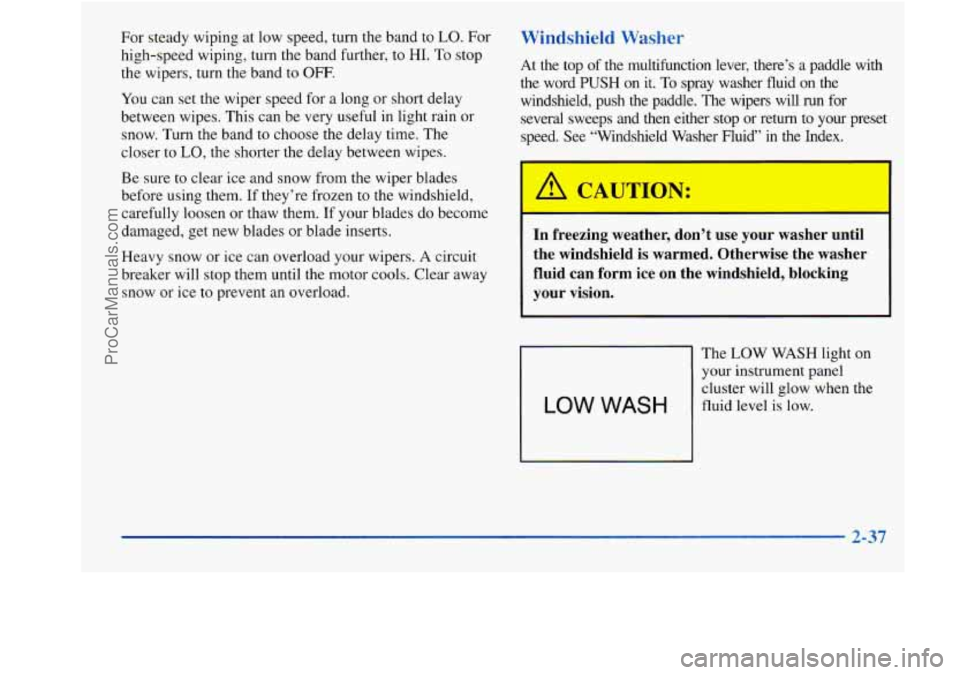
For steady wiping at low speed, turn the band to LO. For
high-speed wiping, turn the band further, to HI. To stop
the wipers, turn the band to
OFF.
You can set the wiper speed for a long or short delay
between wipes, This can be very
useful in light rain or
snow. Turn the band
to choose the delay time. The
closer to
LO, the shorter the delay between wipes.
Be sure to clear ice and snow from the wiper blades
before using them. If they’re frozen to the windshield,
carefully loosen or thaw them. If your blades
do become
damaged, get new blades or blade inserts.
Heavy snow or ice can overload your wipers. A circuit
breaker will stop them until the motor cools. Clear away
snow or ice
to prevent an overload.
Windshield Washer
At the top of the multifunction lever, there’s a paddle with
the word
PUSH on it. To spray washer fluid on the
windshield, push the paddle. The wipers will run for
several sweeps and then either stop or return to your preset
speed. See “Windshield Washer Fluid”
in the Index.
I
A CAUTICU: I
In freezing weather, don’t use your washer until
the windshield is warmed. Otherwise the washer
fluid can form ice on the windshield, blocking
your vision.
The LOW WASH light on
your instrument panel
cluster will glow when the
LOW WASH fluid level is low.
2-37
ProCarManuals.com
Page 113 of 388
Setting Cruise Control
1
If you leave your cruise control switch on when
you’re not using cruise, you might hit
a button
and
go into cruise when you don’t want to. You
could be startled and even lose control. Keep the
cruise control switch off until
you want to use it.
1. Move the cruise control switch to ON.
2. Get up to the speed you want.
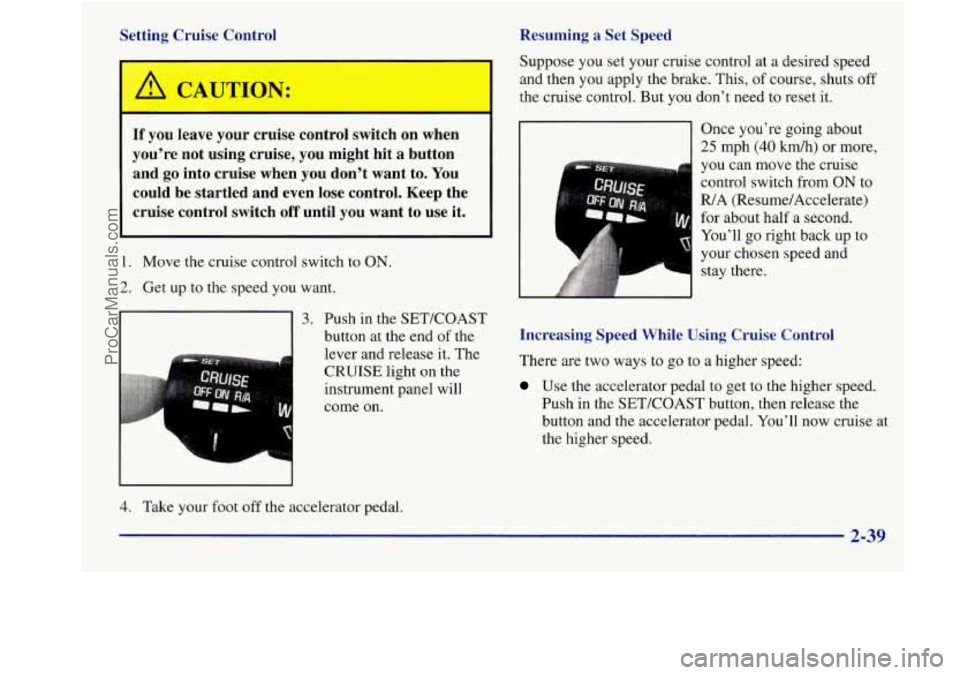
91 button at the end of the
lever and release it. The
CRUISE light on the
instrument panel will
come on.
3. Push in the SET/COAST
1
Resuming a Set Speed
Suppose
you set your cruise control at a desired speed
and then you apply the brake. This,
of course, shuts off
the cruise control. But you don’t need to reset it.
Once you’re going about
25 mph (40 km/h) or more,
you can move the cruise
control switch from
ON to
R/A (Resume/Accelerate)
for about half a second.
You’ll go right back up to
your chosen speed and stay there.
Increasing Speed While Using Cruise Control
There are two
ways to go to a higher speed:
Use the accelerator pedal to get to the higher speed.
Push in the SET/COAST button, then release the
button and the accelerator pedal. You’ll now cruise at
the higher speed.
4. Take your foot off the accelerator pedal.
2-39
ProCarManuals.com
Page 114 of 388
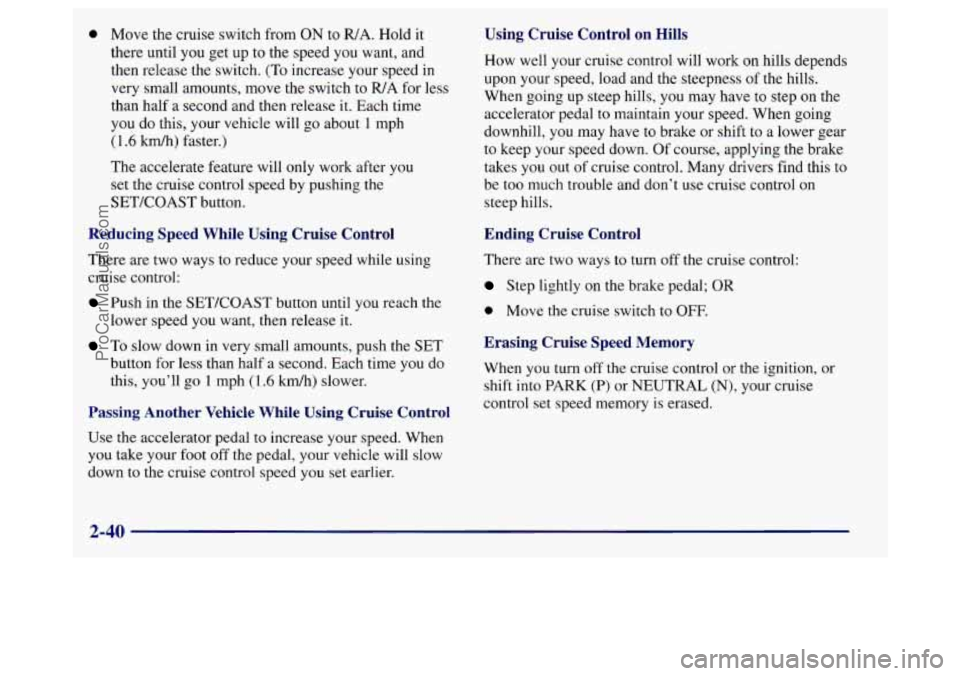
0 Move the cruise switch from ON to WA. Hold it
there until you get up to the speed you want, and
then release the switch.
(To increase your speed in
very small amounts, move the switch to R/A for less
than half a second and then release it. Each time
you do this, your vehicle will go about
1 mph
(1.6 kmk) faster.)
The accelerate feature will
only work after you
set the cruise control speed by pushing the
SETKOAST button.
Reducing Speed While Using Cruise Control
There are two ways to reduce your speed while using
cruise control:
Push in the SETKOAST button until you reach the
lower speed you want,
then release it.
To slow down in very small amounts, push the SET
button for less than half a second. Each time you do
this, you’ll go
1 mph (1.6 km/h) slower.
Passing Another Vehicle While Using Cruise Control
Use the accelerator pedal to increase your speed. When
you take your foot off the pedal, your vehicle will slow
down
to the cruise control speed you set earlier.
Using Cruise Control on Hills
How well your cruise control will work on hills depends
upon your speed, load and the steepness of the hills.
When going up steep hills, you may have to step on the
accelerator pedal to maintain your speed. When going
downhill,
you may have to brake or shift to a lower gear
to keep your speed down. Of course, applying the brake
takes you out of cruise control. Many drivers find this to
be too much trouble and don’t use cruise control on
steep hills.
Ending Cruise Control
There are two ways to turn off the cruise control:
Step lightly on the brake pedal; OR
0 Move the cruise switch to OFF.
Erasing Cruise Speed Memory
When you turn off the cruise control or the ignition, or
shift into PARK (P)
or NEUTRAL (N), your cruise
control set speed memory is erased,
2-40
ProCarManuals.com
Page 115 of 388
Exterior Lamps
The lamp controls are located on the instrument panel.
They control these systems:
0
0
0
a
0
0
0
0
0
Headlamps
Taillamps
Parking Lamps
License Lamps Sidemarker Lamps
Instrument Panel Lights
Courtesy Lamps
Fog Lamps
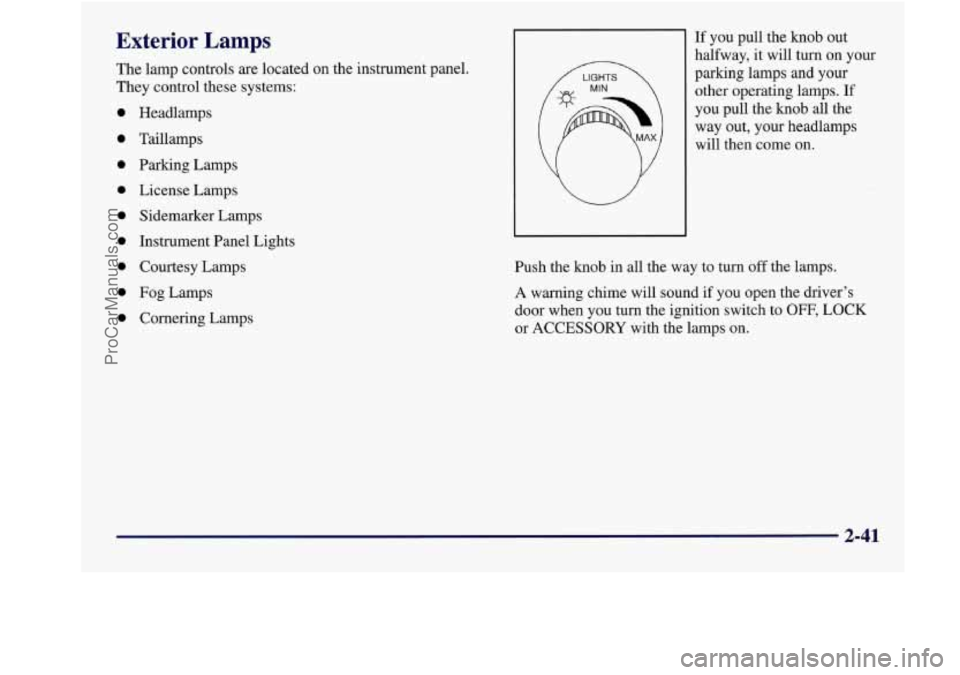
Cornering Lamps If
you pull the
knob out
halfway, it will turn on your
parking lamps and your
other operating lamps.
If
you pull the knob all the
way out, your headlamps
will then come on.
Push the
knob in all the way to turn off the lamps.
A warning chime will sound
if you open the driver’s
door when you turn the ignition switch to
OFF, LOCK
or ACCESSORY with the lamps on.
2-41
ProCarManuals.com
Page 116 of 388
Daytime Running Lamps / Automatic
Headlamp Control
Daytime Running Lamps (DRL) can make it easier for
others to see the front of your vehicle during the day.
DRL can be helpful in many different driving
conditions, but they can be especially helpful in the
short periods after dawn and before sunset.
A light sensor on top of the instrument panel makes the
DRL work,
so be sure it isn’t covered.
The DRL system will make your front turn signal lamps
come on when:
The ignition is on,
The headlamp switch is off and
The parking brake is released. When
the DRL are on, only your front turn signal lamps
will be
on. The headlamps, taillamps, sidemarker and
other lamps
won’t be on. Your instrument panel won’t
be lit up either.
When it’s dark enough outside, your front turn signal
lamps
will turn off and your vehicle’s headlamps and
parking lamps will turn on.
The other lamps that come
on with your headlamps will also come on.
When it’s bright enough outside, your headlamps will
go
off and your front turn signal lamps will come on.
To idle your vehicle with the DRL off, set the parking
brake while the ignition
is in OFF or LOCK. Then start
your vehicle. The
DRL, headlamps and parking lamps
will stay
off until you release the parking brake.
As with any vehicle, you should turn on the regular
headlamp system when you need it.
ProCarManuals.com
Page 117 of 388
Twilight Sentinel
Twilight Sentinel provides a period of exterior
illumination
as you leave the vicinity of your vehicle.
The feature is activated when your vehicle’s headlamps
are on due to the automatic headlamp control feature
described previously
in this section, and when your
vehicle’s ignition is turned off. Your headlamps will
then remain on until the headlamp switch
is moved from
OFF to the parking lamp position or until a 90 second
illumination period has elapsed.
If you turn off the ignition with the headlamp switch in
the parking lamp or headlamp position, the Twilight
Sentinel cycle will not occur.
You can customize the vehicle to activate the Twilight
Sentinel when your vehicle’s ignition is turned off under
the conditions described above, or you may choose
not
to activate this feature under any conditions. The
enabled/disabled
state of this feature will be toggled
when
you perform the following sequence with the
doors closed and the ignition key
in RUN:
1.
2.
3.
Press and hold the power door lock switch. While
holding the door lock switch, cycle the headlamp
switch
on and then off two times.
Release
the power door lock switch. These
operations must be carried out
in a time period of
less than 10 seconds, followed by a delay period of
no more than 10 seconds.
Then, press and hold
the power door unlock switch.
While holding the door unlock switch, cycle the
headlamp switch
on and then off two times. Release
the courtesy door unlock switch. These operations
must be carried out
in a time period of less than
IO seconds.
After releasing the door unlock switch, a single chime
will be heard if the Twilight Sentinel function has been
disabled; two chimes will be heard if the feature
has
been enabled. Disconnecting the vehicle’s battery for up
to a year will not change the programmed operation of
this feature.
2-43
ProCarManuals.com