child restraint BUICK REGAL 1998 Owner's Manual
[x] Cancel search | Manufacturer: BUICK, Model Year: 1998, Model line: REGAL, Model: BUICK REGAL 1998Pages: 388, PDF Size: 20.19 MB
Page 64 of 388
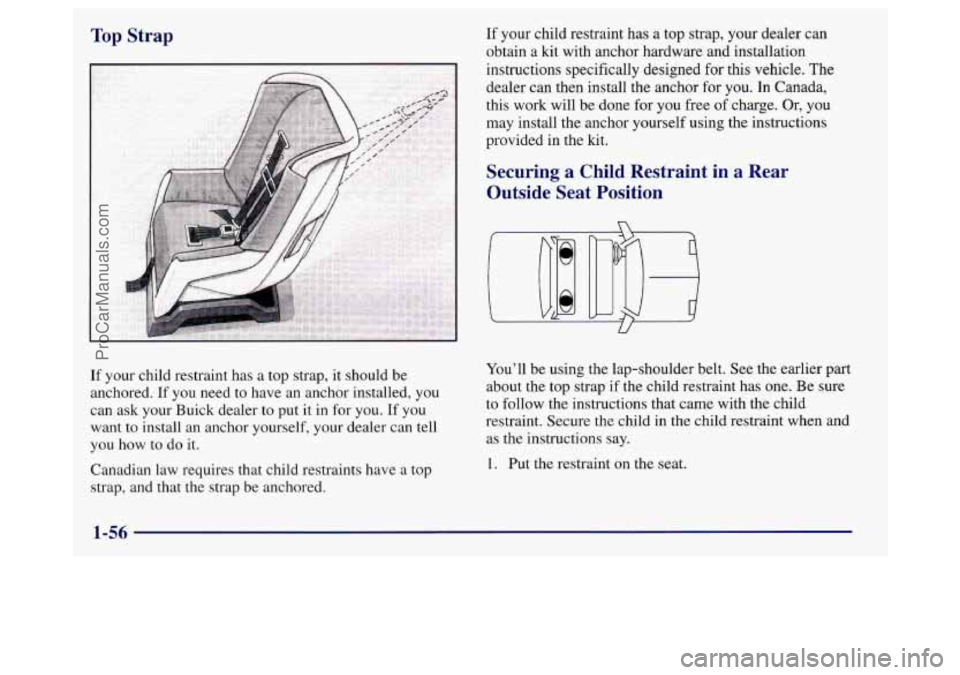
Top Strap
If your child restraint has a top strap, it should be
anchored. If you need to have an anchor installed, you
can ask your Buick dealer to put it in for you.
If you
want
to install an anchor yourself, your dealer can tell
you how to do
it.
Canadian law requires that child restraints have a top
strap, and that the strap be anchored. If
your child restraint has a top strap, your dealer can
obtain a kit with anchor hardware and installation
instructions specifically designed for this vehicle. The
dealer can then install the anchor
for you. In Canada,
this work will be done for you free of charge. Or, you
may install the anchor yourself using the instructions
provided in the
kit.
Securing a Child Restraint in a Rear
Outside Seat Position
U
You’ll be using the lap-shoulder belt. See the earlier part
about the top strap if the child restraint has one. Be sure
to follow the instructions that came with the child
restraint. Secure the child in the child restraint when and
as the instructions say.
1. Put the restraint on the seat.
1-56
ProCarManuals.com
Page 65 of 388
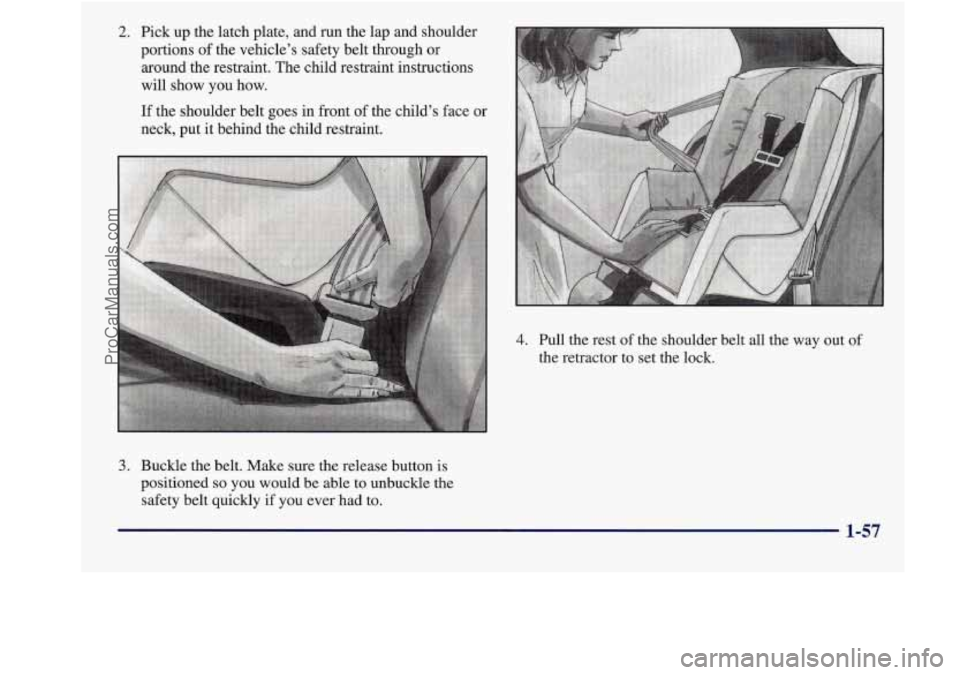
2. Pick up the latch plate, and run the lap and shoulder
portions of the vehicle’s safety belt through or
around the restraint. The child restraint instructions
will show you how.
If the shoulder belt goes in front of the child’s face or
neck, put it behind the child restraint.
4. Pull the rest of the shoulder belt all the way out of
the retractor to set the lock.
3. Buckle the belt. Make sure the release button is
positioned
so you would be able to unbuckle the
safety belt quickly
if you ever had to.
ProCarManuals.com
Page 66 of 388
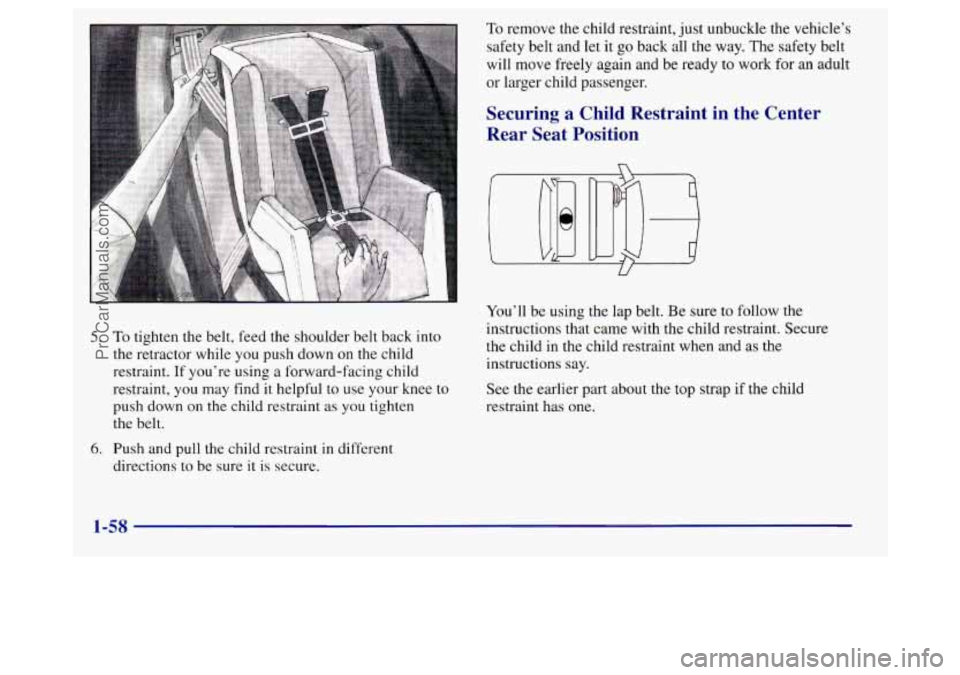
5. To tighten the belt, feed the shoulder belt back into
the retractor while you push down on the child
restraint. If you’re using a forward-facing child
restraint, you may find it helpful to use your knee to
push down on the child restraint as you tighten
the belt.
6. Push and pull the child restraint in different
directions to be sure
it is secure.
To remove the child restraint, just unbuckle the vehicle’s
safety belt and let it go back all the way. The safety belt
will move freely again and be ready to work for an adult
or larger child passenger.
Securing a Child Restraint in the Center
Rear Seat Position
You’ll be using the lap belt. Be sure to follow the
instructions that came with the child restraint. Secure
the child in the child restraint when and
as the
instructions say.
See the earlier part about the top strap if the child
restraint has one.
1-58
ProCarManuals.com
Page 67 of 388
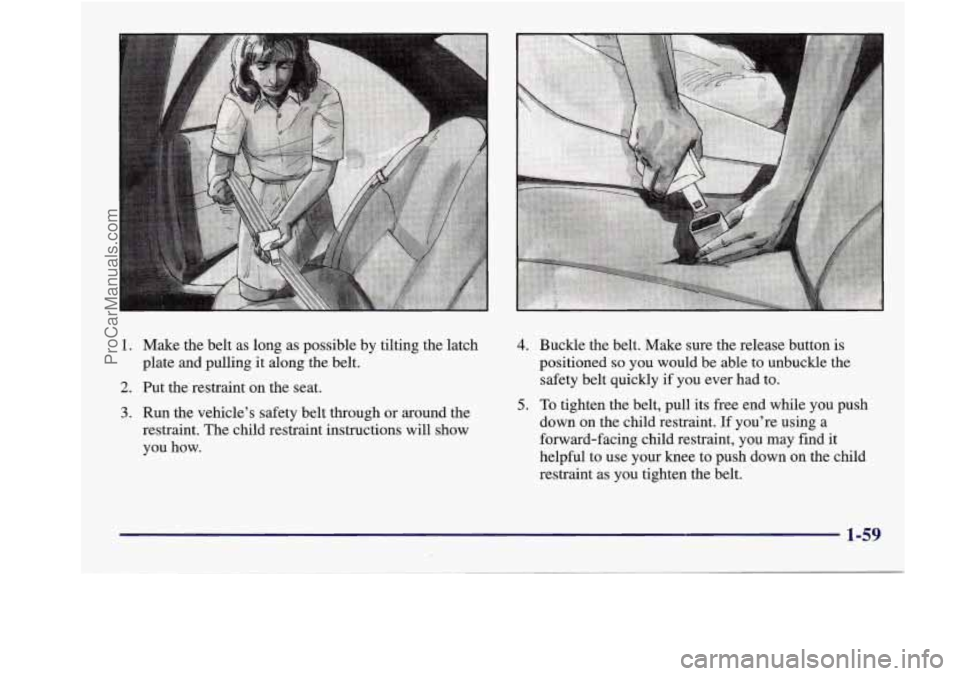
1. Make the belt as long as possible by tilting the latch
plate and pulling it along the belt.
2. Put the restraint on the seat.
3. Run the vehicle's safety belt through or around the
restraint. The child restraint instructions will show
you how.
4. Buckle the belt. Make sure the release button is
positioned so you would be able to unbuckle the
safety belt quickly if you ever had to.
5. To tighten the belt, pull its free end while you push
down on the child restraint.
If you're using a
forward-facing child restraint, you may find it
helpful to use your knee to push down on the child
restraint as you tighten the belt.
1-59
ProCarManuals.com
Page 68 of 388

6. Push and pull the child restraint in different
directions to be sure it
is secure.
To remove the child restraint, just unbuckle the vehicle’s
safety belt. It will be ready
to work for an adult or larger
child passenger.
Securing a Child Restraint in the Right
Front Seat Position
Your vehicle has a right front passenger air bag. Never
put a rear-facing child restraint in this seat. Here’s why:
A CAUTICY:
A child in a rear-facing child rest int can be
seriously injured or killed if the right front
passenger’s air bag inflates, even though your
vehicle has reduced-force frontal air bags. This
is because the back of the rear-facing child
restraint would be very close to the inflating
air bag. Always secure
a rear-facing child
1 restraint in the rear seat.
U
1-60
ProCarManuals.com
Page 69 of 388

You’ll be using the lap-shoulder belt. See the earlier part
about the
top strap if the child restraint has one. Be sure
to follow the instructions that came with the child
restraint. Secure the child
in the child restraint when and
as the instructions say.
1. Because your vehicle has a right front passenger air
bag, always move the seat as far back as it will go
before securing a forward-facing child restraint. (See
“Seats’’
in the Index.)
2. Put the restraint on the seat.
3. Pick up the latch plate, and run the lap and shoulder
portions of the vehicle’s safety belt through or
around the restraint. The child restraint instructions
will show you how.
If the shoulder belt goes in front of the child’s face or
neck, put it behind the child restraint.
4. Buckle the belt. Make sure the release button is
positioned
so you would be able to unbuckle the
safety belt quickly if you ever had to.
1-61
ProCarManuals.com
Page 70 of 388
D
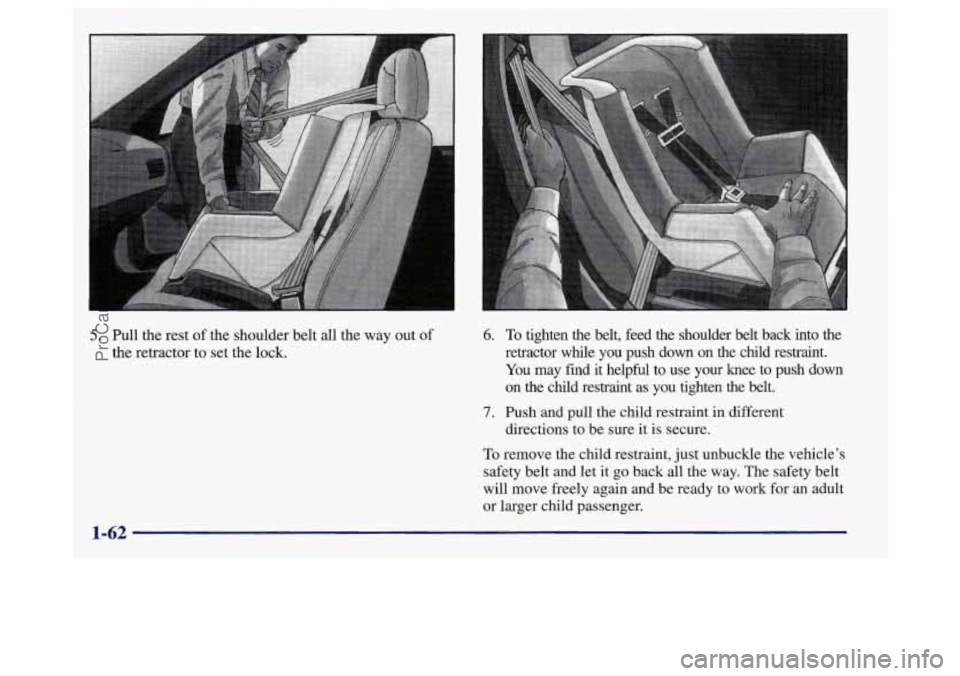
5. Pull the rest of the shoulder belt all the way out of
the retractor to set the lock. 6. To tighten the belt, feed the shoulder belt back into the
retractor while you push down on the child restraint.
You may fmd it helpful to use your knee to push down
on the child restraint as you tighten the belt.
7. Push and pull the child restraint in different
directions to be sure it is secure.
To remove the child restraint, just unbuckle the vehicle’s
safety belt and let it go back all the way. The safety belt
will move freely again and be ready to work for an adult
or larger child passenger.
1-62
ProCarManuals.com
Page 71 of 388
Larger Children
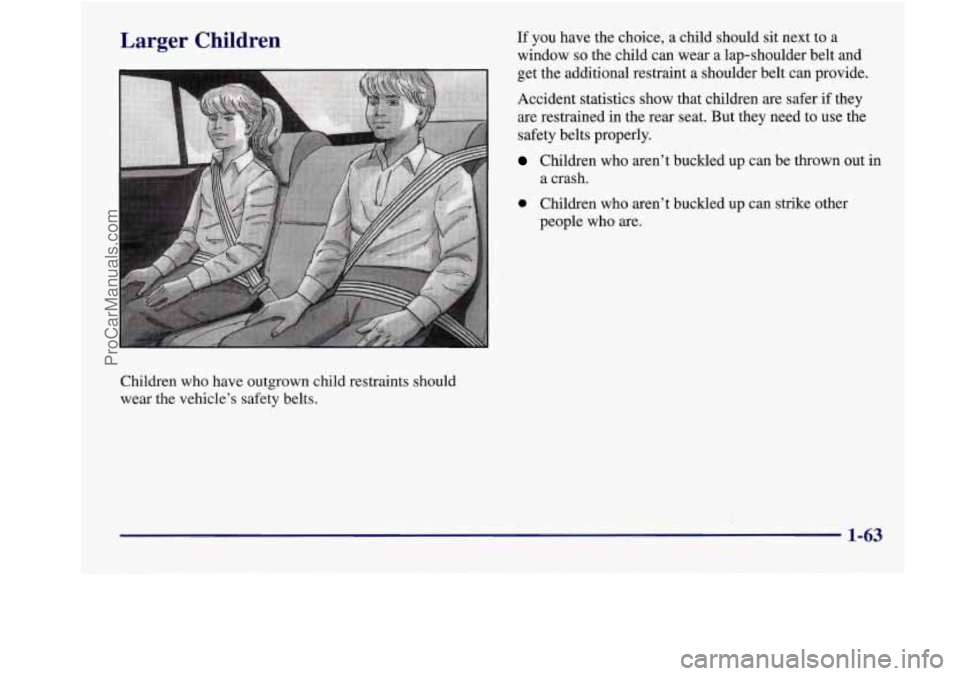
Children who have outgrown child restraints should
wear the vehicle’s safety belts.
If you have the choice, a child should sit next to a
window
so the child can wear a lap-shoulder belt and
get the additional restraint a shoulder belt can provide.
Accident statistics show that children are safer
if they
are restrained in the rear seat. But they need to use the
safety belts properly.
Children who aren’t buckled up can be thrown out in
a crash.
0 Children who aren’t buckled up can strike other
people who are.
1-63
ProCarManuals.com
Page 72 of 388
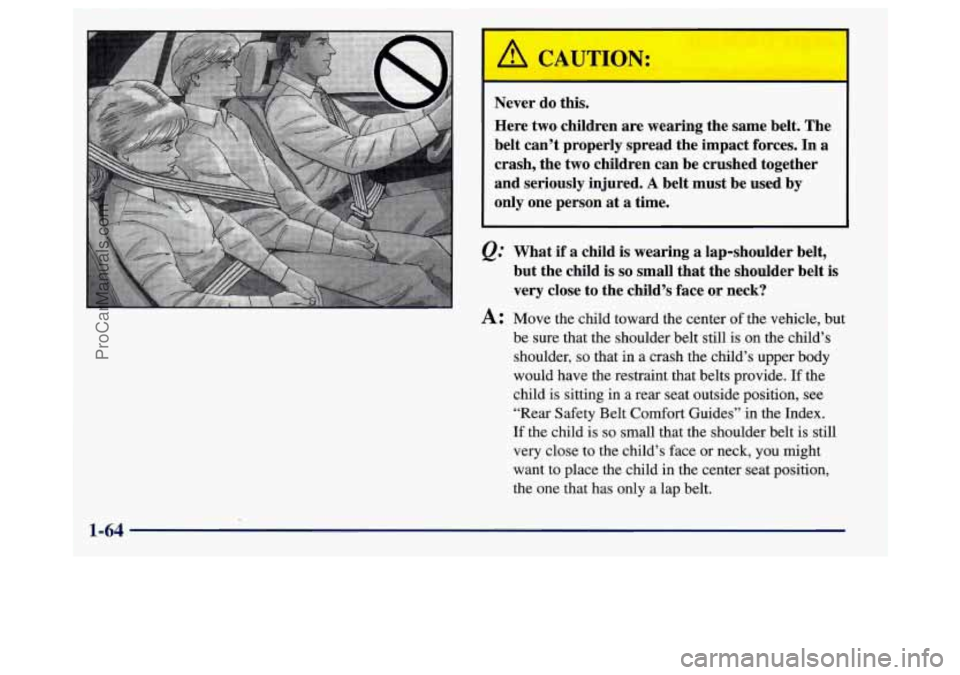
Never do this.
Here two children are weanng me same belt. The
belt can't properly spread the impact forces. In
a
crash, the two children can be crushed together
and seriously injured.
A belt must be used by
only one person at a time.
Q: What if a child is wearing a lap-shoulder belt,
but the child is
so small that the shoulder belt is
very close to the child's face or neck?
A: Move the child toward the center of the vehicle, but
be sure that the shoulder belt still is on the child's
shoulder,
so that in a crash the child's upper body
would have the restraint that belts provide. If the
child is sitting in a rear seat outside position, see
"Rear Safety Belt
Comfort Guides" in the Index.
If the child is
so small that the shoulder belt is still
very close to the child's face or neck, you might
want to place the child in
the center seat position,
the one that
has only a lap belt.
1-64
ProCarManuals.com
Page 74 of 388
be just for you, and just for the seat in your vehicle that
you choose. Don’t let someone else
use it, and use it
only for the seat
it is made to fit. To wear it, just attach it
to the regular safety belt.
Checking Your Restraint Systems
Now and then, make sure the safety belt reminder light
and all your belts, buckles, latch plates, retractors and
anchorages are working properly.
If your vehicle has a
built-in child restraint, also periodically make sure the
harness straps, latch plates, buckle, clip, retractors and
anchorages are working properly. Look for any other
loose or damaged safety belt and built-in child restraint
system parts. If you see anything that might keep a
safety belt or built-in child restraint system from doing
its job, have it repaired.
Torn or frayed safety belts may not protect you
in a
crash. They can rip apart under impact forces. If a belt is
torn or frayed, get a new one right away.
If
your vehicle has the built-in child restraint, torn or
frayed harness straps can rip apart under impact forces
just like torn or frayed safety belts can.
They may not
protect a child
in a crash. If a harness strap is torn or
frayed, get a new harness right away. Also look
for any opened or broken air bag covers, and
have them repaired or replaced. (The air bag system
does not need regular maintenance.)
Replacing Restraint System Parts
After
a Crash
If you’ve had a crash, do you need new safety belts or
built-in child restraint parts?
After a very minor collision, nothing may be necessary.
But if the safety belts
or built-in child restraint harness
straps were stretched, as
they would be if worn during a
more severe crash, then you need new safety belts or
harness straps.
If safety belts or built-in child restraint harness straps
are cut or damaged, replace them. Collision damage also
may mean you will need to have safety belt, built-in
child restraint or seat parts repaired or replaced. New
parts and repairs may be necessary even if the safety belt
or built-in child restraint wasn’t being used at
the time
of the collision.
If an air bag inflates, you’ll need to replace air bag
system parts. See the part
on the air bag system earlier in
this section.
1-66
ProCarManuals.com