warning light BUICK REGAL 1998 Owner's Manual
[x] Cancel search | Manufacturer: BUICK, Model Year: 1998, Model line: REGAL, Model: BUICK REGAL 1998Pages: 388, PDF Size: 20.19 MB
Page 211 of 388
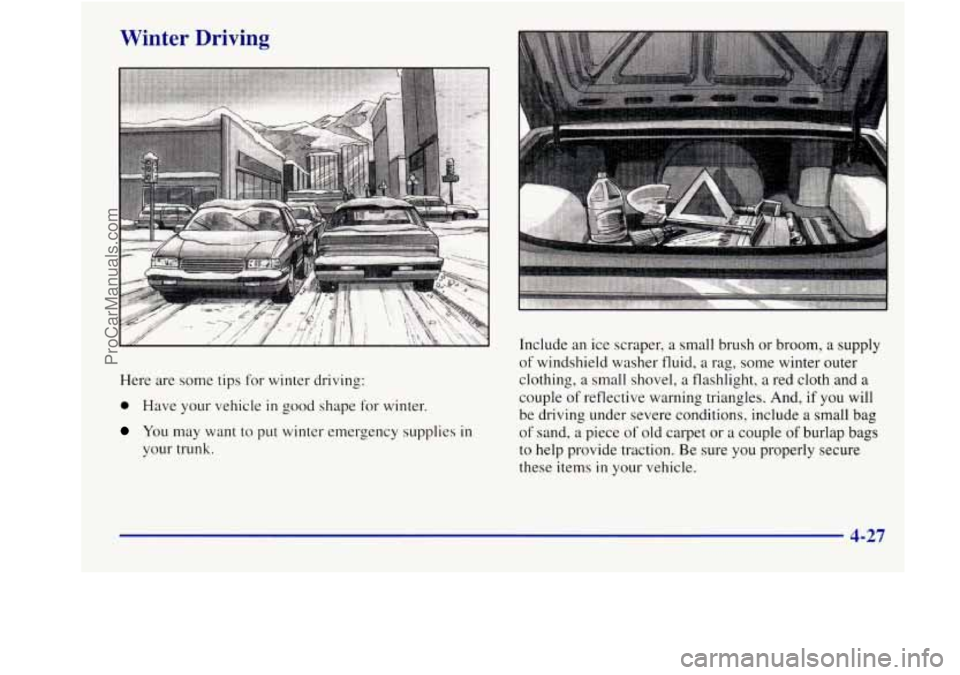
Winter Driving
Here are some tips for winter driving:
0 Have your vehicle in good shape for winter
You may want to put winter emergency supplies in
your trunk. Include
an ice scraper, a small brush or broom,' a supply
of windshield washer fluid, a rag, some winter outer
clothing, a small shovel, a flashlight, a red cloth and a
couple
of reflective warning triangles. And, if you will
be driving under severe conditions, include a small bag
of sand, a piece of old carpet or a couple of burlap bags
to help provide traction. Be sure you properly secure
these items
in your vehicle.
4-27
ProCarManuals.com
Page 241 of 388
Engine Overheating
You will find a coolant temperature gage and a hot
engine warning light on
your instrument panel. See
“Engine Coolant Temperature Gage” and “Engine
Coolant Temperature Warning Light” in the Index.
You
also have a low coolant light on your instrument panel.
See “Low Coolant Light” in the Index.
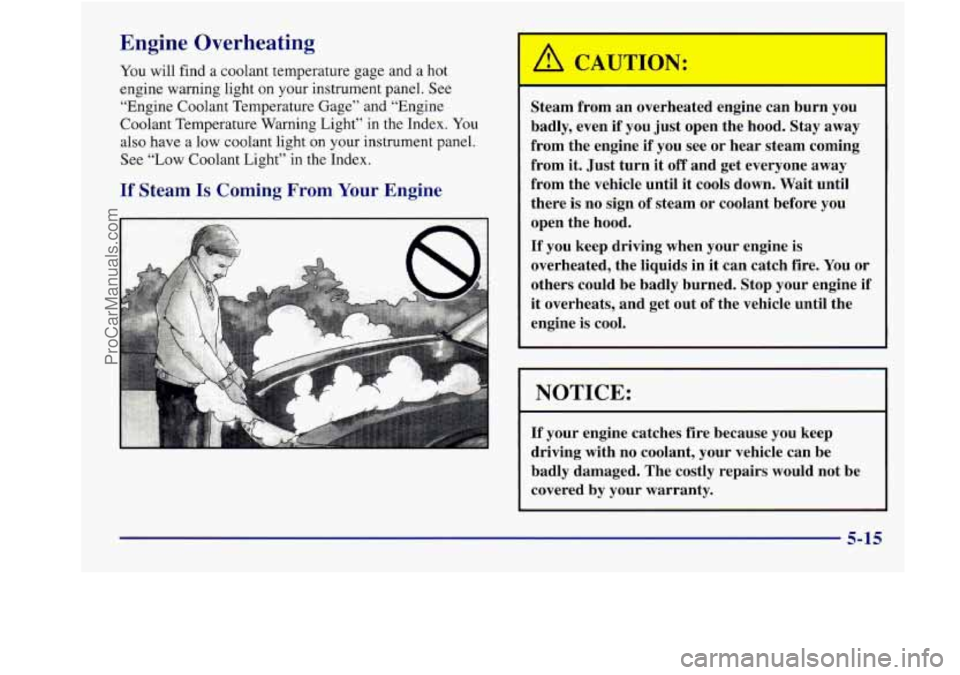
If Steam Is Coming From Your Engine
Steam from an overheated engine can burn you
badly, even if
you just open the hood. Stay away
from the engine if you
see or hear steam coming
from it. Just turn it off and get everyone away
from the vehicle until it cools down. Wait until
there is no sign of steam or coolant before you
open the hood.
If you keep driving when your engine is
overheated, the liquids in it can catch fire.
You or
others could be badly burned. Stop your engine if
it overheats, and get out of the vehicle until the
engine is cool.
I NOTICE:
If your engine catches fire because you keep
driving with no coolant, your vehicle can be
badly damaged. The costly repairs would not be
covered by your warranty.
5-15
ProCarManuals.com
Page 281 of 388
then start the vehicle. If the CHANGE OIL SOON light
comes back on, the system has not reset. Repeat the
procedure.
(If you have a driver information center, the
system may be reset by depressing the DIC
RESET
button for five seconds while viewing the oil life display
on the DIC. See “Driver Information Center” in
the Index.)
What to Do with Used Oil
Did you know that used engine oil contains certain
elements that may be unhealthy for your skin and could
even cause cancer? Don’t
let used oil stay on your skin
for very long. Clean your skin and nails with soap and
water,
or a good hand cleaner. Wash or properly throw
away clothing or rags containing used engine oil. (See
the manufacturer’s warnings about the use and disposal
of oil products.)
Used oil can be a real threat to the environment.
If you
change your own oil, be sure to drain all free-flowing oil
from the filter before disposal. Don’t ever dispose of oil
by putting it in the trash, pouring it on the ground, into
sewers, or into streams
or bodies of water. Instead,
recycle it by taking it to a place that collects used oil. If
you have a problem properly disposing of your used oil,
ask your dealer, a service station or a local recycling
center for help.
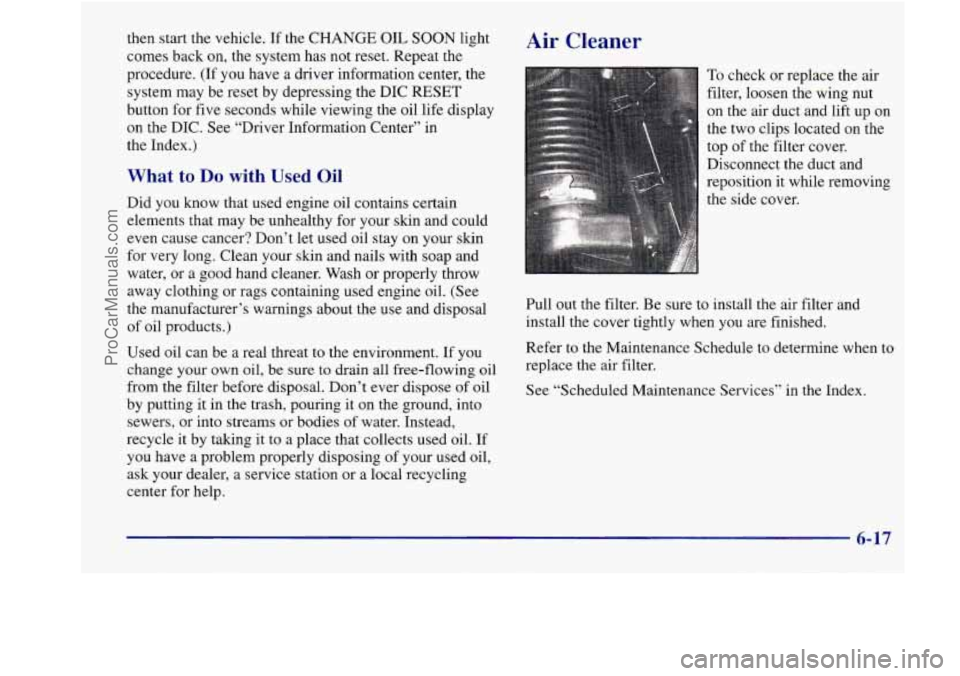
Air Cleaner
To check or replace the air
filter, loosen the wing nut
on the air duct and lift
up on
the two clips located on the
top of the filter cover.
Disconnect the duct and
reposition
it while removing
the side cover.
Pull out the filter. Be sure
to install the air filter and
install the cover tightly when you are finished.
Refer
to the Maintenance Schedule to determine when to
replace the air filter.
See “Scheduled Maintenance Services’’ in the Index.
6-17
ProCarManuals.com
Page 287 of 388
How to Add Fluid
Refer to the Maintenance Schedule to determine what
kind of transaxle fluid to use. See “Recommended
Fluids and Lubricants” in the Index.
If the fluid level is low, add only enough
of the proper
fluid to bring the
level into the cross-hatched area on
the dipstick.
1. Pull out the dipstick.
2. Using a long-neck funnel, add enough fluid at
the
dipstick hole to bring it to the proper level.
It doesn’t take much fluid, generally less than one
pint
(0.5 L). Don’t overfill.
NOTICE:
We recommend you use only fluid labeled
DEXRON@-111, because fluid with that label is
made especially for your automatic transaxle.
Damage caused by fluid other than
DEXRON-I11
is not covered by your new vehicle warranty.
3. After adding fluid, recheck the fluid level as
described under “How to Check.” 4.
When the correct fluid level is obtained, push the
dipstick back in all the way.
Engine Coolant
The cooling s stem in your vehicle is filled with
DEX-COOL engine coolant. This coolant is designed
to remain in your vehicle for 5 years or 150,000 miles
(240
000 km) whichever occurs first, if you add only
DEX-COOL6 extended life coolant.
J
The following explains your cooling system and how to
add coolant when it is low. If
you have a problem with
engine overheating or if you need
to add coolant to your
radiator, see “Engine Overheating”
in the Index.
A 50/50 mixture of water and DEX-COOL@
coolant will:
Give freezing protection down to -34°F (-37°C).
Give boiling protection up to 265 “F (1 29°C).
Protect against rust and corrosion.
0 Help keep the proper engine temperature.
0 Let the warning lights and gages work as they should.
6-23
ProCarManuals.com
Page 294 of 388
Brakes
Brake Fluid
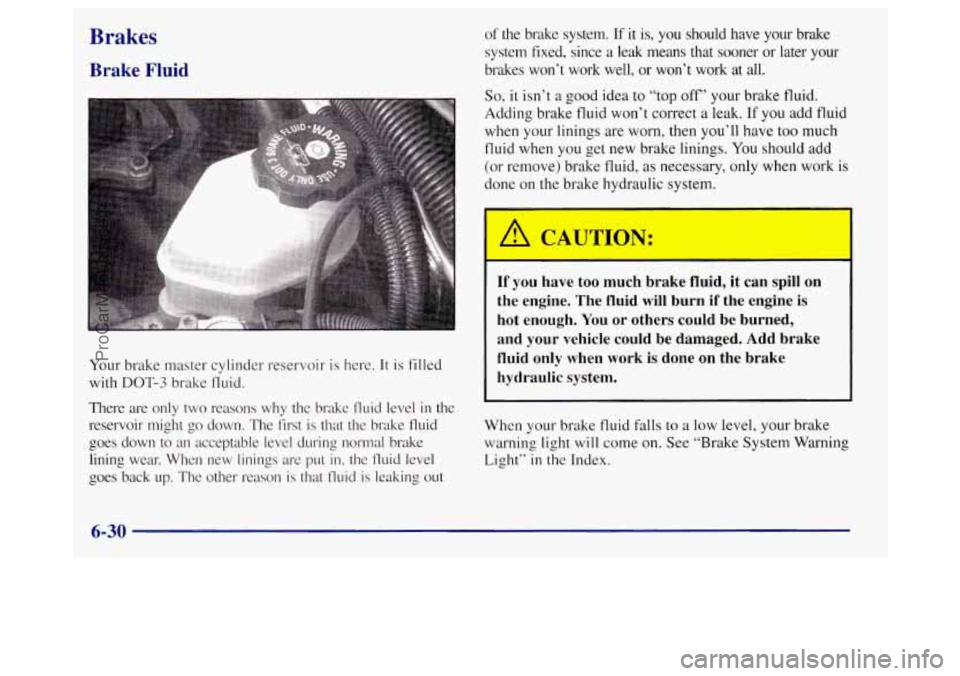
Your brake master cylinder reservoir is here. It is filled
with
DOT-3 brake fluid.
There are only two reasons
why the brake fluid level in the
reservoir might
go down. The first is that the brake fluid
goes down to an acceptable level during normal brake
lining wear. When new linings are put in, the fluid level
goes back up. The other reason is that fluid is leaking out
of the brake system. If it is, you should have your brake
system fixed, since
a leak means that sooner or later your
brakes won’t work well, or won’t work at
all.
So, it isn’t a good idea to “top off’ your brake fluid.
Adding brake fluid won’t correct a leak.
If you add fluid
when your linings are worn, then you’ll have too much
fluid when you get new brake linings.
You should add
(or remove) brake fluid, as necessary, only when work
is
done on the brake hydraulic system.
’ A CAUTION:
F-
If you have too much brake fluid, it can spill on
the engine. The fluid will burn if the engine is
hot enough.
You or others could be burned,
and your vehicle could be damaged. Add brake
fluid only when work is done on the brake
hydraulic system.
When your brake fluid falls to a low level, your brake
warning light
will come on. See “Brake System Warning
Light”
in the Index.
6-30
ProCarManuals.com
Page 296 of 388
Brake Wear
Your vehicle has four-wheel disc brakes.
Disc brake pads have built-in wear indicators that make a
high-pitched warning sound when the brake pads are worn
and new pads are needed. The sound may come and
go or
be heard all the time your vehicle is moving (except when
you are pushing
on the brake pedal firmy).
Some driving conditions or climates may cause a brake
squeal when the brakes are first applied or lightly
applied. This does not mean something is wrong with
your brakes.
Properly torqued wheel nuts are necessary
to help
prevent brake pulsation. When tires are rotated, inspect
brake pads for wear and evenly torque wheel nuts in the
proper sequence to
GM specifications.
The brake wear warning sound means that soon
your brakes won’t work well. That could lead to
an accident. When
you hear the brake wear
warning sound, have
your vehicle serviced.
I Brake linings should always be replaced as complete
axle sets.
See “Brake System Inspection” in Section
7 of this
manual under Part
C “Periodic Maintenance
Inspections.”
I NOTICE:
Continuing to drive with worn-out brake pads
could result in costly brake repair.
Brake Pedal navel
See your dealer if the brake pedal does not return to
normal height, or if there is a rapid increase in pedal
travel. This could be a sign of brake trouble.
Brake Adjustment
Every time you apply the brakes, with or without the
vehicle moving, your brakes adjust for wear.
6-32
ProCarManuals.com
Page 312 of 388
Uniform Tire Quality Grading
The following information relates to the system
developed by the United States National Highway
Traffic Safety Administration, which grades tires by
treadwear, traction and temperature performance. (This
applies only to vehicles sold in the United States.) The
grades are molded on the sidewalls
of most passenger
car tires.
The Uniform Tire Quality Grading system does
not apply to deep tread, winter-type snow tires,
space-saver or temporary use spare tires, tires with
nominal rim diameters
of 10 to 12 inches (25 to 30 cm),
or to some limited-production tires.
While the tires available
on General Motors passenger
cars and light trucks may vary with respect to these
grades, they must also conform to Federal safety
requirements and additional General Motors Tire
Performance Criteria
(TPC) standards.
Treadwear
The treadwear grade is a comparative rating based on
the wear rate
of the tire when tested under controlled
conditions
on a specified government test course. For
example, a tire graded
150 would wear one and a half
(1 1/2) times as well on the government course as a tire
graded
100. The relative performance of tires depends
upon the actual conditions
of their use, however, and
may depart significantly from the norm due to variations
in driving habits, service practices and differences in
road characteristics and climate.
Traction -- A, B, C
The traction grades, from highest to lowest, are A, B,
and C, and they represent the tire’s ability to stop
on wet pavement as measured under controlled
conditions on specified government test surfaces of
asphalt and concrete.
A tire marked C may have poor
traction performance.
Warning: The traction grade assigned to this tire is based
on braking (straight ahead) traction tests and does not
include cornering (turning) traction.
6-48
ProCarManuals.com
Page 373 of 388
Section 9 Index
Accessory Power Receptacle ..................... 2-52
Adding Equipment to the Outside of Your Vehicle ...... 6-3
Air Bag How Does it Restrain
.......................... 1-23
How it Works
................................ 1-21
Location
............................... 1.21. 1-22
Readiness Light
......................... 1.21. 2.60
Servicing
................................... 1-25
System
..................................... 1-19
What Makes it Inflate
.......................... 1-23
What Will You See After
it Inflates ............... 1-24
When Should it Inflate
......................... 1-23
Aircleaner
.................................... 6-17
Air Conditioning
........................ 3.3.3.6. 3.9
Air Conditioning Refrigerants
..................... 6-69
Alarm. Instant
................................. 2- 12
Alignment and Balance. Tire
...................... 6-46
Aluminum or Chrome Wheels. Cleaning
............. 6-54
AM-FM Stereo with Cassette Tape and Compact Disc Player
with Automatic Tone Control
.................... 3-20
AM-FM Stereo with Cassette Tape Player ........... 3-13
AM-FM Stereo with Cassette Tape Player and Automatic
Tonecontrol
................................. 3-16
Antenna Backglass
................................... 3-31
FixedMast .................................. 3-31 Antifreeze
..................................... 6-23
Anti-Lock Brake System Active Light
................. 2.63. 4.9
Brake System Warning Light
................ 2.62. 4.7
Brakes ...................................... 4-7
Anti-Theft, Radio
.............................. 3-25
Appearancecare
............................... 6-51
Appearance Care Materials
....................... 6-59
Arbitration Program
.............................. 8-7
Ashtrays ...................................... 2-50
Astroroof
..................................... 2-53
Audio Controls, Steering Wheel Touch Control
....... 3-28
Audio Equipment, Adding ........................ 3-29
Audio Systems
................................. 3-12
Audio Systems, Tips
............................ 3-29
Auto-Down Window
............................ 2-33
Automatic
Headlamp Control
............................ 2-42
Overdrive
(a) .......................... 2-24, 2-25
Power Door Locks ............................. 2-7
Transaxlecheck .............................. 7-15
Transaxle Fluid
............................... 6-20
Transaxle Operation
........................... 2-22
Transaxle PARK (P) Mechanism Check
........... 7-17
Using
....................................... 4-9
9-1
.
ProCarManuals.com
Page 376 of 388
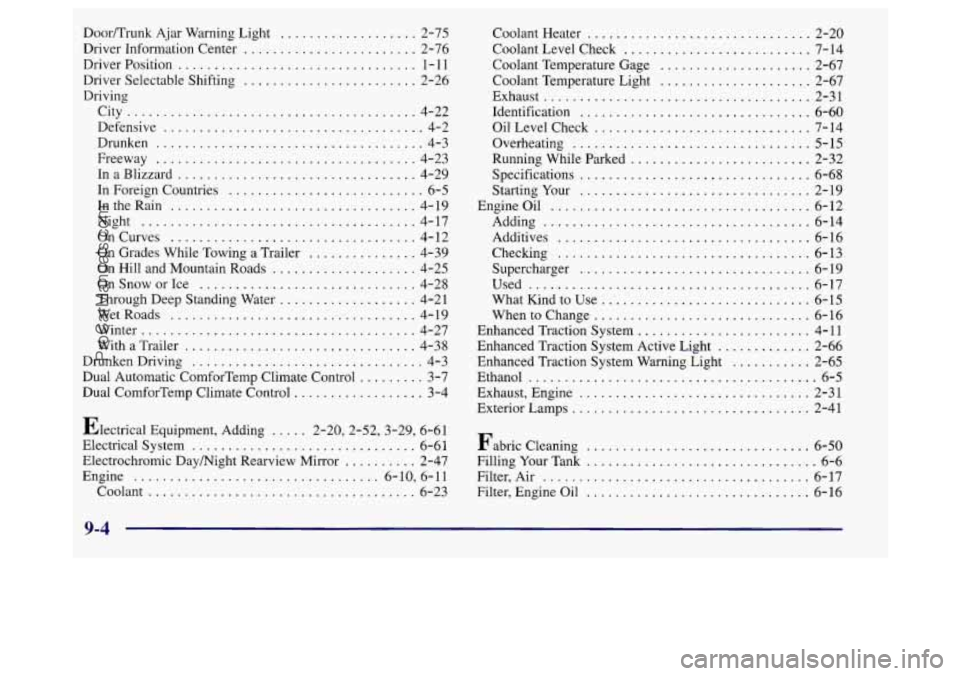
Door/Trunk Ajar Warning Light ................... 2-75
Driver Information Center
........................ 2-76
Driver Position
................................. 1 - 1 1
Driver Selectable Shifting ........................ 2-26
Driving City
........................................ 4-22
Defensive
.................................... 4-2
Drunken
..................................... 4-3
Freeway
.................................... 4-23
InaBlizzard
................................. 4-29
In Foreign Countries
........................... 6-5
IntheRain
.................................. 4-19
Night
...................................... 4-17
OnCurves
.................................. 4-12
On Grades While Towing a Trailer
............... 4-39
On Hill and Mountain Roads
.................... 4-25
On Snow
or Ice .............................. 4-28
Through Deep Standing Water
................... 4-21
WetRoads
.................................. 4-19
Winter
...................................... 4-27
With a Trailer
................................ 4-38
Drunken Driving
................................ 4-3
Dual Automatic ComforTemp Climate Control
......... 3-7
Dual ComforTemp Climate Control
.................. 3-4
Electrical Equipment, Adding
..... 2-20. 2-52. 3-29, 6-61
Electrochromic Daymight Rearview Mirror
.......... 2-47
Engine
.................................. 6-10, 6-11
Coolant
..................................... 6-23
Electrical
System
............................... 6-61 Coolant
Heater
............................... 2-20
Coolant Level Check
.......................... 7-14
Coolant Temperature Gage
..................... 2-67
Coolant Temperature Light
..................... 2-67
Exhaust
..................................... 2-31
Identification
................................ 6-60
OilLevelCheck
.............................. 7-14
Overheating
................................. 5-15
Running While Parked
......................... 2-32
Specifications
................................ 6-68
Starting Your
................................ 2-19
Adding ..................................... 6-14
Checking
................................... 6-13
Engineoil
.................................... 6-12
Additives
................................... 6-16
Supercharger
................................ 6-19
Used
....................................... 6-17
What Kind to Use
............................. 6-15
Whentochange
.............................. 6-16
Enhanced Traction System
........................ 4-11
Enhanced Traction System Active Light
............. 2-66
Enhanced Traction System Warning Light
........... 2-65
Ethanol
........................................ 6-5
Exhaust. Engine
................................ 2-31
Exterior Lamps ................................. 2-41
Fabric Cleaning
............................... 6-50
FillingYourTank
................................ 6-6
Filter, Air
..................................... 6-17
Filter. Engine Oil
............................... 6-16
9-4
ProCarManuals.com
Page 378 of 388
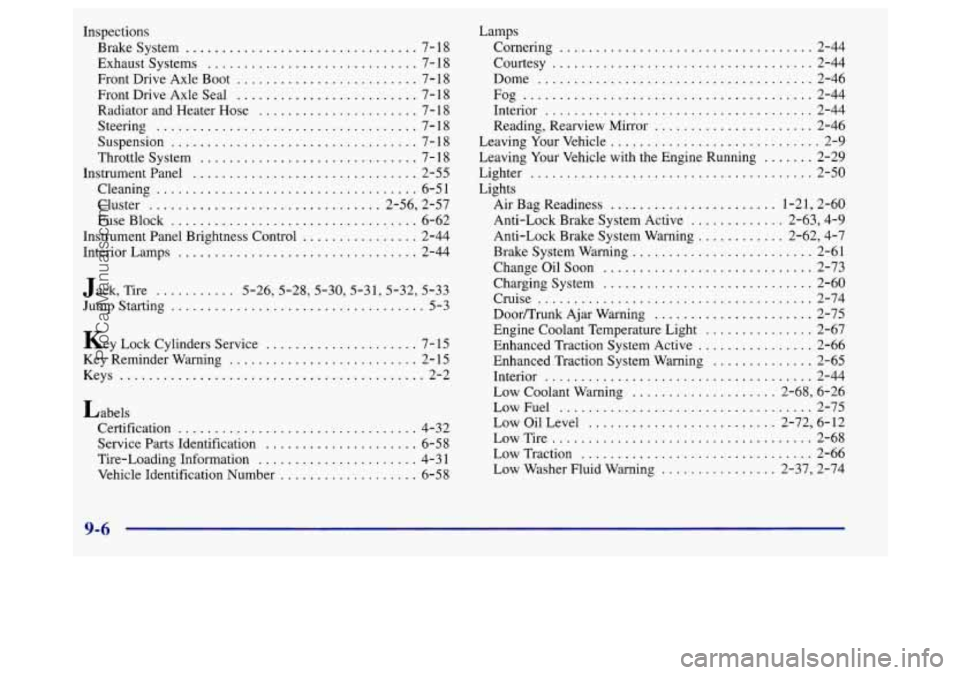
Inspections Brakesystem
................................ 7-18
Exhaust Systems
............................. 7- 18
Front Drive Axle Boot
......................... 7- 18
Front Drive Axle Seal
......................... 7-18
Radiator and Heater Hose
...................... 7- 18
Steering
.................................... 7-18
Suspension
.................................. 7-18
Throttle System
.............................. 7-1 8
InstrumentPanel ............................... 2-55
Cleaning .................................... 6-51
Cluster
................................ 2-56. 2-57
FuseBlock
.................................. 6-62
Instrument Panel Brightness Control
................ 2-44
Interior Lamps
................................. 2-44
Jack. Tire
........... 5.26.5.28.5.30.5.31.5.32. 5.33
Jump Starting
................................... 5-3
Key Lock Cylinders Service
..................... 7-15
Key Reminder Warning
.......................... 2-15
Keys
.......................................... 2-2
Labels Certification
................................. 4-32
Service Parts Identification
..................... 6-58
Tire-Loading Information
...................... 4-3 1
Vehicle Identification Number
................... 6-58 Lamps
Cornering
................................... 2-44
Courtesy
.................................... 2-44
Dome
...................................... 2-46
Fog
........................................ 2-44
Interior
..................................... 2-44
Reading. Rearview Mirror
...................... 2-46
Leaving Your Vehicle
............................. 2-9
Leaving Your Vehicle with the Engine Running
....... 2-29
Lighter
....................................... 2-50
Lights Air Bag Readiness
....................... 1-21, 2-60
Anti-Lock Brake System Active
............. 2-63, 4-9
Anti-Lock Brake System Warning
............ 2-62, 4-7
BrakeSystemWarning
......................... 2-61
Charging System
............................. 2-60
Cruise
...................................... 2-74
Door/Trunk Ajar Warning
...................... 2-75
Engine Coolant Temperature Light
............... 2-67
ChangeOilSoon
............................. 2-73
Enhanced Traction System Active
................ 2-66
Enhanced Traction System Warning
.............. 2-65 .
Interior ..................................... 2-44
Low Coolant Warning
.................... 2.68, 6.26
LowFuel
................................... 2-75
Low Oil Level
.......................... 2.72, 6.12
LowTire
.................................... 2-68
Low Traction
................................ 2-66
Low Washer Fluid Warning
................ 2.37, 2.74
9-6
ProCarManuals.com