belt BUICK REGAL 1998 Workshop Manual
[x] Cancel search | Manufacturer: BUICK, Model Year: 1998, Model line: REGAL, Model: BUICK REGAL 1998Pages: 388, PDF Size: 20.19 MB
Page 224 of 388
Parking on Hills 0 Shift into a gear; and
0 Release the parking brake.
You really should not park your vehicle, with a trailer
attached, on
a hill. If something goes wrong, your rig
could start to move. People can be injured, and both
your vehicle and the trailer can be damaged.
But if you ever have to park your rig on a hill, here’s
how to do it:
1. Apply your regular brakes, but don’t shift into
PARK (P) yet.
2. Have someone place chocks under the
trailer’s wheels.
3. When the wheel chocks are in place, release the
regular brakes until the chocks absorb the load.
4. Reapply the regular brakes. Then apply your parking
brake, and shift to
PARK (P).
5. Release the regular brakes.
When You Are Ready to Leave After
Parking
on a Hill
1. Apply your regular brakes and hold the pedal down
while you:
Start your engine;
2. Let up on the brake pedal.
3. Drive slowly until the trailer is clear of the chocks.
4. Stop and have someone pick up and store the chocks.
Maintenance When Trailer Towing
Your vehicle will need service more often when you’re
pulling a trailer. See the Maintenance Schedule for more
on this. Things that are especially important in trailer
operation are automatic transaxle fluid (don’t overfill),
engine oil, drive belt, cooling system and brake
adjustment. Each of these
is covered in this manual, and
the Index
will help you find them quickly. If you’re
trailering, it’s a good idea to review this information
before you start your trip.
Check periodically
to see that all hitch nuts and bolts
are tight.
Engine Cooling When Trailer Towing
Your cooling system may temporarily overheat during
severe operating conditions. See “Engine Overheating”
in the Index.
4-40
ProCarManuals.com
Page 265 of 388

Section 6 Service and Appearance Care
Here you will find information about the care of your vehicle. This section begins with service and fuel information,
and then it shows how to check important fluid and lubricant levels. There is also technical information about your
vehicle, and a part devoted to its appearance care.
6-2
6-3
6-5 6-5
6-8
6- 12
6-
12
6- 17
6-20
6-23
6-27
6-28 6-30
6-33 6-34
6-39
6-49
6-49 Service
Fuel
Fuels in Foreign Countries
Filling Your Tank
Checking Things Under the Hood
3800 Supercharged (Code 1) Engine
Engine Oil Air Cleaner
Automatic Transaxle Fluid
Engine Coolant
Power Steering Fluid
Windshield Washer Fluid
Brakes
Battery
Bulb Replacement
Tires
Appearance Care Cleaning the Inside
of Your Vehicle 6-5
1
6-52
6-52
6-52
6-53
6-54
6-55
6-57 6-58
6-58
6-59
6-65
6-65
6-66
6-67 6-67 Cleaning the Built-in
Child Restraint
Care of Safety Belts and Built-in Child
Restraint Harness
Cleaning Glass Surfaces
Cleaning the Outside of the Windshield and
Wiper Blades
Cleaning the Outside of Your Vehicle
Cleaning Aluminum or Chrome Wheels
Cleaning Tires
Appearance Care Materials Chart
Vehicle Identification Number (VIN)
Service Parts Identification Label
Electrical System
Replacement Bulbs
Capacities and Specifications
Vehicle Dimensions
Normal Maintenance Replacement Parts
Air Conditioning Refrigerants
6- 1
ProCarManuals.com
Page 276 of 388
Before closing the hood, be sure all the filler caps
are on properly. Then just pull the hood down and close
it firmly.
3800 Supercharged (Code 1) Engine
(If Equipped)
Your vehicle may have a 3800 Supercharged engine.
The supercharger is a device which is designed to pump
more air into the engine than it would normally use.
This
air is mixed with fuel, which creates increased
engine power. Since the supercharger is a pump and is
driven from an engine accessory drive belt, increased
pressure
is available at all driving conditions.
The Powertrain Control Module (PCM), works with a
vacuum control to regulate the increased pressure
required during specific driving conditions. When this
increased pressure or boost is not desired, such as during
idling and light throttle cruising, the excess air that the
supercharger is pumping is routed through a bypass. All
of these controls working together provide high
performance character and fuel efficiency in the
3800
Supercharged L67 engine.
Engine Oil
LOW
OIL
If the LOW OIL light on the
instrument panel comes on,
it means you need to check
your engine oil level right
away. For more
information,
see “Low Oil
Level Light” in the Index.
You should check your engine oil level regularly; this
is
an added reminder.
It’s a good idea to check your engine oil every time you
get fuel. In order to get an accurate reading, the oil must
be warm and the vehicle must be on level ground.
6-12
ProCarManuals.com
Page 311 of 388
0 The tire has a bump, bulge or split.
The tire has a puncture, cut or other damage that
can’t be repaired well because
of the size or location
of the damage.
Buying New Tires
To find out what kind and size of tires you need, look at
the Tire-Loading Information label.
The tires installed on your vehicle when it was new had
a Tire Performance Criteria Specification
(TPC Spec)
number on each tire’s sidewall. When you get new tires,
get ones with that same TPC Spec number. That way
your vehicle will continue to have tires that are designed
to give proper endurance, handling, speed rating,
traction, ride and other things during normal service on
your vehicle.
If your tires have an all-season tread
design, the TPC number will be followed by an
“MS”
(for mud and snow).
If you ever replace your tires with those not having a
TPC Spec number, make sure they are the same size,
load range, speed rating and construction type (bias,
bias-belted or radial) as your original tires.
Mixing tires could cause you to lose control while
driving.
If you mix tires of different sizes or types
(radial and bias-belted tires), the vehicle may not
handle properly, and you could have a crash.
Using tires of different sizes may also cause
damage
to your vehicle. Be sure to use the same
size and type tires on all wheels.
It’s all right to drive with your compact spare,
though. It was developed for use
on your vehicle.
A CAUTION:
If you use bias-ply tires on your
wheel rim flanges could develop cracks after
many miles of driving.
A tire and/or wheel could
fail suddenly, causing
a crash. Use only radial-ply
tires with the wheels on your vehicle.
I
6-47
ProCarManuals.com
Page 318 of 388
Cleaning the Top of the Instrument Panel
Use only mild soap and water to clean the top surfaces
of the instrument panel. Sprays containing silicones or
waxes may cause annoying reflections in the windshield
and even make it difficult to see through the windshield
under certain conditions.
Cleaning Interior Plastic Components
Use only a mild soap and water solution on a soft
cloth or sponge. Commercial cleaners may affect the
surface finish.
Cleaning the Built-in Child Restraint
Your built-in child restraint may be cleaned with mild
soap and lukewarm water. Don’t use household cleaners.
They may weaken the harness or damage plastic parts.
The built-in child restraint pad is attached to the child
restraint cushion and seatback with fastener strips. You
can remove the pad, machine wash it in cold water on
a
gentle cycle and tumble dry it on a low heat setting.
Never bleach or iron the pad, and don’t dry clean
it.
Care of Safety Belts and Built-in
Child Restraint Harness
Keep the safety belts and the built-in child restraint
harness clean and dry.
I A CAUTION:
Do not bleach or dye safety belts or the built-in
child restraint harness.
If you do, they may be
severely weakened. In a crash, they might not be able to provide adequate protection. Clean the
safety belts and the child restraint harness only with mild soap and lukewarm water.
Cleaning Glass Surfaces
Glass should be cleaned often. GM Glass Cleaner (GM
Part No. 1050427) or a liquid household glass cleaner
will remove normal tobacco smoke and dust films on
interior glass.
6-54
ProCarManuals.com
Page 344 of 388
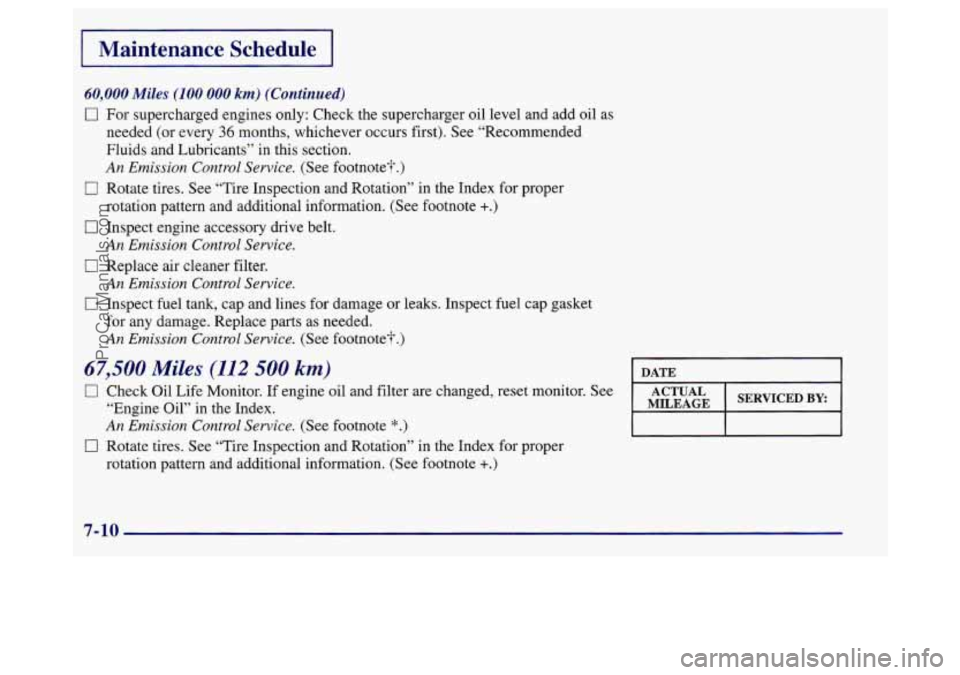
I Maintenance Schedule I
60,000 Miles (100 000 km) (Continued)
0 For supercharged engines only: Check the supercharger oil level and add oil as
needed (or every
36 months, whichever occurs first). See “Recommended
Fluids and Lubricants” in this section.
An Emission Control Service. (See footnote?.)
0 Rotate tires. See “Tire Inspection and Rotation” in the Index for proper
0 Inspect engine accessory drive belt.
0 Replace air cleaner filter.
0 Inspect fuel tank, cap and lines for damage or leaks. Inspect fuel cap gasket
rotation pattern
and additional information. (See footnote
+.)
An Emission Control Service.
An Emission Control Service.
for any damage. Replace parts as needed.
An Emission Control Service. (See footnote?.)
67,500 Miles (112 500 km)
0 Check Oil Life Monitor. If engine oil and filter are changed, reset monitor. See
“Engine Oil” in the Index.
MILEAGE
An Emission Control Service. (See footnote *.)
rotation pattern and additional information. (See footnote +.)
0 Rotate tires. See “Tire Inspection and Rotation” in the Index for proper
7-10
ProCarManuals.com
Page 349 of 388
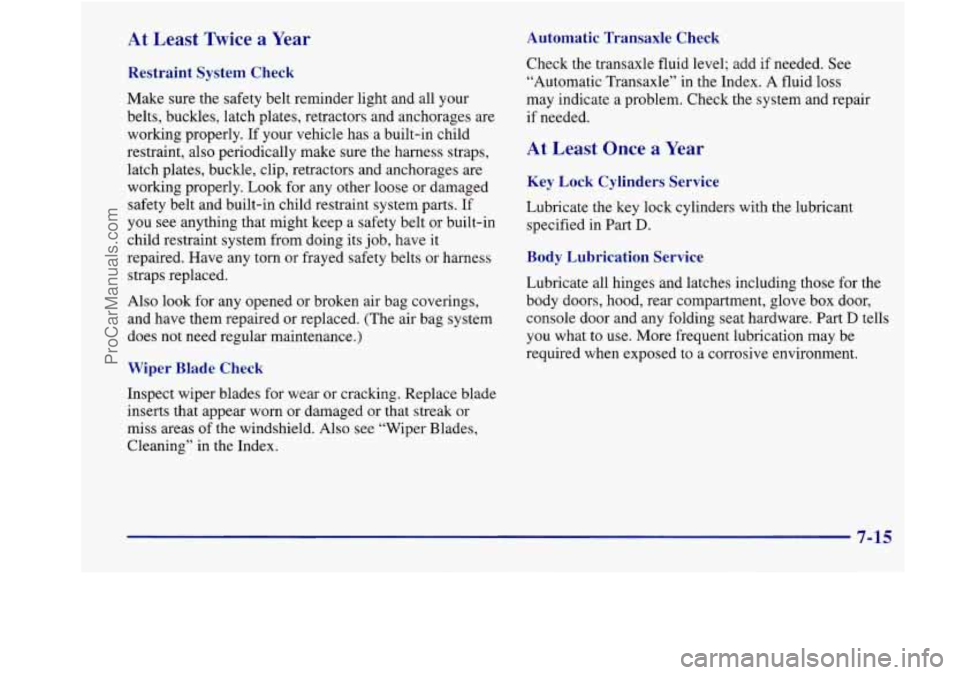
At Least Twice a Year
Restraint System Check
Make sure the safety belt reminder light and all your
belts, buckles, latch plates, retractors and anchorages are working properly. If your vehicle has
a built-in child
restraint, also periodically make sure the harness straps,
latch plates, buckle, clip, retractors and anchorages are
working properly. Look for any other loose or damaged
safety belt and built-in child restraint system parts. If
you see anything that might keep a safety belt or built-in
child restraint system from doing its job, have it
repaired. Have any torn or frayed safety belts or harness
straps replaced.
Also look for any opened or broken air bag coverings,
and have them repaired or replaced. (The air bag system
does not need regular maintenance.)
Wiper Blade Check
Inspect wiper blades for wear or cracking. Replace blade
inserts that appear worn or damaged or that streak
or
miss areas of the windshield. Also see “Wiper Blades,
Cleaning” in the Index.
Automatic Transaxle Check
Check the transaxle fluid level; add if needed. See
“Automatic Transaxle”
in the Index. A fluid loss
may indicate a problem. Check the system and repair
if needed.
At Least Once a Year
Key Lock Cylinders Service
Lubricate the key lock cylinders with the lubricant
specified in Part
D.
Body Lubrication Service
Lubricate all hinges and latches including those for the
body doors, hood, rear compartment, glove box door,
console door and any folding seat hardware. Part
D tells
you what to use. More frequent lubrication may be
required when exposed to a corrosive environment.
7-15
ProCarManuals.com
Page 379 of 388
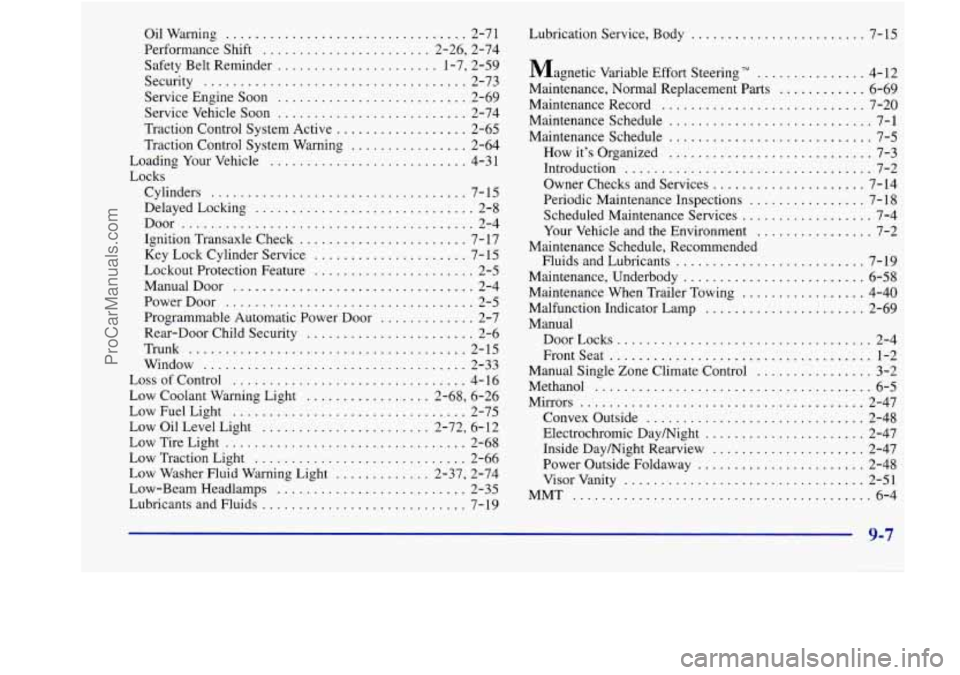
Oilwarning ................................. 2-71
Performance Shift
....................... 2.26. 2.74
Safety Belt Reminder
...................... 1.7. 2.59
Security
.................................... 2-73
Service Engine Soon
.......................... 2-69
Service Vehicle Soon .......................... 2-74
Traction Control System Active
.................. 2-65
Traction Control System Warning
................ 2-64
Loading Your Vehicle
........................... 4-31
Locks
Cylinders
................................... 7-15
DelayedLocking
.............................. 2-8
Door
........................................ 2-4
Ignition Transaxle Check
....................... 7-17
Key Lock Cylinder Service
..................... 7- 15
Lockout Protection Feature
...................... 2-5
ManualDoor
................................. 2-4
PowerDoor
.................................. 2-5
Rear-Door Child Security
....................... 2-6
Trunk
...................................... 2-15
Window
.................................... 2-33
Loss
of Control ................................ 4- 16
Low Coolant Warning Light
................. 2.68. 6.26
LowFuelLight
................................ 2-75
Low Oil Level Light
....................... 2.72. 6.12
Low Tire Light
................................. 2-68
Low Traction Light
............................. 2-66
Low Washer Fluid Warning Light
............. 2.37. 2-74
Low-Beam Headlamps
.......................... 2-35
Lubricants and Fluids
............................ 7-19
Programmable Automatic
Power Door
............. 2-7 Lubrication Service.
Body
........................ 7- 15
Magnetic Variable Effort Steering
................ 4-12
Maintenance. Normal Replacement Parts
............ 6-69
Maintenance Record
............................ 7-20
Maintenance Schedule
............................ 7-1
Maintenance Schedule
............................ 7-5
How it’s Organized ............................ 7-3
Introduction
.................................. 7-2
Owner Checks and Services
..................... 7-14
Scheduled Maintenance Services
.................. 7-4
Your Vehicle and the Environment
................ 7-2
Maintenance Schedule. Recommended
Fluids and Lubricants
.......................... 7-19
Maintenance. Underbody
......................... 6-58
Malfunction Indicator Lamp
...................... 2-69
Periodic Maintenance Inspections
................ 7-18
Maintenance When Trailer Towing
................. 4-40
Manual Door Locks
........................
Front Seat ...................
Manual Single Zone Climate Control
Methanol
.....................
Mirrors .......................
Convex Outside ..............
Electrochromic Daymight ......
Inside Daymight Rearview .....
Power Outside Foldaway .......
Visor Vanity .................
MMT ........................
..
..
..
..
..
..
..
..
..
..
..
..
..
..
..
..
..
..
..
..
.......... 2-4
.....
.....
.....
.....
.....
.....
.....
.....
.....
.....
.... 1-2
.... 3-2
.... 6-5
... 2-47
... 2-48
... 2-47
... 2-47
... 2-48
... 2-51
.... 6-4
9-7
ProCarManuals.com
Page 380 of 388
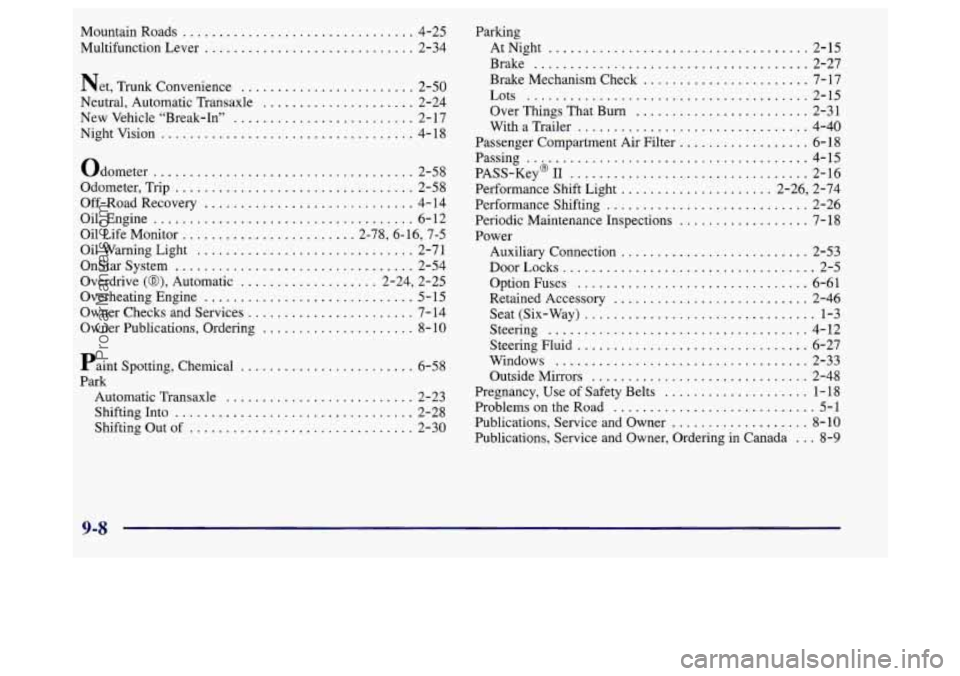
Mountain Roads .................................. 4-25
Multifunction Lever
............................. 2-34
Net. Trunk Convenience
........................ 2-50
Neutral. Automatic Transaxle
..................... 2-24
New Vehicle “Break-In”
......................... 2- 17
Nightvision
................................... 4-18
Odometer
.................................... 2-58
Odometer. Trip
................................. 2-58
Off-Road Recovery
............................. 4- 14
Oil Warning Light
.............................. 2-71
OnStar System
................................. 2-54
Oil.
Engine
.................................... 6-12
Oil Life Monitor
........................ 2-78. 6-16. 7-5
Overdrive
(a). Automatic ..................
Overheating Engine .......................
Owner Checks and Services .................
Owner Publications. Ordering ...............
Paint Spotting. Chemical ..................
Park
Automatic Transaxle
....................
Shifting Out of .........................
Shifting Into ...........................
2.24. 2.25
..... 5-15
..... 7-14
..... 8-10
..... 6-58
..... 2-23
..... 2-28
..... 2-30 Parking
AtNight
.................................... 2-15
Brake
...................................... 2-27
Brake Mechanism Check
....................... 7-17
Lots
....................................... 2-15
Over Things That Burn ........................ 2-31
With a Trailer
................................ 4-40
Passenger Compartment Air Filter
.................. 6-18
Passing
............................... 4-15
PASS-Key I1 2-16
Performance Shift Light
..................... 2-26, 2-74
Periodic Maintenance Inspections
.................. 7-18
Power
.... *.h* .................................
Performance Shifting ............................ 2-26
Auxiliary Connection
.......................... 2-53
DoorLocks
................................... 2-5
Option Fuses
................................ 6-61
Retained Accessory
........................... 2-46
Seat (Six-Way)
Steering
.....
Steering Fluid .
Windows ....
................................ 1-3
............................... 4-12
............................... 6-27
............................... 2-33
Outside Mirrors
.............................. 2-48
Pregnancy.
Use of Safety Belts .................... 1-18
Problems on the Road
............................ 5-1
Publications. Service and Owner
................... 8-10
Publications. Service and Owner. Ordering in Canada
... 8-9
9-8
ProCarManuals.com
Page 381 of 388
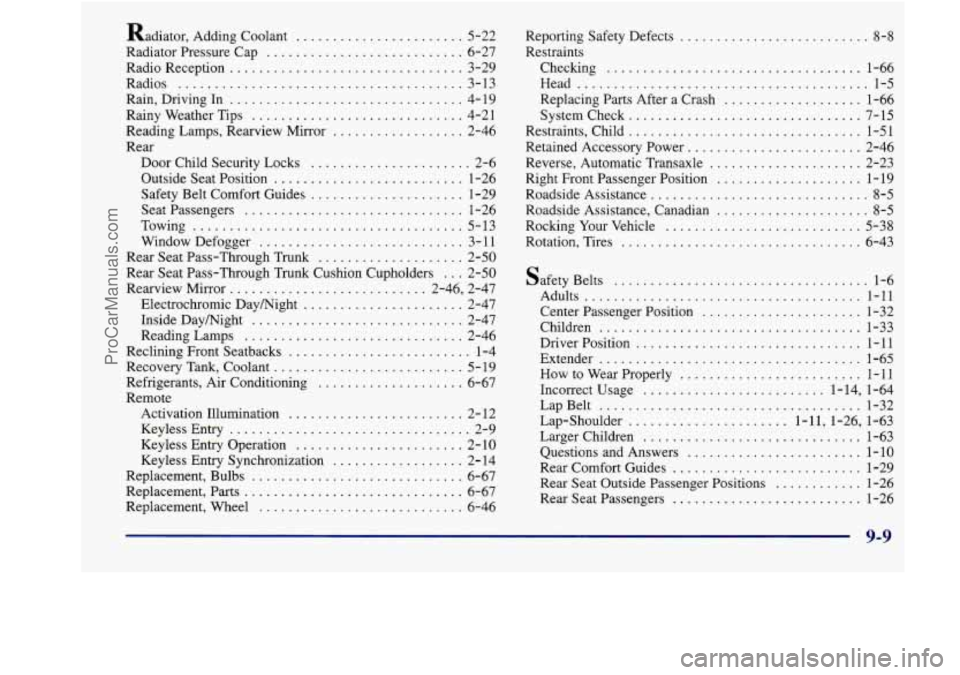
Radiator. Adding Coolant ....................... 5-22
Radiator Pressure Cap
........................... 6-27
Radio Reception
................................ 3-29
Radios
....................................... 3-13
Rain. Driving In
................................ 4- 19
Rainy Weather Tips
............................. 4-21
Reading Lamps. Rearview Mirror
.................. 2-46
Rear Door Child Security Locks
...................... 2-6
Outside Seat Position
.......................... 1-26
Safety Belt Comfort Guides
..................... 1-29
Seatpassengers
.............................. 1-26
Towing
..................................... 5-13
Window Defogger
............................ 3- 11
Rear Seat Pass-Through Trunk .................... 2-50
Rear Seat Pass-Through Trunk Cushion Cupholders ... 2-50
Rearview Mirror ........................... 2-46. 2-47
Electrochromic Daymight
...................... 2-47
Inside Daymight
............................. 2-47
Reading Lamps
.............................. 2-46
Reclining Front Seatbacks
......................... 1-4
Recovery Tank. Coolant
............
Refrigerants. Air Conditioning ......
Remote
Activation Illumination
..........
Keyless Entry ..................
Keyless Entry Operation .........
..
..
........... 5-19
........... 6-67
........... 2-12
............ 2-9
........... 2-10
Keyless Entry Synchronization
.................. 2- 14
Replacement. Bulbs
............................. 6-67
Replacement. Parts
.............................. 6-67
Replacement. Wheel
............................ 6-46
..
..
..
..
Reporting Safety Defects .......................... 8-8
Restraints Checking
................................... 1-66
Head
........................................ 1-5
Replacing Parts After a Crash
................... 1-66
Systemcheck
................................ 7-15
Restraints. Child
................................ 1-51
Retained Accessory Power
........................ 2-46
Reverse. Automatic Transaxle
..................... 2-23
Right Front Passenger Position
.................... 1 . 19
Roadside Assistance
.............................. 8-5
Roadside Assistance. Canadian
..................... 8-5
Rocking Your Vehicle
........................... 5-38
Rotation. Tires
................................. 6-43
Safety Belts
................................... 1-6
Center Passenger Position
...................... 1-32
Children
.................................... 1-33
Driver Position
............................... 1-11
Extender .................................... 1-65
How to Wear Properly ......................... 1-11
Incorrect Usage ......................... 1-14, 1-64
LapBelt
.................................... 1-32
Lap-Shoulder
...................... 1- 11, 1-26, 1-63
Larger Children
.............................. 1-63
Questions and Answers
........................ 1-10
Rear Comfort Guides .......................... 1-29
Rear Seat Outside Passenger Positions
............ 1-26
Rear Seat Passengers
.......................... 1-26
Adults
...................................... 1-11
9-9
ProCarManuals.com