steering wheel BUICK REGAL 2000 Owner's Guide
[x] Cancel search | Manufacturer: BUICK, Model Year: 2000, Model line: REGAL, Model: BUICK REGAL 2000Pages: 349, PDF Size: 2.65 MB
Page 208 of 349
4-38 Following Distance
Stay at least twice as far behind the vehicle ahead as you
would when driving your vehicle without a trailer. This
can help you avoid situations that require heavy braking
and sudden turns.
Passing
You'll need more passing distance up ahead when
you're towing a trailer. And, because you're a good
deal longer, you'll need to go much farther beyond the
passed vehicle before you can return to your lane.
Backing Up
Hold the bottom of the steering wheel with one hand.
Then, to move the trailer to the left, just move that
hand to the left. To move the trailer to the right, move
your hand to the right. Always back up slowly and,
if possible, have someone guide you.
Making Turns
NOTICE:
Making very sharp turns while trailering could
cause the trailer to come in contact with the
vehicle. Your vehicle could be damaged. Avoid
making very sharp turns while trailering.
When you're turning with a trailer, make wider
turns than normal. Do this so your trailer won't
strike soft shoulders, curbs, road signs, trees or other
objects. Avoid jerky or sudden maneuvers. Signal well
in advance.
Page 230 of 349
5-20
12. Then replace the pressure cap. At any time during
this procedure if coolant begins to flow out of the
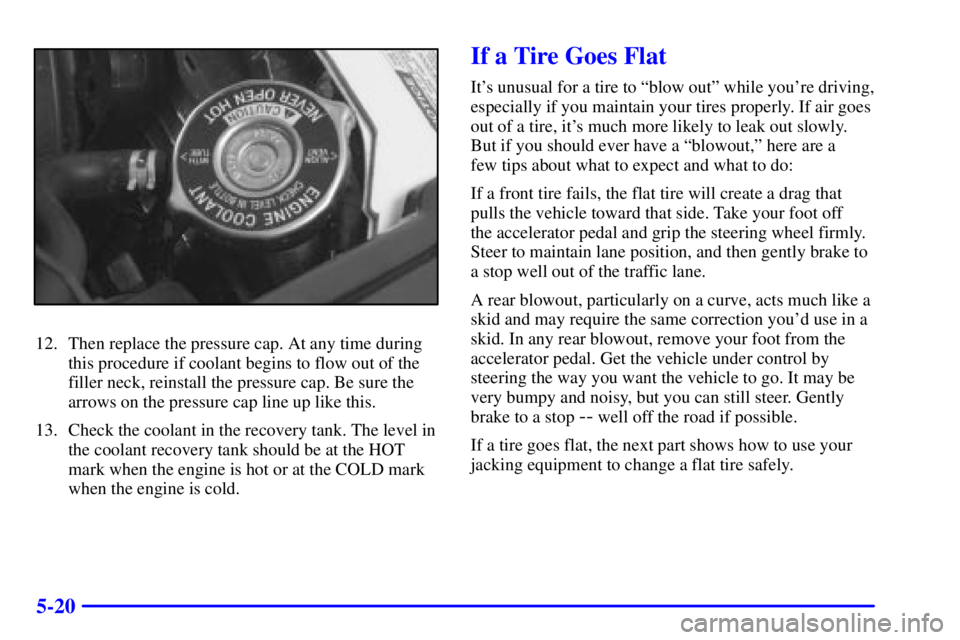
filler neck, reinstall the pressure cap. Be sure the
arrows on the pressure cap line up like this.
13. Check the coolant in the recovery tank. The level in
the coolant recovery tank should be at the HOT
mark when the engine is hot or at the COLD mark
when the engine is cold.
If a Tire Goes Flat
It's unusual for a tire to ªblow outº while you're driving,
especially if you maintain your tires properly. If air goes
out of a tire, it's much more likely to leak out slowly.
But if you should ever have a ªblowout,º here are a
few tips about what to expect and what to do:
If a front tire fails, the flat tire will create a drag that
pulls the vehicle toward that side. Take your foot off
the accelerator pedal and grip the steering wheel firmly.
Steer to maintain lane position, and then gently brake to
a stop well out of the traffic lane.
A rear blowout, particularly on a curve, acts much like a
skid and may require the same correction you'd use in a
skid. In any rear blowout, remove your foot from the
accelerator pedal. Get the vehicle under control by
steering the way you want the vehicle to go. It may be
very bumpy and noisy, but you can still steer. Gently
brake to a stop
-- well off the road if possible.
If a tire goes flat, the next part shows how to use your
jacking equipment to change a flat tire safely.
Page 243 of 349
5-33
If You're Stuck: In Sand, Mud,
Ice or Snow
In order to free your vehicle when it is stuck, you will
need to spin the wheels, but you don't want to spin
your wheels too fast. The method known as ªrockingº
can help you get out when you're stuck, but you must
use caution.
CAUTION:
If you let your tires spin at high speed, they
can explode, and you or others could be injured.
And, the transaxle or other parts of the vehicle
can overheat. That could cause an engine
compartment fire or other damage. When you're
stuck, spin the wheels as little as possible. Don't
spin the wheels above 35 mph (55 km/h) as shown
on the speedometer.
NOTICE:
Spinning your wheels can destroy parts of your
vehicle as well as the tires. If you spin the wheels
too fast while shifting your transaxle back and
forth, you can destroy your transaxle.
For information about using tire chains on your vehicle,
see ªTire Chainsº in the Index.
Rocking Your Vehicle To Get It Out
First, turn your steering wheel left and right. That will
clear the area around your front wheels. If your vehicle has
the Traction Control System, you should turn the system
off. (See ªFull
-Range Traction Control System or Traction
Control Systemº in the Index.) Then shift back and forth
between REVERSE (R) and a forward gear, spinning the
wheels as little as possible. Release the accelerator pedal
while you shift, and press lightly on the accelerator pedal
when the transaxle is in gear. By slowly spinning your
wheels in the forward and reverse directions, you will
cause a rocking motion that may free your vehicle.
If that doesn't get you out after a few tries, you may
need to be towed out. If you do need to be towed out,
see ªTowing Your Vehicleº in the Index.
Page 244 of 349
6-
6-1
Section 6 Service and Appearance Care
Here you will find information about the care of your vehicle. This section begins with service and fuel information,
and then it shows how to check important fluid and lubricant levels. There is also technical information about your
vehicle, and a part devoted to its appearance care.
6
-2 Service
6
-3 Fuel
6
-5 Fuels in Foreign Countries
6
-6 Filling Your Tank
6
-8 Filling a Portable Fuel Container
6
-8 Checking Things Under the Hood
6
-12 3800 Supercharged V6 Engine (If Equipped)
6
-12 Engine Oil
6
-17 Engine Air Cleaner/Filter
6
-18 Passenger Compartment Air Filter
6
-20 Automatic Transaxle Fluid
6
-23 Engine Coolant
6
-27 Power Steering Fluid
6
-28 Windshield Washer Fluid
6
-29 Brakes
6
-33 Battery6
-33 Bulb Replacement
6
-42 Tires
6
-52 Appearance Care
6
-52 Cleaning the Inside of Your Vehicle
6
-55 Cleaning Glass Surfaces
6
-55 Cleaning the Outside of the Windshield and
Wiper Blades
6
-55 Cleaning the Outside of Your Vehicle
6
-57 Cleaning Aluminum or Chrome-Plated
Wheels (If Equipped)
6
-57 Cleaning Tires
6
-59 GM Vehicle Care/Appearance Materials
6
-60 Vehicle Identification Number (VIN)
6
-60 Electrical System
6
-66 Replacement Bulbs
6
-67 Capacities and Specifications
6
-68 Normal Maintenance Replacement Parts
Page 307 of 349

6-64
Fuse Description
ABS Anti
-Lock Brakes
TURN SIGNALS,
CORN LPSTurn Signals, Cornering Lamps
RADIO, HVAC,
RFA, CLUSTERRadio, HVAC Head, Remote
Keyless Entry, Cluster
HIGH BLOWER High Blower
RH HEATED
SEATPassenger's Heated Seat
STRG WHL
CONTAudio Steering Wheel Controls
WIPER Wipers
Underhood Electrical Center
-- Passenger's Side
Some fuses and relays are located in the underhood
electrical center on the passenger's side of the
engine compartment.
Maxi fuse Description
1 ABS
2 Starter Solenoid
3 Power Seats, Rear Defog,
Heated Seats
4 High Blower, Hazard Flasher,
Stoplamps, Power Mirror, Door Locks
Page 308 of 349

6-65
Maxi fuse Description
5 Ignition Switch, BTSI, Stoplamps,
ABS, Turn Signals, Cluster, Air Bag,
DRL Module
6 Cooling Fan
7 Interior Lamps, Retained Accessory
Power, Keyless Entry, CEL TEL,
Data Link, HVAC Head, Cluster,
Radio, AUX Power (Power Drop),
Cigarette Lighter
8 Ignition Switch, Wipers, Radio,
Steering Wheel Controls, Body
Control Module, AUX Power
(Power Drop), Power Windows,
Sunroof, HVAC Controls, DRL,
Rear Defog Relay
Mini relay Description
9 Cooling Fan 2
10 Cooling Fan 3
11 Starter Solenoid
12 Cooling Fan 1
13 Ignition Main
14 Air Pump (Optional)Mini relay Description
15 A/C Clutch
16 Horn
17 Fog Lamps
18 Fuel Pump, Speed Control (L67 only)
19 Fuel Pump
Mini fuse Description
20 Air Pump (Optional)
21 Generator
22 ECM
23 A/C Compressor Clutch
24 Cooling Fan
25 Electronic Ignition
26 Transaxle
Mini fuse Description
27 Horn
28 Fuel Injector
29 Oxygen Sensor
30 Engine Emissions
31 Fog Lamps
32 Headlamp (Right)
33 Rear Compartment Release