ECU BUICK REGAL 2003 Owner's Guide
[x] Cancel search | Manufacturer: BUICK, Model Year: 2003, Model line: REGAL, Model: BUICK REGAL 2003Pages: 344, PDF Size: 2.21 MB
Page 192 of 344
If you do have a heavy load, spread it out. Don’t carry
more than 167 lbs (75 kg) in your trunk.
{CAUTION:
Do not load your vehicle any heavier than the
GVWR, or either the maximum front or rear
GAWR. If you do, parts on your vehicle can
break, and it can change the way your vehicle
handles. These could cause you to lose
control and crash. Also, overloading can
shorten the life of your vehicle.
Notice:Your warranty does not cover parts or
components that fail because of overloading.
If you put things inside your vehicle–like suitcases,
tools, packages or anything else–they will go as fast as
the vehicle goes. If you have to stop or turn quickly,
or if there is a crash, they’ll keep going.
{CAUTION:
Things you put inside your vehicle can strike
and injure people in a sudden stop or turn, or
in a crash.
•Put things in the trunk of your vehicle. In a
trunk, put them as far forward as you can.
Try to spread the weight evenly.
•Never stack heavier things, like suitcases,
inside the vehicle so that some of them
are above the tops of the seats.
•Don’t leave an unsecured child restraint in
your vehicle.
•When you carry something inside the
vehicle, secure it whenever you can.
•Don’t leave a seat folded down unless you
need to.
4-34
2003 - Regal OM
Page 197 of 344

Driving with a Trailer
Towing a trailer requires a certain amount of experience.
Before setting out for the open road, you’ll want to get
to know your rig. Acquaint yourself with the feel of
handling and braking with the added weight of the trailer.
And always keep in mind that the vehicle you are
driving is now a good deal longer and not nearly as
responsive as your vehicle is by itself.
Before you start, check the trailer hitch and platform
(and attachments), safety chains, electrical connector,
lamps, tires and mirror adjustment. If the trailer has
electric brakes, start your vehicle and trailer moving and
then apply the trailer brake controller by hand to be
sure the brakes are working. This lets you check your
electrical connection at the same time.
During your trip, check occasionally to be sure that the
load is secure, and that the lamps and any trailer
brakes are still working.
Following Distance
Stay at least twice as far behind the vehicle ahead as
you would when driving your vehicle without a trailer.
This can help you avoid situations that require
heavy braking and sudden turns.
Passing
You’ll need more passing distance up ahead when
you’re towing a trailer. And, because you’re a good deal
longer, you’ll need to go much farther beyond the
passed vehicle before you can return to your lane.
Backing Up
Hold the bottom of the steering wheel with one hand.
Then, to move the trailer to the left, just move that hand
to the left. To move the trailer to the right, move your
hand to the right. Always back up slowly and, if possible,
have someone guide you.
Making Turns
Notice:Making very sharp turns while trailering
could cause the trailer to come in contact with the
vehicle. Your vehicle could be damaged. Avoid
making very sharp turns while trailering.
When you’re turning with a trailer, make wider turns
than normal. Do this so your trailer won’t strike
soft shoulders, curbs, road signs, trees or other objects.
Avoid jerky or sudden maneuvers. Signal well in
advance.
4-39
2003 - Regal OM
Page 256 of 344
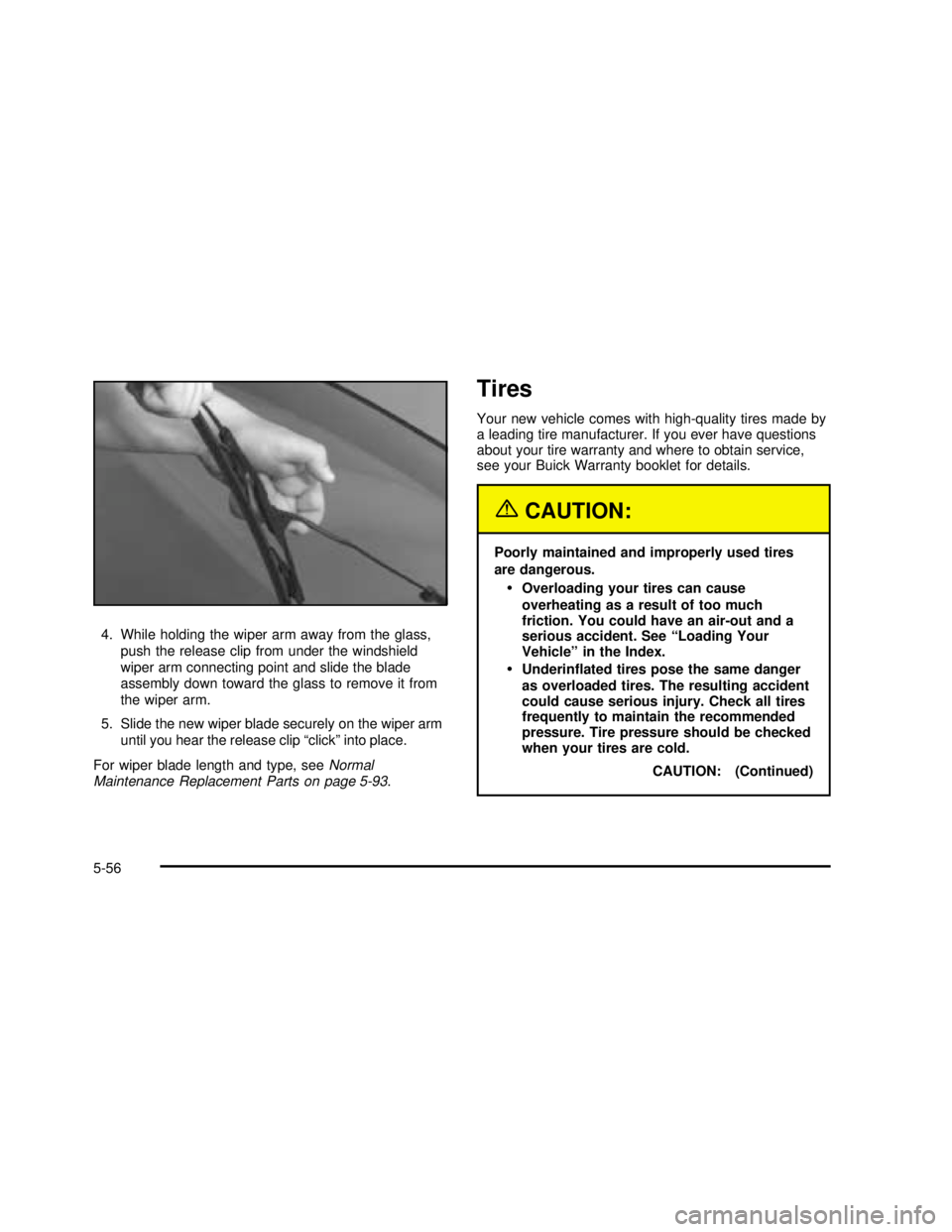
4. While holding the wiper arm away from the glass,
push the release clip from under the windshield
wiper arm connecting point and slide the blade
assembly down toward the glass to remove it from
the wiper arm.
5. Slide the new wiper blade securely on the wiper arm
until you hear the release clip“click”into place.
For wiper blade length and type, seeNormal
Maintenance Replacement Parts on page 5-93.
Tires
Your new vehicle comes with high-quality tires made by
a leading tire manufacturer. If you ever have questions
about your tire warranty and where to obtain service,
see your Buick Warranty booklet for details.
{CAUTION:
Poorly maintained and improperly used tires
are dangerous.
Overloading your tires can cause
overheating as a result of too much
friction. You could have an air-out and a
serious accident. See“Loading Your
Vehicle”in the Index.
Underinated tires pose the same danger
as overloaded tires. The resulting accident
could cause serious injury. Check all tires
frequently to maintain the recommended
pressure. Tire pressure should be checked
when your tires are cold.
CAUTION: (Continued)
5-56
2003 - Regal OM
Page 265 of 344
Tire Chains
{CAUTION:
If your vehicle has P225/60R16 size tires, don’t
use tire chains, there’s not enough clearance.
Tire chains used on a vehicle without the
proper amount of clearance can cause damage
to the brakes, suspension or other vehicle
parts. The area damaged by the tire chains
could cause you to lose control of your vehicle
and you or others may be injured in a crash.
Use another type of traction device only if its
manufacturer recommends it for use on your
vehicle and tire size combination and road
CAUTION: (Continued)
CAUTION: (Continued)
conditions. Follow that manufacturer’s
instructions. To help avoid damage to your
vehicle, drive slowly, readjust or remove the
device if it’s contacting your vehicle, and don’t
spin your wheels.
If you dond traction devices that willt,
install them on the front tires.
Notice:If your vehicle has a tire size other than
P225/60R16 size tires, use tire chains only where
legal and only when you must. Use only SAE Class
″S″type chains that are the proper size for your
tires. Install them on the front tires and tighten them
as tightly as possible with the ends securely
fastened. Drive slowly and follow the chain
manufacturer’s instructions. If you can hear the
chains contacting your vehicle, stop and retighten
them. If the contact continues, slow down until
it stops. Driving too fast or spinning the wheels with
chains on will damage your vehicle.
5-65
2003 - Regal OM
Page 275 of 344
12. Don’t try to put the wheel cover on your compact
spare tire. It won’tfit. Store the wheel cover in the
trunk until you have theflat tire repaired or
replaced.
Notice:Wheel covers won’tt on your compact
spare. If you try to put a wheel cover on your
compact spare, you could damage the cover or the
spare.
Storing the Flat Tire and Tools
{CAUTION:
Storing a jack, a tire, or other equipment in the
passenger compartment of the vehicle could
cause injury. In a sudden stop or collision,
loose equipment could strike someone. Store
all these in the proper place.
After you’ve put the compact tire on your vehicle, you’ll
need to store theflat tire in your trunk. Use the
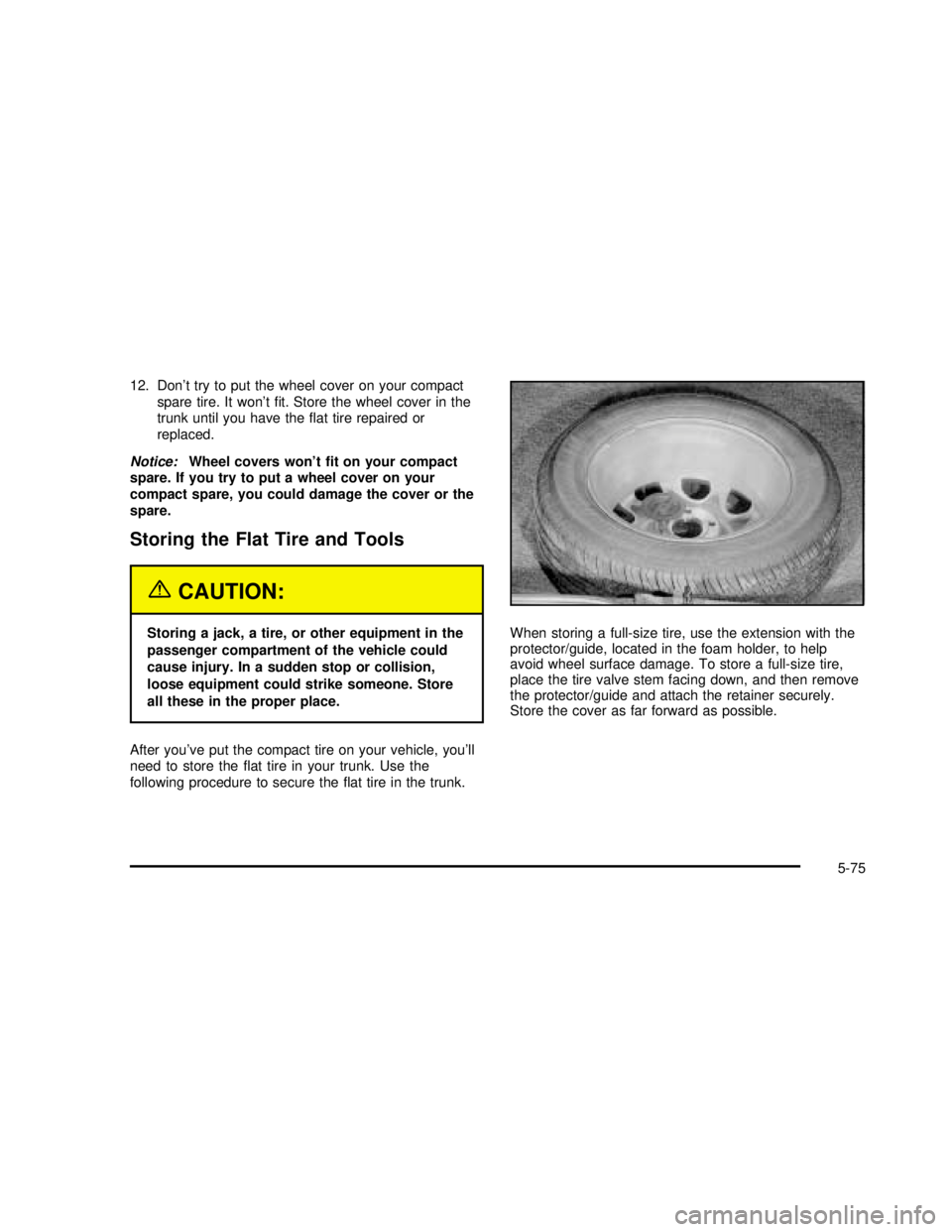
following procedure to secure theflat tire in the trunk.When storing a full-size tire, use the extension with the
protector/guide, located in the foam holder, to help
avoid wheel surface damage. To store a full-size tire,
place the tire valve stem facing down, and then remove
the protector/guide and attach the retainer securely.
Store the cover as far forward as possible.
5-75
2003 - Regal OM
Page 320 of 344

Roadside Assistance Program
Buick Motor Division is proud to offer Buick Premium
Roadside Assistance to customers for vehicles covered
under the 3 year/36,000 mile (60 000 km) new car
warranty (whichever occursrst).
Our commitment to Buick owners has always included
superior service through our network of Buick dealers.
Buick Premium Roadside Assistance provides an
extra measure of convenience and security.
Buick’s Roadside Assistance toll-free number is staffed
by a team of technically trained advisors, who are
available 24 hours a day, 365 days a year.
We take anxiety out of uncertain situations by providing
minor repair information over the phone or making
arrangements to tow your vehicle to the nearest Buick
dealer.
We will provide the following services for
3 years/36,000 miles (60 000 km), at no expense to you:
Fuel delivery
Lock-out service (identication required)
Tow to nearest dealership for warranty service
Change aat tire
Jump startsWe have quick, easy access to telephone numbers of
the following additional services depending on your
needs:
Hotels
Glass replacement
Tire repair facilities
Rental vehicle or taxis
Airports or train stations
Police,re department or hospitals
In many instances, mechanical failures are covered
under Buick’s comprehensive warranty. However, when
other services are utilized, our advisors will explain
any payment obligations you might incur.
For prompt and efficient assistance when calling, please
provide the following information to give the advisor:
Location of vehicle
Telephone number of your location
Vehicle model, year and color
Mileage of vehicle
Vehicle Identication Number (VIN)
Vehicle license plate number
7-6
2003 - Regal OM
Page 321 of 344

Buick reserves the right to limit services or
reimbursement to an owner or driver when, in Buick’s
judgement, the claims become excessive in frequency or
type of occurrence.
While we hope you never have the occasion to use our
service, it is added security while traveling for you
and your family. Remember, we’re only a phone call
away. Buick Roadside Assistance: 1-800-252-1112, text
telephone (TTY) users, call 1-888-889-2438.
Canadian Roadside Assistance
Vehicles purchased in Canada have an extensive
Roadside Assistance program accessible from anywhere
in Canada or the United States. Please refer to the
Warranty and Owner Assistance Information book.
Courtesy Transportation
Buick has always exemplied quality and value in its
offering of motor vehicles. To enhance your ownership
experience, we and our participating dealers are
proud to offer Courtesy Transportation, a customer
support program for new vehicles.
The Courtesy Transportation program is offered to retail
purchase/lease customers in conjunction with the
Bumper-to-Bumper coverage provided by the New
Vehicle Limited Warranty. Several transportation options
are available when warranty repairs are required.
This will reduce your inconvenience during warranty
repairs.
7-7
2003 - Regal OM
Page 329 of 344

Center High-Mounted Stoplamp (CHMSL)...........5-52
Center Passenger Position, Safety Belts.............1-20
Chains, Tires..................................................5-65
Charging System Light....................................3-31
Check
Engine Light...............................................3-35
Checking Coolant............................................5-23
Checking Engine Oil........................................5-13
Checking Things Under the Hood....................... 5-8
Checking Your Restraint Systems......................1-54
Chemical Paint Spotting...................................5-83
Child Restraints
Child Restraint Systems...............................1-32
Infants and Young Children...........................1-29
Lower Anchorages and Top Tethers for
Children (LATCH System)..........................1-38
Older Children.............................................1-27
Securing a Child Restraint Designed for the
LATCH System........................................1-40
Securing a Child Restraint in a Center Rear
Seat Position...........................................1-42
Securing a Child Restraint in a Rear Outside
Seat Position...........................................1-40
Securing a Child Restraint in the Right Front
Seat Position...........................................1-44
Top Strap...................................................1-36
Top Strap Anchor Location............................1-37
Where to Put the Restraint...........................1-35Cigarette Lighter
.............................................3-17
Cleaning
Inside of Your Vehicle
..................................5-78
Outside of Your Vehicle
................................5-80
Underbody Maintenance
...............................5-83
Weatherstrips
..............................................5-80
Cleaning Exterior Lamps/Lenses
.......................5-81
Climate Control System
Air Filter, Passenger Compartment
.................3-24
Dual
..........................................................3-17
Dual Automatic
............................................3-20
Outlet Adjustment
........................................3-24
Compact Disc Messages
..................................3-54
Compact Spare Tire
........................................5-77
Control Buttons
...............................................3-43
Control of a Vehicle
.......................................... 4-5
Convenience Net
............................................2-36
Coolant
Engine Temperature Gage
............................3-34
Engine Temperature Warning Light
.................3-34
Heater, Engine
............................................2-20
Cooling System
..............................................5-28
Cornering Lamps
............................................3-13
Courtesy Lamps
.............................................3-13
Cruise Control
.................................................. 3-8
Cruise Control Light
........................................3-40
3
2003 - Regal OM
Page 334 of 344

L
Lamps
Exterior......................................................3-10
Interior.......................................................3-13
Lap Belt........................................................1-20
Lap-Shoulder Belt...................................1-12, 1-22
LATCH System
Child Restraints...........................................1-38
Securing a Child Restraint Designed for
the LATCH System...................................1-40
Leather.........................................................5-79
Leaving Your Vehicle.......................................2-11
Leaving Your Vehicle With the Engine Running......2-26
Light
Air Bag Readiness.......................................3-30
Anti-Lock Brake System Warning...................3-32
Brake System Warning.................................3-31
Change Engine Oil......................................3-39
Charging System.........................................3-31
Cruise Control.............................................3-40
Door/Trunk Ajar Warning...............................3-40
Engine Coolant Temperature Warning.............3-34
Low Fuel Warning.......................................3-42
Low Oil Level.............................................3-39Light (cont.)
Low Traction...............................................3-33
Low Washer Fluid Warning...........................3-40
Malfunction Indicator....................................3-35
Oil Pressure...............................................3-38
Safety Belt Reminder...................................3-29
Security.....................................................3-40
Service Vehicle Soon...................................3-41
TCS Warning Light......................................3-33
Tire Pressure..............................................3-35
Traction Control System (TCS) Warning..........3-33
Lighted Visor Vanity Mirrors..............................2-15
Loading Your Vehicle
.......................................4-33
Lockout Protection
..........................................2-11
Locks
Door
........................................................... 2-9
Leaving Your Vehicle
....................................2-11
Lockout Protection
.......................................2-11
Power Door
................................................2-10
Programmable Automatic Door Locks
.............2-10
Loss of Control
...............................................4-15
Low Fuel Warning Light
...................................3-42
Low Traction Light
..........................................3-33
Low Washer Fluid Warning Light
.......................3-40
8
2003 - Regal OM
Page 338 of 344

Replacing Restraint System Parts After
a Crash.....................................................1-55
Reporting Safety Defects
Canadian Government..................................7-10
General Motors...........................................7-10
United States Government.............................. 7-9
Restraint System Check...................................6-11
Checking Your Restraint Systems...................1-54
Replacing Restraint System Parts After
a Crash..................................................1-55
Restraint Systems
Checking....................................................1-54
Replacing Parts...........................................1-55
Resynchronization............................................. 2-8
Retained Accessory Power (RAP)......................2-18
Right Front Passenger Position, Safety Belts......1-20
Roadside
Assistance Program....................................... 7-6
Rocking Your Vehicle To Get It Out...................4-31
Running Your Engine While You Are Parked.......2-30
S
Safety Belt
Reminder Light............................................3-29
Safety Belts
Care of ......................................................5-80
Center Passenger Position............................1-20
Driver Position............................................1-12Safety Belts (cont.)
How to Wear Safety Belts Properly
................1-11
Questions and Answers About Safety Belts
.....1-11
Rear Safety Belt Comfort Guides for Children
and Small Adults
......................................1-24
Rear Seat Passengers
.................................1-21
Right Front Passenger Position
......................1-20
Safety Belt Extender
....................................1-26
Safety Belt Use During Pregnancy
.................1-19
Safety Belts Are for Everyone
......................... 1-6
Safety Chains
.................................................4-38
Safety Warnings and Symbols
.............................. iii
Scheduled Maintenance
..................................... 6-4
Seat
Head Restraints
............................................ 1-5
Seats
Heated Seats
............................................... 1-3
Manual
........................................................ 1-2
Reclining Seatbacks
...................................... 1-4
Six-Way Power Seats
.................................... 1-3
Split Folding Rear Seat
.................................. 1-6
Securing a Child Restraint
Center Rear Seat Position
............................1-42
Designed for the LATCH System
...................1-40
Rear Outside Seat Position
...........................1-40
Right Front Seat Position
..............................1-44
Security Feedback
............................................ 2-5
Security Light
.................................................3-40
12
2003 - Regal OM