lock BUICK REGAL 2003 Manual PDF
[x] Cancel search | Manufacturer: BUICK, Model Year: 2003, Model line: REGAL, Model: BUICK REGAL 2003Pages: 344, PDF Size: 2.21 MB
Page 254 of 344

3. Remove the three plastic wing nuts (A).
There is one wing nut located on the outside of the
carpet. The other two are located underneath
the carpet.
4. Pull the taillamp housing (B) away from the body of
the vehicle.
5. Squeeze the tab on the socket and turn the socket
counterclockwise.
6. Pull out the socket.
7. Pull the old bulb out of the socket. (There are two
bulbs on each taillamp.)
8. Push in a new bulb.
9. Reverse these steps to reinstall the lamp assembly.Back-Up Lamps
1. Open the trunk lid.
2. Remove the seven wing nuts (A) from the lamp
covering.
3. Remove the lamp covering.
5-54
2003 - Regal OM
Page 258 of 344

Tire Pressure Monitor System
If your vehicle has the tire inflation monitor system, it
can alert you to a large change in the pressure of
one tire. The system“learns”the pressure at each tire
throughout the operating speed range of your vehicle.
The system normally takes between 45 and 90 minutes
of driving to learn the tire pressures. This time may
be longer depending on your individual driving habits.
Learning need not be accumulated during a single
trip. Once learned, the system will remember the tire
pressures until the system is recalibrated.
After the system has learned tire pressures with properly
inflated tires, the LOW TIRE light will come on if the
pressure in one tire becomes 12 psi (83 kPa) lower than
the other three tires. The tire inflation monitor system
won’t alert you if the pressure in more than one tire is low,
if the system is not properly calibrated, or if the vehicle is
moving faster than 70 mph (110 km/h).
The tire inflation monitor system detects differences in
tire rotation speeds that are caused by changes in
tire pressure. The system can alert you about a low
tire—but it doesn’t replace normal tire maintenance.
SeeTires on page 5-56.When the LOW TIRE light comes on, you should stop
as soon as you can and check all your tires for damage.
(If a tire isflat, seeIf a Tire Goes Flat on page 5-66.)
Also check the tire pressure in all four tires as soon as
you can. SeeInflation—Tire Pressure on page 5-57.
The LOW TIRE light will also be displayed (while
the ignition is on) until you reset (calibrate) the system.
Don’t reset the tire inflation monitor system without
first correcting the cause of the problem and checking
and adjusting the pressure in all four tires. If you
reset the system when the tire pressures are incorrect,
the system will not work properly and may not alert
you when a tire is low.
Any time you adjust a tire’s pressure, rotate your tires,
or have one or more tires repaired or replaced, you’ll
need to reset (calibrate) the tire inflation monitor system.
You’ll also need to reset the system whenever you
buy new tires and whenever the vehicle’s battery has
been disconnected.
To reset (calibrate) the system:
1. Turn the ignition to RUN.
2. Locate the red RESET button inside of your
instrument panel fuse block.
The fuse block is located under the cover labeled
FUSES, which is at the end of the instrument panel
on the passenger’s side of the vehicle. The
RESET button is thefirst button in the top row of
the fuse block.
5-58
2003 - Regal OM
Page 266 of 344

If a Tire Goes Flat
It’s unusual for a tire to“blowout”while you’re driving,
especially if you maintain your tires properly. If air goes
out of a tire, it’s much more likely to leak out slowly.
But if you should ever have a“blowout”, here are a few
tips about what to expect and what to do:
If a front tire fails, theflat tire will create a drag that
pulls the vehicle toward that side. Take your foot off the
accelerator pedal and grip the steering wheelfirmly.
Steer to maintain lane position, and then gently brake to
a stop well out of the traffic lane.
A rear blowout, particularly on a curve, acts much like a
skid and may require the same correction you’d use
in a skid. In any rear blowout, remove your foot from the
accelerator pedal. Get the vehicle under control by
steering the way you want the vehicle to go. It may be
very bumpy and noisy, but you can still steer. Gently
brake to a stop—well off the road if possible.
If a tire goesflat, the next part shows how to use your
jacking equipment to change aflat tire safely.
Changing a Flat Tire
If a tire goesflat, avoid further tire and wheel damage
by driving slowly to a level place. Turn on your
hazard warningflashers.
{CAUTION:
Changing a tire can cause an injury. The
vehicle can slip off the jack and roll over you
or other people. You and they could be badly
injured. Find a level place to change your tire.
To help prevent the vehicle from moving:
1. Set the parking brakermly.
2. Put the shift lever in PARK (P).
3. Turn off the engine.
To be even more certain the vehicle won’t
move, you can put blocks at the front and
rear of the tire farthest away from the one
being changed. That would be the tire on
the other side of the vehicle, at the
opposite end.
5-66
2003 - Regal OM
Page 267 of 344
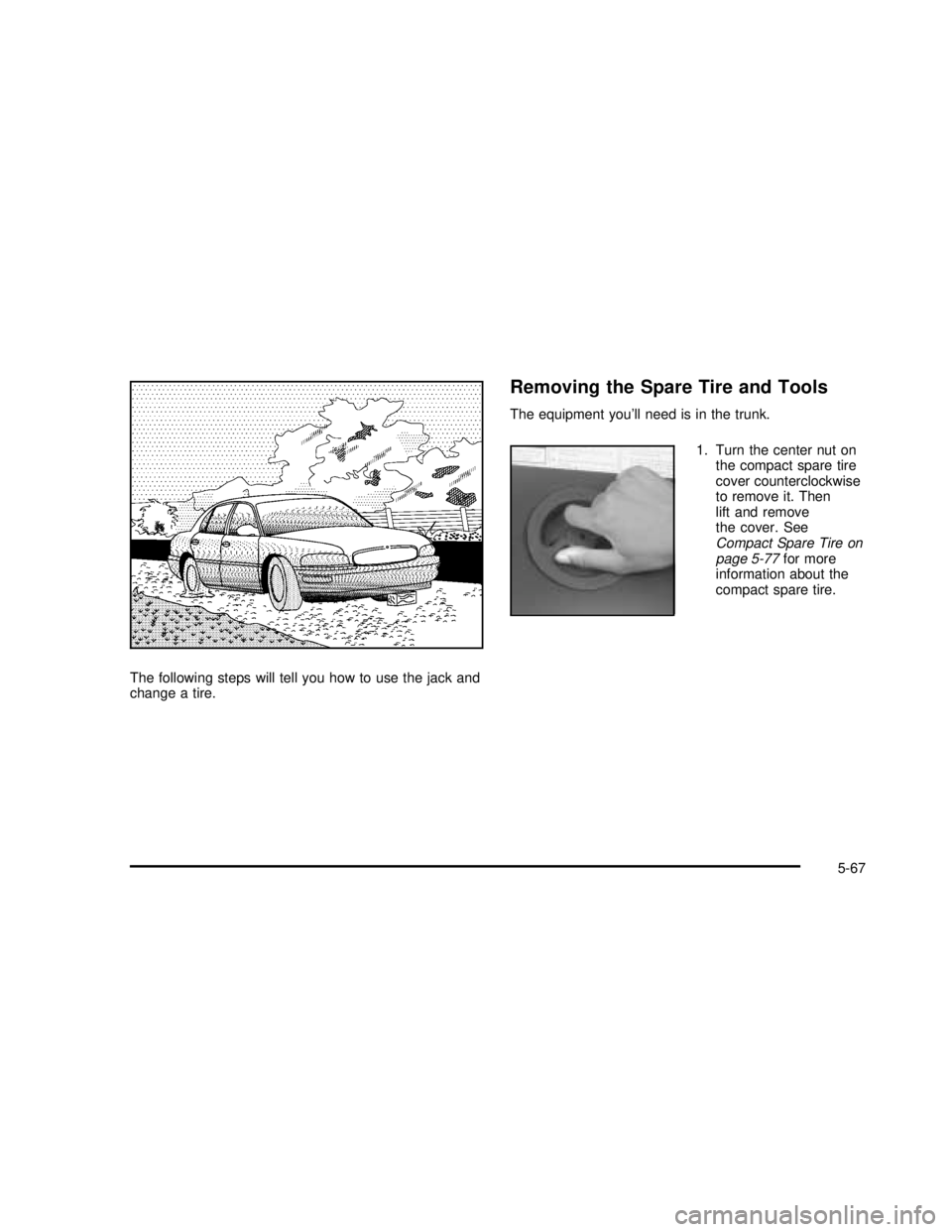
The following steps will tell you how to use the jack and
change a tire.
Removing the Spare Tire and Tools
The equipment you’ll need is in the trunk.
1. Turn the center nut on
the compact spare tire
cover counterclockwise
to remove it. Then
lift and remove
the cover. See
Compact Spare Tire on
page 5-77for more
information about the
compact spare tire.
5-67
2003 - Regal OM
Page 268 of 344
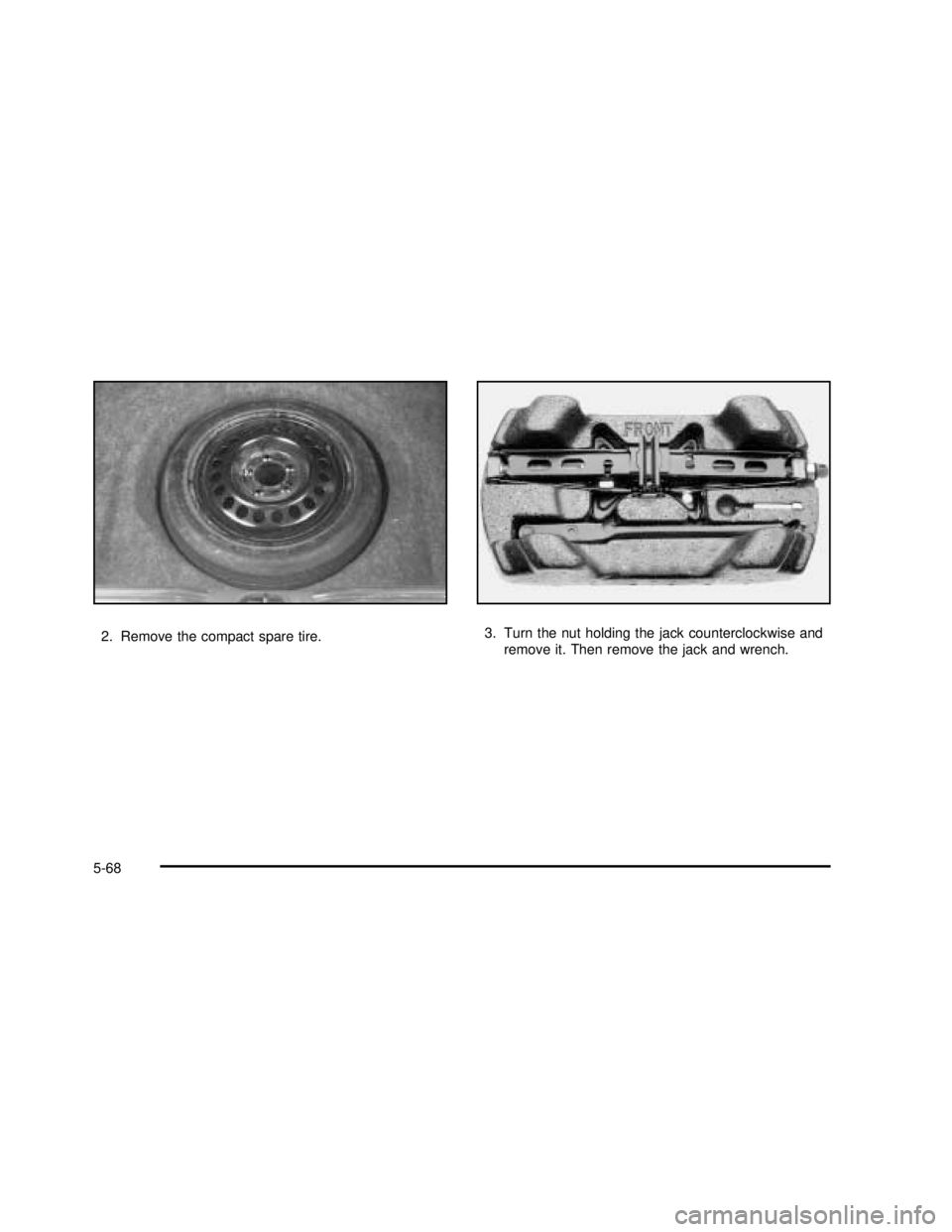
2. Remove the compact spare tire.3. Turn the nut holding the jack counterclockwise and
remove it. Then remove the jack and wrench.
5-68
2003 - Regal OM
Page 270 of 344
Removing the Wheel Covers
If your vehicle is equipped with wheel covers, be sure to
use a wheel wrench to begin the process of loosening
the plastic wheel nut caps.
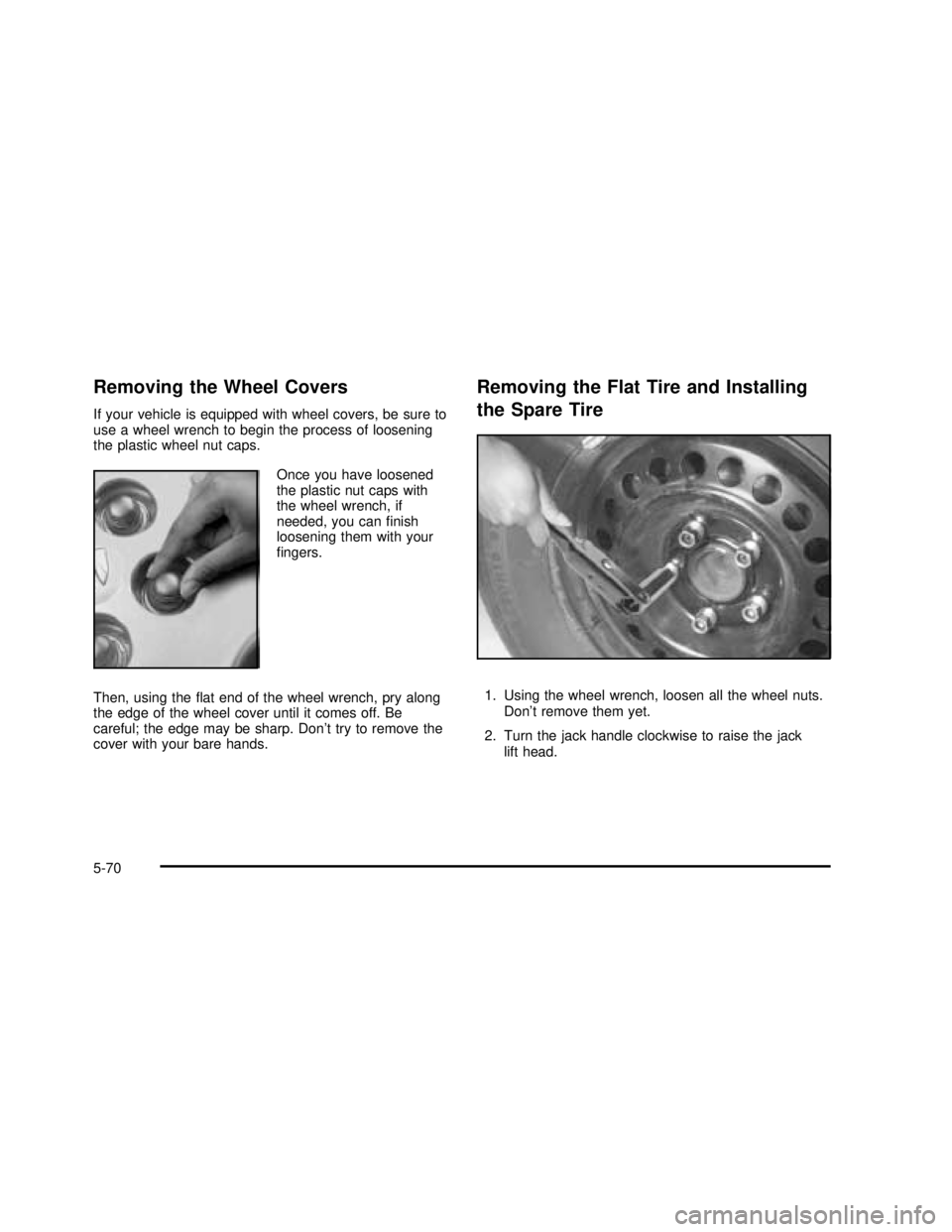
Once you have loosened
the plastic nut caps with
the wheel wrench, if
needed, you canfinish
loosening them with your
fingers.
Then, using theflat end of the wheel wrench, pry along
the edge of the wheel cover until it comes off. Be
careful; the edge may be sharp. Don’t try to remove the
cover with your bare hands.
Removing the Flat Tire and Installing
the Spare Tire
1. Using the wheel wrench, loosen all the wheel nuts.
Don’t remove them yet.
2. Turn the jack handle clockwise to raise the jack
lift head.
5-70
2003 - Regal OM
Page 272 of 344
4. Put the compact spare tire near you.
{CAUTION:
Getting under a vehicle when it is jacked up is
dangerous. If the vehicle slips off the jack you
could be badly injured or killed. Never get
under a vehicle when it is supported only by
a jack.
{CAUTION:
Raising your vehicle with the jack improperly
positioned can damage the vehicle and even
make the vehicle fall. To help avoid personal
injury and vehicle damage, be sure tot the
jack lift head into the proper location before
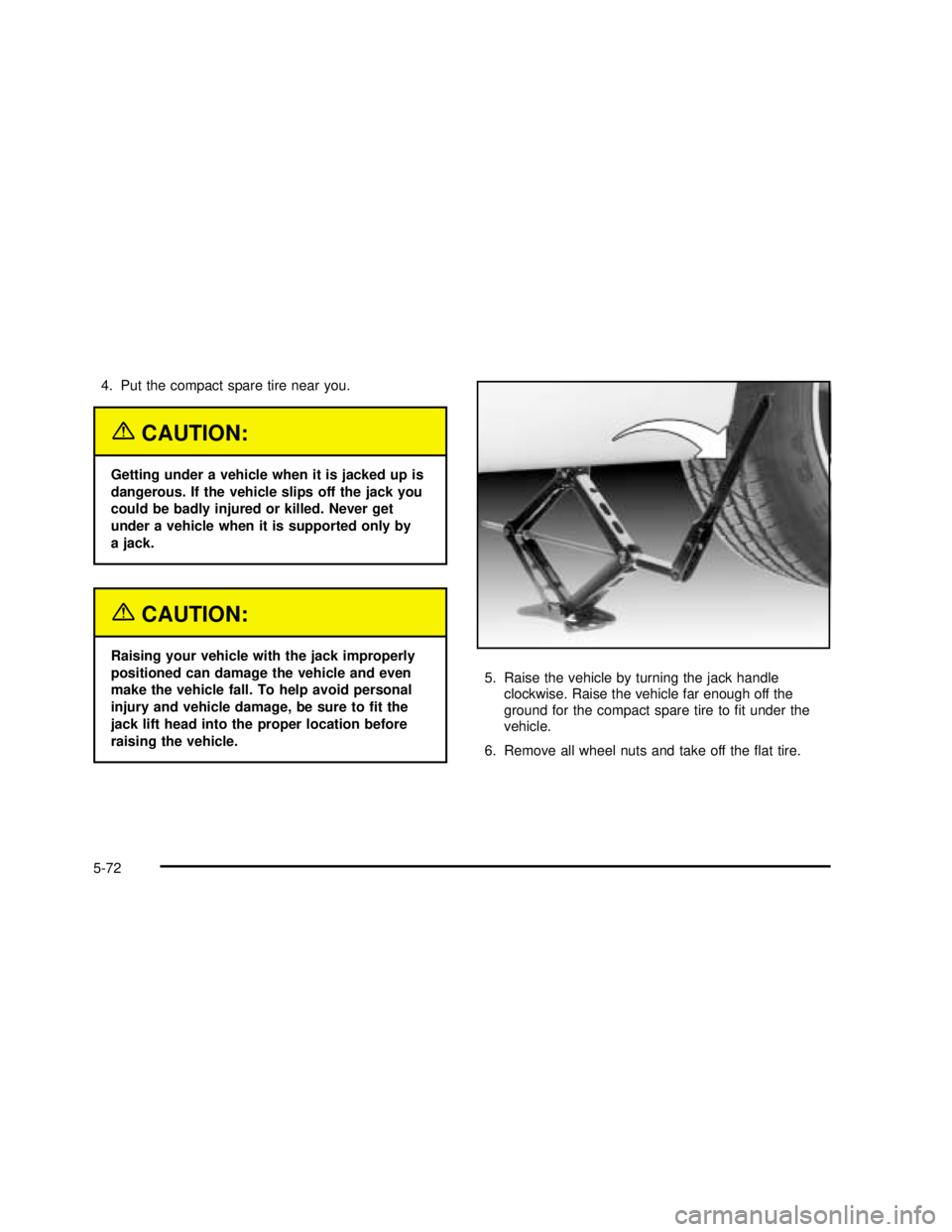
raising the vehicle.5. Raise the vehicle by turning the jack handle
clockwise. Raise the vehicle far enough off the
ground for the compact spare tire tofit under the
vehicle.
6. Remove all wheel nuts and take off theflat tire.
5-72
2003 - Regal OM
Page 274 of 344
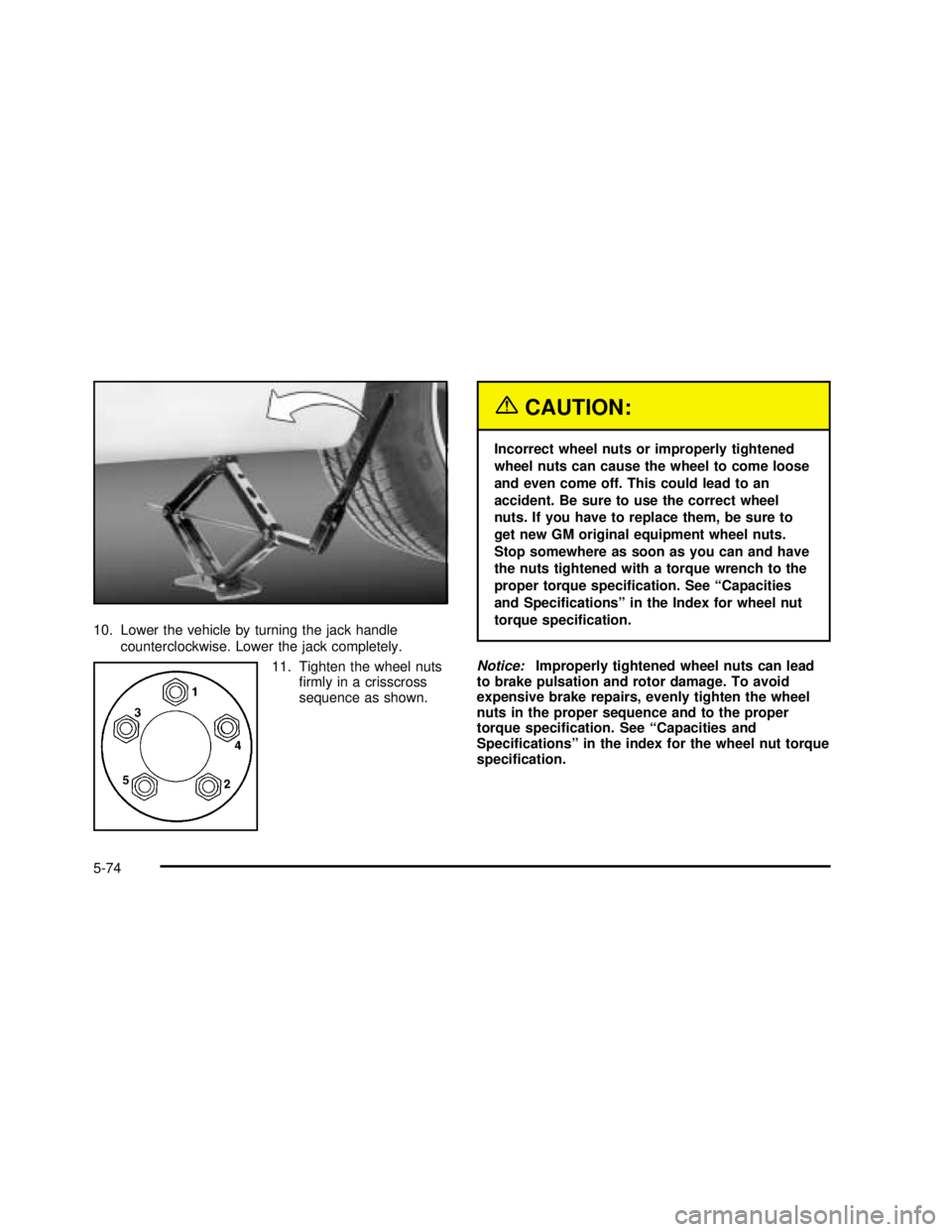
10. Lower the vehicle by turning the jack handle
counterclockwise. Lower the jack completely.
11. Tighten the wheel nuts
firmly in a crisscross
sequence as shown.
{CAUTION:
Incorrect wheel nuts or improperly tightened
wheel nuts can cause the wheel to come loose
and even come off. This could lead to an
accident. Be sure to use the correct wheel
nuts. If you have to replace them, be sure to
get new GM original equipment wheel nuts.
Stop somewhere as soon as you can and have
the nuts tightened with a torque wrench to the
proper torque specication. See“Capacities
and Specications”in the Index for wheel nut
torque specication.
Notice:Improperly tightened wheel nuts can lead
to brake pulsation and rotor damage. To avoid
expensive brake repairs, evenly tighten the wheel
nuts in the proper sequence and to the proper
torque specication. See“Capacities and
Specications”in the index for the wheel nut torque
specication.
5-74
2003 - Regal OM
Page 286 of 344

Service Parts Identication Label
You’llfind this label on the inside of the trunk lid. It’s very
helpful if you ever need to order parts. On this label is:
•your VIN,
•the model designation,
•paint information and
•a list of all production options and special equipment.
Be sure that this label is not removed from the
vehicle.
Electrical System
Add-On Electrical Equipment
Notice:Don’t add anything electrical to your vehicle
unless you check with your dealerrst. Some
electrical equipment can damage your vehicle and
the damage wouldn’t be covered by your warranty.
Some add-on electrical equipment can keep other
components from working as they should.
Your vehicle has an air bag system. Before attempting
to add anything electrical to your vehicle, see
Servicing Your Air Bag-Equipped Vehicle on page 1-54.
Headlamp Wiring
The headlamp wiring is protected by a circuit breaker in
the underhood fuse block. An electrical overload will
cause the lamps to go on and off, or in some cases to
remain off. If this happens, have your headlamp
system checked right away.
Windshield Wiper Fuses
The windshield wiper motor is protected by a circuit
breaker and a fuse. If the motor overheats due to heavy
snow, etc., the wiper will stop until the motor cools. If
the overload is caused by some electrical problem, have
itfixed.
Power Windows and Other Power
Options
Circuit breakers in the instrument panel fuse block
protect the power windows and other power accessories.
When the current load is too heavy, the circuit breaker
opens and closes, protecting the circuit until the
problem isfixed.
5-86
2003 - Regal OM
Page 287 of 344
Fuses and Circuit Breakers
The wiring circuits in your vehicle are protected from
short circuits by a combination of fuses, circuit breakers
and in the fuse block wiring itself. This greatly reduces
the chance offires caused by electrical problems.
Look at the silver-colored band inside the fuse. If the
band is broken or melted, replace the fuse. Be sure you
replace a bad fuse with a new one of the identical
size and rating.
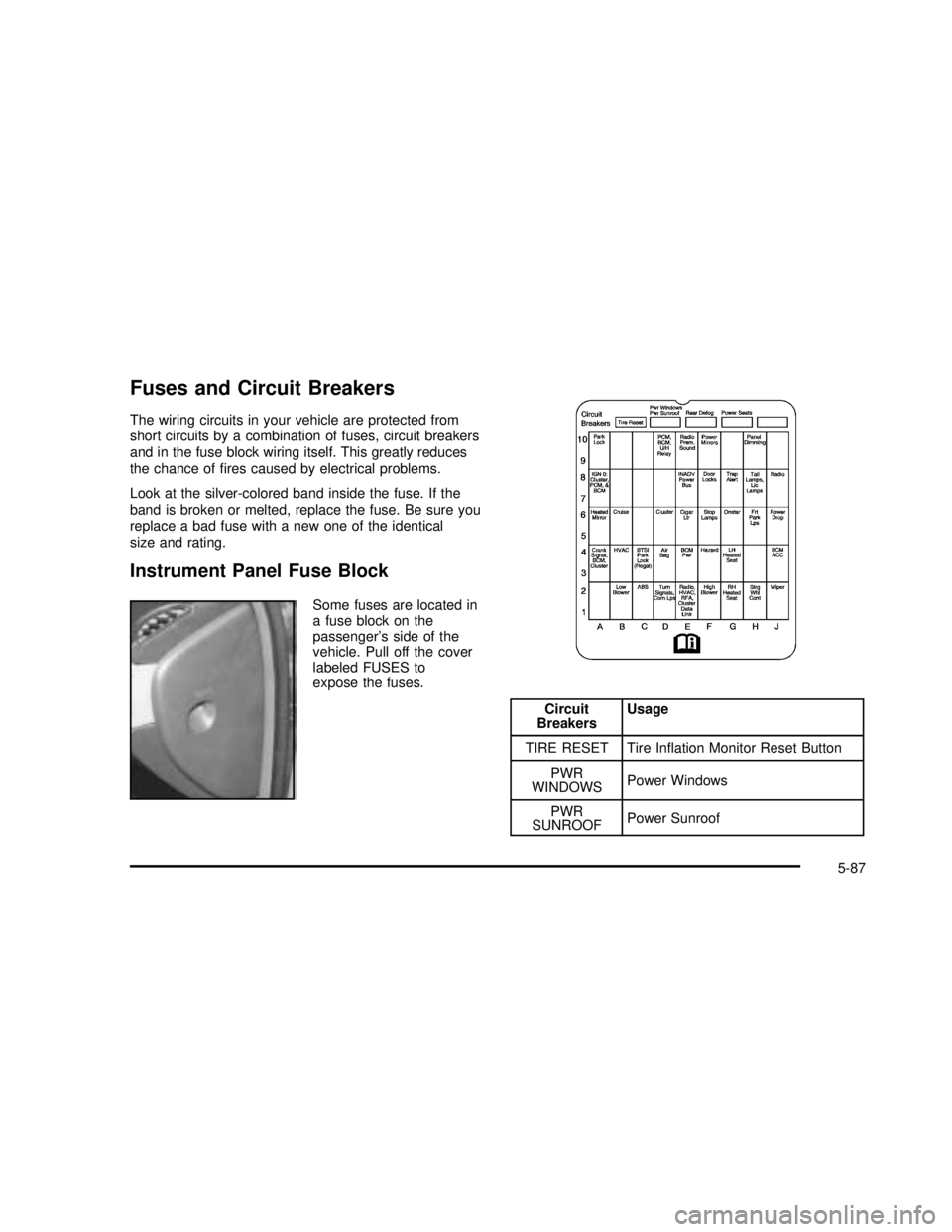
Instrument Panel Fuse Block
Some fuses are located in
a fuse block on the
passenger’s side of the
vehicle. Pull off the cover
labeled FUSES to
expose the fuses.
Circuit
BreakersUsage
TIRE RESET Tire Inflation Monitor Reset Button
PWR
WINDOWSPower Windows
PWR
SUNROOFPower Sunroof
5-87
2003 - Regal OM