ABS BUICK REGAL SPORTBACK 2019 User Guide
[x] Cancel search | Manufacturer: BUICK, Model Year: 2019, Model line: REGAL SPORTBACK, Model: BUICK REGAL SPORTBACK 2019Pages: 391, PDF Size: 5.95 MB
Page 208 of 391
Buick Regal Owner Manual (GMNA-Localizing-U.S./Canada-12163021) -
2019 - CRC - 11/14/18
Driving and Operating 207
Adding accessories can affect the
vehicle performance. See
Accessories and Modifications
0246.
Selective Ride Control
(GS Models Only)
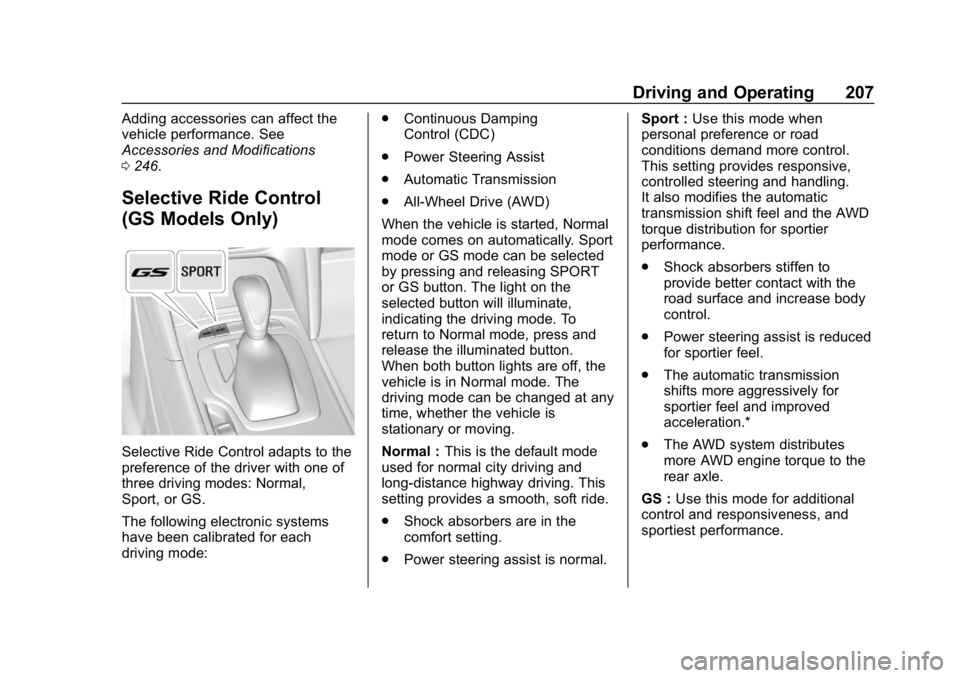
Selective Ride Control adapts to the
preference of the driver with one of
three driving modes: Normal,
Sport, or GS.
The following electronic systems
have been calibrated for each
driving mode: .
Continuous Damping
Control (CDC)
. Power Steering Assist
. Automatic Transmission
. All-Wheel Drive (AWD)
When the vehicle is started, Normal
mode comes on automatically. Sport
mode or GS mode can be selected
by pressing and releasing SPORT
or GS button. The light on the
selected button will illuminate,
indicating the driving mode. To
return to Normal mode, press and
release the illuminated button.
When both button lights are off, the
vehicle is in Normal mode. The
driving mode can be changed at any
time, whether the vehicle is
stationary or moving.
Normal : This is the default mode
used for normal city driving and
long-distance highway driving. This
setting provides a smooth, soft ride.
. Shock absorbers are in the
comfort setting.
. Power steering assist is normal. Sport :
Use this mode when
personal preference or road
conditions demand more control.
This setting provides responsive,
controlled steering and handling.
It also modifies the automatic
transmission shift feel and the AWD
torque distribution for sportier
performance.
. Shock absorbers stiffen to
provide better contact with the
road surface and increase body
control.
. Power steering assist is reduced
for sportier feel.
. The automatic transmission
shifts more aggressively for
sportier feel and improved
acceleration.*
. The AWD system distributes
more AWD engine torque to the
rear axle.
GS : Use this mode for additional
control and responsiveness, and
sportiest performance.
Page 209 of 391
Buick Regal Owner Manual (GMNA-Localizing-U.S./Canada-12163021) -
2019 - CRC - 11/14/18
208 Driving and Operating
.Shock absorbers stiffen to the
firmest setting for increased
control.
. Power steering assist is reduced
for sportier feel.
. The automatic transmission
shifts more aggressively for
sportier feel and improved
acceleration.*
. The AWD system distributes
more AWD engine torque to the
rear axle.
* Performance Shifting is enabled in
Sport mode and GS mode.
Performance Shifting detects
spirited driving and adapts
transmission shifts to maximize
vehicle acceleration.
Personalized Settings in
Sport Mode
The driver can customize the Sport
Mode settings to fit their preference.
See Vehicle Personalization 0153.Cruise Control
With cruise control the vehicle can
maintain a speed of about 40 km/h
(25 mph) or more without keeping
your foot on the accelerator. Cruise
control does not work at speeds
below 40 km/h (25 mph).
{Warning
Cruise control can be dangerous
where you cannot drive safely at
a steady speed. Do not use
cruise control on winding roads or
in heavy traffic.
Cruise control can be dangerous
on slippery roads. On such roads,
fast changes in tire traction can
cause excessive wheel slip, and
you could lose control. Do not use
cruise control on slippery roads. If equipped with the Traction Control
System (TCS), the system may
begin to limit wheel spin while you
are using cruise control. If this
happens, the cruise control will
automatically disengage. See
Traction Control/Electronic Stability
Control
0205. If a collision alert
occurs when cruise control is
activated, cruise control is
disengaged. See Forward Collision
Alert (FCA) System 0221. When
road conditions allow you to safely
use it again, cruise control can be
turned back on.
Cruise control will disengage if
either TCS or StabiliTrak/Electronic
Stability Control (ESC) is turned off.
If the brakes are applied, cruise
control disengages.
Page 240 of 391
Buick Regal Owner Manual (GMNA-Localizing-U.S./Canada-12163021) -
2019 - CRC - 11/14/18
Driving and Operating 239
When parking your vehicle and your
trailer on a hill:1. Press the brake pedal, but do not shift into P (Park) yet. Turn
the wheels into the curb if
facing downhill or into traffic if
facing uphill.
2. Have someone place chocks under the trailer wheels.
3. When the wheel chocks are in place, gradually release the
brake pedal to allow the chocks
to absorb the load of the trailer.
4. Reapply the brake pedal. Then apply the parking brake and
shift into P (Park).
5. Release the brake pedal.
Leaving After Parking on a Hill
1. Apply and hold the brake pedal.
.Start the engine.
. Shift into a gear.
. Release the parking brake.
2. Let up on the brake pedal. 3. Drive slowly until the trailer is
clear of the chocks.
4. Stop and have someone pick up and store the chocks.
Maintenance When Trailer
Towing
The vehicle needs service more
often when used to tow trailers. See
Maintenance Schedule 0336. It is
especially important to check the
automatic transmission fluid, engine
oil, axle lubricant, belts, cooling
system, and brake system before
and during each trip.
Check periodically that all nuts and
bolts on the trailer hitch are tight.
Engine Cooling When Trailer
Towing
The cooling system may temporarily
overheat during severe operating
conditions. See Engine Overheating
0 260.
Trailer Towing
Caution
Towing a trailer improperly can
damage the vehicle and result in
costly repairs not covered by the
vehicle warranty. To tow a trailer
correctly, follow the directions in
this section and see your dealer
for important information about
towing a trailer with the vehicle.
Trailer Weight
{Warning
Never exceed the towing capacity
for your vehicle.
Safe trailering requires monitoring
the weight, speed, altitude, road
grades, outside temperature,
dimensions of the front of the trailer,
and how frequently the vehicle is
used to tow a trailer.
Page 264 of 391
Buick Regal Owner Manual (GMNA-Localizing-U.S./Canada-12163021) -
2019 - CRC - 11/14/18
Vehicle Care 263
Brake Fluid
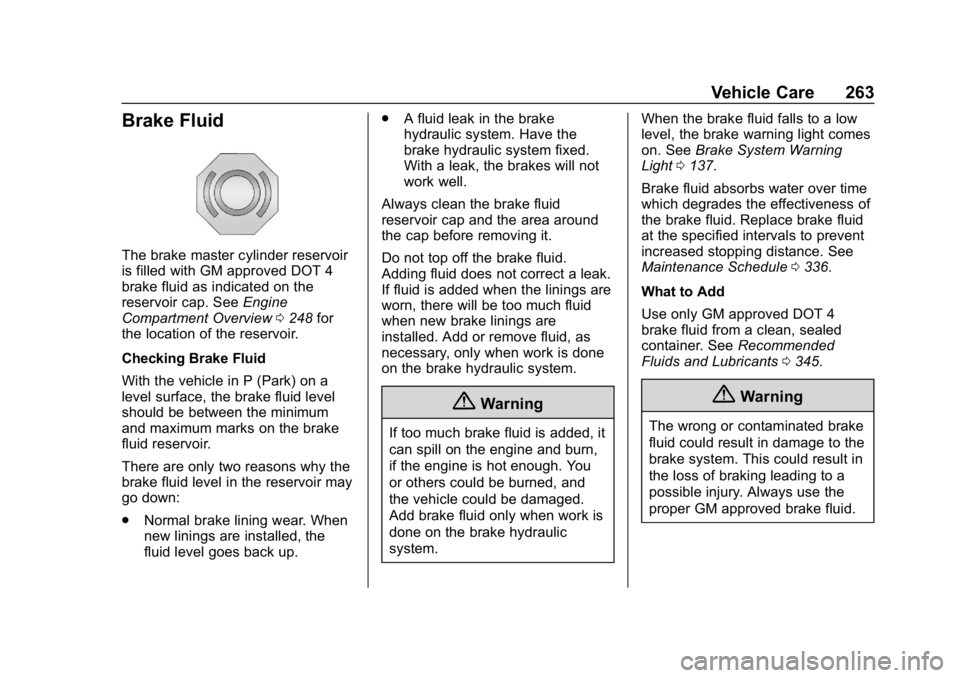
The brake master cylinder reservoir
is filled with GM approved DOT 4
brake fluid as indicated on the
reservoir cap. SeeEngine
Compartment Overview 0248 for
the location of the reservoir.
Checking Brake Fluid
With the vehicle in P (Park) on a
level surface, the brake fluid level
should be between the minimum
and maximum marks on the brake
fluid reservoir.
There are only two reasons why the
brake fluid level in the reservoir may
go down:
. Normal brake lining wear. When
new linings are installed, the
fluid level goes back up. .
A fluid leak in the brake
hydraulic system. Have the
brake hydraulic system fixed.
With a leak, the brakes will not
work well.
Always clean the brake fluid
reservoir cap and the area around
the cap before removing it.
Do not top off the brake fluid.
Adding fluid does not correct a leak.
If fluid is added when the linings are
worn, there will be too much fluid
when new brake linings are
installed. Add or remove fluid, as
necessary, only when work is done
on the brake hydraulic system.
{Warning
If too much brake fluid is added, it
can spill on the engine and burn,
if the engine is hot enough. You
or others could be burned, and
the vehicle could be damaged.
Add brake fluid only when work is
done on the brake hydraulic
system. When the brake fluid falls to a low
level, the brake warning light comes
on. See
Brake System Warning
Light 0137.
Brake fluid absorbs water over time
which degrades the effectiveness of
the brake fluid. Replace brake fluid
at the specified intervals to prevent
increased stopping distance. See
Maintenance Schedule 0336.
What to Add
Use only GM approved DOT 4
brake fluid from a clean, sealed
container. See Recommended
Fluids and Lubricants 0345.
{Warning
The wrong or contaminated brake
fluid could result in damage to the
brake system. This could result in
the loss of braking leading to a
possible injury. Always use the
proper GM approved brake fluid.
Page 265 of 391
Buick Regal Owner Manual (GMNA-Localizing-U.S./Canada-12163021) -
2019 - CRC - 11/14/18
264 Vehicle Care
Caution
If brake fluid is spilled on the
vehicle's painted surfaces, the
paint finish can be damaged.
Immediately wash off any painted
surface.
Battery - North America
The original equipment battery is
maintenance free. Do not remove
the cap and do not add fluid.
If equipped with a V6 engine, the
battery is under the trim panel on
the left side of the rear cargo area.
If equipped with an L4 engine, the
battery is under the hood. See
Engine Compartment Overview
0248. Refer to the replacement
number on the original battery label
when a new battery is needed.
The battery is an Absorbed Glass
Mat (AGM) 12-volt battery.
Installation of a standard 12-volt
battery will result in reduced 12-volt
battery life. When using a 12-volt battery
charger on the 12-volt AGM battery,
some chargers have an AGM
battery setting on the charger.
If available, use the AGM setting on
the charger, to limit charge voltage
to 14.8 volts.
{Warning
WARNING:
Battery posts,
terminals, and related
accessories contain lead and lead
compounds, chemicals known to
the State of California to cause
cancer and birth defects or other
reproductive harm. Batteries also
contain other chemicals known to
the State of California to cause
cancer. WASH HANDS AFTER
HANDLING. For more information
go to www.P65Warnings.ca.gov/
passenger-vehicle.
See California Proposition
65 Warning 0245 and the back
cover. Stop/Start System
This vehicle has a Stop/Start
system to shut off the engine to help
conserve fuel. See
Starting the
Engine 0192.
Vehicle Storage
{Warning
Batteries have acid that can burn
you and gas that can explode.
You can be badly hurt if you are
not careful. See Jump Starting -
North America 0319 for tips on
working around a battery without
getting hurt.
Infrequent Usage: Remove the
12-volt battery black, negative (−)
cable from the battery to keep the
battery from running down.
Extended Storage: Remove the
12-volt battery black, negative (−)
cable from the battery or use a
battery trickle charger.
Remember to reconnect the battery
when ready to drive the vehicle.
Page 274 of 391
Buick Regal Owner Manual (GMNA-Localizing-U.S./Canada-12163021) -
2019 - CRC - 11/14/18
Vehicle Care 273
Engine Compartment
Fuse Block
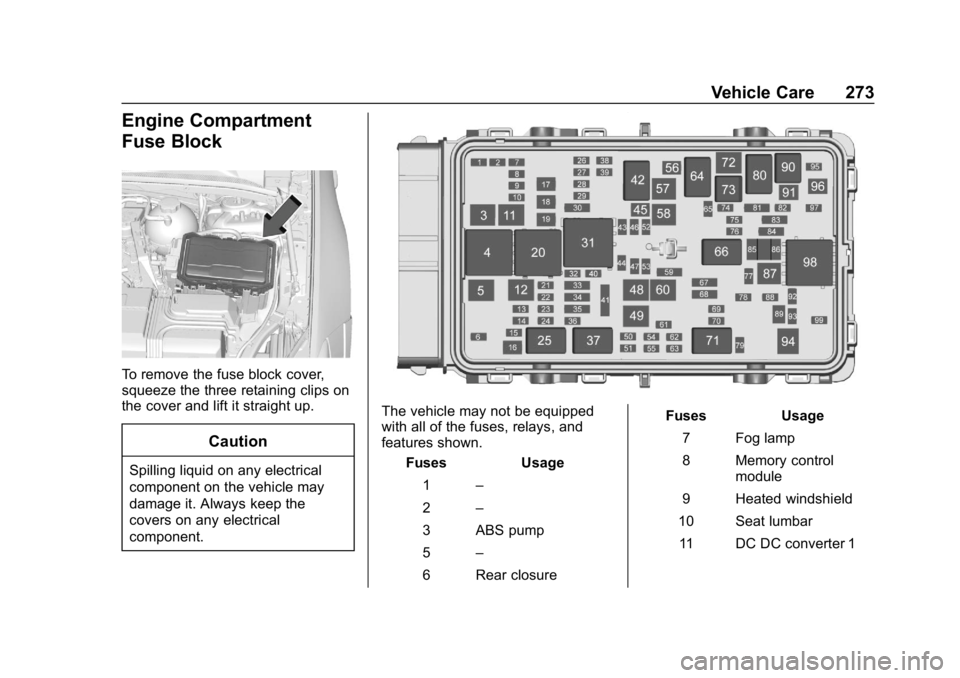
To remove the fuse block cover,
squeeze the three retaining clips on
the cover and lift it straight up.
Caution
Spilling liquid on any electrical
component on the vehicle may
damage it. Always keep the
covers on any electrical
component.
The vehicle may not be equipped
with all of the fuses, relays, and
features shown.Fuses Usage
1 –
2 –
3 ABS pump
5 –
6 Rear closure Fuses Usage
7 Fog lamp
8 Memory control module
9 Heated windshield
10 Seat lumbar 11 DC DC converter 1
Page 319 of 391
Buick Regal Owner Manual (GMNA-Localizing-U.S./Canada-12163021) -
2019 - CRC - 11/14/18
318 Vehicle Care
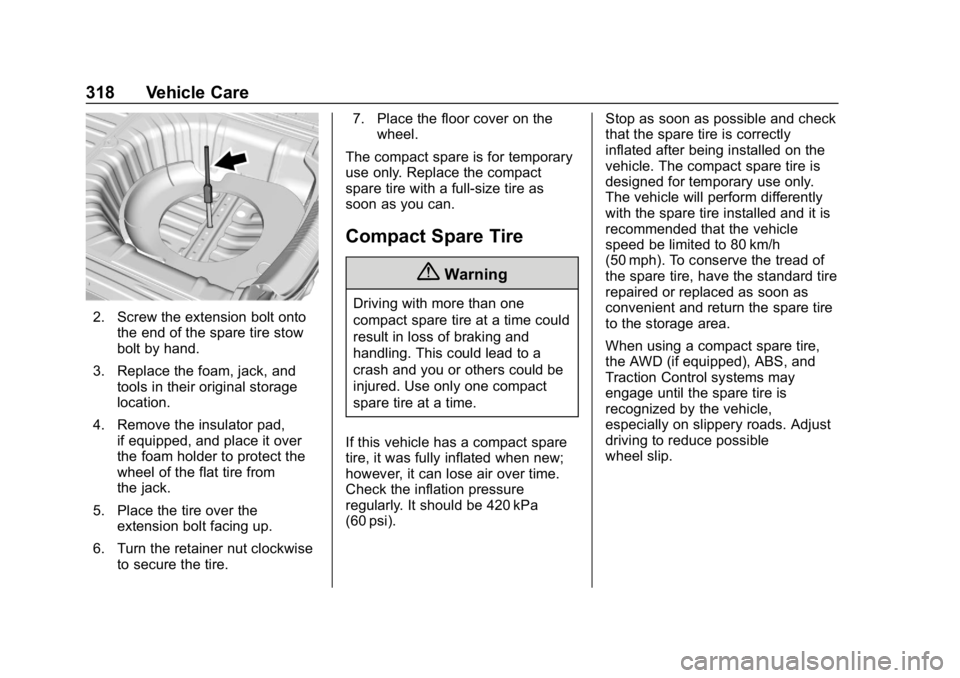
2. Screw the extension bolt ontothe end of the spare tire stow
bolt by hand.
3. Replace the foam, jack, and tools in their original storage
location.
4. Remove the insulator pad, if equipped, and place it over
the foam holder to protect the
wheel of the flat tire from
the jack.
5. Place the tire over the extension bolt facing up.
6. Turn the retainer nut clockwise to secure the tire. 7. Place the floor cover on the
wheel.
The compact spare is for temporary
use only. Replace the compact
spare tire with a full-size tire as
soon as you can.
Compact Spare Tire
{Warning
Driving with more than one
compact spare tire at a time could
result in loss of braking and
handling. This could lead to a
crash and you or others could be
injured. Use only one compact
spare tire at a time.
If this vehicle has a compact spare
tire, it was fully inflated when new;
however, it can lose air over time.
Check the inflation pressure
regularly. It should be 420 kPa
(60 psi). Stop as soon as possible and check
that the spare tire is correctly
inflated after being installed on the
vehicle. The compact spare tire is
designed for temporary use only.
The vehicle will perform differently
with the spare tire installed and it is
recommended that the vehicle
speed be limited to 80 km/h
(50 mph). To conserve the tread of
the spare tire, have the standard tire
repaired or replaced as soon as
convenient and return the spare tire
to the storage area.
When using a compact spare tire,
the AWD (if equipped), ABS, and
Traction Control systems may
engage until the spare tire is
recognized by the vehicle,
especially on slippery roads. Adjust
driving to reduce possible
wheel slip.
Page 326 of 391
Buick Regal Owner Manual (GMNA-Localizing-U.S./Canada-12163021) -
2019 - CRC - 11/14/18
Vehicle Care 325
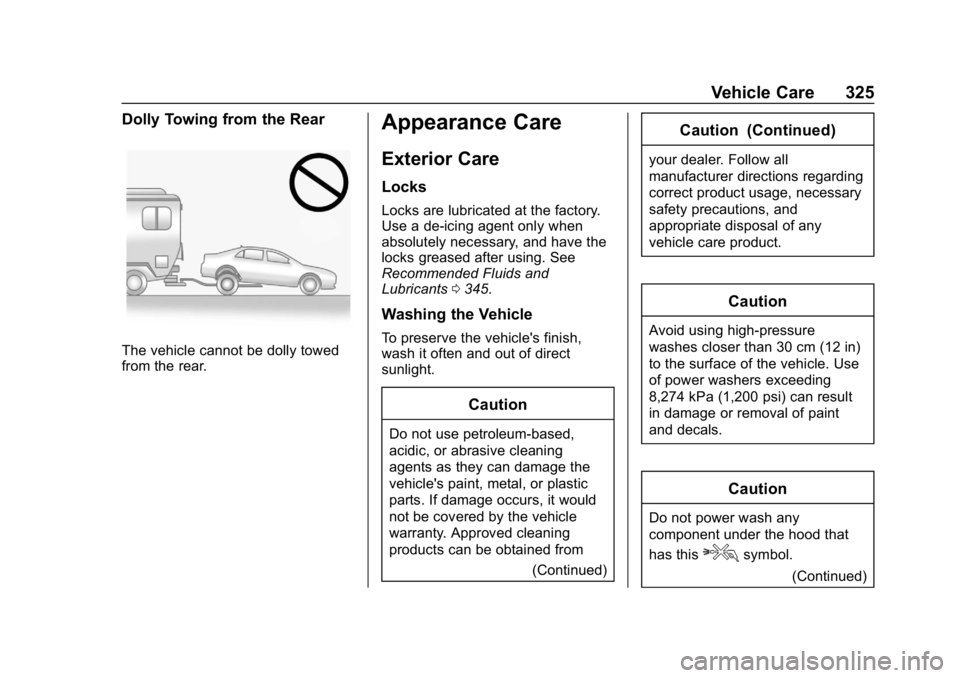
Dolly Towing from the Rear
The vehicle cannot be dolly towed
from the rear.
Appearance Care
Exterior Care
Locks
Locks are lubricated at the factory.
Use a de-icing agent only when
absolutely necessary, and have the
locks greased after using. See
Recommended Fluids and
Lubricants0345.
Washing the Vehicle
To preserve the vehicle's finish,
wash it often and out of direct
sunlight.
Caution
Do not use petroleum-based,
acidic, or abrasive cleaning
agents as they can damage the
vehicle's paint, metal, or plastic
parts. If damage occurs, it would
not be covered by the vehicle
warranty. Approved cleaning
products can be obtained from
(Continued)
Caution (Continued)
your dealer. Follow all
manufacturer directions regarding
correct product usage, necessary
safety precautions, and
appropriate disposal of any
vehicle care product.
Caution
Avoid using high-pressure
washes closer than 30 cm (12 in)
to the surface of the vehicle. Use
of power washers exceeding
8,274 kPa (1,200 psi) can result
in damage or removal of paint
and decals.
Caution
Do not power wash any
component under the hood that
has this
esymbol.
(Continued)
Page 379 of 391

Buick Regal Owner Manual (GMNA-Localizing-U.S./Canada-12163021) -
2019 - CRC - 11/14/18
378 Index
IndexA
Accessories andModifications . . . . . . . . . . . . . . . . . . 246
Accessory Power . . . . . . . . . . . . . . . 195
Adaptive Cruise Control . . . . . . . . 210
Adaptive Forward Lighting (AFL) . . . . . . . . . . . . . . . . . 164
Adaptive Forward Lighting (AFL) Light . . . . . . . . . . . . . . . . . . . . 142
Add-On Electrical Equipment . . . 243
Additional Information
OnStar . . . . . . . . . . . . . . . . . . . . . . . 368
Additional Maintenance and Care . . . . . . . . . . . . . . . . . . . . . . 342
Adjustments Lumbar, Front Seats . . . . . . . . . . . . 61
Thigh Support . . . . . . . . . . . . . . . . . . 62
Air Cleaner/Filter, Engine . . . . . . . 255
Air Conditioning . . . . . . . . . . . . . . . . 171
Air Filter, Passenger Compartment . . . . . . . . . . . . . . . . . 176
Air Vents . . . . . . . . . . . . . . . . . . . . . . . 176
Airbag System Check . . . . . . . . . . . . . . . . . . . . . . . . . . 89
How Does an Airbag
Restrain? . . . . . . . . . . . . . . . . . . . . . 82
Passenger Sensing System . . . . 84 Airbag System (cont'd)
What Makes an Airbag
Inflate? . . . . . . . . . . . . . . . . . . . . . . . . 82
What Will You See after an
Airbag Inflates? . . . . . . . . . . . . . . . 82
When Should an Airbag Inflate? . . . . . . . . . . . . . . . . . . . . . . . . 81
Where Are the Airbags? . . . . . . . . 79
Airbags
Adding Equipment to theVehicle . . . . . . . . . . . . . . . . . . . . . . . . 88
Passenger Status Indicator . . . 134
Readiness Light . . . . . . . . . . . . . . 134
Servicing Airbag-Equipped Vehicles . . . . . . . . . . . . . . . . . . . . . . . 88
System Check . . . . . . . . . . . . . . . . . . 78
Alarm Vehicle Security . . . . . . . . . . . . . . . . 49
Alert Lane Change . . . . . . . . . . . . . . . . . 227
Side Blind Zone (SBZA) . . . . . . 227
All-Season Tires . . . . . . . . . . . . . . . . 279
All-Wheel Drive . . . . . . . . . . . . 201, 265
Antilock Brake System (ABS) . . . 202 Warning Light . . . . . . . . . . . . . . . . . 138
Appearance Care Exterior . . . . . . . . . . . . . . . . . . . . . . . 325
Interior . . . . . . . . . . . . . . . . . . . . . . . . 330
Page 384 of 391

Buick Regal Owner Manual (GMNA-Localizing-U.S./Canada-12163021) -
2019 - CRC - 11/14/18
Index 383
High-Speed Operation . . . . . . . . . . 286
Hill and Mountain Roads . . . . . . . . 183
Hill Start Assist (HSA) . . . . . . . . . . 204
Hood . . . . . . . . . . . . . . . . . . . . . . . . . . . 247
Horn . . . . . . . . . . . . . . . . . . . . . . . . . . . . 117
How to Wear Seat BeltsProperly . . . . . . . . . . . . . . . . . . . . . . . . 72
HVAC . . . . . . . . . . . . . . . . . . . . . . . . . . . 171
I
Ignition Positions . . . . . . . . . . . . . . . 190
Immobilizer . . . . . . . . . . . . . . . . . . . . . . 50
Indicator Vehicle Ahead . . . . . . . . . . . . . . . . 139
Infants and Young Children, Restraints . . . . . . . . . . . . . . . . . . . . . . 92
Information
Publication Ordering . . . . . . . . . . 361
Infotainment . . . . . . . . . . . . . . . . . . . . 170
Infotainment System . . . . . . . . . . . . 365
Instrument Cluster . . . . . . . . . . . . . . 124
Interior Rearview Mirrors . . . . . . . . . 52
Introduction . . . . . . . . . . . . . . . . . . . . . . . 2
J
Jump Starting - North America . . . . . . . . . . . . . . . . . . . . . . . 319
K
Keyless Entry
Remote (RKE) System . . . . . . . . . 29
Keys . . . . . . . . . . . . . . . . . . . . . . . . . . . . . 28
L
Labeling, Tire Sidewall . . . . . . . . . . 280
Lamps Daytime Running (DRL) . . . . . . 163
Dome . . . . . . . . . . . . . . . . . . . . . . . . . 166
Exterior Controls . . . . . . . . . . . . . . 162
Exterior Lamps OffReminder . . . . . . . . . . . . . . . . . . . 163
Exterior Lighting Battery Saver . . . . . . . . . . . . . . . . . . . . . . . 168
Front Turn Signal . . . . . . . . . . . . . 270
Malfunction Indicator (Check Engine) . . . . . . . . . . . . . 135
On Reminder . . . . . . . . . . . . . . . . . 143
Reading . . . . . . . . . . . . . . . . . . . . . . 167
Lane Change Alert (LCA) . . . . . . . 227
Lane Departure Warning (LDW) . . . . . . . . . . . . . . . . 229
Lane Keep Assist (LKA) . . . . . . . . 229
Lane Keep Assist Light . . . . . . . . . 139
Lap-Shoulder Belt . . . . . . . . . . . . . . . 74 LATCH System
Replacing Parts after a
Crash . . . . . . . . . . . . . . . . . . . . . . . 102
LATCH, Lower Anchors and Tethers for Children . . . . . . . . . . . . 97
LED Lighting . . . . . . . . . . . . . . . . . . . . 269
Liftgate . . . . . . . . . . . . . . . . . . . . . . . . . . 41
Lighting Adaptive Forward . . . . . . . . . . . . . 164
Entry . . . . . . . . . . . . . . . . . . . . . . . . . 167
Exit . . . . . . . . . . . . . . . . . . . . . . . . . . . 167
Illumination Control . . . . . . . . . . . 166
LED . . . . . . . . . . . . . . . . . . . . . . . . . . 269
Lights Adaptive Forward Lighting(AFL) Light . . . . . . . . . . . . . . . . . . 142
Airbag Readiness . . . . . . . . . . . . . 134
Antilock Brake System (ABS) Warning . . . . . . . . . . . . . . 138
Brake System Warning . . . . . . . 137
Charging System . . . . . . . . . . . . . 135
Check Engine (Malfunction Indicator) . . . . . . . . . . . . . . . . . . . . 135
Cruise Control . . . . . . . . . . . . . . . . 143
Door Ajar . . . . . . . . . . . . . . . . . . . . . 143
Electric Parking Brake . . . . . . . . 138
Engine Coolant Temperature Warning . . . . . . . 140