run flat BUICK REGAL SPORTBACK 2019 Owner's Manual
[x] Cancel search | Manufacturer: BUICK, Model Year: 2019, Model line: REGAL SPORTBACK, Model: BUICK REGAL SPORTBACK 2019Pages: 391, PDF Size: 5.95 MB
Page 301 of 391
Buick Regal Owner Manual (GMNA-Localizing-U.S./Canada-12163021) -
2019 - CRC - 11/14/18
300 Vehicle Care
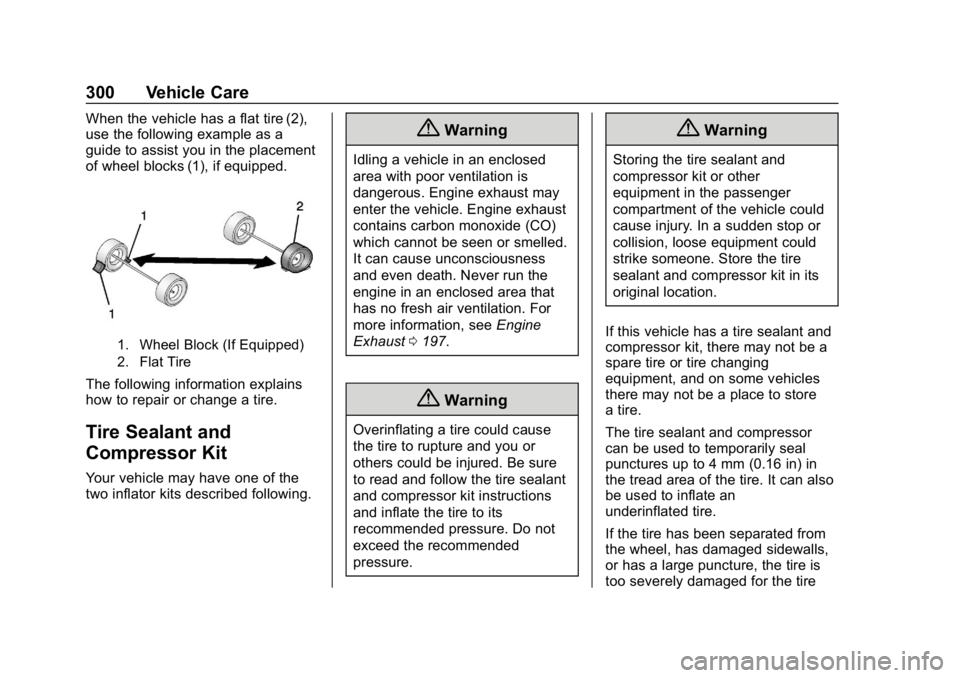
When the vehicle has a flat tire (2),
use the following example as a
guide to assist you in the placement
of wheel blocks (1), if equipped.
1. Wheel Block (If Equipped)
2. Flat Tire
The following information explains
how to repair or change a tire.
Tire Sealant and
Compressor Kit
Your vehicle may have one of the
two inflator kits described following.
{Warning
Idling a vehicle in an enclosed
area with poor ventilation is
dangerous. Engine exhaust may
enter the vehicle. Engine exhaust
contains carbon monoxide (CO)
which cannot be seen or smelled.
It can cause unconsciousness
and even death. Never run the
engine in an enclosed area that
has no fresh air ventilation. For
more information, seeEngine
Exhaust 0197.
{Warning
Overinflating a tire could cause
the tire to rupture and you or
others could be injured. Be sure
to read and follow the tire sealant
and compressor kit instructions
and inflate the tire to its
recommended pressure. Do not
exceed the recommended
pressure.
{Warning
Storing the tire sealant and
compressor kit or other
equipment in the passenger
compartment of the vehicle could
cause injury. In a sudden stop or
collision, loose equipment could
strike someone. Store the tire
sealant and compressor kit in its
original location.
If this vehicle has a tire sealant and
compressor kit, there may not be a
spare tire or tire changing
equipment, and on some vehicles
there may not be a place to store
a tire.
The tire sealant and compressor
can be used to temporarily seal
punctures up to 4 mm (0.16 in) in
the tread area of the tire. It can also
be used to inflate an
underinflated tire.
If the tire has been separated from
the wheel, has damaged sidewalls,
or has a large puncture, the tire is
too severely damaged for the tire
Page 303 of 391
Buick Regal Owner Manual (GMNA-Localizing-U.S./Canada-12163021) -
2019 - CRC - 11/14/18
302 Vehicle Care
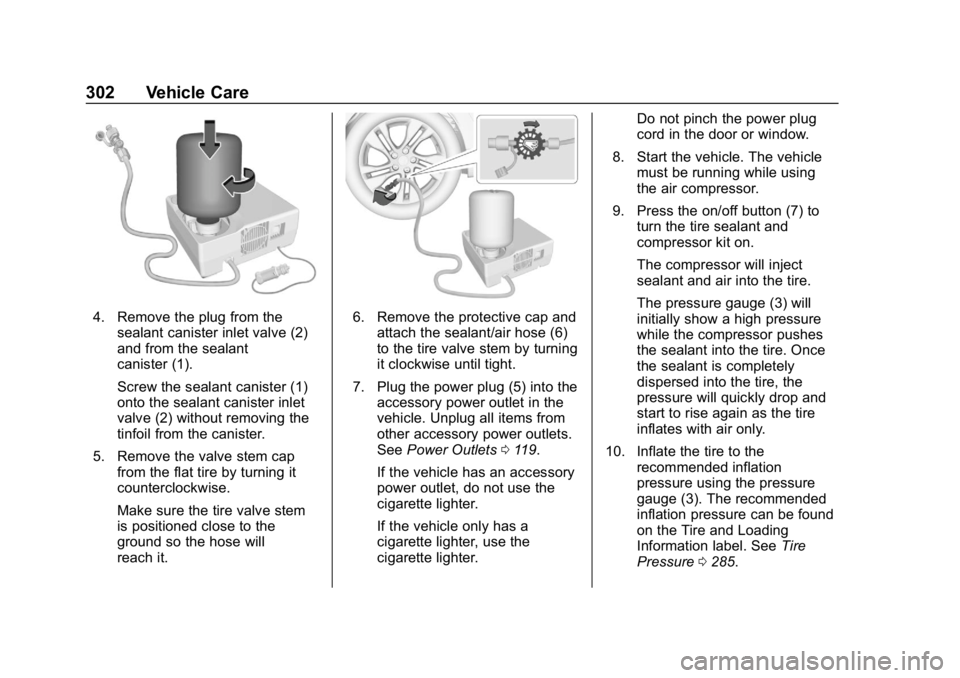
4. Remove the plug from thesealant canister inlet valve (2)
and from the sealant
canister (1).
Screw the sealant canister (1)
onto the sealant canister inlet
valve (2) without removing the
tinfoil from the canister.
5. Remove the valve stem cap from the flat tire by turning it
counterclockwise.
Make sure the tire valve stem
is positioned close to the
ground so the hose will
reach it.6. Remove the protective cap and
attach the sealant/air hose (6)
to the tire valve stem by turning
it clockwise until tight.
7. Plug the power plug (5) into the accessory power outlet in the
vehicle. Unplug all items from
other accessory power outlets.
See Power Outlets 0119.
If the vehicle has an accessory
power outlet, do not use the
cigarette lighter.
If the vehicle only has a
cigarette lighter, use the
cigarette lighter. Do not pinch the power plug
cord in the door or window.
8. Start the vehicle. The vehicle must be running while using
the air compressor.
9. Press the on/off button (7) to turn the tire sealant and
compressor kit on.
The compressor will inject
sealant and air into the tire.
The pressure gauge (3) will
initially show a high pressure
while the compressor pushes
the sealant into the tire. Once
the sealant is completely
dispersed into the tire, the
pressure will quickly drop and
start to rise again as the tire
inflates with air only.
10. Inflate the tire to the recommended inflation
pressure using the pressure
gauge (3). The recommended
inflation pressure can be found
on the Tire and Loading
Information label. See Tire
Pressure 0285.
Page 306 of 391

Buick Regal Owner Manual (GMNA-Localizing-U.S./Canada-12163021) -
2019 - CRC - 11/14/18
Vehicle Care 305
Make sure the tire valve stem
is positioned close to the
ground so the hose will
reach it.
4. Remove the valve stem cap from the flat tire by turning it
counterclockwise.
5. Attach the sealant/air hose (6) to the tire valve stem by turning
it clockwise until tight.
6. Plug the power plug (5) into the accessory power outlet in the
vehicle. Unplug all items from
other accessory power outlets.
See Power Outlets 0119.
If the vehicle has an accessory
power outlet, do not use the
cigarette lighter.
If the vehicle only has a
cigarette lighter, use the
cigarette lighter.
Do not pinch the power plug
cord in the door or window.
7. Start the vehicle. The vehicle must be running while using
the air compressor. 8. Press the on/off button (7) to
turn the tire sealant and
compressor kit on.
The compressor will inflate the
tire with air only.
9. Inflate the tire to the recommended inflation
pressure using the pressure
gauge (3). The recommended
inflation pressure can be found
on the Tire and Loading
Information label. See Tire
Pressure 0285.
The pressure gauge (3) may
read higher than the actual tire
pressure while the compressor
is on. Turn the compressor off
to get an accurate pressure
reading. The compressor may
be turned on/off until the
correct pressure is reached.
Caution
If the recommended pressure
cannot be reached after
approximately 10 minutes, the (Continued)
Caution (Continued)
vehicle should not be driven
farther. The tire is too severely
damaged and the tire sealant and
compressor kit cannot inflate the
tire. Remove the power plug from
the accessory power outlet and
unscrew the inflating hose from
the tire valve. SeeRoadside
Assistance Program 0356.
10. Press the on/off button (7) to turn the tire sealant and
compressor kit off.
Be careful while handling the
compressor as it could be
warm after usage.
11. Unplug the power plug (5) from the accessory power outlet in
the vehicle.
12. Turn the sealant/air hose (6) counterclockwise to remove it
from the tire valve stem.
13. Replace the tire valve stem cap.
Page 307 of 391
Buick Regal Owner Manual (GMNA-Localizing-U.S./Canada-12163021) -
2019 - CRC - 11/14/18
306 Vehicle Care
14. Return the sealant/air hose (6)and power plug (5) back to
their original storage location.
15. Return the equipment to its original storage location in the
vehicle.
The tire sealant and compressor kit
has accessory adapters located in a
compartment on the bottom of its
housing that can be used to inflate
air mattresses, balls, etc.
Tire Sealant and
Compressor Kit
{Warning
Idling a vehicle in an enclosed
area with poor ventilation is
dangerous. Engine exhaust may
enter the vehicle. Engine exhaust
contains carbon monoxide (CO)
which cannot be seen or smelled.
It can cause unconsciousness
and even death. Never run the
engine in an enclosed area that (Continued)
Warning (Continued)
has no fresh air ventilation. For
more information, seeEngine
Exhaust 0197.
{Warning
Overinflating a tire could cause
the tire to rupture and you or
others could be injured. Be sure
to read and follow the tire sealant
and compressor kit instructions
and inflate the tire to its
recommended pressure. Do not
exceed the recommended
pressure.
{Warning
Storing the tire sealant and
compressor kit or other
equipment in the passenger
compartment of the vehicle could
(Continued)
Warning (Continued)
cause injury. In a sudden stop or
collision, loose equipment could
strike someone. Store the tire
sealant and compressor kit in its
original location.
If this vehicle has a tire sealant and
compressor kit, there may not be a
spare tire or tire changing
equipment, and on some vehicles
there may not be a place to store
a tire.
The tire sealant and compressor
can be used to temporarily seal
punctures up to 6 mm (0.25 in) in
the tread area of the tire. It can also
be used to inflate an
underinflated tire.
If the tire has been separated from
the wheel, has damaged sidewalls,
or has a large puncture, the tire is
too severely damaged for the tire
sealant and compressor kit to be
effective. See Roadside Assistance
Program 0356.
Page 310 of 391

Buick Regal Owner Manual (GMNA-Localizing-U.S./Canada-12163021) -
2019 - CRC - 11/14/18
Vehicle Care 309
8. Plug the power plug (10) intothe accessory power outlet in
the vehicle. Unplug all items
from other accessory power
outlets. See Power Outlets
0 119.
If the vehicle has an accessory
power outlet, do not use the
cigarette lighter.
If the vehicle only has a
cigarette lighter, use the
cigarette lighter.
Do not pinch the power plug
cord in the door or window.
9. Start the vehicle. The vehicle must be running while using
the air compressor.
10. Press the on/off button (8) to turn the tire sealant and
compressor kit on.
The compressor will inject
sealant and air into the tire.
The pressure gauge (5) will
initially show a high pressure
while the compressor pushes
the sealant into the tire. Once
the sealant is completely dispersed into the tire, the
pressure will quickly drop and
start to rise again as the tire
inflates with air only.
11. Inflate the tire to the recommended inflation
pressure using the pressure
gauge (5). The recommended
inflation pressure can be found
on the Tire and Loading
Information label. See Tire
Pressure 0285.
The pressure gauge (5) may
read higher than the actual tire
pressure while the compressor
is on. Turn the compressor off
to get an accurate pressure
reading. The compressor may
be turned on/off until the
correct pressure is reached.
Caution
If the recommended pressure
cannot be reached after
approximately 25 minutes, the
vehicle should not be driven (Continued)
Caution (Continued)
farther. The tire is too severely
damaged and the tire sealant and
compressor kit cannot inflate the
tire. Remove the power plug from
the accessory power outlet and
unscrew the inflating hose from
the tire valve. SeeRoadside
Assistance Program 0356.
12. Press the on/off button (8) to turn the tire sealant and
compressor kit off.
The tire is not sealed and will
continue to leak air until the
vehicle is driven and the
sealant is distributed in the tire.
Therefore, Steps 13–21 must
be done immediately after
Step 12.
Be careful while handling the
tire sealant and compressor kit
as it could be warm after
usage.
Page 313 of 391
Buick Regal Owner Manual (GMNA-Localizing-U.S./Canada-12163021) -
2019 - CRC - 11/14/18
312 Vehicle Care
from other accessory power
outlets. SeePower Outlets
0 119.
If the vehicle has an accessory
power outlet, do not use the
cigarette lighter.
If the vehicle only has a
cigarette lighter, use the
cigarette lighter.
Do not pinch the power plug
cord in the door or window.
7. Start the vehicle. The vehicle must be running while using
the air compressor.
8. Press the on/off button (8) to turn the tire sealant and
compressor kit on.
The compressor will inflate the
tire with air only.
9. Inflate the tire to the recommended inflation
pressure using the pressure
gauge (5). The recommended
inflation pressure can be found
on the Tire and Loading
Information label. See Tire
Pressure 0285. The pressure gauge (5) may
read higher than the actual tire
pressure while the compressor
is on. Turn the compressor off
to get an accurate pressure
reading. The compressor may
be turned on/off until the
correct pressure is reached.
Caution
If the recommended pressure
cannot be reached after
approximately 25 minutes, the
vehicle should not be driven
farther. The tire is too severely
damaged and the tire sealant and
compressor kit cannot inflate the
tire. Remove the power plug from
the accessory power outlet and
unscrew the inflating hose from
the tire valve. See
Roadside
Assistance Program 0356.
10. Press the on/off button (8) to turn the tire sealant and
compressor kit off. Be careful while handling the
compressor as it could be
warm after usage.
11. Unplug the power plug (10) from the accessory power
outlet in the vehicle.
12. Turn the air only hose (11) counterclockwise to remove it
from the tire valve stem.
13. Replace the tire valve stem cap.
14. Return the air only hose (11) and power plug (10) back to
their original storage location.
15. Return the equipment to its original storage location in the
vehicle.
The tire sealant and compressor kit
has accessory adapters located in a
compartment on the bottom of its
housing that can be used to inflate
air mattresses, balls, etc.
Page 382 of 391

Buick Regal Owner Manual (GMNA-Localizing-U.S./Canada-12163021) -
2019 - CRC - 11/14/18
Index 381
Driver InformationCenter (DIC) . . . . . . . . . . . . . . . . . . 144
Driving Assistance Systems . . . . . . . . . . 221
Characteristics andTowing Tips . . . . . . . . . . . . . . . . . 235
Defensive . . . . . . . . . . . . . . . . . . . . . 180
Drunk . . . . . . . . . . . . . . . . . . . . . . . . . 180
For Better Fuel Economy . . . . . . . 27
Hill and Mountain Roads . . . . . . 183
If the Vehicle is Stuck . . . . . . . . . 185
Loss of Control . . . . . . . . . . . . . . . 182
Off-Road Recovery . . . . . . . . . . . 182
Vehicle Load Limits . . . . . . . . . . . 186
Wet Roads . . . . . . . . . . . . . . . . . . . 183
Winter . . . . . . . . . . . . . . . . . . . . . . . . 184
Dual Automatic Climate Control System . . . . . . . . . . . . . . . . 171
E
Electric Parking Brake . . . . . . . . . . 202
Electric Parking Brake Light . . . . 138
Electrical Equipment,Add-On . . . . . . . . . . . . . . . . . . . . . . . 243
Electrical System Engine Compartment Fuse
Block . . . . . . . . . . . . . . . . . . . . . . . . 273
Fuses and Circuit Breakers . . . 272 Electrical System (cont'd)
Instrument Panel Fuse
Block . . . . . . . . . . . . . . . . . . . . . . . . 276
Overload . . . . . . . . . . . . . . . . . . . . . 271
Emergency OnStar . . . . . . . . . . . . . . . . . . . . . . . 367
Engine Air Cleaner/Filter . . . . . . . . . . . . . 255
Check Light (MalfunctionIndicator) . . . . . . . . . . . . . . . . . . . . 135
Compartment Overview . . . . . . . 248
Coolant Temperature Gauge . . . . . . . . . . . . . . . . . . . . . . 132
Coolant Temperature
Warning Light . . . . . . . . . . . . . . . 140
Cooling System . . . . . . . . . . . . . . . 256
Drive Belt Routing . . . . . . . . . . . . 351
Exhaust . . . . . . . . . . . . . . . . . . . . . . 197
Heater . . . . . . . . . . . . . . . . . . . . . . . . 194
Oil Life System . . . . . . . . . . . . . . . 253
Oil Pressure Light . . . . . . . . . . . . 141
Overheating . . . . . . . . . . . . . . . . . . 260
Power Messages . . . . . . . . . . . . . 152
Running While Parked . . . . . . . . 198
Starting . . . . . . . . . . . . . . . . . . . . . . . 192
Engine Oil Temperature Gauge . . . . . . . . . . 131
Entry Lighting . . . . . . . . . . . . . . . . . . . 167 Equipment, Towing . . . . . . . . . . . . . 241
Event Data Recorders . . . . . . . . . . 364
Exit Lighting . . . . . . . . . . . . . . . . . . . . 167
Extended Parking . . . . . . . . . . . . . . . 197
Extender, Seat Belt . . . . . . . . . . . . . . 76
Exterior Lamp Controls . . . . . . . . . 162
Exterior Lamps Off Reminder . . . 163
Exterior Lighting Battery
Saver . . . . . . . . . . . . . . . . . . . . . . . . . 168
F
FeaturesMemory . . . . . . . . . . . . . . . . . . . . . . . . . 13
Filter, Engine Air Cleaner . . . . . . . . . . . 255
Flash-to-Pass . . . . . . . . . . . . . . . . . . . 163
Flashers, Hazard Warning . . . . . . 165
Flat Tire . . . . . . . . . . . . . . . . . . . . . . . . 298 Changing . . . . . . . . . . . . . . . . . . . . . 313
Floor Mats . . . . . . . . . . . . . . . . . . . . . . 333
Fluid Automatic Transmission . . . . . . 254
Brakes . . . . . . . . . . . . . . . . . . . . . . . . 263
Washer . . . . . . . . . . . . . . . . . . . . . . . 261
Fog Lamps . . . . . . . . . . . . . . . . . . . . . 166 Bulb Replacement . . . . . . . . . . . . 270
Folding Mirrors . . . . . . . . . . . . . . . . . . 52
Forward Automatic Braking . . . . . 223