brake light BUICK RIVIERA 1993 User Guide
[x] Cancel search | Manufacturer: BUICK, Model Year: 1993, Model line: RIVIERA, Model: BUICK RIVIERA 1993Pages: 324, PDF Size: 16.01 MB
Page 168 of 324
r/d CAUTION:
Wet brakes can cause accidents. They won’t
work well in a quick stop and may cause pulling
to one side. You could lose control of the
vehicle.
After driving through a large puddre of water or
a car wash, apply your brake pedal lightly until
your brakes work normally.
I- Hydroplaning
I
1 Hydroplaning is dangerous. So much water can build up
under your tires that they can actually ride on the water.
This can happen if the road is wet enough and you’re
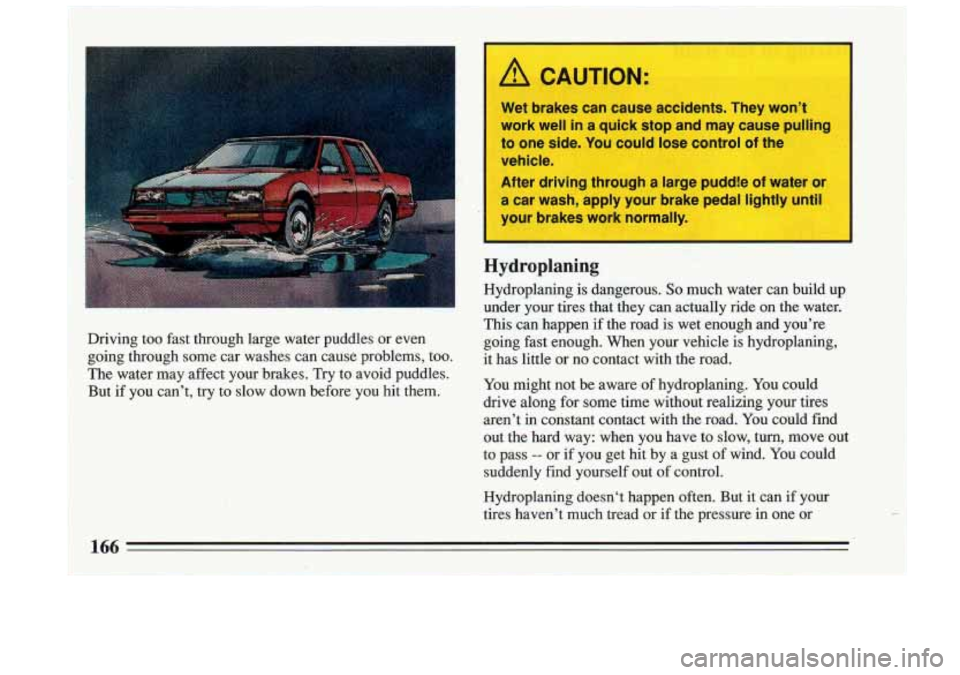
Driving too fast through large water puddles or even
going fast enough. When your vehicle is hydroplaning,
going through some car washes can cause problems, too. it has little or no contact with the road.
The water may affect your brakes. Try to avoid puddles.
But if you can’t, try to slow down before you hit them. You
might not be aware of hydroplaning. You could
drive along for some time without realizing your tires aren’t
in constant contact with the road. You could find
out the hard way: when you have to slow, turn, move out
to pass
-- or if you get hit by a gust of wind. You could
suddenly find yourself out of control.
Hydroplaning doesn‘t happen often. But it can if your
tires haven’t much tread or if the pressure in one or
Page 173 of 324
Just before you leave the lane, glance quickly over your
shoulder to make sure there isn’t another vehicle in your
“blind” spot.
If you are moving from an outside to a center lane on a
freeway having more than two lanes, make sure another
vehicle isn’t about to move into the same spot. Look at
the vehicles two lanes over and watch for telltale signs:
turn signals flashing, an increase in speed,
or moving
toward the edge of the lane. Be prepared to delay your
move.
Once you are moving on the freeway, make certain you
allow a reasonable following. distance. Expect to move
slightly slower at night.
Leaving the Freeway
When you want to leave the freeway, move to the proper
lane well in advance. Dashing across lanes at the last
minute is dangerous.
If you miss your exit do not, under
any circumstances, stop and back up. Drive on to the
next exit.
At each exit point is a deceleration lane. Ideally it
should be long enough for you to enter it at freeway
speed (after signaling, of course) and then do your
braking before moving onto the exit ramp.
Unfortunately, not all deceleration lanes are long enough
-- some are too short for all the braking. Decide when to
start braking. If you must brake on the through lane, and
if there is traffic close behind you, you can allow a little \
extra time and flash your brake lights (in addition to
your turn signal) as extra warning that you are about to
slow down and exit.
The exit ramp can be curved, sometimes quite sharply.
The exit spwd is usually posted. Reduce your speed
according to your speedometer, not to your sense of
motion. After driving for any distance at higher speeds,
you may tend to think you are going slower than you
actually are. For example,
40 mph (65 h/h) might
seem like only
20 mph (30 km/h). Obviously, this. could
lead to serious trouble on a ramp designed for
20 mph
(30 km/h)!
Driving a Long Distance
Although most long trips today are made on freeways,
there are still many made
on regular highways.
Long-distance driving on freeways and regular
highways is the same in some ways. The
trip has to be
planned and the vehicle prepared, you drive at
higher-than-city speeds, and there are longer
turns
behind the wheel. You’ll enjoy your trip more if you and
your vehicle are in good shape. Here are some tips for
a
successful long trip.
171
Page 189 of 324
I A CAUTION:
u could be injured if the vehicles roll. Set the
arking brake firmly on each vehicle. Put an
utomatic transaxle
in “P” (Park) or a manual
axle
in “N” (Neutral).
P
3. Turn off the ignition on both vehicles. Turn off all
lights that aren’t needed, and radios. This
will avoid
sparks and help save both batteries. And it could
save your radio!
4. Open the hoods and locate the batteries.
I A CAUTION:
An electric fan can start up even when the
engine is not running and can injure you. Keep
hands; clothing and tools away from any
underhood electric fan.
~~
Find the positive .(+) and negetive (-), terminals on
each battery.
Page 214 of 324
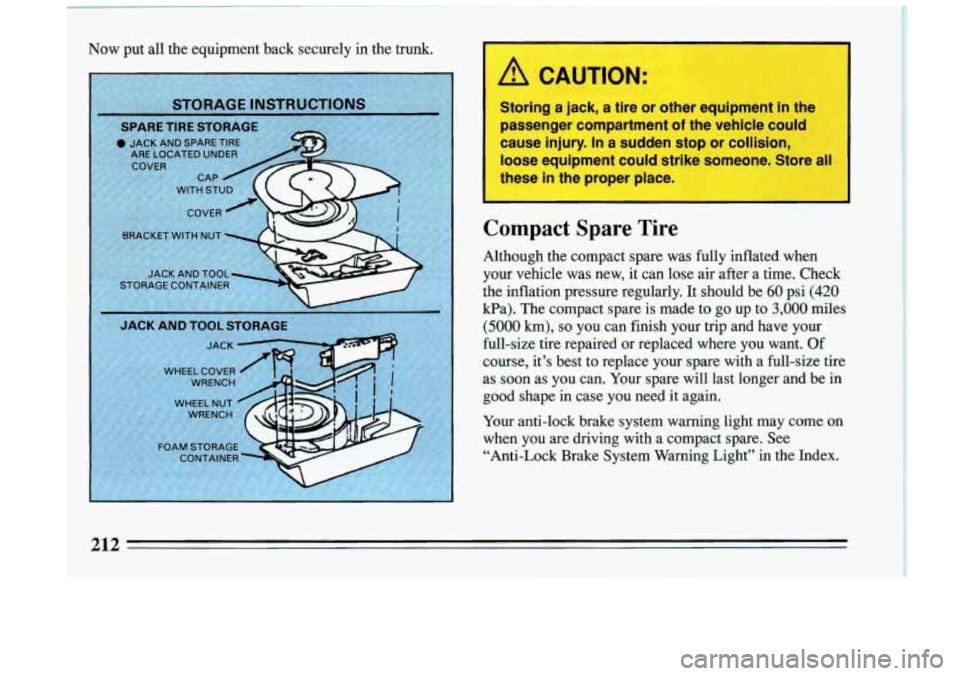
Now put all the equipment back securely in the trunk.
Compact Spare Tire
Although the compact spare was fully inflated when
your vehicle was new, it can lose air after a time. Check
the inflation pressure regularly. It should be
60 psi (420
kPa). The compact spare is made to go up to 3,000 miles
(5000 km), so you can finish your trip and have your
full-size tire repaired or replaced where you want.
Of
course, it’s best to replace your spare with a full-size ti\
re
as soon as you can. Your spare will last longer and be in
good shape in case you need it again.
Your anti-lock brake system warning light may come on
when you are driving with a compact spare. See
“Anti-Lock Brake System Warning Light” in the Index.
212
Page 238 of 324
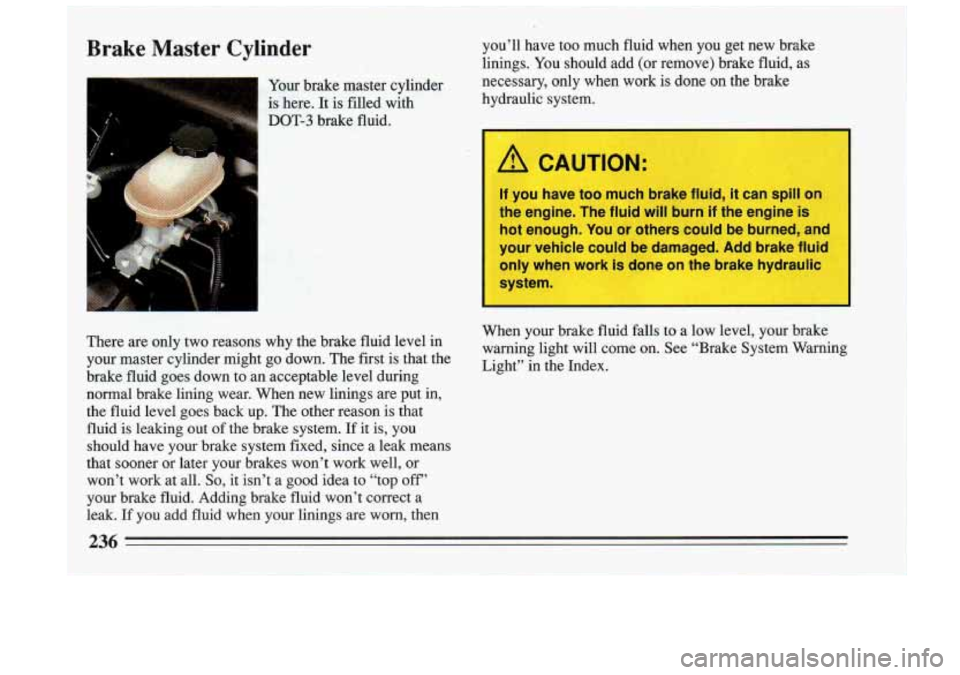
Brake Master Cylinder you’ll have too much fluid when you get new brake
linines. You should add (or remove) brake fluid, as
U
your brake master cylinder necessary, only when work is done on the brake
is here. It is filled with hydraulic system.
DOT-3 brake fluid.
I
I
A CAUTION:
If you have too much brake fluid, it can spill on
the engine. The fluid will burn
if the engine is
hot enough. You or others could be burned,
arr’
your vehicle could be damaged. Add brake flutu
only when work is done on the brake hydraulic
system.
When your brake fluid falls to a low level, your brake
There are only two reasons why the brake fluid level in light will on. See System Warning
your master cylinder might go down. The first is that the Light,’ in the Index,
brake fluid goes down to an acceptable level during
normal brake lining wear. When new linings are put in,
the fluid level goes back
up. The other reason is that
fluid ’is leaking out of the brake system. If it is, you
should have your brake system fixed, since a leak means
that sooner or later
your brakes won’t work well, or
won’t work at all.
So, it isn’t a good idea to “top off’
your brake fluid. Adding brake fluid won’t correct a
leak. If you add fluid when your linings are worn, then
236
Page 287 of 324
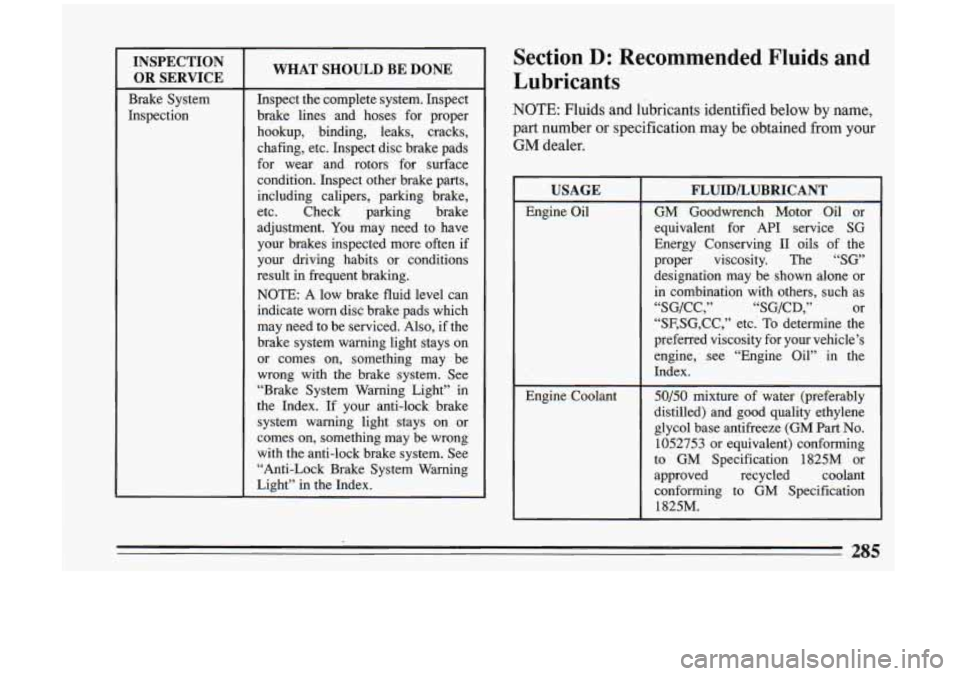
INSPECTION OR SERVICE
Brake System
Inspection
WHAT SHOULD BE DONE
Inspect the complete system. Inspect
brake lines and hoses for proper
hookup, binding, leaks, cracks,
chafing, etc. Inspect disc brake pads
for wear and rotors for surface
condition. Inspect other brake parts, including calipers, parking brake,
etc. Check parking brake
adjustment. You may need to have
your brakes inspected more often if
your driving habits or conditions
result in frequent braking.
NOTE: A low brake fluid level can
indicate worn disc brake pads which
may need to be serviced. Also, if the
brake system warning light stays on
or comes on, something may be
wrong with the brake system. See
“Brake System Warning Light” in
the Index. If your anti-lock brake
system warning light stays on or
comes
-on, something may be wrong
with the anti-lock brake system. See “Anti-Lock Brake System Warning
Light” in the Index.
Section D: Recommended Fluids and
Lubricants
NOTE: Fluids and lubricants identified below by name,
part number or specification may be obtained from your
GM dealer.
USAGE
Engine Oil
Engine Coolant
FLUID/LUBRICANT
GM Goodwrench Motor Oil or
equivalent for API service SG
Energy Conserving
I1 oils of the
proper viscosity. The
“SG’
designation may be shown alone or
in combination with others, such as
“SG/CC,” “SG/CD,” or
“SF,SG,CC,” etc. To determine the
preferred viscosity for your vehicle’s
engine, see “Engine Oil” in the
Index.
50/50 mixture of water (preferably
distilled) and good quality ethylene
glycol base antifreeze
(GM Part No.
1052753 or equivalent) conforming
to GM Specification 1825M
or
approved recycled coolant
conforming to GM Specification
1825M.
285
Page 299 of 324
Part 9 Index
I
I
Acc (Ignition Key Position) ........................ 72
Accessory Power. Retained
......................... 83
Adding Brake Fluid
.................................. 236
Coolant
.............................. 199.202. 23 1
Electrical Equipment
.......................... 125
Power Steering Fluid
.......................... 234
Transaxle/Transmission Fluid
.................... 229
Windshield Washer Fluid
....................... 235
Additives. Engine Oil
............................. 226
Adjustment. Brake
............................... 157
Adult Safety Belt Usage
............................ 26
AirBag
......................................... 32
Aircleaner
..................................... 228
Airconditioner
................................. 119
Airoutlets
..................................... 118
Airsystem
..................................... 118
Alcohol. Driving Under the Influence of
.............. 148
Alcohol in Gasoline
.............................. 2 17
Aluminum Wheels. Cleaning
....................... 257
AM Radio Reception
............................. 124
Engineoil
................................... 224
. ..
K . . B
AM Stereo Radio Reception ....................... 124
Antenna
....................................... 137
Antifreeze
...................................... 231
Antilock Brake System
........................... 154
Anti-Theft Tips
................................... 66
Appearance Care
................................ 252
Armrest Storage
................................. 104
Astroroof
...................................... 102
Audio Systems
.................................. 124
Automatic Door Locks
............................. 63
Automatic Pull-Down Feature
....................... 64
Automatic Overdrive
.............................. 77
Automatic Transaxle
.............................. 75
Automatic Transaxle Fluid
......................... 229
Automatic Transaxle Torque Lock
................... 178
Antilock Braking System Warning Light
.............. 112
Appearance Care and Maintenance Materials
.......... 260
Ashtrays
....................................... 103
Baby. Holding a
................................. 44
Battery
........................................ 237
Page 304 of 324
High Speed. Shifting When Your Engine is Running ..... 76 Jack. Tire ..................................... 205
Highway Hypnosis
............................... 172 Jacking Up the Car ............................... 205
Hill and Mountain Roads
.......................... 173 Jump Starting ................................... 186
Hills. Parking on
................................. 175
Holding a Baby in Your Car
......................... 43
Hood. Opening the
............................... 221
Horn ........................................... 84 Keys 59
Hot Coolant Warning Light
........................ 113 Keyless Entry System. Remote 64
Hydroplaning
................................... 166
..........................................
......................
Hot Engine. Safety Warnings About 196 Kilomefa- J&$q$cx .. +... .? . ... _. % ......... . ... .’_ rs.z7 t- ........ . 105 .................
Ice. Driving on ................................. 179
Identification Label. Service Parts
................... 261
Identification Number. Vehicle
..................... 261
Idling Your Engine
................................ 82
If You’re Stuck: In Sand. Mud. Ice or Snow
........... 214
Indicator. Turn Signal
............................. 85
Indicators. Disc Brake Wear ....................... 156
Indicators. Warning Lights and Gages
................ 107
Infant Restraint
................................... 45
Inflation. Tire
................................... 245
Inside Mirror
.................................... 99
Inspection. Tire
................................. 245
Instrument Panel
................................ 105
Interior Cleaning
................................ 253
Interlock. Brake-Transaxle Shift
.................. 75. 81
Introduction
. How To Use This Manual ............... 10
Ignition Key Positions
............................. 71
Label.
Service Parts Identification
.................. 261
Lane Change Indicator
............................. 85
Lap-Shoulder Belt Usage by Children
................. 55
Leaving Your Vehicle .............................. 80
Level Control. Electronic
.......................... 104
License Plate Holder. Rear
......................... 104
Light. Safety Belt
................................. -25
Light.
Turn Signal Indicator ......................... 85
Lighter. Cigarette
................................ 111
Lights Daytime Running
.............................. 98
Panel and Interior
.............................. 96
Traffic
...................................... 145
“On” Warning
................................. 96
Operation
.................................... 86
Loading Your Vehicle ............................ 242
Lap Belt
........................................ -42
Lights
& Gages. Warning Indicators ................. 107
302
Page 307 of 324
Run (Ignition Key Position) ......................... 72
Running Lights. Daytime
........................... 98
Running Your Engine While You’re Parked
............ 82
Safety Belt Care
................................ 256
Safety Belt Extender
.............................. 56
Safety Belt Reminder Light
......................... 25
Safety Belt Replacement
........................... 57
Safety Belt. Center Adult Passenger
.................. 42
Safety Belt. Lap
.................................. 42
Safety Belt. Lap-Shoulder
.......................... 27
Safety Belts
..................................... 13
Safety Belts. Buckled Wrong
........................ 29
Safety Belts. Questions About
....................... 24
Safety Belts. Rear Seat Passengers
................... 38
Safety Belt.
Too Loose ............................. 28
Safety Belt.
Torn ................................. 57
Safety Belts. Twisted
.............................. 31
Safety Belts. Right Front. Adult Passenger
............. 38
Safety Belts. Usage by Adults
....................... 26
Safety Belts. Usage by Children
..................... 43
Safety Belts. Usage During Pregnancy
................. 37
Safety Belts. Why They Work
....................... 20
Safety Belts. Worn Under
Arm ...................... 30
Safety Defects. Reporting .......................... 291
Scheduled Maintenance Services
.................... 273
Safety Warnings
.................................. 10 Seats and Safety Belts
............................. 13
Seat Controls
.................................... 14
Second Gear. When to Use
......................... 77
Securing A Child Restraint
......................... 45
Security Light
................................. 67. 69
Service Tips
.................................... 216
Service A/C Light
............................... 115
Service and Appearance . Care ...................... 215
“Service Engine Soon” Warning Light
............... 113
Service Parts Identification Label
................... 261
Service Publications
.............................. 292
Setting the Clock
......................... 127.130. 132
Setting the Trip Odometer
......................... 107
ShapeofRoadSigns
............................. 143
Sheet Metal Damage
............................. 258
Shift. Brake-Transaxle Interlock
.................. 75. 81
Shift Lever Positions
.............................. 75
Shifting Into Park
................................. 79
Shifting Out of Park
............................... 81
Signaling Turns
................................... 85
Signs. Road .................................... 140
Skidding ....................................... 161
Slippery Surfaces. Driving on
...................... 179
Snow or Ice. Driving on
........................... 179
Solvent-Type Cleaner on Fabric
.................... 254
Sound Equipment. Adding
......................... 125
Sound Systems
.................................. 124
Snowstorm. If You’re Caught in a Bad
............... 180
SpareTire
...................................... 212
305’ I