brakes BUICK RIVIERA 1993 User Guide
[x] Cancel search | Manufacturer: BUICK, Model Year: 1993, Model line: RIVIERA, Model: BUICK RIVIERA 1993Pages: 324, PDF Size: 16.01 MB
Page 168 of 324
r/d CAUTION:
Wet brakes can cause accidents. They won’t
work well in a quick stop and may cause pulling
to one side. You could lose control of the
vehicle.
After driving through a large puddre of water or
a car wash, apply your brake pedal lightly until
your brakes work normally.
I- Hydroplaning
I
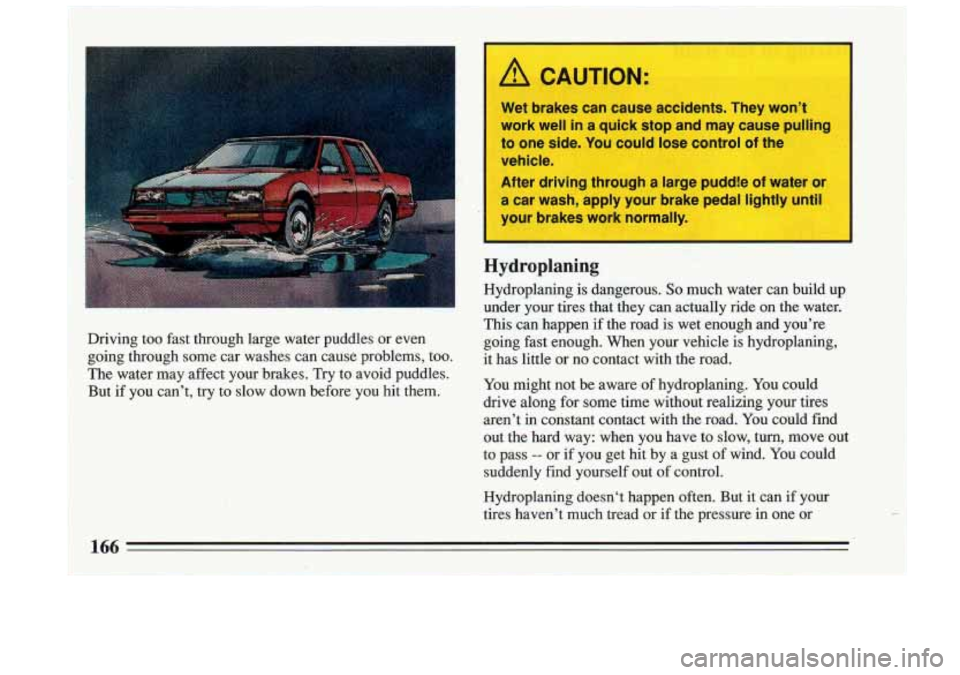
1 Hydroplaning is dangerous. So much water can build up
under your tires that they can actually ride on the water.
This can happen if the road is wet enough and you’re
Driving too fast through large water puddles or even
going fast enough. When your vehicle is hydroplaning,
going through some car washes can cause problems, too. it has little or no contact with the road.
The water may affect your brakes. Try to avoid puddles.
But if you can’t, try to slow down before you hit them. You
might not be aware of hydroplaning. You could
drive along for some time without realizing your tires aren’t
in constant contact with the road. You could find
out the hard way: when you have to slow, turn, move out
to pass
-- or if you get hit by a gust of wind. You could
suddenly find yourself out of control.
Hydroplaning doesn‘t happen often. But it can if your
tires haven’t much tread or if the pressure in one or
Page 176 of 324
If you drive regularly in steep country, or if you're
planning to visit there, here are some tips that can make
your trips safer and more enjoyable.
0 Keep your vehicle in good shape. Check all fluid
levels and also the brakes, tires, cooling system and
transaxle. These parts can work hard on mountain
roads.
@ Know how to go down hills. The most important
thing to know
is thisi let your engine do some of the
slowing down. Don't make your brakes do it all.
Shift to a lower gear when you go down a steep or
long
hill. That way, you will slow down without
excessive use of your brakes.
If you don't shift down, your brakes could get
11 so hot that they wouldn't work well. You would
then have poor braking
or even none going
down a
hill. You could crash. Shift down to let
your engine assist your brakes on a steep
,!~~~~~~~~~~~,~~*~~-~~~~ ,-d:;,,~~,."c.~,-~.:'-- ~i~-~zg352~;~g~~g d 0 w n h i I I sf 0 pe . li,,,,~a,,.>~?&:.
I
I
I
0
/d CAUTION:
Coasting downhill in "N" (Neutral) or with the
ignition off is dangerous. Your brakes will have
to do all the work of slowing down. They could
get
so hot that they wouldn't work well. You
could crash. Always have your engine running
and your vehicle
in gear -]en you go downhill.
Know how to go uphill. You may want to shift down
to a lower gear. The lower gears help cool
your
engine and transaxle, and you can climb the hill
better.
Stay in your own lane when driving on two-lane
roads in hills or mountains. Don't swing wide or cut
across the center of the road. Drive at speeds that let
you stay in your own lane. That way, you won't be
surprised by a vehicle coming toward you
in the
same lane.
It takes longer to pass another vehicle when you're going uphill. You'll want
to leave extra room to pass.
If a vehicle is passing you and doesn't have enough
room, slow down to make it easier for the other
vehicle to get by.
Page 182 of 324
traction of all. You can get “wet ice” when it’s about If You’re Caught in a Blizzard
freezing (32oF; O°C) and freezing rain begins to fall. Try
to avoid driving on wet ice until salt and sand crews can
get there. Y
. . ._ . . .
Whatever the condition -- smooth ice, packed, blowing or
loose snow
-- drive with caution. Accelerate gently. Try
not to break the fragile traction. If you accelerate too fast,
the drive wheels will spin and polish the surface under
the tires even more.
Your anti-lock brakes improve your ability to make a
hard stop on a slippery road. Even though you have the
anti-lock braking system, you’ll want to begin stopping sooner than you would on
dry pavement. See “Anti-lock”
in the Index.
Allow greater following distance on any slippery
road.
Watch for slippery spots. The road might be fine until
you hit a spot that’s covered with ice. On an otherwise
clear road, ice patches may appear
in shaded areas
where the
sun can’t reach: around clumps of trees,
behind buildings, or under bridges. Sometimes the
surface of a curve or an overpass may remain icy
when the surrounding roads are clear.
If you see a
patch
of ice ahead of you, brake before you are on it.
Try not to brake while you’re actually on the ice, and
avoid sudden steering maneuvers.
180
Page 238 of 324
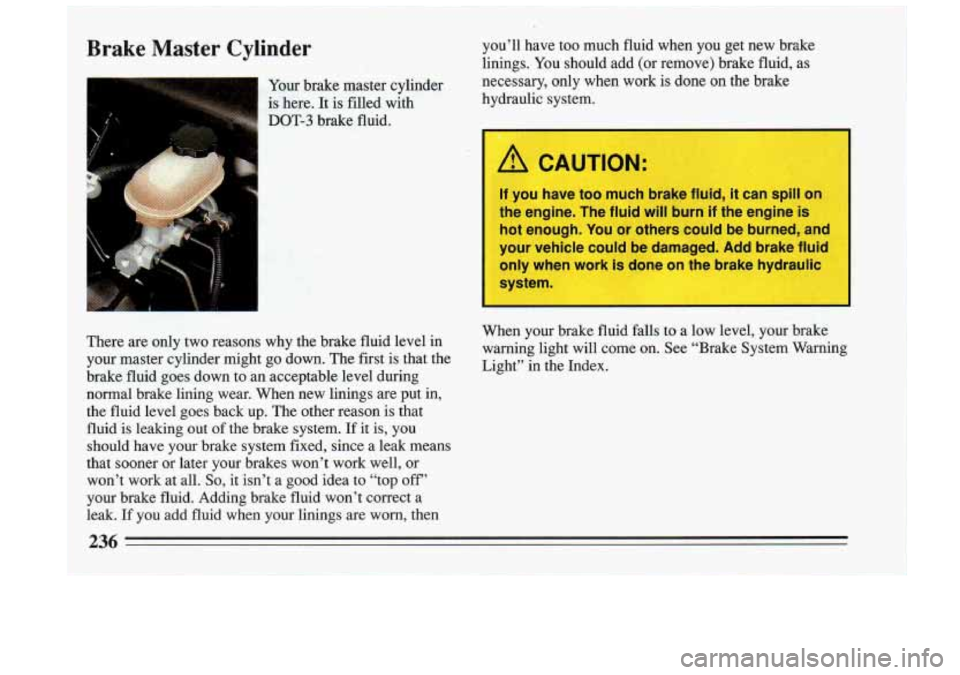
Brake Master Cylinder you’ll have too much fluid when you get new brake
linines. You should add (or remove) brake fluid, as
U
your brake master cylinder necessary, only when work is done on the brake
is here. It is filled with hydraulic system.
DOT-3 brake fluid.
I
I
A CAUTION:
If you have too much brake fluid, it can spill on
the engine. The fluid will burn
if the engine is
hot enough. You or others could be burned,
arr’
your vehicle could be damaged. Add brake flutu
only when work is done on the brake hydraulic
system.
When your brake fluid falls to a low level, your brake
There are only two reasons why the brake fluid level in light will on. See System Warning
your master cylinder might go down. The first is that the Light,’ in the Index,
brake fluid goes down to an acceptable level during
normal brake lining wear. When new linings are put in,
the fluid level goes back
up. The other reason is that
fluid ’is leaking out of the brake system. If it is, you
should have your brake system fixed, since a leak means
that sooner or later
your brakes won’t work well, or
won’t work at all.
So, it isn’t a good idea to “top off’
your brake fluid. Adding brake fluid won’t correct a
leak. If you add fluid when your linings are worn, then
236
Page 239 of 324
What to Add: Replacing Brake System Parts
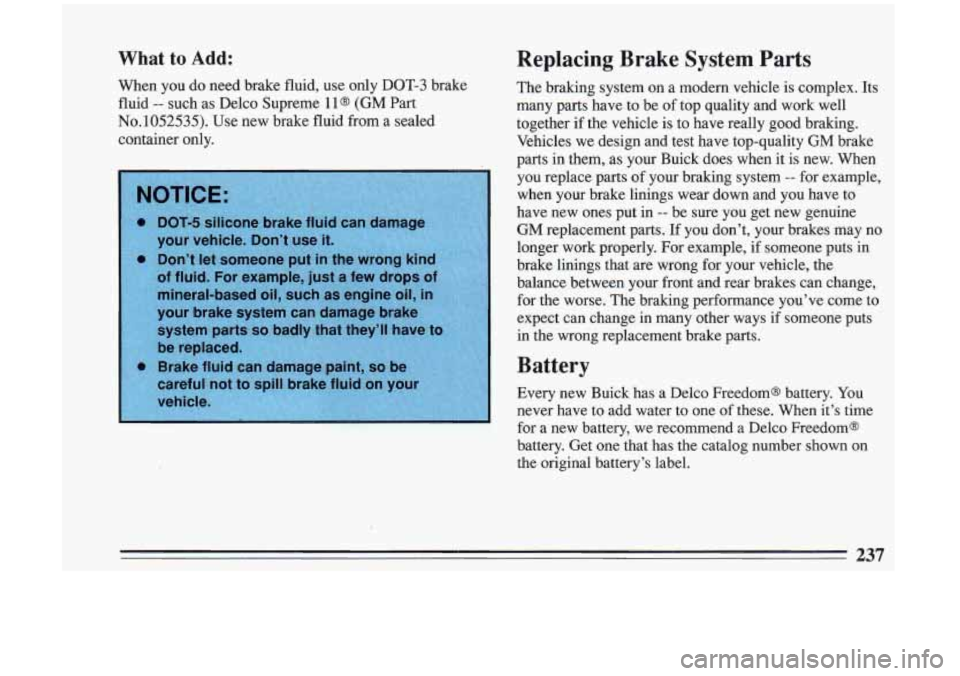
When you do need brake fluid, use only DOT-3 brake
fluid
-- such as Delco Supreme 11 (GM Part
No.1052535). Use new brake fluid from a sealed
container only. The
braking system on a modern vehicle is complex. Its
many parts have to be of top quality and work well
together if the vehicle is to have really good braking.
Vehicles we design and test have top-quality GM brake
parts in them, as your Buick does when it is new. When
you replace parts of your braking system
-- for example,
when your brake linings wear down and you have to
have new ones put in
-- be sure you get new genuine
GM replacement parts.
If you don’t, your brakes may no
longer work properly. For example,
if someone puts in
brake linings that are wrong for your vehicle, the
balance between your front and rear brakes can change, for the worse. The braking performance you’ve come to
expect can change in many other ways if someone puts
in the wrong replacement brake parts.
Battery
Every new Buick has a Delco Freedoms battery. You
never have to add water to one of these. When it’s time
for a new battery, we recommend a Delco Freedoma
battery. Get one that has the ‘catalog number shown on
the original battery’s label.
h
237
Page 285 of 324
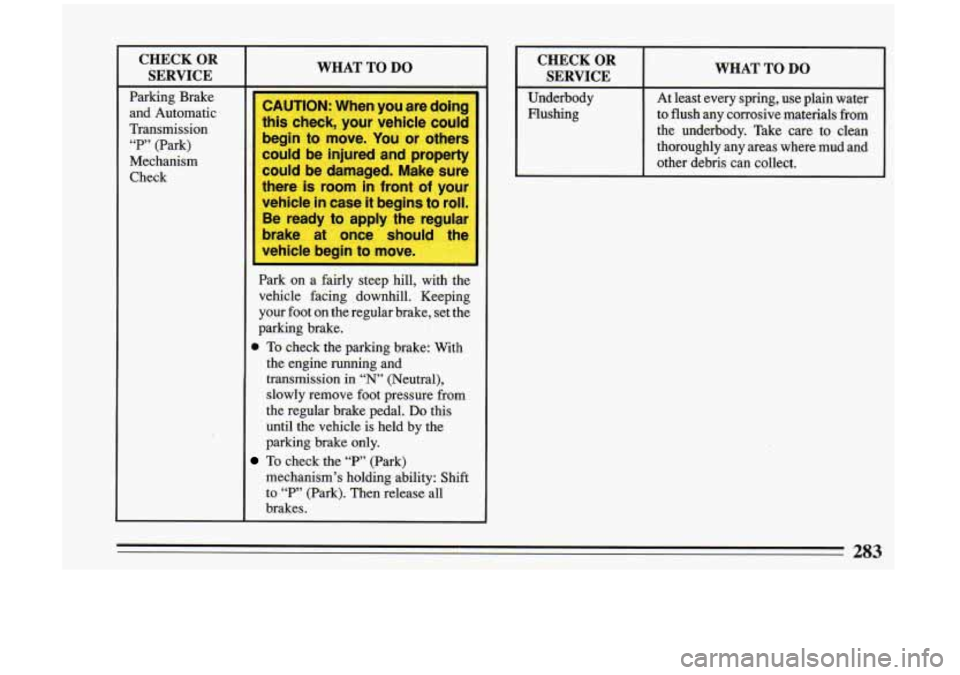
CHECK OR SERVICE
Parking Brake
and Automatic
Transmission
“P” (Park)
Mechanism Check
WHAT TO DO
ZAUTION: When you are doing
this check, your vehicle
could
gin to move. You or others
uld be injured and property
be damaged. Make sure
is room in front of your
hicle
in case it begins to roll.
ready to apply the regular
ake at once should the
ehicle begin to move.
Park on a fairly steep hill, with the
vehicle facing downhill. Keeping
your foot
on the regular brake, set the
parking brake.
li To check the parking brake: With
the engine running and
transmission in
“N’ (Neutral),
slowly remove foot pressure from
the regular brake pedal.
Do this
until the vehicle is held by the
parking brake only.
mechanism’s holding ability: Shift
to
“P” (Park). Then release all
brakes.
To check the “P” (Park)
CHECK OR
SERVICE
Underbody
Flushing
WHAT TO DO
At least every spring, use plain water
to flush any corrosive materials
from
the underbody. Take care to clean
thoroughly any areas where mud and
other debris can collect.
283
Page 287 of 324
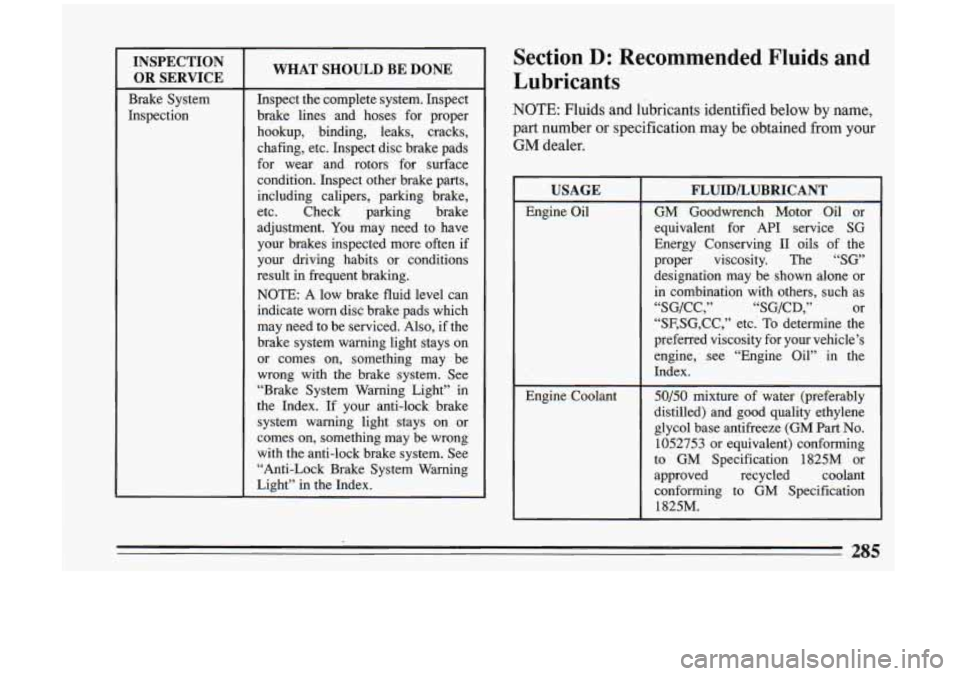
INSPECTION OR SERVICE
Brake System
Inspection
WHAT SHOULD BE DONE
Inspect the complete system. Inspect
brake lines and hoses for proper
hookup, binding, leaks, cracks,
chafing, etc. Inspect disc brake pads
for wear and rotors for surface
condition. Inspect other brake parts, including calipers, parking brake,
etc. Check parking brake
adjustment. You may need to have
your brakes inspected more often if
your driving habits or conditions
result in frequent braking.
NOTE: A low brake fluid level can
indicate worn disc brake pads which
may need to be serviced. Also, if the
brake system warning light stays on
or comes on, something may be
wrong with the brake system. See
“Brake System Warning Light” in
the Index. If your anti-lock brake
system warning light stays on or
comes
-on, something may be wrong
with the anti-lock brake system. See “Anti-Lock Brake System Warning
Light” in the Index.
Section D: Recommended Fluids and
Lubricants
NOTE: Fluids and lubricants identified below by name,
part number or specification may be obtained from your
GM dealer.
USAGE
Engine Oil
Engine Coolant
FLUID/LUBRICANT
GM Goodwrench Motor Oil or
equivalent for API service SG
Energy Conserving
I1 oils of the
proper viscosity. The
“SG’
designation may be shown alone or
in combination with others, such as
“SG/CC,” “SG/CD,” or
“SF,SG,CC,” etc. To determine the
preferred viscosity for your vehicle’s
engine, see “Engine Oil” in the
Index.
50/50 mixture of water (preferably
distilled) and good quality ethylene
glycol base antifreeze
(GM Part No.
1052753 or equivalent) conforming
to GM Specification 1825M
or
approved recycled coolant
conforming to GM Specification
1825M.
285