fuel BUICK RIVIERA 1993 User Guide
[x] Cancel search | Manufacturer: BUICK, Model Year: 1993, Model line: RIVIERA, Model: BUICK RIVIERA 1993Pages: 324, PDF Size: 16.01 MB
Page 219 of 324
Fuel
Use regular unleaded gasoline rated at 87 octane or
higher: It should meet specifications ASTM D4814 in
the U.S. and CGSB 3.5.92 in Canada. These fuels
should have the proper additives,
so you should not have
to add anything to the fuel.
Use regular unleaded gasoline rated at 87 octane or
higher. It should meet specifications ASTM D4814 in
the U.S. and CGSB 3.5-92 in Canada. These fuels should have the proper additives,
so you should not have
to add anything to the
fuel.
In the U.S. and Canada, it’s easy to be sure you get the
right kind of gasoline (unleaded). You’ll see
“UNLEADED” right on the pump. And only unleaded
nozzles will fit into your vehicle’s filler neck.
Be sure the posted octane
is at least 87. If the octane is
less than
87, you may get a heavy knocking noise when
you drive. If it’s bad enough,
it can damage your engine.
If you’re using fuel rated at 87 octane or higher and you
still hear heavy knocking, your engine needs service.
But don’t worry if you hear a little pinging noise when
you’re accelerating or driving up a hill. That’s normal,
and you don’t have to buy a higher octane fuel to get rid
of pinging. It’s the heavy, constant knock that means
you have a problem. What about gasoline with blending materials that
contain oxygen, such as MTBE or alcohol?
MTBE is “methyl tertiary-butyl ether.” Fuel that is no
more than 15% MTBE is fine for your vehicle.
Ethanol
is ethyl or grain alcohol. Properly-blended fuel
that is no more than
10% ethanol is fine for your
vehicle.
Methanol is methyl or wood alcohol.
217
Page 220 of 324
I
Gasolines for Cleaner Air
Your use of gasoline with detergent additives will help
prevent deposits from forming in your engine and fuel
system. That helps keep your engine in tune and your
emission control system working properly. It’s good €or
your vehicle, and you’ll be doing your part for cleaner
air.
Many gasolines are now blended with materials called oxygenates. General Motors recommends that you use
gasolines with these blending materials, such as MTBE
and ethanol. By doing
so, you can help clean the air,
especially in those parts
of the country that have high
carbon monoxide levels.
In addition, some gasoline suppliers are now producing
reformulated gasolines. These gasolines are specially
designed to reduce vehicle emissions. General Motors
recommends that you use reformulated gasoline. By
doing
so, you can help clean the air, especially in those
parts of the country that have high Ozone levels.
You should ask your service station operators if their
gasolines contain detergents and oxygenates, and if they
have been reformulated
to reduce vehicle emissions.
Fuels in Foreign Countries
If you plan on driving in another country outside the
U.S. or Canada, unleaded fuel may be hard to find. Do
not use leaded gasoline. If you use even one tankful,
your emission controls won’t work well or at all. With
continuous use, spark plugs can get fouled, the exhaust system can corrode, and your engine oil can deteriorate
quickly. Your vehicle’s oxygen sensor will be damaged.
All of that means costly repairs that wouldn’t be covered
by your warranty.
To check on fuel availability, ask an auto club, or
contact a major oil company that does business in the
country where you’ll be driving.
You can also write us at the following address for
advice. Just tell us where you’re going and give your
Vehicle Identification Number
(VIN).
General Motors of Canada Ltd.
International Export Sales
P.O. Box 828
Oshawa, Ontario L1H 7N1, Canada
218
Page 221 of 324
A CAUTION:
Gasoline vapor is highly flammable. It burns
violently, and that can cause very bad injuries. Don't smoke
if you're near gasoline or refueling
your vehicle. Keep sparks, flames, and smoking materials away from gasoline.
- -
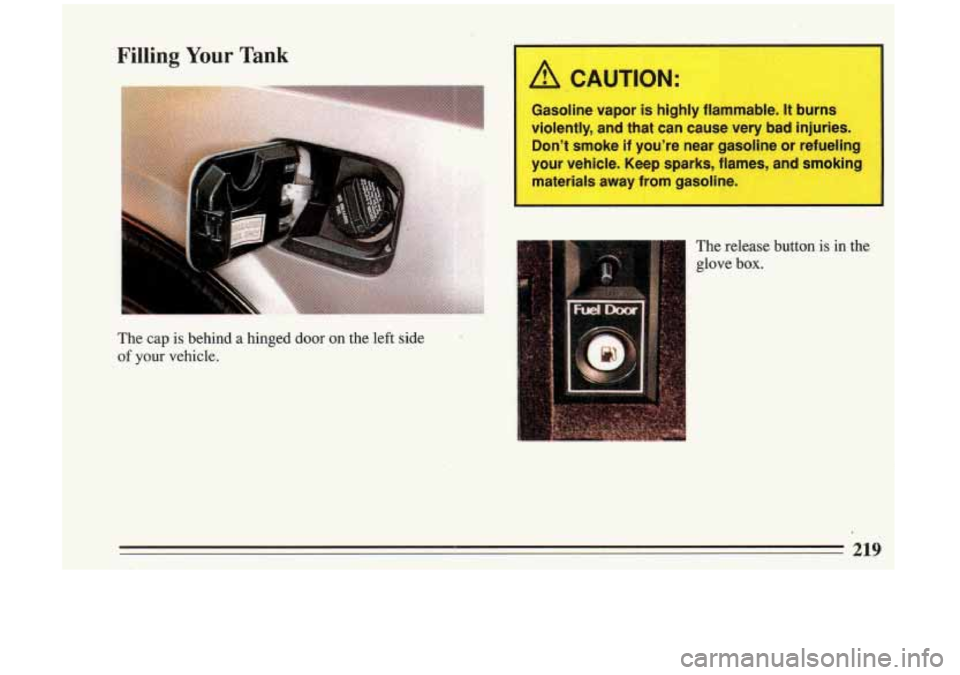
The release button is in the
glove box.
219
Page 222 of 324
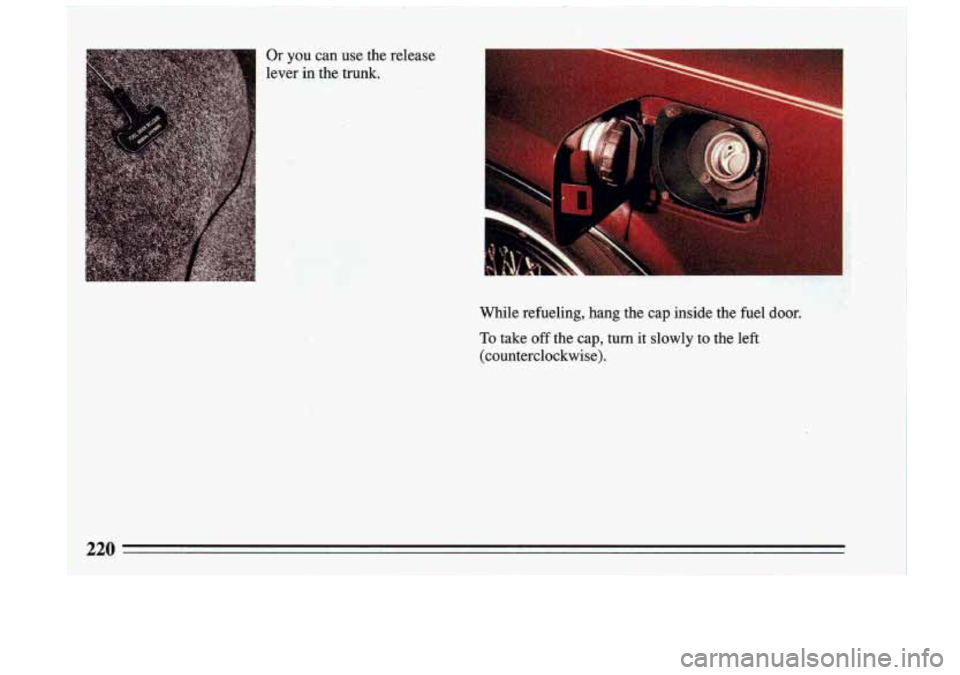
Or you can use the release
lever
in the trunk.
While refueling, hang the cap inside the fuel door.
To take off the cap, turn it slowly to the left
(counterclockwise).
220
Page 226 of 324
Engine Oil
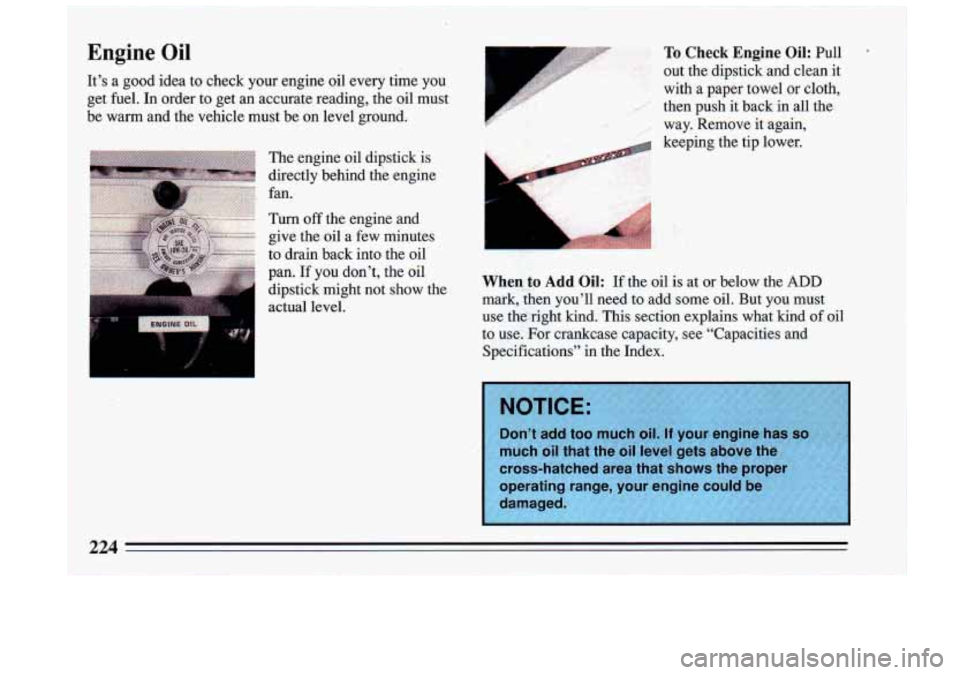
It’s a good idea to check your engine oil every time you
get fuel.
In order to get an accurate reading, the oil must
be warm and the vehicle must be on level ground.
The engine
oil dipstick.is
directly behind the engine
fan..
Turn off the engine and
give the oil a
few minutes
to drain back into the oil
pan.
If you don’t, the oil
dipstick might not show the
actual level.
To Check Engine Oil: Pull ’
1 out the dipstick and clean it
with a paper towel or cloth,
I.ii’ ” then push it back in all the
.. , way. Remove it again,
When to Add Oil: If the oil is at or below the ADD
mark, then you’ll need to add some oil. But you must
use tlwright kind. This section explains what kind
of oil
to use. For crankcase capacity, see “Capacities and
Specifications”
in the Index.
Page 228 of 324
RECOMMENDED SAE VISCOSITY BRADE ENGINE: OILS
FOR BEST FUEL ECONOMY AND COW STARTlW6, SELECT THE LOWEST
SAE VISCOSITY GRADE OIL FOR THE EXPECTED TEMPERATURE RANGE.
HOT
WEATHER r
"F
-100 '
+a0 '
+60
+40
+20 '
7
"C
I +3a
. +27
,+16
+4
-7
- 18
WEATHER
LOOK
@
FOR THIS
LABEL $+';J
-- SAE T. 10W.30
PREFERRED above 0°F (-18°C)
IF NEITHER SAE 5W-30 NOR SAE 1OW-30
GRADE OILS ARE AVAILABLE, SAE 30
GRADE MAY BE USED AT TEMPERATURES
ABOVE
40 DEGREES F (4 DEGREES C).
DO NOT USE SAE
1OW-40, SAE 2OW-50 OR ANY OTHER GRADE OIL NOT RECOMMENDED
SAE 1OW-30
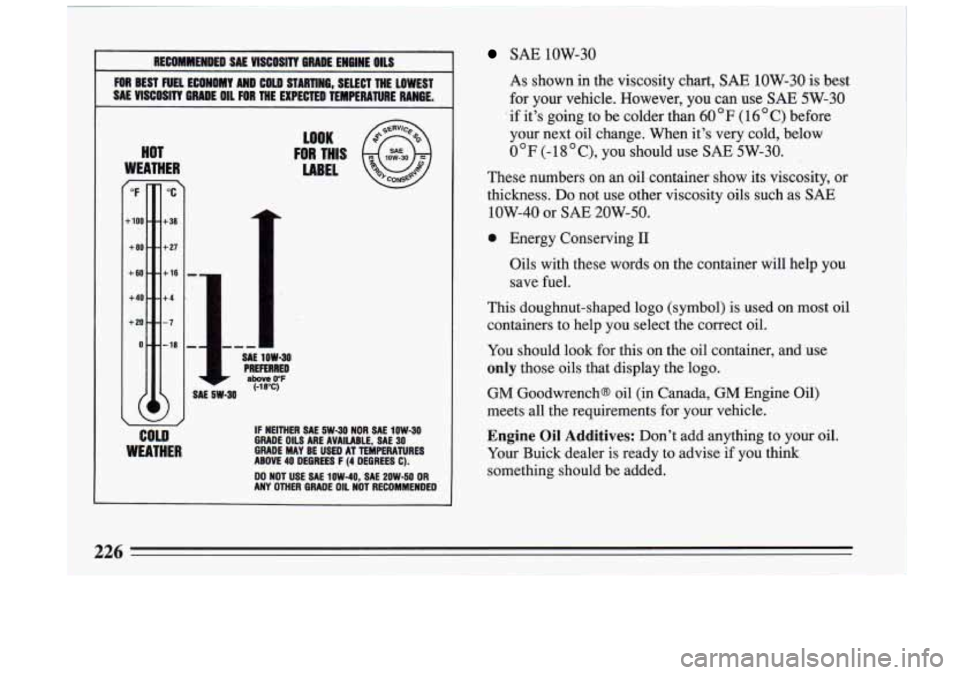
As shown in the viscosity chart, SAE 1OW-30 is best
for
your vehicle. However, you can use SAE 5W-30
' if it's going to be colder than 60 OF (16 C) before
your next oil change. When it's very cold, below
O*F (-18*C), you should use SAE 5W-30.
These numbers on an oil container show its viscosity, or
thickness.
Do not use other viscosity oils such as SAE
1OW-40 or SAE 20W-50.
0 Energy Conserving I1
Oils with these words on the container will help you
save fuel.
This doughnut-shaped logo (symbol) is used on most oil containers to help you select the correct oil.
You should look for this on the oil container, and use
only those oils that display the logo.
GM Goodwrench@ oil (in Canada, GM Engine Oil)
meets all the requirements for your vehicle.
Engine Oil Additives: Don't add anything to your oil.
Your Buick dealer is ready to advise
if you think
something should be added.
226
Page 245 of 324
7
Isl
MFD BY GENERAL MOTORS CORP
DATE GVWR GAWR FRT GAWR
RR
THIS VEHICLE CONFORMS TO ALL APPLI-
CABLE US. FEDERAL MOTOR VEHICLE
SAFETY, BUMPER, AND THEFT PREVENTION
STANDARDS IN EFFECT
ON THE DATE OF
MANUFACTURE SHOWN ABOVE.
@iwlIk$#d!!i
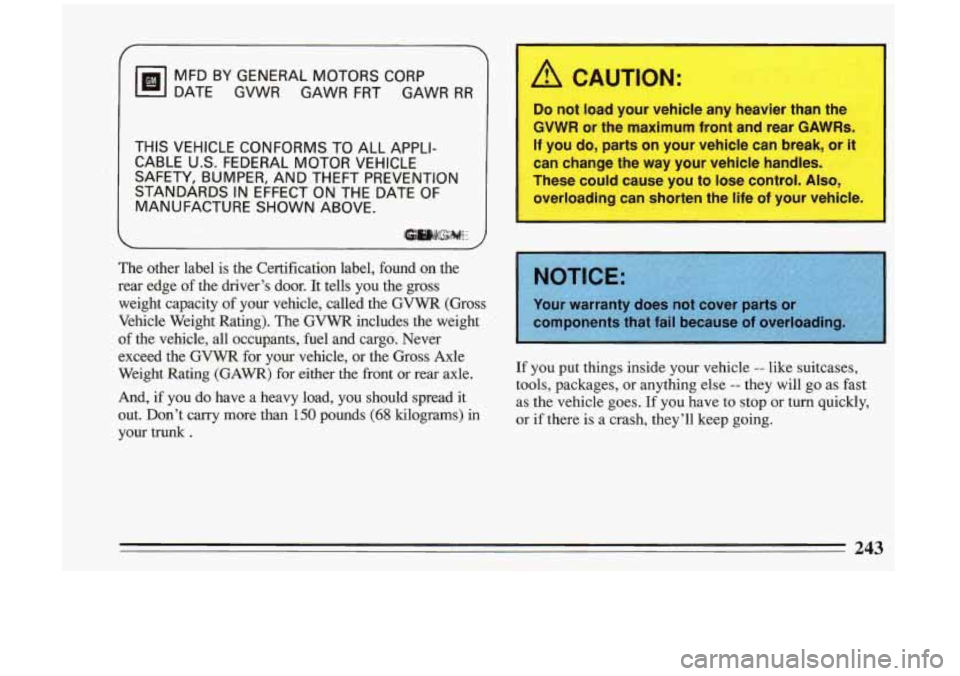
The other label is the Certification label, found on the
rear edge of the driver’s door. It tells you the
gross
weight capacity of your vehicle, called the GVWR (Gross
Vehicle Weight Rating). The
GVWR includes the weight
of the vehicle, all occupants, fuel and cargo. Never
exceed the GVWR for your vehicle, or the Gross Axle
Weight Rating
(GAWR) for either the front or rear axle.
And, if you do have a heavy load, YOU should spread it
out. Don’t carry more than
150 pounds (68 kilograms) in
your trunk
.
ur vehicle any heavier than the
:imum front
and rear GAWRs.
1 your vehicle can break, or it
lay your vehicle handles.
;e you
to lose control. Ako,
;horten the life of your vehicle. I
If you put things inside your vehicle -- like suitcases,
tools, packages, or anything else
-- they will go as fast
as the vehicle goes.
If you have to stop or turn quickly,
or if there
is a crash, they’ll keep going.
243
Page 260 of 324
Weatherstrips
-These are places where glass or metal meets rubber.
Silicone grease there will make them last longer, seal
better, and not squeak. Apply silicone grease with a
clean cloth at least every six months.
Sheet Metal Damage
.If your vehicle is damaged and requires sheet metal
.repair or replacement, make sure the body repair shop
: applies anti-corrosion material to the parts repaired or
replaced to restore corrosion protection.
-Foreign Material
Calcium chloride and other salts, ice melting agents,
road oil and tar, tree sap, bird droppings, chemicals from industrial chimneys, and other foreign matter can
damage your vehicle’s finish if they remain on painted
surfaces. Use cleaners that are marked safe for painted
surfaces for these stains.
Finish Damage
Any stone chips, fractures or deep scratches in the finish
should be repaired right away. Bare metal will corrode
quickly and may develop into a major repair expense. Minor chips and scratches can be repaired with touch-up
materials available fi-om your dealer
or other service
outlets. Larger areas of finish damage can be corrected
in your dealer’s body and paint shop.
Underbody Maintenance
Chemicals used for ice and snow removal and dust
control can collect
on the underbody. If these are not
removed, accelerated corrosion (rust) can occur on the Underbody parts such as fuel lines, frame, floor pan, and
exhaust system even though
they have corrosion
protection.
At least every spring, flush these materials from the
underbody with plain water. Clean any areas where mud
and other debris can collect. Dirt packed in closed areas
of the frame should be loosened before being flushed.
Your dealer or an underbody vehicle washing system
can do this for you.
Page 265 of 324
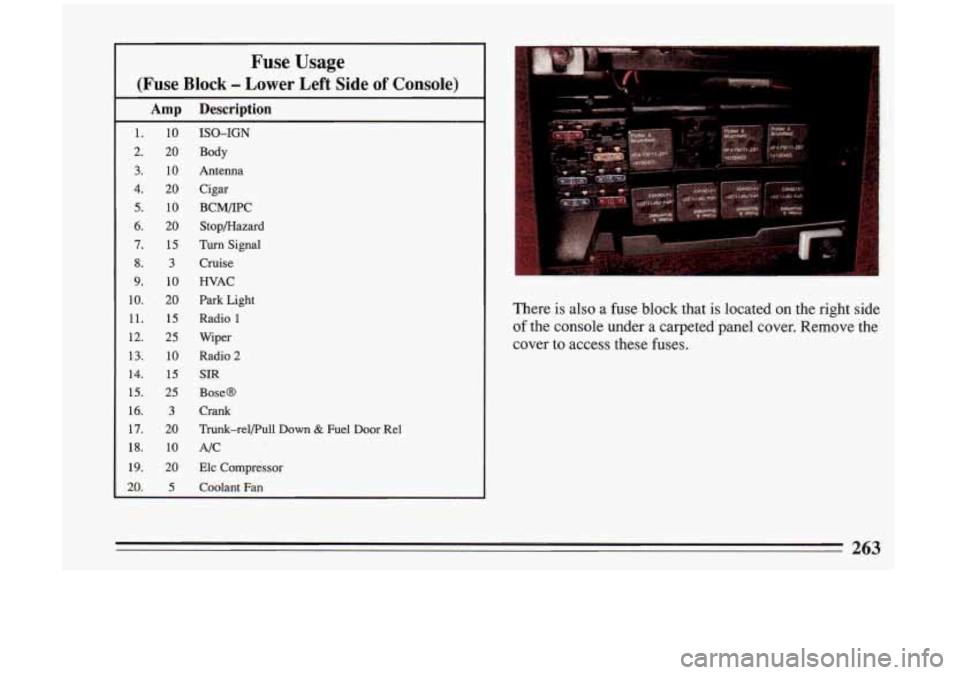
Fuse Usage
(Fuse Block - Lower Left Side of Console)
Amp Description
1.
2.
3.
4.
5.
6.
7.
8.
9.
10.
11.
12.
13.
14.
15.
16.
17.
18.
19.
20.
10
20
10
20
10
20
15
3
10
20
15
25
10
15
25
3
20
10
20
5
ISO-IGN
Body
Antenna
Cigar
BCM/IPC Stopmazard
Turn Signal
Cruise
WAC
Park Light
Radio
1
Wiper
Radio
2
SIR
BoseO
Crank
Trunk-rel/Pull
Down & Fuel Door Re1
AIC
Elc Compressor
Coolant Fan
There is also a fuse block that is located on the right side
of the console under a carpeted panel cover. Remove the
cover to access these fuses.
263
Page 274 of 324
If YOU are skilled enough to do some work on your
vehicle, you will probably want to get the service
information GM publishes. You will find a list of
publications and how to get them in this manual. See
“Service Publications” in the Index.
“Section B: Owner Checks and Services” tells you what
should be checked whenever you stop for fuel. It also
explains what you can easily do to help keep your vehicle in good condition.
“Section C: Periodic Maintenance Inspections” explains
important inspections that your Buick dealer’s service
department or another qualified service center should
perform. ‘‘Section D: Recommended Fluids and Lubricants” lists
some products GM recommends to help keep your
vehicle properly ,maintained. These products, or their
equivalents, should be used whether you do the work
yourself or have it done.
“Section
E: Maintenance Record” provides a place for
you to record the maintenance performed on your
vehicle. Whenever any maintenance is performed, be sure
to write it down in this section. This will help you
determine when your next maintenance should be done.
In addition, it is a good idea to keep your maintenance
receipts. They may be needed to qualify your vehicle for
warranty repairs.
272