oil BUICK RIVIERA 1993 User Guide
[x] Cancel search | Manufacturer: BUICK, Model Year: 1993, Model line: RIVIERA, Model: BUICK RIVIERA 1993Pages: 324, PDF Size: 16.01 MB
Page 226 of 324
Engine Oil
It’s a good idea to check your engine oil every time you
get fuel.
In order to get an accurate reading, the oil must
be warm and the vehicle must be on level ground.
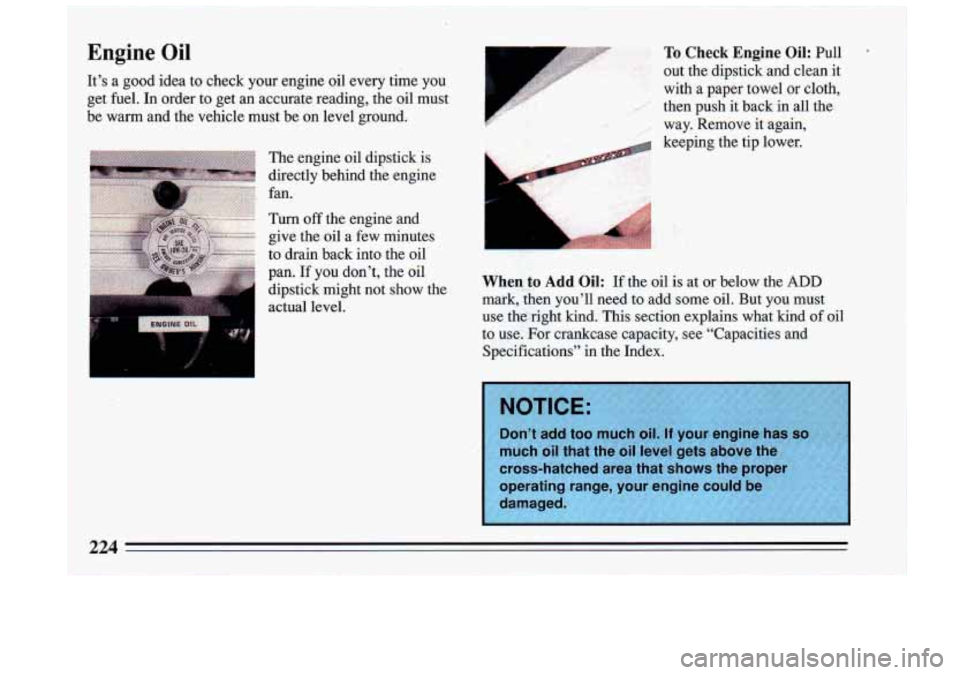
The engine
oil dipstick.is
directly behind the engine
fan..
Turn off the engine and
give the oil a
few minutes
to drain back into the oil
pan.
If you don’t, the oil
dipstick might not show the
actual level.
To Check Engine Oil: Pull ’
1 out the dipstick and clean it
with a paper towel or cloth,
I.ii’ ” then push it back in all the
.. , way. Remove it again,
When to Add Oil: If the oil is at or below the ADD
mark, then you’ll need to add some oil. But you must
use tlwright kind. This section explains what kind
of oil
to use. For crankcase capacity, see “Capacities and
Specifications”
in the Index.
Page 227 of 324
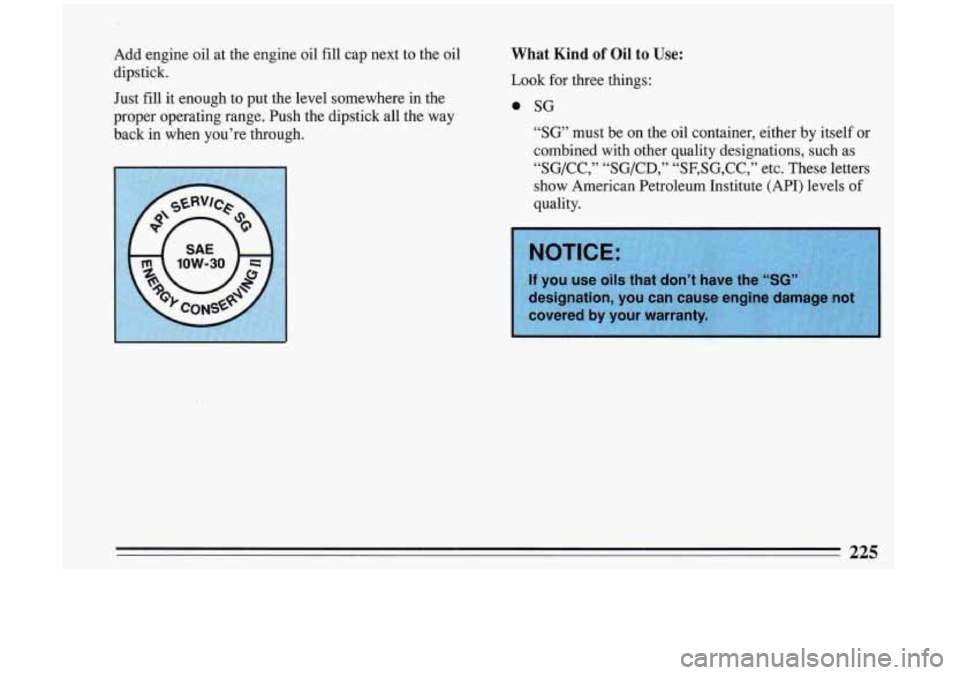
Add engine oil at the engine oil fill cap next to the oil
dipstick.
Just fill it enough to put the level somewhere in the
proper operating range. Push the dipstick all the way
back in when you’re through. What Kind of Oil to Use:
Look for three things:
. sc
“SG’ must be on the oil container, either by itself or
combined with other quality designations, such as
“SG/CC,” “SG/CD,” “SF,SG,CC,” etc. These letters \
show American Petroleum Institute (API) levels of
quality.
225
Page 228 of 324
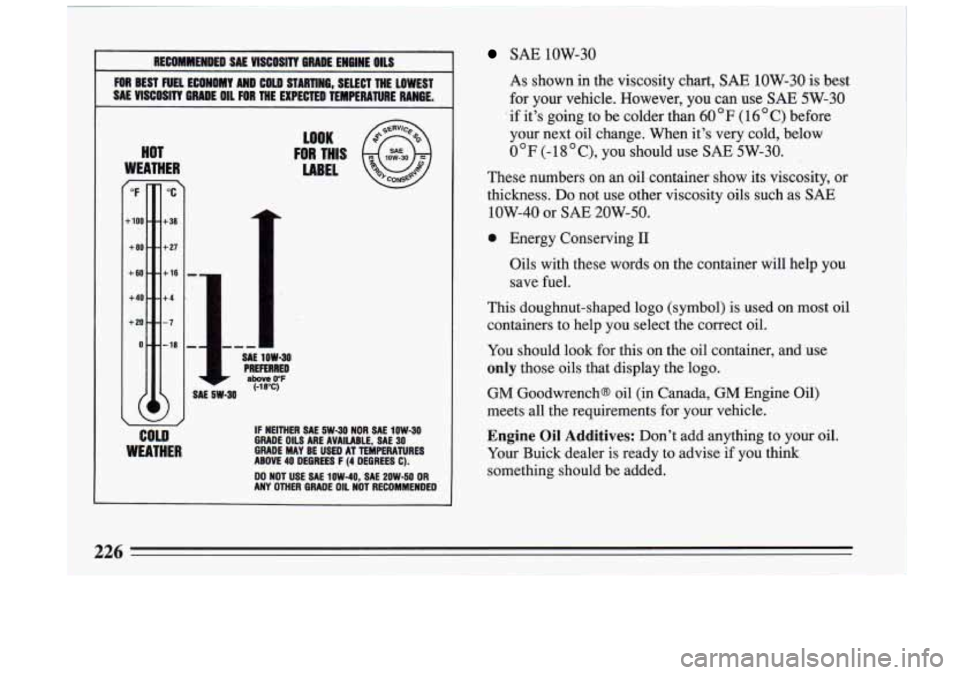
RECOMMENDED SAE VISCOSITY BRADE ENGINE: OILS
FOR BEST FUEL ECONOMY AND COW STARTlW6, SELECT THE LOWEST
SAE VISCOSITY GRADE OIL FOR THE EXPECTED TEMPERATURE RANGE.
HOT
WEATHER r
"F
-100 '
+a0 '
+60
+40
+20 '
7
"C
I +3a
. +27
,+16
+4
-7
- 18
WEATHER
LOOK
@
FOR THIS
LABEL $+';J
-- SAE T. 10W.30
PREFERRED above 0°F (-18°C)
IF NEITHER SAE 5W-30 NOR SAE 1OW-30
GRADE OILS ARE AVAILABLE, SAE 30
GRADE MAY BE USED AT TEMPERATURES
ABOVE
40 DEGREES F (4 DEGREES C).
DO NOT USE SAE
1OW-40, SAE 2OW-50 OR ANY OTHER GRADE OIL NOT RECOMMENDED
SAE 1OW-30
As shown in the viscosity chart, SAE 1OW-30 is best
for
your vehicle. However, you can use SAE 5W-30
' if it's going to be colder than 60 OF (16 C) before
your next oil change. When it's very cold, below
O*F (-18*C), you should use SAE 5W-30.
These numbers on an oil container show its viscosity, or
thickness.
Do not use other viscosity oils such as SAE
1OW-40 or SAE 20W-50.
0 Energy Conserving I1
Oils with these words on the container will help you
save fuel.
This doughnut-shaped logo (symbol) is used on most oil containers to help you select the correct oil.
You should look for this on the oil container, and use
only those oils that display the logo.
GM Goodwrench@ oil (in Canada, GM Engine Oil)
meets all the requirements for your vehicle.
Engine Oil Additives: Don't add anything to your oil.
Your Buick dealer is ready to advise
if you think
something should be added.
226
Page 229 of 324
When to Change Engine Oil: See if any one of these is
true for you:
Most trips are less than 4 miles (6 km).
a It’s below freezing outside and most trips are less
than
10 miles (16 km).
0 The engine is at low speed most of the time (as in
door-to-door delivery, or in stop-and-go traffic).
Most trips are through dusty places.
If any one of these is true for your vehicle, then you
need to change your oil and filter every
3,000 miles
(5 000 km) or 3 months -- whichever comes first.
If none of them is true, change the oil every 7,500 miles
(12
500 km) or 12 months -- whichever comes first.
Change the filter at the first oil change and at every
other oil change after that.
Engine Block Heater: An engine block heater can be a
big help if you have to park outside in very cold
weather, -20
OF (-29 C) or colder. If your vehicle has
this option, see ?Engine Block Heater”
in the Index.
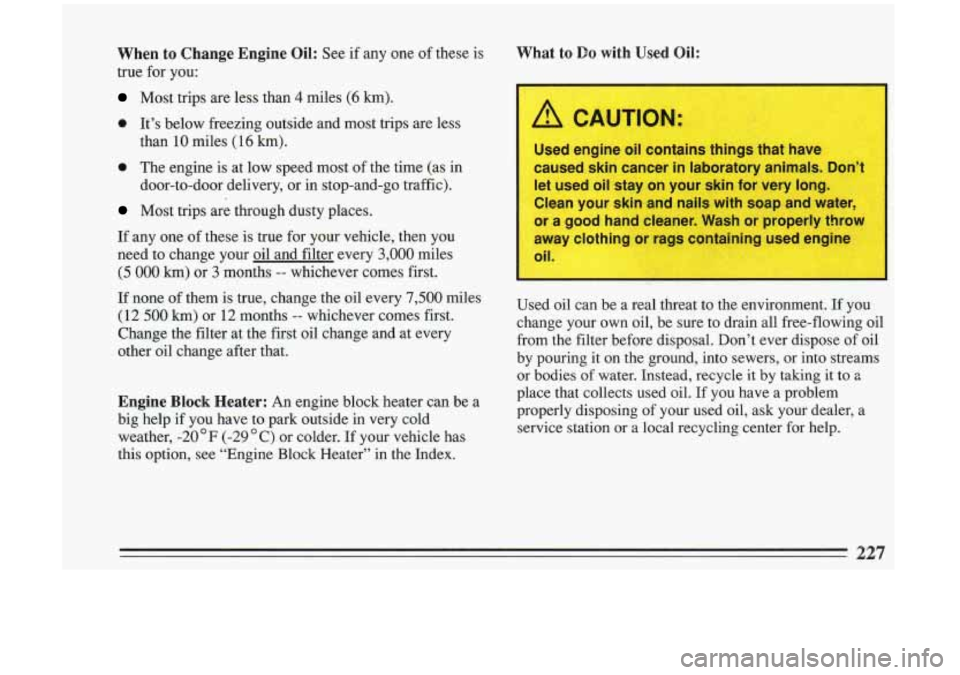
What to Do with Used Oil:
1
Used oil can be a real threat to the environment. If you
change your own oil, be
sure to drain all free-flowing oil
from the filter before disposal. Don’t ever dispose of oil
by pouring it on the ground, into sewers, or into streams
or bodies
of water. Instead, recycle it by taking it to 2
place that collects used oil. If you have a problem
properly disposing
of your used oil, ask your dealer, a
service station or a local recycling center for help.
227
Page 231 of 324
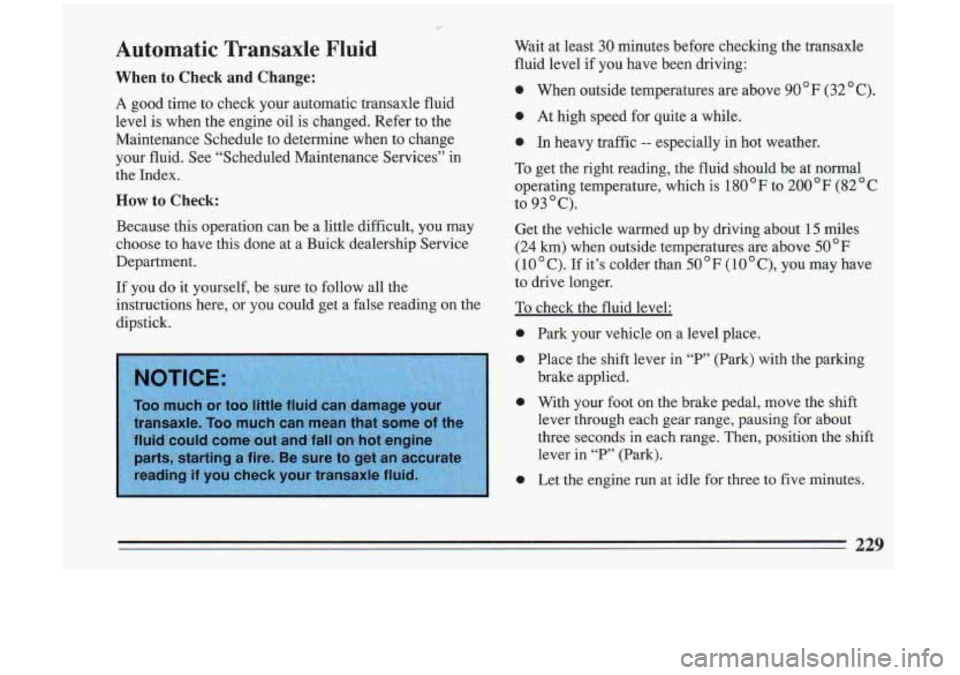
Automatic Transaxle Fluid
When to Check and Change:
A good time to check your automatic transaxle fluid
level is when the engine oil is changed. Refer to the
Maintenance Schedule to determine when
to change
your fluid. See “Scheduled Maintenance Services” in
the Index.
How to Check:
Because this operation can be a little difficult, you may
choose to have this done at a Buick dealership Service
Department.
If you do it yourself, be sure to follow all the
instructions here, or you could get a false reading on the
dipstick.
Page 233 of 324
are made especially for your automatic transaxle.
Damage caused by fluid other than
DEXRONs-IIE is
not covered by your new vehicle warranty.
After adding fluid, recheck the fluid level as
described under
“How to Check.”
When the correct fluid level is obtained, push the
dipstick back in all the way.
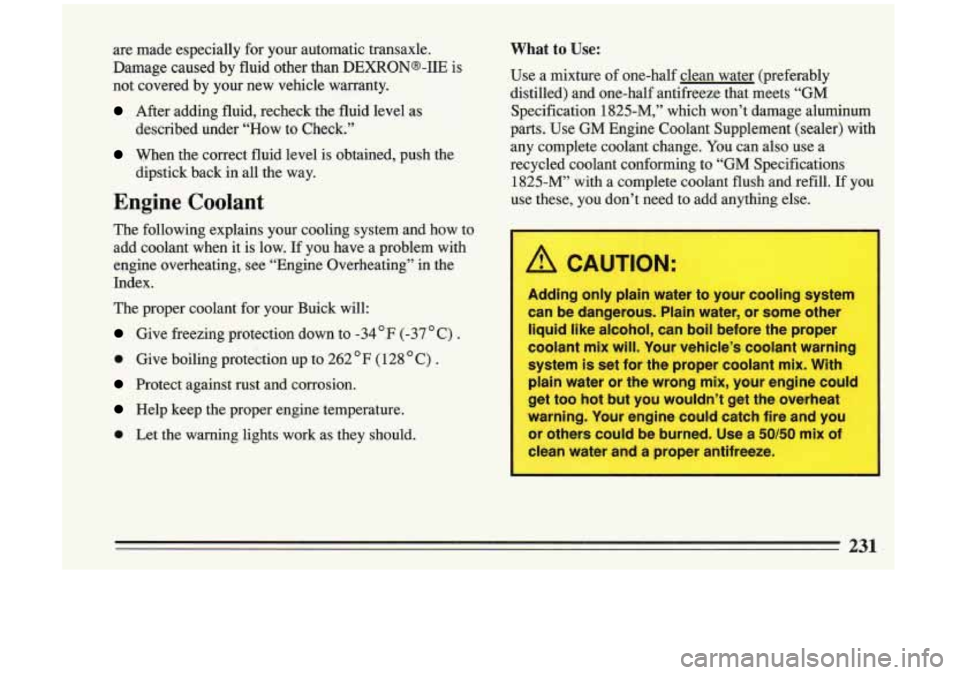
Engine Coolant
The following explains your cooling system and how to
add coolant when it is low. If you have a problem with
engine overheating, see “Engine Overheating” in the
Index.
The proper coolant for your Buick
will:
Give freezing protection down to -34’F (-37 ’ C) .
0 Give boiling protection up to 262 ’ F ( 128 ’ C) .
Protect against rust and corrosion.
Help keep the proper engine temperature.
0 Let the warning lights work as they should.
What to Use:
Use a mixture of one-half clean water (preferably
distilled) and one-half antifreeze that meets “GM Specification 1825-M,” which won’t damage aluminum
parts. Use GM Engine Coolant Supplement (sealer) with
any complete coolant change. You can also use a
recycled coolant conforming to “GM Specifications
1825-M” with a complete coolant flush and-refill.
If you
use these, you don’t need to add anything else.
Adding only plain water to your cooling system
can be dangerous. Plain water, or some other
liquid like alcohol, can boil before the proper
coolant mix will. Your vehicle’s coolant warnin!
system
is set for the proper coolant mix. With
plain water or the wrong mix, your engine coul
get
too hot but you wouldn’t get the overheat
warning. Your engine could catch fire and you
or others could be burned. Use a
50150 mix of
clean water and
a proper antifreeze.
231
Page 257 of 324
0 Shoe polish, wax crayon, tar and asphalt will stain if
left on a vehicle seat fabric. They should be removed
as
soon as possible. Be careful, because the cleaner
will dissolve them and may cause them to bleed.
Non-Greasy Stains: Like catsup, coffee (black), egg,
fruit, fruit juice, milk, soft drinks, wine: vomit, urine and
blood.
0. Carefully scrape off excess stain, then sponge the
If a stain remains, follow the foam-type instructions
If an odor lingers after cleaning vomit or urine, treat
soiled area with cool water.
above.
the area with a waterbaking soda solution:
1 teaspoon (5 ml) of baking soda to 1 cup (250 ml)
of lukewarm water.
Finally, if needed, clean lightly with solvent-type
Combination Stains: Like candy, ice cream,
mayonnaise, chili sauce and unknown stains.
Carefully scrape off excess stain, then clean with
If a stain remains, clean it with solvent-type cleaner.
cleaner.
cool water and allow to dry.
Cleaning Vinyl or Leather
Just use warm water and a clean cloth.
Rub with a clean, damp cloth to remove dirt.
You
Things like tar, asphalt and shoe polish will stain if may have to do it more than once.
you don't get 'them
off quickly. Use a clean cloth and
solvent-type vinylfieather cleaner.
Cleaning the Top of the Instrument
Panel
Use only 'mild soap and water to clean the top surfaces
of the instrument panel. Sprays containing silicones
or
waxes may cause annoying reflections in the windshield
and even make it difficult to see through the windshield
under certain conditions.
255
Page 260 of 324
Weatherstrips
-These are places where glass or metal meets rubber.
Silicone grease there will make them last longer, seal
better, and not squeak. Apply silicone grease with a
clean cloth at least every six months.
Sheet Metal Damage
.If your vehicle is damaged and requires sheet metal
.repair or replacement, make sure the body repair shop
: applies anti-corrosion material to the parts repaired or
replaced to restore corrosion protection.
-Foreign Material
Calcium chloride and other salts, ice melting agents,
road oil and tar, tree sap, bird droppings, chemicals from industrial chimneys, and other foreign matter can
damage your vehicle’s finish if they remain on painted
surfaces. Use cleaners that are marked safe for painted
surfaces for these stains.
Finish Damage
Any stone chips, fractures or deep scratches in the finish
should be repaired right away. Bare metal will corrode
quickly and may develop into a major repair expense. Minor chips and scratches can be repaired with touch-up
materials available fi-om your dealer
or other service
outlets. Larger areas of finish damage can be corrected
in your dealer’s body and paint shop.
Underbody Maintenance
Chemicals used for ice and snow removal and dust
control can collect
on the underbody. If these are not
removed, accelerated corrosion (rust) can occur on the Underbody parts such as fuel lines, frame, floor pan, and
exhaust system even though
they have corrosion
protection.
At least every spring, flush these materials from the
underbody with plain water. Clean any areas where mud
and other debris can collect. Dirt packed in closed areas
of the frame should be loosened before being flushed.
Your dealer or an underbody vehicle washing system
can do this for you.
Page 272 of 324
IMPORTANT:
KEEP ENGINE OIL
AT THE PROPER
LEVEL AND CHANGE AS
RECOMMENDED
This part covers the maintenance required for your Buick. Your vehicle needs these services to retain its
safety, dependability and emission control performance.
Plan
Have you purchased the GM Protection Plan? The
Plan supplements your new vehicle warranties. See
your Buick dealer for details.
Introduction
A Word About Maintenance
We at General Motors want to help you keep your
vehicle in good working condition. But we don't know
exactly how you'll drive it. You may drive very short
distances only a few times a week.
Or you may drive
long distances all the time in very hot, dusty weather.
You may use your vehicle in making deliveries. Or you
may drive it to work, to do errands or in many other
ways.
Because of all the different ways people use their GM
vehicles, maintenance needs vary. You may even need
more frequent checks and replacements than you
will
find in the schedules in this part. So please read this part
and note how you drive.
If you have any questions on
how to keep your vehicle in good condition, see your Buick dealer, the place many GM owners choose to
have their maintenance work done. Your dealer can be
relied upon to use proper parts and practices.
Page 276 of 324
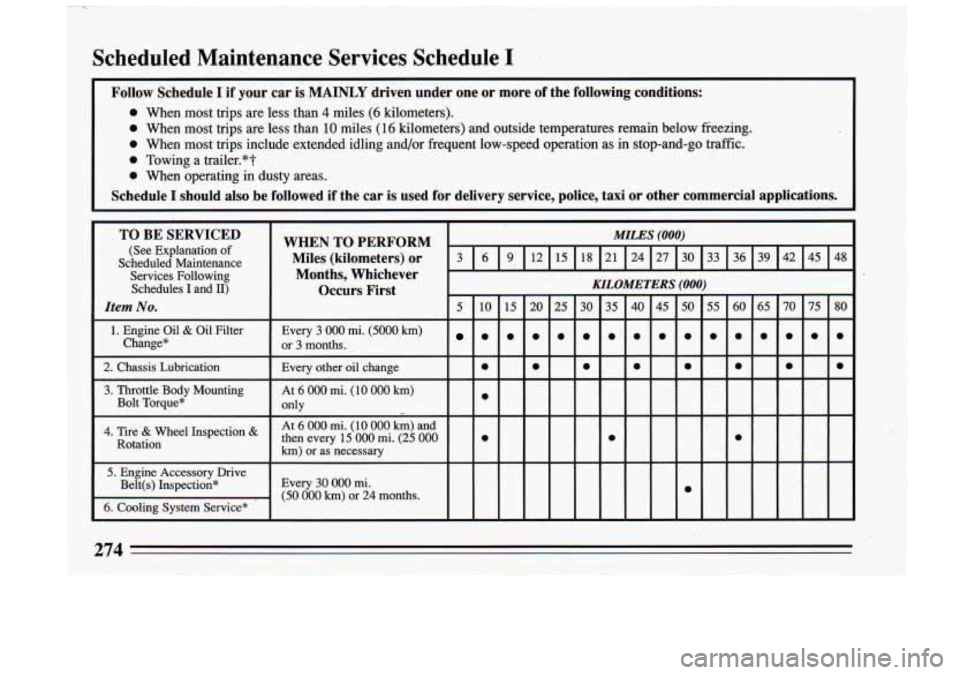
Scheduled Maintenance Services Schedule I
Follow Schedule I if your car is MAINLY driven under one or more of the following conditions:
0 When most trips are less than 4 miles (6 kilometers).
0 When most trips are less than 10 miles (16 kilometers) and outside temperatures remain below fieezing.
0 When most trips include extended idling and/or frequent low-spee\
d operation as in stop-and-go traffic.
0 Towing a trailer.*?
0 When operating in dusty areas.
Schedule I should also be followed if the car is used for delivery service, police, taxi or other commercial applications.
TO BE SERVICED
(See Explanation of
Scheduled Maintenance
Services Following
Schedules
I and n)
Item No.
1. Engine Oil & Oil Filter
Change*
2. Chassis Lubrication
3. Throttle Body Mounting
Bolt Torque*
4. Tire
& Wheel Inspection &
Rotation
5. Engine Accessory Drive Belt(s) Inspection*
6. Cooling System Service*
WHEN TO PERFORM
Miles (kilometers) or Months, Whichever MILES (000)
Occurs First
k
Every 3 000 mi. (5000 km)
or 3 months. , I
Every other oil change
At
6 000 mi. (10 000 km)
only
I
At 6 000 mi. (10 000 km) and
then every
15 000 mi. (25 000
km) or as necessary I
Every 30 000 mi.
(50 000 km) or 24 months.
KILOMETERS (000)
30 35
00
0
0
..
45 50 55
000
0
0
65 70
00
0
274