steering BUICK RIVIERA 1993 User Guide
[x] Cancel search | Manufacturer: BUICK, Model Year: 1993, Model line: RIVIERA, Model: BUICK RIVIERA 1993Pages: 324, PDF Size: 16.01 MB
Page 163 of 324
0
0
0 0
0
Don’t overtake a slowly moving vehicle too rapidly.
Even though the brake lights are not flashing, it may
be slowing down
or starting to turn.
If you’re being passed, make it easy for the
following driver to get ahead
of you. Perhaps you
can ease a little to the right.
Loss of Control
Let’s review what driving experts say about what
happens when the thee control systems (brakes, steering
and acceleration) don’t have enough friction where the
tires meet the road to do what the driver has asked.
In any emergency, don’t give up. Keep trying to steer
and constantly seek an escape route or area
of less
danger.
Skidding
In a skid, a driver can lose control of the vehicle.
Defensive drivers avoid most skids by taking reasonable
care suited to existing conditions, and by not
“overdriving” those conditions. But skids are always
possible.
The three types of skids correspond to your Buick’s
three control systems. In the braking skid your wheels aren’t rolling. In the steering or cornering skid, too
Page 164 of 324
much speed or steering in a curve causes tires to slip and
lose cornering force. And in the acceleration skid too
much throttle causes the driving wheels to spin.
A cornering skid and an acceleration skid are best
handled by easing your foot
off the accelerator pedal.
If your vehicle starts to slide (as when you turn a corner
on a wet, snow- or ice-covered road), ease your foot
off
the acceleratorpedal as soon as you feel the vehicle start
to slide. Quickly steer the way you want the vehicle to go. If you
start steering quickly enough, your vehicle
will straighten out.
As it does, straighten the front
wheels.
Of course, traction is reduced when water, snow, ice,
gravel,
or other material is on the road. For safety, you’ll
want to slow down and adjust your driving to these
conditions. It is important to slow down on slippery
surfaces because stopping distance will be longer and
vehicle control more limited.
While driving on a surface with reduced traction,
try
your best to avoid sudden steering, acceleration, or
braking (including engine braking by shifting to a lower
gear). Any sudden changes could cause the tires to slide.
You may not realize the surface is slippery until your
vehicle is skidding. Learn to recognize warning clues
--
such as enoughewater, ice or packed snow on the road to make
a “mirrored surface” -- and slow down when you
have any doubt.
Remember: Any anti-lock braking system
(ABS) helps
avoid only the braking skid. Steer the way you want to
go.
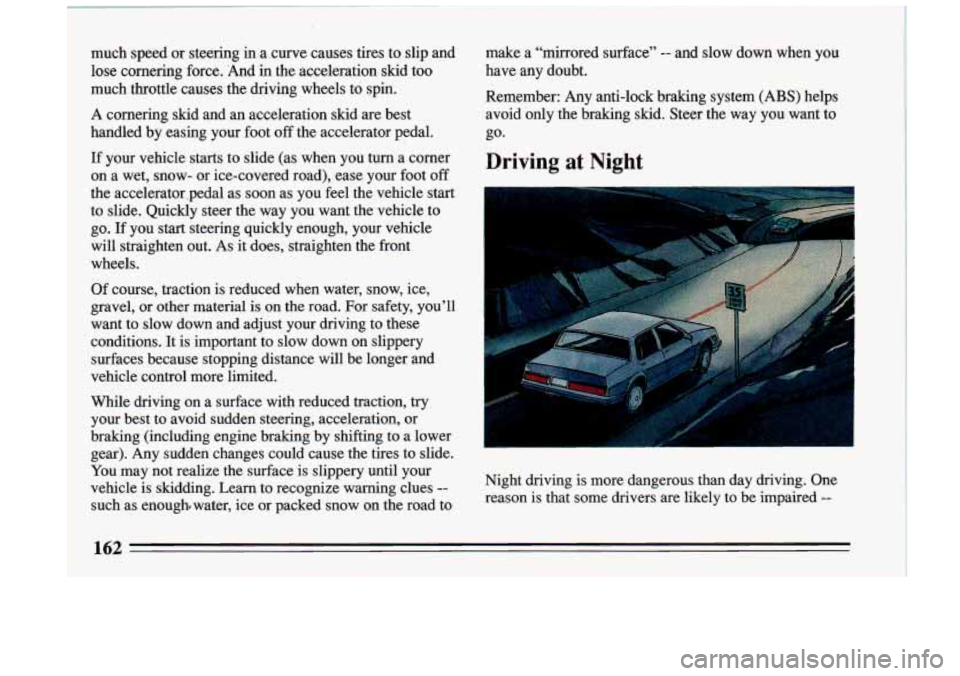
Driving at Night
Night driving is more dangerous than day driving. One reason
is that some drivers are likely to be impaired --
162
I
Page 182 of 324
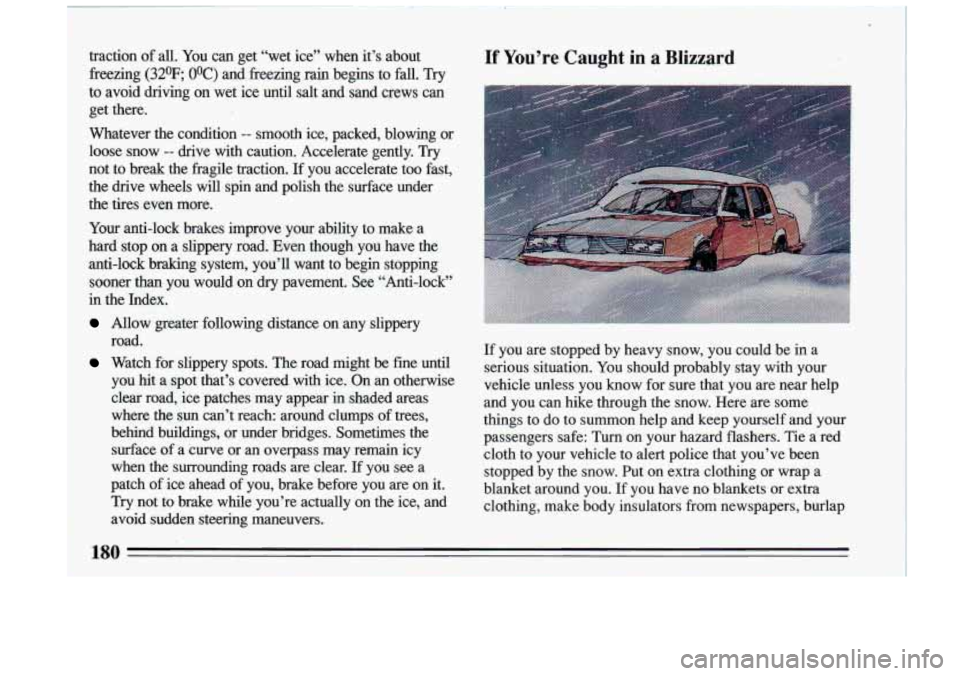
traction of all. You can get “wet ice” when it’s about If You’re Caught in a Blizzard
freezing (32oF; O°C) and freezing rain begins to fall. Try
to avoid driving on wet ice until salt and sand crews can
get there. Y
. . ._ . . .
Whatever the condition -- smooth ice, packed, blowing or
loose snow
-- drive with caution. Accelerate gently. Try
not to break the fragile traction. If you accelerate too fast,
the drive wheels will spin and polish the surface under
the tires even more.
Your anti-lock brakes improve your ability to make a
hard stop on a slippery road. Even though you have the
anti-lock braking system, you’ll want to begin stopping sooner than you would on
dry pavement. See “Anti-lock”
in the Index.
Allow greater following distance on any slippery
road.
Watch for slippery spots. The road might be fine until
you hit a spot that’s covered with ice. On an otherwise
clear road, ice patches may appear
in shaded areas
where the
sun can’t reach: around clumps of trees,
behind buildings, or under bridges. Sometimes the
surface of a curve or an overpass may remain icy
when the surrounding roads are clear.
If you see a
patch
of ice ahead of you, brake before you are on it.
Try not to brake while you’re actually on the ice, and
avoid sudden steering maneuvers.
180
Page 194 of 324
/! CA TlON:
To help-avok rjury to you or others:
Never let passengers ride in a vehicle that I
Never tow fastt than safe or postec
Never tow ith damaged parts not fully
Never get under your vehicle after it has
Always use separate safety chains on
is being towed.
speec
secured.
been lifted by the tow truck.
each.side when towing a vehicle.
CAUTION: (Continued)
CAUTION: (Continued)
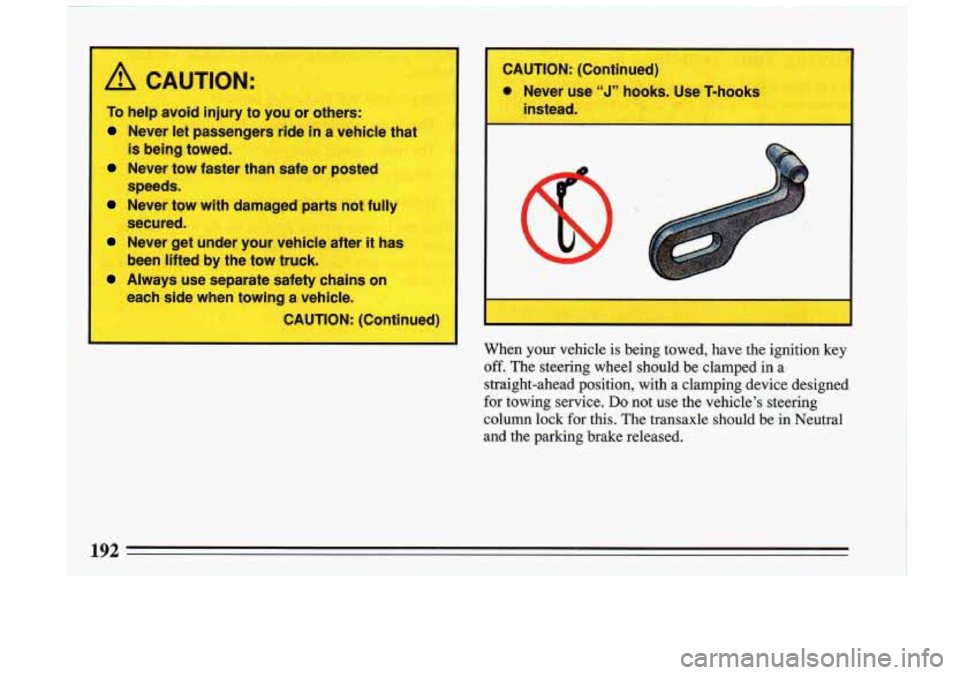
0 Never use “J” hooks. Use T-hooks
instead.
When your vehicle is being towed, have the ignition key off. The steering wheel should be clamped in a.
straight-ahead position, with a clamping device designed
for towing service.
Do not use the vehicle’s steering
column lock for this. The transaxle should be in Neutral
and the parking brake released.
192
Page 206 of 324
I
8.
If a Tire Goes Flat
It’s unusual for a tire to “blow out” while you’re driving,
especially if you maintain your tires properly.
If air goes
out of a tire, it’s much more likely to lepk out slowly.
But if you should ever have a “blowout,” here are a few\
tips about what to expect and what to do:
If a front tire fails, the flat tire will create a drag that
pulls the vehicle toward that side. Take your foot
off the
accelerator pedal and grip the steering wheel firmly.
Steer to maintain lane position, then gently brake to a
stop well out of the traffic lane.
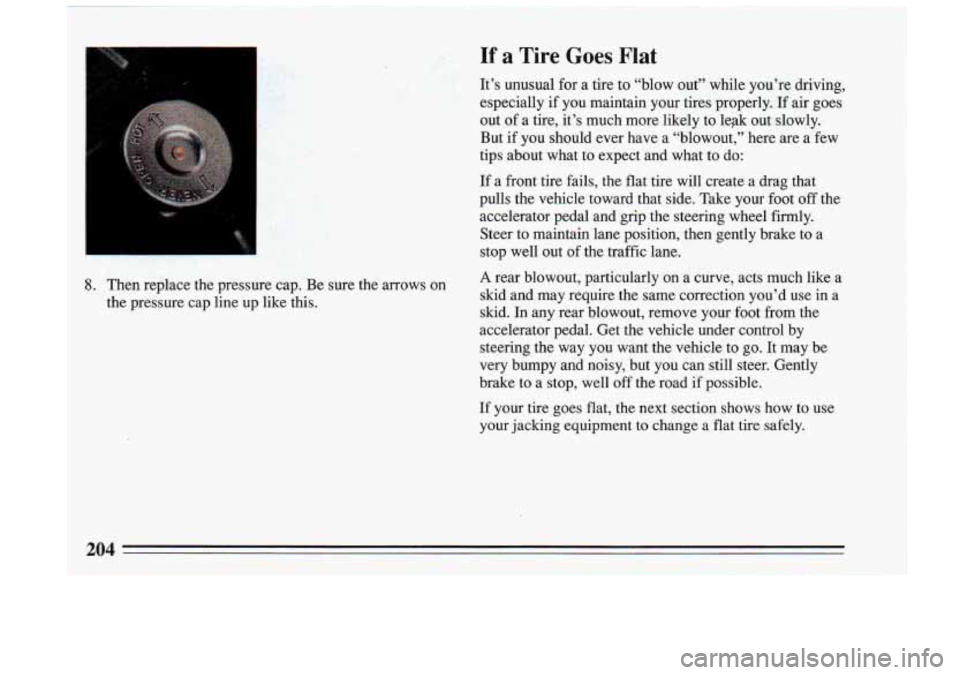
Then replace the pressure cap. Be sure the arrows on
the pressure
cap line up like this.
A rear blowout, particularly on a curve, acts much like a
skid and may require the same correction you’d use in
a
skid. In any rear blowout, remove your foot from the
accelerator pedal. Get the vehicle under control by
steering the way you want the vehicle
to go. It may be
very bumpy and noisy, but you can still steer. Gently
brake to a stop, well
off the road if possible.
If your tire goes flat, the next section shows how to use
your jacking equipment to change a flat tire safely.
204
____
Page 236 of 324
i Power Steering Fluid I
What to Add:
Refer to the Maintenance Schedule to determine what
kind
of fluid to use. See “Recommended Fluids and
Lubricants”
in the Index.
I
i
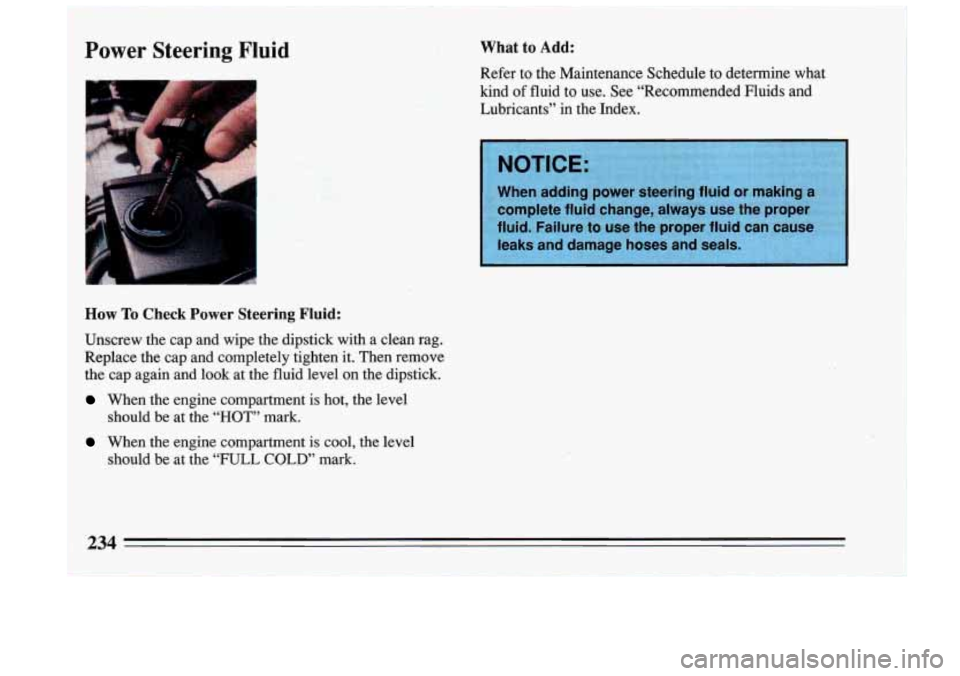
How To Check Power Steering Fluid:
~ Unscrew the cap and wipe the dipstick with a clean rag.
: Replace the cap and completely tighten it. Then remove
~ the cap again and look at the fluid level on the dipstick.
When the engine compartment is hot, the level
When the engine compartment is cool, the level should be
at
the “HOT” mark.
should be at the
“FULL COLD” mark.
I
Page 288 of 324
I
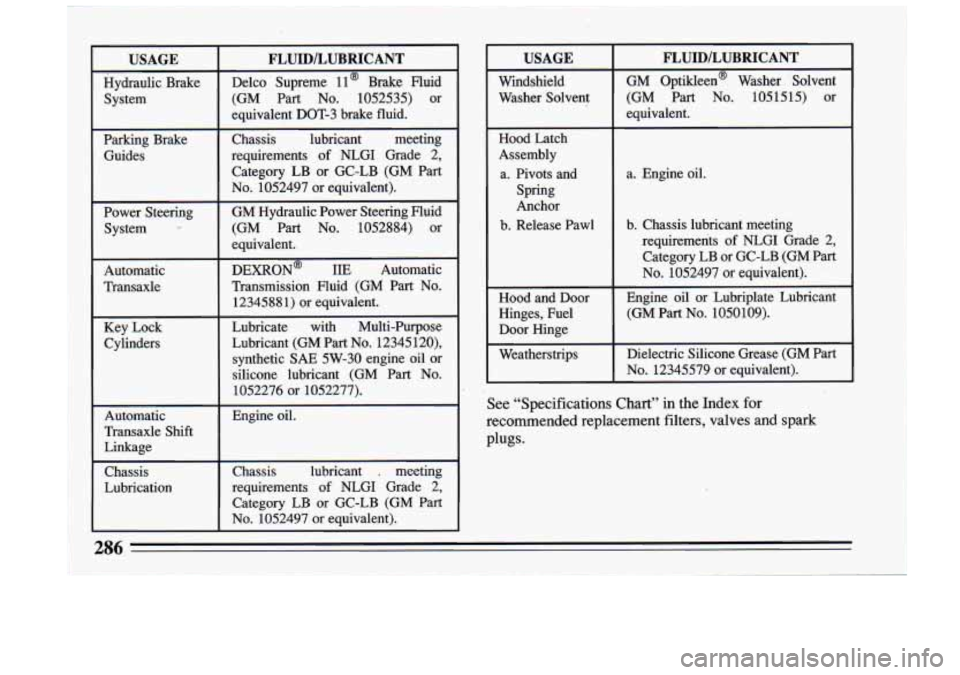
USAGE I FLUID/LUBRICANT
Hydraulic Brake Delco Supreme ll@ Brake Fluid
System (GM Part No. 1052535) or
Parking Brake Chassis lubricant meeting Guides requirements
of NLGI Grade 2,
Category LB or GC-LB (GM Part
No. 1052497 or equivalent).
Power Steering GM Hydraulic Power Steering Fluid System
- (GM Part No. 1052884) or
equivalent
DOT-3 brake fluid.
equivalent.
Automatic
Transaxle
1
Key Lock
Cylinders
DEXFtON@ IIE Automatic
Transmission Fluid (GM Part No. 1234588 1) or equivalent.
Lubricate with Multi-Purpose
Lubricant (GM Part
No. 12345 120),
synthetic
SAE 5W-30 engine oil or
silicone lubricant (GM Part
No.
1052276 or 1052277).
Automatic Engine oil.
Transaxle Shift Linkage ~ ~~~
Chassis
Lubrication Chassis lubricant . meeting
requirements
of NLGI Grade 2,
Category LB
or GC-LB (GM Part
No. 1052497 or equivalent).
USAGE
Windshield
Washer Solvent
Hood Latch Assembly
a. Pivots and Spring
Anchor
b. Release Pawl
Hood and Door
Hinges, Fuel Door Hinge
Weatherstrips
FLUIDLUBRICANT
GM Optikleen@ Washer Solvent
(GM Part No. 1051515) or
equivalent.
a. Engine oil.
b. Chassis lubricant meeting
requirements
of NLGI Grade 2,
Category LB or GC-LB (GM Part
No. 1052497 or equivalent).
Engine oil or Lubriplate Lubricant (GM Part No. 1050109).
Dielectric Silicone Grease (GM Part
No. 12345579 or equivalent).
See “Specifications Chart” in the Index for
recommended replacement filters, valves and
spark
plugs.
286
Page 299 of 324
Part 9 Index
I
I
Acc (Ignition Key Position) ........................ 72
Accessory Power. Retained
......................... 83
Adding Brake Fluid
.................................. 236
Coolant
.............................. 199.202. 23 1
Electrical Equipment
.......................... 125
Power Steering Fluid
.......................... 234
Transaxle/Transmission Fluid
.................... 229
Windshield Washer Fluid
....................... 235
Additives. Engine Oil
............................. 226
Adjustment. Brake
............................... 157
Adult Safety Belt Usage
............................ 26
AirBag
......................................... 32
Aircleaner
..................................... 228
Airconditioner
................................. 119
Airoutlets
..................................... 118
Airsystem
..................................... 118
Alcohol. Driving Under the Influence of
.............. 148
Alcohol in Gasoline
.............................. 2 17
Aluminum Wheels. Cleaning
....................... 257
AM Radio Reception
............................. 124
Engineoil
................................... 224
. ..
K . . B
AM Stereo Radio Reception ....................... 124
Antenna
....................................... 137
Antifreeze
...................................... 231
Antilock Brake System
........................... 154
Anti-Theft Tips
................................... 66
Appearance Care
................................ 252
Armrest Storage
................................. 104
Astroroof
...................................... 102
Audio Systems
.................................. 124
Automatic Door Locks
............................. 63
Automatic Pull-Down Feature
....................... 64
Automatic Overdrive
.............................. 77
Automatic Transaxle
.............................. 75
Automatic Transaxle Fluid
......................... 229
Automatic Transaxle Torque Lock
................... 178
Antilock Braking System Warning Light
.............. 112
Appearance Care and Maintenance Materials
.......... 260
Ashtrays
....................................... 103
Baby. Holding a
................................. 44
Battery
........................................ 237