tow BUICK RIVIERA 1993 User Guide
[x] Cancel search | Manufacturer: BUICK, Model Year: 1993, Model line: RIVIERA, Model: BUICK RIVIERA 1993Pages: 324, PDF Size: 16.01 MB
Page 173 of 324
Just before you leave the lane, glance quickly over your
shoulder to make sure there isn’t another vehicle in your
“blind” spot.
If you are moving from an outside to a center lane on a
freeway having more than two lanes, make sure another
vehicle isn’t about to move into the same spot. Look at
the vehicles two lanes over and watch for telltale signs:
turn signals flashing, an increase in speed,
or moving
toward the edge of the lane. Be prepared to delay your
move.
Once you are moving on the freeway, make certain you
allow a reasonable following. distance. Expect to move
slightly slower at night.
Leaving the Freeway
When you want to leave the freeway, move to the proper
lane well in advance. Dashing across lanes at the last
minute is dangerous.
If you miss your exit do not, under
any circumstances, stop and back up. Drive on to the
next exit.
At each exit point is a deceleration lane. Ideally it
should be long enough for you to enter it at freeway
speed (after signaling, of course) and then do your
braking before moving onto the exit ramp.
Unfortunately, not all deceleration lanes are long enough
-- some are too short for all the braking. Decide when to
start braking. If you must brake on the through lane, and
if there is traffic close behind you, you can allow a little \
extra time and flash your brake lights (in addition to
your turn signal) as extra warning that you are about to
slow down and exit.
The exit ramp can be curved, sometimes quite sharply.
The exit spwd is usually posted. Reduce your speed
according to your speedometer, not to your sense of
motion. After driving for any distance at higher speeds,
you may tend to think you are going slower than you
actually are. For example,
40 mph (65 h/h) might
seem like only
20 mph (30 km/h). Obviously, this. could
lead to serious trouble on a ramp designed for
20 mph
(30 km/h)!
Driving a Long Distance
Although most long trips today are made on freeways,
there are still many made
on regular highways.
Long-distance driving on freeways and regular
highways is the same in some ways. The
trip has to be
planned and the vehicle prepared, you drive at
higher-than-city speeds, and there are longer
turns
behind the wheel. You’ll enjoy your trip more if you and
your vehicle are in good shape. Here are some tips for
a
successful long trip.
171
Page 176 of 324
If you drive regularly in steep country, or if you're
planning to visit there, here are some tips that can make
your trips safer and more enjoyable.
0 Keep your vehicle in good shape. Check all fluid
levels and also the brakes, tires, cooling system and
transaxle. These parts can work hard on mountain
roads.
@ Know how to go down hills. The most important
thing to know
is thisi let your engine do some of the
slowing down. Don't make your brakes do it all.
Shift to a lower gear when you go down a steep or
long
hill. That way, you will slow down without
excessive use of your brakes.
If you don't shift down, your brakes could get
11 so hot that they wouldn't work well. You would
then have poor braking
or even none going
down a
hill. You could crash. Shift down to let
your engine assist your brakes on a steep
,!~~~~~~~~~~~,~~*~~-~~~~ ,-d:;,,~~,."c.~,-~.:'-- ~i~-~zg352~;~g~~g d 0 w n h i I I sf 0 pe . li,,,,~a,,.>~?&:.
I
I
I
0
/d CAUTION:
Coasting downhill in "N" (Neutral) or with the
ignition off is dangerous. Your brakes will have
to do all the work of slowing down. They could
get
so hot that they wouldn't work well. You
could crash. Always have your engine running
and your vehicle
in gear -]en you go downhill.
Know how to go uphill. You may want to shift down
to a lower gear. The lower gears help cool
your
engine and transaxle, and you can climb the hill
better.
Stay in your own lane when driving on two-lane
roads in hills or mountains. Don't swing wide or cut
across the center of the road. Drive at speeds that let
you stay in your own lane. That way, you won't be
surprised by a vehicle coming toward you
in the
same lane.
It takes longer to pass another vehicle when you're going uphill. You'll want
to leave extra room to pass.
If a vehicle is passing you and doesn't have enough
room, slow down to make it easier for the other
vehicle to get by.
Page 193 of 324
Towing Your Vehicle Before you do anything, turn on the hazard warning
flashers.
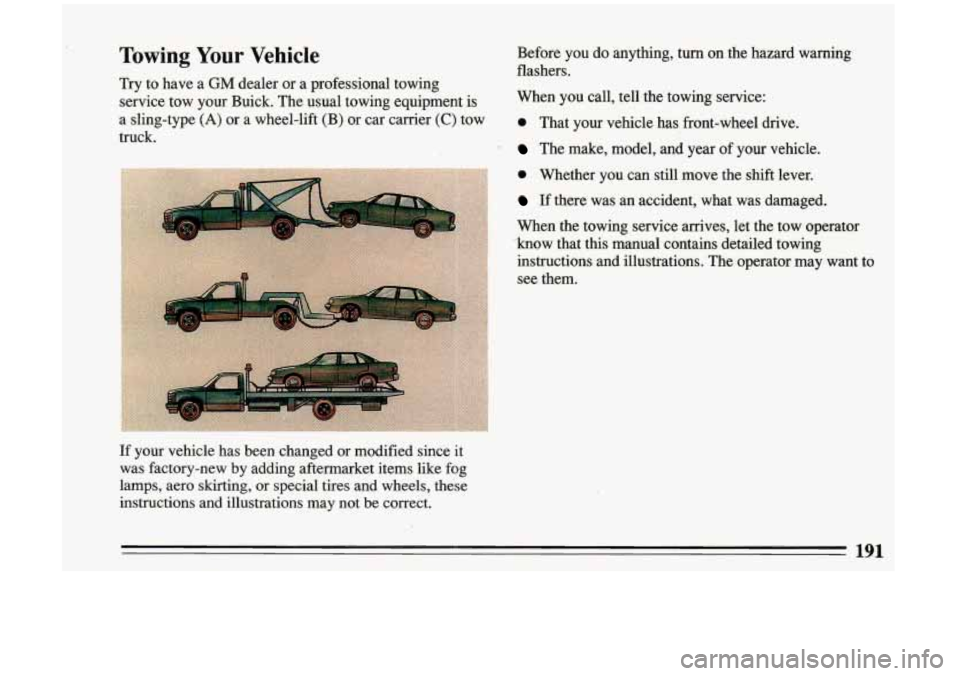
Try to have a
GM dealer or a professional towing
service tow your Buick. The usual towing equipment is When you call, tell the towing service:
a sling-type
(A) Or a wheel-lift (B) Or Car carrier (c) tow 0 That your vehicle has front-wheel drive.
truck.
. The make, model, and year of your vehicle.
If your ‘vehicle has been changed or modified since it
was factory-new by adding aftermarket items like fog
lamps, aero skirting,
or special tires and wheels, these
instructions and illustrations may not be correct.
0 Whether you can still move the shift lever.
If there was an accident, what was damaged.
When the towing service arrives, let the tow operator
-know that this manual contains detailed towing instructions and illustrations. The operator may want to
see them.
191
Page 194 of 324
/! CA TlON:
To help-avok rjury to you or others:
Never let passengers ride in a vehicle that I
Never tow fastt than safe or postec
Never tow ith damaged parts not fully
Never get under your vehicle after it has
Always use separate safety chains on
is being towed.
speec
secured.
been lifted by the tow truck.
each.side when towing a vehicle.
CAUTION: (Continued)
CAUTION: (Continued)
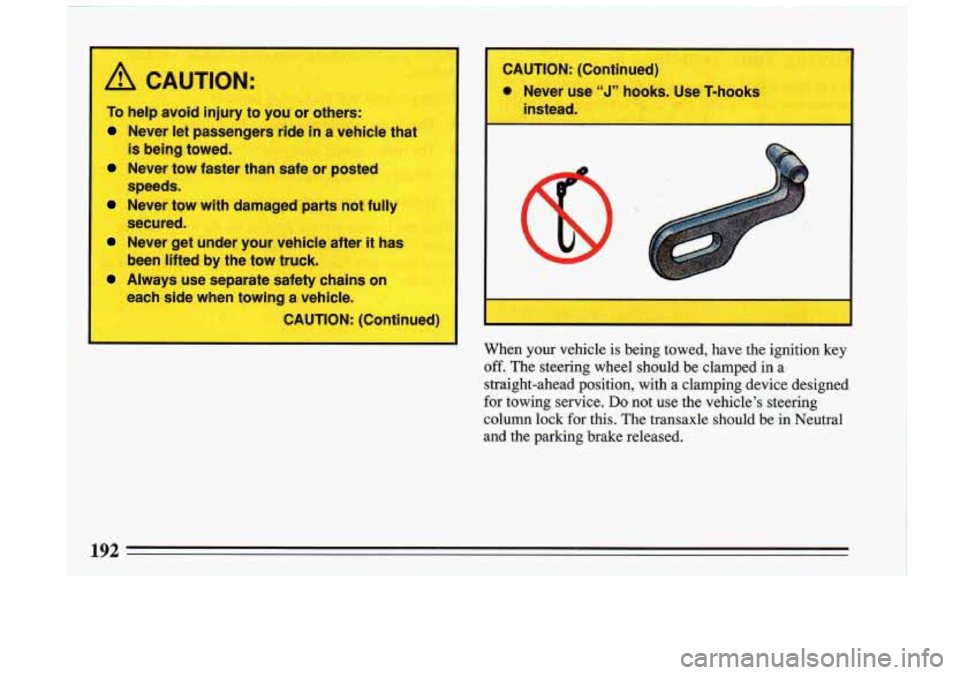
0 Never use “J” hooks. Use T-hooks
instead.
When your vehicle is being towed, have the ignition key off. The steering wheel should be clamped in a.
straight-ahead position, with a clamping device designed
for towing service.
Do not use the vehicle’s steering
column lock for this. The transaxle should be in Neutral
and the parking brake released.
192
Page 195 of 324
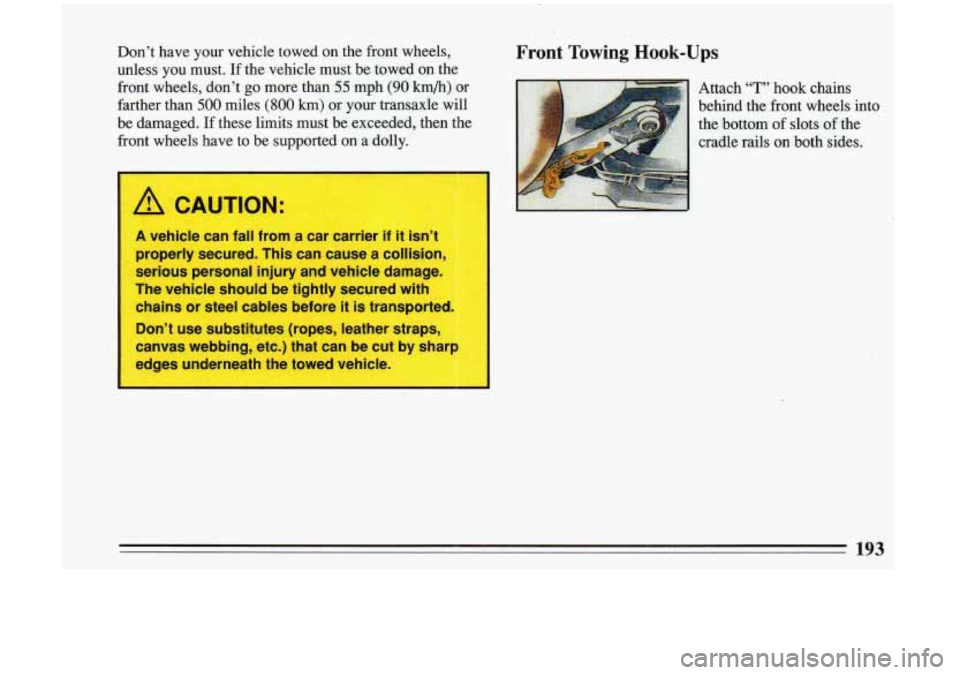
A CAUTION:
t
A vehicle can fall from a car carrier if it isn’t
properly secured. This can cause a collision,
serious personal injury and vehicle damage.
The vehicle should be tightly secured with
chains or steel cables before it is transported.
Don’t use substitutes (ropes, leather straps,
canvas webbing, etc.) that can be cut by sha
.
edges underneath the towed vehicle.
193
Page 206 of 324
I
8.
If a Tire Goes Flat
It’s unusual for a tire to “blow out” while you’re driving,
especially if you maintain your tires properly.
If air goes
out of a tire, it’s much more likely to lepk out slowly.
But if you should ever have a “blowout,” here are a few\
tips about what to expect and what to do:
If a front tire fails, the flat tire will create a drag that
pulls the vehicle toward that side. Take your foot
off the
accelerator pedal and grip the steering wheel firmly.
Steer to maintain lane position, then gently brake to a
stop well out of the traffic lane.
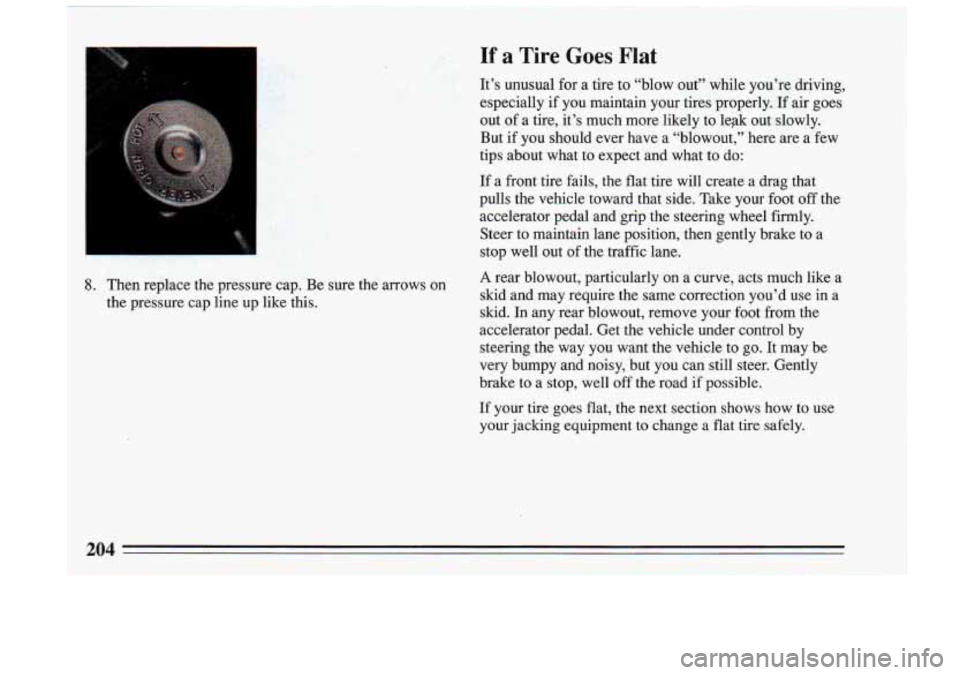
Then replace the pressure cap. Be sure the arrows on
the pressure
cap line up like this.
A rear blowout, particularly on a curve, acts much like a
skid and may require the same correction you’d use in
a
skid. In any rear blowout, remove your foot from the
accelerator pedal. Get the vehicle under control by
steering the way you want the vehicle
to go. It may be
very bumpy and noisy, but you can still steer. Gently
brake to a stop, well
off the road if possible.
If your tire goes flat, the next section shows how to use
your jacking equipment to change a flat tire safely.
204
____
Page 211 of 324
A CAUTION:
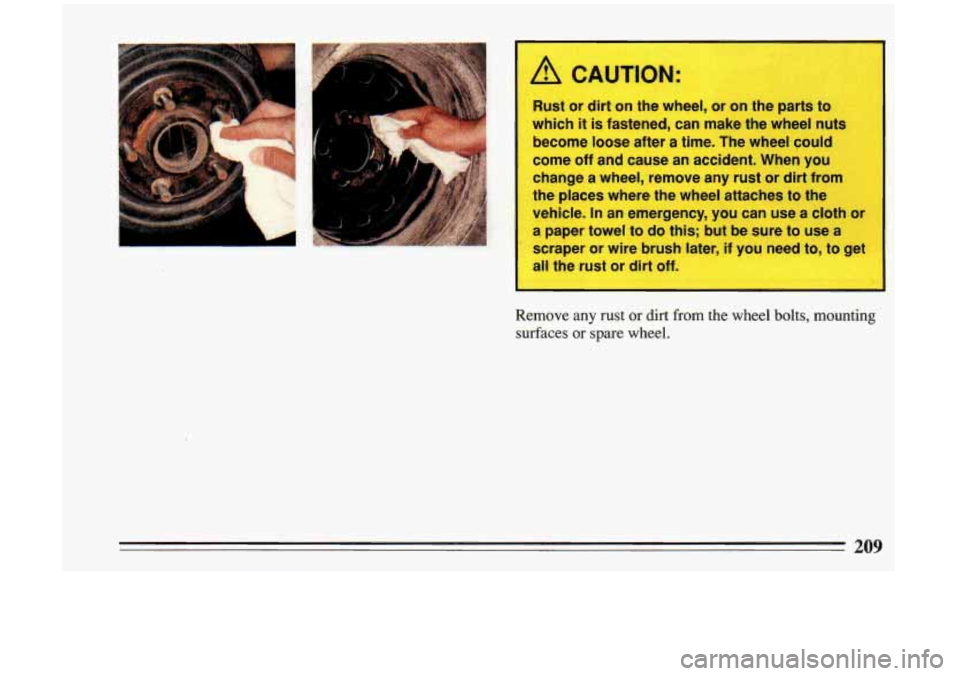
Rust or dirt on the wheel, or on the parts to
which it
is fastened, can make the wheel nuts
become loose after
a time. The wheel could
come off and cause an accident. When you
change a wheel, remove any rust or dirt from
the places where the wheel attaches to the
vehicle.
In an emergency, you can use a cloth or
a paper towel to do this; but be sure to use a
scraper or wire brush later, if you need to, to get
all the rust or dirt off.
Remove any rust or dirt from the wheel bolts, mounting
surfaces or spare wheel.
Page 212 of 324
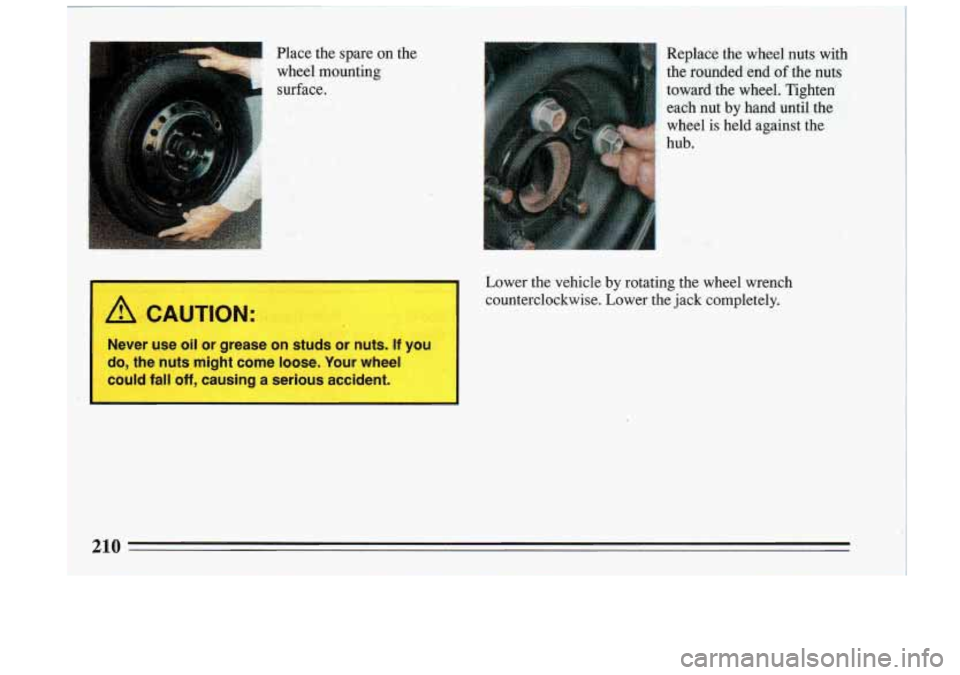
I Place the spare on the
wheel
.mounting
surface.
' Replace the wheel nuts with
the rounded-end of the nuts
toward the wheel. Tighten'
each nut by hand
until the
wheel
is held against the ' -
hub.
, counterclockwise. Lower the jack completely.
Lower the vehicle
by rotating the wheel wrench
/r CAUTIO'N:
Never use ail or grease on studs 1 nuts. If you
d,o, the nuts might !corne l~oose. Your w,heel
muld fall 'off, causing a serious accident.
Page 226 of 324
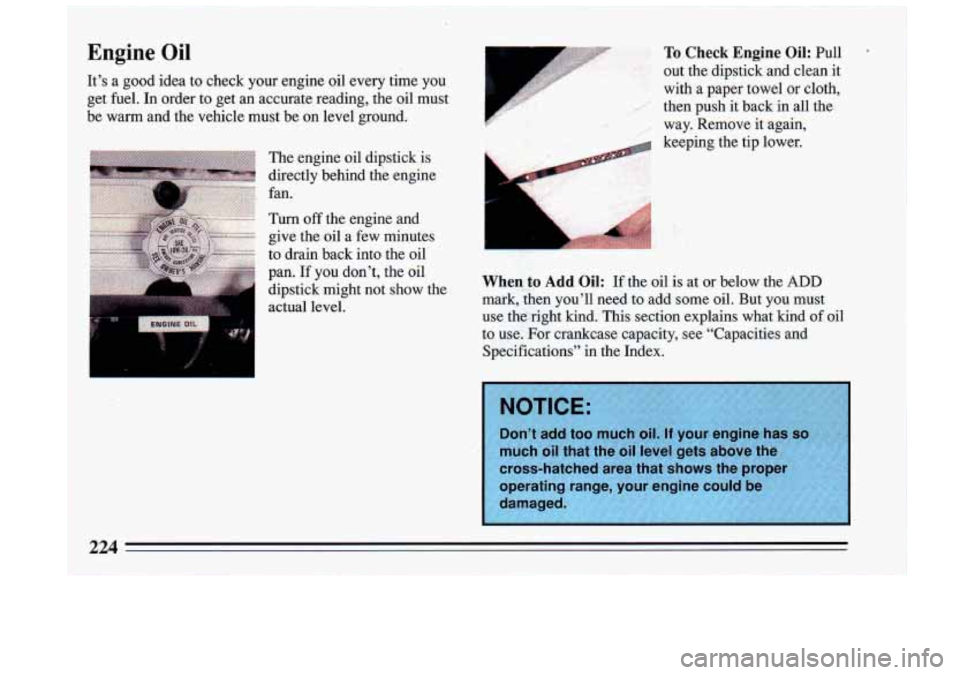
Engine Oil
It’s a good idea to check your engine oil every time you
get fuel.
In order to get an accurate reading, the oil must
be warm and the vehicle must be on level ground.
The engine
oil dipstick.is
directly behind the engine
fan..
Turn off the engine and
give the oil a
few minutes
to drain back into the oil
pan.
If you don’t, the oil
dipstick might not show the
actual level.
To Check Engine Oil: Pull ’
1 out the dipstick and clean it
with a paper towel or cloth,
I.ii’ ” then push it back in all the
.. , way. Remove it again,
When to Add Oil: If the oil is at or below the ADD
mark, then you’ll need to add some oil. But you must
use tlwright kind. This section explains what kind
of oil
to use. For crankcase capacity, see “Capacities and
Specifications”
in the Index.
Page 232 of 324
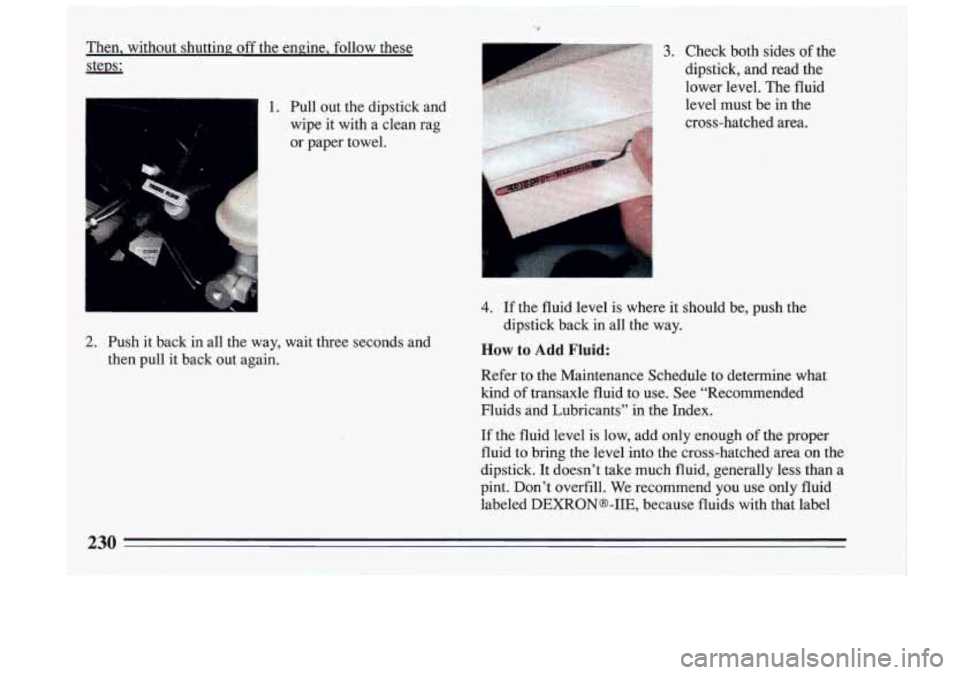
Then, without shutting off the engine, follow these
stem:
1. Pull out the dipstick and
wipe it with a clean rag
or paper towel.
2. Push it ‘back in aa the way, wait three seconds and
I :then pull it back out again.
3. Check both sides ofthe
dipstick, and read the
lower level. The fluid
level must be
.in the
cross-hatched
mea.
P
4. If the fluid level is where it should be, push the
How to Add Fluid:
dipstick back in all the way.
Refer
to the Maintenance Schedule to determine what
kind of transaxle fluid to
use. See “Recommended
Fluids and Lubricants” in the Index.
If the- fluid level is low, add only enough of the proper
fluid
to bring the level into the cross-hatched area on the
dipstick. It doesn’t take much fluid, generally less than a \
pint. D,on’t overfill. We recommend you use only fluid
labeled DEXRONB-IIE, because fluids with that label
230
I