brake BUICK RIVIERA 1993 Owner's Manual
[x] Cancel search | Manufacturer: BUICK, Model Year: 1993, Model line: RIVIERA, Model: BUICK RIVIERA 1993Pages: 324, PDF Size: 16.01 MB
Page 159 of 324
Brake Pedal Travel
See your dealer if the brake pedal does not return to
normal height, or if there is a rapid increase in pedal
travel. This could be
a sign of brake trouble.
Brake Adjustment
Every time you make a moderate brake stop, your disc
brakes adjust for wear.
If you rarely make a moderate or heavier stop, then your
brakes might not adjust correctly.
If you drive in that
way, then
-- very carefully -- make a few moderate
brake stops about every
1000 miles ( 1600 km), so your
brakes will adjust properly.
Braking in Emergencies
Use your anti-lock braking system when you need to.
With anti-lock, you can steer and brake at the same time.
In many emergencies, steering can help you more than
even the very best braking.
Steering
Power Steering
If you lose power steering assist because the engine
stops or the system fails to function, you can steer but it
will take much more
effort.
Steering Tips
Driving on Curves
It’s important to take curves at a reasonable speed.
A lot of the “driver lost control” accidents mentioned on
the news happen on curves. Here’s why:
Experienced driver or beginner, each of us is subject to
the same laws of physics when driving on curves. The
traction
of the tires against the road surface makes it
possible for the vehicle to change its path when you turn
the front wheels.
If there’s no traction, inertia will keep
the vehicle going
in the same direction. If you’ve ever
tried to steer a vehicle on wet ice, you’ll understand this.
The traction you can get in a curve depends on the
condition of your tires and the road surface, the angle at
which the curve is banked, and your speed. While
you’re in a curve, speed is the one factor you can
control.
157
Page 161 of 324
either hand. But you have to act fast, steer quickly, and
just as quickly straighten the wheel once
you have
avoided the object. You must then be prepared to steer
back to your original lane and then brake to a controlled
stop.
Depending on your speed, this can be rather violent for
an unprepared driver. This is one
of the reasons driving
experts recommend that you use your safety belts and
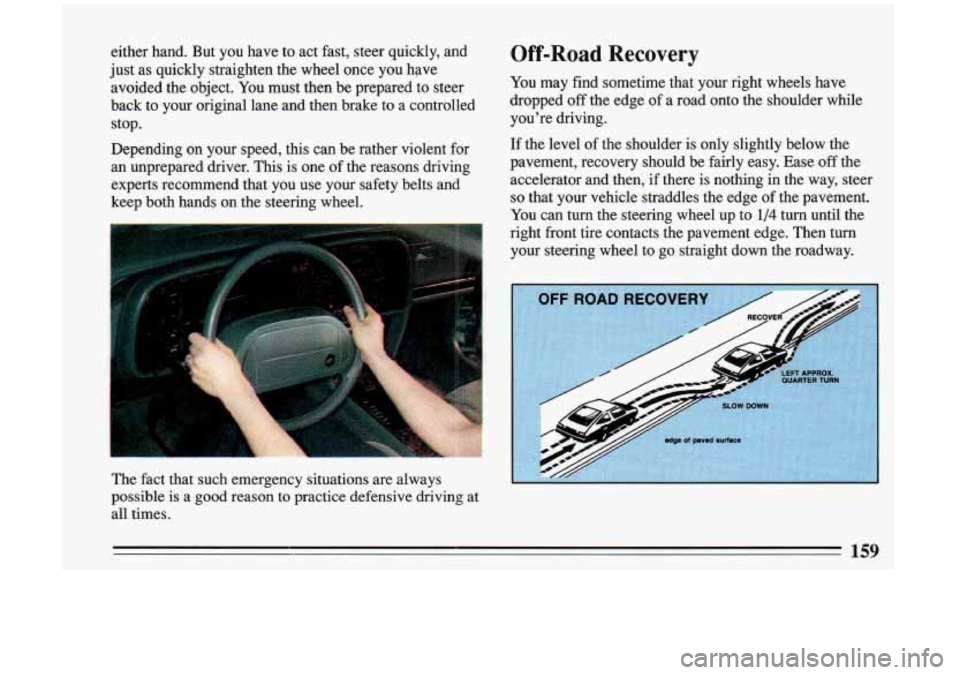
keep both hands on the steering wheel.
The fact that such emergency situations are always
possible is a good reason to practice defensive driving at
all times.
Off-Road Recovery
You may find sometime that your right wheels have
dropped
off the edge of a road onto the shoulder while
you’re driving.
If the level of the shoulder is only slightly below the
pavement, recovery should be fairly easy. Ease
off the
accelerator and then, if there is nothing in the way, steer
so that your vehicle straddles the edge of the pavement.
You can turn the steering wheel
up to 1/4 turn until the
right front tire contacts the pavement edge. Then turn
your steering wheel to
go straight down the roadway.
159
Page 163 of 324
0
0
0 0
0
Don’t overtake a slowly moving vehicle too rapidly.
Even though the brake lights are not flashing, it may
be slowing down
or starting to turn.
If you’re being passed, make it easy for the
following driver to get ahead
of you. Perhaps you
can ease a little to the right.
Loss of Control
Let’s review what driving experts say about what
happens when the thee control systems (brakes, steering
and acceleration) don’t have enough friction where the
tires meet the road to do what the driver has asked.
In any emergency, don’t give up. Keep trying to steer
and constantly seek an escape route or area
of less
danger.
Skidding
In a skid, a driver can lose control of the vehicle.
Defensive drivers avoid most skids by taking reasonable
care suited to existing conditions, and by not
“overdriving” those conditions. But skids are always
possible.
The three types of skids correspond to your Buick’s
three control systems. In the braking skid your wheels aren’t rolling. In the steering or cornering skid, too
Page 168 of 324
r/d CAUTION:
Wet brakes can cause accidents. They won’t
work well in a quick stop and may cause pulling
to one side. You could lose control of the
vehicle.
After driving through a large puddre of water or
a car wash, apply your brake pedal lightly until
your brakes work normally.
I- Hydroplaning
I
1 Hydroplaning is dangerous. So much water can build up
under your tires that they can actually ride on the water.
This can happen if the road is wet enough and you’re
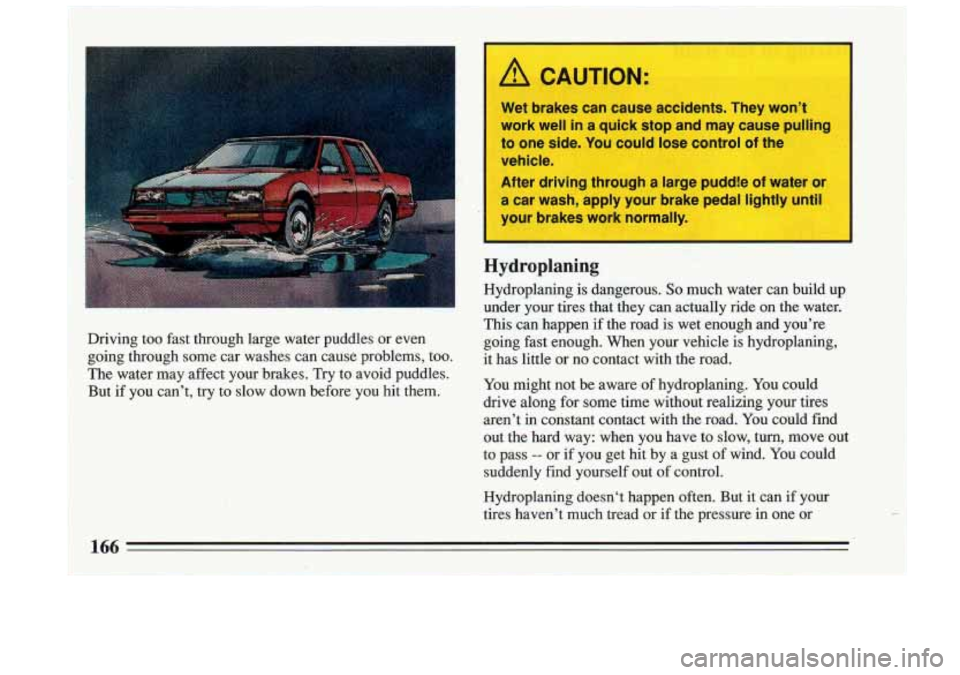
Driving too fast through large water puddles or even
going fast enough. When your vehicle is hydroplaning,
going through some car washes can cause problems, too. it has little or no contact with the road.
The water may affect your brakes. Try to avoid puddles.
But if you can’t, try to slow down before you hit them. You
might not be aware of hydroplaning. You could
drive along for some time without realizing your tires aren’t
in constant contact with the road. You could find
out the hard way: when you have to slow, turn, move out
to pass
-- or if you get hit by a gust of wind. You could
suddenly find yourself out of control.
Hydroplaning doesn‘t happen often. But it can if your
tires haven’t much tread or if the pressure in one or
Page 173 of 324
Just before you leave the lane, glance quickly over your
shoulder to make sure there isn’t another vehicle in your
“blind” spot.
If you are moving from an outside to a center lane on a
freeway having more than two lanes, make sure another
vehicle isn’t about to move into the same spot. Look at
the vehicles two lanes over and watch for telltale signs:
turn signals flashing, an increase in speed,
or moving
toward the edge of the lane. Be prepared to delay your
move.
Once you are moving on the freeway, make certain you
allow a reasonable following. distance. Expect to move
slightly slower at night.
Leaving the Freeway
When you want to leave the freeway, move to the proper
lane well in advance. Dashing across lanes at the last
minute is dangerous.
If you miss your exit do not, under
any circumstances, stop and back up. Drive on to the
next exit.
At each exit point is a deceleration lane. Ideally it
should be long enough for you to enter it at freeway
speed (after signaling, of course) and then do your
braking before moving onto the exit ramp.
Unfortunately, not all deceleration lanes are long enough
-- some are too short for all the braking. Decide when to
start braking. If you must brake on the through lane, and
if there is traffic close behind you, you can allow a little \
extra time and flash your brake lights (in addition to
your turn signal) as extra warning that you are about to
slow down and exit.
The exit ramp can be curved, sometimes quite sharply.
The exit spwd is usually posted. Reduce your speed
according to your speedometer, not to your sense of
motion. After driving for any distance at higher speeds,
you may tend to think you are going slower than you
actually are. For example,
40 mph (65 h/h) might
seem like only
20 mph (30 km/h). Obviously, this. could
lead to serious trouble on a ramp designed for
20 mph
(30 km/h)!
Driving a Long Distance
Although most long trips today are made on freeways,
there are still many made
on regular highways.
Long-distance driving on freeways and regular
highways is the same in some ways. The
trip has to be
planned and the vehicle prepared, you drive at
higher-than-city speeds, and there are longer
turns
behind the wheel. You’ll enjoy your trip more if you and
your vehicle are in good shape. Here are some tips for
a
successful long trip.
171
Page 176 of 324
If you drive regularly in steep country, or if you're
planning to visit there, here are some tips that can make
your trips safer and more enjoyable.
0 Keep your vehicle in good shape. Check all fluid
levels and also the brakes, tires, cooling system and
transaxle. These parts can work hard on mountain
roads.
@ Know how to go down hills. The most important
thing to know
is thisi let your engine do some of the
slowing down. Don't make your brakes do it all.
Shift to a lower gear when you go down a steep or
long
hill. That way, you will slow down without
excessive use of your brakes.
If you don't shift down, your brakes could get
11 so hot that they wouldn't work well. You would
then have poor braking
or even none going
down a
hill. You could crash. Shift down to let
your engine assist your brakes on a steep
,!~~~~~~~~~~~,~~*~~-~~~~ ,-d:;,,~~,."c.~,-~.:'-- ~i~-~zg352~;~g~~g d 0 w n h i I I sf 0 pe . li,,,,~a,,.>~?&:.
I
I
I
0
/d CAUTION:
Coasting downhill in "N" (Neutral) or with the
ignition off is dangerous. Your brakes will have
to do all the work of slowing down. They could
get
so hot that they wouldn't work well. You
could crash. Always have your engine running
and your vehicle
in gear -]en you go downhill.
Know how to go uphill. You may want to shift down
to a lower gear. The lower gears help cool
your
engine and transaxle, and you can climb the hill
better.
Stay in your own lane when driving on two-lane
roads in hills or mountains. Don't swing wide or cut
across the center of the road. Drive at speeds that let
you stay in your own lane. That way, you won't be
surprised by a vehicle coming toward you
in the
same lane.
It takes longer to pass another vehicle when you're going uphill. You'll want
to leave extra room to pass.
If a vehicle is passing you and doesn't have enough
room, slow down to make it easier for the other
vehicle to get by.
Page 177 of 324
As you go over the top of a hill, be alert. There could
be something in your lane, like a stalled car or an
accident. Parking on Hills
You may see highway signs on mountains that warn
of special problems. Examples are long grades,
passing or no-passing zones,
a falling rocks area, or
winding roads. Be alert to these and take appropriate
action.
Winter driving can present special problems. See ,
“Winter Driving” in the Index.
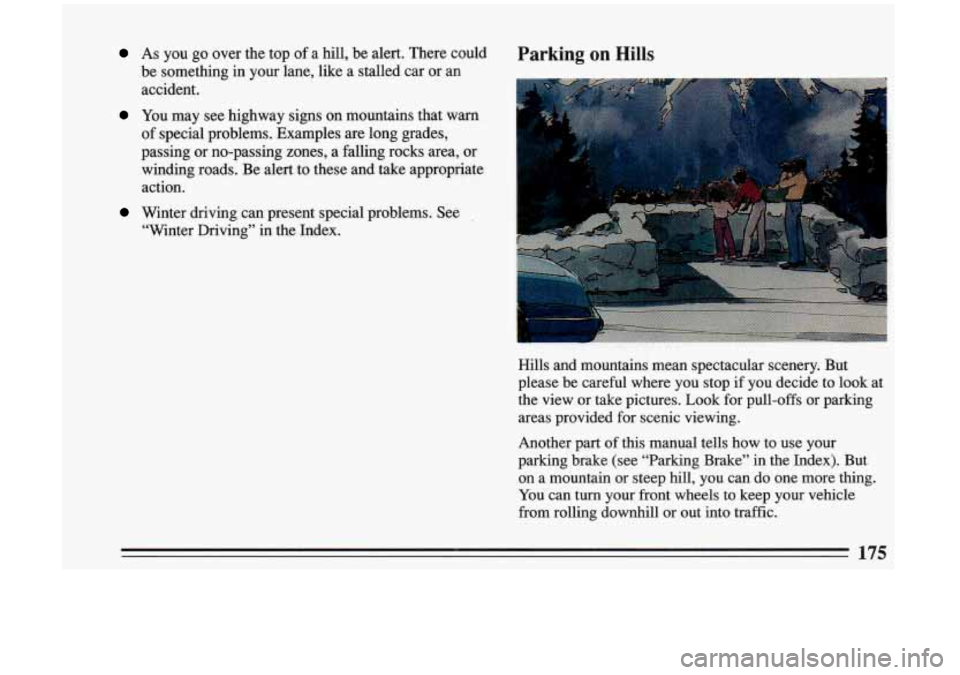
Hills and mountains mean spectacular scenery. But
please be careful where you stop if you decide to look at
the view or take pictures. Look for pull-offs or parking
areas provided for scenic viewing.
Another part of this manual tells how to use your
parking brake (see “Parking Brake” in the Index). But
on a mountain or steep hill, you can do one more thing.
You can turn your front wheels to keep your vehicle
from rolling downhill or out into traffic.
175
Page 182 of 324
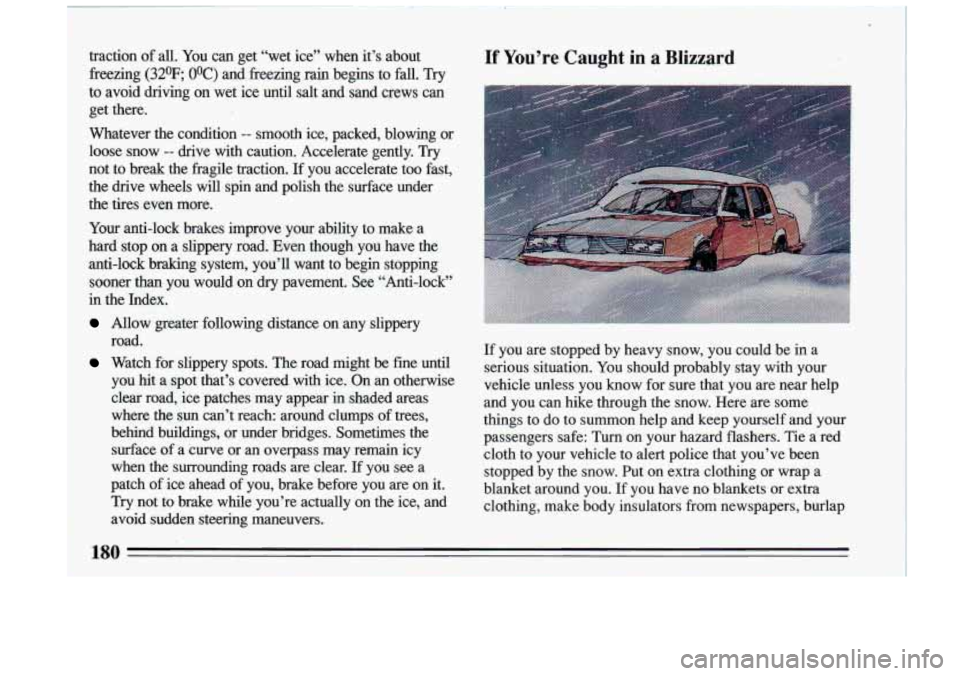
traction of all. You can get “wet ice” when it’s about If You’re Caught in a Blizzard
freezing (32oF; O°C) and freezing rain begins to fall. Try
to avoid driving on wet ice until salt and sand crews can
get there. Y
. . ._ . . .
Whatever the condition -- smooth ice, packed, blowing or
loose snow
-- drive with caution. Accelerate gently. Try
not to break the fragile traction. If you accelerate too fast,
the drive wheels will spin and polish the surface under
the tires even more.
Your anti-lock brakes improve your ability to make a
hard stop on a slippery road. Even though you have the
anti-lock braking system, you’ll want to begin stopping sooner than you would on
dry pavement. See “Anti-lock”
in the Index.
Allow greater following distance on any slippery
road.
Watch for slippery spots. The road might be fine until
you hit a spot that’s covered with ice. On an otherwise
clear road, ice patches may appear
in shaded areas
where the
sun can’t reach: around clumps of trees,
behind buildings, or under bridges. Sometimes the
surface of a curve or an overpass may remain icy
when the surrounding roads are clear.
If you see a
patch
of ice ahead of you, brake before you are on it.
Try not to brake while you’re actually on the ice, and
avoid sudden steering maneuvers.
180
Page 189 of 324
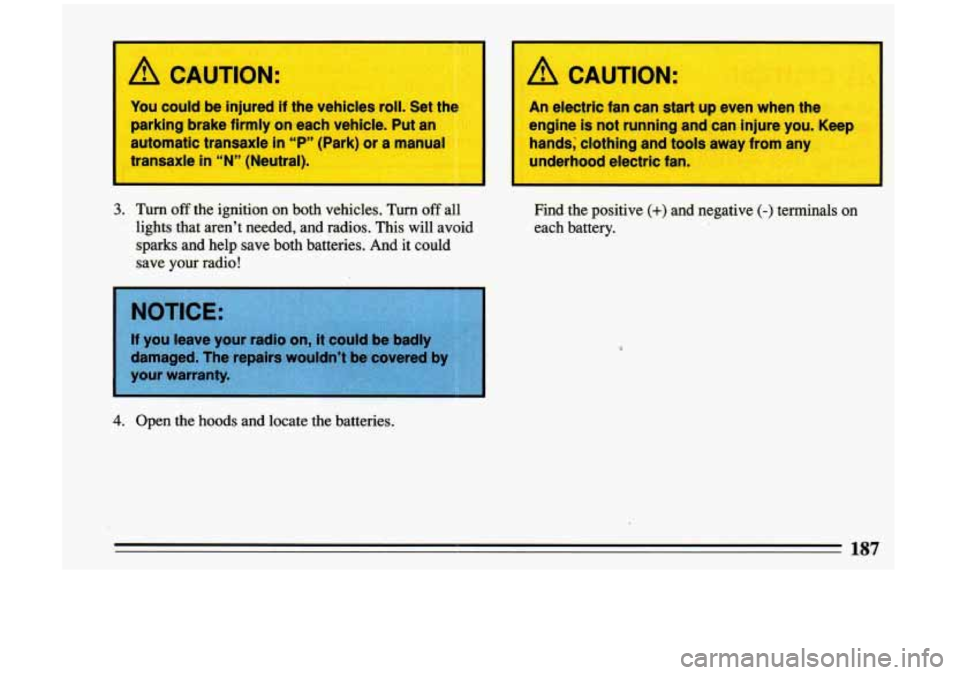
I A CAUTION:
u could be injured if the vehicles roll. Set the
arking brake firmly on each vehicle. Put an
utomatic transaxle
in “P” (Park) or a manual
axle
in “N” (Neutral).
P
3. Turn off the ignition on both vehicles. Turn off all
lights that aren’t needed, and radios. This
will avoid
sparks and help save both batteries. And it could
save your radio!
4. Open the hoods and locate the batteries.
I A CAUTION:
An electric fan can start up even when the
engine is not running and can injure you. Keep
hands; clothing and tools away from any
underhood electric fan.
~~
Find the positive .(+) and negetive (-), terminals on
each battery.
Page 194 of 324
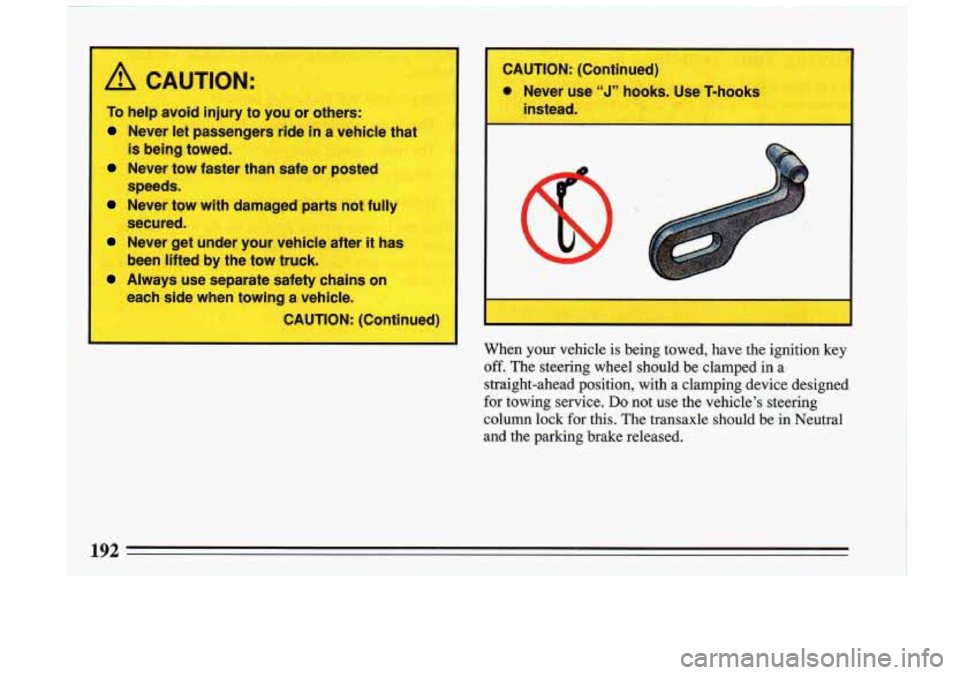
/! CA TlON:
To help-avok rjury to you or others:
Never let passengers ride in a vehicle that I
Never tow fastt than safe or postec
Never tow ith damaged parts not fully
Never get under your vehicle after it has
Always use separate safety chains on
is being towed.
speec
secured.
been lifted by the tow truck.
each.side when towing a vehicle.
CAUTION: (Continued)
CAUTION: (Continued)
0 Never use “J” hooks. Use T-hooks
instead.
When your vehicle is being towed, have the ignition key off. The steering wheel should be clamped in a.
straight-ahead position, with a clamping device designed
for towing service.
Do not use the vehicle’s steering
column lock for this. The transaxle should be in Neutral
and the parking brake released.
192