wheel BUICK RIVIERA 1993 Owner's Manual
[x] Cancel search | Manufacturer: BUICK, Model Year: 1993, Model line: RIVIERA, Model: BUICK RIVIERA 1993Pages: 324, PDF Size: 16.01 MB
Page 178 of 324
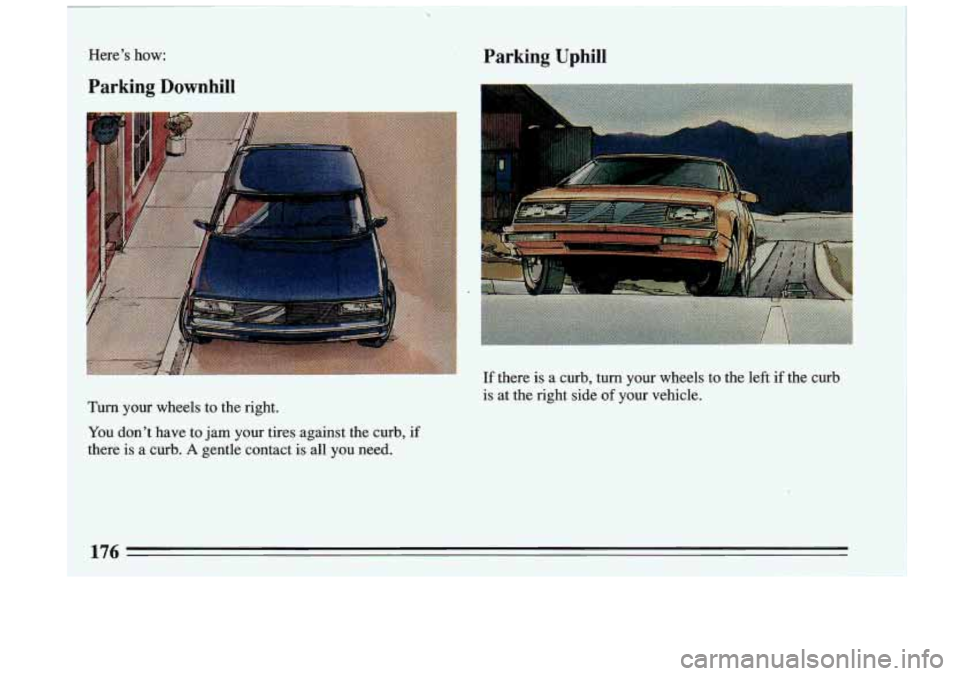
Parking Downhill
Parking Uphill
Turn your wheels to the right.
You don't have to
jam your tires against the curb, if
there is
a curb. A gentle contact is all you need.
If there is a curb, turn your wheels to the left if the curb
is at the right side of your vehicle.
1 I 176
Page 179 of 324
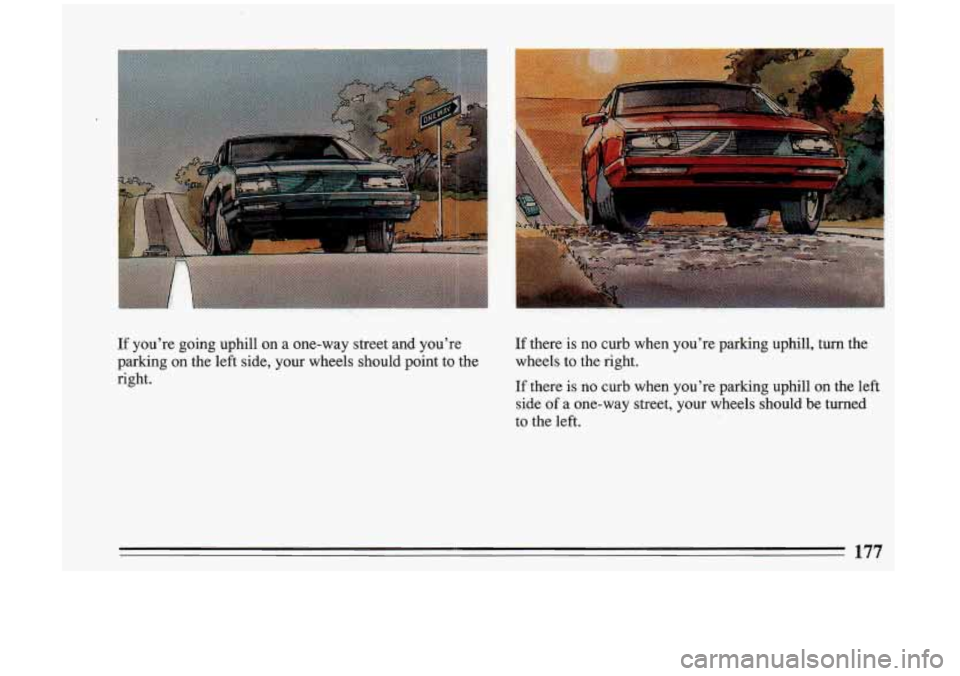
If you're going uphill on a one-way street and you're
parking on the left side, your wheels should point to the
right. If there is no curb when you're parking uphill, turn the
wheels to the right.
If there is no curb when you're parking uphill on the left
side
of a one-way street, your wheels should be turned
to the left.
177
Page 182 of 324
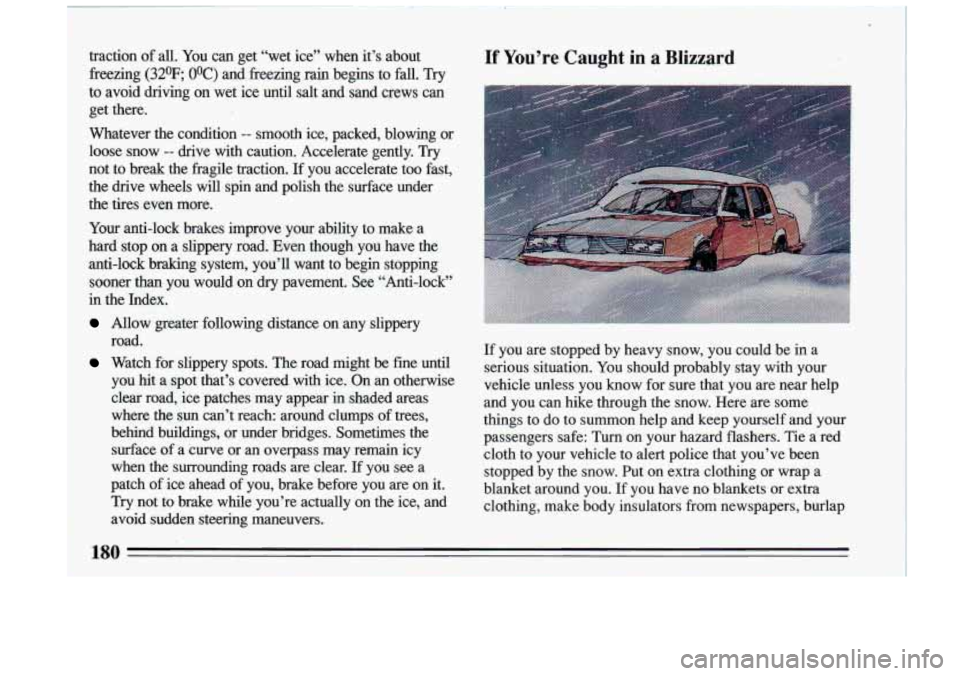
traction of all. You can get “wet ice” when it’s about If You’re Caught in a Blizzard
freezing (32oF; O°C) and freezing rain begins to fall. Try
to avoid driving on wet ice until salt and sand crews can
get there. Y
. . ._ . . .
Whatever the condition -- smooth ice, packed, blowing or
loose snow
-- drive with caution. Accelerate gently. Try
not to break the fragile traction. If you accelerate too fast,
the drive wheels will spin and polish the surface under
the tires even more.
Your anti-lock brakes improve your ability to make a
hard stop on a slippery road. Even though you have the
anti-lock braking system, you’ll want to begin stopping sooner than you would on
dry pavement. See “Anti-lock”
in the Index.
Allow greater following distance on any slippery
road.
Watch for slippery spots. The road might be fine until
you hit a spot that’s covered with ice. On an otherwise
clear road, ice patches may appear
in shaded areas
where the
sun can’t reach: around clumps of trees,
behind buildings, or under bridges. Sometimes the
surface of a curve or an overpass may remain icy
when the surrounding roads are clear.
If you see a
patch
of ice ahead of you, brake before you are on it.
Try not to brake while you’re actually on the ice, and
avoid sudden steering maneuvers.
180
Page 193 of 324
Towing Your Vehicle Before you do anything, turn on the hazard warning
flashers.
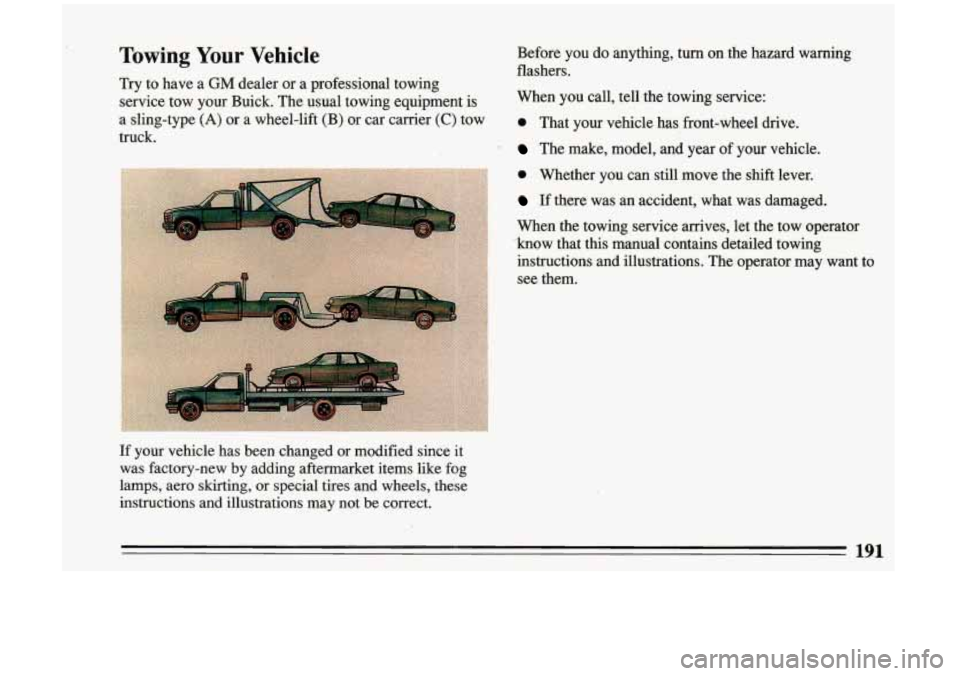
Try to have a
GM dealer or a professional towing
service tow your Buick. The usual towing equipment is When you call, tell the towing service:
a sling-type
(A) Or a wheel-lift (B) Or Car carrier (c) tow 0 That your vehicle has front-wheel drive.
truck.
. The make, model, and year of your vehicle.
If your ‘vehicle has been changed or modified since it
was factory-new by adding aftermarket items like fog
lamps, aero skirting,
or special tires and wheels, these
instructions and illustrations may not be correct.
0 Whether you can still move the shift lever.
If there was an accident, what was damaged.
When the towing service arrives, let the tow operator
-know that this manual contains detailed towing instructions and illustrations. The operator may want to
see them.
191
Page 194 of 324
/! CA TlON:
To help-avok rjury to you or others:
Never let passengers ride in a vehicle that I
Never tow fastt than safe or postec
Never tow ith damaged parts not fully
Never get under your vehicle after it has
Always use separate safety chains on
is being towed.
speec
secured.
been lifted by the tow truck.
each.side when towing a vehicle.
CAUTION: (Continued)
CAUTION: (Continued)
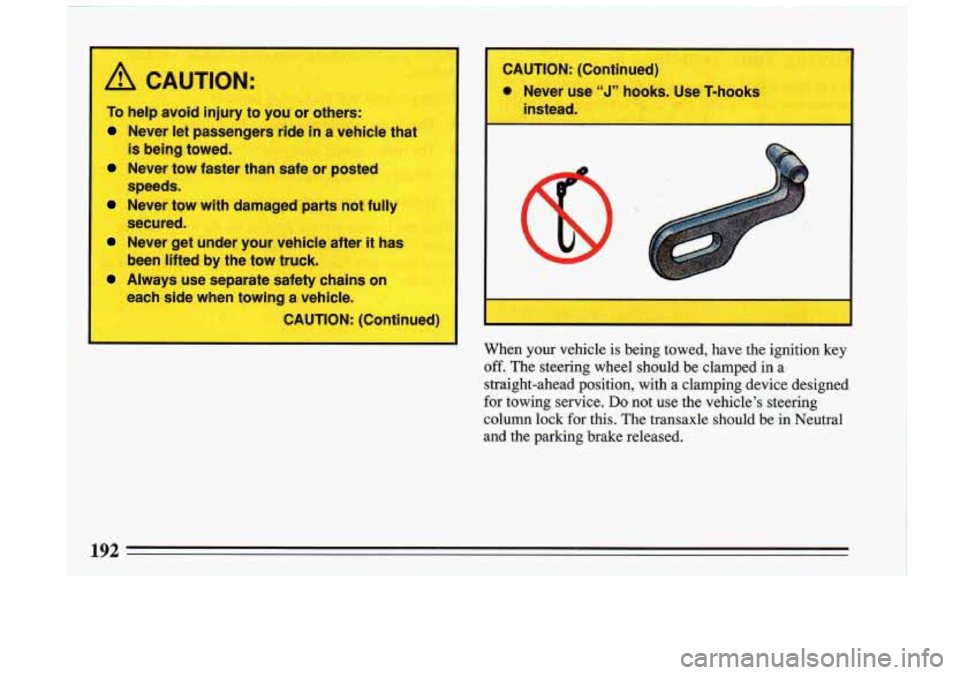
0 Never use “J” hooks. Use T-hooks
instead.
When your vehicle is being towed, have the ignition key off. The steering wheel should be clamped in a.
straight-ahead position, with a clamping device designed
for towing service.
Do not use the vehicle’s steering
column lock for this. The transaxle should be in Neutral
and the parking brake released.
192
Page 206 of 324
I
8.
If a Tire Goes Flat
It’s unusual for a tire to “blow out” while you’re driving,
especially if you maintain your tires properly.
If air goes
out of a tire, it’s much more likely to lepk out slowly.
But if you should ever have a “blowout,” here are a few\
tips about what to expect and what to do:
If a front tire fails, the flat tire will create a drag that
pulls the vehicle toward that side. Take your foot
off the
accelerator pedal and grip the steering wheel firmly.
Steer to maintain lane position, then gently brake to a
stop well out of the traffic lane.
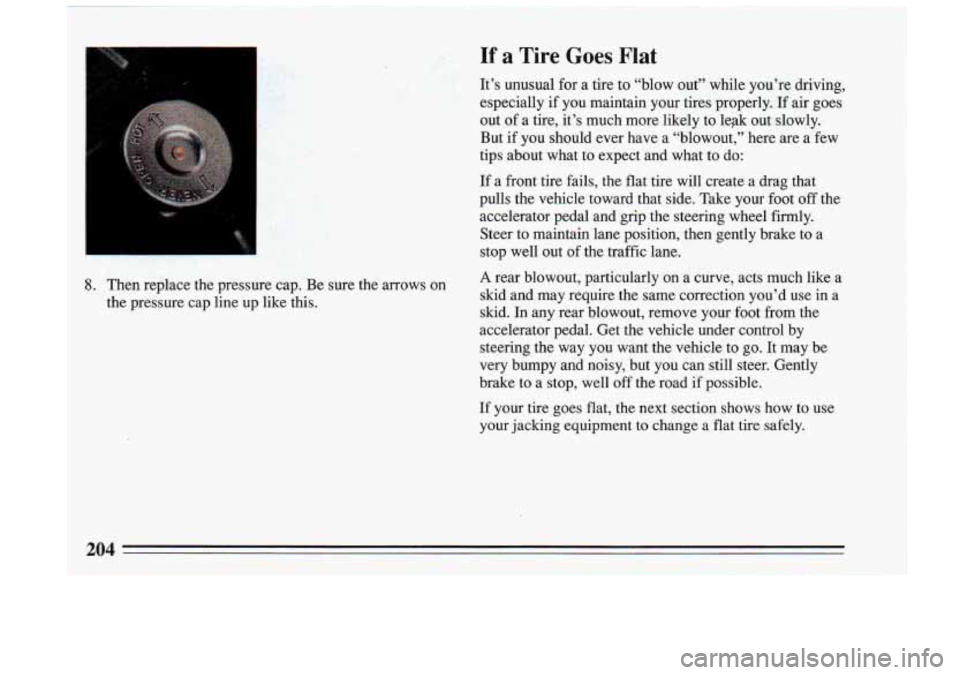
Then replace the pressure cap. Be sure the arrows on
the pressure
cap line up like this.
A rear blowout, particularly on a curve, acts much like a
skid and may require the same correction you’d use in
a
skid. In any rear blowout, remove your foot from the
accelerator pedal. Get the vehicle under control by
steering the way you want the vehicle
to go. It may be
very bumpy and noisy, but you can still steer. Gently
brake to a stop, well
off the road if possible.
If your tire goes flat, the next section shows how to use
your jacking equipment to change a flat tire safely.
204
____
Page 208 of 324
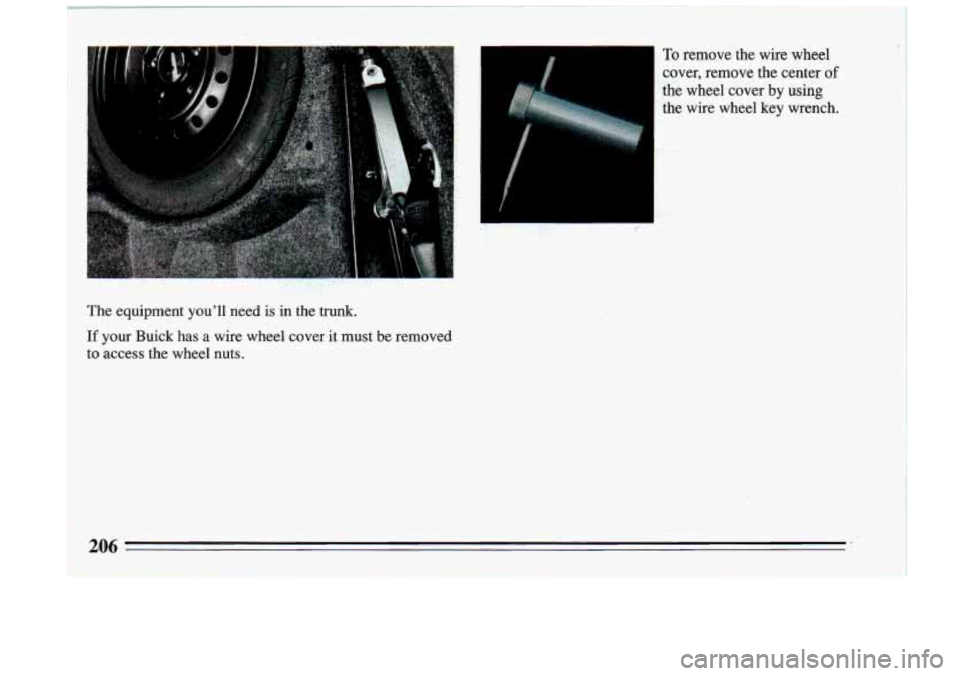
The equipment you'll need is in the trunk.
If your Buick has a wire wheel cover it must be removed
to access the wheel nuts.
To remove the wire wheel
cover, remove the center
of
the wheel cover by using
the wire wheel key wrench.
'
.i ,
Page 209 of 324
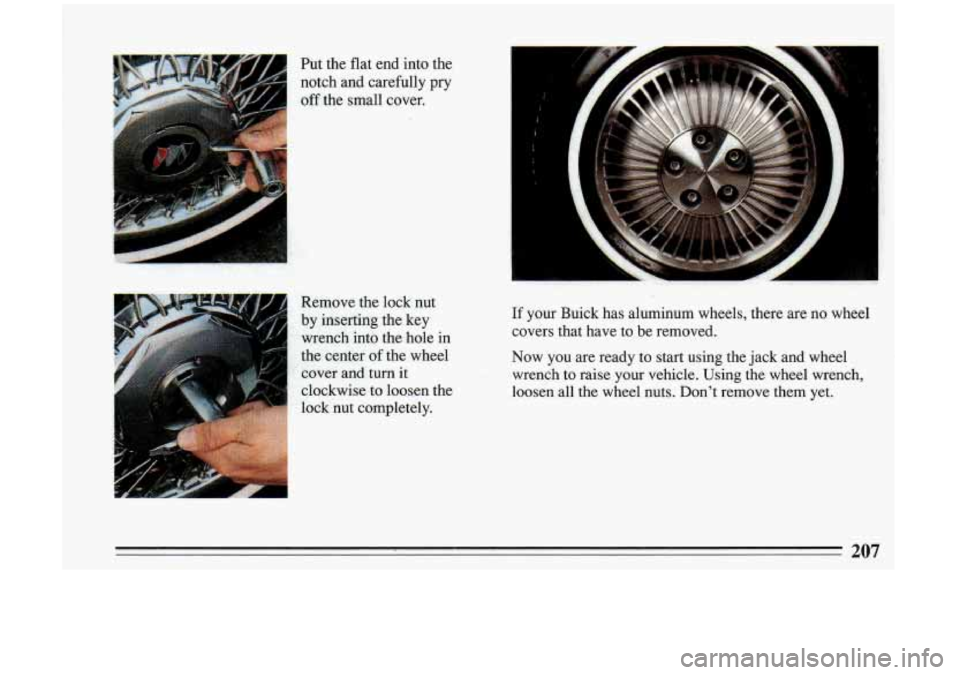
Put the flat end into the
notch and carefully pry off the small cover.
Remove the lock nut
by inserting the key
, wrench into the ,hole in
the: center of the wheel
‘I’ ,cover and turn it
q1ockwis.e to loosen the
lock nut completely.
i
1
i
” ,,.
If your Buick has aluminum wheels, there are no wheel
covers that have to be removed.
Now you are ready to start using the jack and wheel
wrench to raise your vehicle. Using the wheel wrench,
loosen all the wheel nuts. Don’t remove them yet.
207
Page 210 of 324
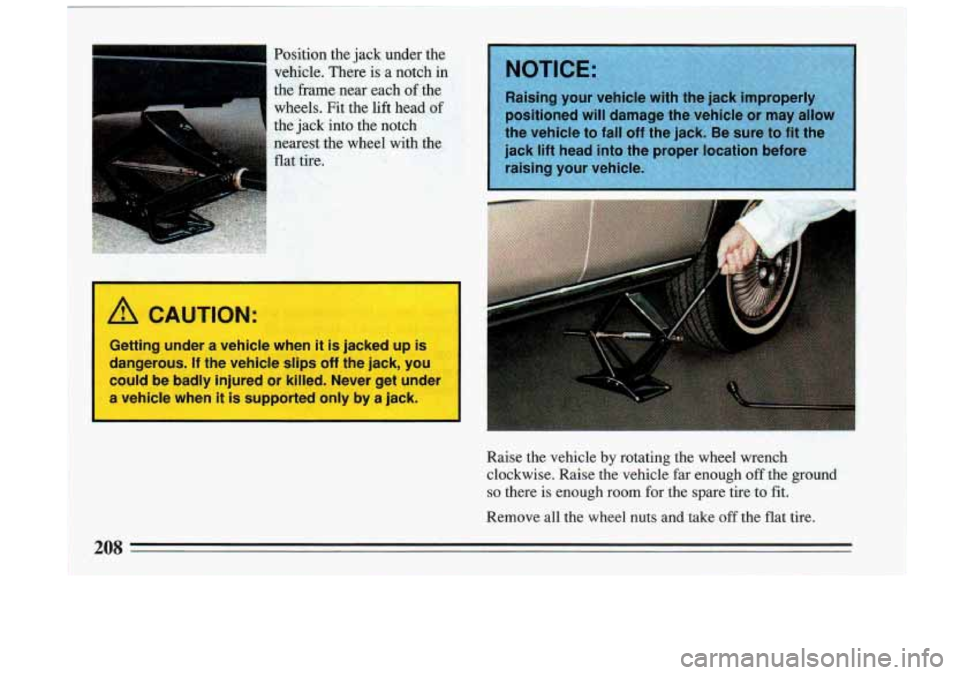
-1 Position the jack under the
3
vehicle. There is a notch in
thk frame near each of the
A CAUTION:
Getting under a vehicle when it is jacked up is
dangerous.
If the vehicle slips off the jack, you
could be badly injured
or kill,ed. Never get under
a vehicle when it
is supported only by a jack.
Raise the vehicle by rotating the wheel wrench
clockwise. Raise the vehicle far enough
off the ground
so there is enough room for the spare tire to fit.
Remove all the wheel nuts and take
off the flat tire.
20s
Page 211 of 324
A CAUTION:
Rust or dirt on the wheel, or on the parts to
which it
is fastened, can make the wheel nuts
become loose after
a time. The wheel could
come off and cause an accident. When you
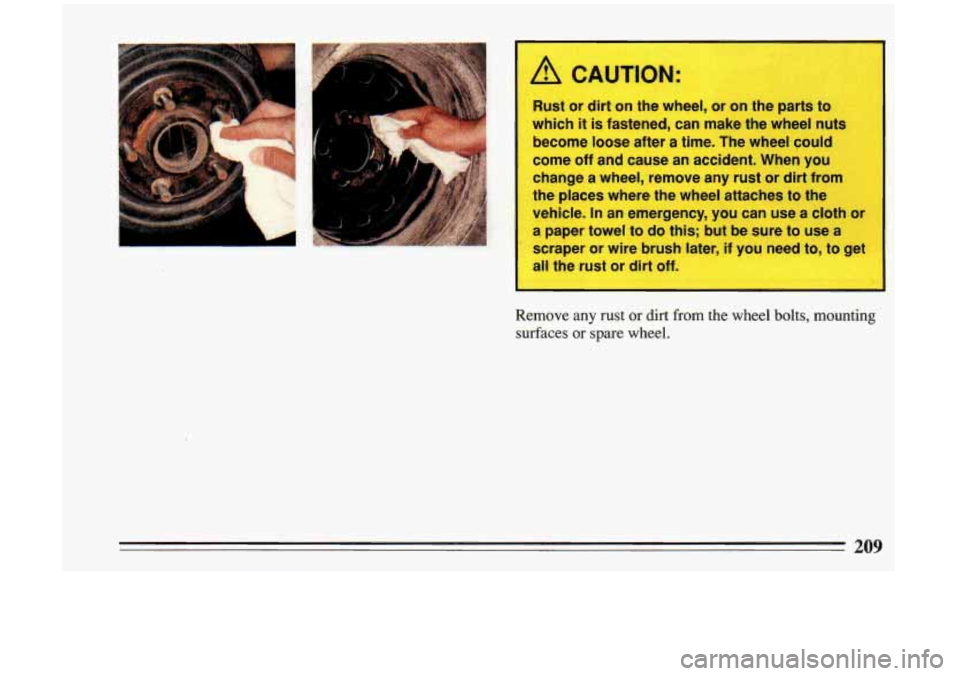
change a wheel, remove any rust or dirt from
the places where the wheel attaches to the
vehicle.
In an emergency, you can use a cloth or
a paper towel to do this; but be sure to use a
scraper or wire brush later, if you need to, to get
all the rust or dirt off.
Remove any rust or dirt from the wheel bolts, mounting
surfaces or spare wheel.