lock BUICK RIVIERA 1993 Service Manual
[x] Cancel search | Manufacturer: BUICK, Model Year: 1993, Model line: RIVIERA, Model: BUICK RIVIERA 1993Pages: 324, PDF Size: 16.01 MB
Page 165 of 324
by alcohol or drugs, with night vision problems, or by
fatigue.
Here are some tips on night driving.
0
0
0
0
0
0
0
Drive defensively. Remember, this is the most
dangerous time.
Don’t drink and drive. (See “Drunken Driving” in
the Index for more on this problem.)
Adjust your inside rearview mirror to reduce the
glare
from headlights behind you.
Since you can’t see as well, you may need to slow
down and keep more space between you and other
vehicles. It’s hard to tell how fast the vehicle ahead
is going just by looking at its tail’lights.
Slow’’ down, especially on higher speed roads. Your
headlights can light up only
so much road ahead.
In remote areas, watch for’animals.
If you’re tired, pull off the road in a safe place and
rest.
Night Vision
No one can see as well at night as in the daytime. But as
we get older these differences increase. A 50-year-old
driver may require at least twice as much light to see the
same thing at night as a 20-year-old. What you
do in the daytime can also affect your night
I
vision. For example, if you spend the day in bright
sunshine you are wise to wear sunglasses. Your eyes will
have less trouble adjusting to night.
But if you’re driving, don’t wear sunglasses at night.
They may cut down on glare from headlights, but they
also make a lot of things invisible that should remain
visible
- such as parked cars, obstacles, pedestrians, or
even trains blocking railway crossings. You may want to
put on your sunglasses after you have pulled into a
brightly-lighted service or refreshment area. Eyes
shielded from that glare may adjust more quickly to
darkness back on the road. But be sure to remove your
sunglasses before you leave the service area.
You can be temporarily blinded by approaching lights. It
can take a second or two, or even several seconds, for
your eyes
to readjust to the dark. When you are faced
with severe glare (as from a driver who doesn’t lower
the hi.gh beams, or a vehicle with misaimed headlights),
slow down a little. Avoid staring directly into the
approaching lights.
If there is a line of opposing traffic,
make occasional glances over the line of headlights to
make certain that one of the vehicles isn’t starting to
move into your lane. Once you are past the bright lights,
give
your eyes time to readjust before resuming speed.
163 ,
Page 182 of 324
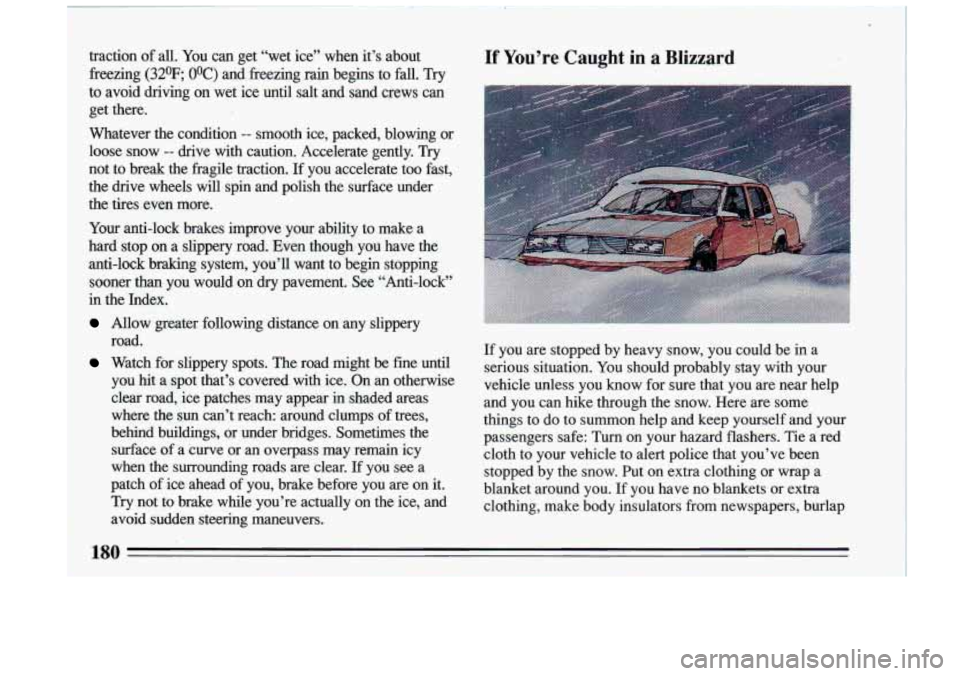
traction of all. You can get “wet ice” when it’s about If You’re Caught in a Blizzard
freezing (32oF; O°C) and freezing rain begins to fall. Try
to avoid driving on wet ice until salt and sand crews can
get there. Y
. . ._ . . .
Whatever the condition -- smooth ice, packed, blowing or
loose snow
-- drive with caution. Accelerate gently. Try
not to break the fragile traction. If you accelerate too fast,
the drive wheels will spin and polish the surface under
the tires even more.
Your anti-lock brakes improve your ability to make a
hard stop on a slippery road. Even though you have the
anti-lock braking system, you’ll want to begin stopping sooner than you would on
dry pavement. See “Anti-lock”
in the Index.
Allow greater following distance on any slippery
road.
Watch for slippery spots. The road might be fine until
you hit a spot that’s covered with ice. On an otherwise
clear road, ice patches may appear
in shaded areas
where the
sun can’t reach: around clumps of trees,
behind buildings, or under bridges. Sometimes the
surface of a curve or an overpass may remain icy
when the surrounding roads are clear.
If you see a
patch
of ice ahead of you, brake before you are on it.
Try not to brake while you’re actually on the ice, and
avoid sudden steering maneuvers.
180
Page 183 of 324
bags, rags, floor mats -- anything you can wrap around
yourself or tuck under your clothing to keep warm.
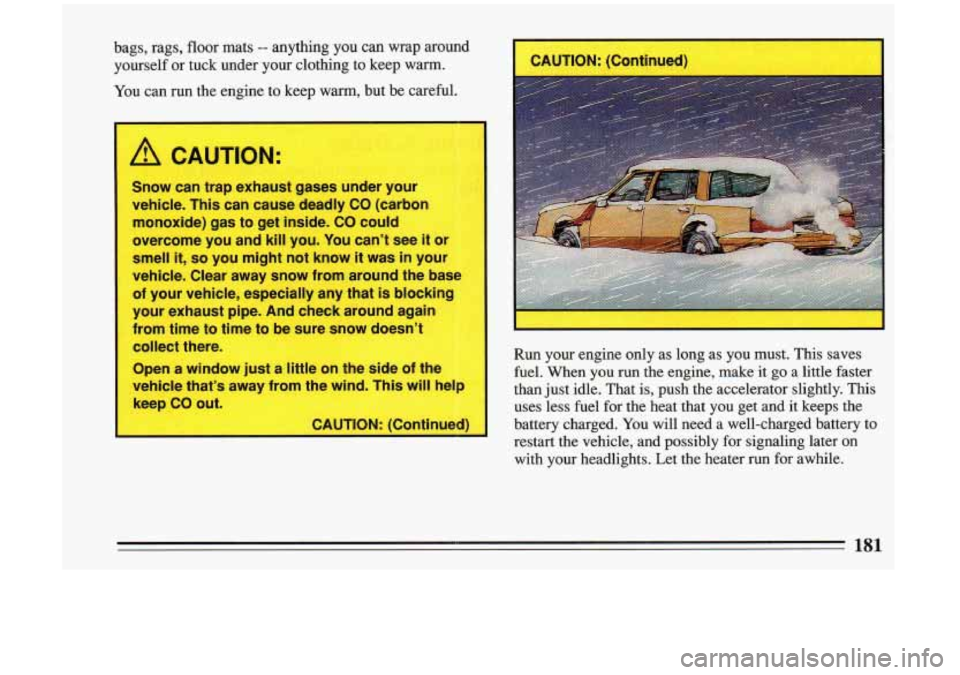
You can run the engine to keep warm, but be careful.
Snow can trap exhaust gases under your
vehicle. This can cause deadly CO (carbon
monoxide) gas to get inside. CO could
overcome you and kill you. You can’t see
it or
smell it,
so you might not know it was in your
vehicle. Clear away snow from around the ba
!
of your vehicle, especially any that is blocking
your exhaust pipe- And check ar
from time to time to be sure snow
collect there.
Open a window just a little on the side of the
vehicle that’s away from the wind. This
will heir
keep CO out.
I CAUTION: (Continued)
Run your engine only
as long as you must. This saves
fuel. When you run the engine, make
it go a little faster
than just idle. That is, push the accelerator slightly.
This
uses less fuel for the heat that you get and it keeps the
battery charged. You will need a well-charged battery to
restart the vehicle, and possibly for signaling later on
with your headlights. Let the heater run for awhile.
181
Page 194 of 324
/! CA TlON:
To help-avok rjury to you or others:
Never let passengers ride in a vehicle that I
Never tow fastt than safe or postec
Never tow ith damaged parts not fully
Never get under your vehicle after it has
Always use separate safety chains on
is being towed.
speec
secured.
been lifted by the tow truck.
each.side when towing a vehicle.
CAUTION: (Continued)
CAUTION: (Continued)
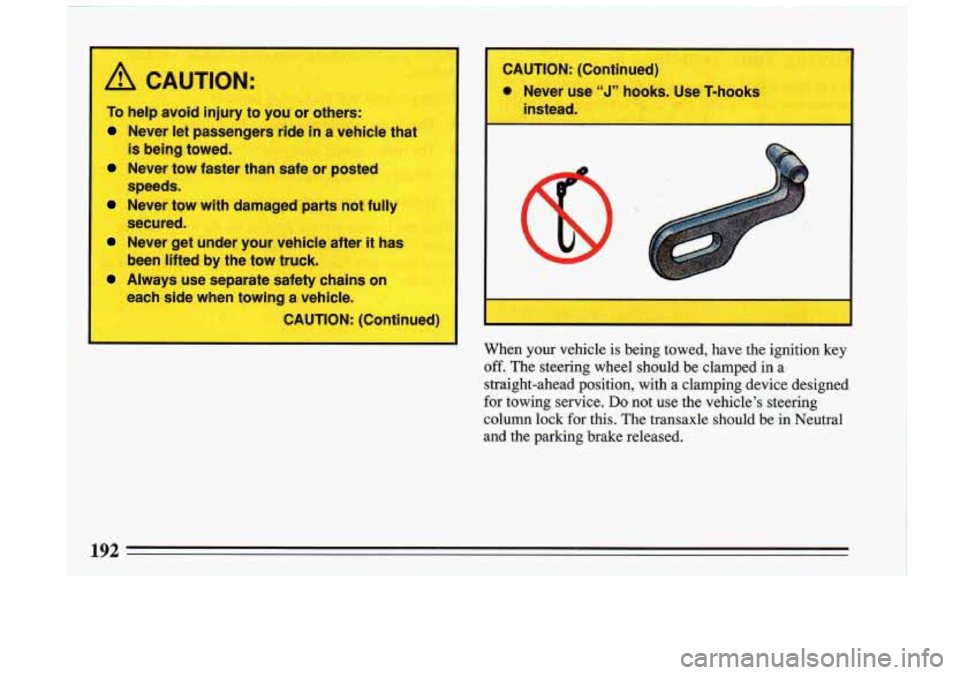
0 Never use “J” hooks. Use T-hooks
instead.
When your vehicle is being towed, have the ignition key off. The steering wheel should be clamped in a.
straight-ahead position, with a clamping device designed
for towing service.
Do not use the vehicle’s steering
column lock for this. The transaxle should be in Neutral
and the parking brake released.
192
Page 209 of 324
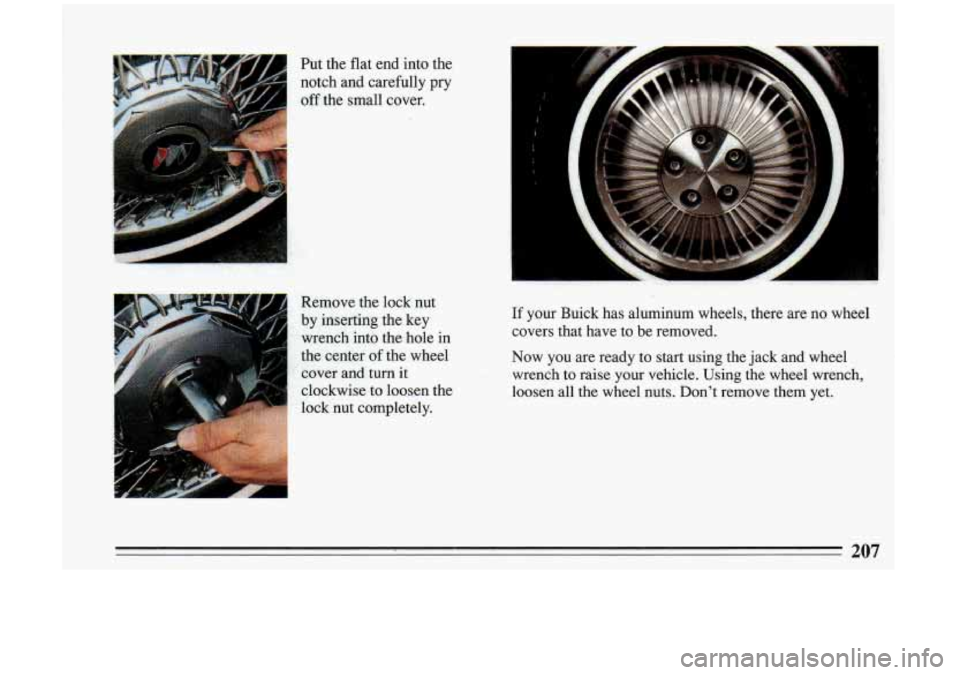
Put the flat end into the
notch and carefully pry off the small cover.
Remove the lock nut
by inserting the key
, wrench into the ,hole in
the: center of the wheel
‘I’ ,cover and turn it
q1ockwis.e to loosen the
lock nut completely.
i
1
i
” ,,.
If your Buick has aluminum wheels, there are no wheel
covers that have to be removed.
Now you are ready to start using the jack and wheel
wrench to raise your vehicle. Using the wheel wrench,
loosen all the wheel nuts. Don’t remove them yet.
207
Page 210 of 324
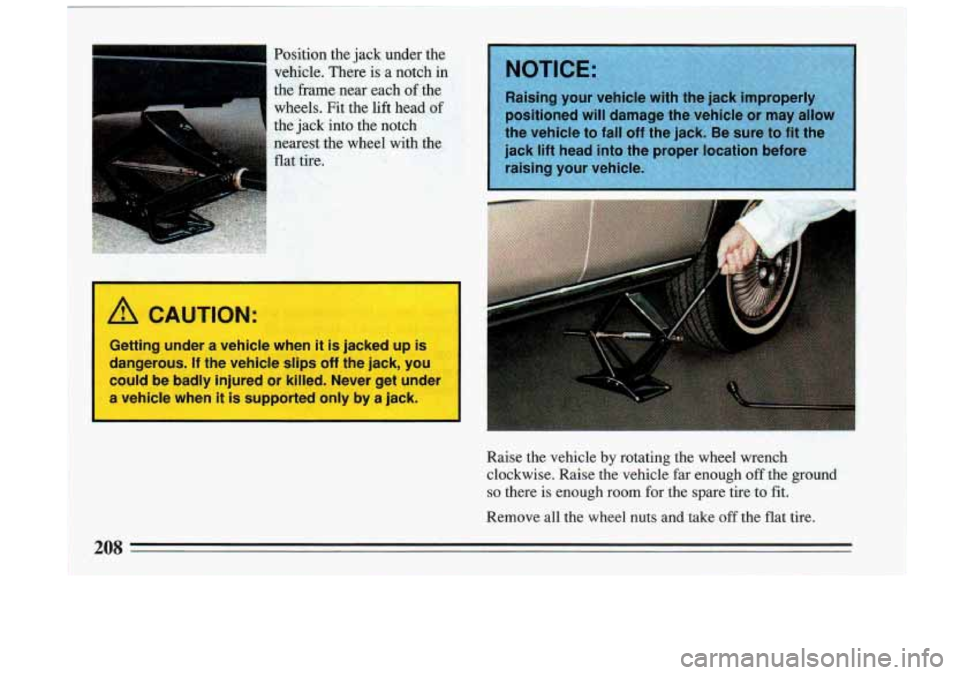
-1 Position the jack under the
3
vehicle. There is a notch in
thk frame near each of the
A CAUTION:
Getting under a vehicle when it is jacked up is
dangerous.
If the vehicle slips off the jack, you
could be badly injured
or kill,ed. Never get under
a vehicle when it
is supported only by a jack.
Raise the vehicle by rotating the wheel wrench
clockwise. Raise the vehicle far enough
off the ground
so there is enough room for the spare tire to fit.
Remove all the wheel nuts and take
off the flat tire.
20s
Page 212 of 324
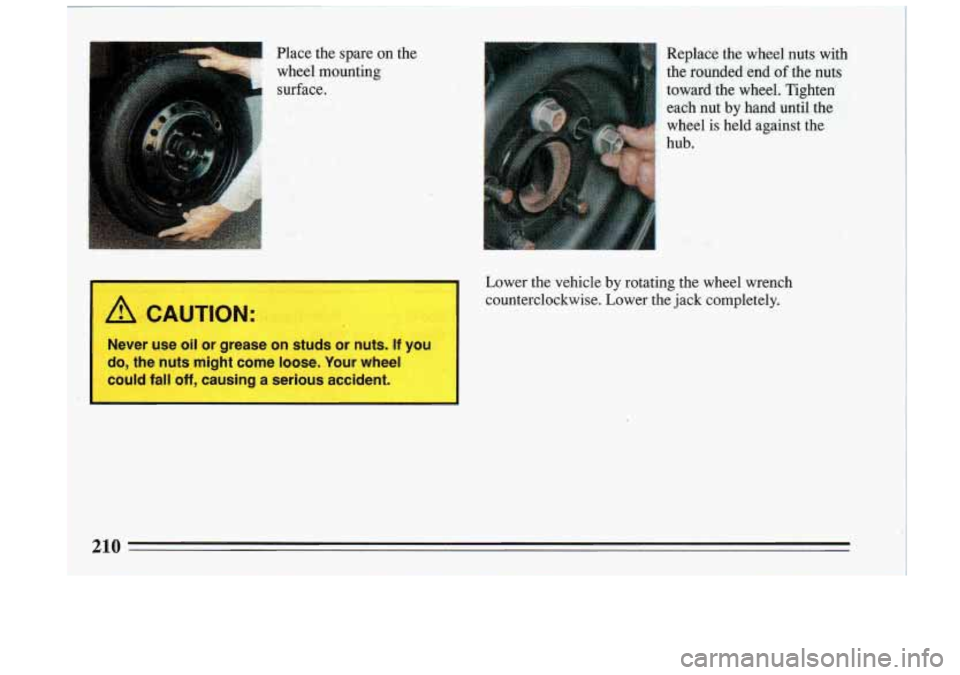
I Place the spare on the
wheel
.mounting
surface.
' Replace the wheel nuts with
the rounded-end of the nuts
toward the wheel. Tighten'
each nut by hand
until the
wheel
is held against the ' -
hub.
, counterclockwise. Lower the jack completely.
Lower the vehicle
by rotating the wheel wrench
/r CAUTIO'N:
Never use ail or grease on studs 1 nuts. If you
d,o, the nuts might !corne l~oose. Your w,heel
muld fall 'off, causing a serious accident.
Page 214 of 324
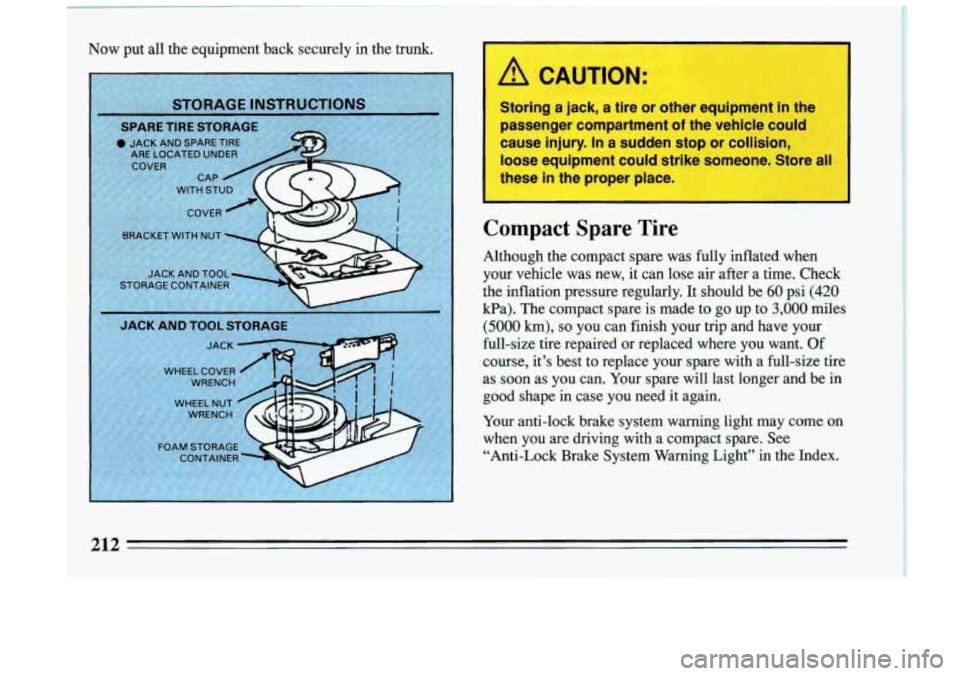
Now put all the equipment back securely in the trunk.
Compact Spare Tire
Although the compact spare was fully inflated when
your vehicle was new, it can lose air after a time. Check
the inflation pressure regularly. It should be
60 psi (420
kPa). The compact spare is made to go up to 3,000 miles
(5000 km), so you can finish your trip and have your
full-size tire repaired or replaced where you want.
Of
course, it’s best to replace your spare with a full-size ti\
re
as soon as you can. Your spare will last longer and be in
good shape in case you need it again.
Your anti-lock brake system warning light may come on
when you are driving with a compact spare. See
“Anti-Lock Brake System Warning Light” in the Index.
212
Page 222 of 324
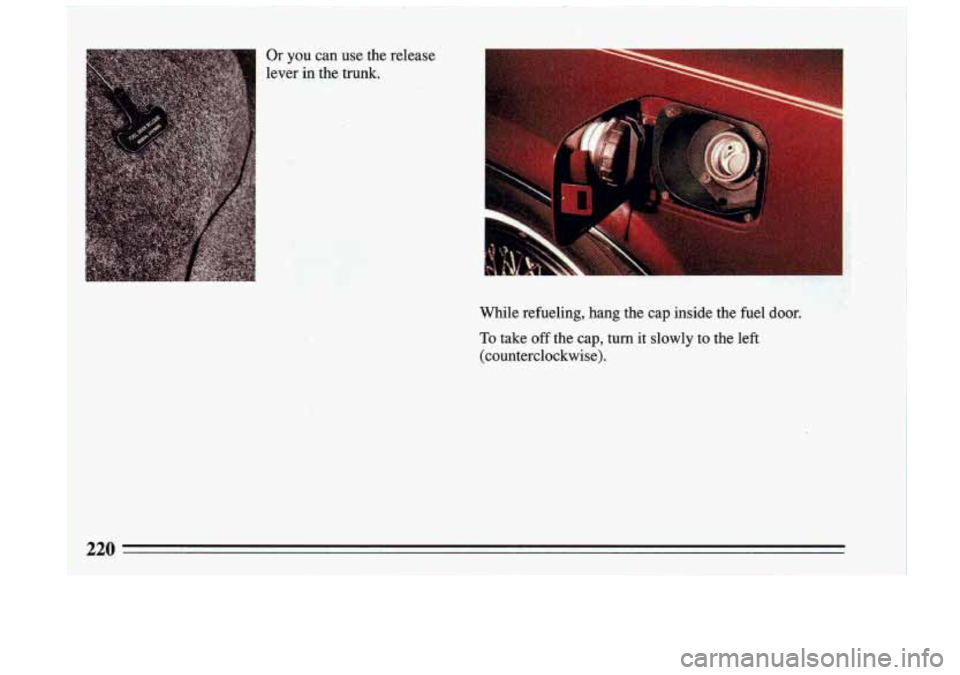
Or you can use the release
lever
in the trunk.
While refueling, hang the cap inside the fuel door.
To take off the cap, turn it slowly to the left
(counterclockwise).
220
Page 229 of 324
When to Change Engine Oil: See if any one of these is
true for you:
Most trips are less than 4 miles (6 km).
a It’s below freezing outside and most trips are less
than
10 miles (16 km).
0 The engine is at low speed most of the time (as in
door-to-door delivery, or in stop-and-go traffic).
Most trips are through dusty places.
If any one of these is true for your vehicle, then you
need to change your oil and filter every
3,000 miles
(5 000 km) or 3 months -- whichever comes first.
If none of them is true, change the oil every 7,500 miles
(12
500 km) or 12 months -- whichever comes first.
Change the filter at the first oil change and at every
other oil change after that.
Engine Block Heater: An engine block heater can be a
big help if you have to park outside in very cold
weather, -20
OF (-29 C) or colder. If your vehicle has
this option, see ?Engine Block Heater”
in the Index.
What to Do with Used Oil:
1
Used oil can be a real threat to the environment. If you
change your own oil, be
sure to drain all free-flowing oil
from the filter before disposal. Don’t ever dispose of oil
by pouring it on the ground, into sewers, or into streams
or bodies
of water. Instead, recycle it by taking it to 2
place that collects used oil. If you have a problem
properly disposing
of your used oil, ask your dealer, a
service station or a local recycling center for help.
227