child seat BUICK RIVIERA 1993 Owners Manual
[x] Cancel search | Manufacturer: BUICK, Model Year: 1993, Model line: RIVIERA, Model: BUICK RIVIERA 1993Pages: 324, PDF Size: 16.01 MB
Page 15 of 324
 systeil\
l
and how to use your safet")
Part 1 Seats and Safety Belts
Here you’ll find information about the seats 111 yuul UUIUS. your Supplemental Inflatable Restraint (“air bag”) systeil\
l
and how to use your safety belts properly
. You can also learn about some things you should @ do with safety belts .
Part 1 includes:
SeatsandSeatControls
............................................................. 14
HeadRestraints
................................................................... 17
WhySafetyBeltsWork ............................................................. 20
Questions Many People Ask About Safety Belts
.......................................... 24
How to Wear Safety Belts Properly
.................................................... 26
Adults
........................................................................\
.... 26
DriverPosition
.................................................................... 26
Lap-ShoulderBelt
................................................................. 27
Supplemental Inflatable Restraint System
............................................... 32
Safety Belt Use During Pregnancy
..................................................... 37
PassengerPositions
................................................................ 38
Children ........................................................................\
. 43
Smaller Children and Babies
......................................................... 43
ChildRestraints
................................................................... 45
LargerChildren
.................................................................... 53
SafetyBeltExtender
................................................................ 56
Checking Your Restraint System
...................................................... 56
Replacing Safety Belts After a Crash
................................................... 57
Safety Belts
. They’re
for Everyone ................................................... 19
Page 23 of 324
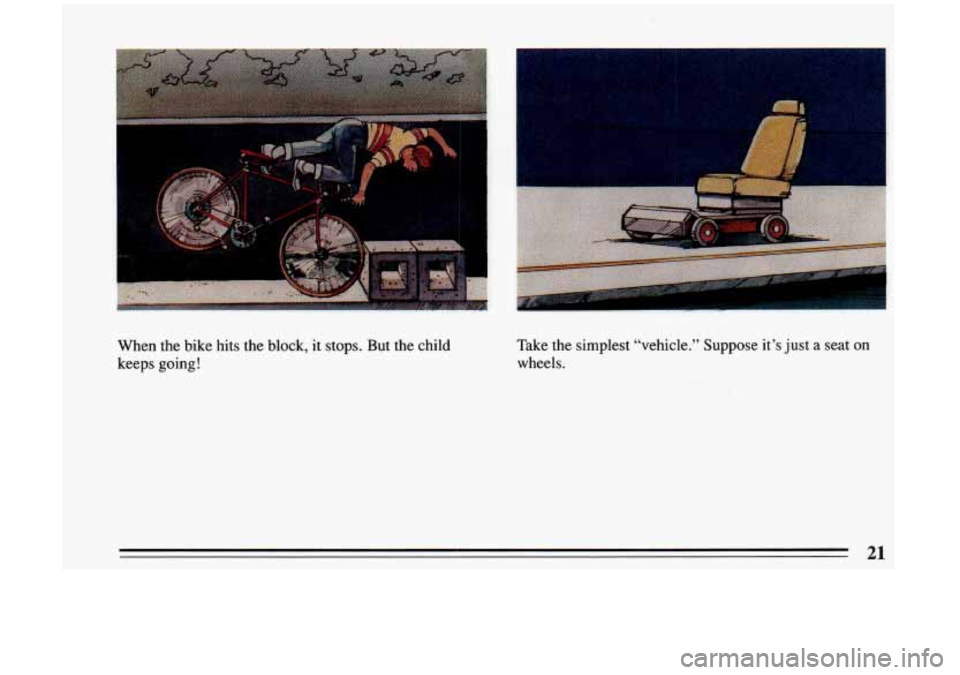
When the bike hits the block, it stops. But the child
keeps going! Take the
simplest “vehicle.” Suppose it’s just a seat on
wheels.
21
Page 47 of 324
Child Restraints
Be sure to follow the instructions for the restraint. You
may find these instructions on the restraint itself or in
a
booklet, or both. These restraints use the belt system in
your vehicle, but the child also has to
be secured within
the restraint to help reduce the chance
of personal injury.
The instructions that come with the infant or child
restraint will show you'how to do that.
Where to Put the Restraint
Accident statistics show that children are safer if they
are restrained in the rear rather than the front seat. We at
General Motors therefore recommend that you put your
child restraint in the rear seat unless the child is an
infant and you're the only adult in the vehicle. In that case, you might want to secure the restraint in the front
seat where you can keep an eye on the baby.
Wherever you install it, be sure to secure the child
restraint properly.
A CAUTION:
An unst :hild restraint can move around
in a collision or sudden stop and injure people
in the vehicle. Be sure to properly secure any
child restraint in your vehicle
-- even when no
child is in it.
I
45
Page 48 of 324
Top Strap Vehicles first sold in Canada have child restraint anchor ’
bracket hardware in the glove box, along with
instructions for installing it. This shouldbe used only
with a child restraint, and only to secure a child restraint
at
the center rear seating position. Additional anchor
brackets for child restraints at one or both
of the rear
outside seating positions
are available at Buick
dealerships in Canada.
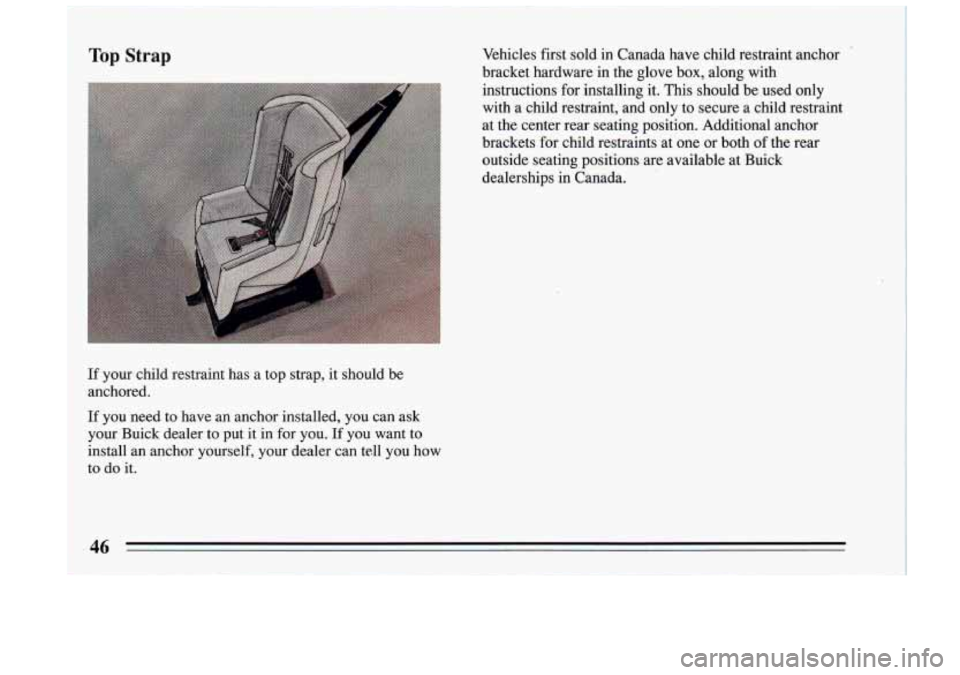
If your child restraint has a
anchored. top strap,
it should be
If you need to have an anchor installed, you can ask your Buick dealer to put it in for you. If you want to
install an anchor yourself, your dealer can tell you how
to do it.
Page 49 of 324
Securing a Child Restraint in, a Rear
Outside Position
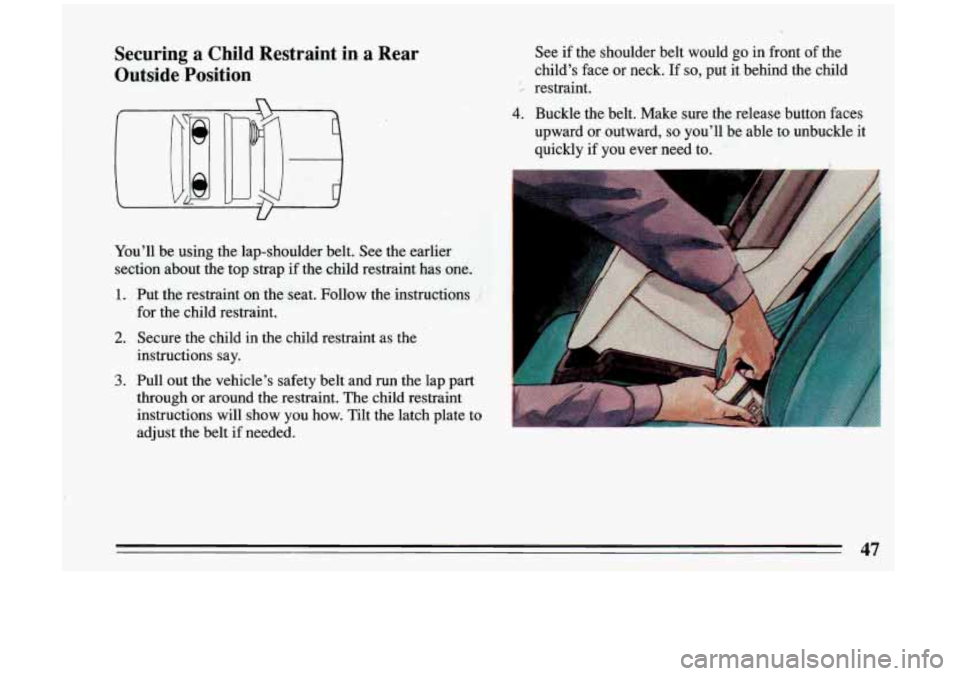
You’ll be using the lap-shoulder belt. See the earlier
section about the top strap if the child restraint has one. See
if the shoulder belt would go in front
of the
child’s face or neck.
If so, put it behind the child
4. Buckle the belt. Make sure the release button faces
upward or outward,
so you’ll be able to unbuckle it
quickly
if you ever need to.
;- restraint.
1. Put the restraint on the seat. Follow the instructions
for the child restraint.
.. .
2. Secure the child in the child restraint as the
instructions say.
3. Pull out the vehicle’s safety belt and run the lap part
through
or around the restraint. The child restraint
instructions will show
you how. Tilt the latch plate to
adjust the belt if needed.
47
Page 51 of 324
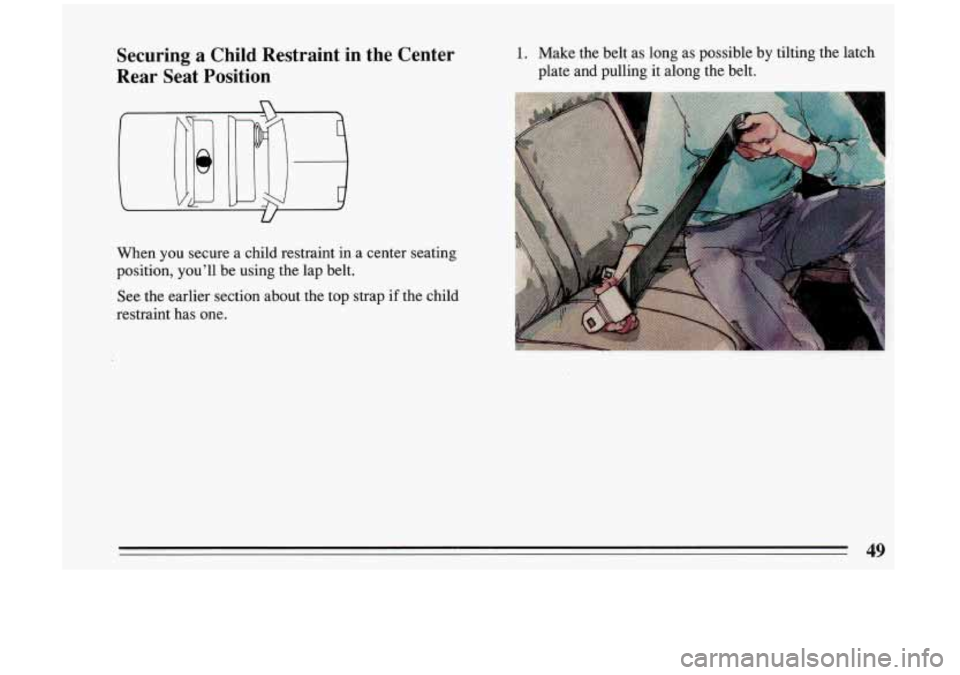
Securing a Child Restraint in the Center
Rear Seat Position 1. Make the belt as long as possible by tilting the latch
plate and pulling it along the belt.
When
you secure a child restraint in a center seating
position, you’ll be using the lap belt.
See the earlier section about the top strap if the child
restraint has one.
49
Page 52 of 324
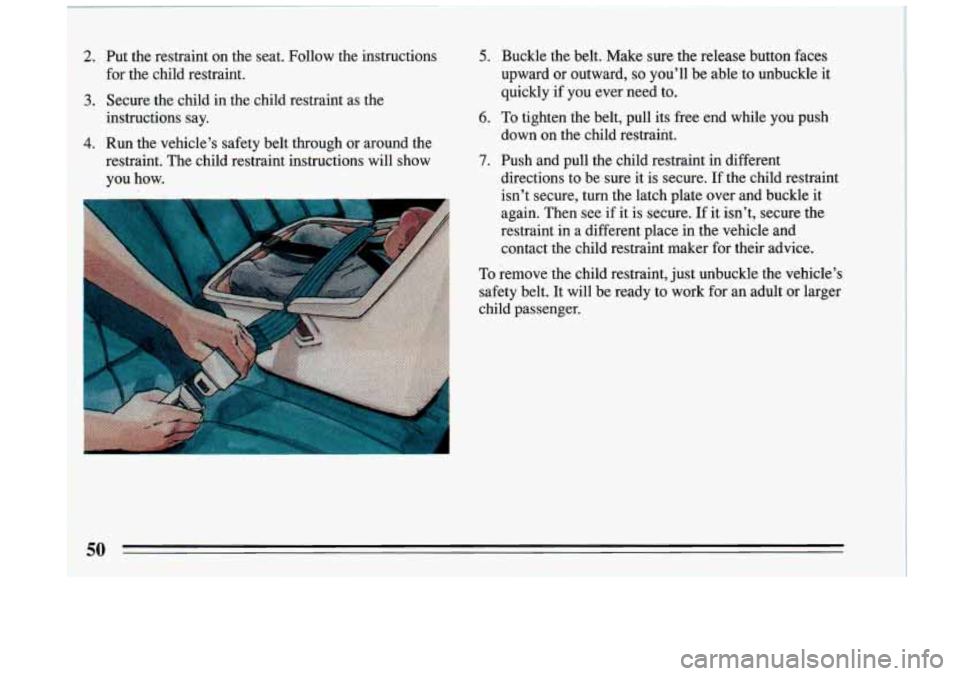
2. Put the .restraint on the seat. Follow the instructions
for the child restraint.
3. Secure the child in .the child restraint as the
instructions say.
4. Run the vehicle’s safety belt through or around the restraint. The child restraint instructions will show
you how.
5. Buckle the belt. Make sure the release button faces
upward or outward,
so you’ll be able to unbuckle it
quickly if you ever need to.
6. To tighten the belt, pull its free end while you push
down on the child restraint.
7. Push and pull the child restraint in different
directions to be sure it is secure. If the child restraint
isn’t secure, turn the latch plate over and buckle it again. Then see if it is secure. If it isn’t, secure the
restraint in a different place in the vehicle and contact the child restraint maker for their advice.
To remove the child restraint, just unbuckle the vehicle’s
safety belt. It will be ready to work for an adult or larger\
child passenger.
50
Page 53 of 324
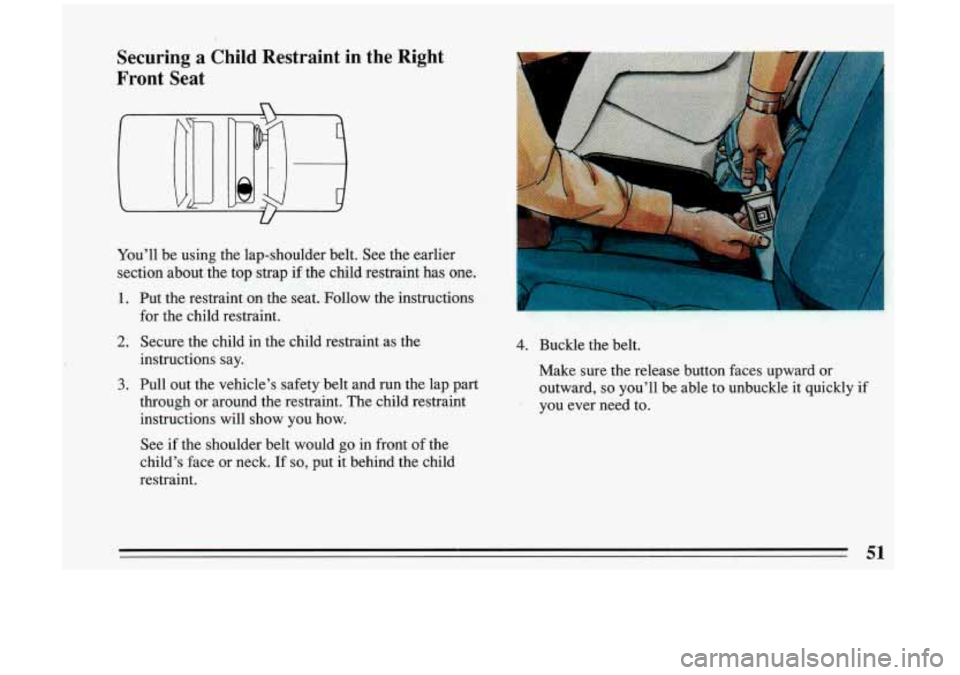
Securing a Child Restraint in the Right
Front Seat
You’ll be using the lap-shoulder belt. See the earlier .
section about the top strap if the child restraint has one.
1. Put the restraint on, the seat. Follow the instructions
for the child restraint.
2. Secure the child in the child restraint as the
instructions say.
3. Pull out the vehicle’s safety belt and run the lap part
through or around the restraint. The child restraint
instructions will show you how.
See if the shoulder belt would go
in front of the
child’s face
or neck. If so, put it behind the child
restraint:
4. Buckle the belt.
Make sure the release button faces upward or outward,
so you’ll be able to unbuckle it quickly if
you ever need to.
51
Page 56 of 324
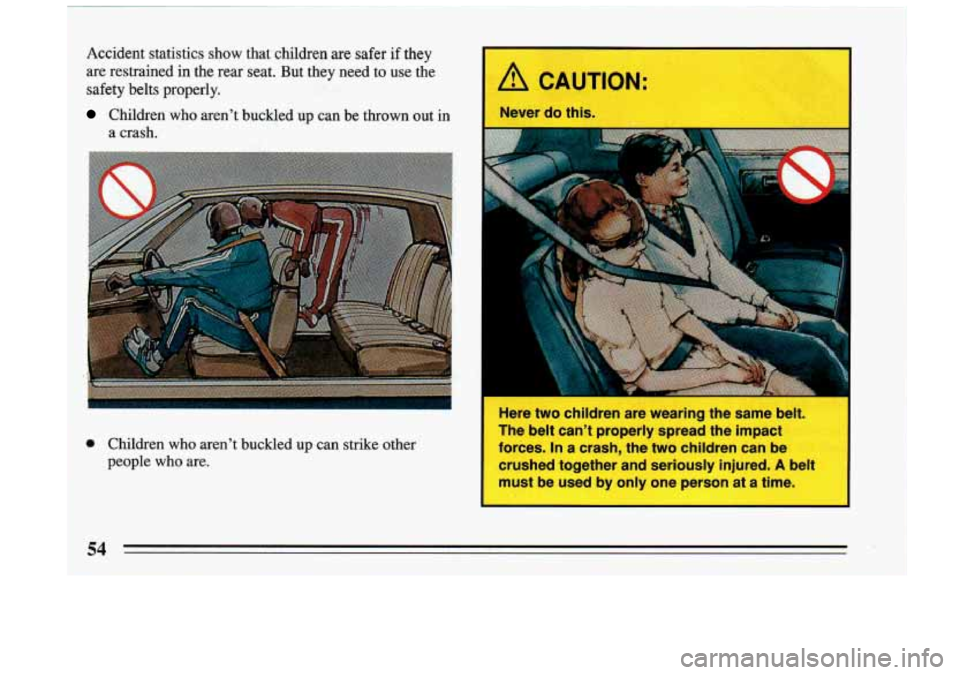
Accident statistics show that childsen are safer if they
are restrained in the rear seat. But they need
to use the
safety belts properly.
Children who aren’t buckled up can be thrown out in
a crash.
m Children who aren’t buckled up can strike other
people who are.
Here two children are wearing the same belt.
The belt can’t properly spread the impact
forces. In
a crash, the two children can be
crushed together and seriously injured.
A belt
must be used by only one person at a time.
54
Page 58 of 324
Wherever the child sits, the lap portion of the belt
should be worn low and snug on the hips, just touching
the child’s thighs. This applies belt force to the child’s
pelvic bones in a crash.
Safety Belt ‘Extender
If the vehicle’s safety belt will fasten around you, you
should use it.
But if a safety belt isn’t long enough to fasten, your
dealer will order you an extender. It’s free. When you go
in to order it, take the heaviest coat you will wear,
so the
extender will be long enough for you. The extender will
be just for you, and just for the seat in your vehicle that
you choose. Don’t let someone else use.it, and use it
only for the seat it is made to
fit. To wear it, just attach it
to the regular safety be
Checking Your Restraint Systems
Now and then, make sure all your belts, buckles, latch
plates, retractors, anchorages and reminder systems are
working properly. Look for any loose parts or damage.
If you see anything that might keep a restraint system
from doing its job, have it repaired.