cooling BUICK RIVIERA 1993 Owners Manual
[x] Cancel search | Manufacturer: BUICK, Model Year: 1993, Model line: RIVIERA, Model: BUICK RIVIERA 1993Pages: 324, PDF Size: 16.01 MB
Page 122 of 324
Auto
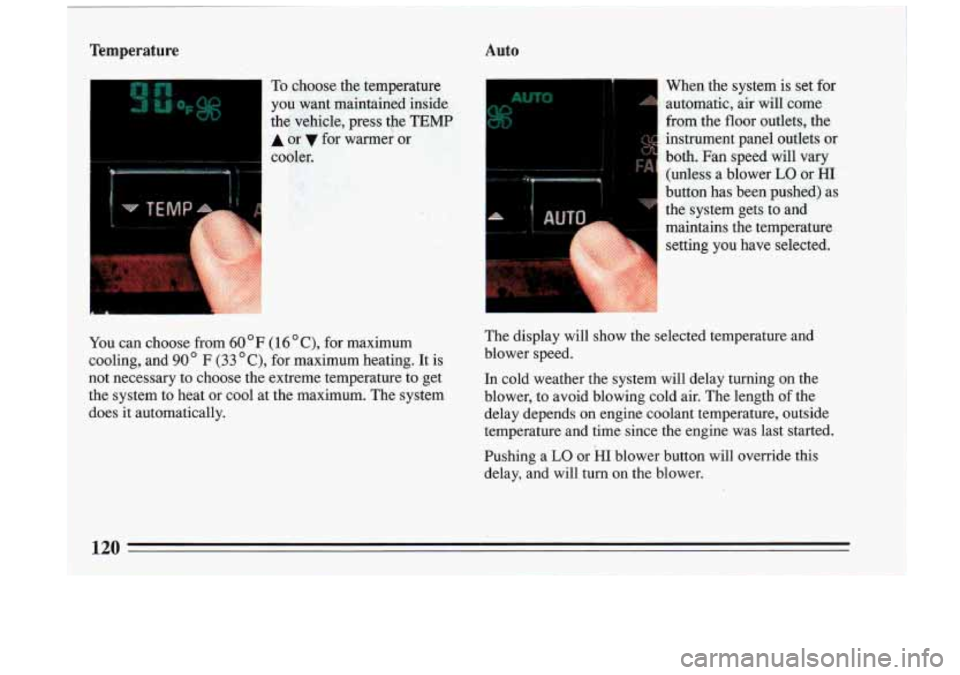
I- - To choose the temperature When the system is set
far
you- want maintained inside automatic, air
will come
the vehicle, press the
TEMP from the floor outlets, the
A or for warmer or instrument panel outlets or
cooler. both. Fan speed will vary
(unless a blower
LO or HI
:.if, button has been pushed) as
the system gets to and
maintains the temperature setting you have selected.
-
,..I . .
a
~
You can choose from 60 OF (1 6 " C), for maximum
1 cooling, and 90' F (33 "C), for maximum heating. It is The display will show the selected temperature and
blower speed.
! not necessary to choose the extreme temperature to get In cold weather the system will delay turning on the
the system to heat
or cool at the maximum. The system
blower, to avoid blowing cold air. The length of the
does it automatically. delay depends
on engine coolant temperature, outside
temperature and time since the engine was last started.
Pushing a
LO or HI blower button will override this
delay, and will turn on the blower.
120
Page 124 of 324
Econ Heater
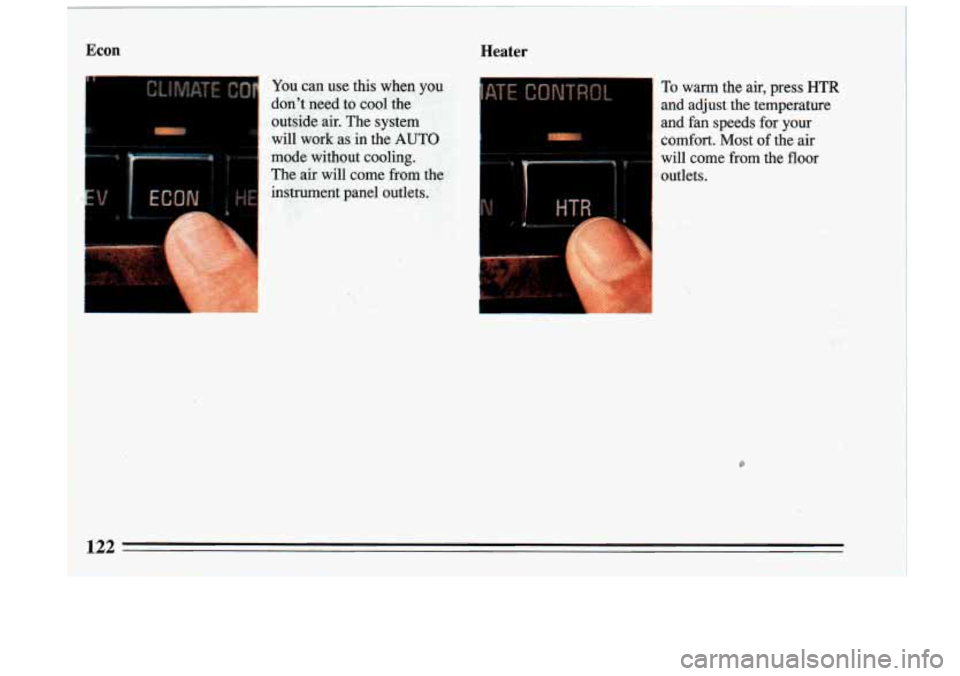
You can use this when JT~~E' To warm the air, press HTR
don't need to cool the and adjust the temperature
outside air. The system
and fan speeds for your
will work as-in the
AUTO comfort. Most of the air
mode without cooling. will come
from the floor
The air will come from
the j outlets.
ingxument panel outlets
122
Page 176 of 324
If you drive regularly in steep country, or if you're
planning to visit there, here are some tips that can make
your trips safer and more enjoyable.
0 Keep your vehicle in good shape. Check all fluid
levels and also the brakes, tires, cooling system and
transaxle. These parts can work hard on mountain
roads.
@ Know how to go down hills. The most important
thing to know
is thisi let your engine do some of the
slowing down. Don't make your brakes do it all.
Shift to a lower gear when you go down a steep or
long
hill. That way, you will slow down without
excessive use of your brakes.
If you don't shift down, your brakes could get
11 so hot that they wouldn't work well. You would
then have poor braking
or even none going
down a
hill. You could crash. Shift down to let
your engine assist your brakes on a steep
,!~~~~~~~~~~~,~~*~~-~~~~ ,-d:;,,~~,."c.~,-~.:'-- ~i~-~zg352~;~g~~g d 0 w n h i I I sf 0 pe . li,,,,~a,,.>~?&:.
I
I
I
0
/d CAUTION:
Coasting downhill in "N" (Neutral) or with the
ignition off is dangerous. Your brakes will have
to do all the work of slowing down. They could
get
so hot that they wouldn't work well. You
could crash. Always have your engine running
and your vehicle
in gear -]en you go downhill.
Know how to go uphill. You may want to shift down
to a lower gear. The lower gears help cool
your
engine and transaxle, and you can climb the hill
better.
Stay in your own lane when driving on two-lane
roads in hills or mountains. Don't swing wide or cut
across the center of the road. Drive at speeds that let
you stay in your own lane. That way, you won't be
surprised by a vehicle coming toward you
in the
same lane.
It takes longer to pass another vehicle when you're going uphill. You'll want
to leave extra room to pass.
If a vehicle is passing you and doesn't have enough
room, slow down to make it easier for the other
vehicle to get by.
Page 200 of 324
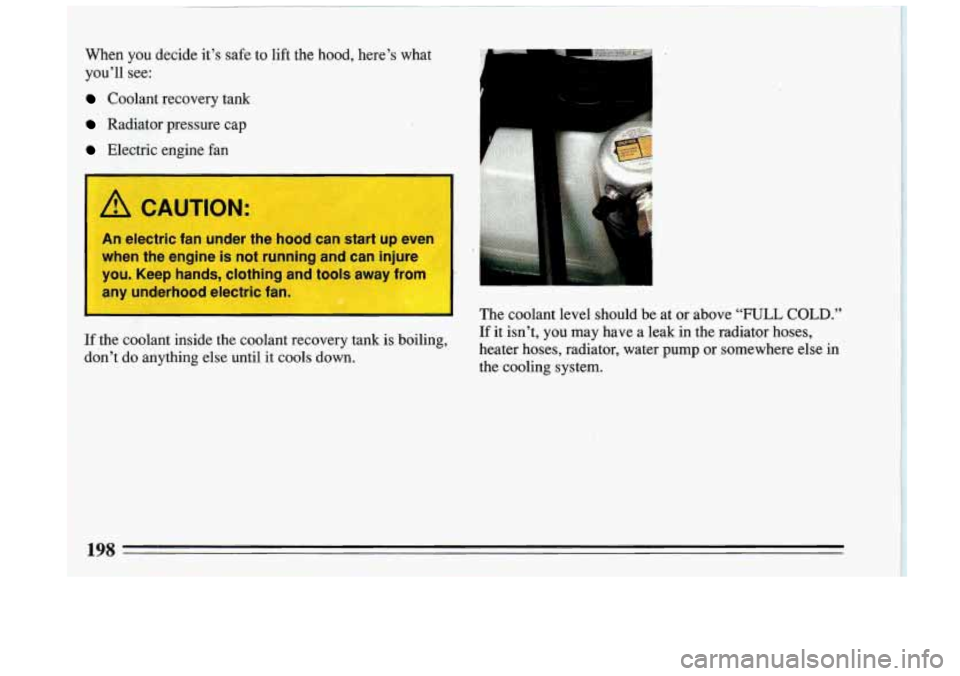
When you decide it’s safe to lift the hood, here’s what
you’ll
see:
Coolant recovery tank
Radiator pressure cap
Electric engine fan
An electric fan under the hood can start up even
when the engine is not running and can injure
you. Keep hands, clothing and tools away from
any underhood electric fan.
I
If the coolant inside the coolant recovery tank is boiling,
don’t do anything else until it coals down. The coolant level should be at or above
“FULL COLD.”
If it isn’t, you may have a leak in the radiator hoses,
heater hoses, radiator, water pump or somewhere else
in
the cooling system.
198
Page 201 of 324
I
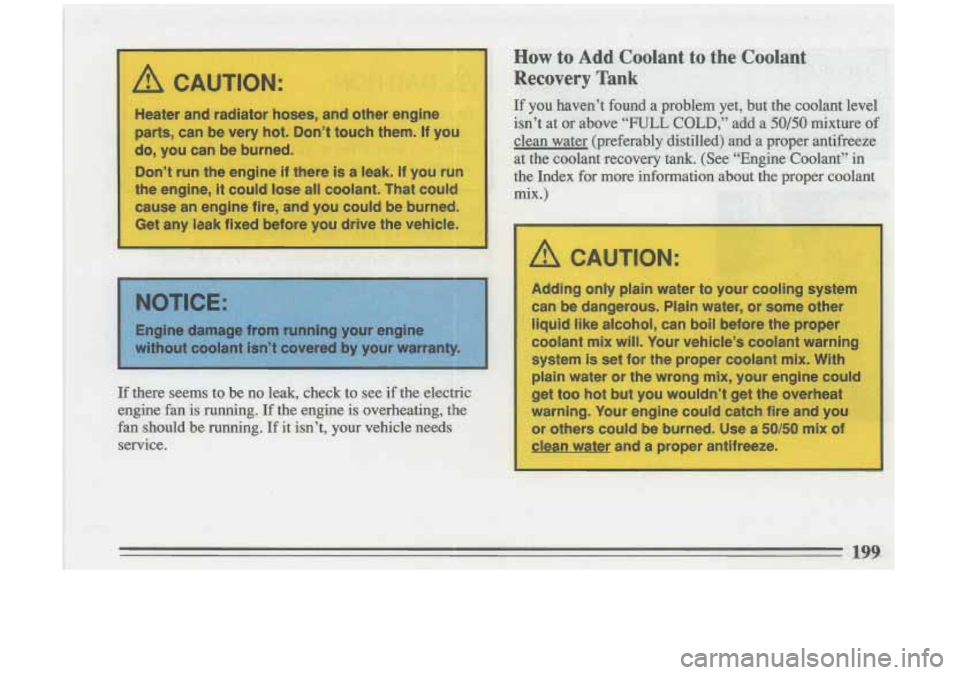
A CAUTION:
' ~ Heater and radiator hoses, and other engine
--# parts, can be very hot. Don't touch them. If you I 1
.': do, you can be burned.
Don't
run the engine if there is a leak. If you run
the engine,
it could lose all coolant. That could
..~ cause an engine fire, and you could be burned.
I_ '1 Get any leak fixed before you drive the vehicle. /I
,
A CAUTION:
Adding only plain water to your cooling system
can be dangerous. Plain water, or some other
liquid like alcohol, can boil before the proper
coolant mix
will. Your vehicle's coolant warning
system
is set for the proper coolant mix. With
plain water or the wrong mix, your engine could
get too hot but you wouldn't get the overheat
warning. Your engine could catch fire and you
or others could be burned. Use a
5060 mix of
clean water and a proper antifreeze.
Page 202 of 324
I
I
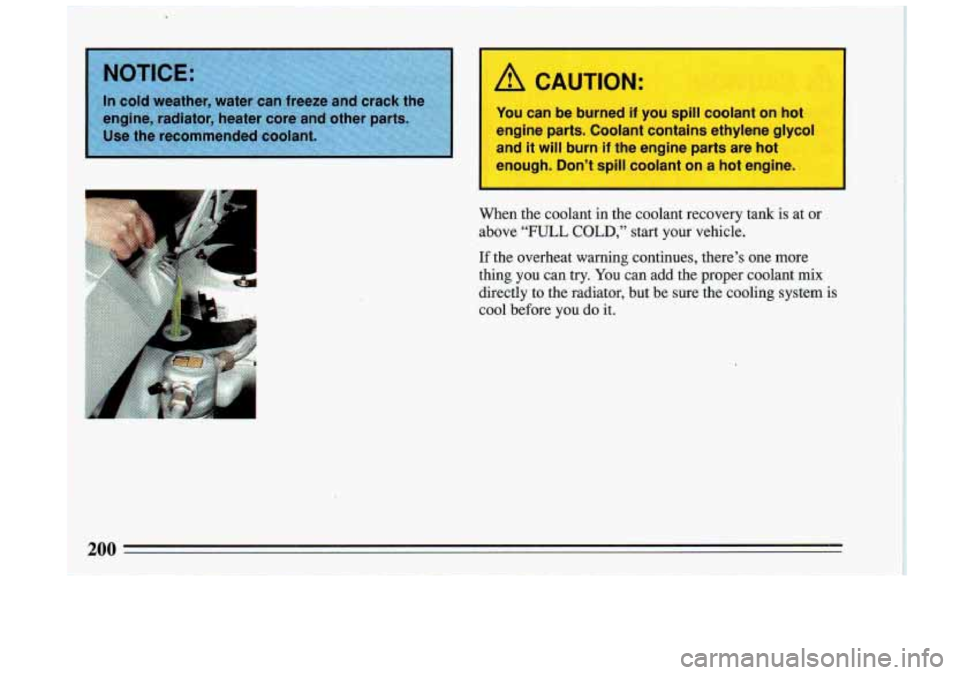
CAUTION:
You can be burned if you spill coolant on hot
engine parts. Coolant contains ethylene glycol
and it will burn
if the engine parts are hot
enough. Don’t spill coolant on a hot engine.
When the coolant in the coolant recovery tank is at or
above
“FULL COLD,” start your vehicle.
If the overheat warning continues, there’s one more
thing
you can try. You can add the proper coolant mix
directly to the radiator, but be sure the cooling system is
cool before
you do it.
Page 203 of 324
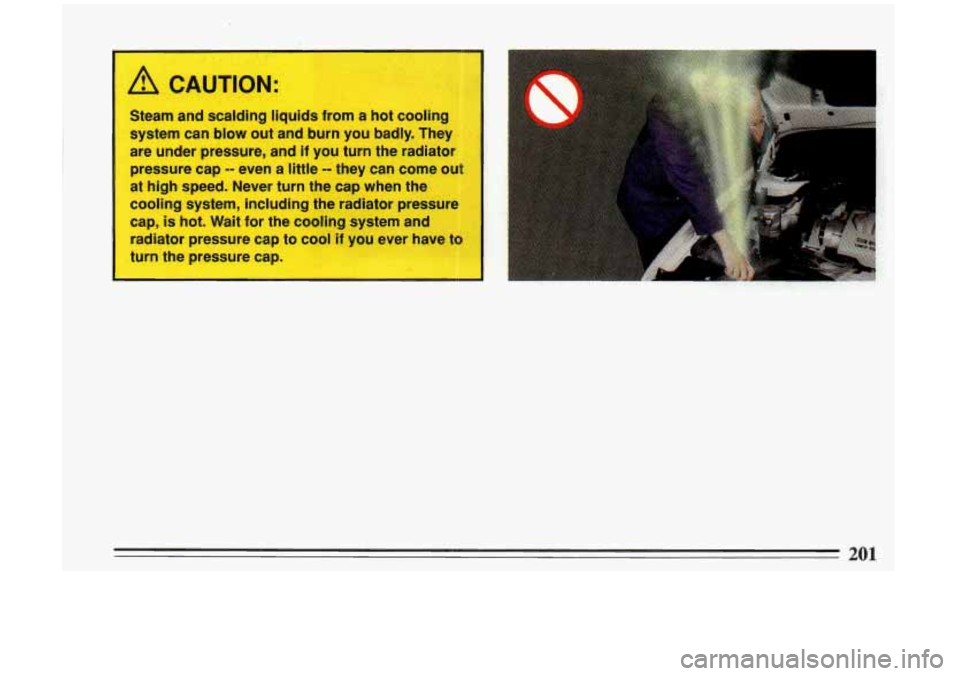
A CAUTION:
Steam and scalding liquids from a hot cooling
system can blow out and burn you badly. They
are under pressure, and if you turn the radiator
pressure cap
-- even a little -- they can come out I
at high speed. Never turn the cap when the
cooling system, including the radiator pressure
cap, is hot. Wait for the cooling system and
radiator pressure cap to cool if you ever have
to
turn the pressure cap. $@.:;<;J &gjK&p
sa , Ad
Page 204 of 324
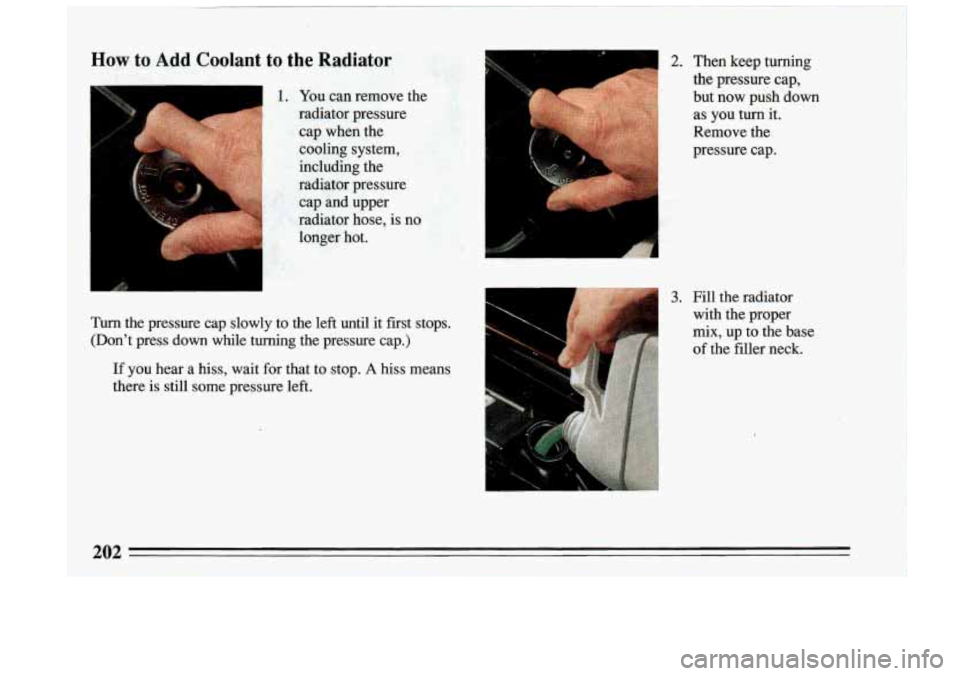
How to Ad,d Coolant to the Radiator
You can remove the
radiator pressure
cap when the
cooling system,
including the
radiator pressure cap
and upper
radiator hose, is no
longer hot.
Turn the pressure cap slowly to the left until it first stops\
.
(Don't press down while turning the pressure cap.)
If you hear a hiss, wait for that to stop. A hiss means
there is still some pressure left.
1 2. Then keep turning
the pressure cap,
but now push down as you turn it.
Remove the pressure cap.
3. Fill the radiator
with the proper
mix, up to the base
of the filler neck.
202
Page 233 of 324
are made especially for your automatic transaxle.
Damage caused by fluid other than
DEXRONs-IIE is
not covered by your new vehicle warranty.
After adding fluid, recheck the fluid level as
described under
“How to Check.”
When the correct fluid level is obtained, push the
dipstick back in all the way.
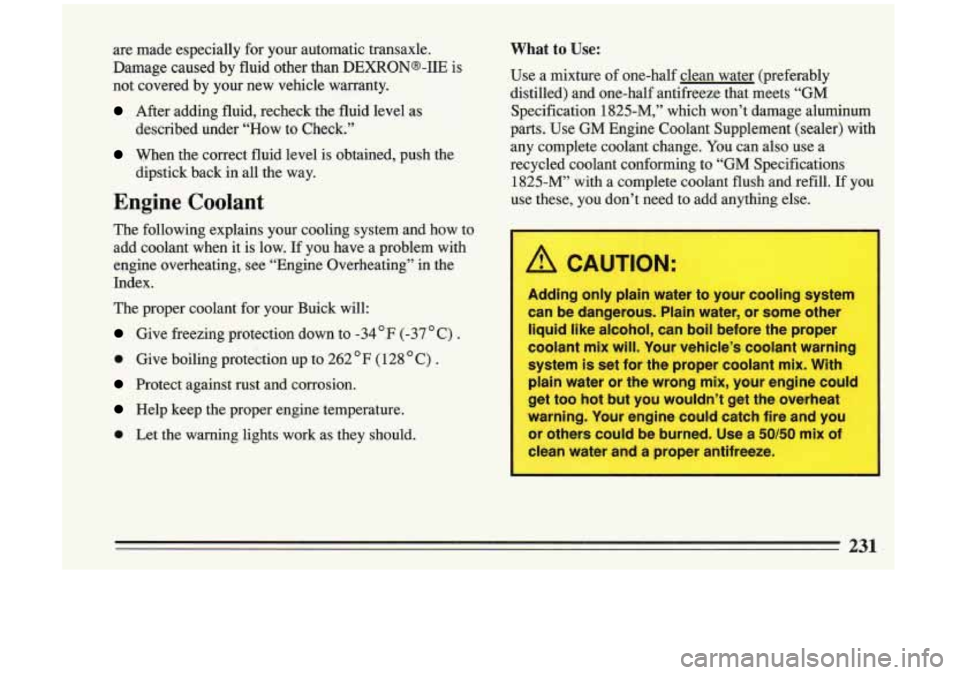
Engine Coolant
The following explains your cooling system and how to
add coolant when it is low. If you have a problem with
engine overheating, see “Engine Overheating” in the
Index.
The proper coolant for your Buick
will:
Give freezing protection down to -34’F (-37 ’ C) .
0 Give boiling protection up to 262 ’ F ( 128 ’ C) .
Protect against rust and corrosion.
Help keep the proper engine temperature.
0 Let the warning lights work as they should.
What to Use:
Use a mixture of one-half clean water (preferably
distilled) and one-half antifreeze that meets “GM Specification 1825-M,” which won’t damage aluminum
parts. Use GM Engine Coolant Supplement (sealer) with
any complete coolant change. You can also use a
recycled coolant conforming to “GM Specifications
1825-M” with a complete coolant flush and-refill.
If you
use these, you don’t need to add anything else.
Adding only plain water to your cooling system
can be dangerous. Plain water, or some other
liquid like alcohol, can boil before the proper
coolant mix will. Your vehicle’s coolant warnin!
system
is set for the proper coolant mix. With
plain water or the wrong mix, your engine coul
get
too hot but you wouldn’t get the overheat
warning. Your engine could catch fire and you
or others could be burned. Use a
50150 mix of
clean water and
a proper antifreeze.
231
Page 276 of 324
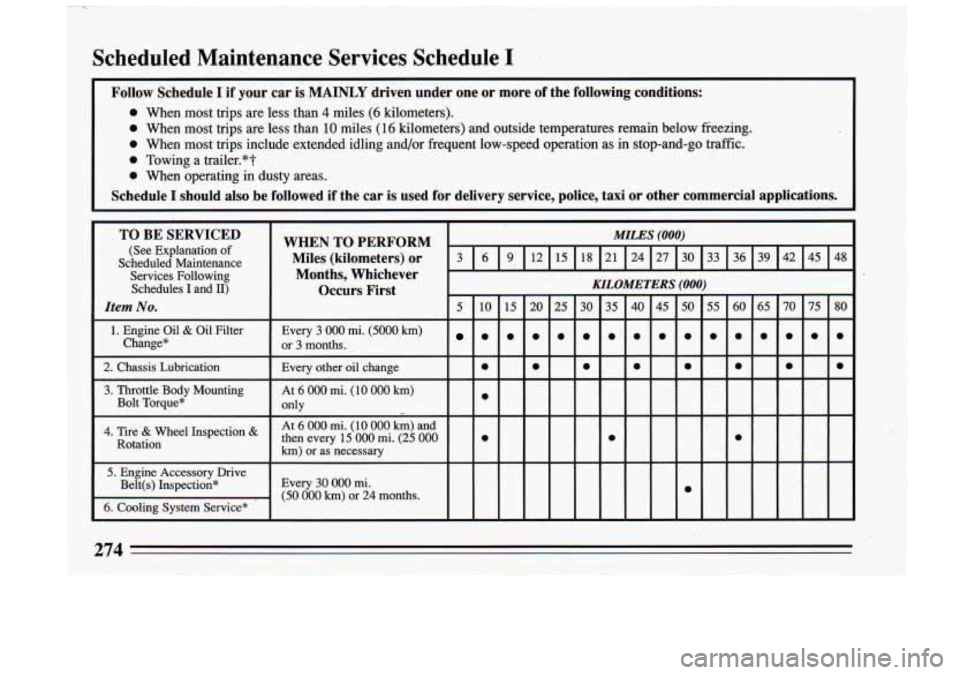
Scheduled Maintenance Services Schedule I
Follow Schedule I if your car is MAINLY driven under one or more of the following conditions:
0 When most trips are less than 4 miles (6 kilometers).
0 When most trips are less than 10 miles (16 kilometers) and outside temperatures remain below fieezing.
0 When most trips include extended idling and/or frequent low-spee\
d operation as in stop-and-go traffic.
0 Towing a trailer.*?
0 When operating in dusty areas.
Schedule I should also be followed if the car is used for delivery service, police, taxi or other commercial applications.
TO BE SERVICED
(See Explanation of
Scheduled Maintenance
Services Following
Schedules
I and n)
Item No.
1. Engine Oil & Oil Filter
Change*
2. Chassis Lubrication
3. Throttle Body Mounting
Bolt Torque*
4. Tire
& Wheel Inspection &
Rotation
5. Engine Accessory Drive Belt(s) Inspection*
6. Cooling System Service*
WHEN TO PERFORM
Miles (kilometers) or Months, Whichever MILES (000)
Occurs First
k
Every 3 000 mi. (5000 km)
or 3 months. , I
Every other oil change
At
6 000 mi. (10 000 km)
only
I
At 6 000 mi. (10 000 km) and
then every
15 000 mi. (25 000
km) or as necessary I
Every 30 000 mi.
(50 000 km) or 24 months.
KILOMETERS (000)
30 35
00
0
0
..
45 50 55
000
0
0
65 70
00
0
274