tire pressure BUICK RIVIERA 1993 Owners Manual
[x] Cancel search | Manufacturer: BUICK, Model Year: 1993, Model line: RIVIERA, Model: BUICK RIVIERA 1993Pages: 324, PDF Size: 16.01 MB
Page 168 of 324
r/d CAUTION:
Wet brakes can cause accidents. They won’t
work well in a quick stop and may cause pulling
to one side. You could lose control of the
vehicle.
After driving through a large puddre of water or
a car wash, apply your brake pedal lightly until
your brakes work normally.
I- Hydroplaning
I
1 Hydroplaning is dangerous. So much water can build up
under your tires that they can actually ride on the water.
This can happen if the road is wet enough and you’re
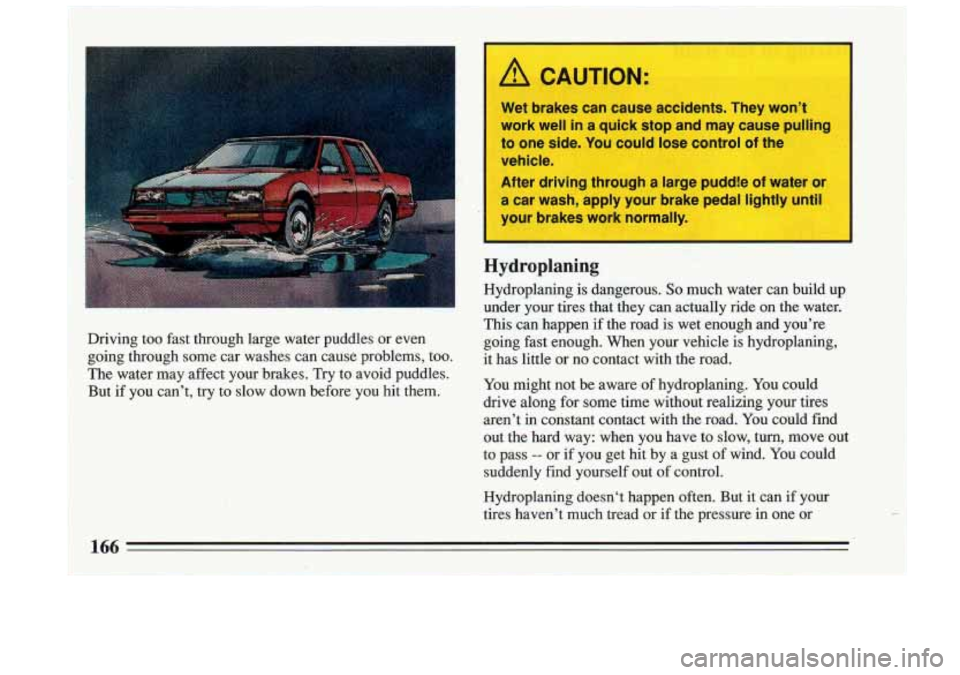
Driving too fast through large water puddles or even
going fast enough. When your vehicle is hydroplaning,
going through some car washes can cause problems, too. it has little or no contact with the road.
The water may affect your brakes. Try to avoid puddles.
But if you can’t, try to slow down before you hit them. You
might not be aware of hydroplaning. You could
drive along for some time without realizing your tires aren’t
in constant contact with the road. You could find
out the hard way: when you have to slow, turn, move out
to pass
-- or if you get hit by a gust of wind. You could
suddenly find yourself out of control.
Hydroplaning doesn‘t happen often. But it can if your
tires haven’t much tread or if the pressure in one or
Page 169 of 324
if the pressure in one or more is low. It can happen if a
lot of water
is standing on the road. If you can see
reflections from trees, telephone poles, or other vehicles, and raindrops “dimple” the water’s surface, there could \
be hydroplaning.
Hydroplaning usually happens at higher speeds. There
just isn’t a hard and fast rule about hydroplaning. The
best advice is to slow down when it is raining, and be
.
careful.
Some Other .Rainy Weather Tips
0
0
0
0
0
Turn on your headlights -- not just your parking
lights
-- to help make you more visible to others.
Look for hard-to-see vehicles corning from behind.
You may want to use your headlights even in
daytime if it’s raining hard.
Besides slowing down, allow some extra following
distance. And be especially careful when you pass
another vehicle. Allow yourself more clear room
ahead, and be prepared to have your view restricted
by road spray. If the road spray is
so heavy you are
actually blinded, drop back. Don’t pass until conditions improve. Going more slowly
is better
than having an accident.
Use your defogger
if it helps.
Have good tires with proper tread depth. (See
“Tires” in the Index.)
Driving in Fog, Mist and Haze
IIII
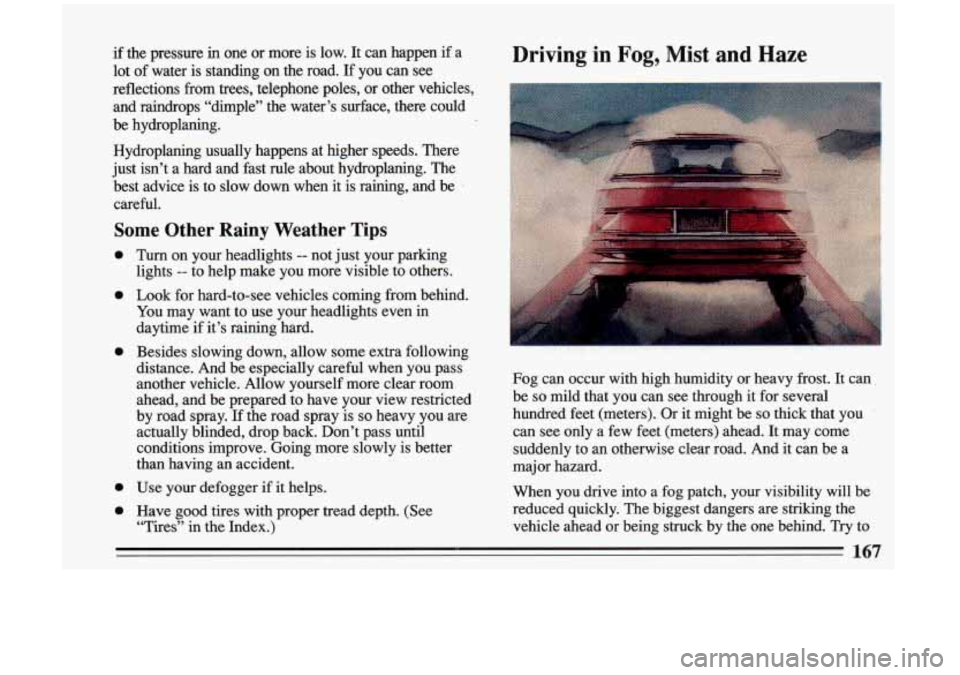
Fog can occur with high humidity or heavy frost. It can,
be
so mild that you can see through it for several
hundred feet (meters).
Or it might be so thick that you
can see only a few feet (meters) ahead. It may come
suddenly to an otherwise clear road. And it can be a
major hazard.
When you drive into a fog patch, your visibility will be
reduced quickly. The biggest dangers are striking the
vehicle ahead
or being struck by the one behind. Try to
167
Page 174 of 324
~ Before Leaving on a
Long Trip 0 Weather Forecasts: What’s the weather outlook along
your route? Should
you delay your trip a short time
Make sure you’re ready. Try to be well rested. If you to avoid a major storm system?
must start when you’re not fresh
-- such as after a day’s
work
-- don’t plan to make too many miles that first part 0 Maps: Do you have up-to-date maps?
I
of the journey. Wear comfortable clothing and shoes you
can easily drive in. On the Road
Is your vehicle ready for a long trip? If you keep it
serviced and maintained, it’s ready to go. If it needs
service, have it done before starting out. Of course,
you’ll find experienced and able service experts in
Buick dealerships all across North America. They’ll be
ready and willing to help if
you need it.
Here are
some things you can check before a trip:
0 Windshield Washer Fluid: Is the reservoir full? Are
all windows clean inside and outside?
0 Wiper Blades: Are they in good shape!
0 Fuel, Engine Oil, Other Fluids: Have you checked all
levels?
0 Lights: Are they all working? Are the lenses clean?
0 Tires: They are vitally important to a safe,
trouble-free trip.
Is the tread good enough for
long-distance driving?
Are the tires all inflated to the
recommended pressure? Unless you
are the only driver, it is good to share
the
driving task with others. Limit turns behind the wheel to
about
100 miles (160 km) or two hours at a sitting.
Then, either change drivers or stop for some refreshment
like coffee, tea or soft drinks and some limbering up. But do stop and move around. Eat lightly along the way.
Heavier meals tend to make some people sleepy.
On two-lane highways or undivided multilane highways
that do not have controlled access, you’ll want to watch for some situations not usually found on freeways.
Examples are: stop signs and signals, shopping centers with direct access to the highway, no passing zones and school zones, vehicles turning left and right off the road,
pedestrians, cyclists, parked vehicles. td even animals.
Highway Hypnosis
Is there actually such a condition as “highway
hypnosis”?
Or is it just plain falling asleep at the wheel?
Call
it highway hypnosis, lack of awareness, or
whatever.
172
Page 206 of 324
I
8.
If a Tire Goes Flat
It’s unusual for a tire to “blow out” while you’re driving,
especially if you maintain your tires properly.
If air goes
out of a tire, it’s much more likely to lepk out slowly.
But if you should ever have a “blowout,” here are a few\
tips about what to expect and what to do:
If a front tire fails, the flat tire will create a drag that
pulls the vehicle toward that side. Take your foot
off the
accelerator pedal and grip the steering wheel firmly.
Steer to maintain lane position, then gently brake to a
stop well out of the traffic lane.
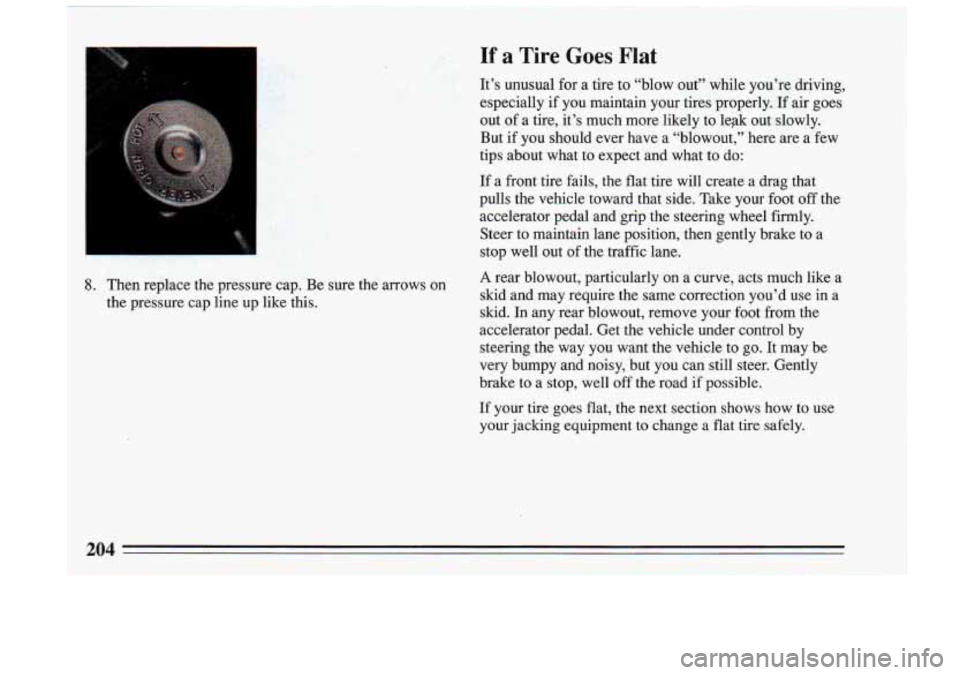
Then replace the pressure cap. Be sure the arrows on
the pressure
cap line up like this.
A rear blowout, particularly on a curve, acts much like a
skid and may require the same correction you’d use in
a
skid. In any rear blowout, remove your foot from the
accelerator pedal. Get the vehicle under control by
steering the way you want the vehicle
to go. It may be
very bumpy and noisy, but you can still steer. Gently
brake to a stop, well
off the road if possible.
If your tire goes flat, the next section shows how to use
your jacking equipment to change a flat tire safely.
204
____
Page 214 of 324
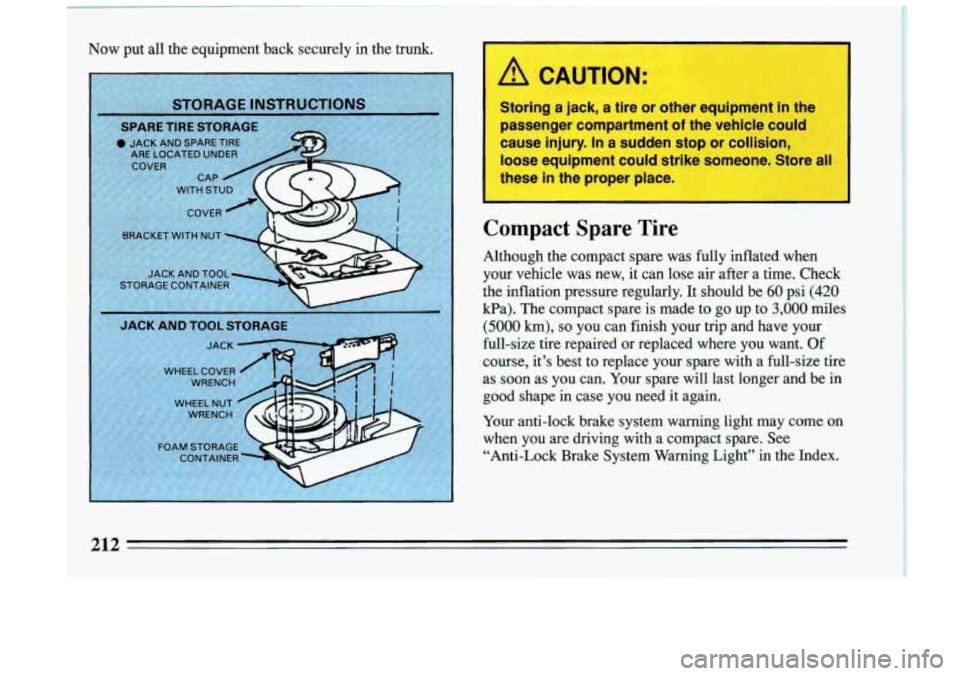
Now put all the equipment back securely in the trunk.
Compact Spare Tire
Although the compact spare was fully inflated when
your vehicle was new, it can lose air after a time. Check
the inflation pressure regularly. It should be
60 psi (420
kPa). The compact spare is made to go up to 3,000 miles
(5000 km), so you can finish your trip and have your
full-size tire repaired or replaced where you want.
Of
course, it’s best to replace your spare with a full-size ti\
re
as soon as you can. Your spare will last longer and be in
good shape in case you need it again.
Your anti-lock brake system warning light may come on
when you are driving with a compact spare. See
“Anti-Lock Brake System Warning Light” in the Index.
212
Page 244 of 324
Remove the bulb from the Loading Your Vehicle
bulb socket by turning it
counterclockwise.
%I OCCUPANTS VEHICLE CAP. WT.
I
TIRE-LOADING INFORMATION,
FRT. CTR. RR. TOTAL
LBS. KG
MAX. LOADING & GVWR SAME AS VEHICLE
CAPACITY WEIGHT XXX COLD
TIRE
TIRE SIZE SPEED PRESSURE
RTG PSI/KPa
FRT.
RR.
SPA.
IF TIRES ARE HOT, ADD 4PS1128KPa
SEE OWNER'S MANUAL FOR ADDITIONAL
1 Install a new bulb into the socket turning it clockwise INFORMATION 111-p ?j$##..:,
(right) until it is locked in place. Insert the socket into \
the lamp and turn it clockwise (right) to lock it into
place. Reverse the instructions to replace the taillamp assembly.
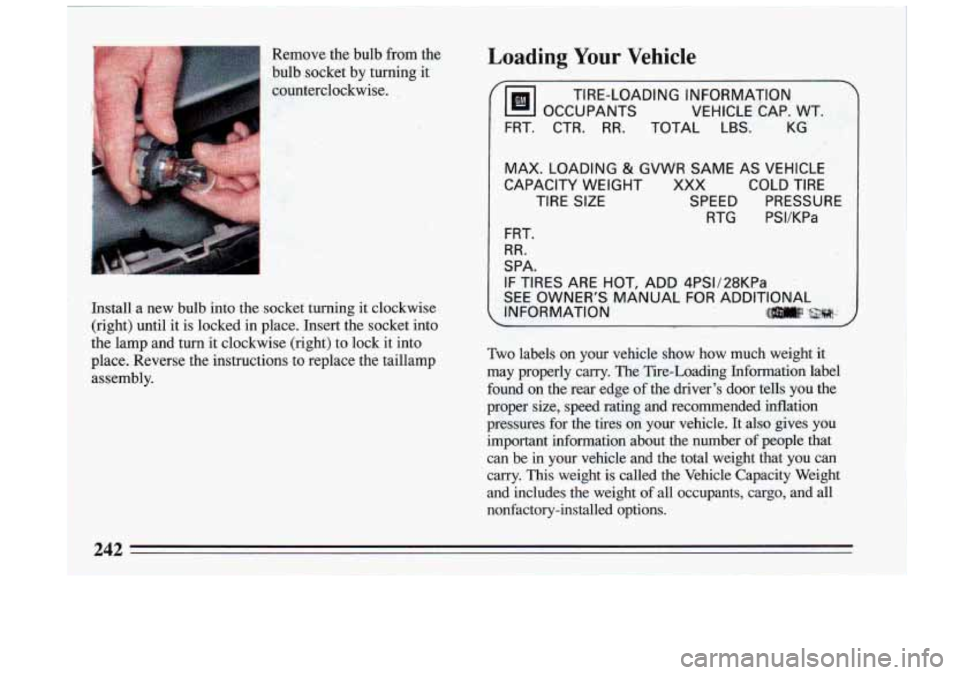
Two labels on your vehicle show how much weight it
may properly carry. The Tire-Loading Information label
found on the rear edge of the driver's door tells you the
proper size, speed rating and recommended inflation
pressures for the tires on your vehicle. It also gives you
important information about the number of people that can be in your vehicle and the total weight that you can
carry. This weight is called the Vehicle Capacity Weight
and includes the weight
of all occupants, cargo, and all
nonfactory-installed options.
242
Page 246 of 324
TI
I
A CAUTION:
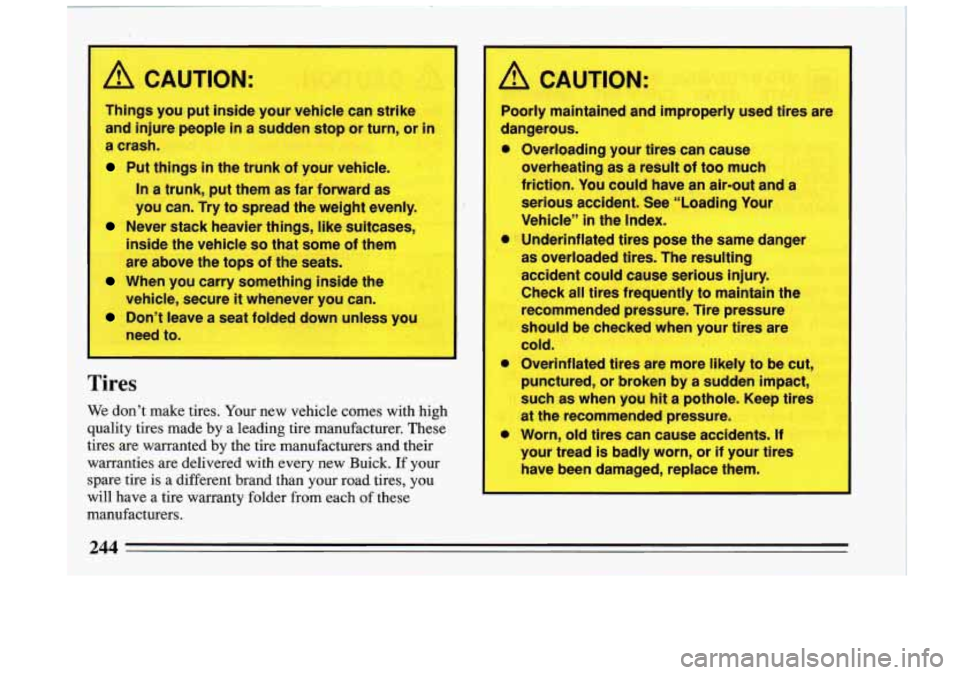
1 Things you put inside your vehicle can strike
! I
' and injure people in a sudden stop or turn, or in
j a crash.
Put things in the trunk of your vehicle.
In a trunk, put them as far forward as
you can. Try to spread the weight evenly.
Never stack heavier things, like suitcases,
inside the vehicle
so that some of them
are above the tops of the seats.
vehicle, secure it whenever you can.
need to.
When you carry something inside the
Don't leave a seat folded down unless you
Tires
We don't make tires. Your new vehicle comes-with high
quality tires made by a leading tire manufacturer. These
tires are warranted by the tire manufacturers and their warranties are delivered with every new Buick.
If your
spare tire is a different brand than your road tires, you
will have
a tire warranty folder from each of these
manufacturers.
I
A?!,, CAUTION:
1
Poorly maintained and' i!rn,pvaget.ly used tires are
dangemus.
* Owrloadi'ng your tlires can cause
overheatingl
as a result of too much,
friction. You could have an air-crut and a
Vehicle"
in the Index.
Underinflated tires pose tlhe same danger
6s overloaded tires. The viesulting
acci'dent could cause seriouls injury.
Check all1 tires frequently to msintdn the "
recormmended pressure,. Tire (pressure
shoul,d
be checked w'hsn your tires a're
I * averinflated tires are moire likely t'o be ,GU!~,
punctured, 'or broken by a sudden impact,,
such as when you, hit a pothole. Keep tires
at the recommended pres'sura
0 Worn, old tires can cause accidents. If
your tread is ;badily worm,, lor if your tires
have been damaged, replace them
I serious accident. See "kading Your
Gold.
244
Page 247 of 324
Inflation - Tire Pressure
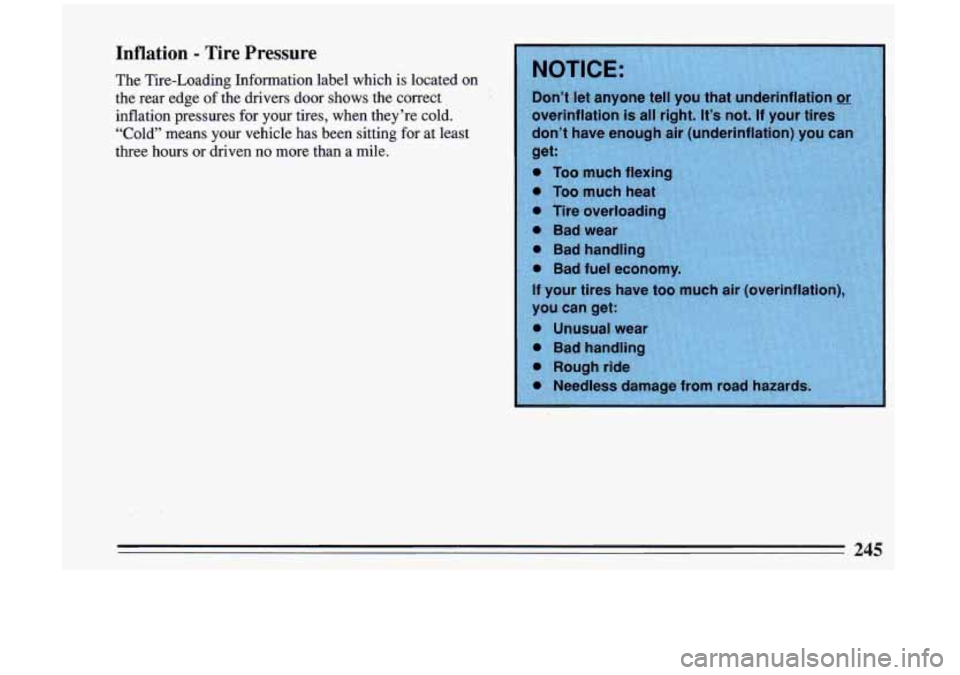
The Tire-Loading Information label which is located on
the rear edge
of the drivers door shows the correct
inflation pressures
for your tires, when they’re cold.
“Cold” means your vehicle has been sitting for at least
three hours or driven no more than a mile.
245
Page 248 of 324
When to Check: Check your tires once a month or
more.
Don’t forget your compact spare tire. It should be at
60
psi (420 kPa).
I
How to Check: Use a good quality pocket-type gage to
check tire pressure. Simply looking at the tires will not
tell you the pressure, especially
if you have radial tires --
which may look properly inflated even if they’re
underinflated.
If your tires have valve caps, be sure to put them back on. They help prevent leaks .by keeping out dirt and
moisture.
Tire Inspection and Rotation
To make your tires last longer, have them inspected and
rotated at the mileages recommended
in the
Maintenance, Schedule. See “Scheduled Maintenance
Services”
in the Index.
r-
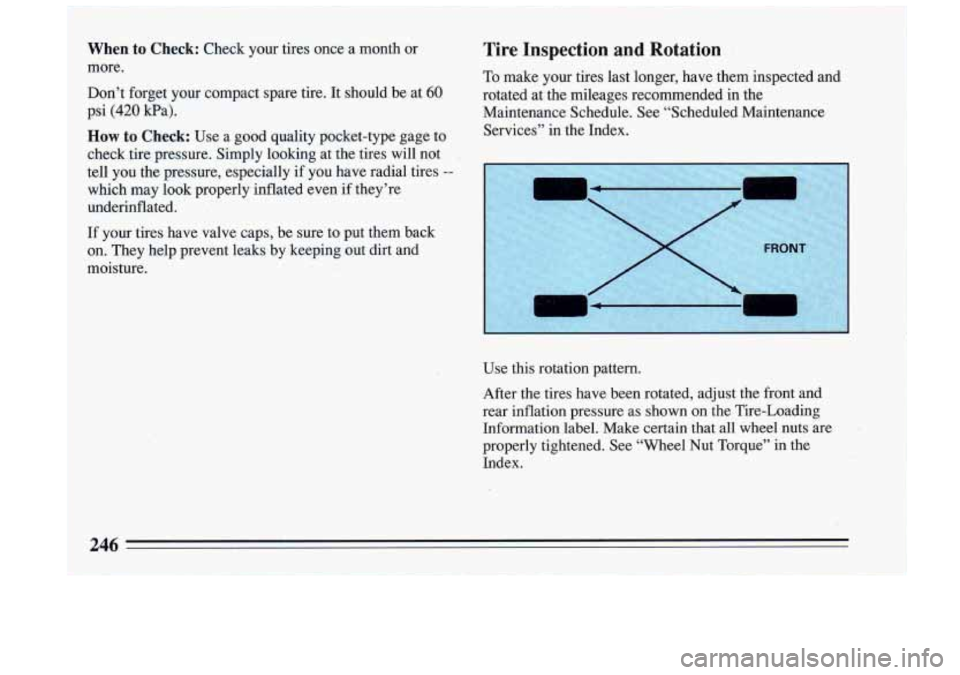
Use this rotation pattern.
After the tires have been rotated, adjust the front and
rear inflation pressure
as shown on the Tire-Loading
Information label. Make certain that all wheel nuts are
properly tightened. See “Wheel Nut Torque”
in the
Index.
Page 283 of 324
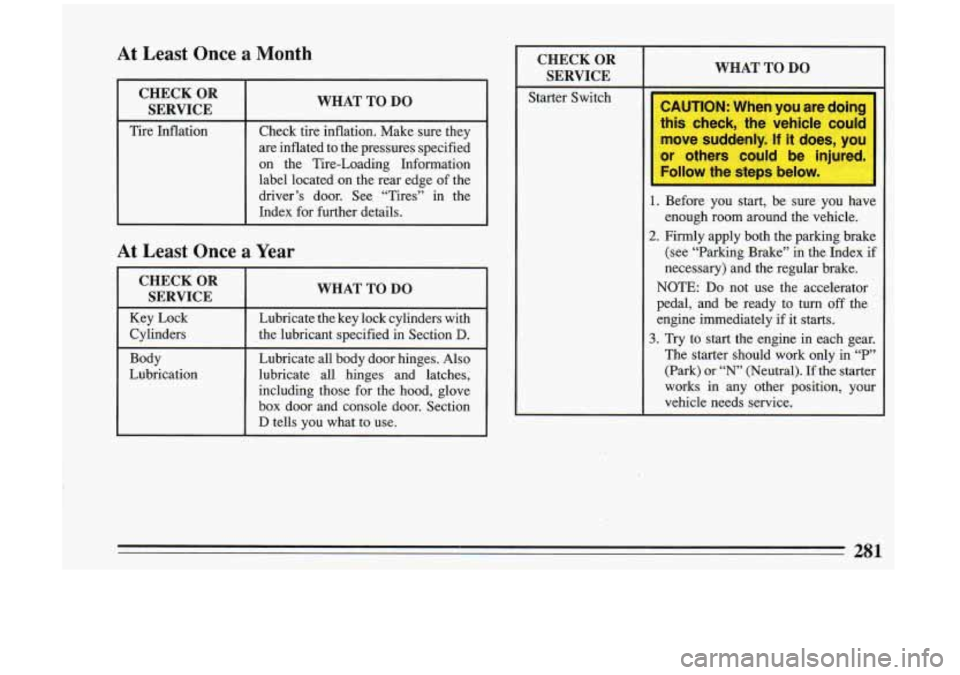
At Least Once a Month
CHECK OR
Tire Inflation
WHAT TO DO
~~ ~~ ~~ ~
Check tire inflation. Make sure they
are inflated to the pressures specified
on the Tire-Loading Information
label located on the rear edge of the
driver’s door. See “Tires” in the
Index for further details.
At Least Once a Year
CHECK OR
SERVICE I WHAT TO DO
Key Lock
the lubricant specified
in Section D. Cylinders Lubricate the key lock cylinders with
Lubricate all body door hinges. Also
Body
Lubrication lubricate ‘all hinges and latches,
including those for the hood, glove
box door and console door. Section
D tells you what to use.
CHECK OR SERVICE
Starter Switch
WHAT TO DO
or others could be injured.
Follow the stem below.
I
1. Before you start, be sure you have
enough room around the vehicle.
2. Firmly apply both the parking brake (see “Parking Brake” in the Index if
necessary) and the regular brake.
NOTE: Do not use the accelerator
pedal, and be ready to
turn off the
engine immediately if it starts.
3. Try to start the engine in each gear.
The starter should work only
in “P”
(Park) or “N” (Neutral). If the starter
works in any other position, your
vehicle needs service.
281