warning lights BUICK RIVIERA 1993 Owners Manual
[x] Cancel search | Manufacturer: BUICK, Model Year: 1993, Model line: RIVIERA, Model: BUICK RIVIERA 1993Pages: 324, PDF Size: 16.01 MB
Page 14 of 324
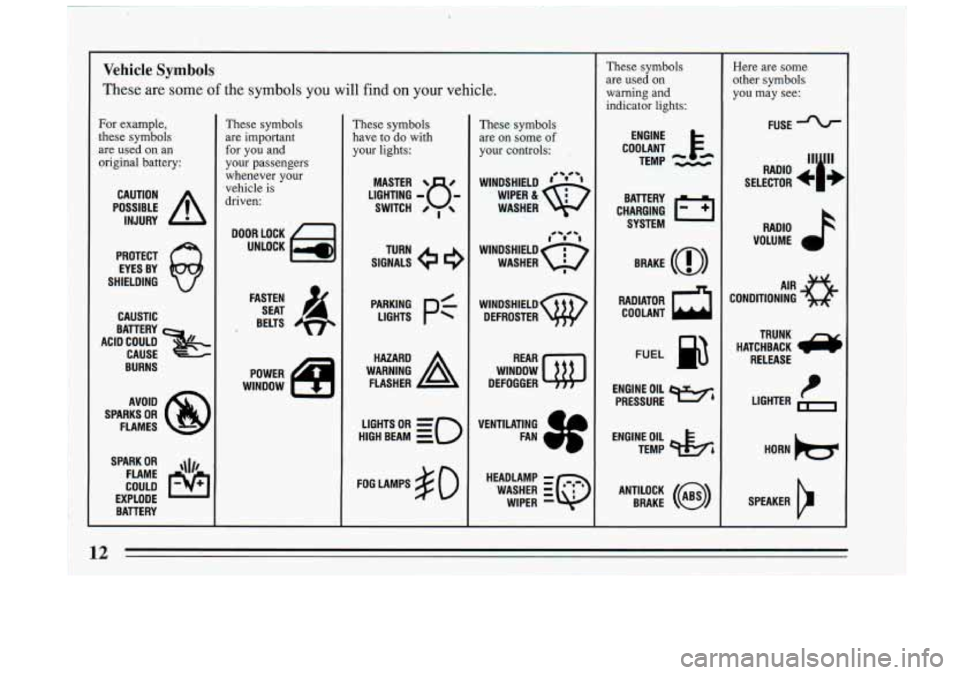
Vehicle Symbols
These are some of the symbols you will find on your vehicle.
For example,
these symbols
are used on an
original battery:
POSSIBLE A
CAUTION
INJURY
PROTECT EYES BY
SHIELDING
CAUSTIC
BURNS AVOID
SPARKS
OR
FLAMES
SPARK
OR ,111,
COULD pq
FLAME
EXPLODE BATTERY
These symbols
are important
for you and
your passengers whenever your
vehicle
is
driven:
FASTEN SEAT 4
BELTS
These symbols
have to do with
your lights:
SIGNALS TURN
HIGH BEAM
OR = =o
FOG LAMPS $0
These symbols
are on some
of
your controls:
WINDSHIELD ’ ’ ’ 4- #-
WASHER
f0 -**
WINDSHIELD Q
WASHER I
WINDSHIELD
DEFROSTER
WINDOW
DEFOGGER
VENTILATING
FAN
L.
HEADLAMP - ,~*-,
WASHER iQ
WIPER -
L
These symbols
are used on
warning and
indicator lights:
COOLANT F-
TEMP --
ENGINE
CHARGING
I-1
BATTERY SYSTEM
RADIATOR
a
COOLANT
FUEL
ENGINE OIL
PRESSURE
Wb
TEMP OIL &
ANTILOCK (@)
BRAKE
Here are some
other symbols
you may see:
FUSE
RADIO
‘‘ill
SELECTOR
RADIO
k
VOLUME
CONDITIONING
AIR 33
HATCHBACK /y
TRUNK
RELEASE
t LIGHTER 1-
HORN
SPEAKER
cr
~ 12 , .
Page 61 of 324
 Part 2 Features & Controls
Here you can learn about the many standard and optional featur\
es on your Buick. and information on starting. shifting
and braking
. Also explaine")
@) Part 2 Features & Controls
Here you can learn about the many standard and optional featur\
es on your Buick. and information on starting. shifting
and braking
. Also explained are the instrument panel and the warning systems that tell you if everything is working
properly
.. and what to do if you have a problem .
Part 2 includes:
Keys
........................................................................\
....
DoorLocks ....................................................................... \
NewVehicleBreak-In ..............................................................
StartingtheEngine .................................................................
ShiftingtheTransaxle ..............................................................
Windows ........................................................................\
.
TiltSteeringWheel ................................................................
Multi-FunctionLever ...............................................................
TurnandLaneChangeSignals ...................................................
Headlight High-Low Beam Changer ..............................................
Windshield Wipermasher ......................................................
CruiseControl ................................................................
Instrumentpanel ...................................................................
Speedometer and Odometer ......................................................
Warning Lights and Gages ......................................................
60
61
70
72
75 84
84
85
85 87
87
90
105
105
107
c 59
Page 98 of 324
Lights
'
1 0 Headlights
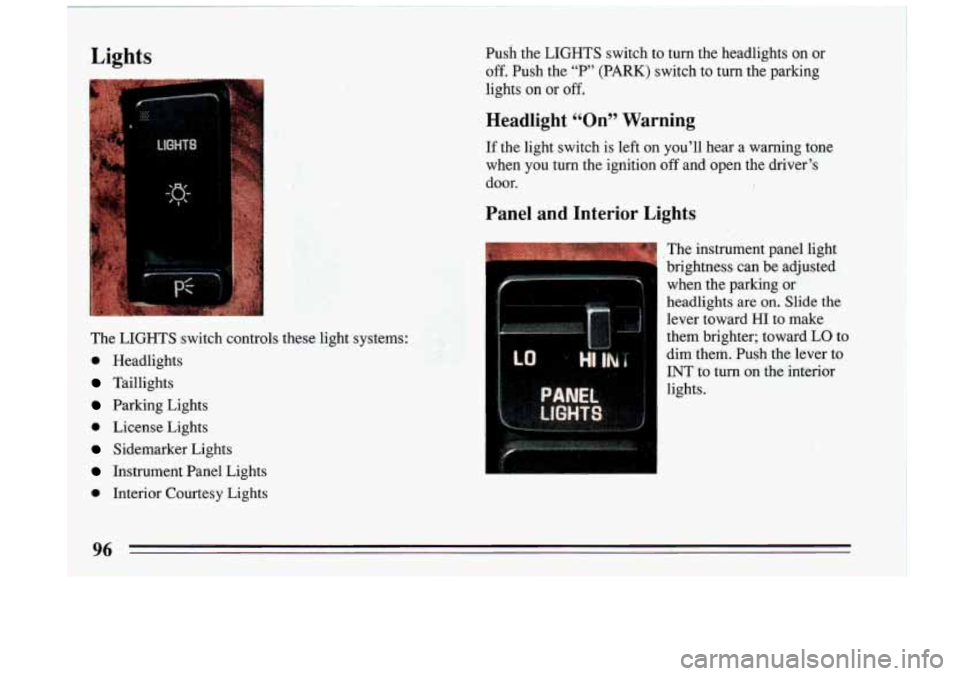
The LIGHTS switch controls these light systems:
Taillights
Parking Lights
0 License Lights
Sidemarker Lights
Instrument Panel Lights
0 Interior Courtesy Lights
Push the LIGHTS switch to turn the
headlights on or
off. Push the "P" (PARK) switch to turn the parking
lights
on or off.
Headlight ''On" Warning
If the light switch is left on you'll hear a warning tone
when you turn the ignition off and open the driver's
door.
\,
Panel and Interior Lights
The instrument panel light
brightness can be adjusted when the parking or
headlights are
on. Slide the
lever toward HI to make
them brighter; toward
LO to
dim them. Push the lever to
INT to
turn on the interior
lights.
96
Page 109 of 324

Trip Odometer
I
Warning Lights, Gages and Indicators
A trip odometer can tell you
how many miles you have Warning lights and gages can signal t\
hat something is
driven since you last set it wrong before it becomes serious enough to cause an
back to zero.
TO reset, push expensive repair or replacement. Paying attention to
the button. your warning lights and gages could also save you or
others from injury.
Warning lights go on when there may be or
is a problem
with one
of your vehicle's functions. As you will see in
the details on the next few pages, some warning lights come on briefly when you turn the ignition key just to
let you know they're working.
If you are familiar with
this section, you should not be alarmed when this
happens.
This section describes the warning lights and gages that
are on your vehicle. The pictures will help
you locate
them. Gages can indicate when there may be or is a problem
with one
of your vehicle's functions. Often gages and
warning lights work together to let you know when
there's a problem with your vehicle.
When one of the warning lights comes on and stays on
when you are driving, or when one of the gages shows
there may be a problem, check the section that tells
you
what to do about it. Please follow the manual's advice.
Waiting to do repairs can be costly
-- and even
dangerous.
So please get to know your warning lights
and gages. They're a big help.
107
Page 149 of 324
Your Own Signals
Drivers signal to others, too. It’s not only more polite,
it’s safer to let other drivers know what you are doing.
And in some places the law requires driver signals.
urn and lane change signals. Always signal when you
plan to turn or change lanes.
If necessary, you can use hand signals out the window:
Left arm straight out for a left turn, down for slow or
about-to-stop, and up for a right turn.
Slowing down. If time allows, tap the brake pedal once
or twice in advance of slowing or stopping. This warns
the driver behind you.
Disabled. Your four-way flashers signal that your
vehicle is disabled or is a hazard. See “Hazard Warning
Flasher” in the Index.
Traffic Officer
The traffic police officer is also a source of important
information. The officer’s signals govern, no matter
what the traffic lights or other signs say.
The next section discusses some of the road conditions
you may encounter.
Defensive Driving
The best advice anyone can give about driving is: Drive
defensively.
Please start with
a very important safety device in your
Buick: Buckle up. (See “Safety Belts” in the Index.)
Defensive driving really means “be ready for anything.”
On city streets, rural roads, or freeways, it means
“always expect the unexpected.”
Assume that pedestrians or other drivers are going to be
careless and make mistakes. Anticipate what they might
do. Be ready for their mistakes.
Expect children to dash out from behind parked cars, often- followed by other children. Expect occupants in
parked cars to open doors into traffic. Watch for
movement in parked cars
-- someone may be about to
open a door.
Expect other drivers to run stop signs when
you are on a
through street. Be ready to brake if necessary as you go
through intersections. You may not have to use the
brake, but
if you do, you will be ready.
If you’re driving through a shopping center parking lot
where there are well-marked lanes, directional arrows,
and designated parking areas, expect some drivers to
147
Page 170 of 324
Don’t use your high beams. The light will bounce off
the water droplets that make up fog and reflect back at
you.
Use your defogger.
In high humidity, even a light
buildup of moisture on the inside of the glass will cut
down on your already limited visibility.
Run your
windshield wipers and washer ‘occasionally. Moisture
can build up on the outside glass, and what seems to be
fog may actually be moisture on the outside of your
windshield.
Treat dense fog as an emergency.
Try to find a place to
pull off the road. Of course you want to respect
another’s property, but you might need to put something
between you and moving vehicles
-- space, trees,
telephone poles, a private driveway, anything ,that
removes you from other traffic.
If visibility is near zero and you
must stop but are
unsure whether you are away from the road, tu_m your
lights on, start your hazard warning flasher, and sound your horn at intervals or when you hear approaching
traffic.
Pass other vehicles in fog only if you can see far enough
ahead to pass safely. Even then, be prepared to delay
your pass if you suspect the fog is worse up ahead.
If
other vehicles try to pass you, make it easy for them.
Page 173 of 324
Just before you leave the lane, glance quickly over your
shoulder to make sure there isn’t another vehicle in your
“blind” spot.
If you are moving from an outside to a center lane on a
freeway having more than two lanes, make sure another
vehicle isn’t about to move into the same spot. Look at
the vehicles two lanes over and watch for telltale signs:
turn signals flashing, an increase in speed,
or moving
toward the edge of the lane. Be prepared to delay your
move.
Once you are moving on the freeway, make certain you
allow a reasonable following. distance. Expect to move
slightly slower at night.
Leaving the Freeway
When you want to leave the freeway, move to the proper
lane well in advance. Dashing across lanes at the last
minute is dangerous.
If you miss your exit do not, under
any circumstances, stop and back up. Drive on to the
next exit.
At each exit point is a deceleration lane. Ideally it
should be long enough for you to enter it at freeway
speed (after signaling, of course) and then do your
braking before moving onto the exit ramp.
Unfortunately, not all deceleration lanes are long enough
-- some are too short for all the braking. Decide when to
start braking. If you must brake on the through lane, and
if there is traffic close behind you, you can allow a little \
extra time and flash your brake lights (in addition to
your turn signal) as extra warning that you are about to
slow down and exit.
The exit ramp can be curved, sometimes quite sharply.
The exit spwd is usually posted. Reduce your speed
according to your speedometer, not to your sense of
motion. After driving for any distance at higher speeds,
you may tend to think you are going slower than you
actually are. For example,
40 mph (65 h/h) might
seem like only
20 mph (30 km/h). Obviously, this. could
lead to serious trouble on a ramp designed for
20 mph
(30 km/h)!
Driving a Long Distance
Although most long trips today are made on freeways,
there are still many made
on regular highways.
Long-distance driving on freeways and regular
highways is the same in some ways. The
trip has to be
planned and the vehicle prepared, you drive at
higher-than-city speeds, and there are longer
turns
behind the wheel. You’ll enjoy your trip more if you and
your vehicle are in good shape. Here are some tips for
a
successful long trip.
171
Page 186 of 324
Hazard Warning Flashers
c
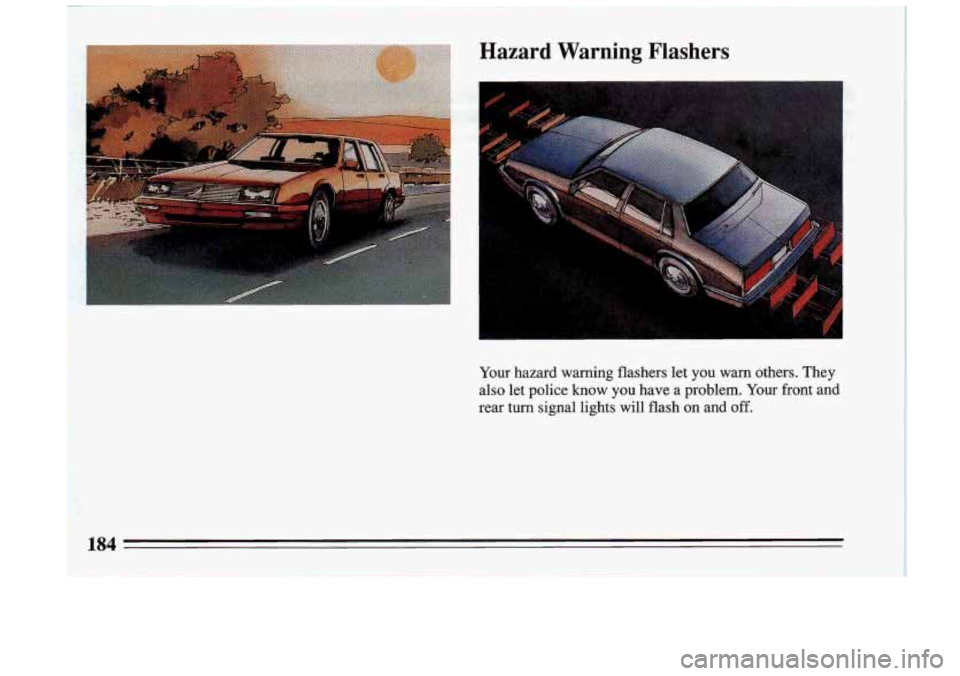
Your hazard warning flashers let you warn others. They
also let police know you have a problem. Your front and
rear turn signal lights will flash on and
off.
Page 187 of 324
I
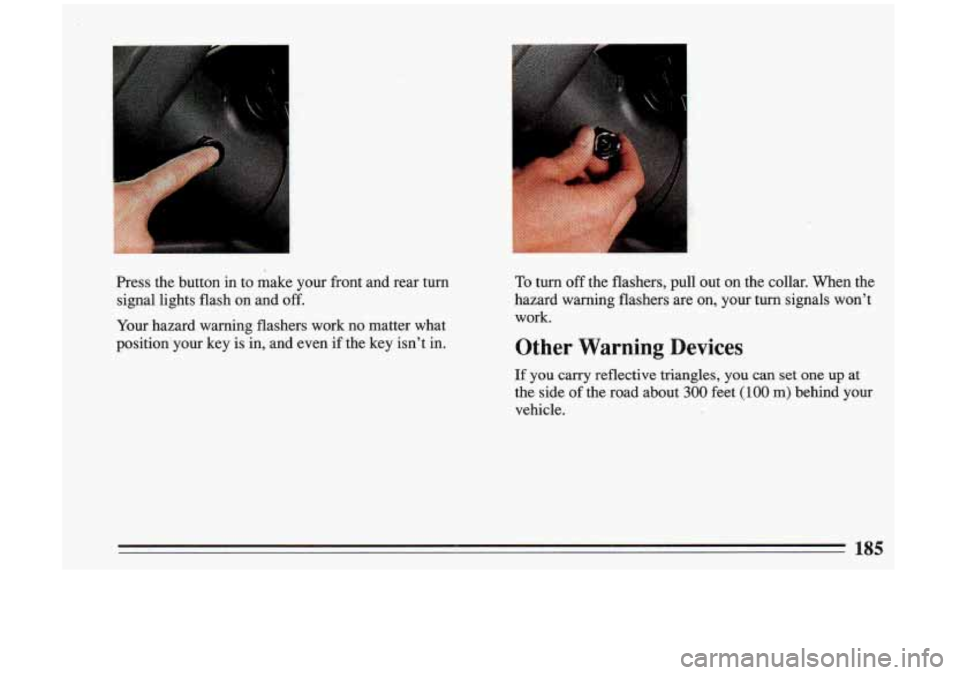
Press the button in to make your front and rear turn
signal lights flash on and
off.
Your hazard warning flashers work no matter what
position your key is in, and even
if the key isn't in.
To turn off the flashers, pull out on the collar. When the
hazard warning flashers are on, your
turn signals won't
work.
Other Warning Devices
If you carry reflective triangles, you can set one up at
the side
of the road about 300 feet (100 m) behind your
vehicle.
185
Page 233 of 324
are made especially for your automatic transaxle.
Damage caused by fluid other than
DEXRONs-IIE is
not covered by your new vehicle warranty.
After adding fluid, recheck the fluid level as
described under
“How to Check.”
When the correct fluid level is obtained, push the
dipstick back in all the way.
Engine Coolant
The following explains your cooling system and how to
add coolant when it is low. If you have a problem with
engine overheating, see “Engine Overheating” in the
Index.
The proper coolant for your Buick
will:
Give freezing protection down to -34’F (-37 ’ C) .
0 Give boiling protection up to 262 ’ F ( 128 ’ C) .
Protect against rust and corrosion.
Help keep the proper engine temperature.
0 Let the warning lights work as they should.
What to Use:
Use a mixture of one-half clean water (preferably
distilled) and one-half antifreeze that meets “GM Specification 1825-M,” which won’t damage aluminum
parts. Use GM Engine Coolant Supplement (sealer) with
any complete coolant change. You can also use a
recycled coolant conforming to “GM Specifications
1825-M” with a complete coolant flush and-refill.
If you
use these, you don’t need to add anything else.
Adding only plain water to your cooling system
can be dangerous. Plain water, or some other
liquid like alcohol, can boil before the proper
coolant mix will. Your vehicle’s coolant warnin!
system
is set for the proper coolant mix. With
plain water or the wrong mix, your engine coul
get
too hot but you wouldn’t get the overheat
warning. Your engine could catch fire and you
or others could be burned. Use a
50150 mix of
clean water and
a proper antifreeze.
231