windshield wipers BUICK RIVIERA 1993 Owners Manual
[x] Cancel search | Manufacturer: BUICK, Model Year: 1993, Model line: RIVIERA, Model: BUICK RIVIERA 1993Pages: 324, PDF Size: 16.01 MB
Page 74 of 324
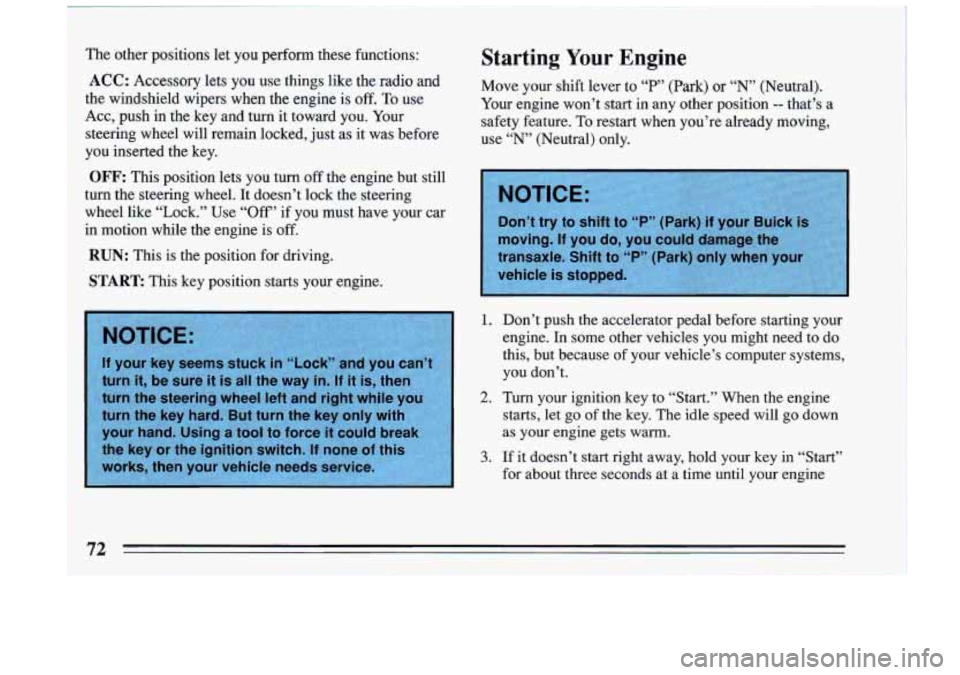
Starting Your Engine The other positions let you perform these functions:
ACC: Accessory lets you use things like the radio and
the windshield wipers when the engine is
off. To use
Acc, push
in the key and turn it toward you. Your
steering wheel will remain locked, just as it was before
you inserted the key.
OFF: This position lets you turn off the engine but still
turri the steering wheel. It doesn’t lock the steering wheel like “Lock.” Use “Off’ if you must have your car
in motion while the engine is off.
RUN: This is the position for driving.
START This key position starts your engine. Move your shift lever
to “P,’ (Park) or “N’ (Neutral).
Your engine won’t start in any other position
-- that’s a
safety feature, To restart when you’re already moving,
use
“N” (Neutral) only.
1. Don’t push the accelerator pedal before starting your
engine.
In some other vehicles you might need to do
this, but because of your vehicle’s computer systems,
you don’t.
starts, let go of the key. The idle speed will go down
as your engine gets warm.
3. If it doesn’t start right away, hold your key in “Start”
for about three seconds at a time until your engine
2. Turn your ignition key to “Start.” When the engine
72
Page 87 of 324
1Ai
The Turn SignallHeadlight Beam
Lever nrn Signal and Lane Change Indicator
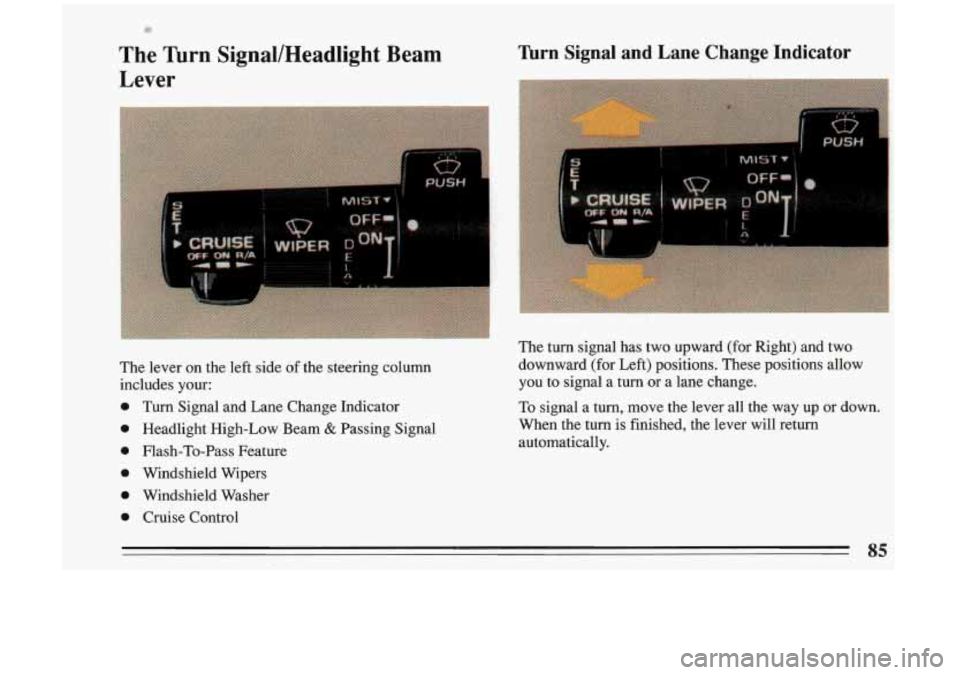
The lever an the left side of the steering column
includes
your:
0 Turn Signal and Lane Change Indicator
0 Headlight High-Low Beam & Passing Signal.
0 Flash-To-Pass Feature
6 Windshield Wipers
0 Windshield Washer
0 Cruise Control The turn signal has two upward (for Right) and two
downward (for Left) positions. These positions allow
you to signal a turn or a lane change.
To signal a turn, move the lever all the way up or down.
When the turn is finished, the lever will return
automatically.
85
Page 88 of 324
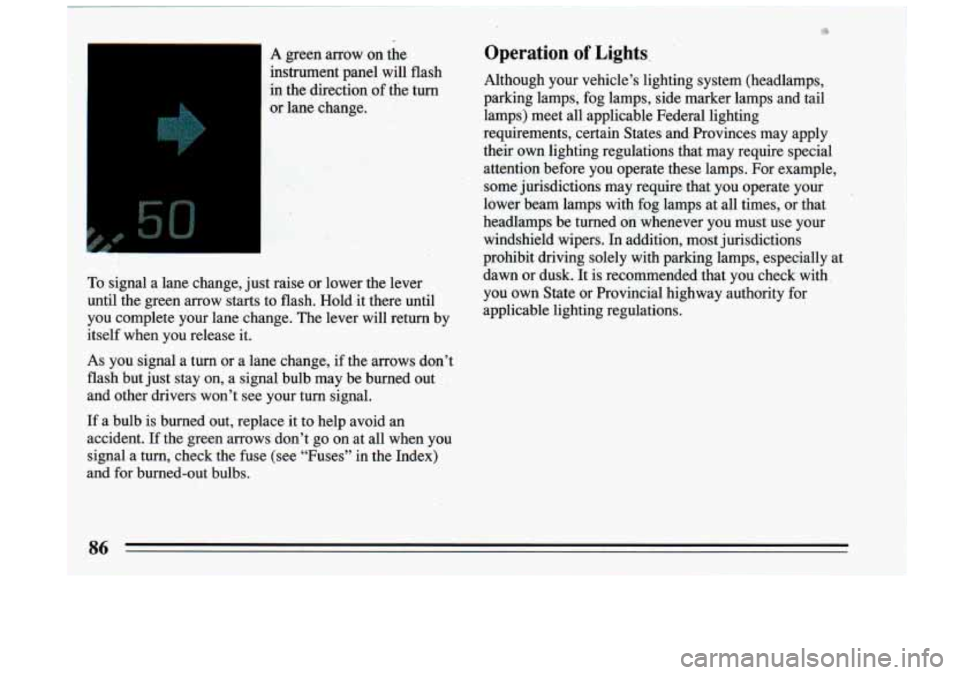
L
in the direciion of the turn
or lane change.
To signal a lane change, just raise or lower
the lever
until the green arrow starts to flash. Hold it there until
you complete your lane change. The lever will return by
itself when you release it.
As you signal a turn or a lane change, if the arrows don’t
flash but just stay on, a signal bulb may be burned out
‘and other drivers won’t see your turn signal.
Operation of Lights.
Although your vehicle’s lighting system (headlamps,
parking lamps, fog lamps, side marker lamps and tail
lamps) meet all applicable Federal lighting
requirements, certain States and Rovinces may apply
their
own lighting regulations that may require special
attention before you operate these lamps. For example,
some jurisdictions may require that you operate your
lower beam lamps with fog lamps at all times, or that
headlamps be turned on whenever you must use your
windshield wipers. In addition, most jurisdictions
prohibit driving solely with parking lamps, especially at
dawn or dusk. It is recommended that you check with you own State or Provincial highway authority
for
applicable lighting regulations.
1
If a bulb is burned out, replace it to help avoid an
accident.
If the green arrows don’t go on at all when you
signal a turn, check the fuse (see “Fuses” in the Index)
hnd-fQr bumed-Qvt bulbs. i
3
Page 89 of 324
Headlight High-Low Beam
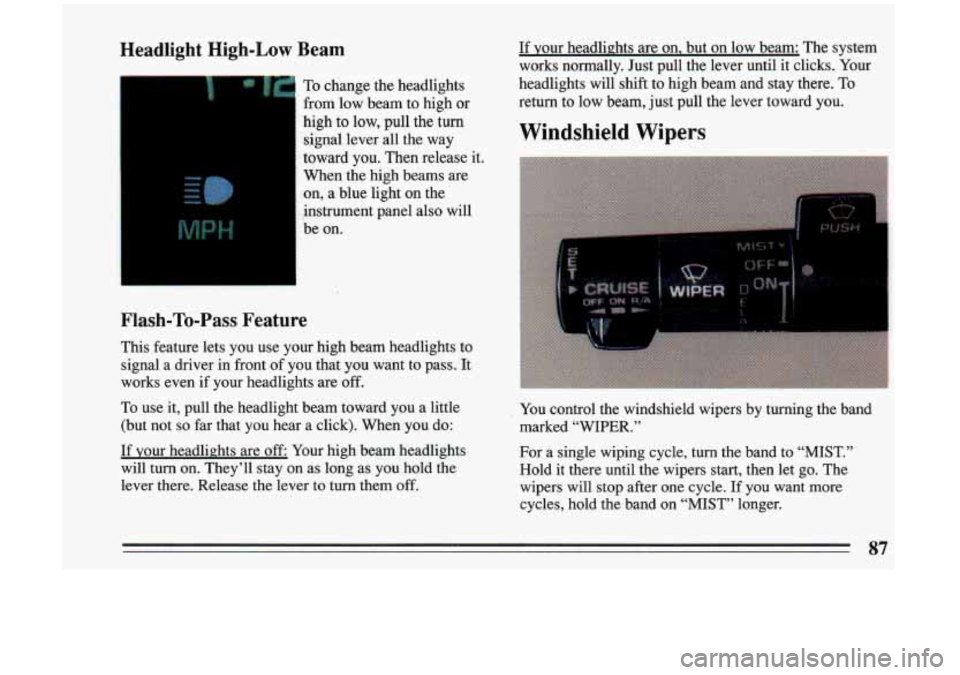
To change the headlights
from low beam to high or
high to low, pull the turn signal lever all the way
toward
you. Then release it.
When the high beams are
on, a blue light on the
instrument panel also will
be on.
If your headlights are on, but on low beam: The system
works normally. Just pull the lever until it clicks. Your
headlights will shift to high beam and stay there. To
return to low beam, just pull the lever toward you.
Windshield Wipers
Flash-To-Pass Feature
This feature lets you use your high beam headlights to
signal a driver in front of you that
you want to pass. It
works even if your headlights are
off.
To use it, pull the headlight beam toward you a little
(but not
so far that you hear a click). When you do:
If your headlights are off Your high beam headlights
will
turn on. They’ll stay on as long as you hold the
lever there. Release the lever to turn them
off.
.
. . . ~
You control the windshield wipers by turning the band
marked “WIPER.”
For a single wiping cycle, turn the band to
“MIST.”
Hold it there until the wipers start, then let go. The
wipers will stop after one cycle. If
you want more
cycles, hold the band on
“MIST” longer.
87
Page 90 of 324
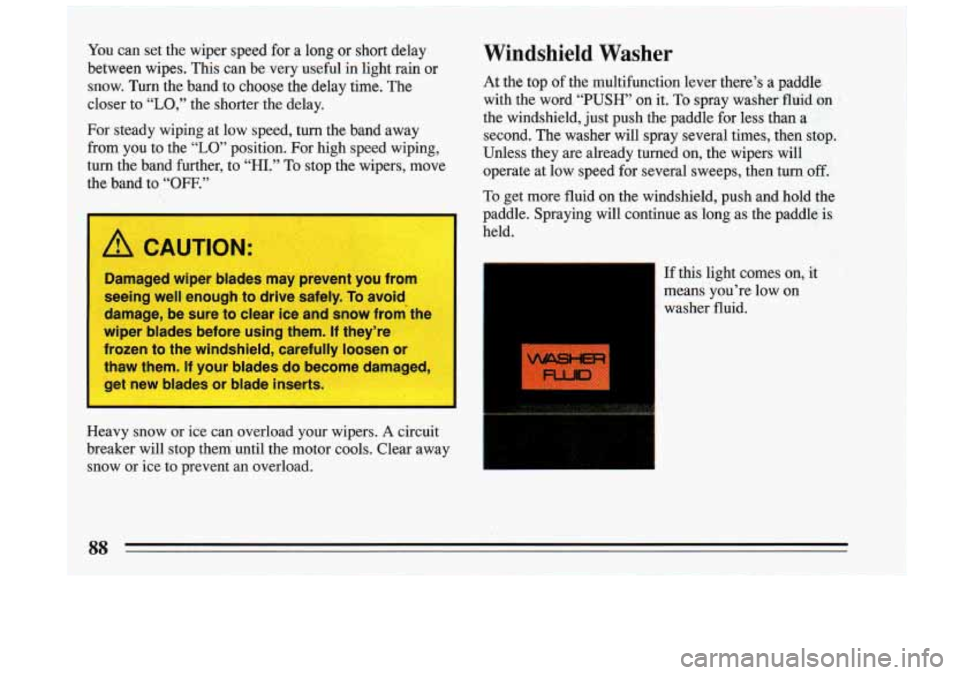
You can set the wiper speed for a long or short delay
between wipes. This can be very useful
in light rain or
snow. Turn the
band to choose the delay time. The
closer to
“LO,” the shorter the delay.
For steady wiping at low speed,
turn the band away
from
you to the “LO” position. For high speed wiping,
turn the band further, to “HI.” To stop the wipers, move
$he band to
“OFF.”
A CAUTION:
Damaged wiper blades may prevent you fro!..
seeing well enough to drive safely.
To avoid
damage, be sure to clear ice and snow from the
wiper blades before using them.
If they’re
frozen to the windshield, carefully loosen or
I
thaw them. If your blades do become damaged,
get new blades or blade inserts.
Heavy snow or ice can overload your wipers. A circuit
breaker will stop them until the motor cools. Clear away
,snow or ice to prevent an overload.
Windshield Washer
At the top of the multifunction lever there’s a paddle
with the word
“PUSH” on it. To spray washer fluid on
the windshield, just push the paddle for less than a
second. The washer will spray several times, then stop.
Unless they are already turned on, the wipers will
operate at low speed for several sweeps, then turn
off.
To get more fluid on the windshield, push and .hold the
paddle. Spraying will continue as long as the paddle is
held.
If this light comes on, it
means you’re low on
I washer fluid.
m
Page 170 of 324
Don’t use your high beams. The light will bounce off
the water droplets that make up fog and reflect back at
you.
Use your defogger.
In high humidity, even a light
buildup of moisture on the inside of the glass will cut
down on your already limited visibility.
Run your
windshield wipers and washer ‘occasionally. Moisture
can build up on the outside glass, and what seems to be
fog may actually be moisture on the outside of your
windshield.
Treat dense fog as an emergency.
Try to find a place to
pull off the road. Of course you want to respect
another’s property, but you might need to put something
between you and moving vehicles
-- space, trees,
telephone poles, a private driveway, anything ,that
removes you from other traffic.
If visibility is near zero and you
must stop but are
unsure whether you are away from the road, tu_m your
lights on, start your hazard warning flasher, and sound your horn at intervals or when you hear approaching
traffic.
Pass other vehicles in fog only if you can see far enough
ahead to pass safely. Even then, be prepared to delay
your pass if you suspect the fog is worse up ahead.
If
other vehicles try to pass you, make it easy for them.
Page 267 of 324
Windshield Wipers Power Windows and Other Power Options
The windshield wiper motor is protected by a circuit
Circuit breakers in the fuse panel protect the power
breaker and a fuse.
If the motor overheats due to heavy
windows and other power accessories. When the current
snow, etc., the wiper will stop until the motor cools. If
load is too heavy, the circuit breaker opens and closes,
the overload
is caused by some electrical problem and
protecting the circuit until the problem is fixed or goes
not snow, etc., be sure to get
it fixed. away.
Page 310 of 324
1
Why Wear Safety Belts ? ........................... 19
Windows. Power
................................. 84
Windshield Cleaning
.................................... 256
Washer
...................................... 88
Washer Fluid
................................. 235
Wipers
................................... 87. 256
Winter Driving
.................................. 178
WireWheelCover
............................... 206 Working on Your Car
............................. 216
Worn Tires
...................................... 247
Wrecker Towing
................................. 191
Your Driving and the Road
....................... 139
Your Own Signs
................................. 147
Your Vehicle and the Environment
.................. 271
I
308