tow BUICK ROADMASTER 1993 User Guide
[x] Cancel search | Manufacturer: BUICK, Model Year: 1993, Model line: ROADMASTER, Model: BUICK ROADMASTER 1993Pages: 340, PDF Size: 18.34 MB
Page 199 of 340
Weight of the Trailer
How heavy can a trailer safely be? load from
your vehicle’s capacity weight because your
vehicle will be carrying that weight, too. See “Loading
’
Your Vehicle” in the Index for more information about
,.
It should never weigh more than 2,000 pounds (900 kg), your vehicle’s maximum load capacity.
unless you have the optional
5,000 pound (2,250 kg)
trailer towing package. But even that can be too heavy.
,.
. . 8:
It -depends on how you plan to .use your rig. For
example, speed, altitude,,road grades, outside
. . .
temperatuie and how much your vehicle is us.ed to pull a
trailer ‘are .all important. And,
it can also depen‘d on any
special equipment that you have on your vehicle.
.’
You can ask your dealer for our traiIering information or
advice, or
you can write us at Buick Motor Division,
Customer Assistance .Center;
902 E. Hamilton Avenue,
Flint,
M.148550.
,.
In Canada, write to General Motors ,of Canada Limited,
Customer Assistance Center, 1908 Colonel Sam. Drive,
Qshawa, Ontario
LlH 8P7.
Weight of the Trailer Tongue
The tongue load (A) -of any trailer is an important
weight to measure because it affects the total capacity
weight of your vehicle. The capacity weight includes ‘the
curb weight’ of the vehicle, any cargo you may carry in
it, and the people who will .be riding in the vehicle. And
if you will
~QW a trailer, you must subtract the tongue
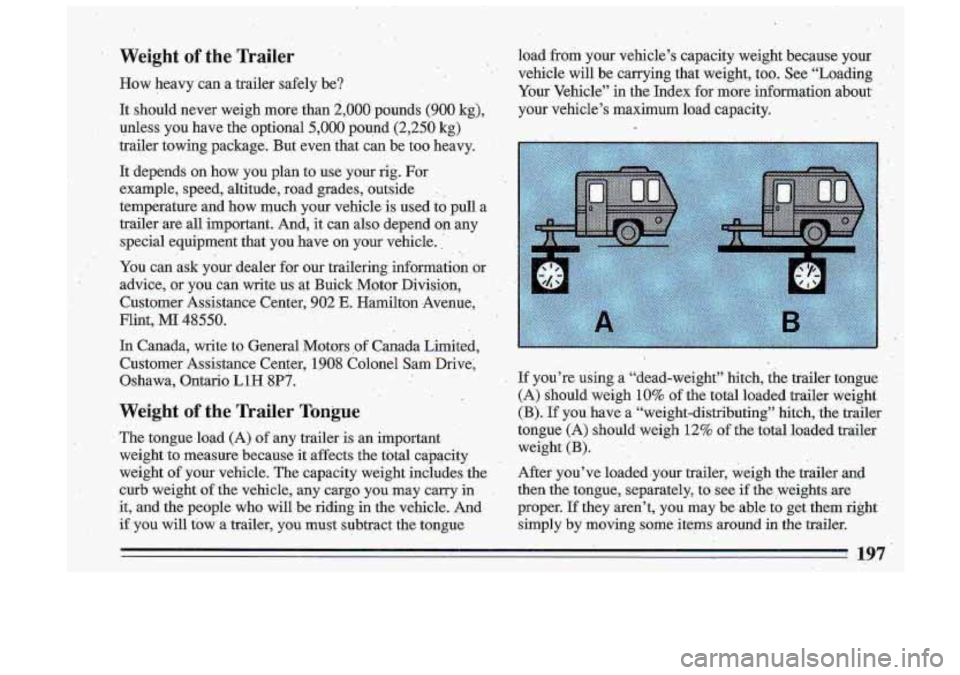
If you’re using a “dead-weight” hitch, the trailer tongue
(A) should weigh 10% of the total loaded trailer weight
(B).
If you have a “weight-distributing” hitch, the trailer
tongue
(A) should weigh 12% of the total loaded trailer
weight
(B). - ’
After you’ve lo,aded.your trailer, weigh the trailer and
then the tongue, separately,
to. see if the weights are
proper. If they aren’t, you may be able’ to get them tight
simply by moving some
items around in the trailer.
Page 201 of 340
Driving with a Trailer
Towing a trailer requires a certain amount of experience. Before setting out for the open road, you’ll want to get
to
know your rig. Acquaint yourself with the feel of
handling and braking. with the added weight of the
trailer. And always keep in mind that the vehicle you are
driving is now
a good deal longer and not nearly so
responsive as your vehicle is by itself.
Before you start, check the trailer hitch and platform,
safety chains, electrical connector, lights, tires and
mirror adjustment.
If the trailer has electric biakes, start
your yehicle and trailer moving and then apply the
trailer brake controller by hand to be sure the- brakes are
working. This lets you check your electrical connection
at the same time.
During your trip, check occasionally to
be sure that the
load
is secure, and that the Lights.and any trailer brakes
are .still working.
Following Distance
Stay at least twice as far behind the vehicle ahead as you
would when driving your vehicle without a trailer. This
can help
you avoid situations that require heavy braking
and sudden turris.
.
Passing
You’ll need. more passing distance up ahead when
you’re towing a trailer. And, because you’re a good deal \
longer, you’ll need to go much farther beyond the
.
passed vehicle before you can return to your lane.
Backing Up
Hold the bottom of the steering wheel with one hand.
Then, to move the trailer
to the left, just move that hand
to the left.
To mo.ve the trailer to the right, move your
hand to the right. Always back up slowly and, if
possible, have someone guide
you.
Making Turns
When you’re turning with a trailer, make wider turns
than normal.
Do this so your trailer won’t strike soft
shoulders, curbs, road signs, trees, or other objects.
Avoid jerky or sudden maneuvers. Signal well in
advance.
Turn Signals When Towing a Trailer
When you tow a trailer, your vehicle has to have .a
different turn signal flasher and extra wiring. The green
arrows on your instrument panel will
flash whenever
you signal a
turn or lane change. Properly hooked up,
199
Page 205 of 340
Part 5 Problems on the Road
I- .. . 1. ’ . ’ ‘I
.. .....
Here you’ll find what to do about some problems that can occur on the road .
Part 5 includes:
Hazard Warning Flashers
............................................................
“Jump”Starting ...................................................................
OtherWarningDevices .............................................................
TowingYourBuick ................................................................
Engineoverheating ................................................................
IfaTireGoesFlat .................................................................
ChangingaFlatTire ................................................................
CompactSpareTire ................................................................
If You’re Stuck in Sand, Mud, Ice or Snow ..............................................
204
205
206
212
216
224
224
238
239
Page 208 of 340
Jump Starting
If your battery has run down, you may want towe
another vehicle and, some jurnner, cables to start you?
Buick. But please follow the US bel ir to do it sa-. .~y.
I
“atteri-- can hurt you. Th
Decause:
0 They contain aci hat c
ali
of these things can hurt you.
2. Get the vehicles close enough so the jumper cables
can reach, but be sure the vehicles aren’t touching
each other.
If they are, it could cause a ground
connection you don’t want. You wouldn’t be able to
start
your Buick, and the bad grounding. could
damage the electrical systems.
206
Page 214 of 340
Towing Your Car
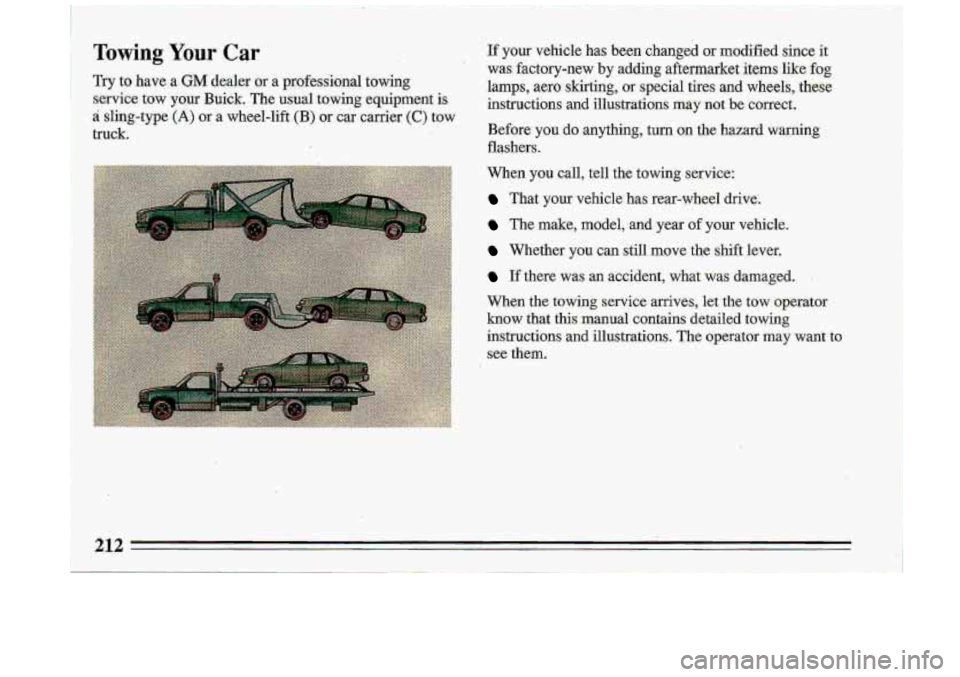
Try to have a GM dealer or a professional towing
service tow your Buick. The usual towing equipment is
a sling-type (A) or a wheel-lift (B) or car carrier (C) tow
truck.
If your vehicle has been changed or modified since it
was factory-new
by adding aftermarket items like fog
lamps, aero skirting, or special
tires and wheels, these
instructions and illustrations may not
be correct.
Before you do anything, turn on the hazard warning
flashers.
When you call, tell.the towing service:
That your vehicle has rear-wheel drive.
The make, model, and year of- your vehicle.
Whether you can still move the shift lever.
If there was an accident, what was damaged.
When the towing service arrives, let the
tow operator
know that this manual contains detailed towing
instructions and illustrations. The operator may want to
see them.
Page 217 of 340
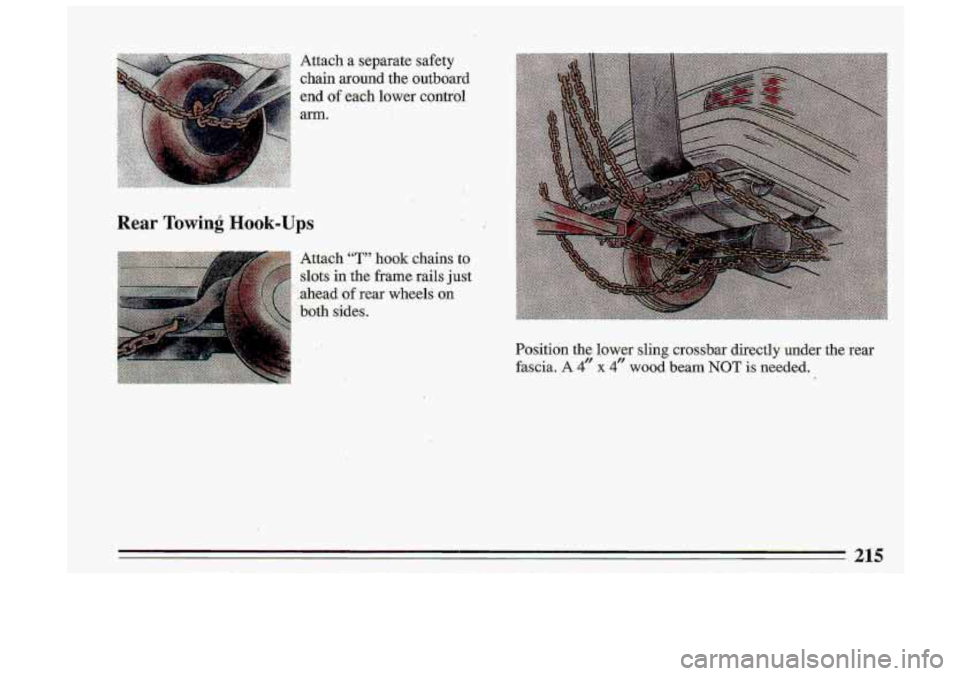
Attach a separate safety chain around the outboard
end
of ,each lower contrbl
am.
Rear Towing Hook-Ups
Attach “T” hook chains to
slots in the frame rails just
both sides.
’ .ahead of rear wheels on
Position the
I-owes sling crossbar directly under the rear
fascia. A 4” x 4” wood beam NOT is needed.
215
Page 219 of 340
1. Turn off yom air conditioner.
If :No .Steam Is Coming From Your Engine:
If you get the overheat warning but see or hear no
steam, the problem may not be
too serious. Sometimes
the engine can get a little
too hot when you:
Climb a long hill on a.hot day.
Stop :after high speed driving.
Idle for long periods in traffic.
Tow a trailer.
If you get the overheat warning with no sign of steam,
try this
for a minute or so:
If there's still no. sign of steam, push the accelerator until
the .engine speed is about twice
as fast as normal idle-
speed. Bring the engine speed back
to normal idle speed
after two or three minutes.
Now see if the warning stops.
But then,
if you still have the-warning, TURN OF'F THE
ENGINE AND GET EVERYONE OUT OF THE
VEHICLE until it cools down.
You may decide not to 1ift.the hood but to get service
help right away.
217
Page 228 of 340
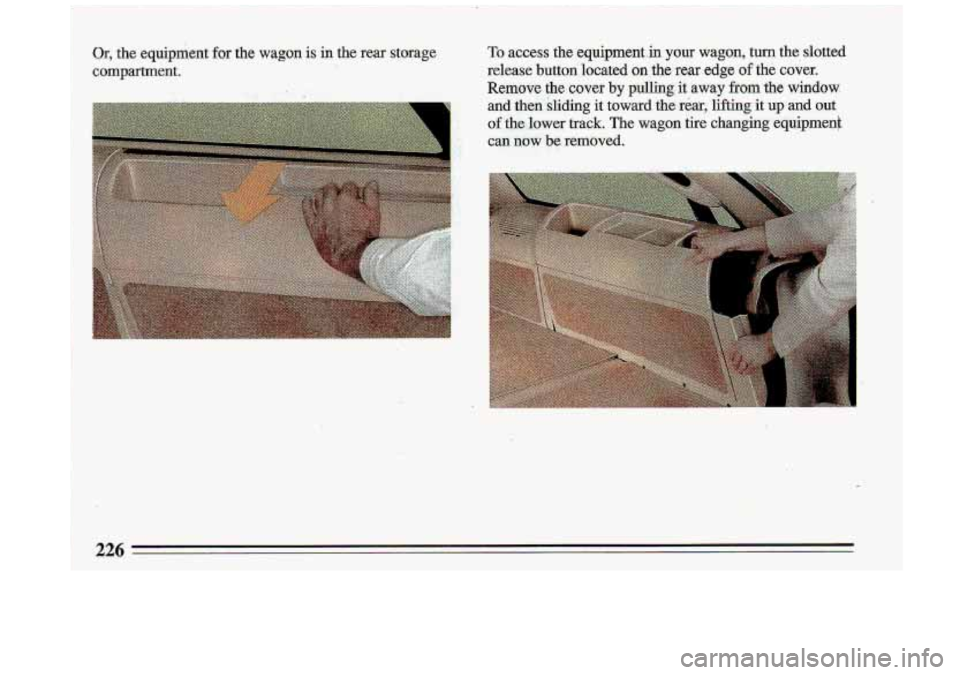
Or, the equipment for the wagon is in the rear storage
compartment.
..
a
To access the equipmentin your wagon, turn the slotted
release
button located on the rear,edge of thk cover.
Rempve the
covef by pulliing, it away fkom the window
and then sliding it toward the rear, Ming it up and out
of thelower track. The wagon tire changing equipmen1
can
now be removed.
Page 236 of 340
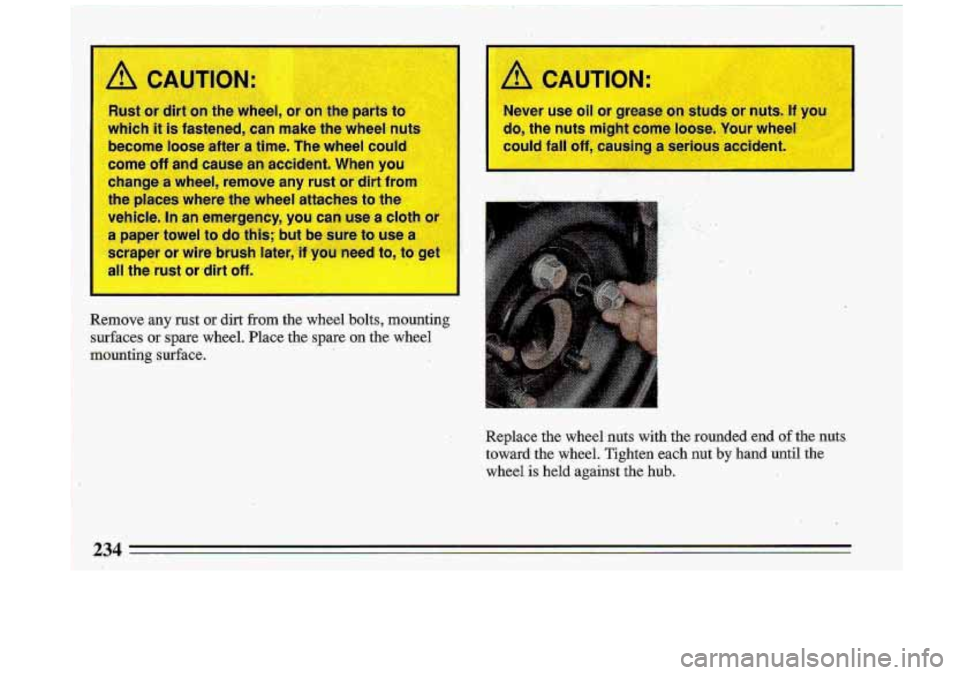
CAUTIO A
Rust or dirt on the wheel,
which it
is fastened, can make the wheel nu
become loose after a time. The wheel could
come
off and cause an accident. When you
change
a wheel, remove any rust or dirt fro1
the places where the wheel attaches to the
vehicle. In an emergency, you can use
a cloth or
a paper towel to
do this; but be sure to use a
scraper or wire brush later, if you need to, to get
all the r---t or dirt off.
N use oil or gre
e on stu
Remove any rust or dirt fro-rn the wheel bolts, rnoullLl1lg
surfaces or spare wheel. Place the spare on the wheel
mounting surface.
Replace.
the wheel nuts with the rounded end of the nuts
toward the wheel. Tighten each nut by hand until the
wheel is held against the hub.
234
Page 254 of 340
It’s below freezing outside and most trips are less:
than
10 miles (16 km).
. The engine is -at low .speed most of the time (as in
door
tp door delivery, or in stop-and-go traffic).
You tow a trailer often.
Most trips are through dusty places.
If -any one of these is true for your vehicle, then you
need-to change
your oil.and filter every 3,000 miles
(5 000 km) or, 3 months - whichever comes first.
If none of them is true, change the oil every 7,500 miles
(12 -500 km) or 12 months - whichever comes first.
Change the filter at the first oil change and
at every
other oil change after that.
Engine Block Heater: An engine block heater can be a
big help if-you have
to park outside in very cold
weather,
-20 * F (-29 C] or .colder. If your vehicle has
this option, see
“Engine Block Heater” in the Index.
What to Do with Used Oil:
Used engine oil contains things that have
caused skin cancer in laboratory animals.
Da
let used oil stay on your skin for very long
Clean your skin and nails with soap and water,
away clothing or rags containing used engine
0
lr a good hand cleaner. Wash or properly throw
I
..
Used oil can be a real threat to the environment. If you
change your
own oil, be sure to drain all free-flowing oil
Erom the filter before disposal. Don’t ever dispose of oil
by pouring
it on the ground, into sewers, or into streams
or bodies of water. Instead, recycle it by taking it.to a
place that collects used oil. If you have a problem
properly disposing of your used oil, ask your dealer, a
service station or
a local recycling center for help.
252