wheel BUICK ROADMASTER 1993 User Guide
[x] Cancel search | Manufacturer: BUICK, Model Year: 1993, Model line: ROADMASTER, Model: BUICK ROADMASTER 1993Pages: 340, PDF Size: 18.34 MB
Page 194 of 340
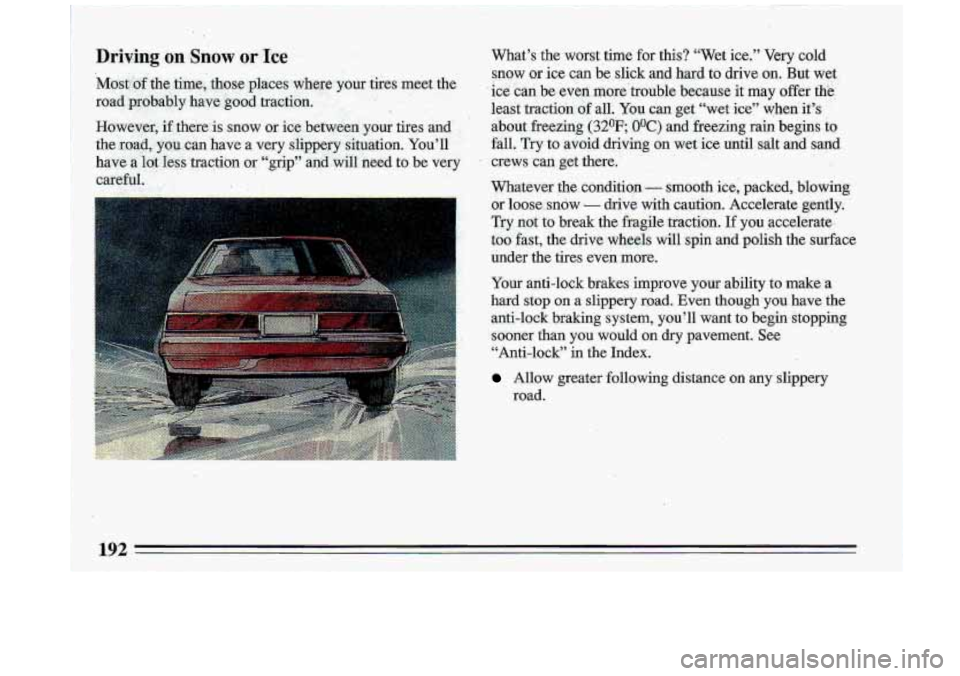
D.riving on Snow or Ice What’s the worst time for this? “Wet ice.” Very cold
snow or ice c.an be slick and hard to drive
on, But wet
ice can be even more’trouble because it may offer
the.
leait traction of all. You can get “wet ice” when’ it’s , ’
about freezing (3ZoF..O0C) and freezing rain begins to
fail. Try to avoid driving on we1 ice until salt and sand
crews can get there.
,.
Whatever the conditio,n - smooth ice, packed, blowing
or loose. snow
.- drive with caution. Accelerate gently.
Try .not
to break the fragile traction. If you accelerate,,
too fast, the drive wheels will spin and polish the surface
under the tires even more.
Your anti-lock brakes improve your ability to make. a
hard stop on a slippery road. Even though you have the
anti-lock braking system, you’ll want to begin-stopping
sooner than you would on dry pavement. See “Anti-lock” in the Index.
Allow greater following distance on any slippery
road.
Page 201 of 340
Driving with a Trailer
Towing a trailer requires a certain amount of experience. Before setting out for the open road, you’ll want to get
to
know your rig. Acquaint yourself with the feel of
handling and braking. with the added weight of the
trailer. And always keep in mind that the vehicle you are
driving is now
a good deal longer and not nearly so
responsive as your vehicle is by itself.
Before you start, check the trailer hitch and platform,
safety chains, electrical connector, lights, tires and
mirror adjustment.
If the trailer has electric biakes, start
your yehicle and trailer moving and then apply the
trailer brake controller by hand to be sure the- brakes are
working. This lets you check your electrical connection
at the same time.
During your trip, check occasionally to
be sure that the
load
is secure, and that the Lights.and any trailer brakes
are .still working.
Following Distance
Stay at least twice as far behind the vehicle ahead as you
would when driving your vehicle without a trailer. This
can help
you avoid situations that require heavy braking
and sudden turris.
.
Passing
You’ll need. more passing distance up ahead when
you’re towing a trailer. And, because you’re a good deal \
longer, you’ll need to go much farther beyond the
.
passed vehicle before you can return to your lane.
Backing Up
Hold the bottom of the steering wheel with one hand.
Then, to move the trailer
to the left, just move that hand
to the left.
To mo.ve the trailer to the right, move your
hand to the right. Always back up slowly and, if
possible, have someone guide
you.
Making Turns
When you’re turning with a trailer, make wider turns
than normal.
Do this so your trailer won’t strike soft
shoulders, curbs, road signs, trees, or other objects.
Avoid jerky or sudden maneuvers. Signal well in
advance.
Turn Signals When Towing a Trailer
When you tow a trailer, your vehicle has to have .a
different turn signal flasher and extra wiring. The green
arrows on your instrument panel will
flash whenever
you signal a
turn or lane change. Properly hooked up,
199
Page 214 of 340
Towing Your Car
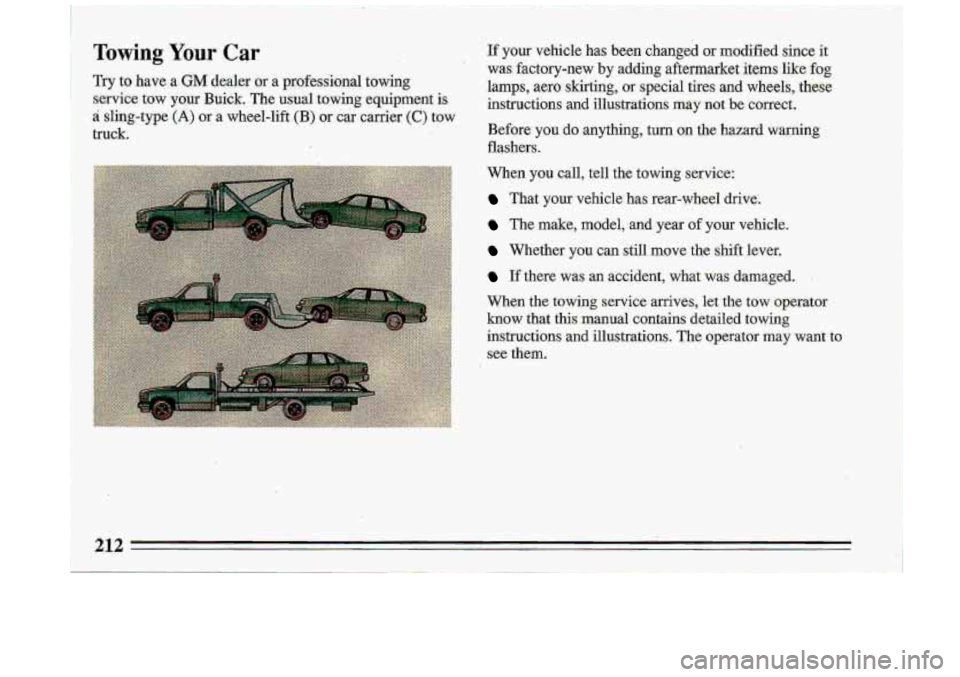
Try to have a GM dealer or a professional towing
service tow your Buick. The usual towing equipment is
a sling-type (A) or a wheel-lift (B) or car carrier (C) tow
truck.
If your vehicle has been changed or modified since it
was factory-new
by adding aftermarket items like fog
lamps, aero skirting, or special
tires and wheels, these
instructions and illustrations may not
be correct.
Before you do anything, turn on the hazard warning
flashers.
When you call, tell.the towing service:
That your vehicle has rear-wheel drive.
The make, model, and year of- your vehicle.
Whether you can still move the shift lever.
If there was an accident, what was damaged.
When the towing service arrives, let the
tow operator
know that this manual contains detailed towing
instructions and illustrations. The operator may want to
see them.
Page 216 of 340
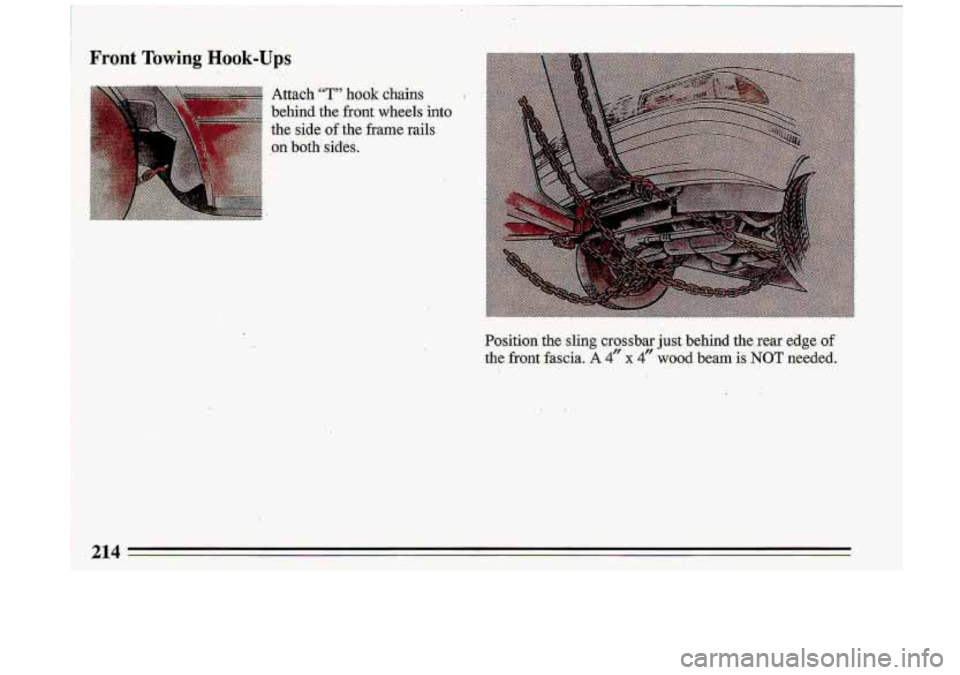
Front TomGng Hook-Ups
Attach “T” hook chains k,
behind the front wheels &to
the side
of the frame rails
,on both,’sides.
Position the sling crossbar just behind the rear edge of
the front fascia.
A 4” x 4” wood beam is .NOT needed.
Page 217 of 340
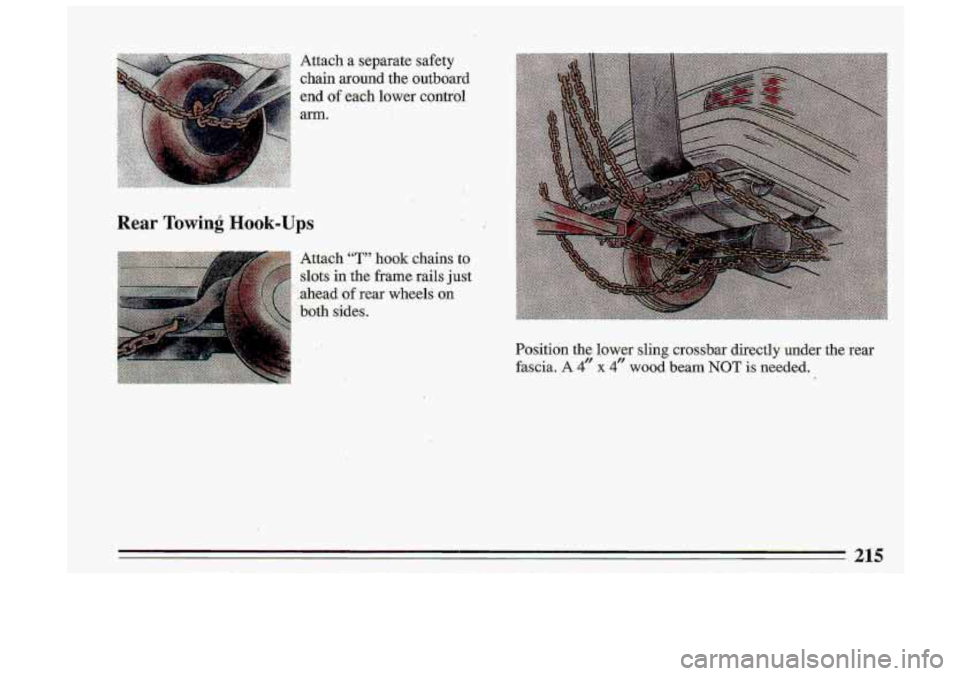
Attach a separate safety chain around the outboard
end
of ,each lower contrbl
am.
Rear Towing Hook-Ups
Attach “T” hook chains to
slots in the frame rails just
both sides.
’ .ahead of rear wheels on
Position the
I-owes sling crossbar directly under the rear
fascia. A 4” x 4” wood beam NOT is needed.
215
Page 230 of 340
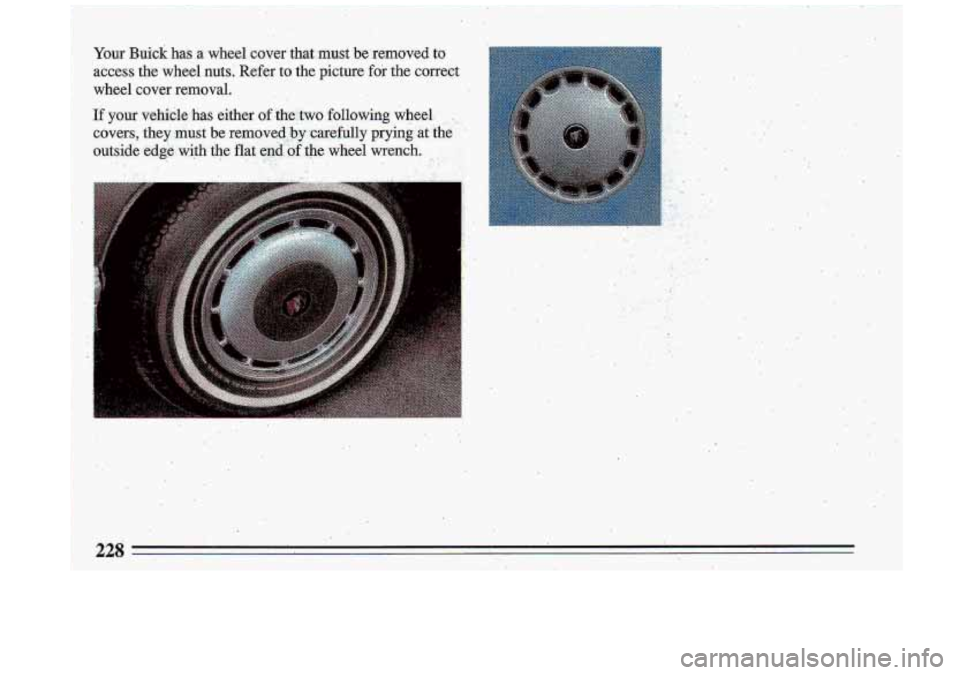
Your Buick has a wheel. cover that .must be'removed to
access the wheel nuts; Refer to the picture for the correct
wheel cover removal.
If your vehicle 'has .either of -the:.two following wheel.
covers, they :must be removed &-carefully prying 'at the
outside ,[email protected] the
Bat . end . 1. 'of @e wheel wrench. , . . ,
j.
.. ,. ..
.. . ,. ,
..
,. ..
Page 231 of 340

Remove, this wheel cover by carefully prying off the If your vehicle \
has wire wheel covers, .remove the center
center
-of the cover with the flat end of the wheel of the wheel cover by using the wire wheel key wrench.
wrench.
Page 234 of 340
I 'P J 'IC
Getting UI er a vehicle when i s j; ied up is
dangerous. If the vehicle slips off the jack, you
could be badly injured or kilied. Never get wnder
a hide wh I it. orted only by a jack.
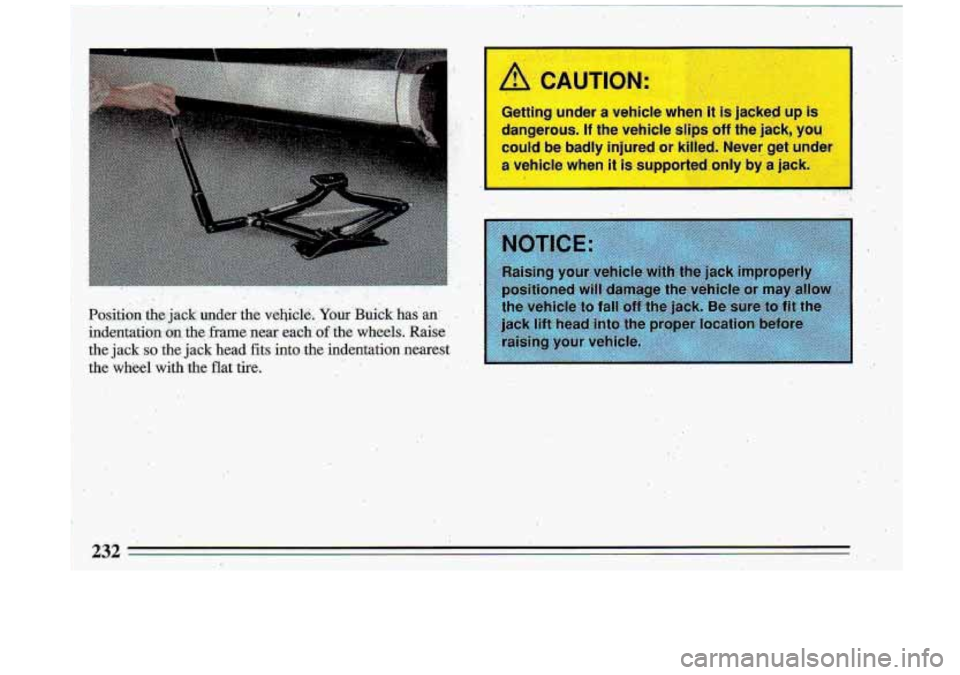
Position theijack under the vekcle. ,Your .Buick,has:.m' '.
indentat&n,on the .fi-ame near each 'of the wheels. Raise ' '
the jack so the,jack head fits into-the indentation nearest
the wheel with the flat tire.
232
Page 236 of 340
CAUTIO A
Rust or dirt on the wheel,
which it
is fastened, can make the wheel nu
become loose after a time. The wheel could
come
off and cause an accident. When you
change
a wheel, remove any rust or dirt fro1
the places where the wheel attaches to the
vehicle. In an emergency, you can use
a cloth or
a paper towel to
do this; but be sure to use a
scraper or wire brush later, if you need to, to get
all the r---t or dirt off.
N use oil or gre
e on stu
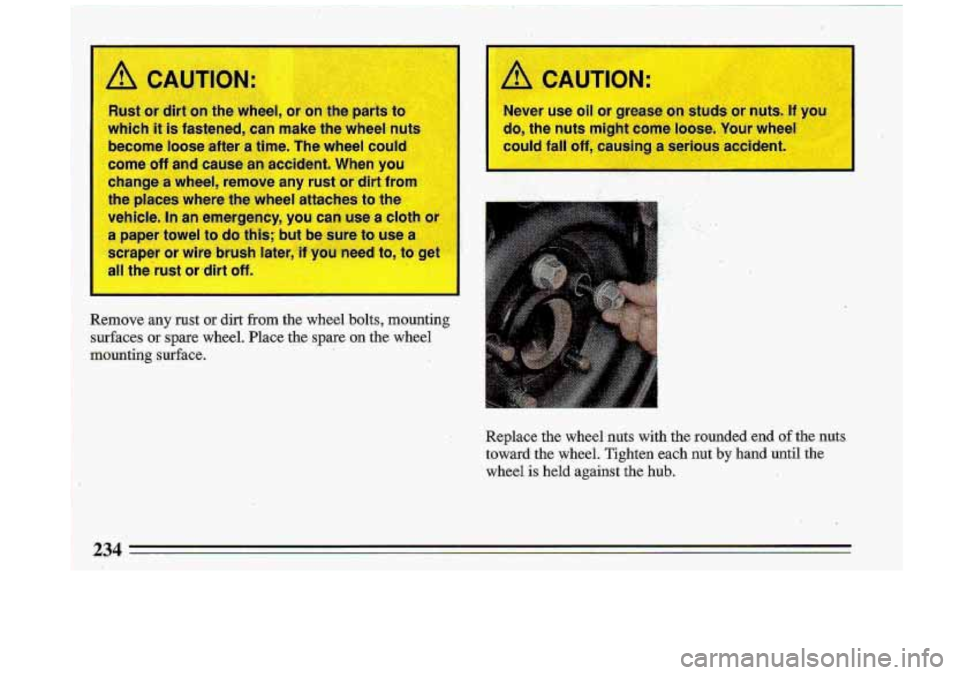
Remove any rust or dirt fro-rn the wheel bolts, rnoullLl1lg
surfaces or spare wheel. Place the spare on the wheel
mounting surface.
Replace.
the wheel nuts with the rounded end of the nuts
toward the wheel. Tighten each nut by hand until the
wheel is held against the hub.
234
Page 237 of 340
t
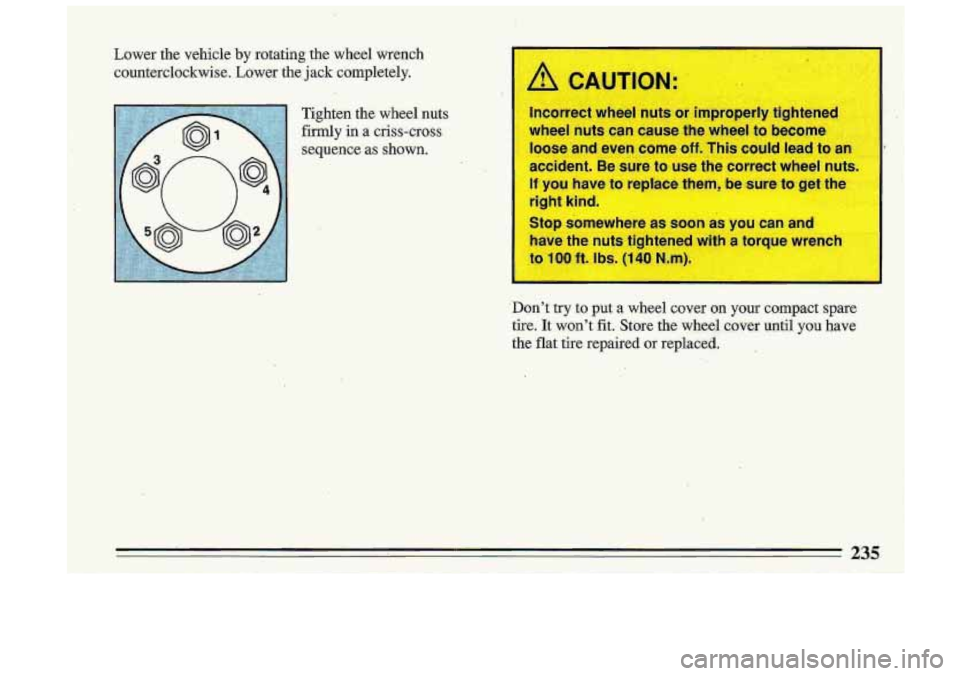
Lower the vehicle by rotating the wheel wrench
counterclockwise. Lower the jack completely.
Tighten the wheel nuts
firmly in a criss-cross
sequence as shown.
lncorrect wheel nuts or improperly tightened
wheel nuts can cause the wheel to become
loose and even come
off. This could lead to an
accident. Be sure to use the correct wheel nuts.
If you have to replace them, be sure to get the
right kind.
Stop somewhere
as soon as you can an
have the nuts tightened with
a
to I00 ft. Ibs. (1 40 N.m)
Don't try to put a wheel cover on your compact spare
tire. It won't fit. Store the wheel cover until
you have
the flat tire repaired or replaced.
. .. .i ,?. 1 C.".
235