oil BUICK ROADMASTER 1993 Owners Manual
[x] Cancel search | Manufacturer: BUICK, Model Year: 1993, Model line: ROADMASTER, Model: BUICK ROADMASTER 1993Pages: 340, PDF Size: 18.34 MB
Page 14 of 340
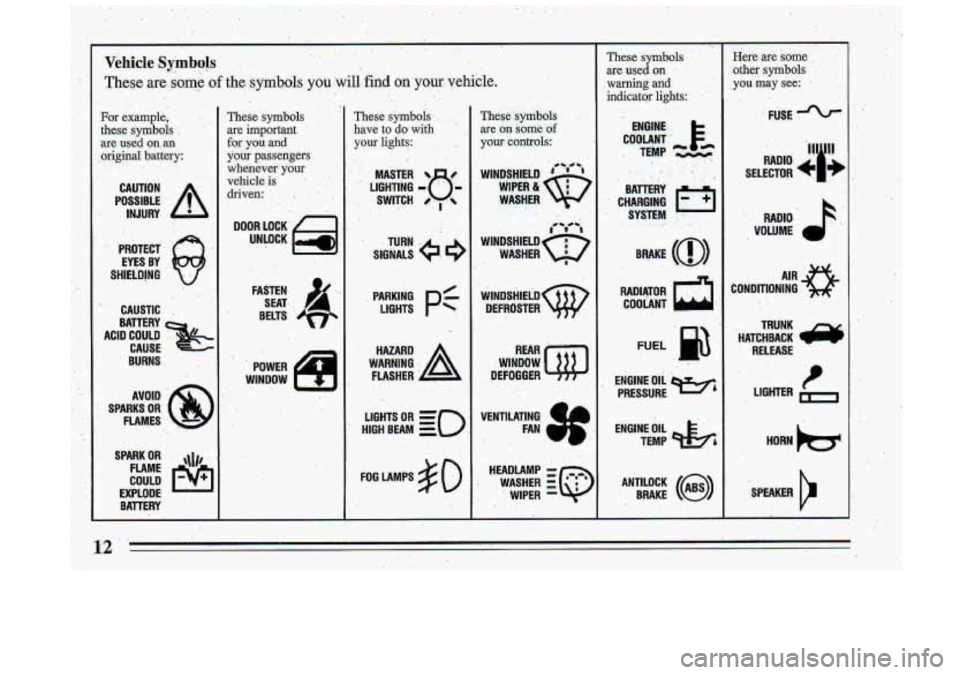
Vehicle Symbols . , . '
mcese are some .of the,symbols you will find on your vehicle. . ' . '".' . '*
I. .. . .- . .* . t . . :.
.. ... .. , I. .'
For example,
these symbols
'
are used on an
original battery:
CAUTION
INJURY
..
POSSIBLE: .' A
.' PR~TECT @
EYES BY
SHIELDING
CAUSTIC
ACID COULD
&
BATTERY CAUSE
BURNS
SPARKS AVOID
OR '"8
FLAMES
COULD
EXPLODE BATTERY
I,
These symbols
are
important
for you.and.
your passengers
whenever your
vehicle-is- ' .
driven: ~ , E , .. , .,
iI
..
DOOR LOCK,' f 1
UNLOCK e
SEAT,
BELTS
WlNDOW
f -1
POWER
These symbols, . _.
have to'do with , .
your lights: ' ,. , - .<
*_
' 'LIGHTING
-8-
MASTER %. . 8
. 'SWITCH /., .
PARKING pf
LIGHTS
HAZARD
WARNING
:A
FLASHER
HIGH
'IGHTS BEAM OR = =o
,. T.hese symbols ',
are on some bf
your controls.:
WIN'DSHIELD. ' ' ' 0- c,
WIPER a Q
WINDSHIELDQ WASHER
** ri I91
WASHER I
. WlNDSHlELD(fji)
DEFROSTER
,) .
WINDOW
DEFOGGER
' WASHER EG
HEADLAMP -
WIPER
These symbols
are used on '
,warning and
indicator lights:
RADIATOR COOLANT
FUEL
ENGINE OIL 'e,
PRESSURE
TEMP
Oli 4%
ANTILOCK. (a)
BRAKE
Bere are some
other symbols
,you may see:
FUSE
RADIO.
CONDITIONING ..
TRUNK
HATCHBACK
e
RELEASE --
LIGHTER e,
SPEAKER
b
?
Page 119 of 340
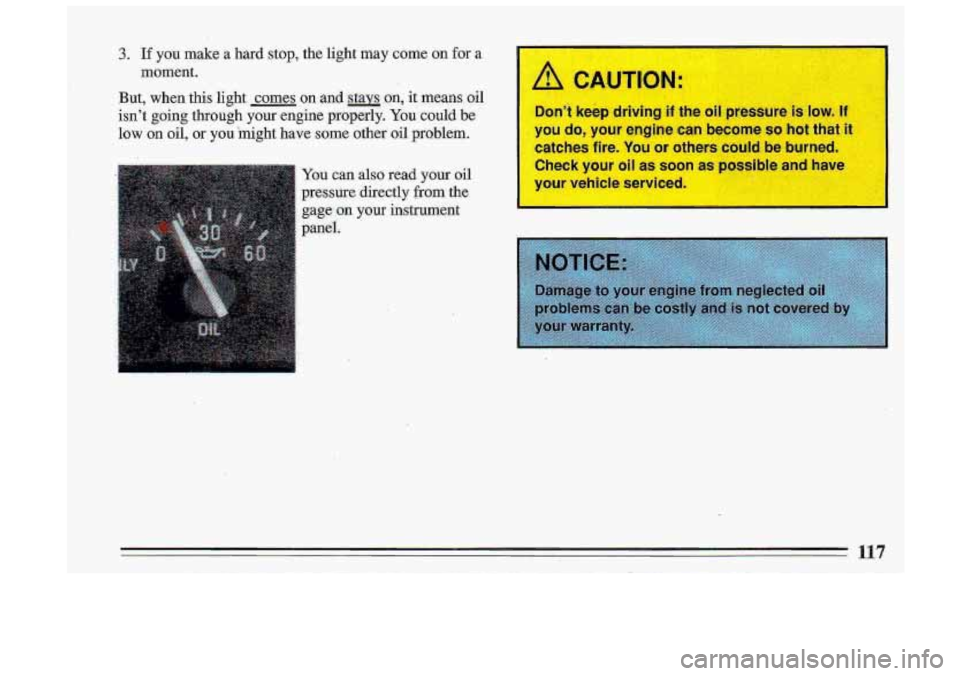
3. If you make a hard stop, the light may come on for a
moment. I
But, when
isn't going
low on oil, this light comes
on and
stays, on, it meansoil
through your engine properly.
You could be
or yoimight have some other oil prGblem.
You can. also read your oil
pressure .directly
fmrn the
gage.- on your instrument
panel.
:. . ;
A CAUTION:
Don't keep driving if the oil pressure is low. If
you do, your engine can become so hot that i,
catches fire. You or others could be burned.
Check your
oil as soon as possible and have
your vehicle serviced.
I
., I
117
Page 143 of 340
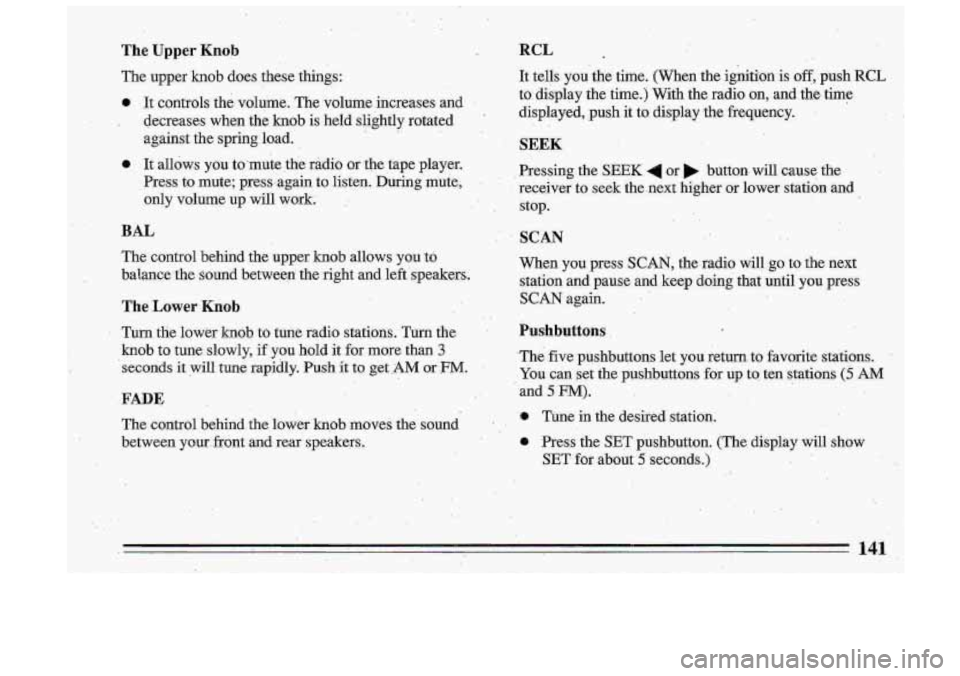
The Upper Knob
The upper knob does these things:
0 It controls the volume. The volume increases and I
I decretises when the knob is held slightly rotated
against the spring load.
e It allows you to.mute the radio or the tape player.
Press to mute; press:again to listen. During
mute;
only volume up will work: .
BAL
The coiltrol behind the upper h0.b allows you 'to
balance-the sound between the right and left'speakers.
The Lower -Knob
' Turn the lower knob to tune radio statians. Turn the .
knob to tune slowly, if you hold it for more than 3
'seconds it will tune rapidly. Push it to get .AM OF .FM.
FADE
The control behind the lower knob moves the sound
between your, front and. rear speakers.
RCL _.
It tells you.the time. (When the,ignition-is off, push RCL
to display the time.); With the radio on, and the time
displayed, push it to, display the frequency.
- .
SEEK &
Pressing the SEEK 4 or button, will cause the
rec-eiver
to seek the.next higher or lower station and
stop.
SCAN
When you press SCAN, the radio will go to .the next
station and pause and keep doing that ,until you press
SCAN again.
Pushbuttons
.The. five. pushbuttons let you return. to favorite stations ..
You can .set the pushbuttons for up to ten stations (5 AM
and 5 FM).
Tune in the desired' station.
0 .Press the SET pushbutton. (The display will show
SET-for abiouf
5 seconds.)
. .. 141
Page 151 of 340
cassette has no improvement in s.ound quality, clean the
tape player.
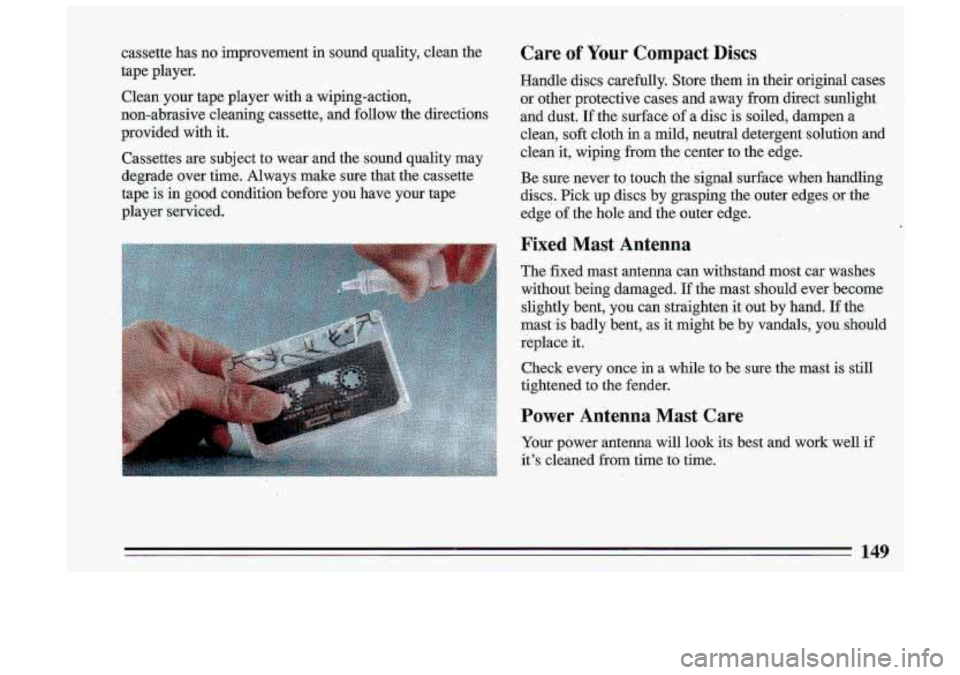
Clean
your tape player with a wiping-action,
non-abrasive cleaning cassette, and follow the directions
provided with it.
Cassettes are subject to wear and the sound quality may
degrade over time. Always make sure that the cassette
tape
is in good condition before you have your tape
player serviced.
Care of Your Compact Discs
Handle discs carefully. Store them in their original cases
or other protective cases and away from direct sunlight
1
and dust. If the surface of a disc is soiled, dampen a
clean, soft cloth in
a mild, neutral detergent solution and i
clean it, wiping from the center to the edge. I
Be sure never to touch the signal surface when handling
discs. Pick up discs by grasping the outer edges ,or .the
edge'of the hole and the outer edge.
I
-1
Fixed Mast Antenna
The fixed mast antenna can withstand most car washes
without being damaged. If the mast should ever become slightly bent, you can straighten it out by hand.
If the
mast is badly bent,
as it might be by vandals, you should
replace
it.
Check every once in a while to be sure the mast is still
tightened to the fender.
Power Antenna Mast Care
Your power antenna will look its best and work well if
it's cleaned from time to time.
149
Page 221 of 340
1
I
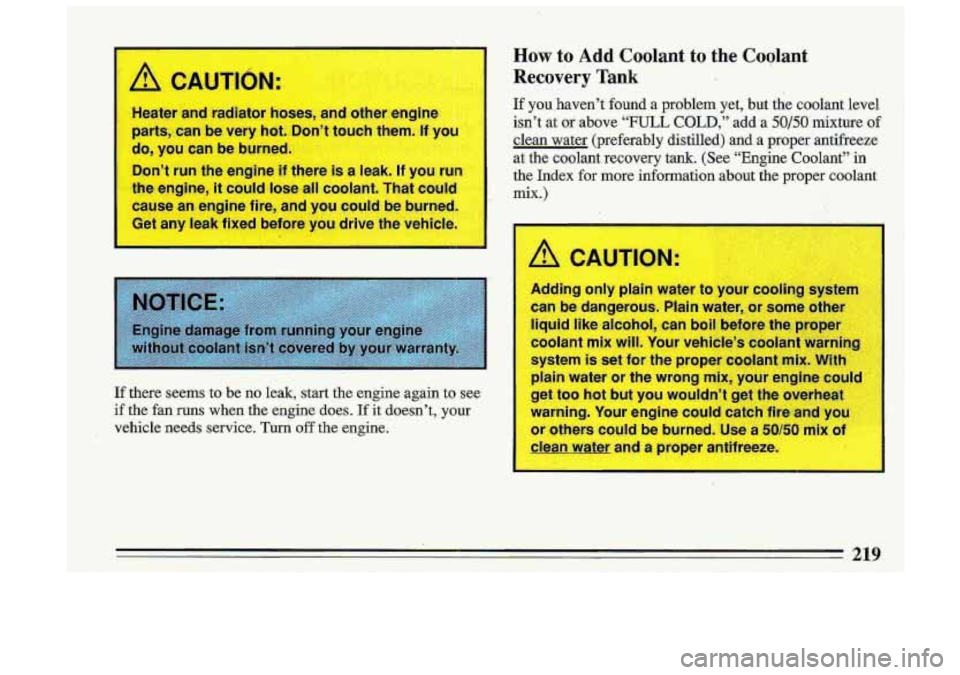
11 parts, can be very hot. Don’t 1 Ich them. I
do, you can be burned.
Don’t
run the engine if ther I leak. If yo
the engine,
it could lose all coolant. That could
cause an engine Pire, and you could be burned.
Get any leak fixed before you drive the vehicle.
If there seems to be no leaK, start tne engine again to see
if the fan runs when the engine does. If it doesn’t,, your
vehicle needs service. Turn
off the engine.
How to Add Coolant to the Coolant
Recovery Tank
If you,haven’t found a problem yet, but the coolant level
isn’t at or above
“FULL COLD,” add-a 50/50 mixture of
clean water (preferably distilled) and a proper antifreeze
at the coolant recovery tank. (See “Engine Coolant’’ i\
n
the Index for more information about the proper coolant
mix.)
can be dangerous. Plain water, or some other I
liquid like alcohol, can boil before the, proper
coolant mix will. Your vehicle’s coolant warning
system
is set for the proper coolant mix. With
plain water
or the wrong mix, your engine could
get too hot but you wouldn’t get the overheat
warning. Your engine could catch fire.and you
or others could be burned. Use a 50/50 mix of
clean
---- s-- -1 a proper antifr ze.
5
219 1 i
Page 236 of 340
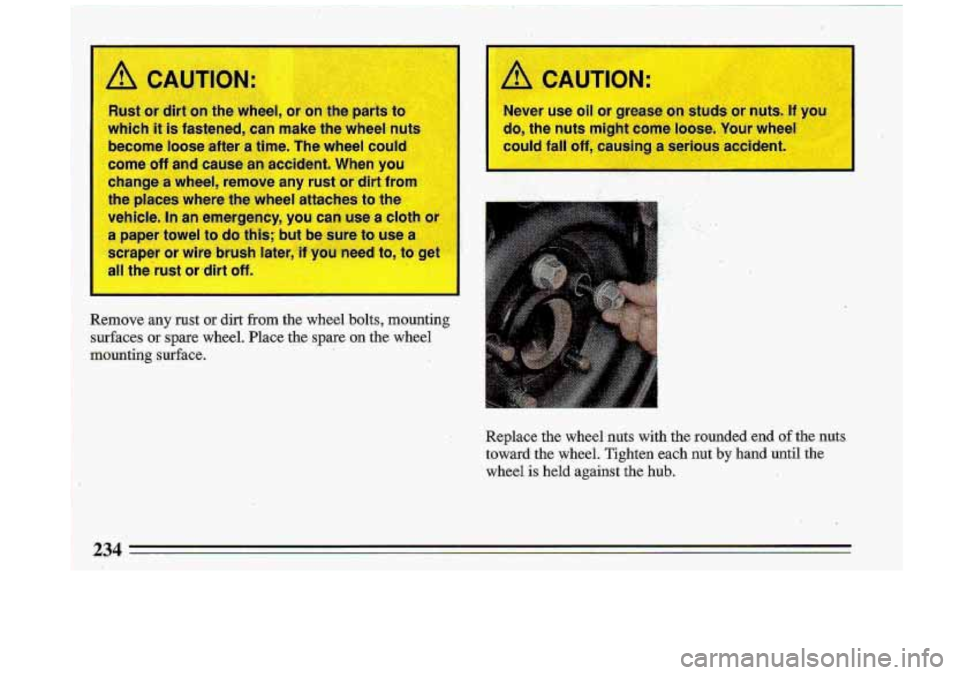
CAUTIO A
Rust or dirt on the wheel,
which it
is fastened, can make the wheel nu
become loose after a time. The wheel could
come
off and cause an accident. When you
change
a wheel, remove any rust or dirt fro1
the places where the wheel attaches to the
vehicle. In an emergency, you can use
a cloth or
a paper towel to
do this; but be sure to use a
scraper or wire brush later, if you need to, to get
all the r---t or dirt off.
N use oil or gre
e on stu
Remove any rust or dirt fro-rn the wheel bolts, rnoullLl1lg
surfaces or spare wheel. Place the spare on the wheel
mounting surface.
Replace.
the wheel nuts with the rounded end of the nuts
toward the wheel. Tighten each nut by hand until the
wheel is held against the hub.
234
Page 251 of 340
Engine OiI
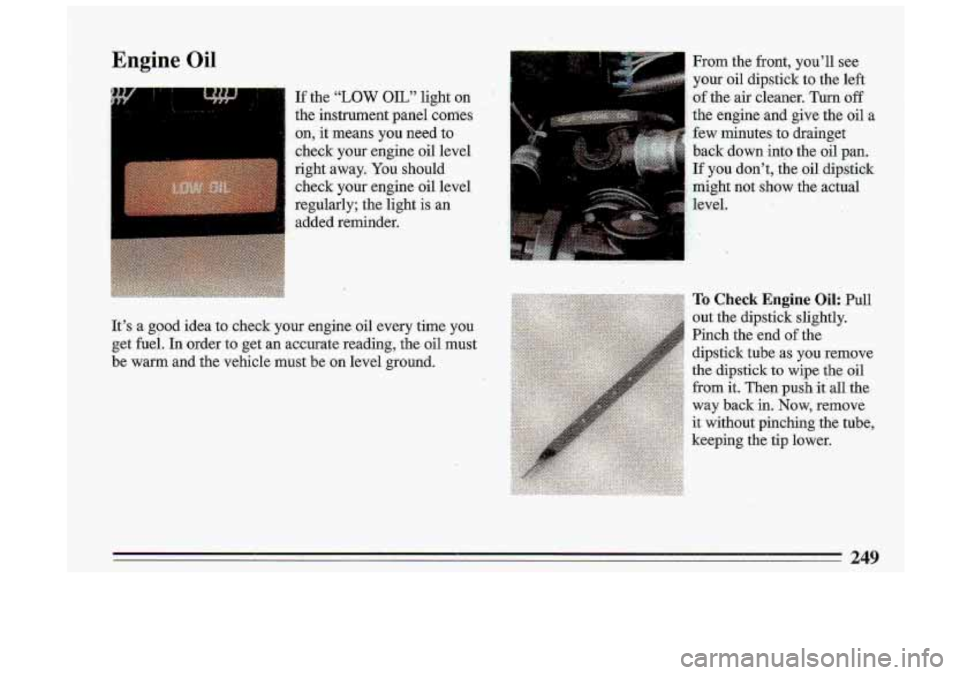
If the "LOW OIL" light on '
the instrument panel comes
on, it means .you need to
check your engine oil level
right away. You should
check your engine oil level
regularly; the light
is an
added reminder.
It's a good idea to check your engine oil every time you
get fuel. In order to get an accurate reading, the oil must
be warm and the vehicle must be on level ground. From the front, you'll
see
your oil hpstick to the left
of 'the air cleaner. Turn off
the engine and give the oil a
fe.w minutes.
to drainget
back down-into the
oil pan.
If
you don't, the oil dipstick
might not show the actual
h%l.
To Check Engine Oil: Pull
out the dipstick slightly.
Pinch the ,end of the
dipstiek tube as you remove
the dipstick to wipe the oil
fi-om it. Then,push it' all the
way back
in. No.w, remgve
it without pinching the tube,
keeping the tip lcmer.
Page 253 of 340
1 I
! I'
I'
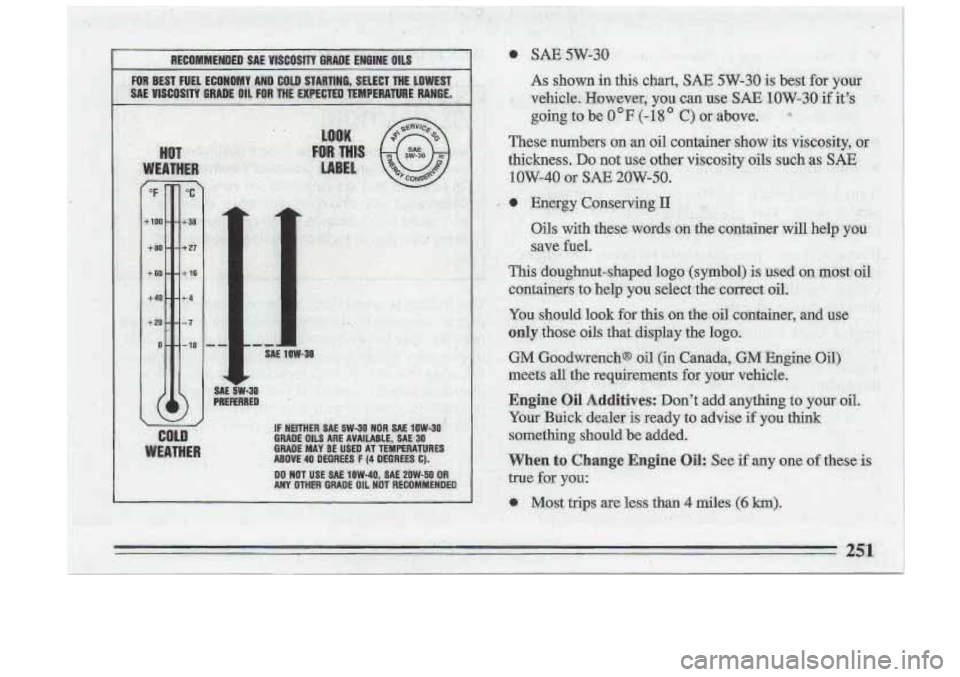
thickness. DO not we other visco,sity-oils such ;as SAE
low-40 or SAE 2OW-50.
Page 254 of 340
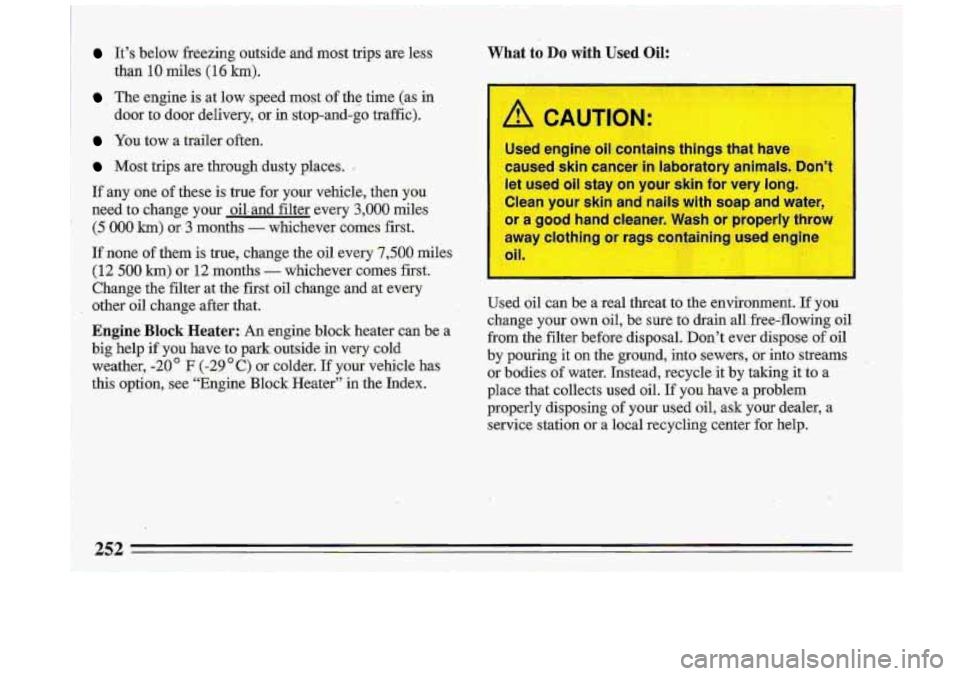
It’s below freezing outside and most trips are less:
than
10 miles (16 km).
. The engine is -at low .speed most of the time (as in
door
tp door delivery, or in stop-and-go traffic).
You tow a trailer often.
Most trips are through dusty places.
If -any one of these is true for your vehicle, then you
need-to change
your oil.and filter every 3,000 miles
(5 000 km) or, 3 months - whichever comes first.
If none of them is true, change the oil every 7,500 miles
(12 -500 km) or 12 months - whichever comes first.
Change the filter at the first oil change and
at every
other oil change after that.
Engine Block Heater: An engine block heater can be a
big help if-you have
to park outside in very cold
weather,
-20 * F (-29 C] or .colder. If your vehicle has
this option, see
“Engine Block Heater” in the Index.
What to Do with Used Oil:
Used engine oil contains things that have
caused skin cancer in laboratory animals.
Da
let used oil stay on your skin for very long
Clean your skin and nails with soap and water,
away clothing or rags containing used engine
0
lr a good hand cleaner. Wash or properly throw
I
..
Used oil can be a real threat to the environment. If you
change your
own oil, be sure to drain all free-flowing oil
Erom the filter before disposal. Don’t ever dispose of oil
by pouring
it on the ground, into sewers, or into streams
or bodies of water. Instead, recycle it by taking it.to a
place that collects used oil. If you have a problem
properly disposing of your used oil, ask your dealer, a
service station or
a local recycling center for help.
252
Page 256 of 340
Automatic Transmission Fluid
When to Check and Change:
A good time to check your auiomatic transmission fluid
level is when the engine oil is changed. Refer to the
Maintenance Schedule to determine when to change
your fluid. See “Scheduled Maintenance Services” in
the Index.
How to Check:
Because this operation can be a little difficult, you may
choose to have this done at
a Buick,dealership Service
Department.
If
you do it yourself, be sure to follow all the
instructions here, or you could get a false reading on the
.
dipstick. Wait
at least
30 minutes before checking the
transmission fluid level
if you have been driving:
0 When outside temperatures are above. 90 F ‘(32 C);
0 At high speed for quite a while. I
In heavy traffic - &specially in hot weathEr.: . .
While pulling a trailer.
To get the right reading, the fluid should be at normal
operating temperature, which is
180 F to 200 *F (82 C
To check transmission fluid hot: Get the vehicle ‘warmed
up
by driving about 15 miles (24 krn) when outside
temperatures are above
50 F (1 0 C). If it’s colder than
50 F ( 10 C), drive the vehicle in “D” (3rd Gear) until
the engine temperature gage moves and then remains
steady for ten minutes. Then follow the hot check
procedures.
To check transmission fluid cold: A cold check is made
after the vehicle has been sitting for
8 hours or more
with the engine
off and is used only as a reference. Let
the engine run at idle for
5 minutes if outside
temperatures are
50 F (10 C) or more. If ‘it’s colder
than
50 OF (10 * C), you may have to idle the engine
longer.
A hot check must €0110~ when fluid is added
during
a cold check.
..
to 93 C).
254