transmission BUICK ROADMASTER 1993 Owners Manual
[x] Cancel search | Manufacturer: BUICK, Model Year: 1993, Model line: ROADMASTER, Model: BUICK ROADMASTER 1993Pages: 340, PDF Size: 18.34 MB
Page 63 of 340
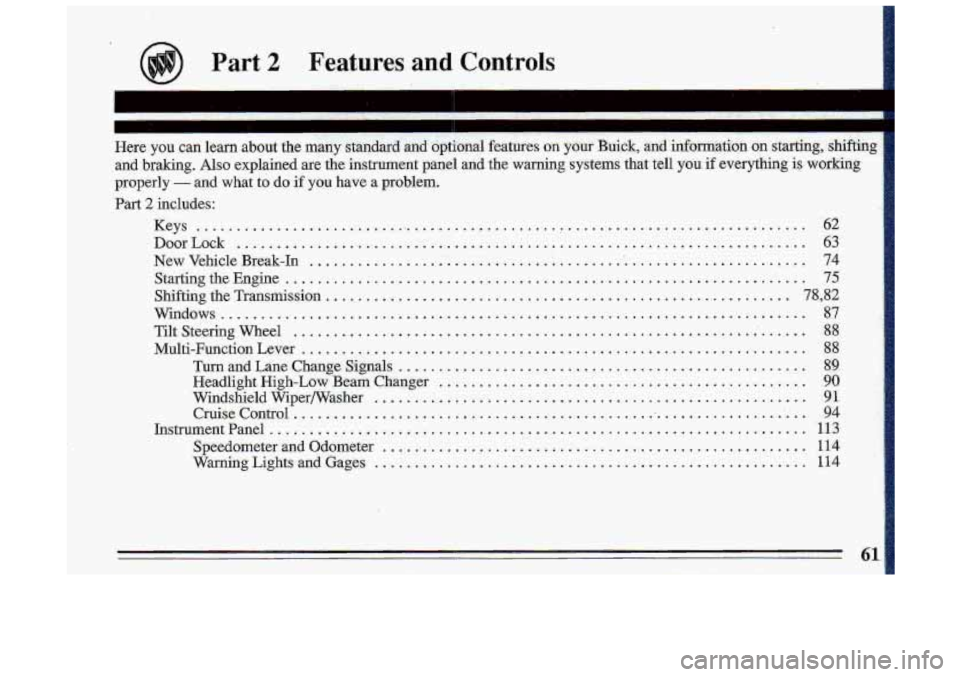
Part 2 Feat.ures and Controls
n .
Here you can learn about the many standard and optional features on your Buick, and infom.ation on starting. shifting
and braking
. Also explained are the instrument panel and the warning systems that tell you if everything is working
properly
. and what to do if you have a problem .
Part 2 includes:
Keys
........................................................................\
..... 62
DoorLock ....................................................................... \
63
New Vehicle Break-In ............................................................... 74
Starting the Engine
................................................................. 75
Shifting the Transmission
.......................................................... 78, 82
Windows ........................................................................\
. 87
TiltSteeringWheel
................................................................ 88
Multi-IFunctionLever ............................................................... 88
TurnandLaneChangeSignals ................................................... 89
Headlight High-Low Beam Changer .............................................. 90
Windshield WiperWasher
....................................................... 91
Cruise Control
.................................................................. 94
Instrument Panel
................................................................... 1 13
Speedometer and Odometer
..................................................... 114
Warning Lights and Gages
...................................................... 114
61
.
Page 74 of 340
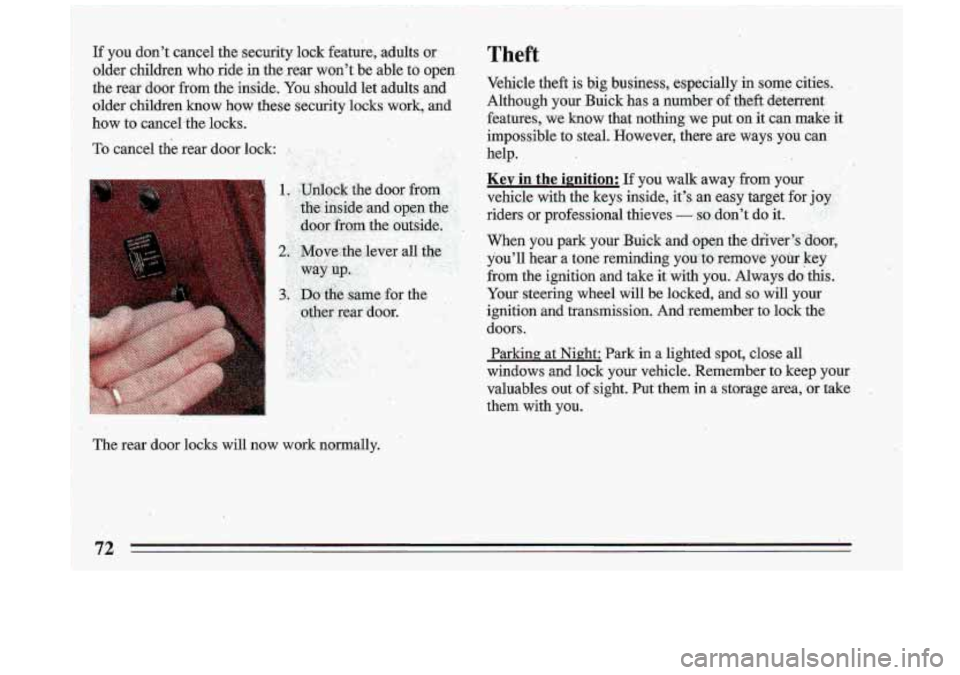
Theft
Vehicle theft is big business, especially in some cities.
Although your Buick has
a number of the€t deterrent
features, we know that nothing we put on it can make
it
impossible to steal. However, there are ways y6U can
help.
Kev in t~he ignition: If you walk away from your
vehicle with the keys inside, it's an easy'target for joy%..
riders or professional thieves - so don't do it. wyqw. .:: %3: F: ;-;.::. *.'%(:.
When you park your Buick and open'the diiver 's'door,
you'll hear a tone reminding you'to remove your key
from the ignition and take it with you.' Always
do this..
Your steering wheel will be locked, and
so will your
ignition and transmission. And remember to lock the
doors.
.. .L: . . *:*.a ;*;,,,
Parking at Night: Park in a lighted spot, close all
windows and lock your vehicle. Remember to keep your
valuables out
of sight. Put them in a storage area, -or take
them with you.
Page 82 of 340
-. Going,about 35 mph (-5.6 km/h) or more, push the
accelerator all the way do.wn.
. .
You’ll shift,down to the next gear and have more
power.
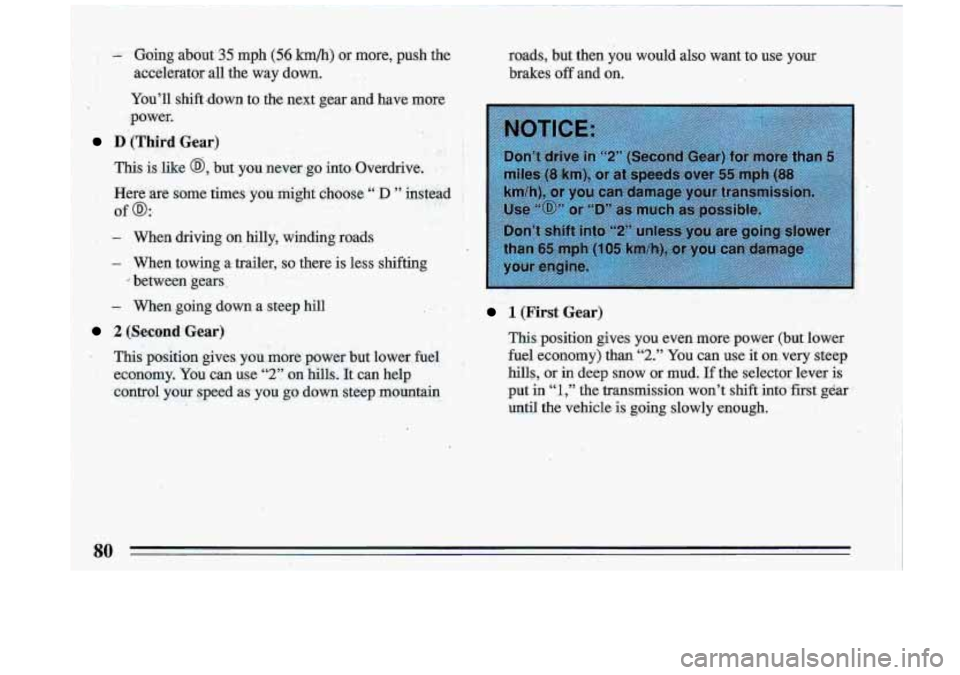
D.(Third Gear)
This is like @, but you never.go into-Overdrive. - .
Here ’ue some tirnes kowmight dboose “ D ” instiad
of a:. -,
.. - When driving on hilly, winding roads
- When towing a- trailer, so there is less shifting
- When .going down a steep hill . . . !A
J between gears.
2 (Second Gear)
. This position gives you.more ,power but lower fuel
ecanomy. You can use
“2’’ on hills..Zt can help
cohtrol your
speed as. you go down steep mountain roads, but
then-you would also want
to use your
brakes
off and on.
1 (First Gear)
This position gives you even more power (but lower.
fuel economy) than
“2.” YOU can use it on,very steep
hills, or in deep snow or mud.
If the selector lever is
put in
“1,” the transmission won’t shift into first gear
until the vehicle is going slowly enough.
Page 86 of 340
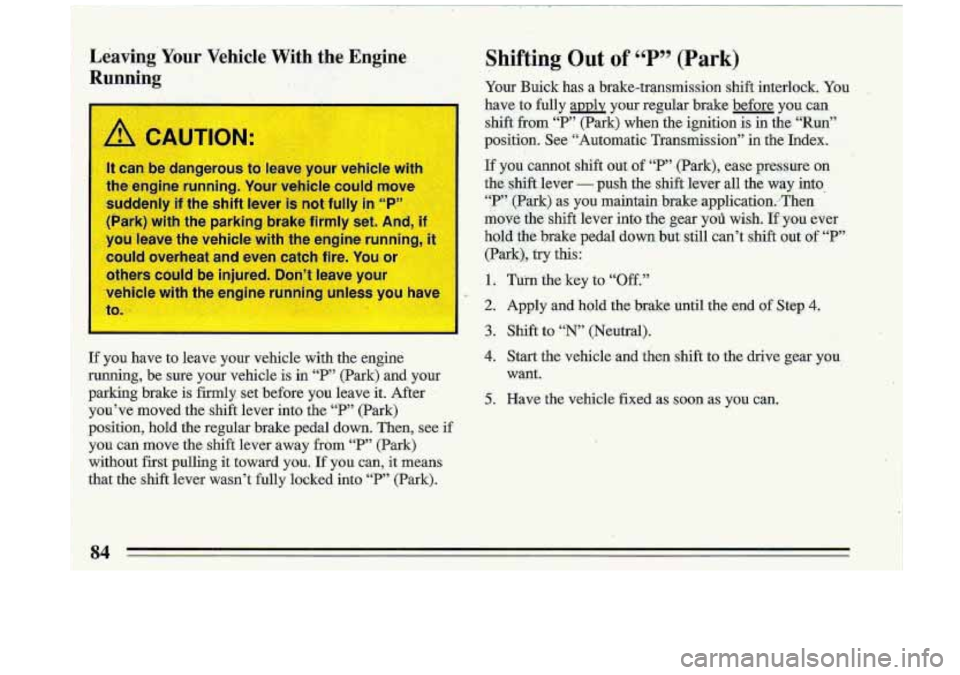
Shifting Out of ‘T” (Park)
Your Buick has a brake-transmission shift interlock. You
have to fully apply your regular brake before you can shift
from ‘T“ (Park) when tbe ignition .is in the “Run”
position. See “Automatic Transmission” in the Index.
If you cannot shift out of “P”.(Park), ease pressure on
tW$hift lever -push the
shift lever all the way inta.-
“p‘“..(Park) ai you maintain brake app1ication;wThen
riove the
shift lever into the gear yoii wish. If you ever
hold.
the brake pedal down but still can’t shift out of “P”
(Park$, try this:
1. Tmn the key to “Off.’-’
2. Apply and hold the brake until the end of Step 4.
3. Shift to “N’ (Neutral).
4. Start the vehicle and then shift to the drive gear you
5. Have the vehicle fixed as soon as you can.
c
.. .- ,- . ._
want.
Page 209 of 340
I
I
You eou be injured ! V€ !s roll
parking brake firmly on each vehicle. Put an
automatic transmission
in ‘‘P” (Park) or a
manu nsl in 9
3. Twm off the ignition .on both vehicles. Turn ofr all
lights that aren’t needed, and radios. This will avoid
sparks- and help save both batteries. And
it could
save your radio!
4. Open the hoods and locate the batteries. Find the
positive (+) and negative (-) terminals on each
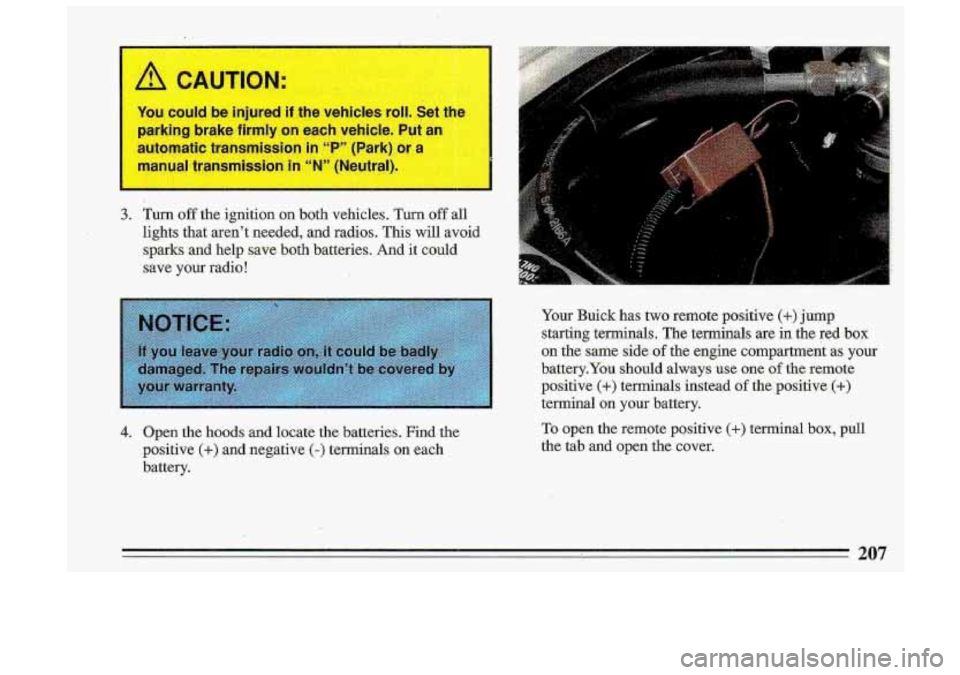
battery. Your Buick has two remote positive.
(+) jump
starting terminals.
The terminals are in the red box
on the. same side’of the engine compartment BS your
battery.You should always use one, of the remote
.positive
(+) terminals instead of the positive (+)
terminal on your battery.
To open the remote positive (+) terminal box, pull
the tab and open the cover.
Page 241 of 340
I A CAUTION:
If you let your tires spin at high eed, the I
explode and YOU or others could be injured.
And, the transmission or other parts of the
vehicle can overheat. That could cause an
engine compartment fire other damage.
When
you’re stuck, spin the wheels as little as
possible. Don’t spin the wheels above 35 I h
(55 km/h) as shown on the speedome r. c
239
Page 256 of 340
Automatic Transmission Fluid
When to Check and Change:
A good time to check your auiomatic transmission fluid
level is when the engine oil is changed. Refer to the
Maintenance Schedule to determine when to change
your fluid. See “Scheduled Maintenance Services” in
the Index.
How to Check:
Because this operation can be a little difficult, you may
choose to have this done at
a Buick,dealership Service
Department.
If
you do it yourself, be sure to follow all the
instructions here, or you could get a false reading on the
.
dipstick. Wait
at least
30 minutes before checking the
transmission fluid level
if you have been driving:
0 When outside temperatures are above. 90 F ‘(32 C);
0 At high speed for quite a while. I
In heavy traffic - &specially in hot weathEr.: . .
While pulling a trailer.
To get the right reading, the fluid should be at normal
operating temperature, which is
180 F to 200 *F (82 C
To check transmission fluid hot: Get the vehicle ‘warmed
up
by driving about 15 miles (24 krn) when outside
temperatures are above
50 F (1 0 C). If it’s colder than
50 F ( 10 C), drive the vehicle in “D” (3rd Gear) until
the engine temperature gage moves and then remains
steady for ten minutes. Then follow the hot check
procedures.
To check transmission fluid cold: A cold check is made
after the vehicle has been sitting for
8 hours or more
with the engine
off and is used only as a reference. Let
the engine run at idle for
5 minutes if outside
temperatures are
50 F (10 C) or more. If ‘it’s colder
than
50 OF (10 * C), you may have to idle the engine
longer.
A hot check must €0110~ when fluid is added
during
a cold check.
..
to 93 C).
254
Page 258 of 340
How to Add Fluid:
Refer to the Maintenance Schedule to determine what
kind
of transmission fluid to use. See “Recommended
Fluids and.lLubricants” in the Index.
If the fluid level is low, add only enough of the proper
fluid to bring the level up to the COLD area for a cold
check or the
HOT area fora hot check. It doesn’t take
much fluid, generally less than a pint. Don’t overfill.
we
recommend you use only fluid labeled DEXRONBIIE,
because fluids with that label are made-especially for
you automatic transmission. Damage caused by fluid
other than DEXRON@IIE
is not covered by your new
vehicle warranty.
0 After adding fluid, recheck the fluid level as
described under “How to Check.77
0 When the correct-fluid level is obtained, push the
dipstick back in all the way.
Rear Axle
When to Check and Change Lubricant:
Refer to the Maintenance Schedule to determine how
often to check the lubricant and when to change it. See
“Periodic Maintenance Inspections” in the Index.
How to Check Lubricant:
If the level is below the bottom of the filler plug hole,
you’ll need to add some lubricant. Add enough lubricant
to raise the level to the bottom
of the filler plug hole.
What
to Use:
Standard Differential
Use Axle Lubricant (GM Part
No. 1052271) or SAE
80W-90 GL-5 gear lubricant.
Limited-Slip Differential
To add lubricant when the level is low, use Axle
Lubricant (GM Part
No. 1052271) or SAE 8OW-90
GL-5 gear lubricant.
To completely refill after draining,
add
4 ounces (1 18 ml) of Limited-Slip Differential
Lubricant Additive (GM Part
No. 1052358). Then fill to
the bottom of the filler plug hole with Axle Lubricant
(GM Part
No. 1052271) or SAE 80W-90 GL-5 gear
lubricant.
Page 307 of 340
..
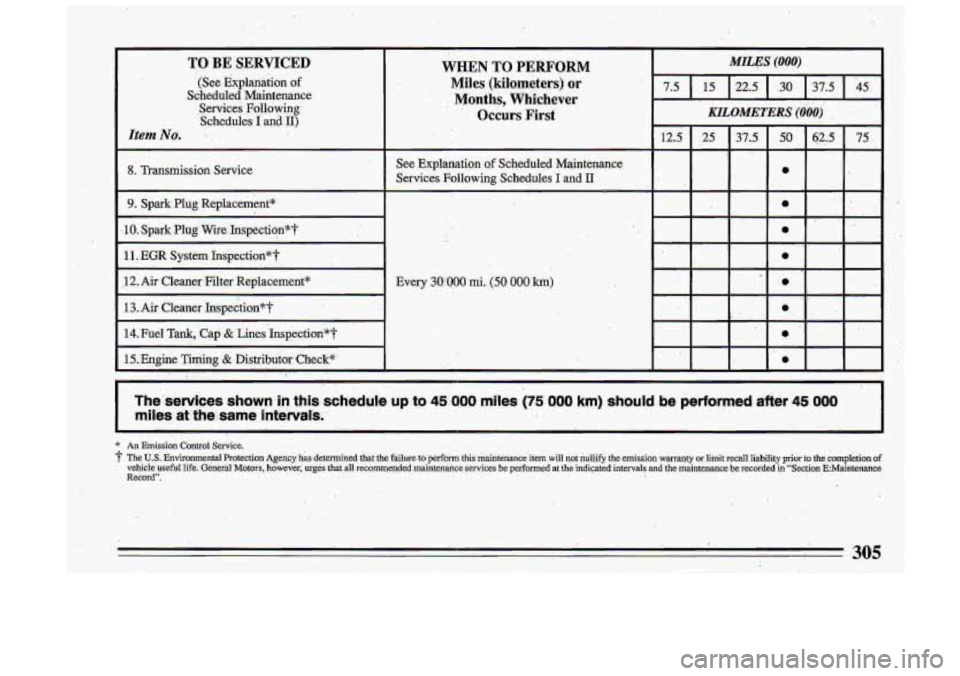
TO BE ,SERVICED
(See explanation of
Scheduled Maintenance Services Following
Schedules I'and
11)
Item No. - .
8. Transmission Service
9. Spark Plug Replacement"
10. Spark Plug. Wire.Inspection*T
11. EGR System Inspection*?
12. Air Cleaner Filter Replacement"
13. ~ir cleaner Inspection*?
14. Fuel Tank, Cap & Lines'Inspectiori*f
15. En&e Timing & Distributor Check!
WHEN TO PERFORM
., Miles (kilometers) or
Months, Whichever
Occurs First
See Explanation of Scheduled Maintenance
Services Following Schedules
I and 11
Every 30!000 mi. (50 000 km)
t-
KILOMETERS (000)
..
The'services shown in this schedule up to 45.000 miles (75 000 km) should be performed after 45 000
miles at the'same inte-Wals.
I I ..
* An Emission Control Service.
f The U.S. Environmental Protection Agency has determined that the failure to perform this maintenance item will not nullify the emission warranty or limit recall liability prior to the completion of
vehicle useful life. Gerieml Motors, however; urges that all recommended maintenance services be performed at the indicated intervals and the maintenance be.recorded in "Section EMaintenance
Record".
305
Page 309 of 340
7.
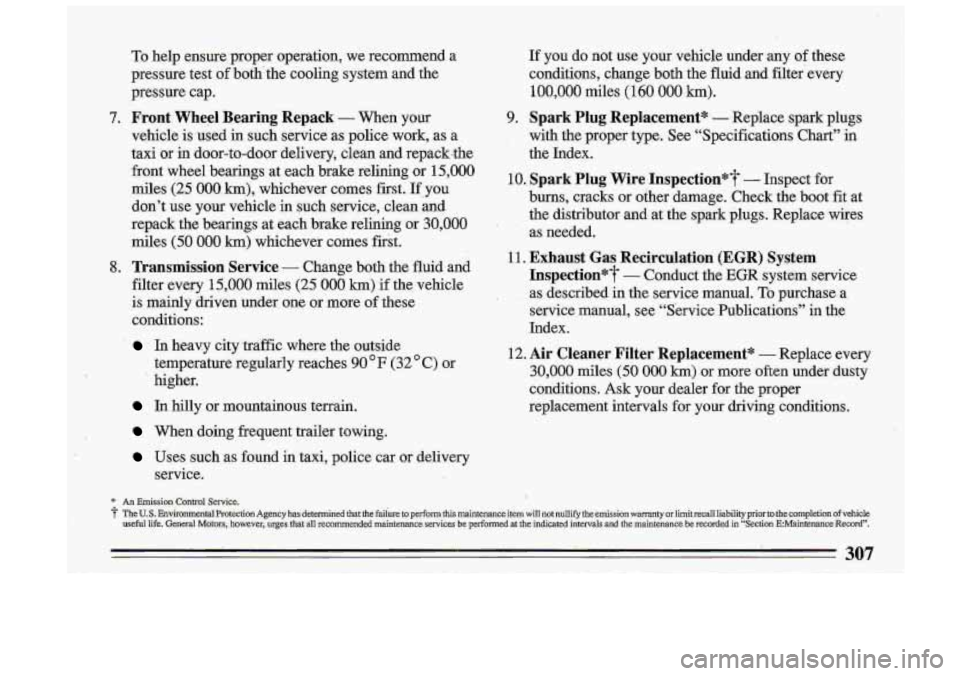
8.
To help ensure-proper operation, we recommena a
pressure test of both’the cooling system and the
pressure cap. If you do not use your vehicle under any of these
conditions, change both the fluid and filter every
100,000 miles (1 60 000 km).
Front Wheel Bearing Repack - When your 9. Spark Plug Replacement* - Replace spark plugs
vehicle is used in such service as police work, as a with the proper type. See “Specifications Chart.’’ in
taxi or
in door-to-door delivery, clean and repackthe the Index.
front wheel bearings at each brake relining or
15,000 Spark plug Wire Inspection*? - Inspect for
miles (25 000 km), whichever comes first. If you
don’t use your vehicle in such service, clean
and
repack the bearings at each brake relining or 30,000 -
miles (50 000 km) whichever comes first. burns, cracks .or other damage. Check the boot fit
at
the distributor and at the spark plugs. Replace wires
as. needed.
Transmission Service - Change both the fluid and
filter every
15,000 miles (25 000 km) if the vehicle
is mainly driven under one or ‘more
of these
conditions:
In heayy city traffic where the outside
temperature regularly reaches
‘90 OF (32 C) or
higher.
In hilly or mountainous terrain.
When doing frequent trailer towing.
Uses such as found in taxi, police car or delivery
service.
11. Exhaust Gas Recirculation (EGR) System
Inspection*?
- Conduct the EGR system service
as described in the service manual.
To purchase a
service manual, see “Service Publications” in the
Index.
12. Air Cleaner Filter Replacement* - Replace every
30,000 miles (50 000 km) or more ofkn under dusty
conditions. Ask your dealer for the proper
replacement intervals for your driving conditions.
307
I