fuel BUICK SKYLARK 1993 User Guide
[x] Cancel search | Manufacturer: BUICK, Model Year: 1993, Model line: SKYLARK, Model: BUICK SKYLARK 1993Pages: 306, PDF Size: 15.84 MB
Page 224 of 306
Engine Oil
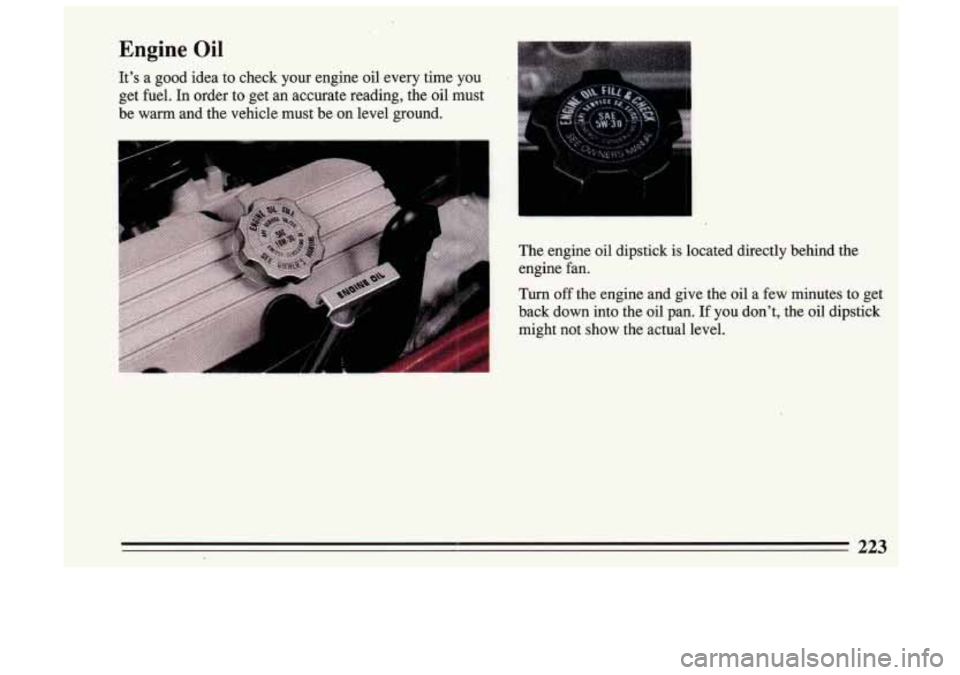
It's a good idea to check your engine oil every time you
get fuel.
In order to get an accurate reading, the oil must
be warm and the vehicle must be
on level ground.
1
I
The engine oil dipstick is located directly behind the
engine fan.
Turn
off the engine and give the oil a few minutes to get
back down into the oil pan.
If you don't, the oil dipstick
might not show the actual level.
223
Page 226 of 306
What Kind of Oil to Use:
Look for three things:
SG
“SG’ must be on the oil container, either by itself or
combined with other quality designations, such
as
“SG/CC,” “SG/CD,” “SF,SG,CC;” etc. These letters
show American Petroleum Institute (API) levels
of
quality.
I
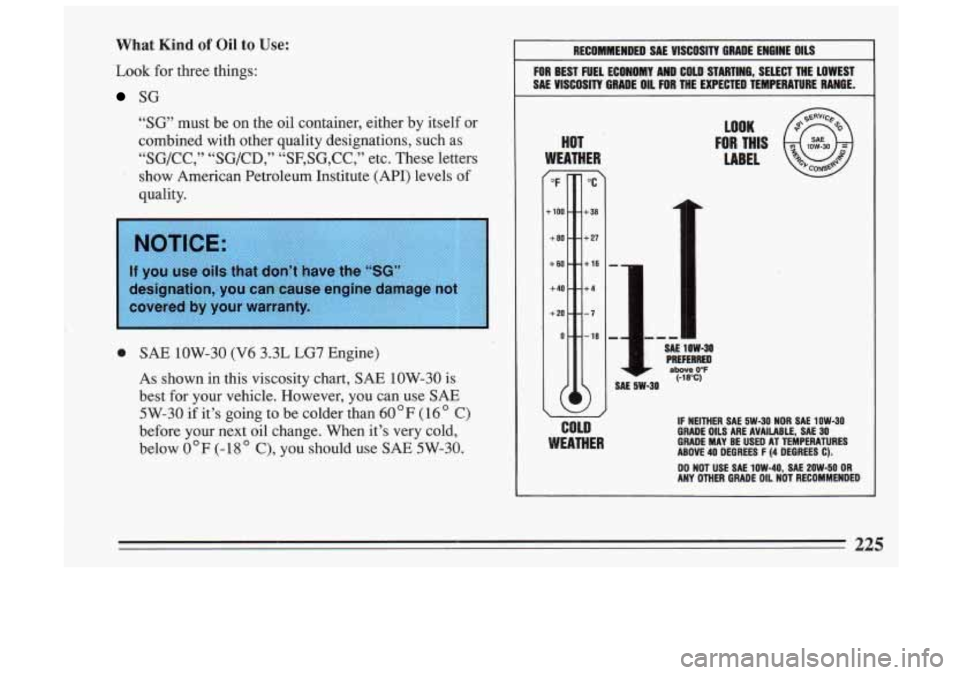
0 SAE low-30 (V6 3.3L LG7 Engine)
As shown in this viscosity chart,
SAE 1OW-30 is
best for your vehicle. However, you can use SAE
5W-30
if it’s going to be colder than 60 OF ( 16 C)
before your next oil change. When it’s very cold,
below
O°F (-18 C), you should use SAE 5W-30.
RECOMMENDED SAE VISCOSITY GRADE ENGINE OILS
FOR BEST FUEL ECONOW AND COLD 16, SELECT THE LOWEST
SAE VISCOSITY GRADE OIL
FOR THE El.. -_ .-J TEMPERATURE RANGE.
HOT
WEATMER
r
“F
k100
+ 80
+ 60
+ 40
+ 20
0
f
r
“C
. +38
.+27
- +16
.+4
.-7
. -18
WEATHER LOOK
LABEL
FOR THIS IOW-30
1
-
-
above WF
SAE 5W-30
IF NEITHER SAE 5W-30 NOR SAE 1OW-30 GRADE OILS’ARE AVAILABLE, SAE 30 GRADE MAY BE USED AT TEMPERATURES
ABOVE 40 DEGREES F (4 DEGREES C).
ANY OTHER GRADE
OIL NOT RECOMMENDED
DO NOT USE SAE 1OW-40,
SAE 2OW-50 OR
Page 227 of 306
RECOMMENDED SAE VlSCOSlTY GRADE ENGINE OILS
FOR BEST FUEL ECONOMY AND COLD STARTING, SELECT THE LOWEST
SAE VISCOSITY GRADE
OIL FOR THE EXPECTED TEMPERATURE RANGE.
HOT
WEATHER
COLD
FOR LOOK THIS @
LABEL
5W-30
"t'LcoNse94'
IE 1OW-30
SAE 5W-30 PREFERRED
IF NEITHER SAE 5W-30 NOR SAE low-30
GRADE OILS ARE AVAILABLE, SAE 30 GRADE MAY BE USED AT TEMPERATURES
ABOVE 40 DEGREES F (4 DEGREES C). WEATHER
DO NOT USE SAE 1OW-40, SAE 2OW-50 OR
ANY OTHER GRADE OIL NOT RECOMMENDED
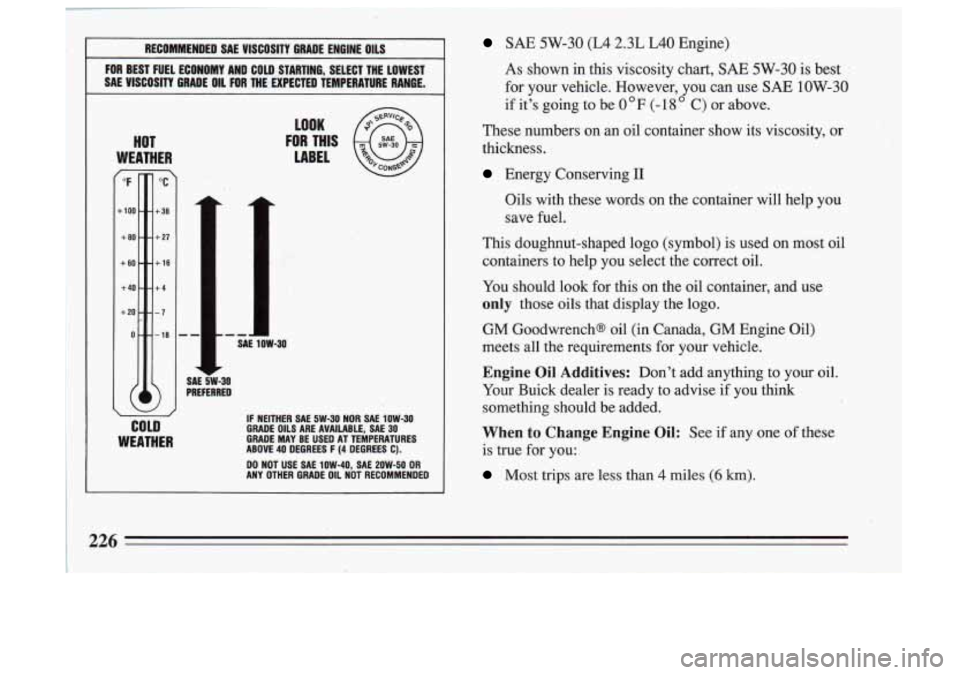
SAE 5W-30 (L4 2.3L L40 Engine)
As shown in this viscosity chart, SAE
5W-30 is best
for your vehicle. However, you can use
SAE low-30
if it's going to be
0 OF (- 18 C) or above.
These numbers on an oil container show its viscosity, or
thickness.
Energy Conserving I1
Oils with these words on the container will help you
save fuel.
This doughnut-shaped logo (symbol) is used on most oil
containers to help you select the correct oil.
You should look for this on the oil container, and use
only those oils that display the logo.
GM Goodwrench@ oil (in Canada,
GM Engine Oil)
meets all the requirements for your vehicle.
Engine Oil Additives: Don't add anything to your oil.
Your Buick dealer is ready to advise if you think
something should be added.
When to Change Engine Oil: See if any one of these
is true for you:
Most trips are less than 4 miles (6 km).
226
I
1
Page 241 of 306
Loading Your Vehicle
TIRE-LOADI',NG INFORMATION
OCCUPANTS
, VEHICLE CAP. WT.
FRT. CTR.
RR. TOTAL LBS. KG
MAX
... LOADING & GVWR SAME AS VEHICLE
CAPACITY WEIGHT- XXX COLD 'TIRE
TIRE SIZE SPEED PRESSURE .R.TG PSI/KPa
FRT.
,., : 3. ~
RR.
SPA.
IF TlRES ARE HOT, ADD 4PSI28KPa
SEE OWNER'S MANUAL
FOR ADDITIONAL
INFORMATION
11)mp .$$##,::
.. ~ c . ., . 'Lj . - .,.
,::.,,: - -i, y- . e,; 2-.,- .- .
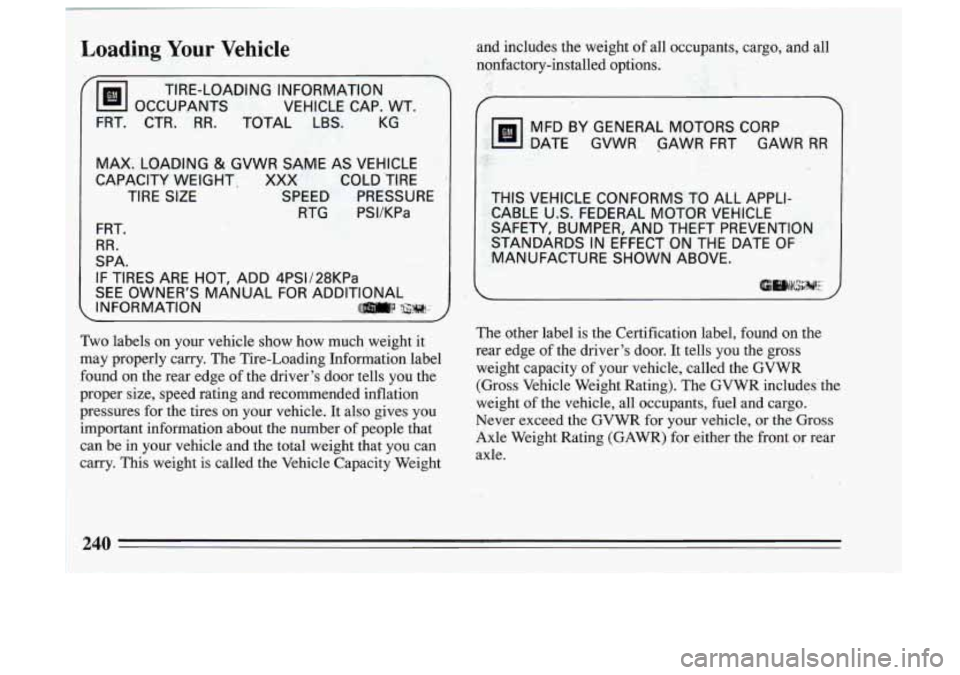
Two labels on your vehicle show how much weight it
may properly carry. The Tire-Loading Information label
found
on the rear edge of the driver's door tells you the
proper size, speed rating and recommended inflation
pressures for the tires on your vehicle. It also gives you
important information about the number of people that
can be in your vehicle and the total weight that you can
carry. This weight is called the Vehicle Capacity Weight
and includes the weight of all occupants, cargo, and all
nonfactory-installed options.
,~,,
- -
:.I.
' I
F >
MFD BY GENERAL MOTORS CORP
:.r .~,. a. DATE GVWR' GAWR FRT GAWR RR (1 . -. i < .
THIS VEHICLE CONFORMS TO ALL APPLI-
CA5LE US. FED.ERAL MOTOR VEHICLE
SAFETY, BUMPER, AND THEFT PREVENTION
STANDARDS IN EFFECT
ON THE DATE OF
MANUFACTURE SHOWN ABOVE..
The other label is the Certification label, found on the
rear edge of the driver's door.
It tells you the gross
weight capacity of your vehicle, called the GVWR
(Gross Vehicle Weight Rating). The GVWR includes the
weight of the vehicle, all occupants,
fuel and cargo.
Never exceed the GVWR for your vehicle,
or the Gross
Axle Weight Rating (GAWR) for either the front or rear
axle.
Page 243 of 306
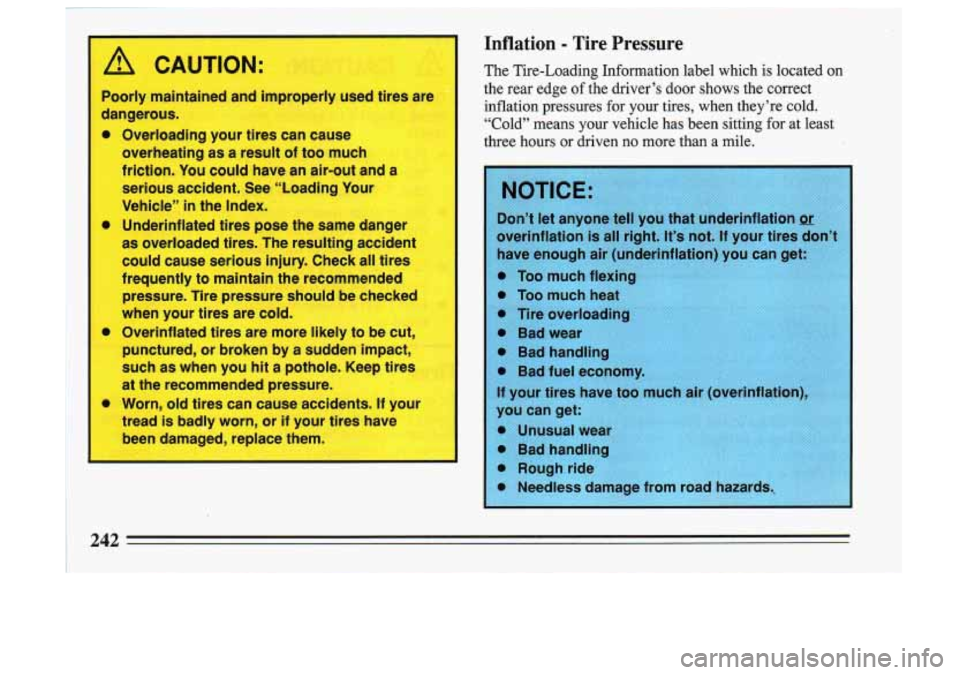
Inflation - Tire Pressure I
I
I
The Tire-Loading Information label which is located on
the rear edge
of the driver’s door shows the correct
inflation pressures
for your tires, when they’re cold,
“Cold” means your vehicle has been sitting for at least
three hours or driven no more than
a mile.
overinflation is all right. it’s not. If your tires d
have enough air (underinflation) you can get:
0 Too much flexin
0 Too much heat
Tire overloadi
0 Bad wear
0 Bad handlin
0 Bad fuel ec
If your tires have too
242
Page 256 of 306
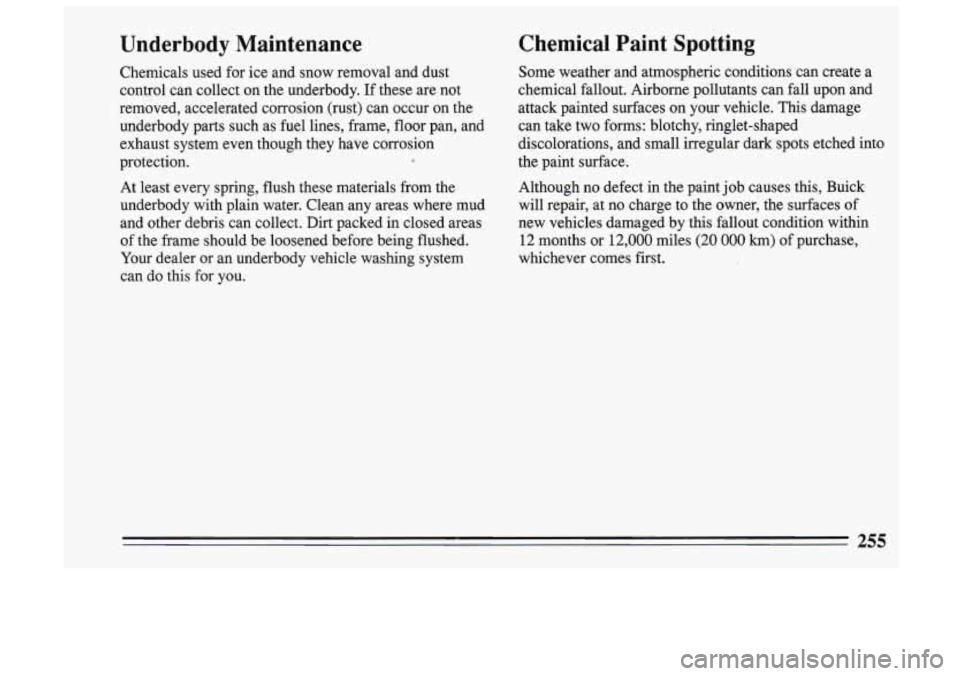
Underbody Maintenance
Chemicals used for ice and snow removal and dust
control can collect on the underbody. If these are not
removed, accelerated corrosion (rust) can occur on the
underbody parts such as fuel lines, frame, floor pan, and
exhaust system even though they have corrosion
protection.
x
At least every spring, flush these materials from the
underbody with plain water. Clean any areas where mud
and other debris can collect. Dirt packed in closed areas
of the frame should be loosened before being flushed.
Your dealer or an underbody vehicle washing system
can
do this for you.
Chemical Paint Spotting
Some weather and atmospheric conditions can create a
chemical fallout. Airborne pollutants can fall upon and
attack painted surfaces on your vehicle. This damage
can take two forms: blotchy, ringlet-shaped
discolorations, and small irregular dark spots etched into
the paint surface.
Although no defect in the paint job causes this, Buick
will repair, at no charge to the owner, the surfaces of
new vehicles damaged by this fallout condition within
12 months or 12,000 miles (20 000 km) of purchase,
whichever comes first.
255
Page 260 of 306
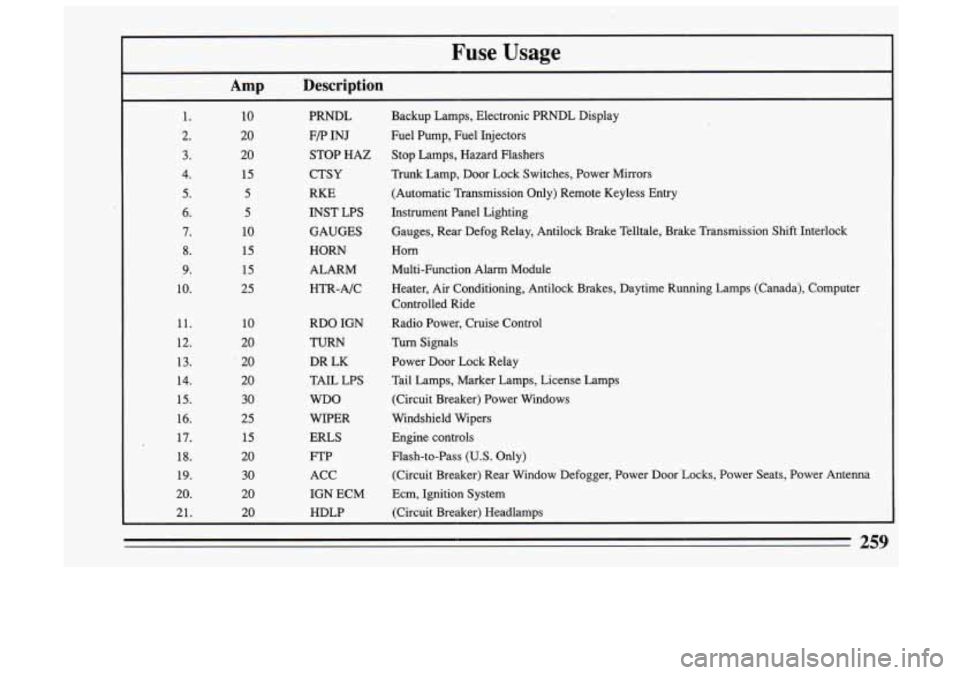
~~ Fuse Usage
Amp Description
1.
2.
3.
4.
5.
6.
7.
8.
9.
10.
11.
12.
13.
14.
15.
16.
17.
18.
19.
20.
21. 10
20
20
15
5
5
10
15
15
25
10
20
20
20
30
25 15
20
30
20
20 PRNDL
F/P INJ
STOP HAZ
CTSY
RKE
INST LPS
GAUGES
HORN
ALARM HTR-A/C
RDO IGN
TURN DR LK
TAIL LPS
WDO
WIPER
ERLS
FTP
ACC
IGN ECM HDLP Backup Lamps, Electronic PRNDL Display
Fuel Pump, Fuel Injectors
Stop Lamps, Hazard Flashers
Trunk Lamp,-Door Lock Switches, Power Mirrors
(Automatic Transmission Only) Remote Keyless Entry
Instrument Panel Lighting
Gauges, Rear Defog Relay, Antilock Brake Telltale, Brake Transmi\
ssion Shift Interlock
Horn
Multi-Function Alarm Module
Heater, Air Conditioning, Antilock Brakes, Daytime Running Lamps \
(Canada), Computer Controlled Ride
Radio Power, Cruise Control
Turn Signals
Power Door Lock Relay
.Tail Lamps, Marker Lamps, License Lamps (Circuit Breaker) Power Windows
Windshield Wipers Engine controls
Flash-to-Pass
(U.S. Only)
(Circuit Breaker) Rear Window Defogger, Power Door Locks, Powe\
r Seats, Power Antenna
Ecm, Ignition System (Circuit Breaker) Headlamps
259
Page 264 of 306
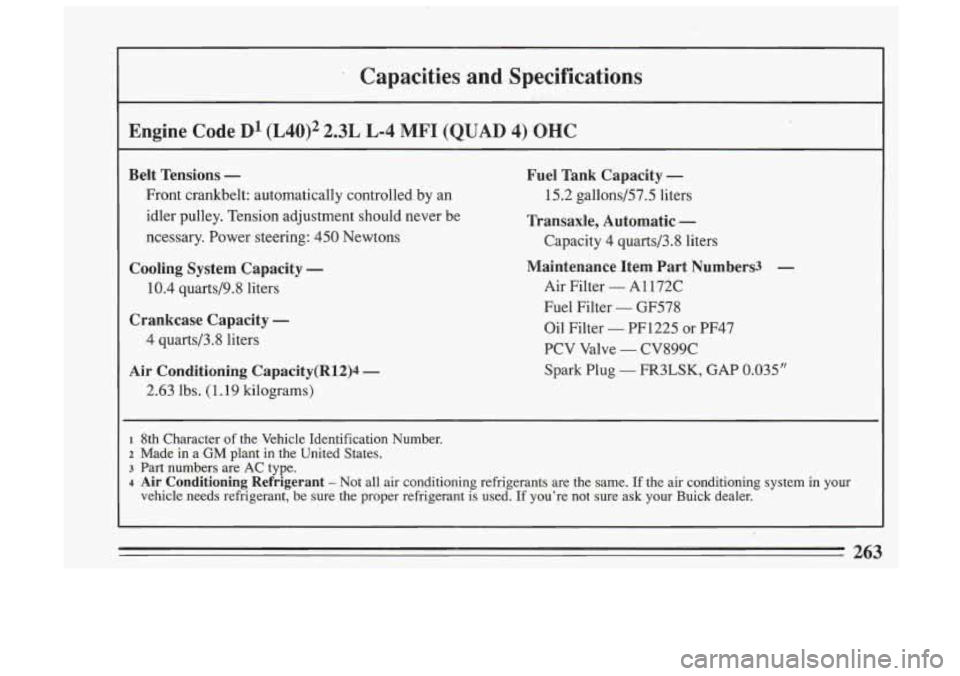
. Capacities and Specifications
Engine Code D1 (L40)2 2.3L L-4 (QUAD 4) OHC
Belt Tensions -
Front crankbelt: automatically controlled by an
idler pulley. Tension adjustment should never be
ncessary. Power steering:
450 Newtons
Cooling System Capacity -
10.4 quarts/9.8 liters
Crankcase Capacity -
4 quarts/3.8 liters
Air Conditioning Capaeity(Rl2)4 -
2.63 lbs. (1.19 kilograms)
Fuel Tank Capacity -
15.2 gallons/57.5 liters
Transaxle, Automatic -
Capacity 4 quarts/3.8 liters
Maintenance Item Part Numbers3
Air Filter - AI 172C
Fuel Filter
- GF578
Oil Filter
- PF1225 or PF47
PCV Valve
- CV899C
Spark Plug
- FR3LSK, GAP 0.035”
~~~~
1 8th Character of the Vehicle Identification Number.
z Made in a GM plant in the United States.
3 Part numbers are AC type.
4 Air Conditioning Refrigerant - Not all air conditioning refrigerants are the same. If the air conditioning system in your
vehicle needs refrigerant, be sure the proper refrigerant
is used. If you’re not sure ask your Buick dealer.
263
Page 265 of 306
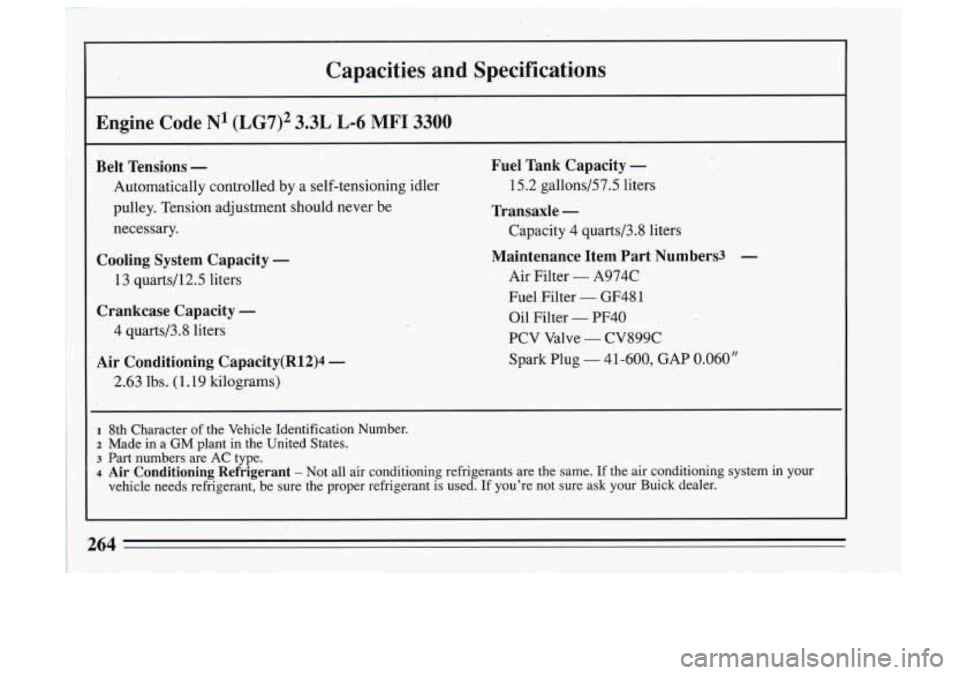
Capacities and Specifications
Engine Code N1 (LG7)2 3.3L L-6 MFI 3300
Belt Tensions -
Automatically controlled by a self-tensioning idler
pulley. Tension adjustment.should new be
necessary.
Cooling System Capacity -
13 quarts/l2.5 liters
Crankcase Capacity -
4 quarts/3.8 liters
Air Conditioning Capacity(R12)d -
2.63 lbs. (1.19 kilograms)
Fuel Tank Capacity -
Transaxle -
15.2 gallons/57.5 liters
Capacity
4 quartd3.8 liters
Maintenance Item Part Numbers3 -
Air Filter - A974C
Fuel Filter
- GF48 1
Oil Filter - PF40
PCV Valve
- CV899C
Spark Plug
- 41-600, GAP 0.060”
1 8th Character of the Vehicle Identification Number.
2 Made in a GM plant in the United States.
3 Part numbers are AC type.
4 Air Conditioning Refrigerant - Not all air conditioning refrigerants are the same. If the air conditioning system in your
vehicle needs refrigerant, be sure the proper refrigerant
is used. If you’re not sure ask your Buick dealer.
264
Page 266 of 306
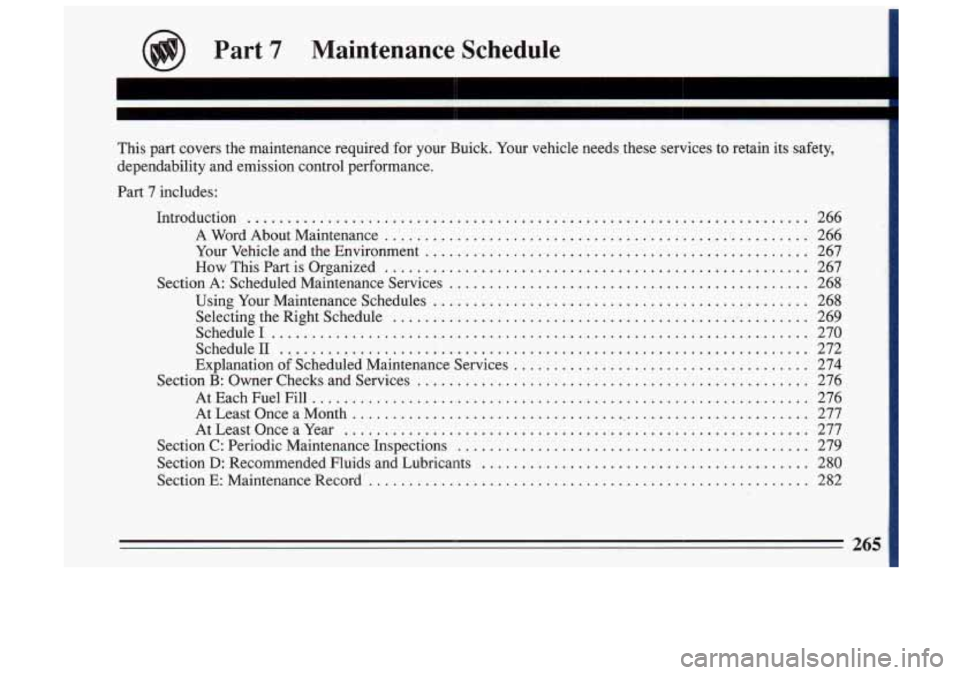
Part 7 Maintenance Schedule
This part covers the maintenance required for your Buick . Your vehicle needs these services to retain its safety.
dependability and emission control performance
.
Part 7 includes:
Introduction
...................................................................... 266
A Word About Maintenance
.....................................................
Your Vehicle and the Environment ................................................ 267
How This Part is Organized
..................................................... 267
Section A: Scheduled Maintenance Services
.............................................
Using Your Maintenance Schedules ............................................... 268
Selecting the Right Schedule
....................................................
Schedule1 ................................................................... 270
Schedule11
.................................................................. 272
Explanation
of Scheduled Maintenance Services ..................................... 274
AtEachFuelFill
.............................................................. 276
At Least Once a Month .......................................................... 277
AtLeastOnceaYear
..........................................................
Section C: Periodic Maintenance Inspections ............................................ 279
Section
D: Recommended Fluids and Lubricants ......................................... 280
Section E: Maintenance Record
....................................................... 282
Section
B: Owner Checks and Services .................................................