parking brake BUICK SKYLARK 1993 User Guide
[x] Cancel search | Manufacturer: BUICK, Model Year: 1993, Model line: SKYLARK, Model: BUICK SKYLARK 1993Pages: 306, PDF Size: 15.84 MB
Page 175 of 306
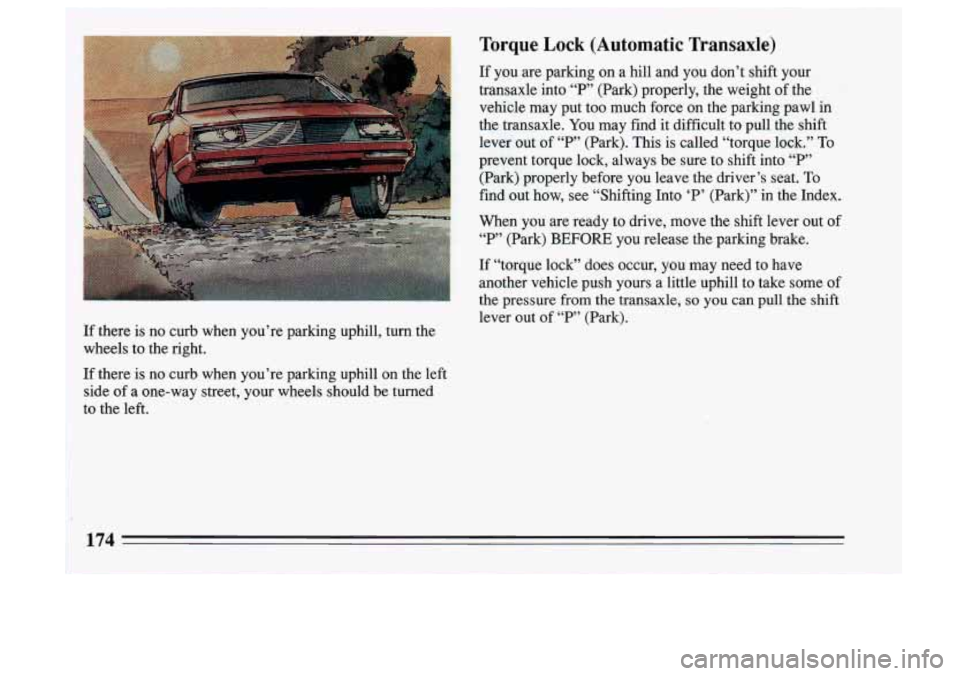
If there is no curb when you’re parking uphill, turn the
wheels to the right.
If there is no curb when you’re parking uphill on the left
side of a one-way street, your wheels should be turned
to the left.
Torque Lock (Automatic Transaxle)
If you are parking on a hill and you don’t shift your
transaxle into“‘F” (Park) properly, the weight
of the
vehicle may put too much force on the parking pawl in
the transaxle. You may find it difficult to pull the shift
lever out of
T“ (Park). This is called “torque lock.” To
prevent torque lock, always be sure to shift into “P”
(Park) properly before you leave the driver’s seat. To
find out how, see “Shifting Into ‘P’ (Park)” in t\
he Index.
When you are ready to drive, move the shift lever out of
“P” (Park) BEFORE you release the parking brake.
If “torque lock” does occur, you may need to have
another vehicle push yours a little uphill to take some of
the pressure
from the transaxle, so you can pull the shift
lever out of
“P” (Park).
174
Page 184 of 306

Passing
You’ll need more passing distance up ahead when
you’re towing a trailer. And, because you’re a good deal \
longer, you’ll need to go much farther beyond the
passed vehicle before you can return to your lane.
d
Backing Up
Hold the bottom of the steering wheel with one hand.
Then, to move the trailer to the left, just move that hand
to the left. To move the trailer to the right, move your
hand to the right. Always. back up slowly and, if
possible, have someone guide you.
Making Turns
When you’re turning with a trailer, make wider turns
than normal.
Do this so your trailer won’t strike soft
shoulders, curbs, road signs, trees, or other objects.
Avoid jerky or sudden maneuvers. Signal well in
advance.
nrn Signals When Towing a Trailer
When you tow a trailer, your vehicle has to have a
different turn signal flasher and extra wiring. The green
arrows on your instrument panel will flash whenever you signal a turn or lane change. Properly hooked up, the trailer lights will also flash, telling other drivers
you’re about to turn, change lanes or stop.
When towing a trailer, the green arrows on your
instrument panel will flash for turns even if the bulbs on
the trailer are burned out. Thus, you may think drivers
behind you are seeing your signal when they are not. It’s
important to check occasionally to be sure the trailer
bulbs are still working.
Driving On Grades
Reduce speed and shift to a lower gear before you start
down a long
or steep downgrade. If you don’t shift
down, you might have to use your’brakes
so much that
they would get hot and no longer work well.
On a long uphill grade, use the highest gear. possible. If
you cannot maintain posted speeds, driving at a lower
speed may help avoid overheating your engine and
transaxle.
Parking on Hills
You really should not park your vehicle, with a trailer
attached, on a hill. If something goes wrong, your rig
could
start to move. People can be injured, and both
your vehicle and the trailer can be damaged.
183
Page 185 of 306
But if you ever have to park your rig on a hill, here’s
, how to do it:
1 1. Apply your regular brakes, but don’t shift into.“P”
I (Park) yet.
I 2. Have someone place chocks under.the trailer wheels.
1
I
I I
I 3. When the wheel chocks are in place, release the
regular brakes until the chocks absorb the load.
4. Reapply the regular brakes. Then apply your parking
brake, and then shift to
“F’” (Park).
5. Release the regular brakes.
,. I I
~ When You Are Ready to Leave After
I Parking on a Hill
Maintenance When Trailer Towing
Your vehicle will need service more often when you’re
pulling a trailer. See the Maintenance Schedule for more
on this. Things that are especially important in trailer
operation are automatic transaxle fluid (don’t overfill),
engine oil, belt, cooling system, and brake adjustment.
Each of these is covered in this manual, and the Index
will help you find them quickly.
If you’re trailering, it’s
a good idea to review these sections before
you start
your trip.
Check periodically to see that all hitch nuts and bolts are
tight.
I 1. Apply your regular brakes and hold the pedal down
while you:
Start your engine;
0 Shift into a gear; and
0 Release the parking brake.
2. Let up on the brake pedal.
3. Drive slowly until the trailer is clear of the chocks.
4. Stop and have someone pick up and store the chocks.
284
Page 190 of 306
You could be injured if the whicles rd. Sat ths
parking brake firmly on each ve,hicle, ‘Put an
automatic tra’nsaxle in “P*” (Pa~k) or a. ._,an#ual
transaxle in ‘W’ (Neutral).
3. Turn off the ignition on both vehicles. Turn off all
lights that aren’t needed, and radios. This will avoid
sparks and help save both batteries. And it could
save your radio!
4. Open the hood and locate the batteries.
/1 CAUTION:
An electric fan can start up even when the eng
is not running and can injure you. Keep hands
clothing and tools away from
electric fan.
Find the positive (+) and negative (-) terminals on
each battery.
189
Page 195 of 306
P-
When your vehicle is being towed, have the ignition key
off. The steering wheel should be clamped in a
straight-ahead position, with a clamping device designed
for towing service.
Do not use the vehicle’s steering
column lock for this. The transaxle should be in Neutral
and the parking brake released.
Don’t have your vehicle towed on the front wheels,
unless you must.
If the vehicle must be towed on the
front wheels, don’t go more than
35 mph (57 kmh) or
farther than
50 miles (80 km) or your transaxle will be
damaged. If these limits must be exceeded, then the
front wheels have to be supported on a dolly.
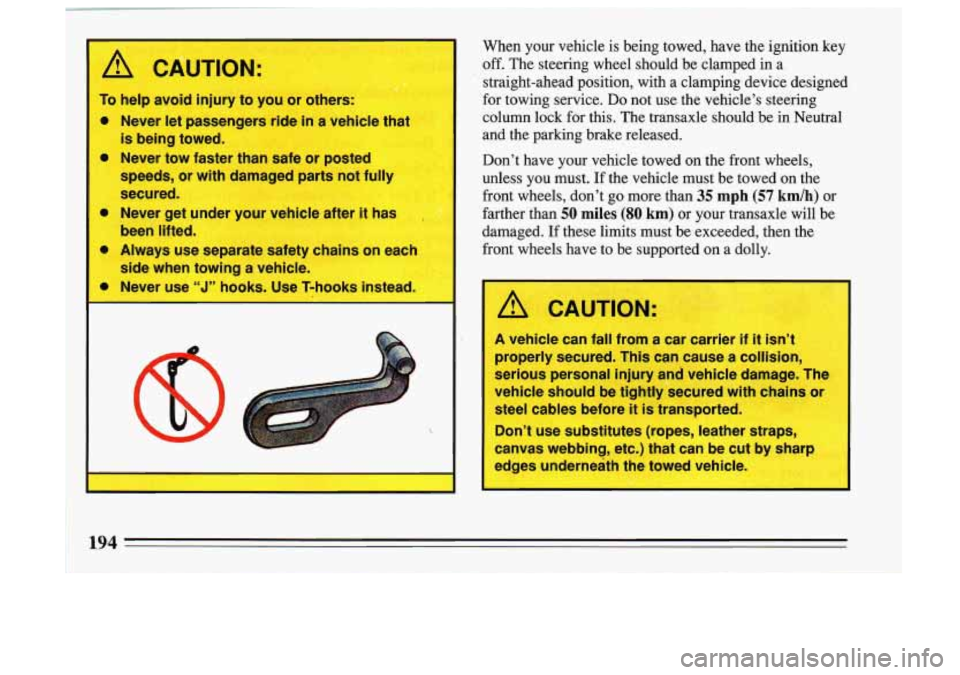
CAUTION:
I A vehicle 1 fall from a car cal t It isn’t
properly secured. This can cause a collision,
serious personal injury and vehicle damage. The
vehicle should be tightly secured with chains or
steel cables before
it is transported.
on’t use substitutes (ropes, leather straps,
canvas webbing, etc.) that can be cut by
sh; 1
I
I edges underneath the towed vehicle.
Page 205 of 306
.If a Tire Goes Flat Changing a Flat Tire
It’s unusual for a tire to “blow out” while you’re driving,
especially
if you maintain yourtires properly. If air goes
out of a tire, it’s much more likely to leak out slowly.
But if you should ever have a “blowout,” here are a few
tips about what to expect and what to do:
1
If a front tire fails, the flat tire will create a drag that
pulls the vehicle toward that side: Take your foot off the
accelerator pedal and grip the steering wheel firmly. Steer to maintain lane position, then gentlv
I. - to a
stop well out of the traffic lane.
A rear blowout, particularly on a curve, acts much like a
skid and may require the same correction you’d use in a
skid. In any rear blowout, remove your foot from the
accelerator pedal. Get the vehicle under control by steering the way you want the vehicle to go. It may be
very bumpy and noisy, but you can still steer. Gently
brake to
a stop, well off the road if possible.
If your tire goes flat, the next section shows how to use
your jacking equipment to change a flat tire safely.
If a tire goes flat, avoid further tire and wheel damage
by driving slowly
to a level place. Turn on your hazard
warning flashers.
A “-CAUTION:
I Changing a tire can cause an injury. The vehicle
can slip off the jack and roll over you or other
people. You and they could be badly injured. Find
a level place to change your tire.
To help prevent
the vehicle from moving:
1. Set the parking brake K- Ay.
2. Put the shift lever in “P” (Park
3. Turn off the engine.
To be even more certain the vehicle won’t mob
you can put chocks at the front and rear of t
tire farthest away from the one being changed,
I That would be the tire on the oP?r side of the
vehicle, the oppos’-
1 end.
CAUTION: (Continued)
Page 231 of 306
Wait at least 30 minutes before checking the transaxle
fluid level if you have been driving:
When outside temperatures are above 90 ’ F (32 ’ C).
0 At high speed .for quite a while.
In heavy traffic -- especially in hot weather.
While pulling a trailer.
To get the right reading, the fluid should be at normal
operating temperature, which is 180’F to 200’F (82OC
Get the vehicle warmed up by driving about
15 miles
(24 km) when outside temperatures are above 50’F
(1 0 C). If it’s colder than 50 OF (10 ’ C), you may have
to drive longer.
To’check the fluid level:
to 93
“C).
0
e
0
Park your vehicle on
a level place.
Place the
shift lever in “F”’ (Park) with the parking
brake applied.
With your foot on the brake pedal, move the shift
lever through each gear range, pausing for about
three seconds
in each range. Then, position the shift
lever
in “P,’ (Park).
Let the engine
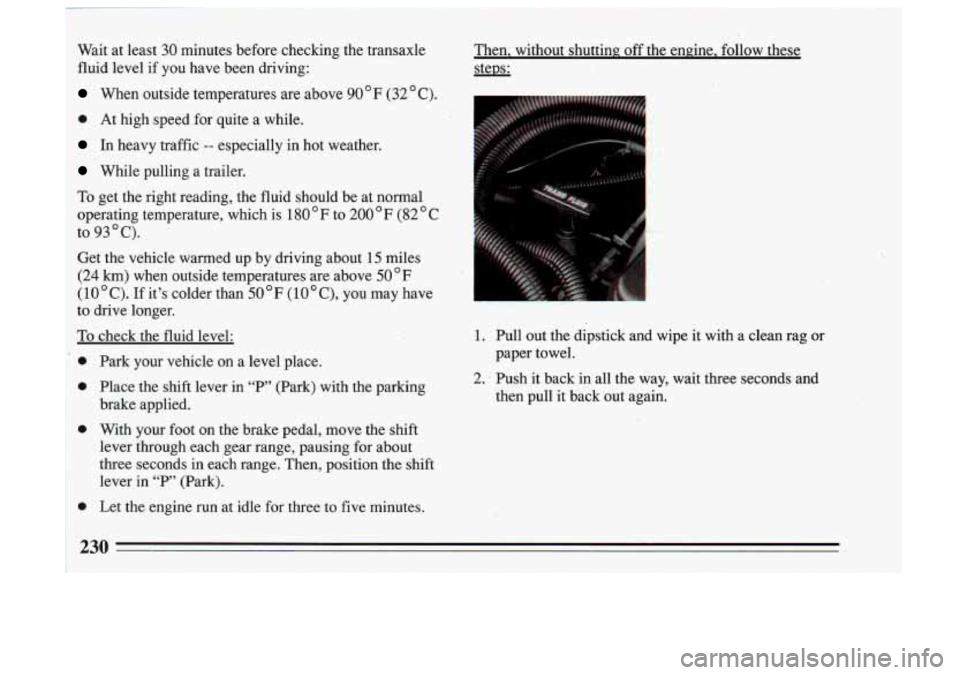
run at idle far three to five minutes. Then; without shutting off the engine, follow these
steps:
.I. Pull out the dipstick and wipe it with a clean rag or
paper towel.
2. . Push it back in all the way, wait three seconds and
then pull it back out again.
Page 259 of 306
Fuses and Circuit Breakers
The wiring circuits in your car are protected from short
circuits.by a combination of fuses, circuit breakers, and
fusible thermal links in the wiring itself. This greatly
reduces the chance of fires caused by electrical
problems.
Be sure to use the correct fuse. If you ever have a
problem on the road and don’t have a spare fuse, you
I
can “borrow” one of the identical size and rating. Just
pick some feature of your car that you can get along
without
-- like the radio or cigarette lighter -- and use its
fuse, if it is of the value you need. Replace it as soon as
you can.
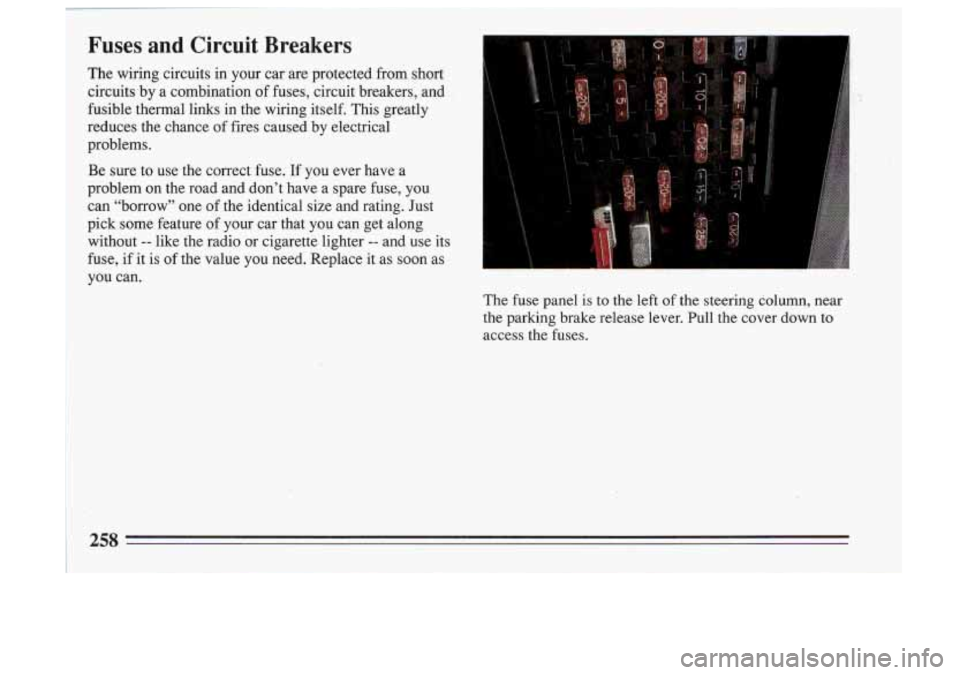
The fuse panel
is to the left of the steering column, near
the parking brake release lever. Pull the cover down to
access the fus.es.
I
258
Page 275 of 306
Explanation of Scheduled Maintenance equipped with grease fittings, lubricate the
Services suspension and steering linkage.
Below are explanations
of the services listed in $chediie ‘ ‘ 3. Throttle Body Mounting; Bolt Torque (3.3L Code . , I:
I and Schedule 11.
The proper fluids and lubricants to use are listed in
Section
D. Make sure whoever services your vehicle
uses these. All parts should be replaced and all
necessary repairs done before you or anyone else drives
the vehicle.
NOTE:
To determine your engine’s displacement and
code, see “Engine 1dentific.ation” in the Index.
1. Engine Oil and Filter Change* -- Always use SG
Energy Conserving
I1 oils of proper viscosity. The
“SG, designation may be shown alone or in
combination with others, such as “SG/CC”,
“SG/CD” or “SF,
SG, CC,” etc. To determine the
preferred viscosity for your vehicle’s engine (e.g.,
SAE 5W-30 or SAE 10W-30), see “Engine Oil” in
the Index.
2. Chassis Lubrication -- Lubricate the transaxle shift
linkage, parking brake cable guides, underbody
contact points and linkage. If your vehicle is
An Emission Control Service.
N engine only)* -- Che& the torque of the
mounting bolts and/or nuts.
proper wear and maximum tire life, rotate your tires
following the instructions in this manual. See “Tires,
Inspection
& Rotation” in the Index, Check the tires
for uneven wear or damage. If you see irregular or
premature wear, check
the wheel alignment. Check
for damaged wheels also.
5. Engine Accessory Drive Belt@) Inspection --
Inspect the belt(s) for cracks, fraying, wear and
proper tension. Replace as needed.
6. Cooling System Service* -- Drain, flush and refill
the system with new or approved recycled coolant
conforming to GM Specification 1825M. Keep
coolant at the proper mixture as specified. See
“Coolant” in the Index. This provides proper freeze
protection, corrosion inhibitor level and engine operating temperature.
4. Tire and Wheel Rotation and Inspection -- For
The U.S. Environmental Protection Agency has determined that the failure to perform this maintenance item will not nullify the emission war\
ranty or limit recall liability prior to the completion of vehicle
useful life. General Motors, however, urges that all recommended maintenance services be performed at the indicated i\
ntervals and the maintenance be recorded in “Section EMaintenance Record”.
274
Page 278 of 306
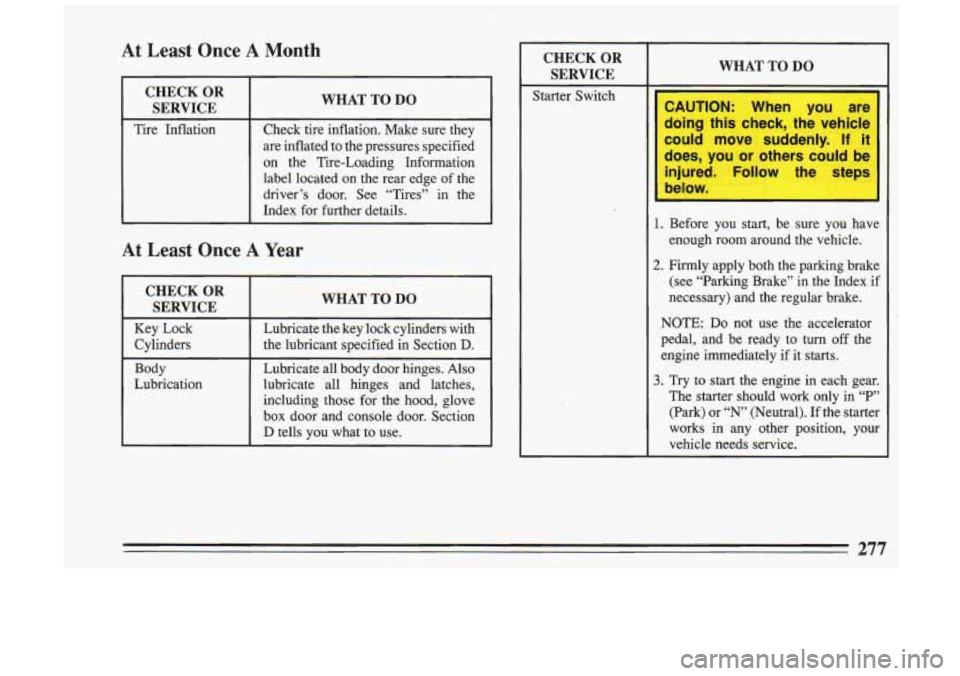
At Least Once A Month
CHECK OR SERVICE
Tire Inflation
WHAT TO DO
Check tire inflation. Make sure they
are inflated to the pressures specified
on the Tire-Loading Information
label located on the rear edge of the
driver’s door. See “Tires” in the
Index for further details.
At Least Once A Year
CHECK OR
SERVICE
I WHAT TO DO
Key Lock
Lubricate all body door hinges. Also
Body the
lubricant specified in Section
D. Cylinders Lubricate the
key lock cylinders with
Lubrication lubricate all hinges and latches,
including those for the hood, glove
box door and console door. Section
D tells you what to use.
CHECK OR
SERVICE
Starter Switch
WHAT TO DO
kAUTION: When you are
doing this check, the vehicle
could move suddenly.
If it
does, you or others could be
injured. Follow the steps
bellow.
- 1
1. Before you start, be sure you have
enough room around the vehicle.
2. Firmly apply both the parking brake
(see “Parking Brake” in the Index if
necessary) and the regular brake.
NOTE:
Do not use the accelerator
pedal, and be ready to
turn off the
engine immediately if it starts.
3. Try to start the engine in each gear.
The starter should work only in
“P’
(Park) or “N” (Neutral). If the starter
works in any other position, your
vehicle needs service.
277