tires BUICK SKYLARK 1993 Owner's Manual
[x] Cancel search | Manufacturer: BUICK, Model Year: 1993, Model line: SKYLARK, Model: BUICK SKYLARK 1993Pages: 306, PDF Size: 15.84 MB
Page 244 of 306
When to Check: Check your tires once a month or
more.
Don’t forget your compact spare tire. It should be at
60
psi (420 Pa).
How tco Check: Use a good quality pocket-type gage to
check tire pressure. Simply looking at the tires will not
tell you the pressure, especially if
you have radial tires --
which may look~properly inflated even if they’re
underinflated. 1
If your tires have valve caps, be sure to put them back
on. They help prevent leaks~ by keeping out dirt and
moisture.
Tire Inspection and Rotation
To make your tires last longer, have them, inspected and
rotated at the mileages recommended in the
Maintenance Schedule. See “Scheduled Maintenance
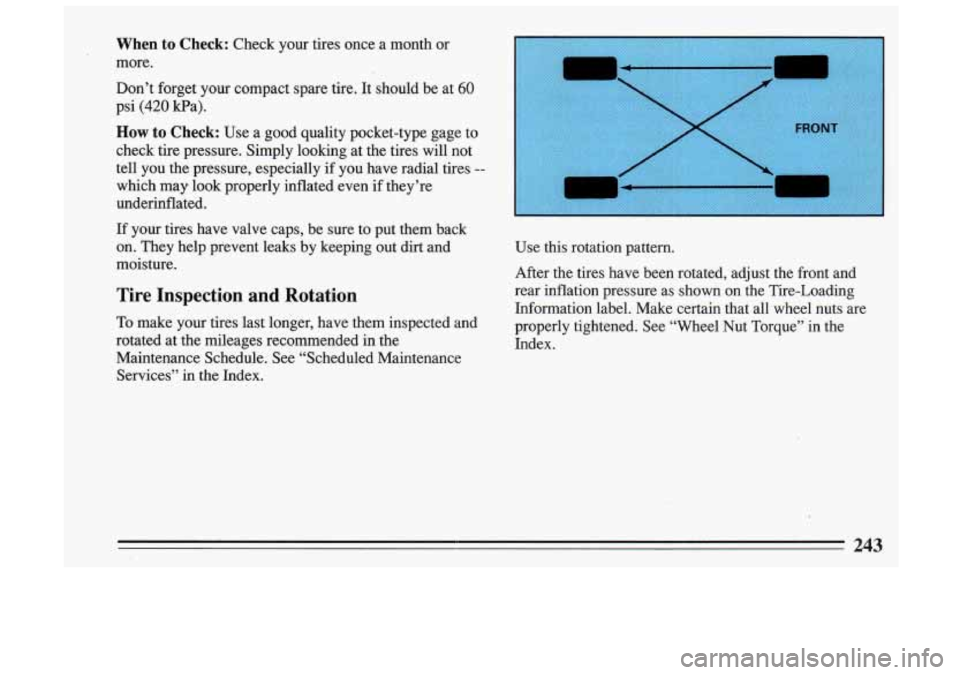
Services” in the Index. Use this rotation pattern.
After the tires have been rotated, adjust the
front and
rear inflation pressure as shown on the Tire-Loading
Information label. Make certain that all wheel nuts are
properly tightened. See “Wheel Nut Torque” in the
Index.
243
Page 245 of 306
When It% Time for New Tires
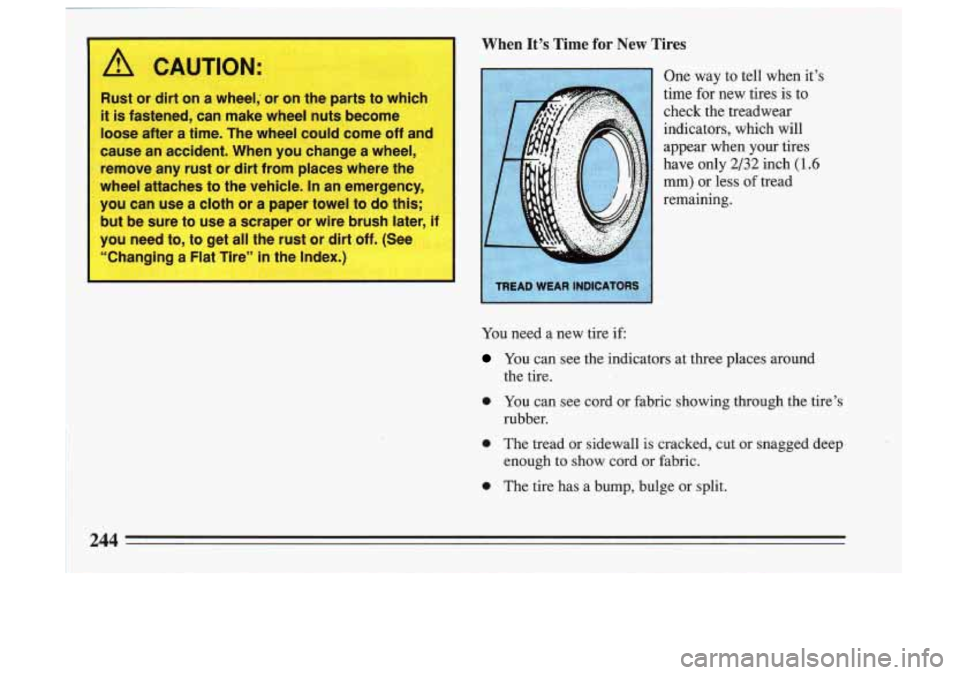
One way to tell when it’s
time for new tires is
to
check the treadwear
indicators, which will
appear when your tires
have only
2/32 inch (1.6
mm) or less of tread
remaining.
You need a new tire if
You can see the indicators at three places around
0 You can see cord or fabric showing through the tire’s
0 The tread or sidewall is cracked, cut or snagged deep
enough to show cord or fabric.
0 The tire has a bump, bulge or split. the tire.
rubber.
Page 246 of 306
The tire has a puncture, cut, or other damage that
can’t be repaired well because of the size or location
of the damage.
Buying New Tires
To find out what kind and size of tires you need, look at
the Tire-Loading Information label.
The tires installed on your vehicle when it was new had
a Tire Performance Criteria Specification (TPC Spec)
number on each tire’s sidewall. When you get new tires, get ones with that same
TPC Spec number. That way,
your vehicle will continue to have tires that are designed
to give proper endurance, handling, speed rating,
traction, ride and other things during normal service on
your vehicle. If your tires have an all-season tread
design, the TPC number will be followed by a
“MS”
(for mud and snow).
If you ever replace your tires with those not having a
TPC Spec number, make sure they are the same size,
load range, speed rating and construction type (bias,
bias-belted or radial) as your original tires.
A CAUTION:
Mixing tires could cause you to lose control
while driving.
If you mix tires of different sizes or
types (radial and bias-belted tires), the vehicle
may not handle properly, and you could have a
crash. Be sure to use the same size and type
tires on all wheels.
It’s all right to drive with your compact spare,
though. It was developed for limited use on your
vehicle.
I
Uniform Tire Quality Grading
The following information relates to the system
developed by the United States National Highway
Traffic Safety Administration which grades tires by
treadwear, traction and temperature performance. (This applies only to vehicles sold in the United States.)
Treadwear
The treadwear grade is a comparative rating based on
the wear rate of the tire when tested under controlled
conditions on a specified government test course. For
example, a tire graded
150 would wear one and a half
245
Page 247 of 306
(1 112) times as well on the government course as a tire
graded
100. The relative performance of tires depends
upon the actual conditions of their use, however, and
may depart significantly from the norm due to variations
in driving habits, service practices.and differences in
road characteristics and climate.
’Ikaction - A, B, C
The traction grades, from highest to lowest are: A, B,
and C. They represent the tire’s.ability to stop on wet
pavement
as measured under controlled conditions on
specified government test surfaces
of asphalt and
concrete. A tire marked
C may have poor traction
performance.
Warning: The traction grade assigned to this tire is based on braking (straight-ahead) traction tests and does not
include cornering (turning) traction.
Temperature - A, B, C
The temperature grades are A (the highest), B, and C,
representing the tire’s resistance to the generation of
heat and its ability to dissipate heat when tested under controlled conditions on a- specified indoor laboratory
test wheel. Sustained high temperature can cause the
material of the tire to degenerate and reduce tire life, and
excessive temperature can lead to sudden tire failure. The
grade
C corresponds to a level of performance
Federal Motor Vehicle Safety Standard
No. 109. Grades
B and A represent higher levels of performance on the
laboratory test wheel than the minimum required by law.
Warning: The temperature grade for this tire is
established for a tire that is properly inflated and not
overloaded. Excessive speed, underinflation, or
excessive loading, either separately or in combination,
can cause heat buildup and possible tire failure.
Those grades are molded on the sidewalls of passenger
car tires.
While the tires available as standard or optional
equipment on General Motors vehicles may vary with
respect to these grades, all such tires meet General
Motors performance standards and have been approved
for use on General Motors vehicles. All passenger type
(P Metric) tires must conform to Federal safety
requirements in addition to these grades.
Wheel Alignment and Tire Balance
The wheels on your vehicle were aligned and balanced
carefully at the factory to give you the longest tire life
and best overall performance.
. which all passenger car tires must meet under the
246
Page 248 of 306
In most cases, you will not need to have your wheels
. aligned again. However, if you notice unusual tire wear or your vehicle pulling one way or the other, the
alignment may need to be reset. If you notice your
vehicle vibrating when driving on a smooth road, your
wheels may need to be rebalanced.
Wheel Replacement
Replace any wheel that is bent, cracked or badly rusted.
If wheel nuts keep coming loose, the wheel, wheel bolts,
and wheel nuts should be replaced. If the wheel leaks air out, replace it (except some aluminum wheels, which
can sometimes be repaired
-- See your Buick dealer) if
any of these conditions exist.
Your dealer will know the kind of wheel you need.
Each new wheel should have the same load carrying
capacity, diameter, width, offset, and be mounted the
same way
as the one it replaces.
If you need to replace any of your wheels, wheel bolts,
or wheel nuts, replace them only with new
GM original
equipment parts. This way, you will be sure to. have the
right wheel, wheel bolts, and wheel nuts for your Buick
model.
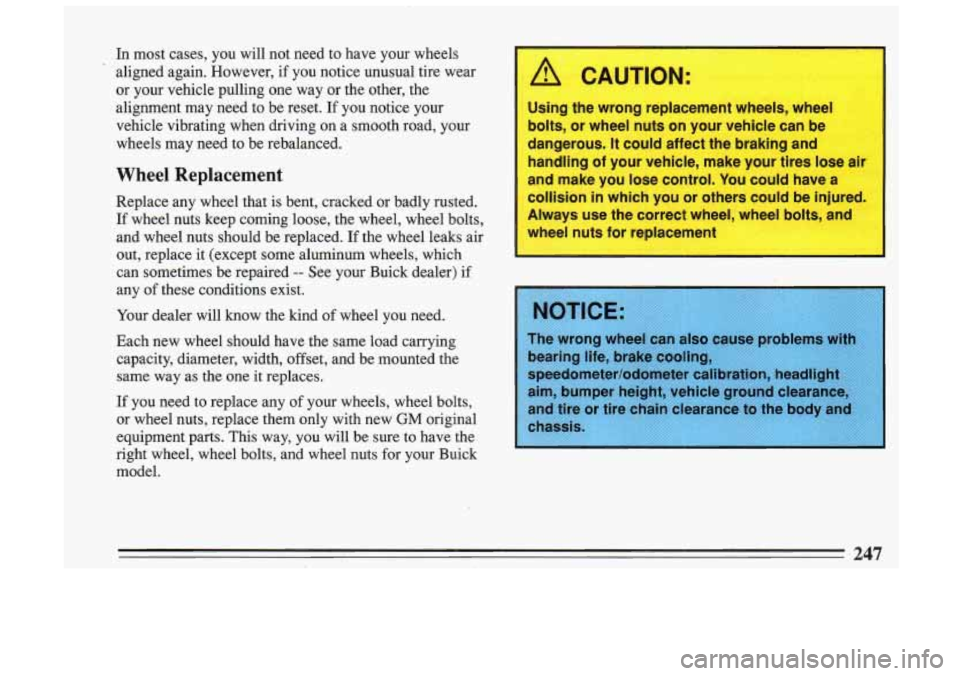
A CAUTION:
Using the wrong replacement wheels, wheel
bolts, or wheel nuts
on your vehicle can be
dangerous.
It could affect the braking and
handling
of your vehicle, make your tires lose
and make you lose control. You could have a
collision
in which you or others could be injured.
Always use the correct wheel, wheel bolts, and
wheel nuts for replacement
earing life, brake cooling,
peedQmeter/Qdometer
cali
im, bumper height, vehicl
nd tire or tire chain clearance to the body an
, 247
Page 255 of 306
.-1
White Sidewail Tires
your Buick dealer has a GM White Sidewall Tire
Cleaner. You can use a stiff brush with it.
Weatherstrips
These are places where glass or metal meets rubber.
Silicone grease there will make them last longer, seal
better, and not stick or squeak. Apply silicone grease
with
a clean cloth at least every six months.
Sheet Metal Damage
If your vehicle is damaged and requires sheet metal
repair or replacement, make sure the body repair shop applies anti-corrosion material to the parts repaired or
replaced to restore corrosion protection.
Foreign Material
Calcium chloride and other salts, ice melting agents,
road oil and
tar, tree sap, bird droppings, chemicals from
industrial chimneys, and other foreign matter can
damage your vehicle’s finish
if they remain on painted
surfaces. Use cleaners that are marked safe for painted
surfaces for these stains.
Finish Damage
Any stone chips, fractures. or deep scratches in the finish
should be repaired right away. Bare metal will corrode
quickly and may develop into a major repair expense.
Minor chips and scratches can be repaired with touch-up materials available
from your dealer or other service
outlets. Larger areas of finish damage can be corrected
in your dealer’s body and paint shop.
254
Page 257 of 306
I
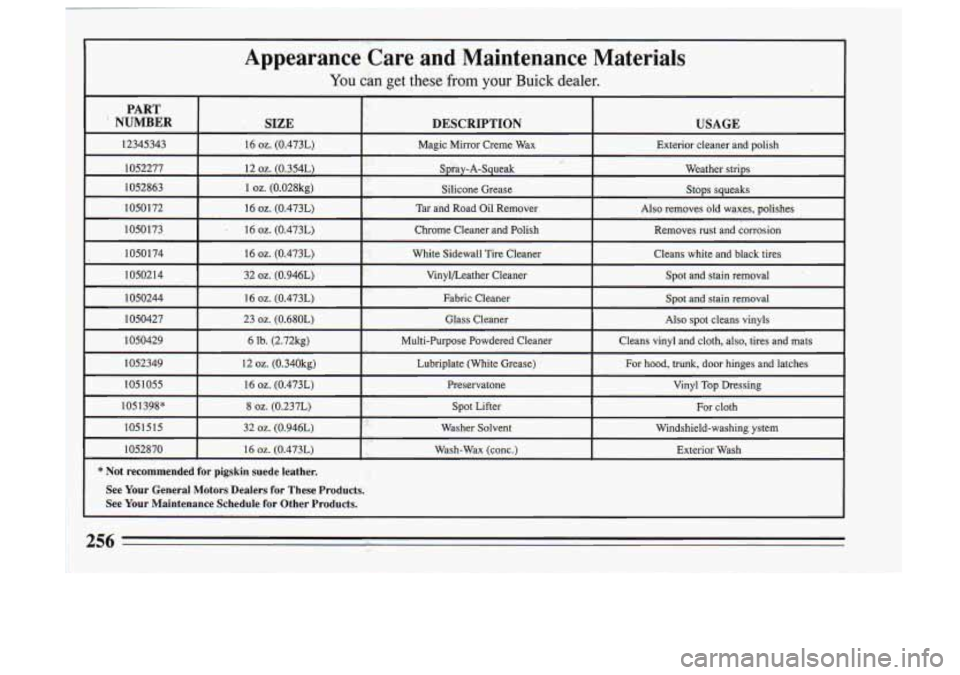
Appearance Care,and Maintenance Materials
You can get these from your Buick dealer.
PART
' NUMBER . SIZE DESCRIPTION USAGE
12345343 16 oz. (0.473L) Magic Mirror Creme
Wax
Exterior cleaner and polish
I052277 12
OZ. (0.354L)
Spray-A-Squeak Weather
strips
1052863
1 oz. (0.028kg) ,. Silicone Grease Stops squeaks
10501 72 16
oz. (0.473L) Tar and Road Oil Remover
Also removes old waxes, polishes
1050 173 . 16 OZ. (0.473L) Chrome Cleaner and Polish
Removes rust and corrosion
1050 174 16
oz. (0.473L) White Sidewall Tire Cleaner
Cleans white and black tires
10502 14 32
oz. (0.946L) Vinylbeather
Cleaner
Spot and stain removal
1050244 16
02. (0.473L) Fabric Cleaner
Spot and stain removal
1050427 23
oz. (0.680L) Glass Cleaner Also spot cleans vinyls
1050429 6 lb. (2.72kg) Multi-Purpose Powdered Cleaner Cleans vinyl and cloth, also, tires and mats
1052349 12
oz. (0.340kg)
Lubriplate (White Grease) For hood, trunk, door hinges
and latches
105 1055 16
oz. (0.473L) Preservatone
Vinyl Top Dressing
1051398* 8
oz. (0.237L) Spot Lifter
For cloth
1051515 32
oz. (0.946L) Washer Solvent
Windshield-washing ystem
1052870 16
oz. (0.473L)
Wash-Wax (conc.) Exterior
Wash
~
~
* Not recommended for pigskin suede leather.
See Your General Motors Dealers for These Products.'
See Your Maintenance Schedule for Other Products.
256 ..
Page 275 of 306
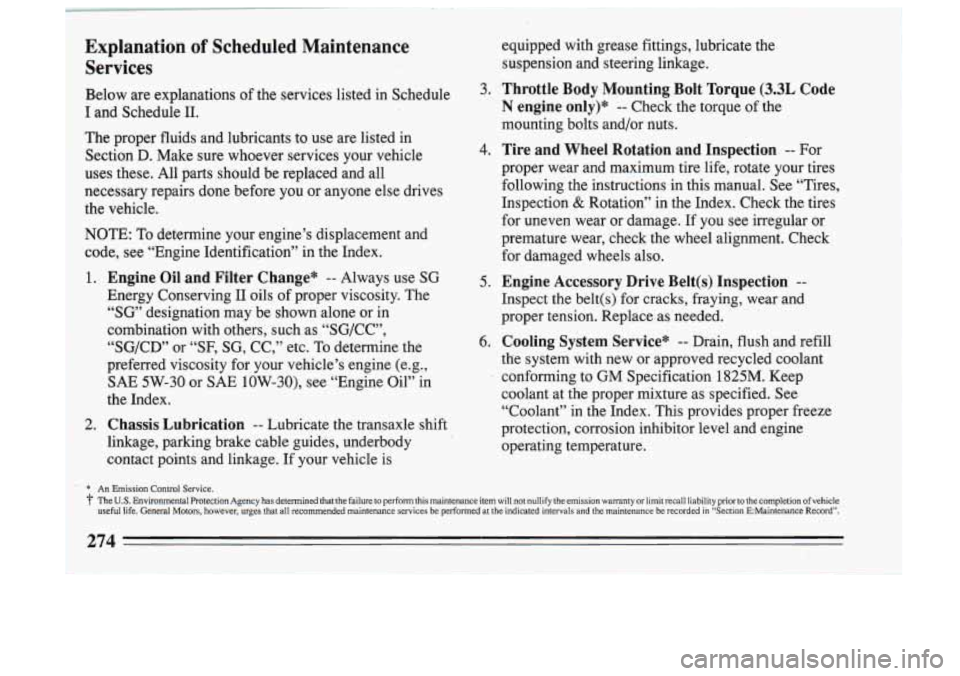
Explanation of Scheduled Maintenance equipped with grease fittings, lubricate the
Services suspension and steering linkage.
Below are explanations
of the services listed in $chediie ‘ ‘ 3. Throttle Body Mounting; Bolt Torque (3.3L Code . , I:
I and Schedule 11.
The proper fluids and lubricants to use are listed in
Section
D. Make sure whoever services your vehicle
uses these. All parts should be replaced and all
necessary repairs done before you or anyone else drives
the vehicle.
NOTE:
To determine your engine’s displacement and
code, see “Engine 1dentific.ation” in the Index.
1. Engine Oil and Filter Change* -- Always use SG
Energy Conserving
I1 oils of proper viscosity. The
“SG, designation may be shown alone or in
combination with others, such as “SG/CC”,
“SG/CD” or “SF,
SG, CC,” etc. To determine the
preferred viscosity for your vehicle’s engine (e.g.,
SAE 5W-30 or SAE 10W-30), see “Engine Oil” in
the Index.
2. Chassis Lubrication -- Lubricate the transaxle shift
linkage, parking brake cable guides, underbody
contact points and linkage. If your vehicle is
An Emission Control Service.
N engine only)* -- Che& the torque of the
mounting bolts and/or nuts.
proper wear and maximum tire life, rotate your tires
following the instructions in this manual. See “Tires,
Inspection
& Rotation” in the Index, Check the tires
for uneven wear or damage. If you see irregular or
premature wear, check
the wheel alignment. Check
for damaged wheels also.
5. Engine Accessory Drive Belt@) Inspection --
Inspect the belt(s) for cracks, fraying, wear and
proper tension. Replace as needed.
6. Cooling System Service* -- Drain, flush and refill
the system with new or approved recycled coolant
conforming to GM Specification 1825M. Keep
coolant at the proper mixture as specified. See
“Coolant” in the Index. This provides proper freeze
protection, corrosion inhibitor level and engine operating temperature.
4. Tire and Wheel Rotation and Inspection -- For
The U.S. Environmental Protection Agency has determined that the failure to perform this maintenance item will not nullify the emission war\
ranty or limit recall liability prior to the completion of vehicle
useful life. General Motors, however, urges that all recommended maintenance services be performed at the indicated i\
ntervals and the maintenance be recorded in “Section EMaintenance Record”.
274
Page 278 of 306
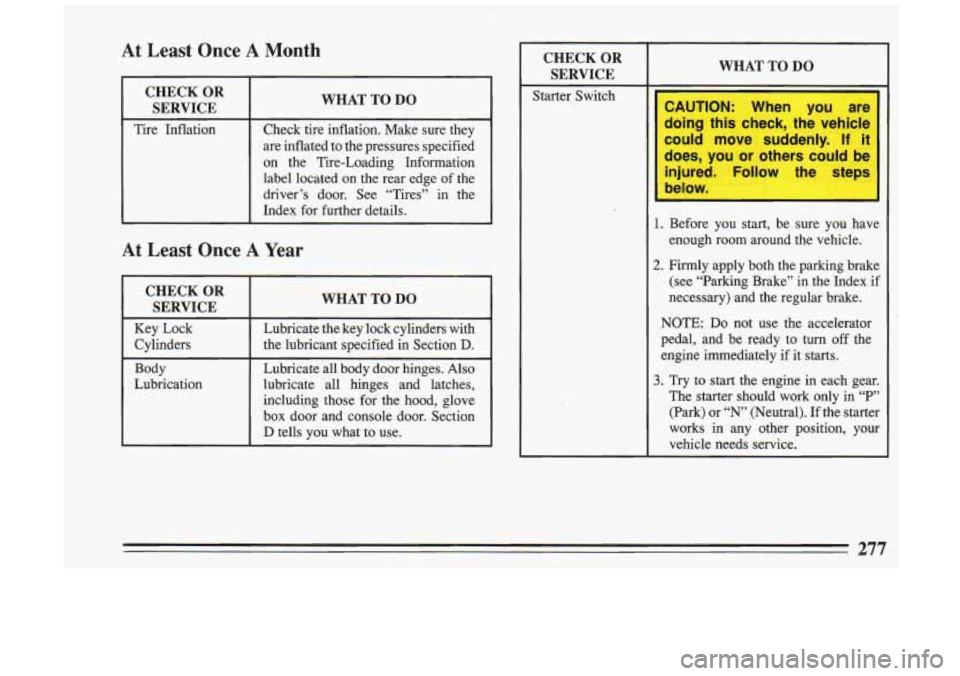
At Least Once A Month
CHECK OR SERVICE
Tire Inflation
WHAT TO DO
Check tire inflation. Make sure they
are inflated to the pressures specified
on the Tire-Loading Information
label located on the rear edge of the
driver’s door. See “Tires” in the
Index for further details.
At Least Once A Year
CHECK OR
SERVICE
I WHAT TO DO
Key Lock
Lubricate all body door hinges. Also
Body the
lubricant specified in Section
D. Cylinders Lubricate the
key lock cylinders with
Lubrication lubricate all hinges and latches,
including those for the hood, glove
box door and console door. Section
D tells you what to use.
CHECK OR
SERVICE
Starter Switch
WHAT TO DO
kAUTION: When you are
doing this check, the vehicle
could move suddenly.
If it
does, you or others could be
injured. Follow the steps
bellow.
- 1
1. Before you start, be sure you have
enough room around the vehicle.
2. Firmly apply both the parking brake
(see “Parking Brake” in the Index if
necessary) and the regular brake.
NOTE:
Do not use the accelerator
pedal, and be ready to
turn off the
engine immediately if it starts.
3. Try to start the engine in each gear.
The starter should work only in
“P’
(Park) or “N” (Neutral). If the starter
works in any other position, your
vehicle needs service.
277
Page 296 of 306
Children and Safety Belts .......................... 44
Cigarette Lighter
................................ 106
Circuit Breakers and Fuses
........................ 258
City Driving
.................................... 165
Cleaner. Air
.................................... 228
Cleaning Aluminum Wheels
............................ 253
Fabric
...................................... 249
Glass
....................................... 252
InsideofyourCar
............................. 249
Instrument Panel Top
.......................... 251
Power Antenna
............................... 134
Safety Belts
.................................. 252
Underbody Of Your Car
........................ 255
Vinyl and Leather ............................. 251
Weather Strips
................................ 254
White Sidewall Tires
............................ 254
Windshield and Wiper Blades
.................... 252
Coat Hanger
.................................... 107
Comfort Control System
.......................... 119
Clock. Setting the
......................... 125.127. 129
Closed-In Places. Don’t Idle in
...................... 85
CO in Your Exhaust ............................... 84
Color of Road Signs
.............................. 138
Comfort Controls and Audio Systems
................ 119
Compact Disc Care
.............................. 133
Compact Spare Tire
.............................. 2 12
Contents. Table of
................................. 9
Control of a Vehicle ............................... 148
Outside
of your Car
........................... 252 Control. Loss
of
................................. 158
Convenience Net
................................ 104
Convex Outside Mirror
............................ 104
Coolant. Engine
................................. 231
Coolant. Engine Warning Light
..................... 112
Coolant. Safety Warnings About
.................... 197
Courtesy Lights
................................. 102
Covers. How To Remove Wheel
.................... 206
Cruise Control
................................... 93
Cruise Control. Changing Speed With
................. 96
Cruise Control on Hills
............................ 97
Cruise Control. Turning
Off ......................... 98
Curves. Driving On
............................... 154
Customer Assistance for the Hearing/Speech Impaired
... 286
Customer Assistance Information
................... 285
Customer Satisfaction Procedure
.................... 285
D (Drive) Third Gear ............................. 78
Damage to Finish
................................ 254
Damage to Sheet Metal
............................ 254
Damage Warnings
................................ 11
Daytime Running Lights
.......................... 100
Defensive Driving
............................... 144
Defogger. Rear Window
.......................... 121
Dimensions
.................................... 261
Disc Brake Wear Indicators
........................ 152
Disposal of Used Oil
............................. 227
DoorLocks
...................................... 63
295