cooling BUICK SKYLARK 1993 Owners Manual
[x] Cancel search | Manufacturer: BUICK, Model Year: 1993, Model line: SKYLARK, Model: BUICK SKYLARK 1993Pages: 306, PDF Size: 15.84 MB
Page 121 of 306
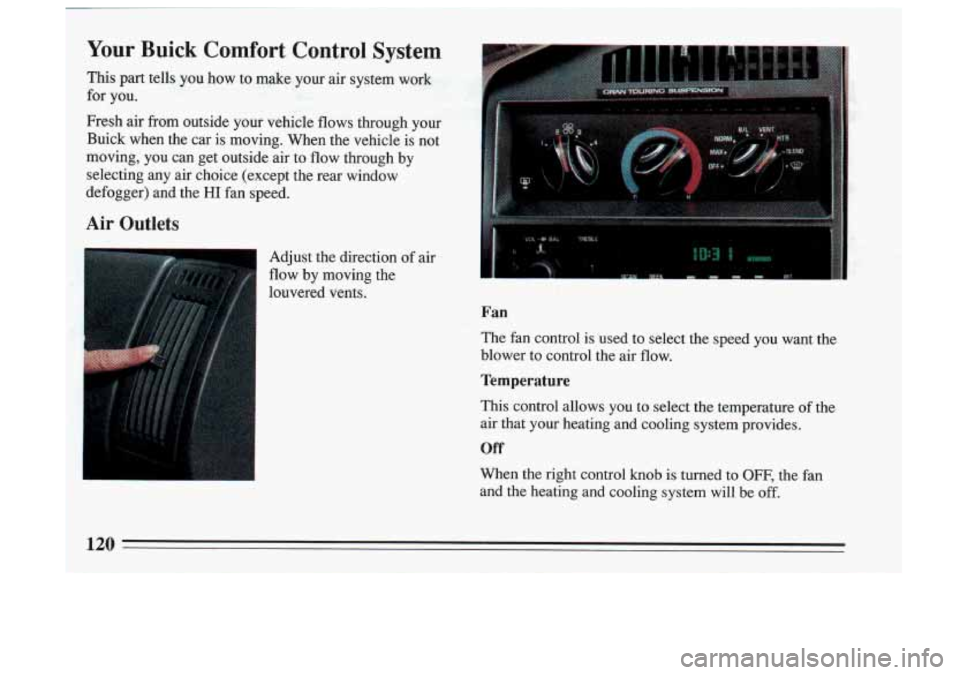
Your Buick Comfort Control System
This part tells you how to make your air system work
for you.
Fresh air from outside your vehicle flows through your
Buick when
the car is moving. When the vehicle is not
moving, you can get outside air to flow through by
selecting any air choice (except the rear window
defogger) and the
HI fan speed.
Air Outlets
Adjust the direction of air
flow by moving the
louvered vents.
Fan
The fan control is used to select the speea you want the
blower to control the air flow.
Temperature
This control allows you to select the temperature of the
air that your heating and cooling system provides.
Off
When the right control knob is turned to OFF, the fan
and the heating and cooling system will be
off.
120
c:. t..: I
Page 123 of 306
I’ not cover thisdamage. And don’t put decals
Air Conditioner (Option)
The air conditioner cools the air coming into your
vehicle. The air conditioner won’t .work, well unless all
the windows are closed. On a very hot day, you might
want to open the windows to let the hottest air out.
Max
This setting provides maximum cooling with the least
amount of work. MAX recirculates the air inside your
vehicle, and cools the air quickly. Adjust the
temperature control to a cold setting.
Norm.
After using the MAX setting to cool the air quickly,
adjust the air conditioner to NORM and the temperature
to the desired comfort setting. This permits fresh air to
be cooled and to circulate through your vehicle.
Audio Systems
Your Delcoa audio system has been degigned to operate
easily and give years
of listening pleasure. But you will
get the most enjoyment out
of your system if you
acquaint yourself with it first. Find out what your
Delcom system can do and how to operate all its
controls,
to be sure you’re getting the most out of the
advanced engineering that went into it.
FM Stereo
FM stereo will give you the best sound. But FM signals
will reach only about
10 to 40 miles (16 to 65 km). And,
tall buildings or hills can interfere with FM signals, causing the sound to come and go.
AM
The range for most AM stations is greater than for FM,
especially at night. The longer range, however, can
cause stations to interfere with each other. AM can pick
up noise from things like storms and power lines.
Try
reducing the treble to reduce this noise.
122
1
Page 171 of 306
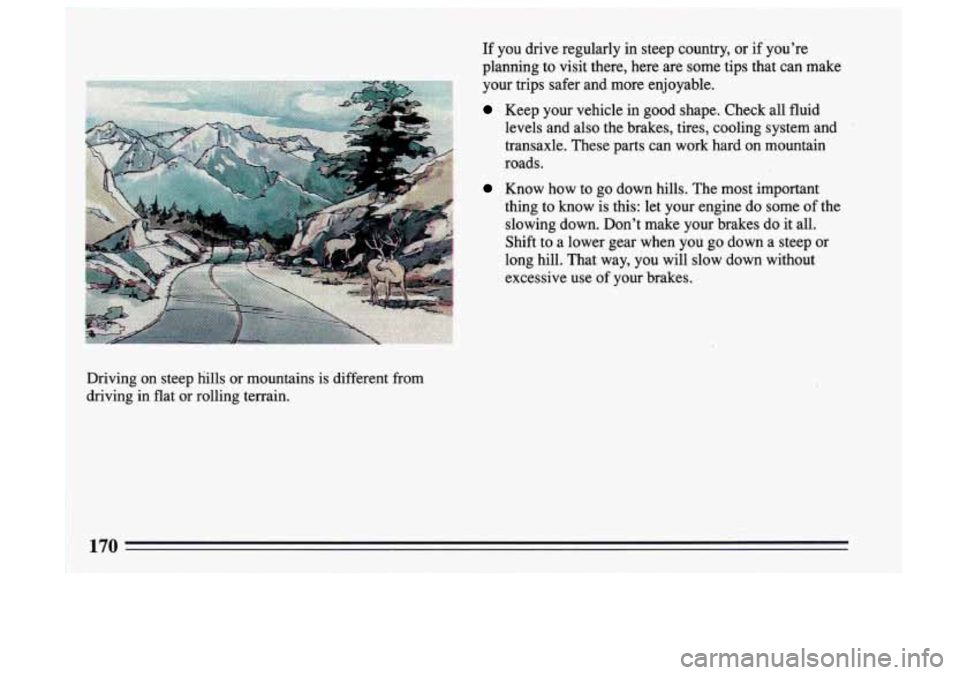
Driving on steep hills or mountains is different from
driving in flat or rolling terrain. If you
drive regularly in steep country, or if you’re
planning to visit there, here are some tips that can make
your trips safer and more enjoyable.
Keep your vehicle in good shape. Check all fluid
levels and also the brakes, tires, cooling system and
transaxle. These parts can work hard on mountain
roads.
Know how to go down hills. The most important
thing to know is this: let your engine do some of the
slowing down. Don’t make your brakes do it all.
Shift to a lower gear when you go down a steep or
long hill. That way, you will slow down without
excessive use of your brakes.
I 170
Page 185 of 306
But if you ever have to park your rig on a hill, here’s
, how to do it:
1 1. Apply your regular brakes, but don’t shift into.“P”
I (Park) yet.
I 2. Have someone place chocks under.the trailer wheels.
1
I
I I
I 3. When the wheel chocks are in place, release the
regular brakes until the chocks absorb the load.
4. Reapply the regular brakes. Then apply your parking
brake, and then shift to
“F’” (Park).
5. Release the regular brakes.
,. I I
~ When You Are Ready to Leave After
I Parking on a Hill
Maintenance When Trailer Towing
Your vehicle will need service more often when you’re
pulling a trailer. See the Maintenance Schedule for more
on this. Things that are especially important in trailer
operation are automatic transaxle fluid (don’t overfill),
engine oil, belt, cooling system, and brake adjustment.
Each of these is covered in this manual, and the Index
will help you find them quickly.
If you’re trailering, it’s
a good idea to review these sections before
you start
your trip.
Check periodically to see that all hitch nuts and bolts are
tight.
I 1. Apply your regular brakes and hold the pedal down
while you:
Start your engine;
0 Shift into a gear; and
0 Release the parking brake.
2. Let up on the brake pedal.
3. Drive slowly until the trailer is clear of the chocks.
4. Stop and have someone pick up and store the chocks.
284
Page 200 of 306
A CAUTION:
I
An electric fan under the hood can start up even
when the engine is not running and can injure
you. Keep hands, clothing and tools away from
any underhood electric fan.
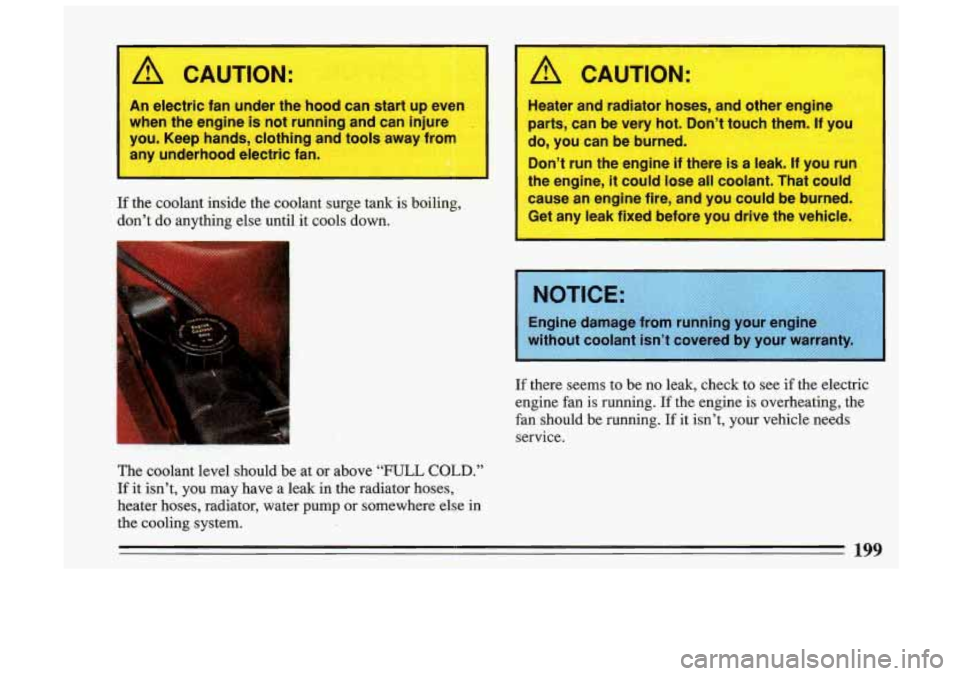
If the coolant inside the coolant surge tank is boiling,
don’t
do anything else until it cools down.
The coolant level should be at or above
“FULL COLD.”
If it isn’t, you may have a leak in the radiator hoses,
heater hoses, radiator, water pump or somewhere else in
the cooling system.
A CAUTION:
Heater and radiator hoses, and other engine
parts, can be very hot. Don’t touch them. If you
do, you can be burned.
Don’t run the engine if there is a leak. If you run
-le engine, it could lose all coolant. That could
cause an engine fire, and you could be burned.
Nt any leak fixed before you drive the vehicle.
If there seems to be no leak, check to see if the electric
engine fan is running.
If the engine is overheating, the
fan should be running.
If it isn’t, your vehicle needs
service.
199
Page 201 of 306
How to Add Coolant to the Coolant Surge
Tank
If you haven’t found a problem yet, but the coolant level
isn’t at or above
“FULL COLD,” add a 50/50 mixture of
clean water (preferably distilled) and the proper
antifreeze at the coolant surge tank, but be sure the
cooling system, including the coolant surge tank
pressure cap, is cool before you do it. (See “Engine
Coolant” in the Index for more information about the
proper coolant mix.)
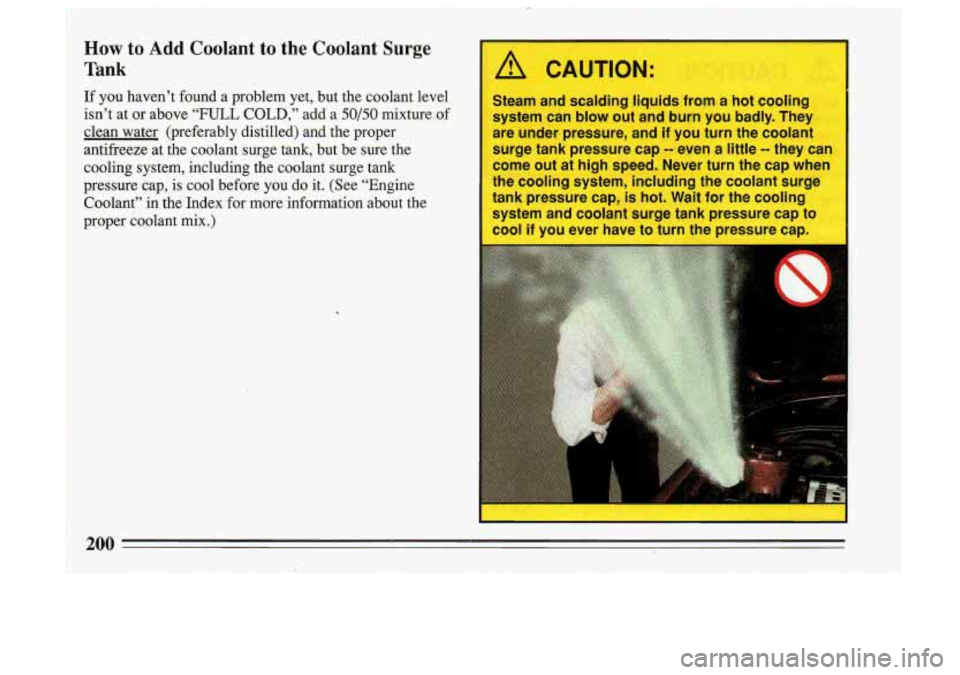
/I CAUTION:
Steam and scalding liquids from a hot cooling
system
can blow out and burn you badly. They
are under pressure, and if you turn the coolant
surge tank pressure cap
-- even a little -- they can
come out
at high speed. Never turn the cap when
lhe cooling system, including the coolant surge
tank pressure cap, is hot. Wait for the coolin-
system and coolant surge tank pressure cap
13
cool if you ever have to turn the pressure cap.
t
Page 202 of 306
1
A CAUTION':
Adding only plain water to your cooling system
can be dangerous. Plain water, or some lother
liquid li~ke alcohol, can boil before tihe proper
coolant
mix will. Your whicl'e's CoOilant warning
You can1 be burned if you spill coolant on hot ,,
engilne ~parts. Coolaint contains ethylene glycol
and lit wil~il burn if the enlgine parts are ,hot
enough. hn't spill coolant
on a hot engine. I
system is set for the proper coolant mix. With
plain water or the wron.g, mix, your engi'ne could8 1
get too h,ot but you wouldn't get thie overheat
warning. Your engine could catclh fire and
you or
others could
be burned. Use ;a 50/50 mix of clean
water and a proper antifreeze.
1
I
1-
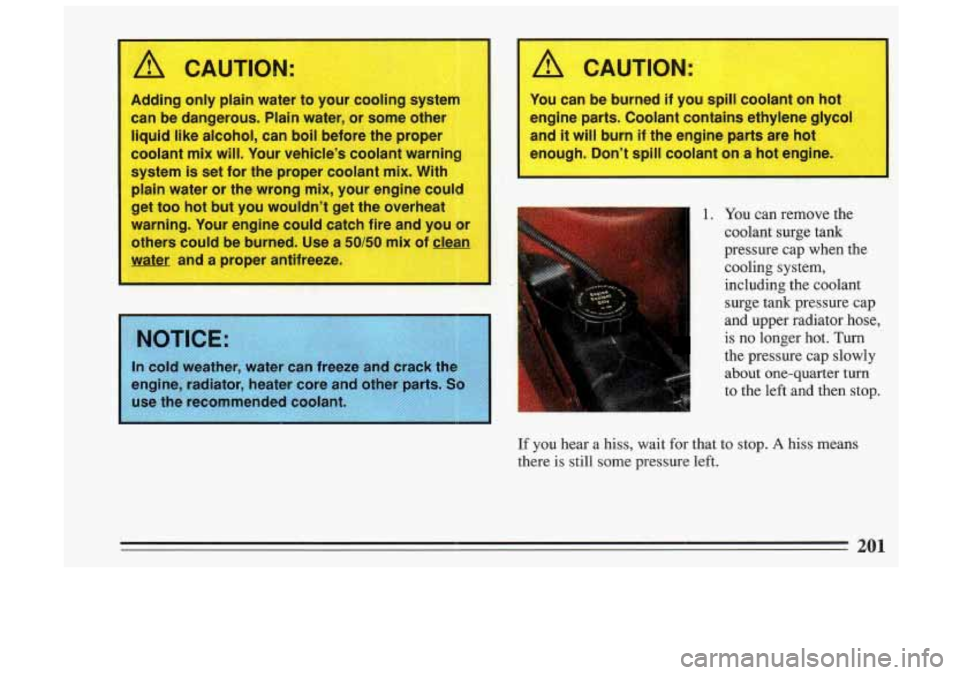
1. You can remove the
coolant surge tank
pressure cap when the
cooling system,
including the coolant
surge
tank pressure cap
and upper radiator hose,
is no longer hot. Turn
the pressure cap slowly
i about one-quarter turn
1 to the left and then stop. I
If you hear a hiss, wait for that to stop. A hiss means
there is still some pressure left.
201
Page 233 of 306
~~~x~~~~ of one-half clean water (preferably
distilled) and one-half antifreeze that meets
“GM
Specification 1825-M,” which won’t damage aluminum
parts. You can also use a recycled coolant conforming to
GM Specification 1825-M with a complete coolant-flush
and refill. Use
GM Engine Coolant Supplement (sealer)
with any complete coolant change. If you use these, you
don’t need to add anything else.
n
1 A CAUTION:
Adding only plain water to your cooling system
can be dangerous. Plain water, or some other
liquid like alcohol, can boil before the proper
coolant mix will. Your vehicle’s coolant warning
system is set for the proper coolant mix. With
plain water or the wrong mix, your engine could
get too hot but you wouldn’t get the overheat
warning. Your engine could catch fire and you or
others could be burned. Use a
50150 mix of clean
water and a proper antifreeze.
I
warrantv. Too much water in the mix can freeze
Adding Coolant
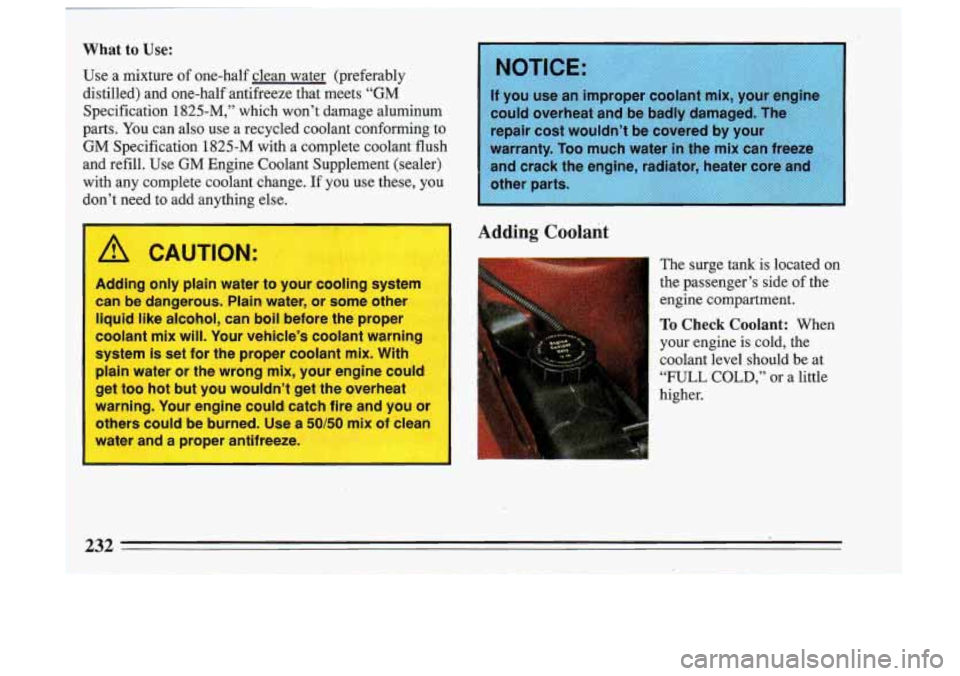
The surge tank is located on
the passenger’s side
of the
engine compartment.
To Check Coolant: When
.your engine is cold, the
coolant level should be at
“FULL COLD,” or a little
higher.
Page 248 of 306
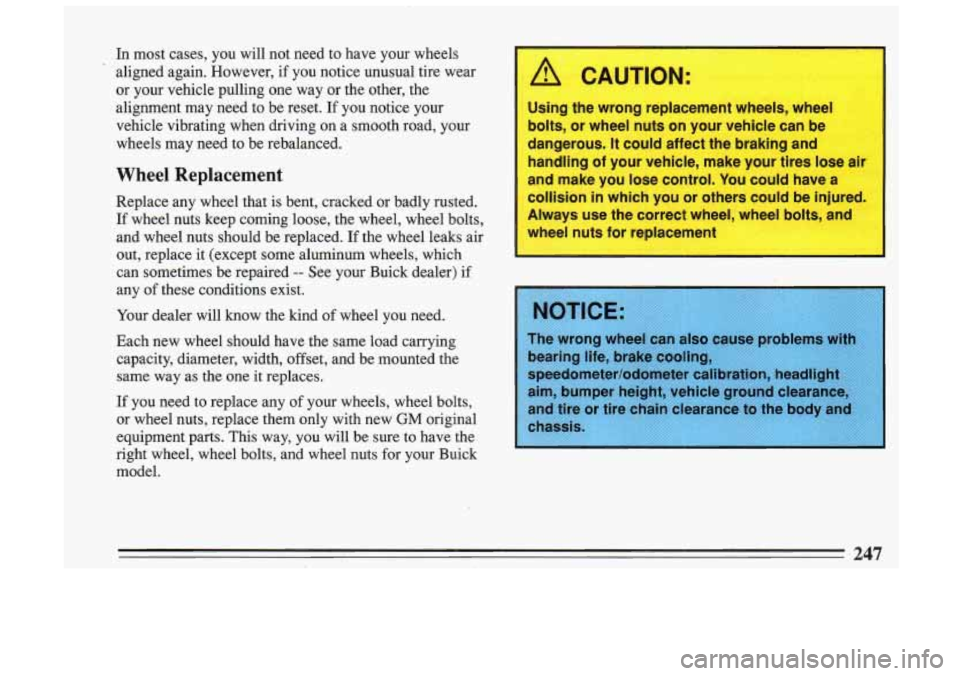
In most cases, you will not need to have your wheels
. aligned again. However, if you notice unusual tire wear or your vehicle pulling one way or the other, the
alignment may need to be reset. If you notice your
vehicle vibrating when driving on a smooth road, your
wheels may need to be rebalanced.
Wheel Replacement
Replace any wheel that is bent, cracked or badly rusted.
If wheel nuts keep coming loose, the wheel, wheel bolts,
and wheel nuts should be replaced. If the wheel leaks air out, replace it (except some aluminum wheels, which
can sometimes be repaired
-- See your Buick dealer) if
any of these conditions exist.
Your dealer will know the kind of wheel you need.
Each new wheel should have the same load carrying
capacity, diameter, width, offset, and be mounted the
same way
as the one it replaces.
If you need to replace any of your wheels, wheel bolts,
or wheel nuts, replace them only with new
GM original
equipment parts. This way, you will be sure to. have the
right wheel, wheel bolts, and wheel nuts for your Buick
model.
A CAUTION:
Using the wrong replacement wheels, wheel
bolts, or wheel nuts
on your vehicle can be
dangerous.
It could affect the braking and
handling
of your vehicle, make your tires lose
and make you lose control. You could have a
collision
in which you or others could be injured.
Always use the correct wheel, wheel bolts, and
wheel nuts for replacement
earing life, brake cooling,
peedQmeter/Qdometer
cali
im, bumper height, vehicl
nd tire or tire chain clearance to the body an
, 247
Page 264 of 306
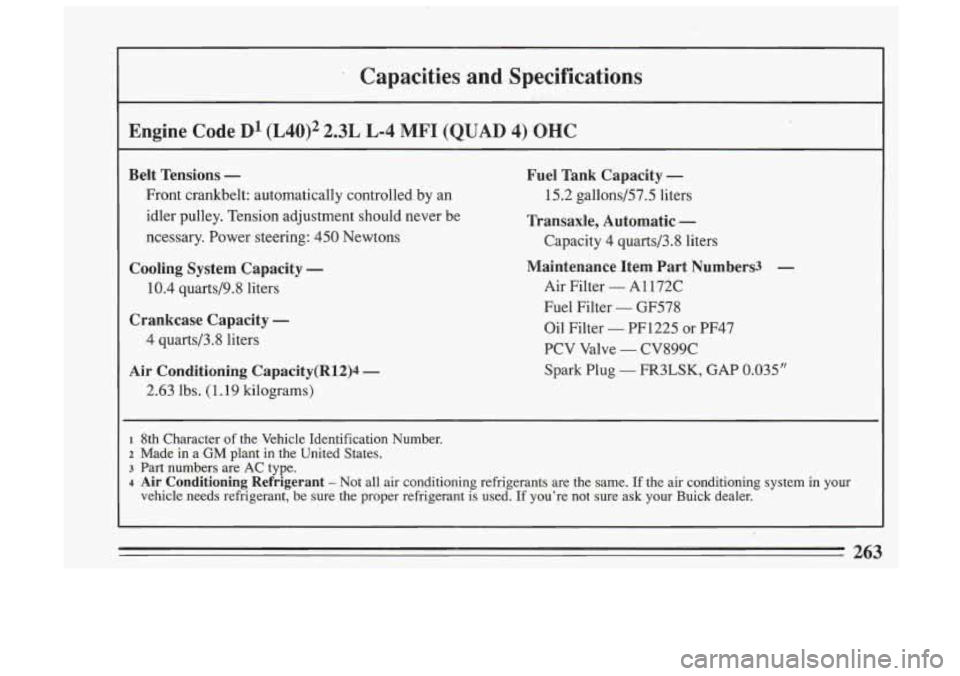
. Capacities and Specifications
Engine Code D1 (L40)2 2.3L L-4 (QUAD 4) OHC
Belt Tensions -
Front crankbelt: automatically controlled by an
idler pulley. Tension adjustment should never be
ncessary. Power steering:
450 Newtons
Cooling System Capacity -
10.4 quarts/9.8 liters
Crankcase Capacity -
4 quarts/3.8 liters
Air Conditioning Capaeity(Rl2)4 -
2.63 lbs. (1.19 kilograms)
Fuel Tank Capacity -
15.2 gallons/57.5 liters
Transaxle, Automatic -
Capacity 4 quarts/3.8 liters
Maintenance Item Part Numbers3
Air Filter - AI 172C
Fuel Filter
- GF578
Oil Filter
- PF1225 or PF47
PCV Valve
- CV899C
Spark Plug
- FR3LSK, GAP 0.035”
~~~~
1 8th Character of the Vehicle Identification Number.
z Made in a GM plant in the United States.
3 Part numbers are AC type.
4 Air Conditioning Refrigerant - Not all air conditioning refrigerants are the same. If the air conditioning system in your
vehicle needs refrigerant, be sure the proper refrigerant
is used. If you’re not sure ask your Buick dealer.
263