trailer BUICK TERRAZA 2007 Owner's Guide
[x] Cancel search | Manufacturer: BUICK, Model Year: 2007, Model line: TERRAZA, Model: BUICK TERRAZA 2007Pages: 562, PDF Size: 2.96 MB
Page 393 of 562
Towing a trailer requires a certain amount of
experience. Before setting out for the open road,
you will want to get to know your rig. Acquaint
yourself with the feel of handling and braking with
the added weight of the trailer. And always
keep in mind that the vehicle you are driving is
now a good deal longer and not nearly as
responsive as your vehicle is by itself.
Before you start, check all trailer hitch parts and
attachments, safety chains, electrical connector,
lamps, tires, and mirror adjustment. If the
trailer has electric brakes, start your vehicle and
trailer moving and then apply the trailer brake
controller by hand to be sure the brakes are
working. This lets you check your electrical
connection at the same time.
During your trip, check occasionally to be sure
that the load is secure, and that the lamps and any
trailer brakes are still working.Following Distance
Stay at least twice as far behind the vehicle ahead
as you would when driving your vehicle without
a trailer. This can help you avoid situations
that require heavy braking and sudden turns.
Passing
You will need more passing distance up ahead
when you are towing a trailer. And, because
you are a good deal longer, you will need to go
much farther beyond the passed vehicle
before you can return to your lane.
Backing Up
Hold the bottom of the steering wheel with one
hand. Then, to move the trailer to the left,
just move that hand to the left. To move the trailer
to the right, move your hand to the right. Always
back up slowly and, if possible, have someone
guide you.
393
Page 394 of 562
Making Turns
Notice:Making very sharp turns while
trailering could cause the trailer to come in
contact with the vehicle. Your vehicle could be
damaged. Avoid making very sharp turns
while trailering.
When you are turning with a trailer, make wider
turns than normal. Do this so your trailer will
not strike soft shoulders, curbs, road signs, trees,
or other objects. Avoid jerky or sudden
maneuvers. Signal well in advance.
Turn Signals When Towing a Trailer
When you tow a trailer, your vehicle has to have
extra wiring.
The arrows on your instrument panel will ash
whenever you signal a turn or lane change.
Properly hooked up, the trailer lamps will also
ash, telling other drivers you are about to turn,
change lanes, or stop.When towing a trailer, the arrows on your
instrument panel will ash for turns even if the
bulbs on the trailer are burned out. Thus, you may
think drivers behind you are seeing your signal
when they are not. It is important to check
occasionally to be sure the trailer bulbs are still
working.
Driving on Grades
Reduce speed and shift to a lower gear before
you start down a long or steep downgrade. If you
do not shift down, you might have to use your
brakes so much that they would get hot and
no longer work well.
If you are towing a trailer that weighs more than
1,000 lbs (450 kg), you may prefer to drive in
THIRD (3) instead of DRIVE (D) or, as you need
to, a lower gear. This will minimize heat build-up
and extend the life of your transaxle.
394
Page 395 of 562
Parking on Hills
{CAUTION:
You really should not park your vehicle,
with a trailer attached, on a hill. If
something goes wrong, your rig could
start to move. People can be injured, and
both your vehicle and the trailer can be
damaged.
But if you ever have to park your rig on a hill, do
the following:
1. Apply your regular brakes, but do not shift into
PARK (P).
2. Have someone place chocks under the trailer
wheels.
3. When the wheel chocks are in place, release
the regular brakes until the chocks absorb
the load.
4. Reapply the regular brakes. Then apply your
parking brake, and shift into PARK (P).
5. Release the regular brakes.
When You Are Ready to Leave After
Parking on a Hill
1. Apply your regular brakes and hold the pedal
down while you do the following:
Start your engine.
Shift into a gear.
Release the parking brake.
2. Let up on the brake pedal.
3. Drive slowly until the trailer is clear of the
chocks.
4. Stop and have someone pick up and store the
chocks.
395
Page 396 of 562

Maintenance When Trailer Towing
Your vehicle will need service more often when
you are pulling a trailer. See the Maintenance
Schedule for more on this. Things that are
especially important in trailer operation are
automatic transaxle uid, engine oil, belts, cooling
system, and brake system. Each of these is
covered in this manual, and the Index will help
you nd them quickly. If you are trailering, it is a
good idea to review these sections before you
start your trip.Check periodically to see that all hitch nuts and
bolts are tight.
Trailer Wiring Harness
Your vehicle may have a trailer wiring harness
package located in the glove box. It can be
connected from the rear of your vehicle to your
trailer. Contact your dealer for more information.
396
Page 418 of 562

How to Check Automatic Transaxle
Fluid
Because this operation can be a little difficult, you
may choose to have this done at the dealership
service department.
If you do it yourself, be sure to follow all the
instructions here, or you could get a false reading
on the dipstick.
Notice:Too much or too little uid can damage
the transaxle. Too much can mean that some of
the uid could come out and fall on hot engine
or exhaust system parts, starting a re. Too
little uid could cause the transaxle to overheat.
Be sure to get an accurate reading if you check
the transaxle uid.
Wait at least 30 minutes before checking the
transaxle uid level if you have been driving:
When outside temperatures are above
90°F (32°C).
At high speed for quite a while.
In heavy traffic — especially in hot weather.
While pulling a trailer.To get the right reading, the uid should be at
normal operating temperature, which is 180°F to
200°F (82°C to 93°C).
Get the vehicle warmed up by driving about
15 miles (24 km) when outside temperatures are
above 50°F (10°C). If it is colder than 50°F (10°C),
you may have to drive longer.
Checking the Fluid Level
Prepare your vehicle as follows:
1. Park your vehicle on a level place. Keep the
engine running.
2. With the parking brake applied, place the shift
lever in PARK (P).
3. With your foot on the brake pedal, move the
shift lever through each gear range, pausing
for about three seconds in each range.
Then, position the shift lever in PARK (P).
4. Let the engine run at idle for three to
ve minutes.
418
Page 424 of 562
If Steam Is Coming From Your Engine
{CAUTION:
Steam from an overheated engine can
burn you badly, even if you just open the
hood. Stay away from the engine if you
see or hear steam coming from it. Turn it
off and get everyone away from the
vehicle until it cools down. Wait until
there is no sign of steam or coolant
before you open the hood.
If you keep driving when the vehicles
engine is overheated, the liquids in it can
catch re. You or others could be badly
burned. Stop your engine if it overheats,
and get out of the vehicle until the engine
is cool.
SeeOverheated Engine Protection
Operating Mode on page 425for
information on driving to a safe place in
an emergency.Notice:If your engine catches re because
you keep driving with no coolant, your vehicle
can be badly damaged. The costly repairs
would not be covered by your warranty. See
Overheated Engine Protection Operating Mode
on page 425for information on driving to a
safe place in an emergency.
If No Steam Is Coming From Your
Engine
If you get an engine overheat warning but see or
hear no steam, the problem may not be too
serious. Sometimes the engine can get a little too
hot when you:
Climb a long hill on a hot day.
Stop after high-speed driving.
Idle for long periods in traffic.
Tow a trailer.
424
Page 425 of 562
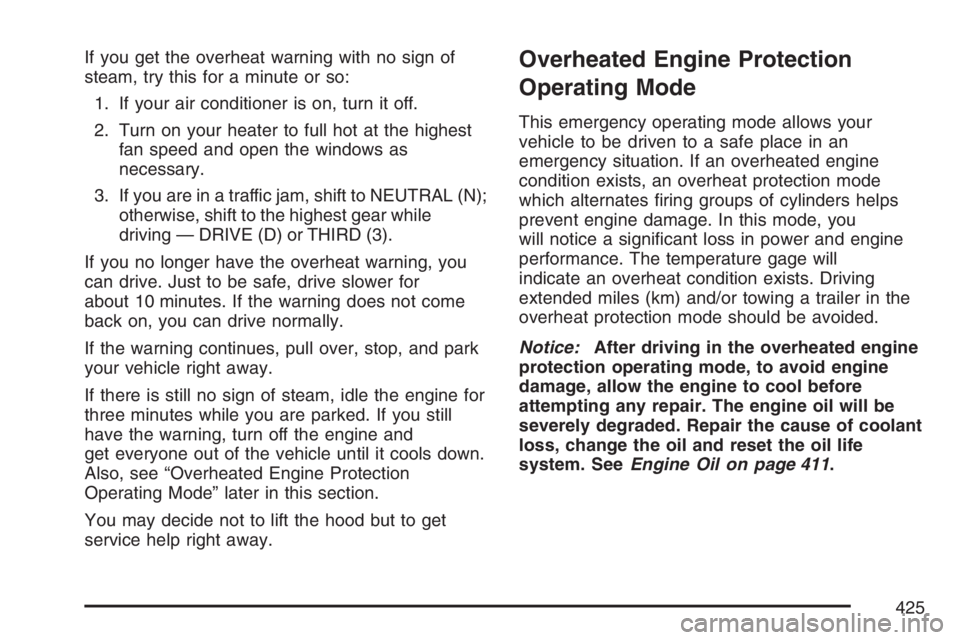
If you get the overheat warning with no sign of
steam, try this for a minute or so:
1. If your air conditioner is on, turn it off.
2. Turn on your heater to full hot at the highest
fan speed and open the windows as
necessary.
3. If you are in a traffic jam, shift to NEUTRAL (N);
otherwise, shift to the highest gear while
driving — DRIVE (D) or THIRD (3).
If you no longer have the overheat warning, you
can drive. Just to be safe, drive slower for
about 10 minutes. If the warning does not come
back on, you can drive normally.
If the warning continues, pull over, stop, and park
your vehicle right away.
If there is still no sign of steam, idle the engine for
three minutes while you are parked. If you still
have the warning, turn off the engine and
get everyone out of the vehicle until it cools down.
Also, see “Overheated Engine Protection
Operating Mode” later in this section.
You may decide not to lift the hood but to get
service help right away.Overheated Engine Protection
Operating Mode
This emergency operating mode allows your
vehicle to be driven to a safe place in an
emergency situation. If an overheated engine
condition exists, an overheat protection mode
which alternates ring groups of cylinders helps
prevent engine damage. In this mode, you
will notice a signicant loss in power and engine
performance. The temperature gage will
indicate an overheat condition exists. Driving
extended miles (km) and/or towing a trailer in the
overheat protection mode should be avoided.
Notice:After driving in the overheated engine
protection operating mode, to avoid engine
damage, allow the engine to cool before
attempting any repair. The engine oil will be
severely degraded. Repair the cause of coolant
loss, change the oil and reset the oil life
system. SeeEngine Oil on page 411.
425
Page 514 of 562

(h)Change automatic transaxle uid and lter if
the vehicle is mainly driven under one or more of
these conditions:
In heavy city traffic where the outside
temperature regularly reaches 90°F (32°C) or
higher.
In hilly or mountainous terrain.
When doing frequent trailer towing.
Uses such as found in taxi, police, or delivery
service.
(i)Drain, ush, and rell cooling system. See
Engine Coolant on page 420 for what to
use. Inspect hoses. Clean radiator, condenser,
pressure cap, and ller neck. Pressure test
the cooling system and pressure cap.
(j)Check system for interference or binding and
for damaged or missing parts. Replace parts
as needed. Replace any components that have
high effort or excessive wear. Do not lubricate
accelerator or cruise control cables.(k)A uid loss in any vehicle system could
indicate a problem. Have the system inspected
and repaired and the uid level checked. Add uid
if needed.
(l)If you drive regularly under dusty conditions,
the lter may require replacement more often.
(m)Visually inspect belt for fraying, excessive
cracks, or obvious damage. Replace belt if
necessary.
Owner Checks and Services
These owner checks and services should be
performed at the intervals specied to help ensure
the safety, dependability, and emission control
performance of your vehicle. Your GM
Goodwrench
®dealer can assist you with these
checks and services.
Be sure any necessary repairs are completed at
once. Whenever any uids or lubricants are added
to your vehicle, make sure they are the proper
ones, as shown inRecommended Fluids and
Lubricants on page 518.
514
Page 561 of 562
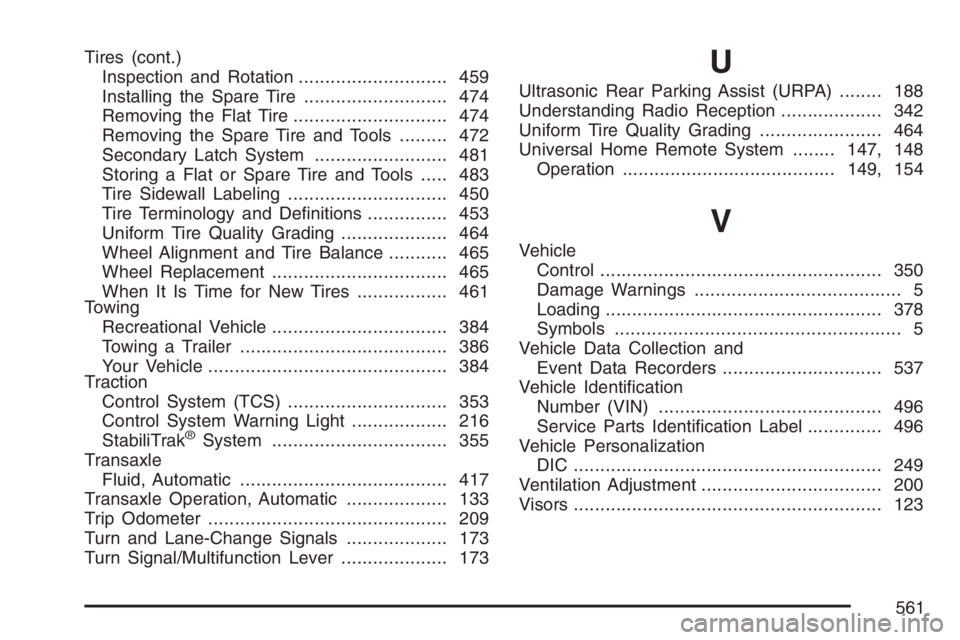
Tires (cont.)
Inspection and Rotation............................ 459
Installing the Spare Tire........................... 474
Removing the Flat Tire............................. 474
Removing the Spare Tire and Tools......... 472
Secondary Latch System......................... 481
Storing a Flat or Spare Tire and Tools..... 483
Tire Sidewall Labeling.............................. 450
Tire Terminology and Denitions............... 453
Uniform Tire Quality Grading.................... 464
Wheel Alignment and Tire Balance........... 465
Wheel Replacement................................. 465
When It Is Time for New Tires................. 461
Towing
Recreational Vehicle................................. 384
Towing a Trailer....................................... 386
Your Vehicle............................................. 384
Traction
Control System (TCS).............................. 353
Control System Warning Light.................. 216
StabiliTrak
®System................................. 355
Transaxle
Fluid, Automatic....................................... 417
Transaxle Operation, Automatic................... 133
Trip Odometer............................................. 209
Turn and Lane-Change Signals................... 173
Turn Signal/Multifunction Lever.................... 173
U
Ultrasonic Rear Parking Assist (URPA)........ 188
Understanding Radio Reception................... 342
Uniform Tire Quality Grading....................... 464
Universal Home Remote System........147, 148
Operation........................................149, 154
V
Vehicle
Control..................................................... 350
Damage Warnings....................................... 5
Loading.................................................... 378
Symbols...................................................... 5
Vehicle Data Collection and
Event Data Recorders .............................. 537
Vehicle Identication
Number (VIN).......................................... 496
Service Parts Identication Label.............. 496
Vehicle Personalization
DIC .......................................................... 249
Ventilation Adjustment.................................. 200
Visors.......................................................... 123
561