roof BUICK VERANO 2017 User Guide
[x] Cancel search | Manufacturer: BUICK, Model Year: 2017, Model line: VERANO, Model: BUICK VERANO 2017Pages: 354, PDF Size: 4.92 MB
Page 68 of 354

Buick Verano Owner Manual (GMNA- Localizing-U.S./Canada-10122753) -
2017 - crc - 5/16/16
Seats and Restraints 67
predict how severe a crash is likely
to be in time for the airbags to
inflate and help restrain the
occupants. The vehicle has
electronic sensors that help the
airbag system determine the
severity of the impact. Deployment
thresholds can vary with specific
vehicle design.
Frontal airbags are designed to
inflate in moderate to severe frontal
or near frontal crashes to help
reduce the potential for severe
injuries, mainly to the driver's or
front outboard passenger's head
and chest.
Whether the frontal airbags will or
should inflate is not based primarily
on how fast the vehicle is traveling.
It depends on what is hit, the
direction of the impact, and how
quickly the vehicle slows down.
Frontal airbags may inflate at
different crash speeds depending on
whether the vehicle hits an object
straight on or at an angle, and
whether the object is fixed or
moving, rigid or deformable, narrow
or wide.Frontal airbags are not intended to
inflate during vehicle rollovers, rear
impacts, or in many side impacts.
In addition, the vehicle has
advanced technology frontal
airbags. Advanced technology
frontal airbags adjust the restraint
according to crash severity.
Knee airbags are designed to inflate
in moderate to severe frontal or
near frontal impacts. Knee airbags
are not designed to inflate during
vehicle rollovers, in rear impacts,
or in many side impacts.
Seat-mounted side impact airbags
are designed to inflate in moderate
to severe side crashes depending
on the location of the impact.
Seat-mounted side impact airbags
are not designed to inflate in frontal
impacts, near frontal impacts,
rollovers, or rear impacts.
A seat-mounted side impact airbag
is designed to inflate on the side of
the vehicle that is struck.
Roof-rail airbags are designed to
inflate in moderate to severe side
crashes depending on the location
of the impact. In addition, theseroof-rail airbags are designed to
inflate during a rollover or in a
severe frontal impact. Roof-rail
airbags are not designed to inflate in
rear impacts. Both roof-rail airbags
will inflate when either side of the
vehicle is struck or if the sensing
system predicts that the vehicle is
about to roll over on its side, or in a
severe frontal impact.
In any particular crash, no one can
say whether an airbag should have
inflated simply because of the
vehicle damage or repair costs.
What Makes an Airbag
Inflate?
In a deployment event, the sensing
system sends an electrical signal
triggering a release of gas from the
inflator. Gas from the inflator fills the
airbag causing the bag to break out
of the cover. The inflator, the airbag,
and related hardware are all part of
the airbag module.
For airbag locations, see
Where Are
the Airbags? 065.
Page 69 of 354
Buick Verano Owner Manual (GMNA- Localizing-U.S./Canada-10122753) -
2017 - crc - 5/16/16
68 Seats and Restraints
How Does an Airbag
Restrain?
In moderate to severe frontal or
near frontal collisions, even belted
occupants can contact the steering
wheel or the instrument panel. In
moderate to severe side collisions,
even belted occupants can contact
the inside of the vehicle.
Airbags supplement the protection
provided by safety belts by
distributing the force of the impact
more evenly over the
occupant's body.
Rollover capable roof-rail airbags
are designed to help contain the
head and chest of occupants in the
outboard seating positions in the
first and second rows. The rollover
capable roof-rail airbags are
designed to help reduce the risk of
full or partial ejection in rollover
events, although no system can
prevent all such ejections.But airbags would not help in many
types of collisions, primarily
because the occupant's motion is
not toward those airbags. See
When
Should an Airbag Inflate? 066.
Airbags should never be regarded
as anything more than a supplement
to safety belts.
What Will You See after
an Airbag Inflates?
After the frontal, knee, and
seat-mounted side impact airbags
inflate, they quickly deflate, so
quickly that some people may not
even realize an airbag inflated.
Roof-rail airbags may still be at least
partially inflated for some time after
they inflate. Some components of
the airbag module may be hot for
several minutes. For location of the
airbags, see Where Are the
Airbags? 065.
The parts of the airbag that come
into contact with you may be warm,
but not too hot to touch. There may
be some smoke and dust coming
from the vents in the deflated
airbags. Airbag inflation does not prevent the driver from seeing out of
the windshield or being able to steer
the vehicle, nor does it prevent
people from leaving the vehicle.
{Warning
When an airbag inflates, there
may be dust in the air. This dust
could cause breathing problems
for people with a history of
asthma or other breathing trouble.
To avoid this, everyone in the
vehicle should get out as soon as
it is safe to do so. If you have
breathing problems but cannot
get out of the vehicle after an
airbag inflates, then get fresh air
by opening a window or a door.
If you experience breathing
problems following an airbag
deployment, you should seek
medical attention.
The vehicle has a feature that may
automatically unlock the doors, turn
on the interior lamps and hazard
warning flashers, and shut off the
fuel system after the airbags inflate.
Page 75 of 354
Buick Verano Owner Manual (GMNA- Localizing-U.S./Canada-10122753) -
2017 - crc - 5/16/16
74 Seats and Restraints
Adding Equipment to the
Airbag-Equipped Vehicle
Adding accessories that change the
vehicle's frame, bumper system,
height, front end, or side sheet
metal, may keep the airbag system
from working properly. The
operation of the airbag system can
also be affected by changing any
parts of the front seats, safety belts,
airbag sensing and diagnostic
module, steering wheel, instrument
panel, any of the airbag modules,
ceiling or pillar garnish trim, front
sensors, side impact sensors,
or airbag wiring.
Your dealer and the service manual
have information about the location
of the airbag sensors, sensing and
diagnostic module, and airbag
wiring.
In addition, the vehicle has a
passenger sensing system for the
front outboard passenger position,
which includes sensors that are part
of the passenger seat. The
passenger sensing system may not
operate properly if the original seat
trim is replaced with non-GMcovers, upholstery, or trim; or with
GM covers, upholstery, or trim
designed for a different vehicle. Any
object, such as an aftermarket seat
heater or a comfort-enhancing pad
or device, installed under or on top
of the seat fabric, could also
interfere with the operation of the
passenger sensing system. This
could either prevent proper
deployment of the passenger
airbag(s) or prevent the passenger
sensing system from properly
turning off the passenger airbag(s).
See
Passenger Sensing
System 069.
If the vehicle has rollover roof-rail
airbags, see Different Size Tires
and Wheels 0274 for additional
important information.
If you have to modify your vehicle
because you have a disability and
you have questions about whether
the modifications will affect the
vehicle's airbag system, or if you
have questions about whether the
airbag system will be affected if the
vehicle is modified for any other reason, call Customer Assistance.
See
Customer Assistance
Offices 0321.
Airbag System Check
The airbag system does not need
regularly scheduled maintenance or
replacement. Make sure the airbag
readiness light is working. See
Airbag Readiness Light 0106.
Caution
If an airbag covering is damaged,
opened, or broken, the airbag
may not work properly. Do not
open or break the airbag
coverings. If there are any
opened or broken airbag
coverings, have the airbag
covering and/or airbag module
replaced. For the location of the
airbags, see Where Are the
Airbags? 065. See your dealer
for service.
Page 152 of 354
Buick Verano Owner Manual (GMNA- Localizing-U.S./Canada-10122753) -
2017 - crc - 5/16/16
Infotainment System 151
Backglass Antenna
The AM-FM antenna is integrated
with the rear window defogger in the
rear window. Do not scratch the
inside surface or damage the lines
in the glass. If the inside surface is
damaged, it could interfere with
radio reception. For proper radio
reception, the antenna connector
needs to be properly attached to the
post on the glass.
If attaching a cell phone antenna to
the glass, attach it between the grid
lines.
Caution
Using a razor blade or sharp
object to clear the inside rear
window can damage the rear
window antenna and/or the rear
window defogger. Repairs would
not be covered by the vehicle
warranty. Do not clear the inside
rear window with sharp objects.
Caution
Do not apply aftermarket glass
tinting with metallic film. The
metallic film in some tinting
materials will interfere with or
distort the incoming radio
reception. Any damage caused to
the backglass antenna due to
metallic tinting materials will not
be covered by the vehicle
warranty.
Multi-Band Antenna
The multi-band antenna is on the
roof of the vehicle. The antenna is
used for the AM-FM radio, OnStar,
the SiriusXM Satellite Radio Service
System, and GPS (Global
Positioning System), if the vehicle
has these features. Keep the
antenna clear of obstructions for
clear reception.
If the vehicle has a sunroof, and it is
open, reception can also be
affected.
Audio Players
Avoiding Untrusted Media
Devices
When using media devices such as
CDs, DVDs, Blu-ray Discs®, SD
cards, USB drives, and mobile
devices, consider the source.
Untrusted media devices could
contain files that affect system
operation or performance. Avoid use
if the content or origin cannot be
trusted.
CD Player
For radios with CD and touch
screen, see “CD Player” in the
infotainment manual.
The CD player can be used for CDs
and MP3s.
With the ignition on, insert a CD into
the slot, label side up. The player
pulls it in and begins playing.
The vehicle must be in P (Park) for
video to display.
Page 194 of 354
Buick Verano Owner Manual (GMNA- Localizing-U.S./Canada-10122753) -
2017 - crc - 5/16/16
Driving and Operating 193
{Warning
Improper use of the heater cord
or an extension cord can damage
the cord and may result in
overheating and fire.. Plug the cord into a
three-prong electrical utility
receptacle that is protected
by a ground fault detection
function. An ungrounded
outlet could cause an
electric shock.
. Use a weatherproof,
heavy-duty, 15 amp-rated
extension cord if needed.
Failure to use the
recommended extension
cord in good operating
condition, or using a
damaged heater or
extension cord, could make
(Continued)
Warning (Continued)
it overheat and cause a fire,
property damage, electric
shock, and injury.
. Do not operate the vehicle
with the heater cord
permanently attached to the
vehicle. Possible heater
cord and thermostat
damage could occur.
. While in use, do not let the
heater cord touch vehicle
parts or sharp edges. Never
close the hood on the
heater cord.
. Before starting the vehicle,
unplug the cord, reattach
the cover to the plug, and
securely fasten the cord.
Keep the cord away from
any moving parts.
4. Before starting the engine, be sure to unplug and store the
cord as it was before to keep it away from moving engine
parts. If you do not it could be
damaged.
The length of time the heater should
remain plugged in depends on
several factors. Ask a dealer in the
area where you will be parking the
vehicle for the best advice on this.
Retained Accessory
Power (RAP)
These vehicle accessories may be
used for up to 10 minutes after the
engine is turned off:
. Audio System
. Power Windows
. Sunroof
The power windows and sunroof will
continue to work for up to
10 minutes or until any door is
opened. The radio will work when
the key is in ON/RUN or ACC/
ACCESSORY. Once the key is
turned from ON/RUN to LOCK/OFF,
the radio will continue to work for
Page 259 of 354
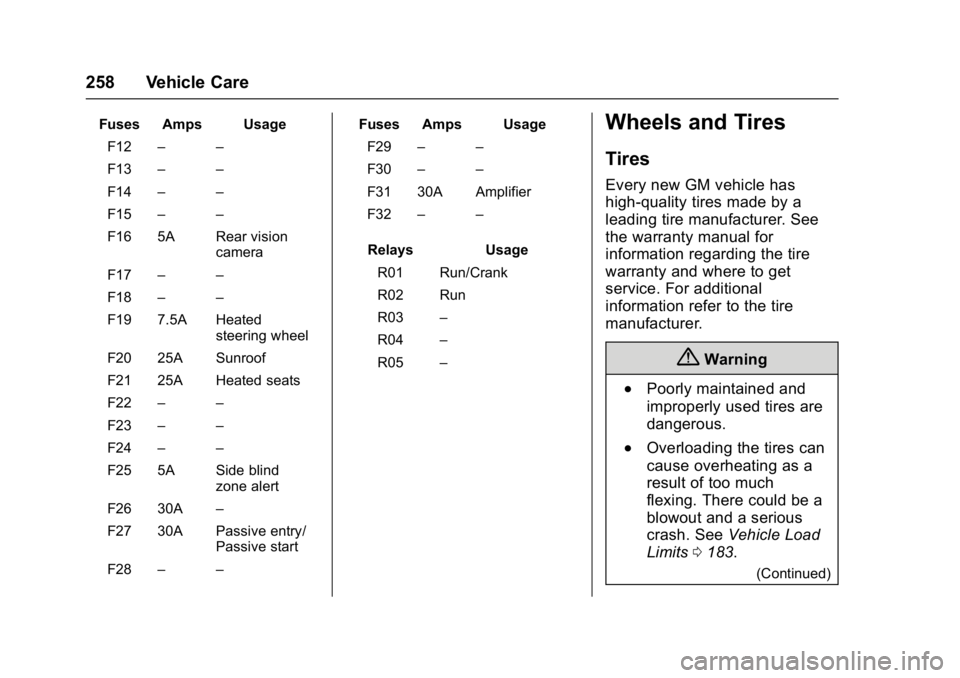
Buick Verano Owner Manual (GMNA- Localizing-U.S./Canada-10122753) -
2017 - crc - 5/16/16
258 Vehicle Care
Fuses Amps UsageF12 – –
F13 – –
F14 – –
F15 – –
F16 5A Rear vision camera
F17 – –
F18 – –
F19 7.5A Heated steering wheel
F20 25A Sunroof
F21 25A Heated seats
F22 – –
F23 – –
F24 – –
F25 5A Side blind zone alert
F26 30A –
F27 30A Passive entry/ Passive start
F28 – – Fuses Amps Usage
F29 – –
F30 – –
F31 30A Amplifier
F32 – –
Relays Usage R01 Run/Crank
R02 Run
R03 –
R04 –
R05 –Wheels and Tires
Tires
Every new GM vehicle has
high-quality tires made by a
leading tire manufacturer. See
the warranty manual for
information regarding the tire
warranty and where to get
service. For additional
information refer to the tire
manufacturer.
{Warning
.Poorly maintained and
improperly used tires are
dangerous.
.Overloading the tires can
cause overheating as a
result of too much
flexing. There could be a
blowout and a serious
crash. See Vehicle Load
Limits 0183.
(Continued)
Page 306 of 354

Buick Verano Owner Manual (GMNA- Localizing-U.S./Canada-10122753) -
2017 - crc - 5/16/16
Service and Maintenance 305
.Check automatic transmission
shift lock control function. See
Automatic Transmission Shift
Lock Control Function
Check 0245.
. Check ignition transmission lock.
See Ignition Transmission Lock
Check 0245.
. Check parking brake and
automatic transmission park
mechanism. See Park Brake and
P (Park) Mechanism
Check 0245.
. Check accelerator pedal for
damage, high effort, or binding.
Replace if needed.
. Visually inspect gas strut for
signs of wear, cracks, or other
damage. Check the hold open
ability of the strut. See your
dealer if service is required.
. Inspect sunroof track and seal,
if equipped. See Sunroof047.
Page 352 of 354

Buick Verano Owner Manual (GMNA- Localizing-U.S./Canada-10122753) -
2017 - crc - 5/16/16
Index 351
RoofSunroof . . . . . . . . . . . . . . . . . . . . . . . . . 47
Rotation, Tires . . . . . . . . . . . . . . . . . . 271
Routing, Engine Drive Belt . . . . . . 318
Running the Vehicle While Parked . . . . . . . . . . . . . . . . . . . . . . . . 197
S
Safety Belts . . . . . . . . . . . . . . . . . . . . . 57Care . . . . . . . . . . . . . . . . . . . . . . . . . . . . 62
Extender . . . . . . . . . . . . . . . . . . . . . . . . 62
How to Wear Safety BeltsProperly . . . . . . . . . . . . . . . . . . . . . . . 58
Lap-Shoulder Belt . . . . . . . . . . . . . . 59
Reminders . . . . . . . . . . . . . . . . . . . . 105
Replacing after a Crash . . . . . . . . 63
Use During Pregnancy . . . . . . . . . . 61
Safety Defects Reporting Canadian Government . . . . . . . . 330
General Motors . . . . . . . . . . . . . . . 330
U.S. Government . . . . . . . . . . . . . 329
Safety Locks . . . . . . . . . . . . . . . . . . . . . 38
Safety System Check . . . . . . . . . . . . 62
Satellite Radio . . . . . . . . . . . . . . . . . . 148
Scheduling Appointments . . . . . . . 325
Seats Adjustment, Front . . . . . . . . . . . . . . . 51
Head Restraints . . . . . . . . . . . . . . . . 50
Heated Front . . . . . . . . . . . . . . . . . . . 54 Seats (cont'd)
Lumbar Adjustment, Front . . . . . . 53
Power Adjustment, Front . . . . . . . 52
Rear . . . . . . . . . . . . . . . . . . . . . . . . . . . . 55
Reclining Seatbacks . . . . . . . . . . . . 53
Securing Child Restraints . . . . 89, 91
Security Light . . . . . . . . . . . . . . . . . . . . . . . . . . .113
Messages . . . . . . . . . . . . . . . . . . . . 123
OnStar
®. . . . . . . . . . . . . . . . . . . . . . 334
Vehicle . . . . . . . . . . . . . . . . . . . . . . . . . 40
Vehicle Alarm . . . . . . . . . . . . . . . . . . . 40
Service . . . . . . . . . . . . . . . . . . . . . . . . . 174 Accessories and
Modifications . . . . . . . . . . . . . . . . 228
Doing Your Own Work . . . . . . . . 228
Engine Soon Light . . . . . . . . . . . . 107
Maintenance Records . . . . . . . . 315
Maintenance, General Information . . . . . . . . . . . . . . . . . . 302
Parts Identification Label . . . . . 316
Publications Ordering Information . . . . . . . . . . . . . . . . . . 328
Scheduling Appointments . . . . . 325
Services Special Application . . . . . . . . . . . 309
Servicing the Airbag . . . . . . . . . . . . . 73 Shift Lock Control Function
Check, Automatic
Transmission . . . . . . . . . . . . . . . . . . 245
Shifting Into Park . . . . . . . . . . . . . . . . . . . . . . 194
Out of Park . . . . . . . . . . . . . . . . . . . 195
Side Blind Zone Alert (SBZA) . . . 213
Signals, Turn and
Lane-Change . . . . . . . . . . . . . . . . . 136
Spare Tire Compact . . . . . . . . . . . . . . . . . . . . . . 285
Special Application Services . . . . 309
Specifications and Capacities . . . . . . . . . . . . . . . . . . . . . 317
Speedometer . . . . . . . . . . . . . . . . . . . 104
StabiliTrak OFF Light . . . . . . . . . . . . . . . . . . . . . . 111
Start Assist, Hill . . . . . . . . . . . . . . . . . 203
Start Vehicle, Remote . . . . . . . . . . . 34
Starter Switch Check . . . . . . . . . . . 244
Starting the Engine . . . . . . . . . . . . . 191
Steering . . . . . . . . . . . . . . . . . . . . . . . . 178 Heated Wheel . . . . . . . . . . . . . . . . . . 99
Wheel Adjustment . . . . . . . . . . . . . . 98
Wheel Controls . . . . . . . . . . . . . . . . . 98
Stoplamps and Back-up Lamps Bulb Replacement . . . . . . . . . . . . 249
Page 353 of 354

Buick Verano Owner Manual (GMNA- Localizing-U.S./Canada-10122753) -
2017 - crc - 5/16/16
352 Index
Storage AreasCenter Console . . . . . . . . . . . . . . . . . 95
Convenience Net . . . . . . . . . . . . . . . 96
Glove Box . . . . . . . . . . . . . . . . . . . . . . 94
Instrument Panel . . . . . . . . . . . . . . . 94
Storage Compartments . . . . . . . . . . 94
Stuck Vehicle . . . . . . . . . . . . . . . . . . . 183
Sun Visors . . . . . . . . . . . . . . . . . . . . . . . 47
Sunroof . . . . . . . . . . . . . . . . . . . . . . . . . . 47
Symbols . . . . . . . . . . . . . . . . . . . . . . . . . . 3
System Forward CollisionAlert (FCA) . . . . . . . . . . . . . . . . . . .211
Infotainment . . . . . . . . . . . . . 139, 332
T
Tachometer . . . . . . . . . . . . . . . . . . . . . 104
Taillamps Bulb Replacement . . . . . . . . . . . . 249
Text Telephone (TTY) Users . . . . 322
Theft-Deterrent Systems . . . . . 41, 42 Immobilizer . . . . . . . . . . . . . . . . . . . . . 41
Time . . . . . . . . . . . . . . . . . . . . . . . . . . . . 100
Tires . . . . . . . . . . . . . . . . . . . . . . . . . . . . 258 All-Season . . . . . . . . . . . . . . . . . . . . 259
Buying New Tires . . . . . . . . . . . . . 273
Chains . . . . . . . . . . . . . . . . . . . . . . . . 277
Changing . . . . . . . . . . . . . . . . . . . . . 279
Compact Spare . . . . . . . . . . . . . . . 285 Tires (cont'd)
Designations . . . . . . . . . . . . . . . . . 263
Different Size . . . . . . . . . . . . . . . . . 274
If a Tire Goes Flat . . . . . . . . . . . . 278
Inspection . . . . . . . . . . . . . . . . . . . . 271
Low Profile . . . . . . . . . . . . . . . . . . . 260
Messages . . . . . . . . . . . . . . . . . . . . 123
Pressure Light . . . . . . . . . . . . . . . . .112
Pressure Monitor Operation . . 268
Pressure Monitor System . . . . . 267
Rotation . . . . . . . . . . . . . . . . . . . . . . 271
Sidewall Labeling . . . . . . . . . . . . . 260
Terminology and Definitions . . 263
Uniform Tire Quality
Grading . . . . . . . . . . . . . . . . . . . . . 275
Wheel Alignment and Tire Balance . . . . . . . . . . . . . . . . . . . . . 276
Wheel Replacement . . . . . . . . . . 277
When It Is Time for New
Tires . . . . . . . . . . . . . . . . . . . . . . . . 272
Winter . . . . . . . . . . . . . . . . . . . . . . . . 260
Towing Driving Characteristics . . . . . . . . 220
Equipment . . . . . . . . . . . . . . . . . . . . 224
General Information . . . . . . . . . . 220
Recreational Vehicle . . . . . . . . . . 291
Trailer . . . . . . . . . . . . . . . . . . . . . . . . 223
Vehicle . . . . . . . . . . . . . . . . . . . . . . . 289 Traction
Control System (TCS)/
StabiliTrak
®Light . . . . . . . . . . . . .112
Off Light . . . . . . . . . . . . . . . . . . . . . . . 111
Traction Control/Electronic Stability Control . . . . . . . . . . . . . . . 203
Trademarks and License
Agreements . . . . . . . . . . . . . . . . . . . 167
Trailer Towing . . . . . . . . . . . . . . . . . . . . . . . . 223
Transmission
Automatic . . . . . . . . . . . . . . . . . . . . . 197
Fluid, Automatic . . . . . . . . . . . . . . 235
Messages . . . . . . . . . . . . . . . . . . . . 123
Transportation Program, Courtesy . . . . . . . . . . . . . . . . . . . . . . 325
Trip Odometer . . . . . . . . . . . . . . . . . . 104
Trunk . . . . . . . . . . . . . . . . . . . . . . . . . . . . 38
Turn and Lane-Change Signals . . . . . . . . . . . . . . . . . . . . . . . . 136
Turn Signal
Bulb Replacement . . . . . . . . . . . . 249
U
Uniform Tire Quality Grading . . . 275
Universal Remote System . . . . . . 130Operation . . . . . . . . . . . . . . . . . . . . . 132
Programming . . . . . . . . . . . . . . . . . 130
Using This Manual . . . . . . . . . . . . . . . . 2